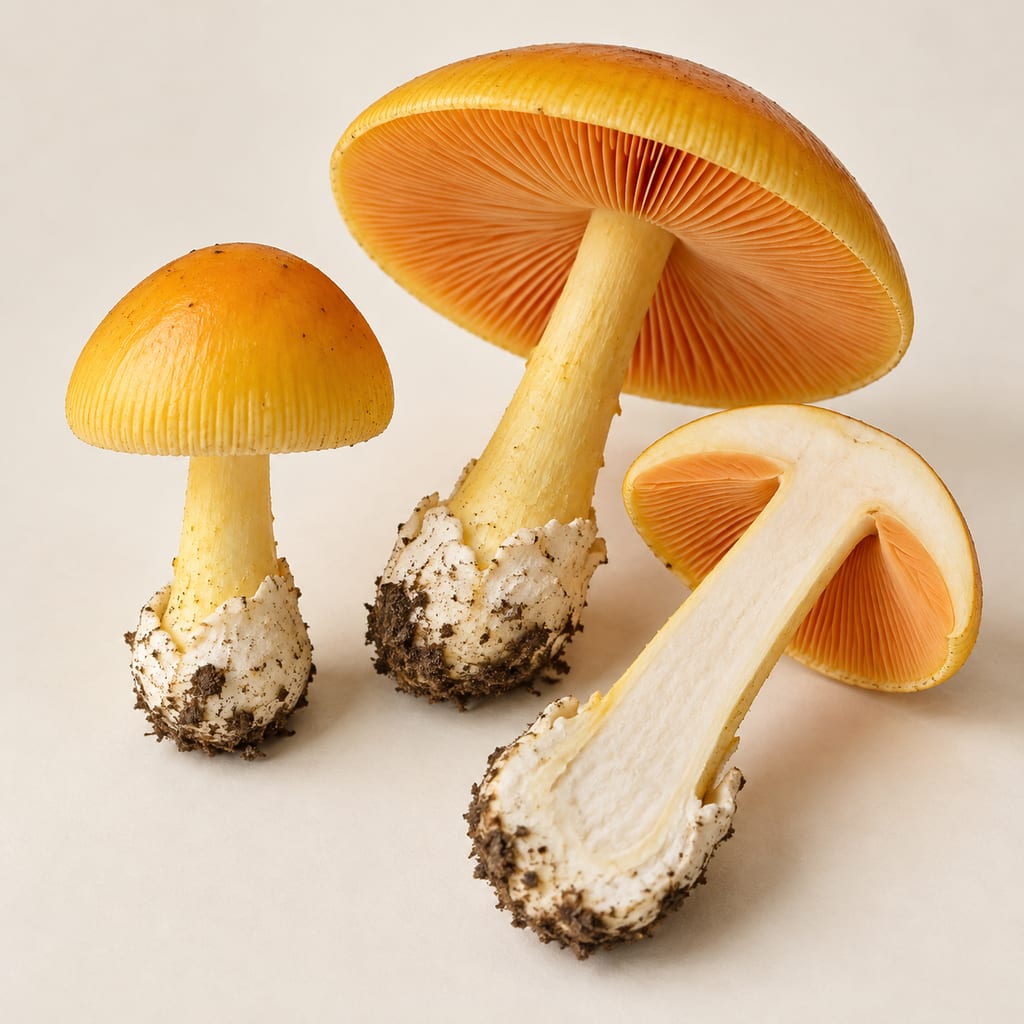
Amanita flammeola
A wild miombo Amanita recorded as a local food in northern Zambia, with collections also documented in Haut-Katanga, DRC. The evidence is regional and does not make wild identification safe.
 FermenteaWhere food goes to change
Mushrooms
A small red ectomycorrhizal chanterelle of African open forest and miombo. Sources document regional food use but differ on taste and harvesting preference; older records as C. floridulus or C. miniatescens require care.
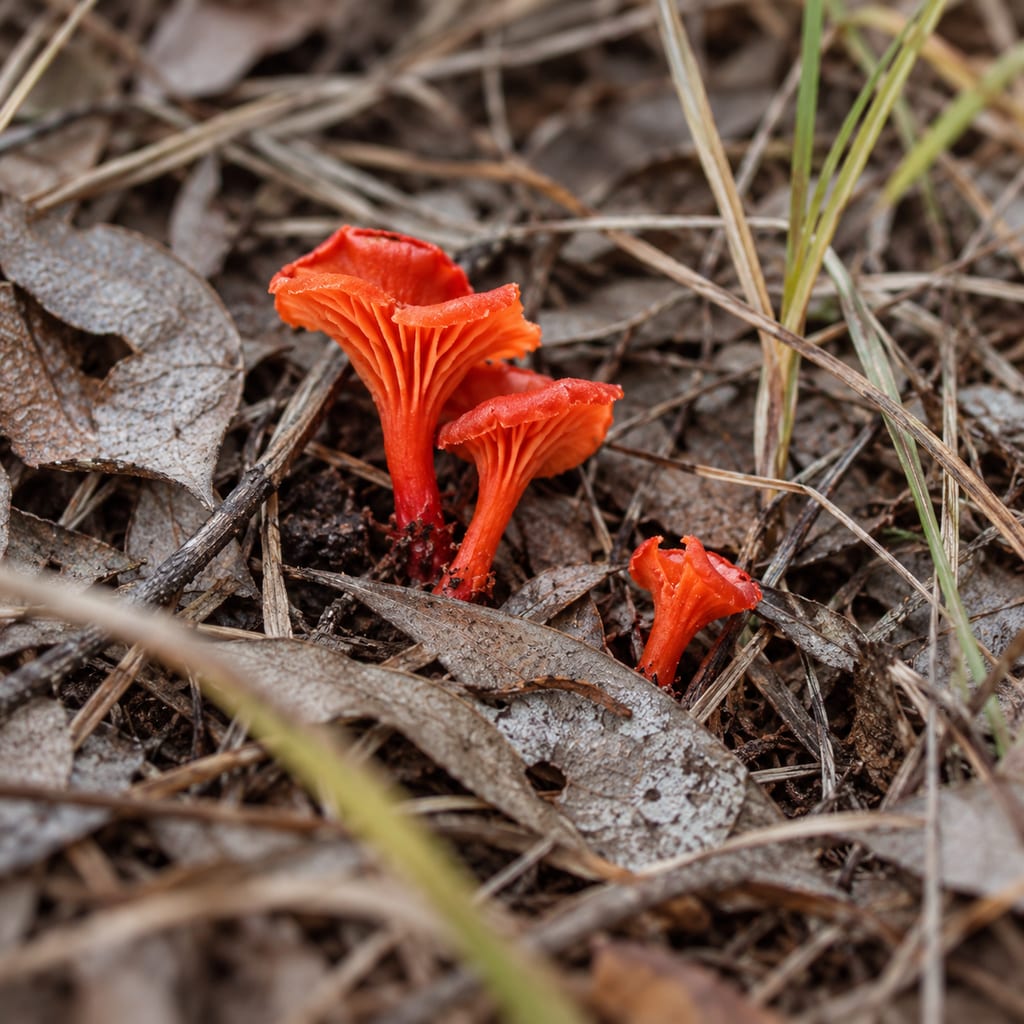
Species Fungorum lists Cantharellus addaiensis Henn., published in 1898, as an accepted name. EFTA describes a small, thin-fleshed, bright-red chanterelle with a funnel-shaped cap and shallow, decurrent, forked folds. The Zambian account records close red folds that are forked but not interveined. EFTA describes the cap as bright red when young, with age-related orange tones and a paler stipe base.
Taste reports conflict: the Zambian field guide says mild, while EFTA and the Haut-Katanga book note a sharp or pungent quality. Treat taste as variable or reported differently, not a fixed diagnostic or culinary trait. Older African literature often applied C. floridulus or C. miniatescens to specimens now assigned to C. addaiensis; the names are not interchangeable, and each record needs its own taxonomic context.
This is an ectomycorrhizal fungus associated with trees in open forest and miombo woodland. The Zambian field guide describes it growing in groups and calls it common across the African miombo zone; EFTA also reports it in open forests of West Africa and miombo in the Zambesian region.
The compiled country list includes Benin, Burkina Faso, DR Congo, Côte d'Ivoire, Ghana, Guinea, Nigeria, Tanzania, Togo, Zambia and Zimbabwe. Confidence is uneven because several entries derive from reports under C. floridulus, C. cf. floridula or C. miniatescens. A museum record anchors the accepted name to a neotype collected in Tanzania in 1998. A later Tanzania field report adds records from Wembele hunting camp, Kululu forest area, Rungwa River Forest Reserve and Mulele Hills Forest Reserve.
Regional sources document food use but not a universal food reputation. The Zambian guide calls it edible; some informants liked it, while others considered the small fruit bodies too laborious to pick. The Haut-Katanga guide reports consumption in DR Congo and Zambia and occasional sun-drying in Zambia, while noting it may be neglected despite fruiting abundantly because of its size, slightly sharp taste and sandy specimens. A 2022 Tanzania report lists it as edible in some villages but not others and records that it is also eaten dried.
These sources establish reported local practice, not toxicological clearance, a standardized cooking method, or safety of any particular specimen. No species-specific preparation protocol was verified. The drying report is a documented preservation practice, not a validated instruction set. Keep expert identification and taxonomic confusion adjacent to any food-use statement.
Available dates are collection records rather than a complete fruiting calendar: a voucher from Myafi Forest Reserve in Zambia was collected in February 2013, and the Tanzania neotype was collected on 27 April 1998. The 2022 regional report links the broader miombo mushroom flush to the rainy season but does not give a month-by-month season for this species. The evidence supports these dated occurrences and a regional rainy-season context only; it does not support a single season across tropical Africa.
In Tanzania the report records Kinyamwezi Wijogoro (nyekundu), Kikonongo Kakungulumee, Umgongo and Ukungulume, and Swahili Wange nyekundu. These are local names recorded in that survey, not pan-African common names.
Three linked field photographs by Tony Rebelo are individually licensed CC BY-SA at photo level; the observation-level license field differs and is not used in place of each photo license. They show the species in situ, including an underside view, but are not foraging or safety guidance. Two additional Benin field photographs are linked as comparisons and retain their individual CC BY-NC attribution. The AI-generated editorial hero was generated from text describing published morphology; it did not use linked photo files as image inputs and is not an in-situ specimen photograph. All five field photos and the synthetic hero are illustrative, not identification or safety evidence.
Field guide documents occurrence and reported edible use; precise voucher locality: Myafi Forest Reserve, Mkushi District, February 2013.
Regional monograph documents consumption; taxonomic notes flag confusion with C. floridulus.
Field report lists use in some villages and records several forest localities; the species is not eaten in all villages.
A wild miombo Amanita recorded as a local food in northern Zambia, with collections also documented in Haut-Katanga, DRC. The evidence is regional and does not make wild identification safe.
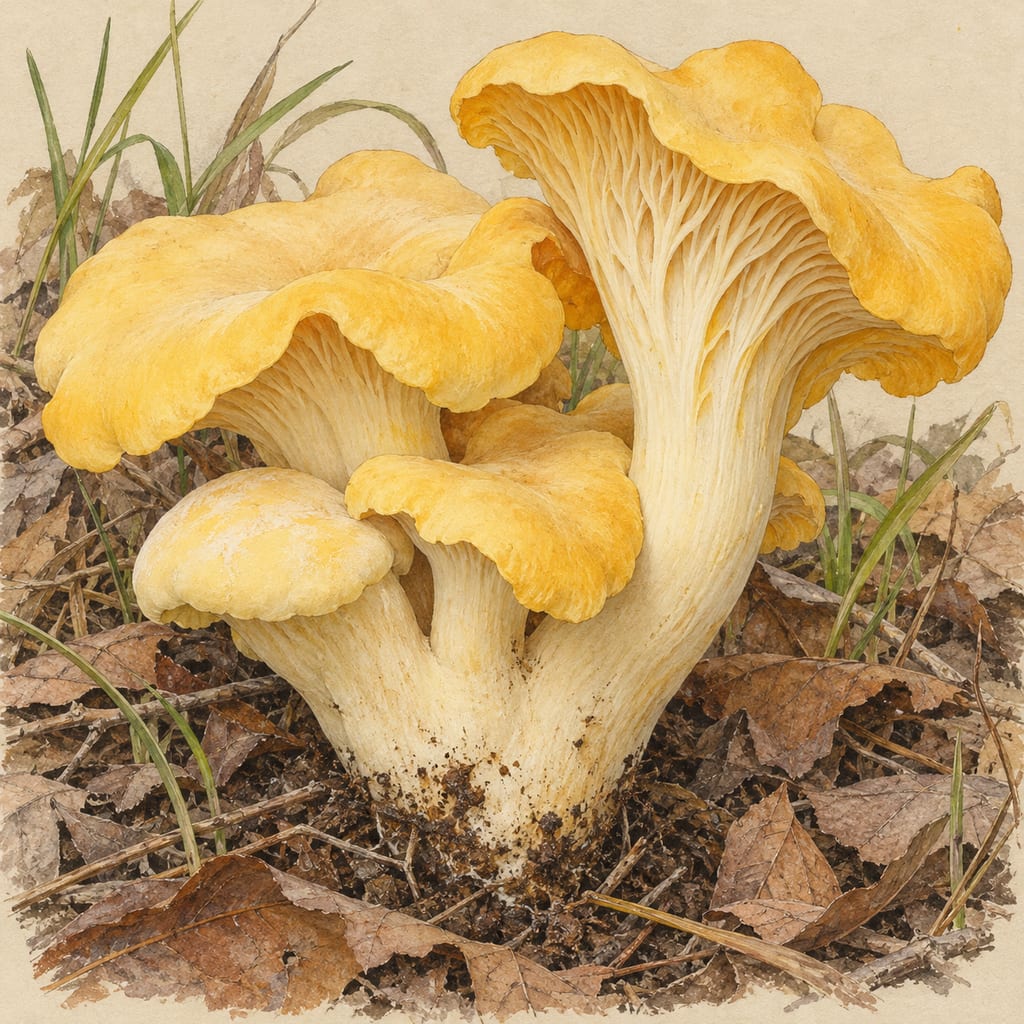
Cantharellus afrocibarius is a robust yellow chanterelle of the miombo woodlands of southern Central Africa. It is eaten and sold locally, is rated Vulnerable on the IUCN Red List, and is hard to tell from related species in the field.
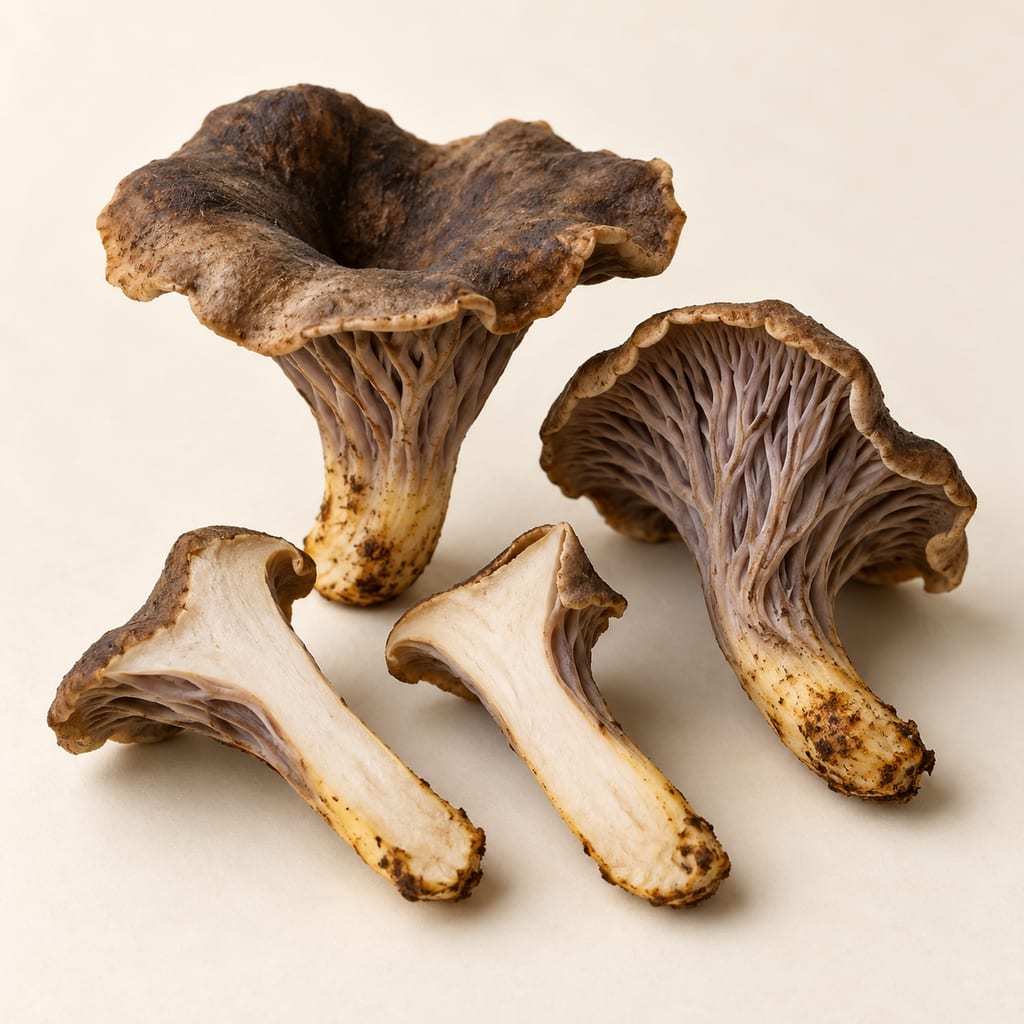
Cantharellus congolensis is an ectomycorrhizal chanterelle of sub-Saharan Africa, eaten in the Democratic Republic of the Congo under local names. Its edibility rests on food-use surveys, not on toxicity tests.
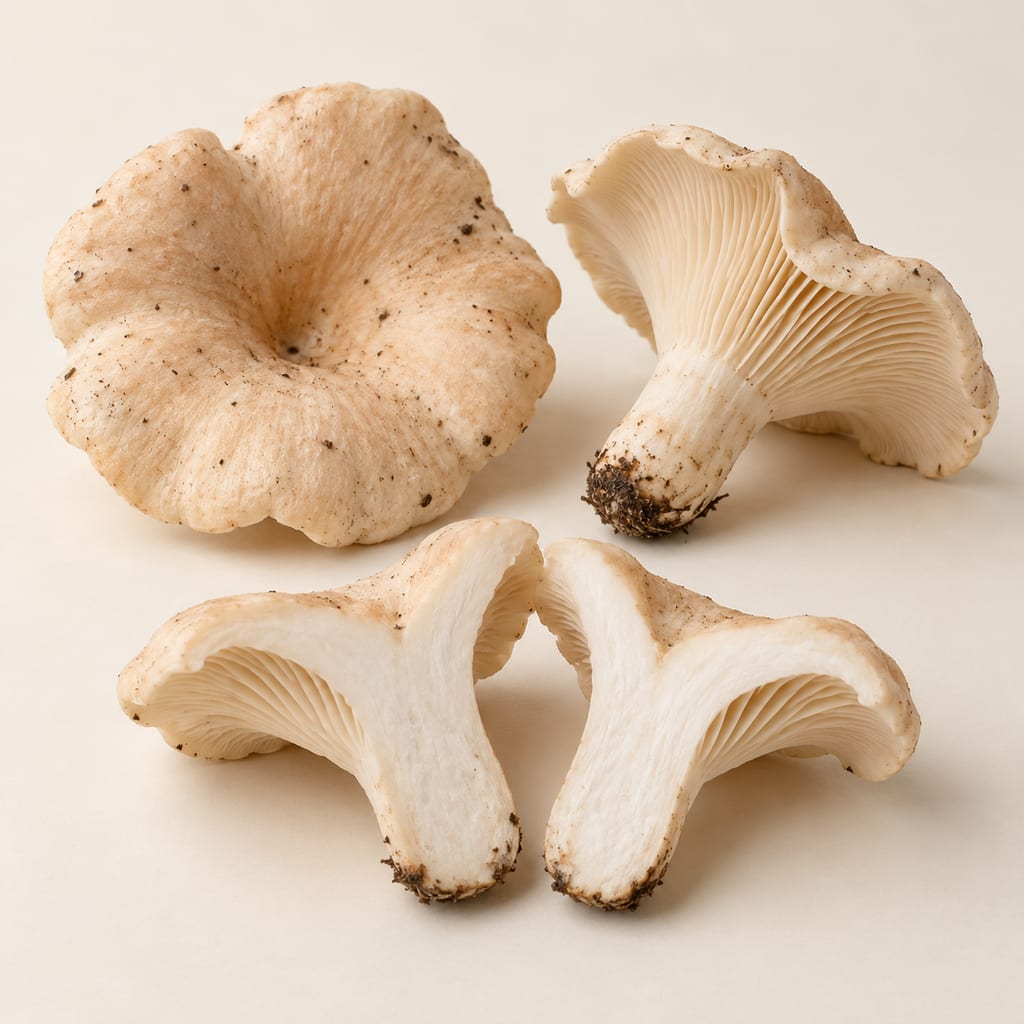
Lactifluus gymnocarpoides is an African milkcap of open Uapaca and miombo woodland. Regional inventories record it as food, but its bitter taste means local cooks remove it before eating, and the sources give no preparation.
No community contributions have been published for this entry yet.
Sign in to contribute. Published comments and photos are free to read.
Edible Fungi of Tropical Africa / Meise Botanic GardenIdentity · Ecology · Geography
Cantharellus addaiensisCited in: Name and identity; Ecology and range; Image and safety limits
Finnish Museum of Natural History, Norrlinia 29Identity · Ecology · Food use · Geography · Season
Zambian mushrooms and mycologyCited in: Name and identity; Ecology and range; Food use and preservation; Season and place; Image and safety limits
Abc Taxa 17, Royal Belgian Institute of Natural SciencesFood use · Ecology · Geography · Taxonomy · Photo lead
Champignons comestibles du Haut-Katanga (R.D. Congo)Cited in: Name and identity; Ecology and range; Food use and preservation; Image and safety limits
Adansonia-Consulting / ADAPFood use · Geography · Local names · Season
Added value chain for wild edible mushrooms: Katavi and Tabora regions, Stage 1Cited in: Ecology and range; Food use and preservation; Season and place; Image and safety limits
Abc Taxa 24, CeBios / Royal Belgian Institute of Natural SciencesTaxonomy · Geography · Photo lead
Champignons comestibles d'Afrique de l'OuestCited in: Image and safety limits
Muséum national d'Histoire naturelleIdentity · Geography
Cantharellus addaiensis Henn. neotype record PC0084717Cited in: Ecology and range; Season and place
iNaturalist, photo by Tony RebeloPhoto provenance · Taxonomy · Geography
Cantharellus addaiensis observation 281902270 and photo licensesThree selected photo objects (506391480, 506391465, 506391444) individually report CC BY-SA and depict the same confirmed observation from Chimanimani, Zimbabwe on 2025-04-21; the observation-level license field is separate and must not replace the photo-level licenses.
Cited in: Image and safety limits
iNaturalist; photo by cteteliPhoto provenance · Taxonomy · Geography
Cantharellus addaiensis observation 240411695 and photo licenseThe page records the Lolo, Benin observation submitted as Cantharellus addaiensis.
iNaturalist photo 428313357 reports CC BY-NC; photo is linked as a field-photo comparison, not identification guidance.
Cited in: Image and safety limits
iNaturalist; photo by ONG OeBeninPhoto provenance · Taxonomy · Geography
Cantharellus addaiensis observation 233085037 and photo licenseThe page records the Natitingou, Benin observation submitted as Cantharellus addaiensis.
iNaturalist photo 414190863 reports CC BY-NC; photo is linked as a field-photo comparison, not identification guidance.
Cited in: Image and safety limits