A name carried across languages and revisions
Amanita loosei is a large wild forest mushroom of tropical Africa. Its literature uses several names: Beeli described it in 1936 as Amanita loosii; A. zambiana was later applied to Zambian material; taxonomic accounts have treated A. zambiana as a synonym and use loosei as the corrected epithet dedicated to the mycologist de Loose. Regional books and market records still carry earlier spellings. Those names do not necessarily refer to separate foods, but keeping them as search names helps readers find older work.
The naming history is not a food-origin story. The species has a record of local use, but the consulted sources do not date when people first began gathering or eating it. A formal Latin description dates scientific publication, not the beginning of customary knowledge. Its food history is best read through studies of particular communities, forests and markets without turning a later scientific name into a claim about the tradition’s origin.
Sources for this section
A forest fungus tied to miombo trees
This is an ectomycorrhizal Amanita: its underground mycelium lives in association with fine tree roots rather than decomposing a log. Tropical African descriptions place it in open woodland and miombo, naming Caesalpiniaceae and Phyllanthaceae among associated tree groups. The fungus fruits from a living woodland system, so its supply follows forest conditions and rainfall. Field accounts document wild gathering; they do not document a domesticated production method. It is not an ordinary cultivated mushroom raised on a bag of sawdust or grain.
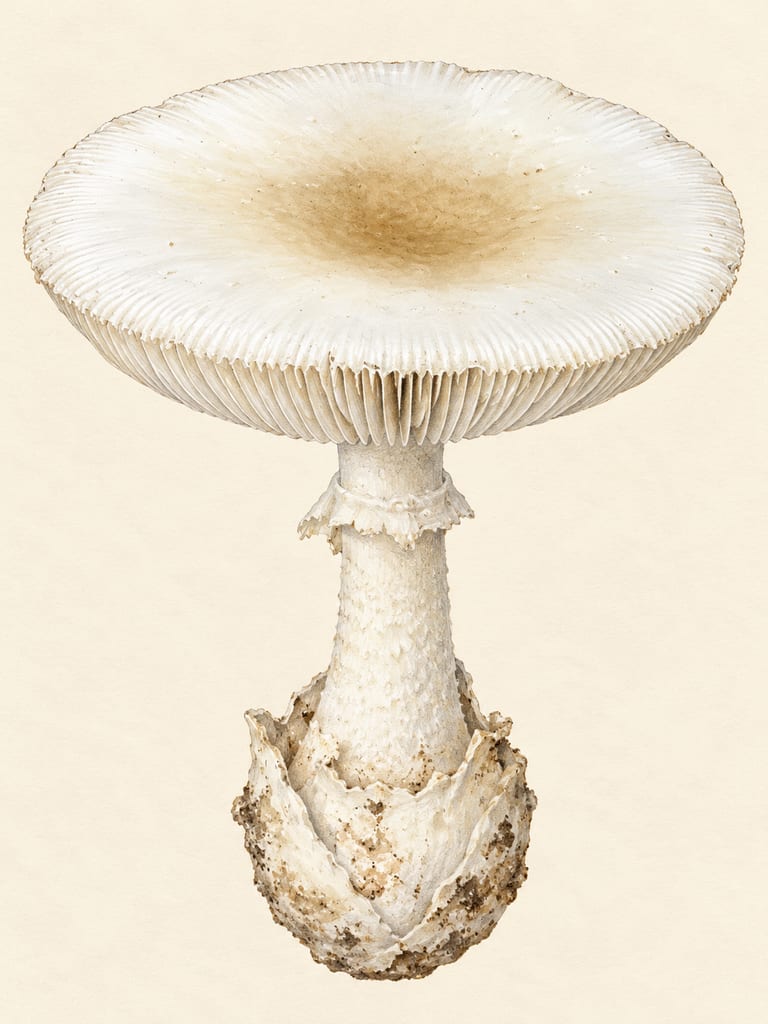
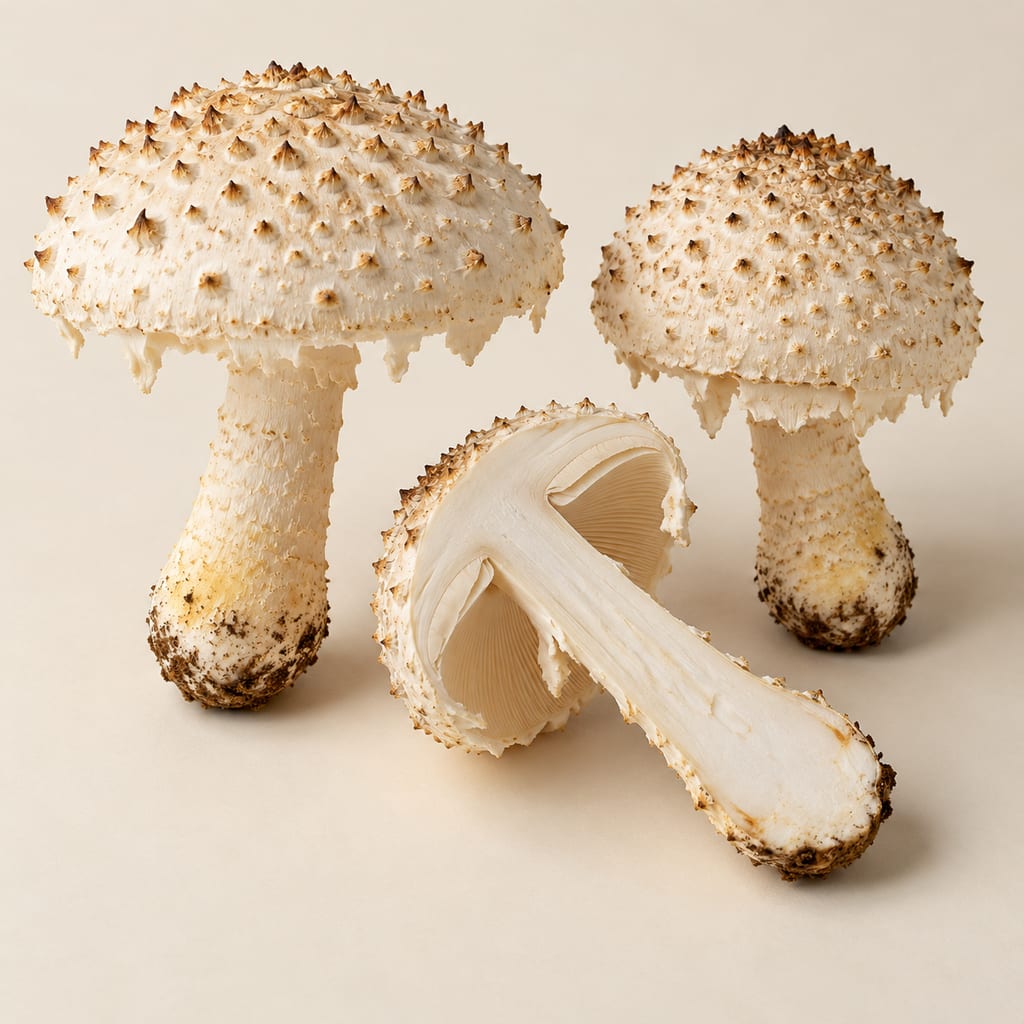
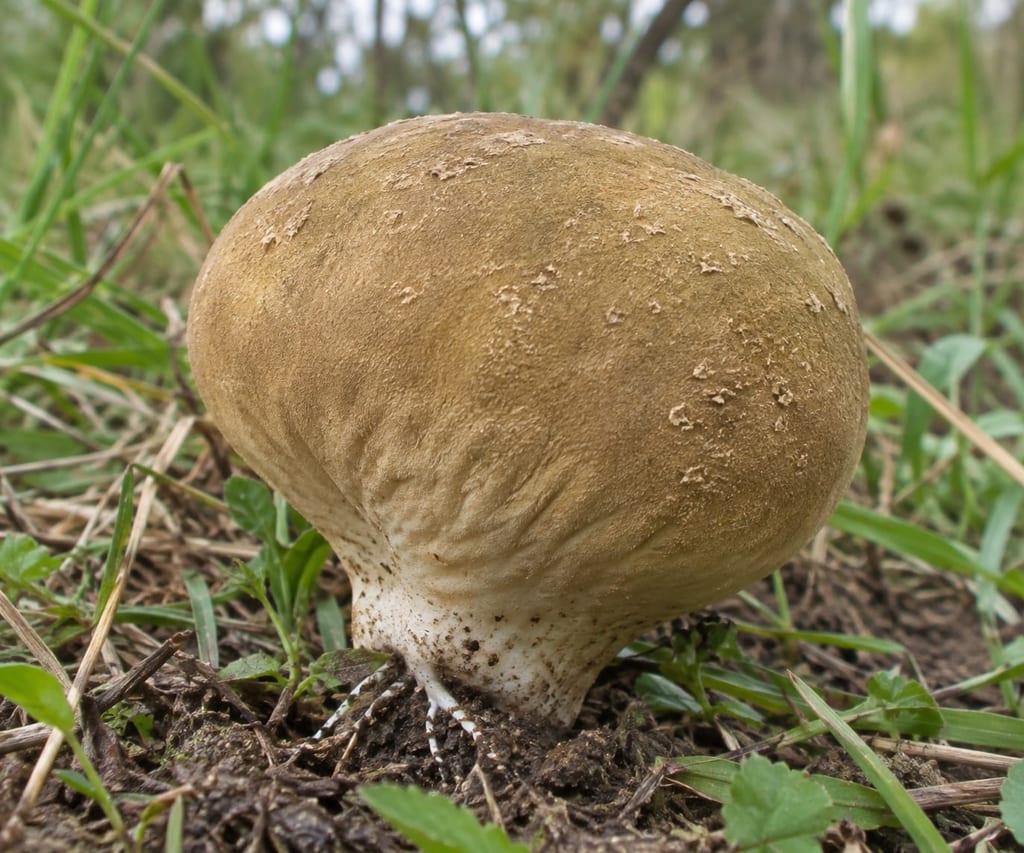
The fruit body is conspicuous and fleshy. Regional descriptions give a broad cap that may be olive-brown centrally and pale toward an ivory margin, crowded white gills, a stout pale stem, a ring and a large sac-like volva at the base. The ring and volva are remnants of the protective veil around a young mushroom. The cap expands and changes, so fruit bodies at different stages can appear unlike one another. These details explain mycological descriptions; they are not a field key or a way to decide whether an unknown Amanita is safe.
Sources for this section
Rain, fruiting and a short season
Visible fruiting is seasonal and linked to rain. A review of Central and Southern African food fungi describes a succession of species after the first rains and reports A. loosei in Haut-Katanga from November through the rainy season, with consumption continuing into April. That calendar belongs to the cited regional account. It should not be copied onto every country in the range: rainfall, local tree communities and fruiting times vary across the Sudanian-Guinean and Zambezian regions.
A Zambian field monograph describes the species fruiting in large quantities in Zambezian miombo and illustrates collections made in February. A date on one collection is evidence for that collection, not a universal harvest month. The mushroom belongs to a changing seasonal market basket whose timing follows local rains. Its short availability helps explain why households preserve some of the harvest, although the sources do not give a universal method or schedule.
Sources for this section
A market mushroom and a valued food
The strongest descriptions of this mushroom as food come from regional ethnomycology, not from a standardized commercial recipe. In Upper Katanga, the EFTA account describes it as the Amanita receiving particular local interest and as one of the most sold, consumed and appreciated species in its regional account. The Zambian monograph records names including tente and telya, alongside ndelema and related forms in several languages; EFTA notes that more than forty-five local names for A. loosii have appeared in literature from the Zambesian region. A name belongs to a language and place, not to the whole continent.
The literature records choices made at different stages. Young rounded bodies are especially favoured in the Zambian account and may fetch higher market prices than expanded caps. With older, open specimens, the stem is often removed and discarded. These are documented household and market practices, not universal rules. A 2022 study of markets in Huíla, Angola, also identified A. loosei among wild edible mushrooms sold locally, using phenotypical and molecular approaches. It adds a precise market record without proving that every mushroom sold under a vernacular name is this species.
The available sources do not supply one canonical dish or cross-regional preparation. They do not support an invented recipe with quantities, cooking times or seasonings. The practical evidence is narrower: regional recognition, a preference for young rounded bodies in one Zambian context, removal of older stems in some collections, and preservation by brief cooking followed by drying in the field account. Other household preparations need evidence from the community and place where they are practised.
Sources for this section
Texture, keeping and preservation
A. loosei is described as fleshy, with firm-to-soft white cap flesh and a fibrous, more brittle stem. Its size makes it productive, but the same softness creates a handling problem: the Zambian account says it deteriorates quickly and is not easy to preserve. The sources give no cold-storage temperature or safe number of days for household storage. A fresh-looking cap or market photograph cannot establish how long a specimen has been held.
Drying is documented, and the mushrooms are briefly cooked before drying. Cooking, drying or another preparation does not make a misidentified mushroom safe.
There is no species-specific evidence here for fermentation, pickling, salting, culturing or use as a microbial starter. A mushroom may occur in a fermented dish, but that does not show that this species itself is fermented or that fermentation makes it suitable for eating. For Fermentea, A. loosei is a raw gathered ingredient with documented food use; any fermentation method would need its own evidence.
Sources for this section
Range and what ecology means for supply
Its relationship with living woodland trees is central to supply. Ectomycorrhizal fungi live in close association with tree roots, and visible fruit bodies emerge from that living system. Market supply therefore reflects woodland conditions, rainfall and collectors’ knowledge of productive places. The sources do not show that A. loosei can be grown by ordinary mushroom cultivation, so no cultivation method is presented.
The EFTA distribution account includes Benin, Burundi, the Democratic Republic of the Congo, Kenya, Malawi, Tanzania, Togo, Zambia and Zimbabwe. Evidence from Huíla adds a studied food-market record in Angola. These are country- or region-level associations; they do not establish equal abundance, collection in every population, or a birthplace. Place precision stays at the scale the cited sources support.
Sources for this section
Safety and the limits of a photograph
The word edible in regional ethnomycology records a food tradition; it is not a toxicology certificate and does not identify an unknown specimen. Amanita includes deadly poisonous species. The Zambian monograph raises the possibility—explicitly as unproved—that A. phalloides may have reached tree plantations, and says plantation collecting is a problem. This raises the importance of exact identity; it does not prove death caps are present at a particular site or season.
A photo gallery can show what identified records look like, but cannot tell a reader that a mushroom in a basket, forest or market is A. loosei. Photos can omit the base, veil, underside, scale, habitat or microscopic characters, and cannot supply the taxonomic examination behind a studied identification. Never use this page, a local name, market label, smell, taste or a single visual feature to decide whether a wild Amanita is safe. Do not eat an uncertain Amanita. This page describes a named regional food, not a foraging method.
Taxonomic research helps explain that caution: African Amanita identifications have been examined using morphology and molecular data, while related names have shifted in the literature. Published market and herbarium records are valuable because specialists connect a name to studied material. That chain of evidence is absent when a person has only an uncertain specimen or online image. A correct caption is not a substitute for qualified identification and local food-safety knowledge.
Sources for this section
A careful reading of the evidence
Amanita loosei is best understood as a large, seasonal, ectomycorrhizal forest mushroom whose food importance is rooted in documented African traditions. The literature gives useful detail: several local names; a strong market reputation in Upper Katanga; a documented preference for young fruit bodies in Zambia; rainfall-linked availability; and a preservation sequence of brief cooking followed by drying. A molecularly informed market study in Angola provides another specific record.
The evidence is regional and uneven. The name has appeared in several forms; country-level range records do not establish abundance everywhere; food-use reports do not create one universal recipe; and available preparation notes do not provide validated times, temperatures or storage limits. Keeping those boundaries visible lets readers see both the knowledge present in the source traditions and what cannot safely be generalized.
Sources for this section
Evidence, names and the limits of comparison
Research on tropical African Amanitas draws on more than one kind of evidence. Field descriptions record cap, gills, stem, ring, volva, habitat and collection details. Taxonomic studies compare physical characters and, where available, molecular data. Ethnomycological studies add local names, uses, gathering patterns and market importance. Each type answers a different question. A distribution record can show where a name has been reported without demonstrating that the same species is abundant there; a market survey can document sale without establishing a single preparation; and a morphological description cannot, on its own, certify a specimen seen only in a photograph.
The history of the names reflects this work. Amanita loosii was described by Beeli in 1936. The later name A. zambiana was based on material from Zambia, and subsequent taxonomic discussions have treated it as synonymous with A. loosii. EFTA uses A. loosei, explaining that Härkönen and colleagues proposed this epithet to correct the spelling in reference to de Loose. Readers may still find the older forms in field guides, ethnomycological studies and specimen records. Keeping all three names searchable helps connect those records without claiming that every historical use of a name was applied with identical precision.
The scale of the reported range also needs care. EFTA’s country list spans the Sudanian-Guinean and Zambezian regions; the Angola study adds a market record from Huíla. These sources do not describe one continuous population or a uniform food culture. Local names, preferred stages, seasonal timing and value may differ from one community to another. Countries named in a distribution account are not all equivalent in documentation: some records come from specialist field books, others from regional surveys, and some areas may have far fewer studies. The map is therefore a guide to documented literature, not a measure of abundance or a substitute for local knowledge.
Comparison with other foods should stay equally specific. This mushroom is not a generic stand-in for a button mushroom, a Caesar mushroom from another continent, or an Amanita sold under a similar local name. The field book’s description of a young rounded stage and an expanded cap explains why the market may distinguish developmental stages; it does not establish that shape, colour or size alone can confirm the species. A regional ethnomycological account of one identified food cannot be transferred to a look-alike or a specimen from another habitat.
Nor do the reports establish a general preservation recipe. Brief cooking before drying appears in the Zambian account, while the Angola study concerns market specimens and laboratory characterization rather than household method. Neither provides a validated storage duration or a complete process with a safety endpoint. The right editorial choice is to preserve the practice that is documented and identify the measurements that are absent. That leaves room for future community-based research to add specific dishes, preparation language and safe handling evidence without rewriting the accounts of other regions as though they were the same.
Sources for this section
Places
Benin
Documented use · Country evidenceCountry-level distribution associated with regional food-use literature; not a precise locality or origin claim.
Burundi
Documented use · Country evidenceCountry-level distribution associated with regional food-use literature; not a precise locality or origin claim.
Democratic Republic of the Congo
Documented use · Country evidenceCountry-level distribution associated with regional food-use literature; not a precise locality or origin claim.
Kenya
Documented use · Country evidenceCountry-level distribution associated with regional food-use literature; not a precise locality or origin claim.
Malawi
Documented use · Country evidenceCountry-level distribution associated with regional food-use literature; not a precise locality or origin claim.
Tanzania
Documented use · Country evidenceCountry-level distribution associated with regional food-use literature; not a precise locality or origin claim.
Togo
Documented use · Country evidenceCountry-level distribution associated with regional food-use literature; not a precise locality or origin claim.
Zambia
Documented use · Country evidenceCountry-level distribution associated with regional food-use literature; not a precise locality or origin claim.
Zimbabwe
Documented use · Country evidenceCountry-level distribution associated with regional food-use literature; not a precise locality or origin claim.
Huíla
Documented use · Region evidenceA. loosei was identified among wild edible morphotypes sold in Huíla markets.