Burton Union
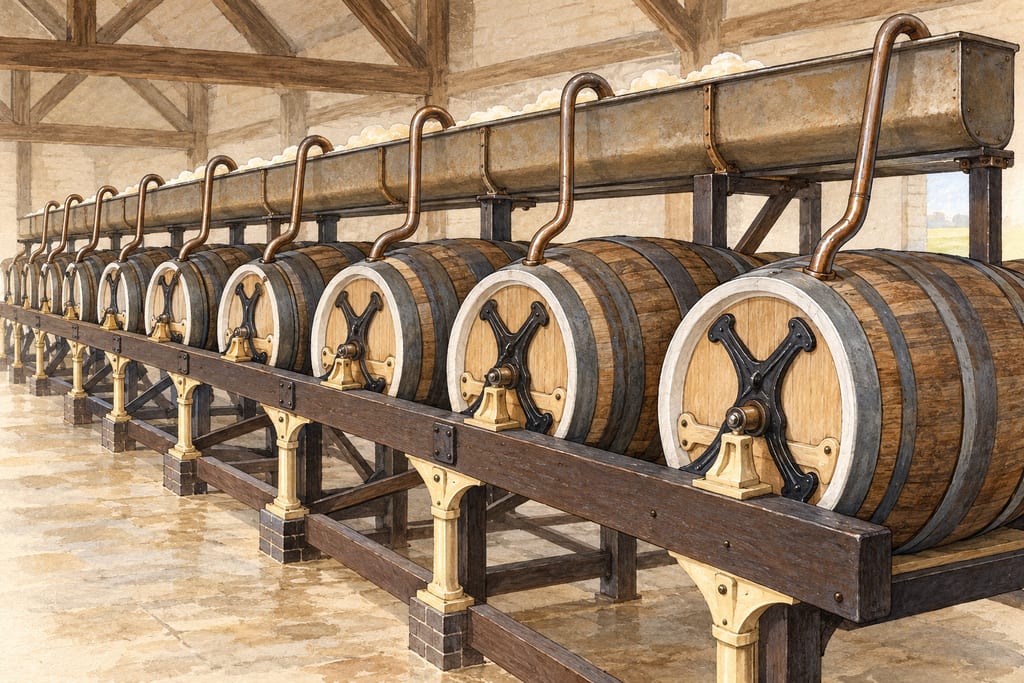
A Burton Union is a connected set of horizontal wooden beer casks, swan-neck pipes and shared troughs. Fermentation lifts yeast-rich foam into the trough; beer drains back to the casks, leaving yeast behind.
 FermenteaWhere food goes to change
Equipment · Bottles, carboys and demijohns
Codd-neck bottle · Ramune bottle
A marble-stoppered bottle is a glass carbonated-drink bottle sealed by a glass marble pressed against a rubber washer. Its Codd neck holds the marble at the mouth when sealed and gives it a side pinch after opening.
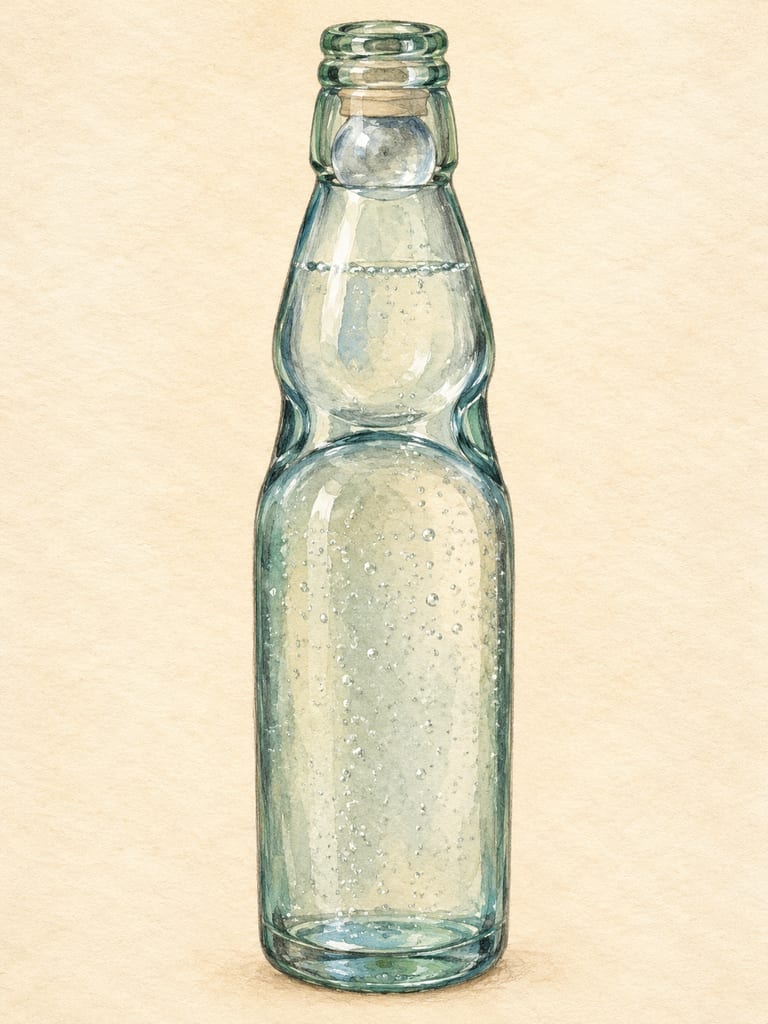
A marble-stoppered bottle is a glass bottle for a carbonated drink, with a glass marble trapped in a widened part of its neck. In the Codd design, a rubber washer at the mouth provides the seat for the marble. The bottle can be sealed without a cork: pressure from the fizzy drink pushes the marble upward against the washer. The narrow neck and its shaped side pinch keep the marble from simply falling back onto the mouth after the drinker presses it down.
This makes the bottle a distinctive packaging device rather than a general fermentation jar. Its body holds a beverage; the marble is the stopper, and the neck is part of the closing mechanism. Glass, marble and rubber are the materials documented for the mechanism. No standard capacity, universal body shape or pressure rating is given in the sources.
The bottle is filled with a carbonated liquid and inverted during sealing, so internal pressure pushes the marble against the rubber washer at the mouth. The marble closes the opening, and pressure maintains the seal. To open it, the marble is pushed inward. It drops from the washer into the bottle’s neck chamber; a molded pinch at one side holds it away from the pour path, allowing liquid to flow while the marble remains captive inside.
That sequence explains why the bottle’s glass shape matters. A simple straight-neck bottle would not retain the marble at the mouth, and without the side pinch the displaced marble could roll back and obstruct the opening. The historic bottle therefore combines an ordinary glass container with a purpose-shaped neck and a loose glass stopper. The museum’s description documents the mechanism but does not specify a pressure rating, rubber formulation or standard dimensions.
The date of a marble-stoppered bottle depends on which milestone is meant. The Japan Glass Bottle Association’s chronology lists a glass-ball bottle in 1849. The Museum of the Highlands describes a Codd bottle made to Hiram Codd’s 1872 patent. These dates should not be collapsed: one is the association’s earlier glass-ball-bottle entry, while the other identifies the patented design represented by a museum specimen.
The museum holds a glass Codd bottle dated 1900–1920 and lists its size as 23 by 6 centimetres. Its page does not label the axes or present those figures as a standard. The bottle form was later superseded in many drinks by the steel crown cap, but the same source says Codd bottles continue to be manufactured for use in Japan and India. Its history is therefore industrial and multi-place, rather than a design that belongs exclusively to one modern beverage.
The marble bottle became closely associated with Ramune in Japan, but the drink and its container have separate timelines. The Ministry of Agriculture, Forestry and Fisheries recounts an earlier cork-stoppered lemonade and dates domestic Japanese production of marble-stopper bottles to 1892. The ministry also gives separate dates for the arrival of carbonated lemonade and for local drink production. Those dates describe beverage history and bottle manufacture respectively; the Japanese name Ramune does not date the Codd design itself.
The Japan Soft Drink Association describes Ramune as the carbonated drink sealed with a marble, distinguishing it in contemporary usage from crown- or screw-capped cider. That naming convention helps explain why a Codd bottle is often called a Ramune bottle, while the bottle design itself is wider than the drink. The equipment-to-Ramune link on this site reflects that documented association; it is not a claim that every Ramune recipe or every marble-sealed bottle is identical.
The photographs in the gallery show Japanese Ramune bottles from the 2000s: one full bottle with a paper seal and one close view of the marble in a Sangaria bottle. They are useful for seeing the actual glass material, bottle neck and marble. They are photographs of particular bottles, not evidence that their caps, labels, size or color are universal. The illustration shows one plausible sealed glass example and omits maker marks and modern packaging details.
The available records do not establish a standard volume, a single outside silhouette, a universal gasket material beyond the rubber washer in the museum account, or a tested reuse procedure. The museum’s one specimen measurement is not a specification. This item describes the marble-sealing bottle and its documented historical and Japanese use; it does not provide a safety or pressure rating for filling other bottles.
Marble-sealed bottles predate Ramune’s familiar Japanese form. The Japan Glass Bottle Association lists a glass-ball bottle in 1849; the Museum of the Highlands identifies a Codd bottle made to Hiram Codd’s 1872 patent. Japan’s Ministry of Agriculture, Forestry and Fisheries distinguishes the earlier cork-stoppered lemonade from Japanese manufacture of glass marble bottles, dated 1892. These are separate design, patent and adoption milestones, not one date for the drink or every bottle.
This is a pressure-sealed bottle for carbonated drinks, not a fermentation vessel. The cited history gives no pressure rating or suitability standard for reuse.
Source →The 23 × 6 cm measurement belongs to one museum specimen; the record does not establish a standard capacity or dimension.
Source →Ramune’s name and bottle association are Japanese use history; the marble-seal design has earlier British patent and glass-bottle milestones.
Source →The museum identifies Codd as an English inventor and the specimen as made to his 1872 patent; this records a patent context, not an exclusive origin for every marble-sealed bottle.
These sources place use and manufacture in Japan; the bottle’s design is not claimed to have originated there.
The ministry dates Japanese domestic production to 1892; earlier beverage/import milestones are distinct.
The museum notes continuing use in India; it does not present India as the invention site or specify one local form.
A Burton Union is a connected set of horizontal wooden beer casks, swan-neck pipes and shared troughs. Fermentation lifts yeast-rich foam into the trough; beer drains back to the casks, leaving yeast behind.
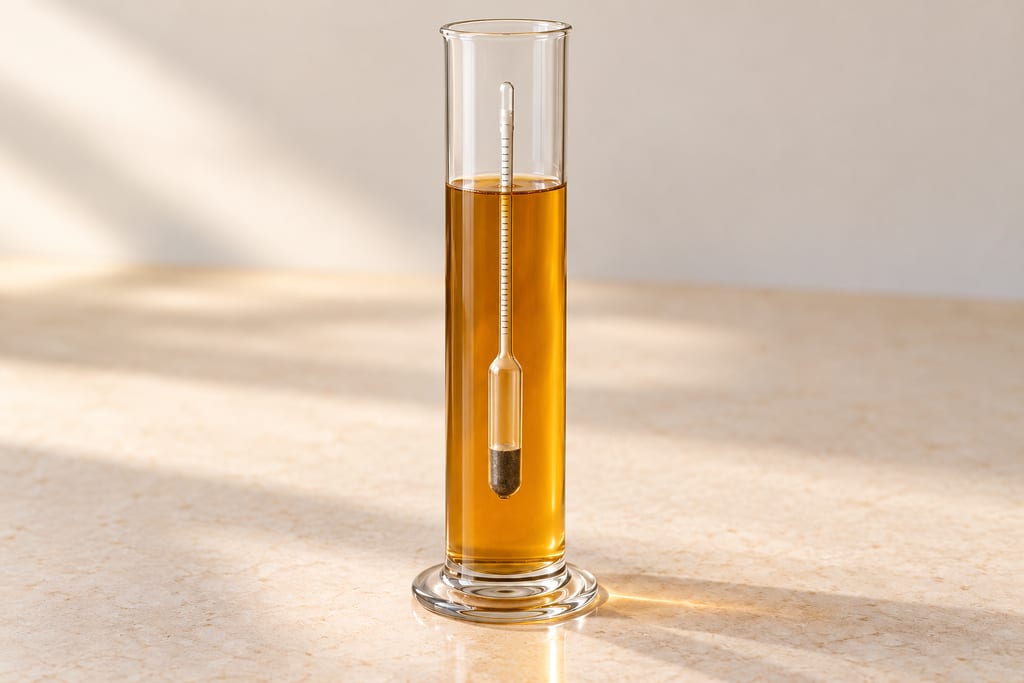
A hydrometer floats in liquid and uses its weighted body's depth to indicate density. In brewing, readings track changing gravity, not every dissolved substance or kombucha alcohol.
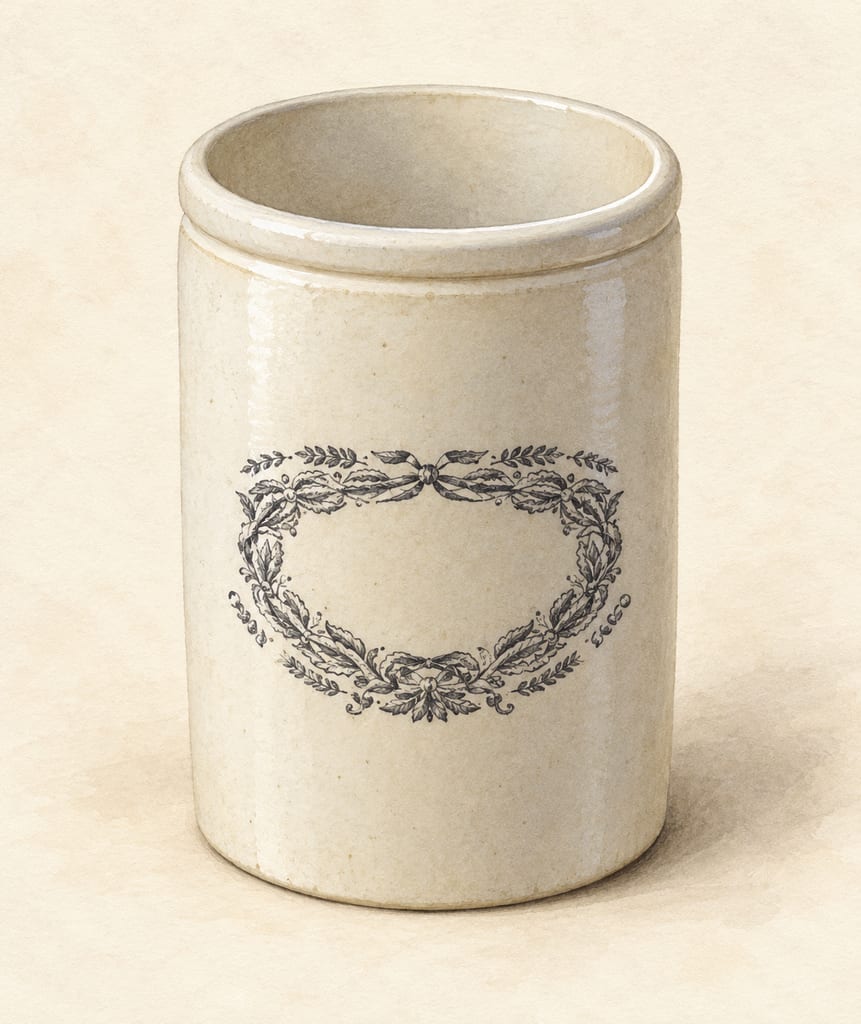
Keiller-branded stoneware jars were commercial packages for Dundee marmalade. Collections show cylindrical forms with printed marks; sources distinguish the Dundee brand from documented Maling manufacture in Newcastle.
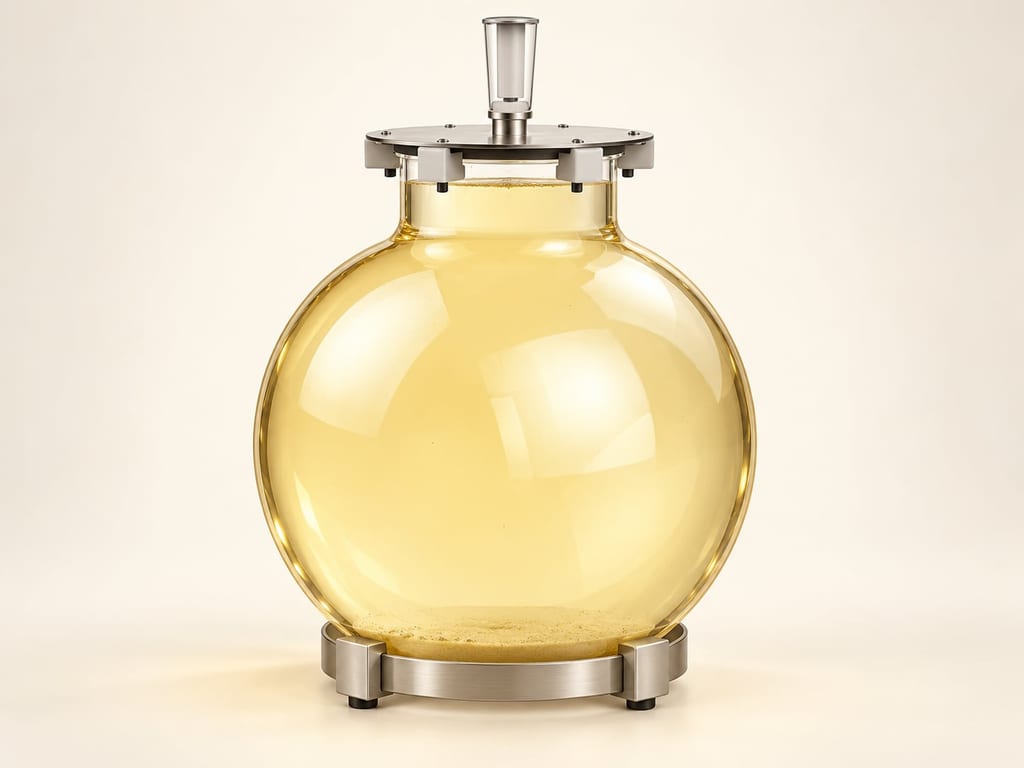
A large, transparent, spherical borosilicate-glass vat designed for modern wine fermentation and maturation. The 220-litre Wineglobe model has a wide neck, fitted lid and support; its use and fittings vary by model.
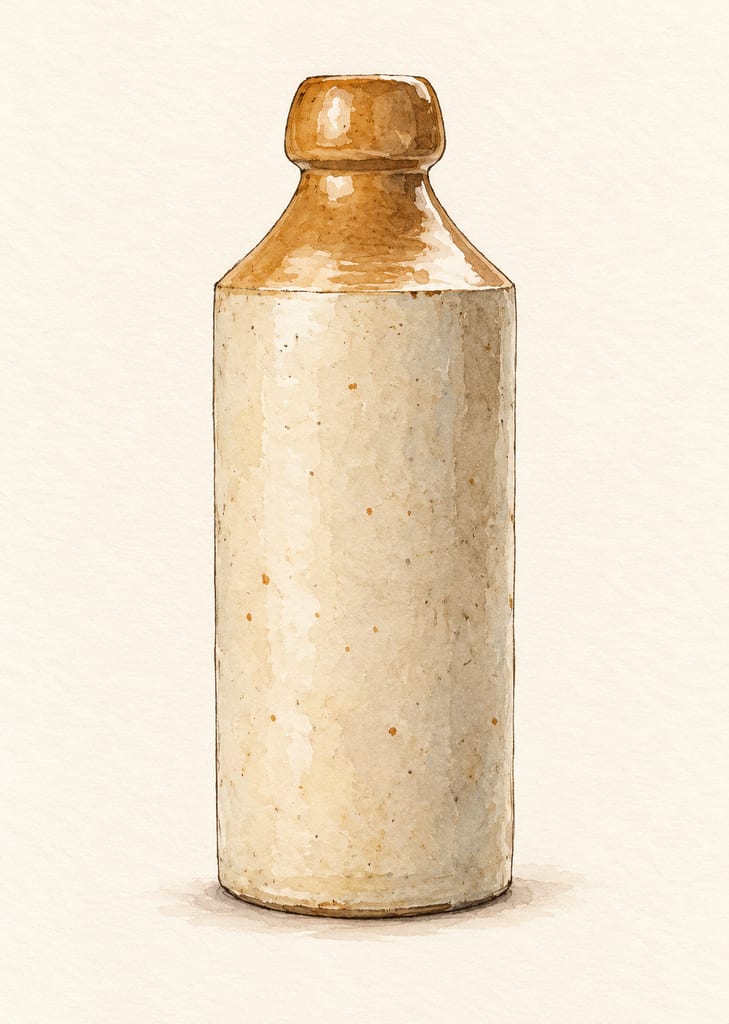
A late nineteenth-century stoneware bottle for ginger beer, represented by an Aberdeen museum object dated 1850–1899. It documents beverage packaging, not a fermentation vessel or a universal bottle design.
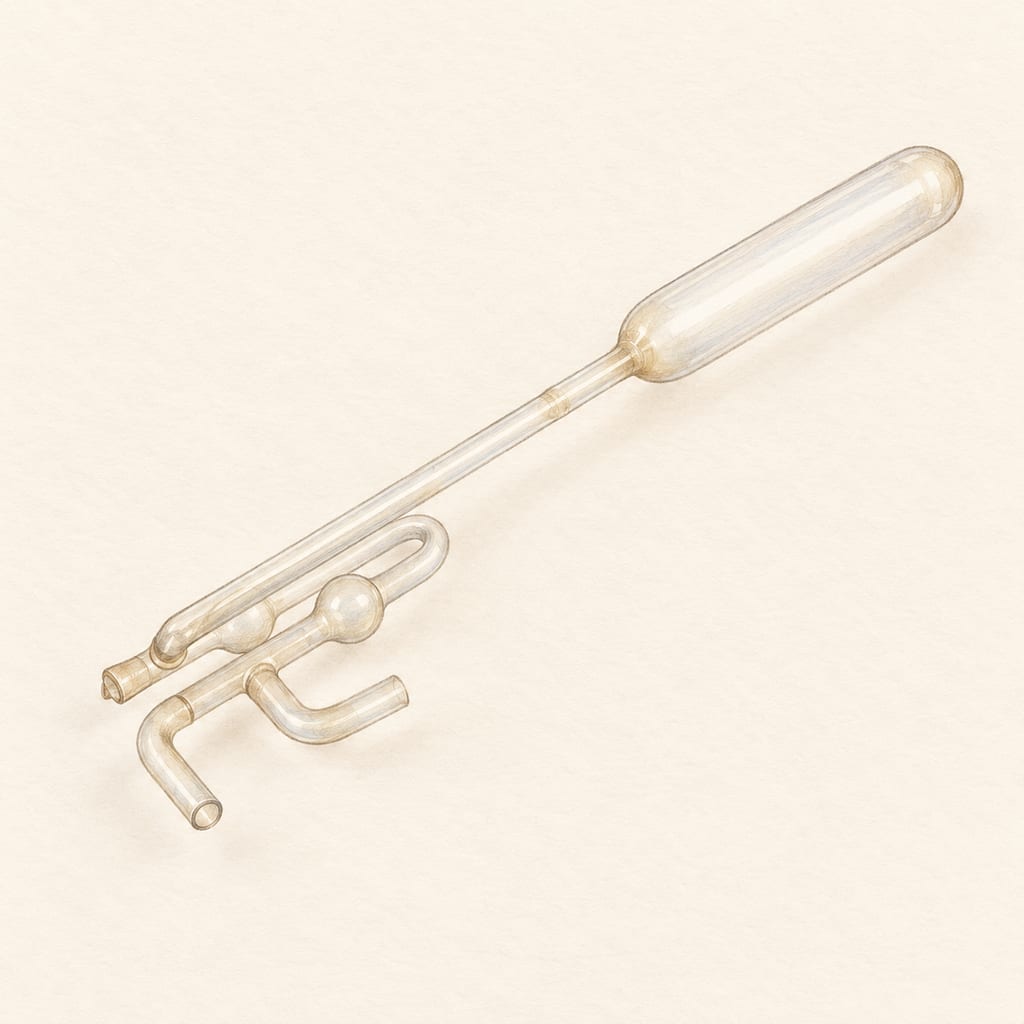
A thermostat senses temperature and regulates heating or cooling to a chosen condition. It may be built into an appliance or supplied as a separate controller; a sensor reading describes its measured point, not every part of a batch.

A Cap-Pelé boucanière is an Acadian herring-smoking building. The documented Willie Niles example is a one-storey wood-frame structure with a ridge smoke vent and interior bays for hanging fish-bearing cannes.

Achcharu is a family of Sri Lankan vinegar pickles made with mixed vegetables or seasonal fruit and a piquant spice dressing. This version is a quick, refrigerated, non-fermented mixed-vegetable pickle.

The acocote is a long, hollowed and dried gourd used to draw aguamiel from a mature maguey. It is a harvesting tool: the sap is transferred to a separate vessel before it ferments into pulque.

Adrak murabba preserves young ginger in sugar syrup, a sweet South Asian preparation recorded in Indian cookery and food-processing sources.

Parkia biglobosa seeds are fermented into regional West African seasonings, including nététou, iru, dawadawa and soumbala. The yellow fruit pulp is a separate food, and names and methods vary by place.

Japanese reddish-brown vinegar from sake lees matured about three years, turned to vinegar by acetic bacteria; the vinegar of Handa and Edomae sushi rice.

A refined common-wheat flour blended for a broad range of baking; its protein and behavior vary with wheat, milling and market.

The almond mushroom, Agaricus subrufescens, was cultivated in eastern North America in the 1800s, lost its market, and returned as a cultivated mushroom from Brazil, where it is grown under several names.
No community contributions have been published for this entry yet.
Sign in to contribute. Published comments and photos are free to read.
Japan Glass Bottle AssociationHistory · Equipment
History of glass bottlesThe association’s chronology lists a glass-ball bottle in 1849 outside Japan.
Cited in: Design, patent and dates
Museum of the Highlands, Brora Heritage CentreEquipment · History · Mechanism · Geography
Marble in Codd BottleIdentifies a bottle made to Hiram Codd’s 1872 patent and describes its glass body, marble, rubber seal, narrowed neck and side pinch.
Lists one 1900–1920 glass specimen as 23 × 6 cm; the page does not label the axes or claim these dimensions are standard.
States that Codd bottles remain manufactured for use in Japan and India.
Cited in: A bottle made to hold its own stopper; How the seal works; Design, patent and dates; Variations and limits of the record
Ministry of Agriculture, Forestry and Fisheries, JapanHistory · Geography
食品産業の発展:ラムネ・サイダー~炭酸飲料の登場Distinguishes Perry-era cork-stoppered lemonade from the later UK marble-stopper bottle.
Reports the start of Japanese manufacture of glass marble-stopper bottles in 1892; also gives separate dates for lemonade introduction and drink production.
Cited in: Japan, Ramune and bottle identity
Japan Soft Drink AssociationGeography · Classification
「ラムネ」の名前の由来を教えてくださいDescribes Ramune as the marble-stoppered carbonated drink and distinguishes it from crown- or screw-capped cider by closure.
Cited in: Japan, Ramune and bottle identity
Wikimedia CommonsImage
Ramune-lemonade,japan.JPGShows a full Japanese glass Ramune bottle with its marble and top paper seal; licensed CC BY 3.0.
Cited in: Variations and limits of the record
Wikimedia CommonsImage
Ramune Sangaria (Coddneck marble).jpegClose photograph shows the marble inside a Sangaria Codd bottle; file license is CC BY-SA 3.0.
Cited in: Variations and limits of the record