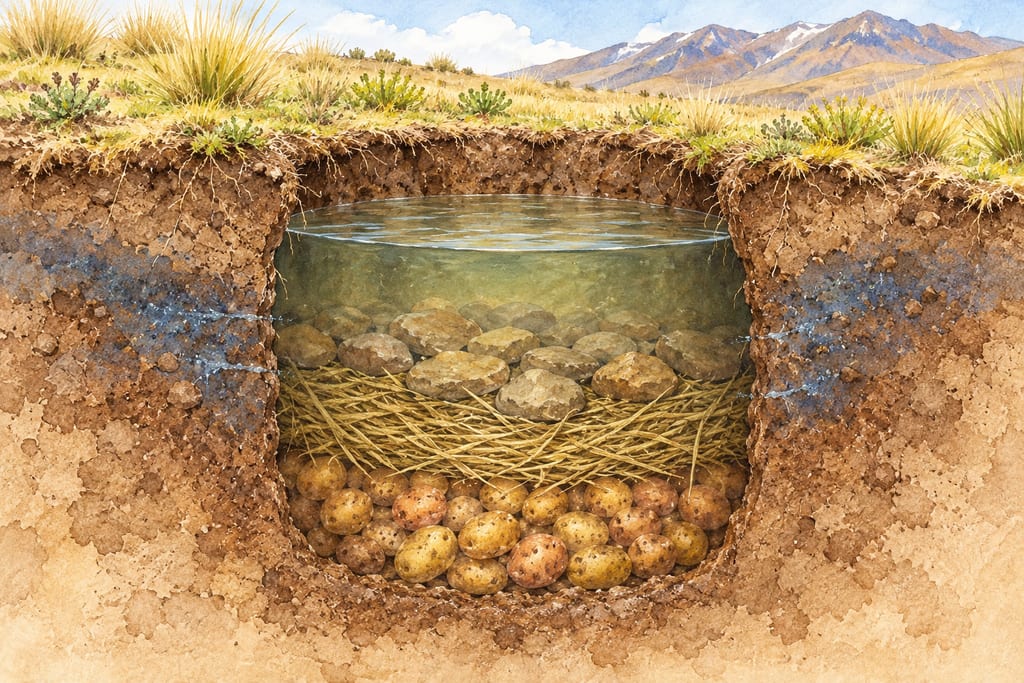
Tocosh spring-fed pit
In the Huánuco highlands, tocosh potatoes are placed in deep earthen wells beside running water. Dry straw and stones cover the potatoes as seepage fills the pit, submerging its contents during a long fermentation.
 FermenteaWhere food goes to change
Built structures · Pits and cavities
Pachamanca Huánuqueña · Huanuco pachamanca oven · Pachamanca pit oven
The Huánuco pachamanca is a temporary ground oven: firewood heats stones, which enclose layers of tubers and seasoned meat in an excavated pit. Banana leaves, blankets and earth seal the cooking cavity.
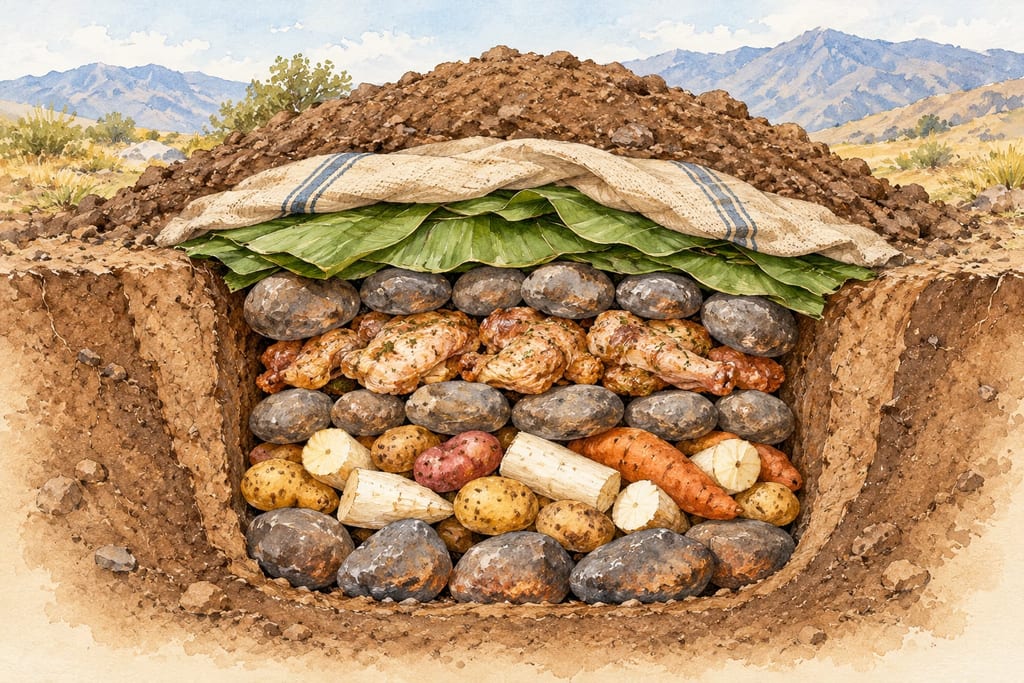
Pachamanca Huánuqueña is a named regional preparation documented by Peru’s tourism inventory for Huánuco District in Huánuco Province. The equipment is a temporary hole excavated in the ground. The inventory calls the stones the oven’s working heat source: firewood heats them, and the food is enclosed among successive stone layers. It does not describe a built masonry chamber or a separate cooking pot.
The inventory places its resource in Huánuco Department and lists an altitude of 1,880 metres. That figure belongs to the inventory record, not to a surveyed pit. The cited sources do not give pit dimensions, a required soil type or a standard stone size, so the illustration and description avoid supplying those details.
The Huánuco inventory describes a particular order: tubers go into the excavated cavity first, followed by a bed of heated stones; seasoned meat is placed above, then another layer of stones seals the food. Banana leaves, blankets, wet paper sacks and earth form the cover. This is the source-supported basis for the cutaway illustration. The Commons photograph is a separate, locality-unspecified Peruvian pachamanca image; it is useful for seeing an open cooking stage but does not document Huánuco.
The regional ingredient list names pork, potato, sweet potato and yuca, with seasonings including chincho or walmish, garlic, chile and salt. This page describes the oven rather than prescribing a meal: the cited descriptions do not establish a single compulsory ingredient list or load size.
The 2023 MINCETUR inventory gives a broad 40–90 minute range and says duration depends on the preparation. An INEI regional account published in 2000 reports 45–60 minutes for the arrangement it describes. The accounts differ in scope and date, so neither figure is a universal duration or a substitute for checking the actual food. The sources provide no measured oven temperature or validated modern safety procedure.
The historical record is also limited: these accounts show the Huánuco preparation documented by 2000 and again in 2023, but do not establish when the practice began. The inventory’s mention of the name watya does not, by itself, prove that all preparations using that name share one construction or a single origin.
An INEI regional account published in 2000 and a MINCETUR inventory recorded in 2023 document Huánuco pachamanca and a stone-heated underground oven. They establish that the preparation was recorded by those dates, not when it began. The regional inventory also names an earlier term, watya, but the cited material is not sufficient to claim a single origin or an unbroken history from that name.
A build is made where it stands: moving it means building it again.
The described stones and buried cavity retain substantial heat; opening and unloading can expose people to hot stones, steam and earth.
These official records identify Huánuco pachamanca with Huánuco. The MINCETUR resource record lists 1,880 m altitude; no exact pit coordinate or dimensions are given.
In the Huánuco highlands, tocosh potatoes are placed in deep earthen wells beside running water. Dry straw and stones cover the potatoes as seepage fills the pit, submerging its contents during a long fermentation.
No community contributions have been published for this entry yet.
Sign in to contribute. Published comments and photos are free to read.
Ministerio de Comercio Exterior y Turismo (MINCETUR), PeruGeography · Construction · Materials · Method · Regional variation
Pachamanca Huanuqueña, Ficha de Inventario 12051The inventory identifies Pachamanca Huanuqueña in Huanuco District, Huanuco Province, Huanuco Department, Peru; the listed altitude is 1,880 m for the inventory resource.
It describes a temporary oven formed in an excavated hole in the ground, with stones heated by firewood performing the oven function.
Its sequence starts with tubers, then a bed of heated stones, seasoned meat, and another stone layer to seal; banana leaves, blankets, wet paper sacks and earth cover the oven.
The page reports cooking durations of 40 to 90 minutes depending on the preparation; this is a source-specific range, not a guarantee.
The Huanuco ingredients named include pork, potato, sweet potato and yuca; chincho or walmish, garlic, chile and salt are also described.
Cited in: A pit oven identified with Huánuco; Layering and the earth seal; Timing varies across accounts
Instituto Nacional de Estadística e Informática (INEI), Dirección Nacional de Estadística e Informática DepartamentalMethod · Regional context
Conociendo HuánucoThe regional account describes the Huanuco pachamanca as an underground oven using large river stones heated beforehand, covered with banana leaves, wet cloths and earth.
It reports 45 to 60 minutes for the arrangement it describes; this differs from the later MINCETUR inventory range and should remain a distinct historical account rather than a universal timing.
This source records the regional preparation but does not establish the origin date of the pit-oven practice.
Cited in: Timing varies across accounts
Wikimedia Commons; photograph by UnukornoImage reference
Pachamanca in Peru.jpgThe CC BY 3.0 photograph shows an open Peruvian pachamanca cooking stage with food and heated stones. Its caption does not specify a locality, so it is comparative visual evidence and not a photograph of Huanuco.
Cited in: Layering and the earth seal