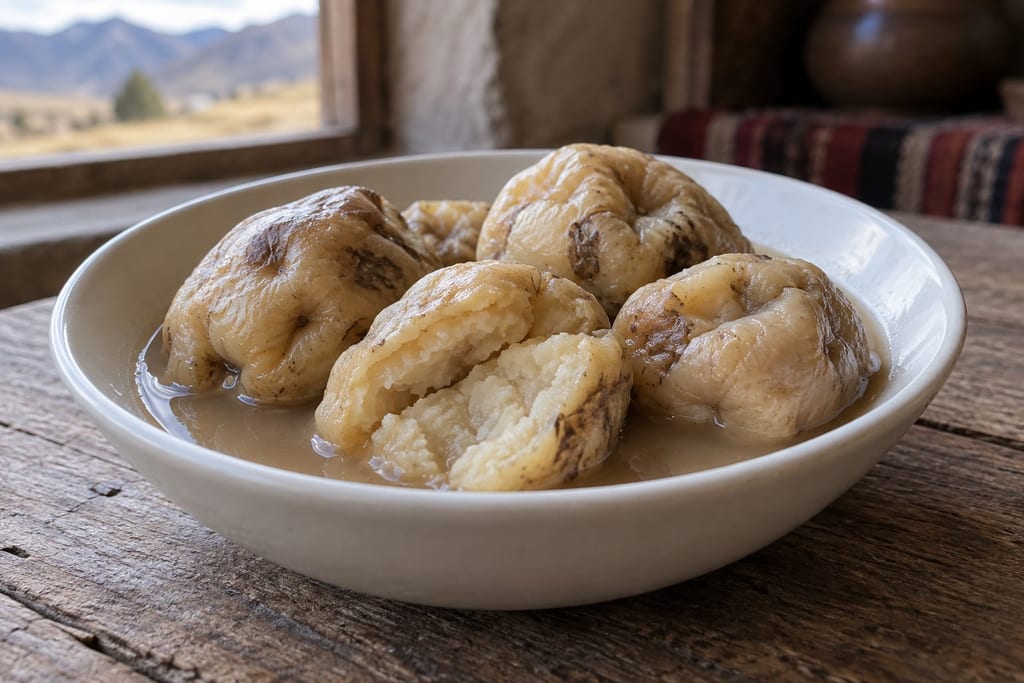
Tocosh
Peruvian Andean fermented potato: tubers held in water-fed earthen wells for a long lactic fermentation, giving an acidic food that can be dried and ground into flour for storage.
 FermenteaWhere food goes to change
Built structures · Pits and cavities
Poza de tocosh · Tocosh well · Tocosh fermentation pit · Pozo de tocosh
In the Huánuco highlands, tocosh potatoes are placed in deep earthen wells beside running water. Dry straw and stones cover the potatoes as seepage fills the pit, submerging its contents during a long fermentation.
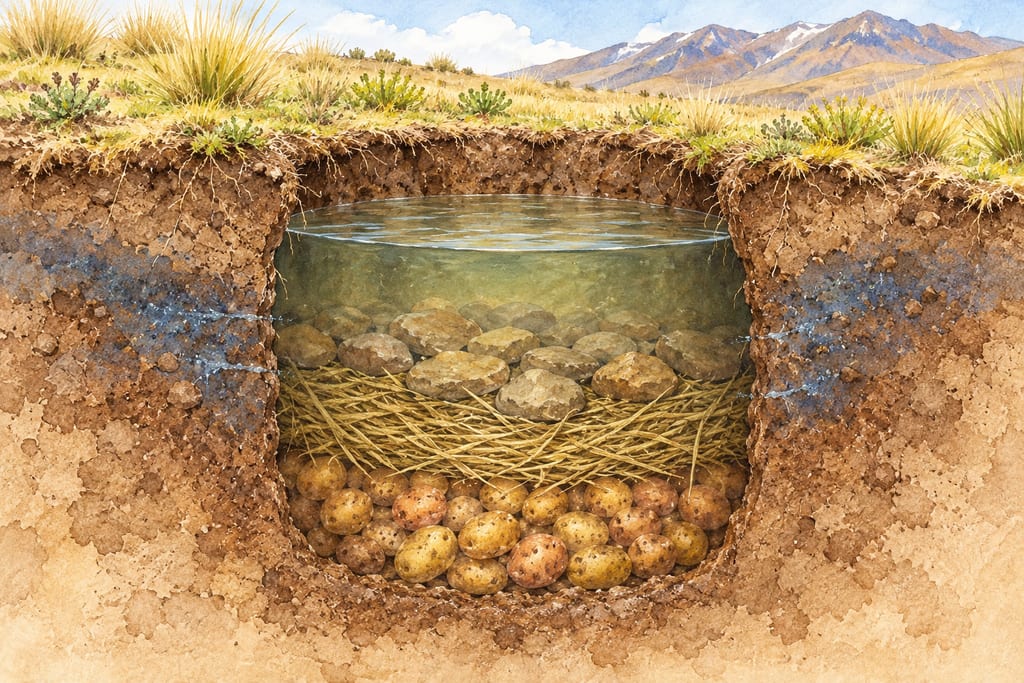
Tocosh is associated with fermented potatoes, and the pit documented at Obas is a water-fed well rather than a dry storage cavity. In this account, the excavation sits beside a river or other running water. The field report describes water seeping from the adjacent flow and rising through the pit until it submerges the contents. This physical relation between stream, permeable earth and well is central to the build.
The reported Obas wells were two metres or more deep. The account names the town as Obas in Yarowilca Province, Huánuco Department, at about 3,500 metres elevation. Those details describe the field visit; the source does not give a standard width, exact well coordinates or a general construction plan. A separate 2026 study confirms that traditional earthen wells near natural springs are used for potato tocosh at other high-altitude sites in the Peruvian Andes, while documenting different places and elevations.
The documented sequence begins with selected potatoes placed in the earthen well. Dry straw covers the load, and stones go above the straw. Water from the nearby flow then filters through the ground and covers the contents. The 2013 account identifies hualash potatoes as a local preference reported by producers; it does not establish that the variety is compulsory everywhere. Nor does it specify a single stone type, straw thickness, pit width or water flow rate.
A Commons photograph shows a different Peruvian tocosh well holding potatoes under water. Its caption associates it with a 2024 WikiAcción Perú photographic expedition around Chavín de Huántar; it is useful as a comparative view of the water-filled form, not evidence for the exact Obas well or its water route.
The Obas field account gives approximately five to six months for the potatoes to become tocosh. A later study sampled potatoes from spring-fed earthen wells after three and six months at three distinct highland sites. These reports show why the time cannot be treated as a universal schedule: they describe particular preparations and research samples, not a standard operating target for every locality.
The 2013 account says foam may appear in earlier months. That is an observation of the process, not a reliable test of safety or completion. The same paper describes eating fresh tocosh or tocosh flour in mazamorra. These field descriptions establish a documented local use and a distinctive water-fed structure, but they do not establish the history of the practice’s origin or provide a complete modern food-safety protocol.
A 2013 field account documents tocosh wells observed at Obas, Huánuco, and describes their water-fed construction. A 2026 study reports sampling potato tocosh prepared in traditional earthen wells near natural springs at three Peruvian highland sites. These records confirm contemporary documentation but do not date the origin of the well form.
A build is made where it stands: moving it means building it again.
A deep water-filled pit presents a serious fall and access hazard. The described water source and fermentation signs do not establish food safety.
The field account names Obas, Yarowilca Province, Huánuco Department, and gives the town altitude as about 3,500 m. It does not provide coordinates for a particular well; this location is specific to that study, not every tocosh well.
Peruvian Andean fermented potato: tubers held in water-fed earthen wells for a long lactic fermentation, giving an acidic food that can be dried and ground into flour for storage.
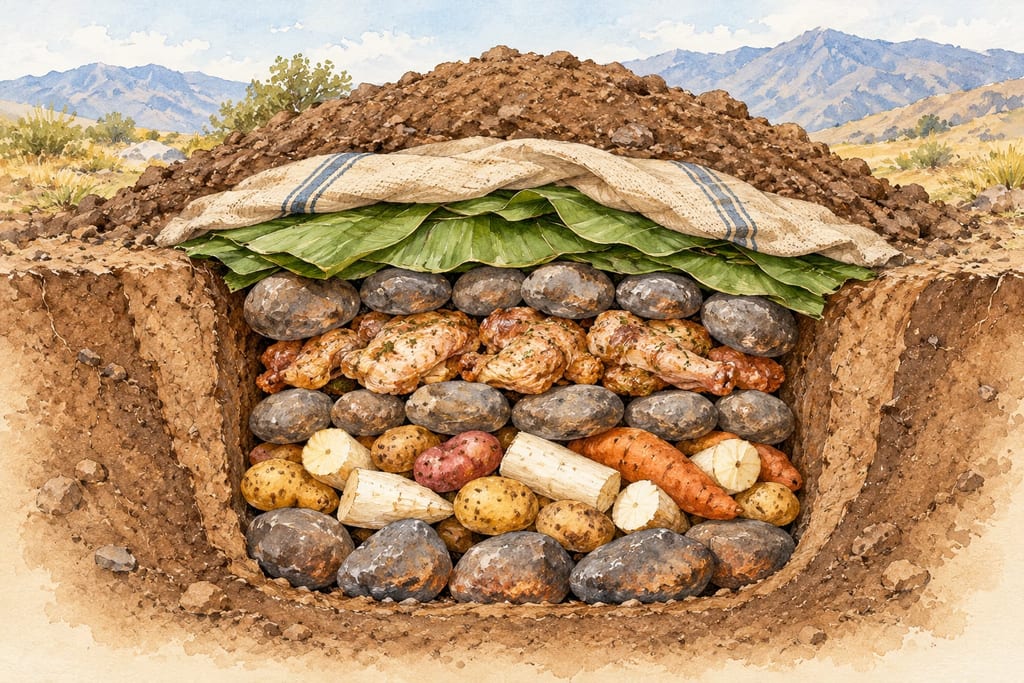
The Huánuco pachamanca is a temporary ground oven: firewood heats stones, which enclose layers of tubers and seasoned meat in an excavated pit. Banana leaves, blankets and earth seal the cooking cavity.
No community contributions have been published for this entry yet.
Sign in to contribute. Published comments and photos are free to read.
Hugo Lechuga-Gilt and Hugo Ilan Salas-Ramírez, Universidad de Lima, Ingeniería Industrial 31 (2013), pp. 115–140Construction · Geography · Method · Timing · Regional use
Estudio para la instalación de una planta productora de mazamorra de tocosh con maca, quinua y lecheThe authors report observing tocosh wells and extraction during fieldwork in Obas, Yarowilca Province, Huánuco Department, at about 3,500 m altitude.
The text describes wells two or more metres deep beside a river or water flow; selected potatoes are covered with dry straw and stones, and water seeps in to submerge the contents.
It reports approximately five to six months at the observed site and says foam may appear in earlier months; neither duration nor foam is a universal safety endpoint.
It names hualash potatoes as locally preferred and describes traditional use in mazamorra, including fresh tocosh or tocosh flour.
Cited in: A well that depends on its water source; Potatoes, straw, stones and seepage; A long process, with local observations
Reyes et al., International Journal of Molecular Sciences 27(9), 3981 (2026), via PubMed CentralModern use · Geography · Method
Genomic Insights into the Probiotic Potential of Lactic Acid Bacteria Isolated from Tocosh: Traditional Peruvian Fermented PotatoesThe 2026 study states that tocosh potatoes were prepared in traditional earthen wells near natural springs in the Peruvian Andes.
Its sample locations include Panaopampa, Amarillis, Huánuco at 2,992 m, Huallquin Grande, Huaricolca, Tarma at 3,882 m, and Caracuchan Mountain, San Pedro de Cajas, Junín at 4,451 m.
Samples were collected after three and six months; these study periods do not replace the separate 2013 Obas account or establish one standard duration for all sites.
Cited in: A well that depends on its water source; A long process, with local observations
Wikimedia Commons; photograph by Carlo Brescia (Felino Volador)Image reference
Pozo de preparación de papas para tocosh 01.jpgThe photograph shows a water-filled earthen pit containing potatoes prepared for tocosh. Commons metadata dates it 26 February 2024 and licenses it CC BY-SA 4.0.
Its caption associates the photograph with a WikiAcción Perú expedition to archaeological sites in Chavín de Huántar; the image is a comparative view and is not claimed to depict the Obas well.
Cited in: Potatoes, straw, stones and seepage