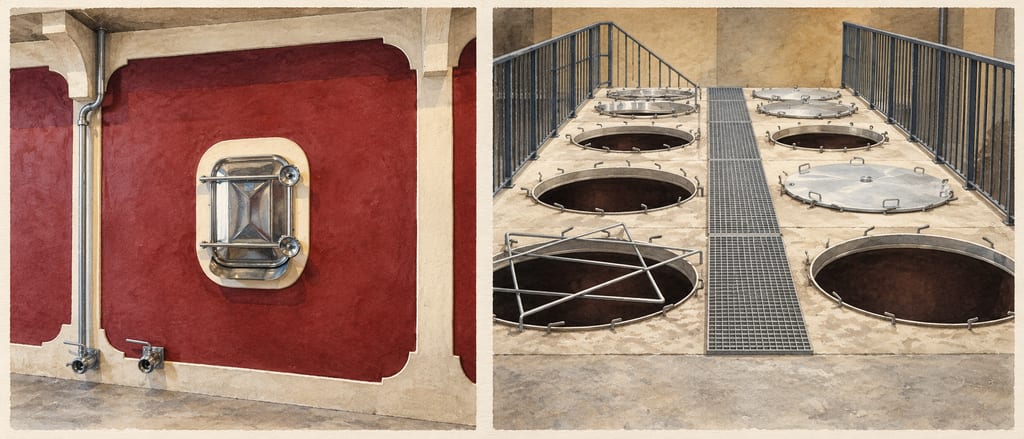
Concrete wine tank
Concrete wine tanks are heavy, fixed vessels in rectangular, cylindrical and tapered forms. Their thermal response and wine contact depend on mix, wall construction and interior finish.
 FermenteaWhere food goes to change
Equipment · Rotating hearth spits and rollers
palo chochoquero
A palo chochoquero is a large wooden roller used to cook Chiloé’s potato-based chochoca. Dough coats the pole as it turns above a hearth, browning in place of a pan.
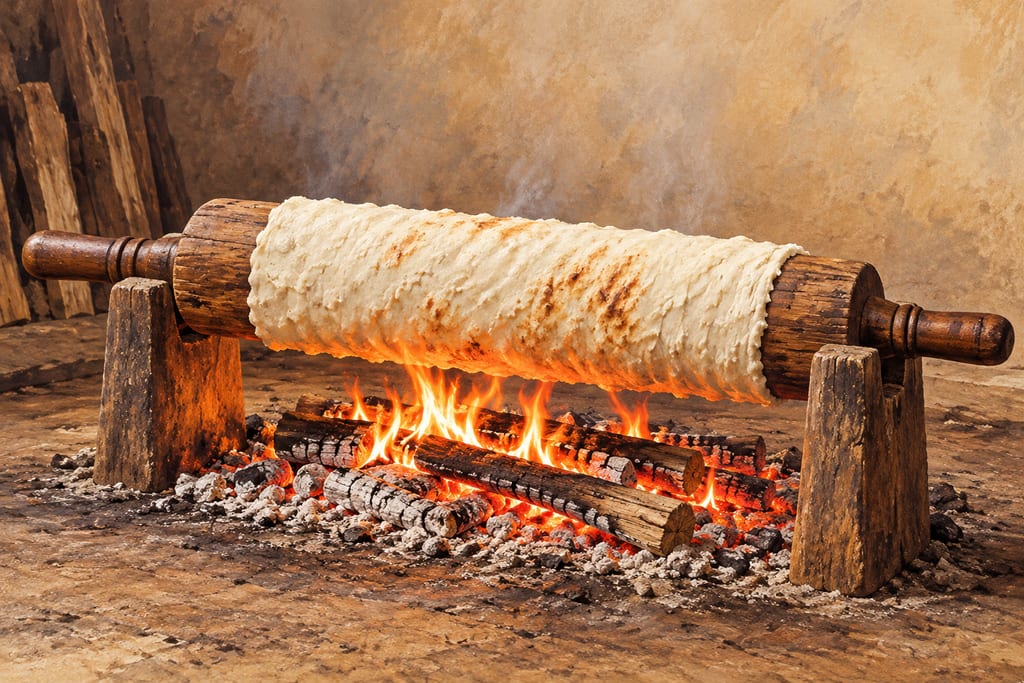
The palo chochoquero is a long wooden roller used to cook chochoca, a Chilote potato preparation. The name distinguishes the implement from a flat griddle: the dough is spread around the wood, and the roller turns above a hearth. As it rotates, the exposed dough browns in place, so the pole is both support and cooking surface.
In Cochrane, Enedina Rain described how her mother brought family cooking learned in Chiloé to Aysén. She called the palo a very large wooden uslero, or rolling pin. A museum photo sequence from Calen, Dalcahue, shows a cook pressing dough onto the upright pole, then cooking and removing the finished layer. Together, the accounts show the same tool at preparation and cooking stages without establishing a single standard design.
Rain’s family method begins with a thick potato dough. In the recorded version, two kilograms of potatoes are divided between boiled potatoes and raw potatoes that are grated and squeezed; the cooked portion is mashed and combined with the raw portion. That formula belongs to this account and should not be treated as the only chochoca dough.
Pieces of dough are pressed around the roller until its working surface is covered. Two handles, or manillas, rest on caballetes above the fogón so the pole can turn while the dough faces the heat. The cook rotates it slowly, turning the surface until it is golden and crisp. The account gives no standard roller length, diameter, wood species, support material or fixed distance from the fire.
The museum’s photographs are captioned in Calen, Dalcahue, on Chiloé in October 2017. The field account follows a family practice from Chiloé to Cochrane in Aysén. These records support a local association with Chiloé and a specific documented continuation in Aysén; they do not establish where the tool was invented or how widely it is used elsewhere.
No cited account dates the first use of the palo chochoquero. The sources also do not identify a standard wood, measure a typical roller, describe its maintenance, or provide general instructions for building hearth supports. The illustration is generated editorial art based on the inspected museum photographs and written account, not a historical photograph or construction plan.
The account of Enedina Rain in Cochrane describes her mother's Chiloé family practice. Museum photographs document preparation and hearth cooking in Calen, Dalcahue, in 2017.
The described roller and its dough are cooked over a fogón; the account gives no flame spacing or fire-management instructions.
Hazard sourceNo wood species, standard diameter or standard length is given; the photographs are not a scale reference.
Source →No general fire spacing, support construction or load rating is established by the field account.
Source →The museum documents chochoca on a palo chochoquero in Calen, Dalcahue. This supports local use, not an exact invention place or date.
The account records a Chiloé-derived family practice in Cochrane; it does not relocate the tradition's origin to Aysén.
Concrete wine tanks are heavy, fixed vessels in rectangular, cylindrical and tapered forms. Their thermal response and wine contact depend on mix, wall construction and interior finish.
No community contributions have been published for this entry yet.
Sign in to contribute. Published comments and photos are free to read.
Fundación para la Innovación Agraria (FIA), Chilean Ministry of AgricultureHistory · Form · Method · Geography · Dimensions · Materials · Safety
Patrimonio alimentario de Chile: Productos y preparaciones de la región de AysénA field account records Enedina Rain's family practice in Cochrane and says her mother came from Chiloé.
The implement is described as a very large wooden uslero; the account gives no wood species or dimensions.
For that family version, two handles rest on caballetes so the dough-coated pole can turn over the fogón; it is turned slowly until the surface is golden and crisp.
The family recipe uses two kilograms of potatoes, half boiled and half raw, grated and squeezed; this is one version, not a general equipment specification.
Cited in: A wooden roller that becomes the cooking surface; Loading and turning the pole; A Chilote practice documented in two regions
Museo Regional de Ancud, Servicio Nacional del Patrimonio CulturalForm · Use · Geography · Image reference
Preparaciones a base de papaThe museum documents potato preparations as local heritage of Chiloé.
Photographs captioned Calen (Dalcahue), October 2017 show dough being placed on a palo chochoquero, chochoca cooking on it, and its removal.
The page credits the photographs to Juan Pablo Turén; it does not state reuse terms for the images.
Cited in: A wooden roller that becomes the cooking surface; A Chilote practice documented in two regions