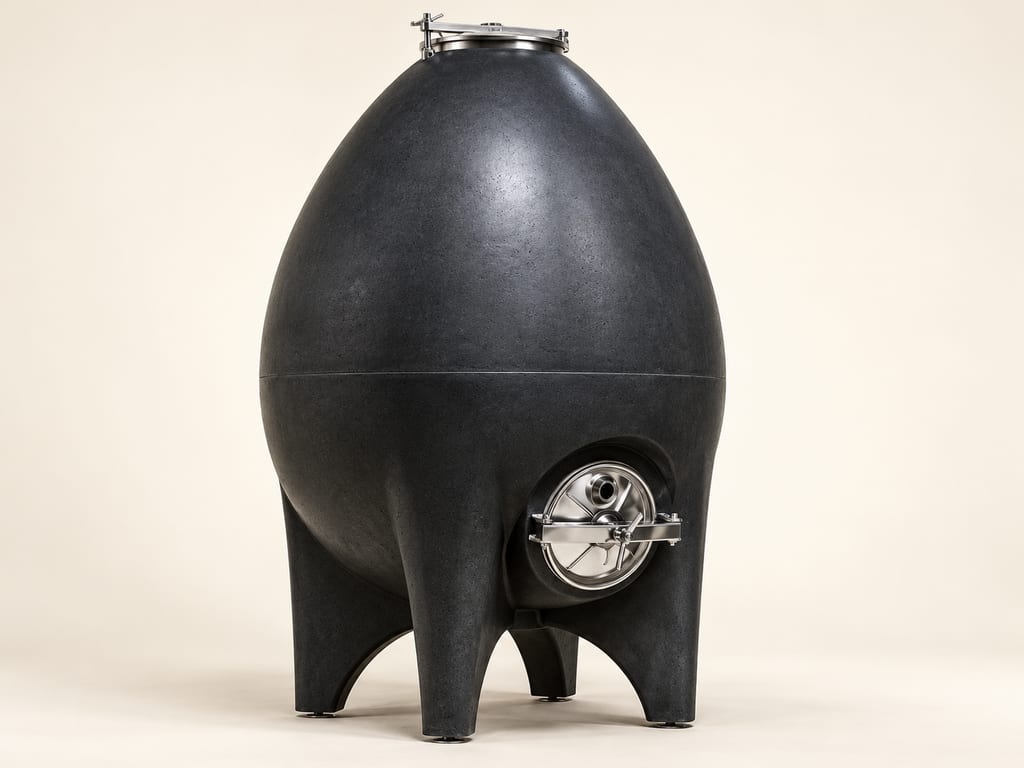
Concrete egg
A modern ovoid concrete wine vat with smooth curved walls, made in several sizes and fitted according to model. Used for wine fermentation and maturation; support, access, cooling and interior treatment vary.
 FermenteaWhere food goes to change
Equipment · Tanks and vats
concrete vat · cement wine vat
Concrete wine tanks are heavy, fixed vessels in rectangular, cylindrical and tapered forms. Their thermal response and wine contact depend on mix, wall construction and interior finish.
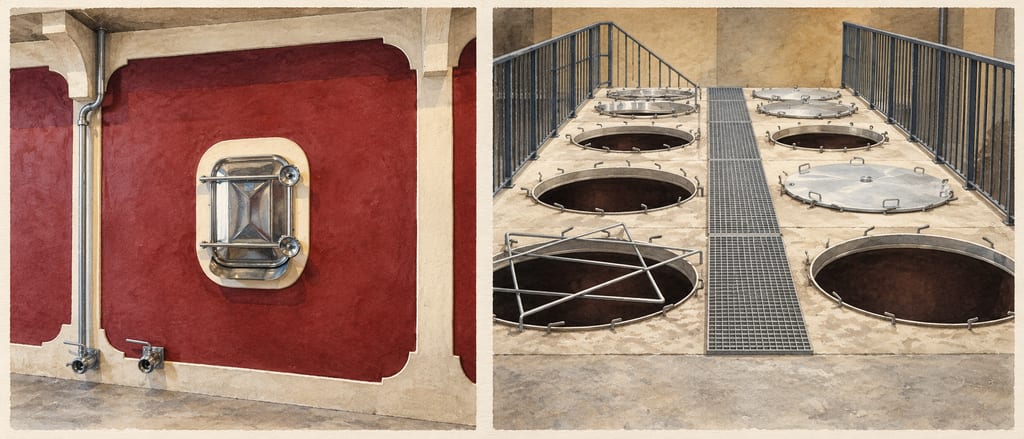
A concrete wine tank is made as a heavy, fixed-in-place object rather than a small cellar jar. Documented forms range from rectangular compartments to freestanding cylindrical or tapered vats. A 2009 photograph from Maury shows broad concrete rims and open tank tops; a Pomerol photograph shows a large tank face with stainless access and fittings. Those images document particular wineries, not one standard design.
Today, manufacturers cast or prefabricate reinforced-concrete vats and offer model-specific forms, manholes, ports and optional internal finishes. The material is substantial, so installing one involves cellar space, access and structural planning. Concrete tanks can be used for fermentation or maturation, but the tank's precise design and fittings determine how it is operated.
The label covers several designs. A maker's catalogue, for example, separates rectangular parallelepiped, cylindrical, truncated-pyramid and truncated-cone vats. Oval concrete vessels are another documented form used in research, but the distinct concrete egg is covered separately in this equipment catalogue. The shape names therefore describe examples, not a complete worldwide typology.
Capacity is similarly model-specific. Nico Velo publishes a 10–300 hectolitre range for its Quadra parallelepiped line. That tells a reader how large one manufacturer's range is; it does not set the limits of concrete tanks generally. The same maker offers standard and custom models, with optional temperature control and different interior treatments.
Concrete has high thermal inertia, so its mass can soften temperature changes around fermenting wine. That does not make every tank self-regulating: cellar conditions, wall design and any integrated control system still matter. Concrete composition also varies by manufacturer, and an interior finish changes the surface the wine meets.
Concrete is not automatically inert or uniformly porous. Laboratory work found that tested concrete could resist liquid passage while still allowing oxygen transmission; formulation, pore structure and coating altered that transfer. In one triplicate Sauvignon Blanc study, wine held in the oval concrete vessels had the highest pH and lowest titratable acidity among the tested vessel types. The researchers linked the result to inorganic compounds released from those tank walls, so it should not be generalized to other vats.
A concrete-vat cellar at Celler Cooperatiu d'Igualada in Catalonia was built in 1921–1922, and a photograph identifies its original reinforced-cement vat lids. This is a dated example, not evidence that Igualada invented concrete wine tanks or that modern designs descend unchanged from ancient masonry vessels. Manufacturer records and winery photographs show concrete tanks still in use in several regions.
The evidence does not establish one concrete recipe, wall thickness, coating, capacity or cleaning protocol for all tanks. Some products offer epoxy or cement-based interiors, and these finishes can change contact and oxygen-transfer behavior. Commissioning and cleaning should follow the specification for the actual tank and liner; laboratory permeability procedures are not a winery care manual.
An Igualada cooperative cellar built in 1921–1922 contains original reinforced-cement wine vats. This attests use by that date, not an origin or an unbroken line from ancient masonry vats.
Concrete composition and interior coating affect liquid contact and oxygen transmission; tested porous concrete or untreated surfaces may require treatment to prevent liquid passage. A coating can change oxygen transfer substantially.
Source →The higher pH and lower titratable acidity reported for concrete-fermented Sauvignon Blanc came from a particular replicated trial; it is not a guaranteed result for other tanks or wines.
Source →A photo documents an inscription on one original cement-vat lid at the Celler Cooperatiu d'Igualada; it records this cellar, not the tank type's place of origin.
The file identifies concrete fermentors at Calvet-Thunevin winery in Maury; the image shows broad upper edges and openings.
The file identifies a fermentation tank at Château Gazin in Pomerol; it is one producer's example.
The study reports that juice from Leyda Valley grapes was fermented in triplicate oval concrete vessels at Miguel Torres Winery in Maule, Curicó, among other vessel types.
Nico Velo documents production of concrete wine vats in Fontaniva; this is a manufacturer's location, not an origin claim for all such tanks.
A modern ovoid concrete wine vat with smooth curved walls, made in several sizes and fitted according to model. Used for wine fermentation and maturation; support, access, cooling and interior treatment vary.
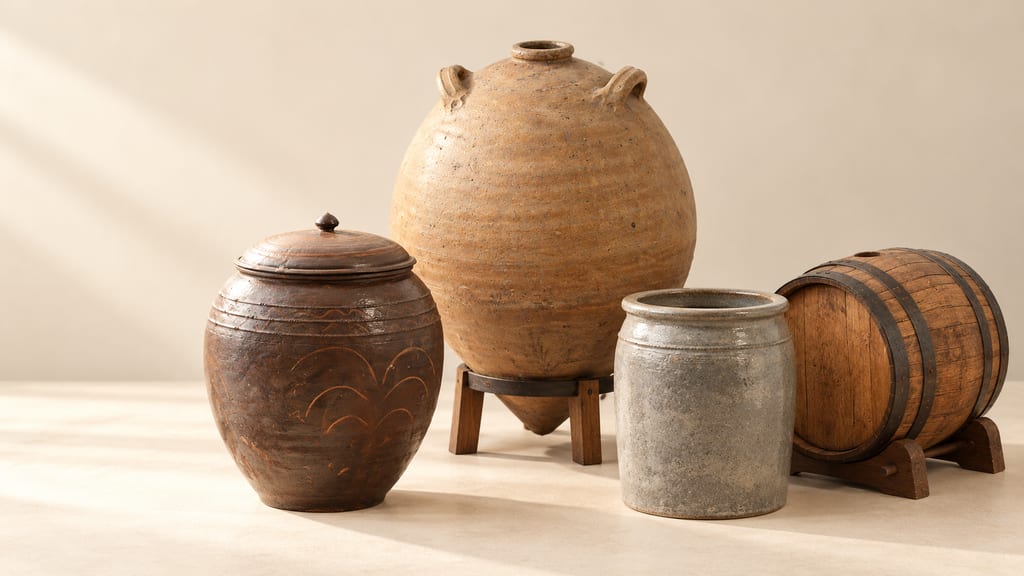
Jars, barrels, skins, leaves, pits and whole rooms decide much of what happens to fermented and cured food. This is how a container works on its contents, and how people in different places chose theirs.
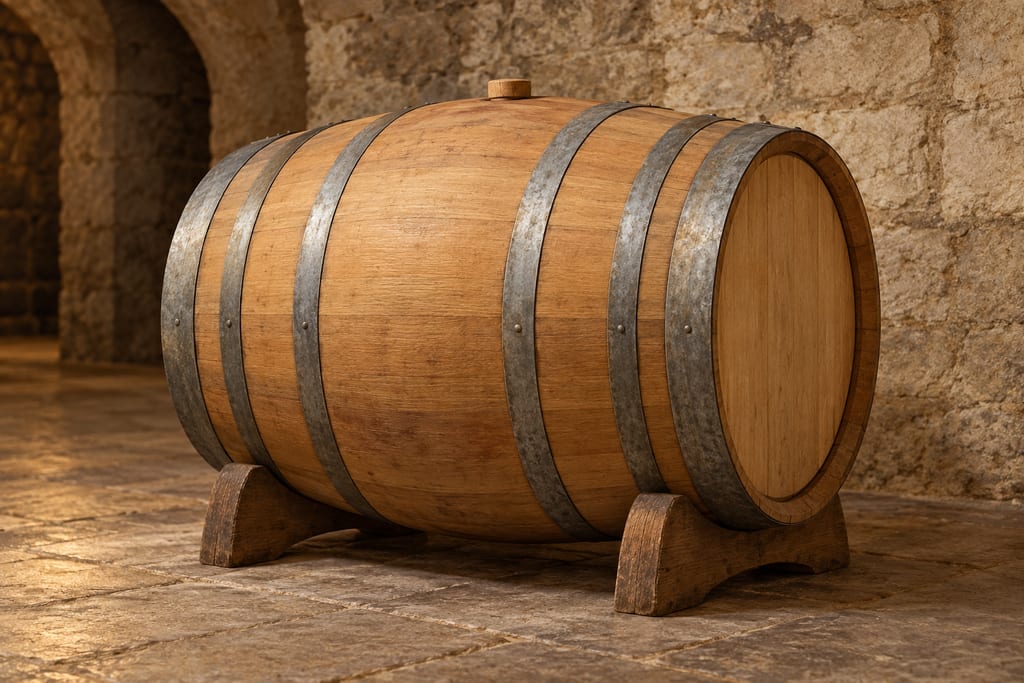
Coopered vessels use shaped staves and hoops, but portable barrels, large foeders and upright wooden vats serve different roles. Materials and uses vary by place and process.
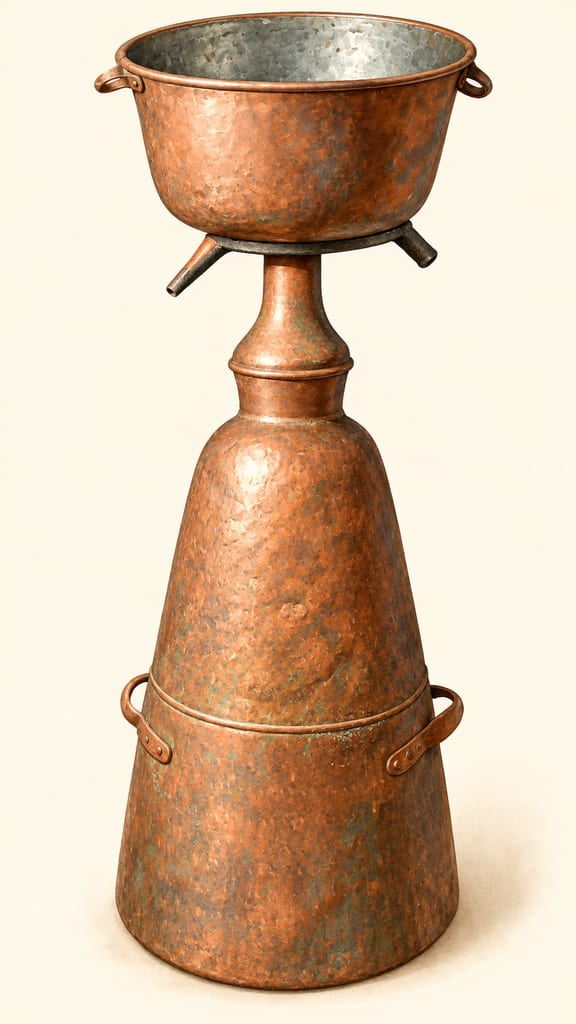
A traditional Galician direct-fire pomace still: its copper pot and cap condense vapour in a water-cooled chamber, then send the distillate through a short biqueira.
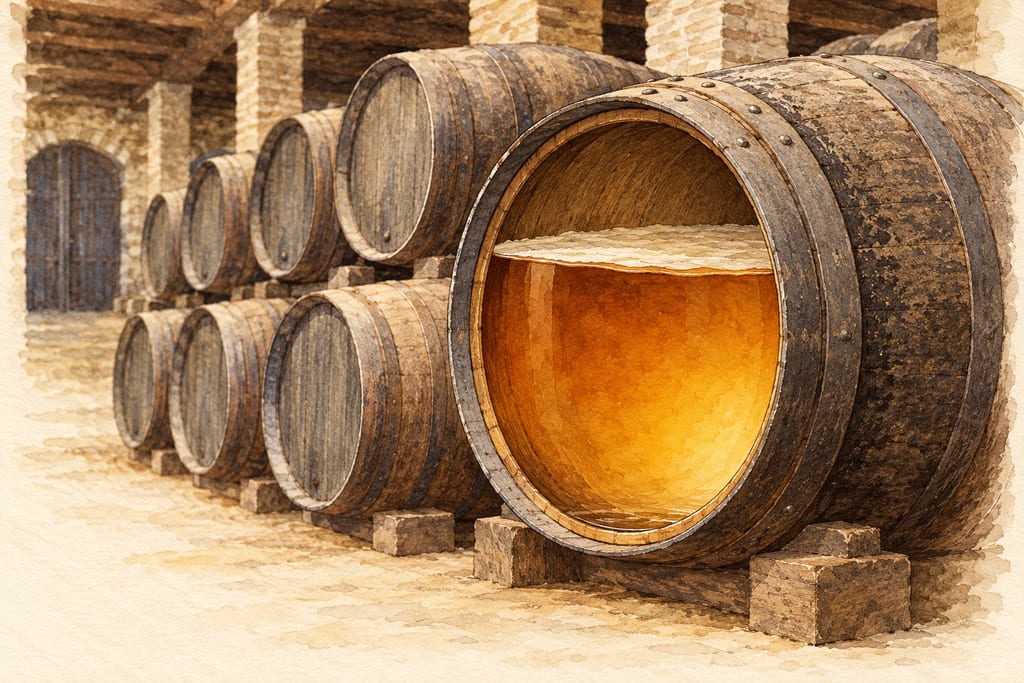
A Jerez bota is a coopered oak butt used for wine ageing. In a criaderas-and-solera array, butts at successive ages are arranged in scales and partly drawn and replenished; the bota's capacity and fill depend on the documented system.
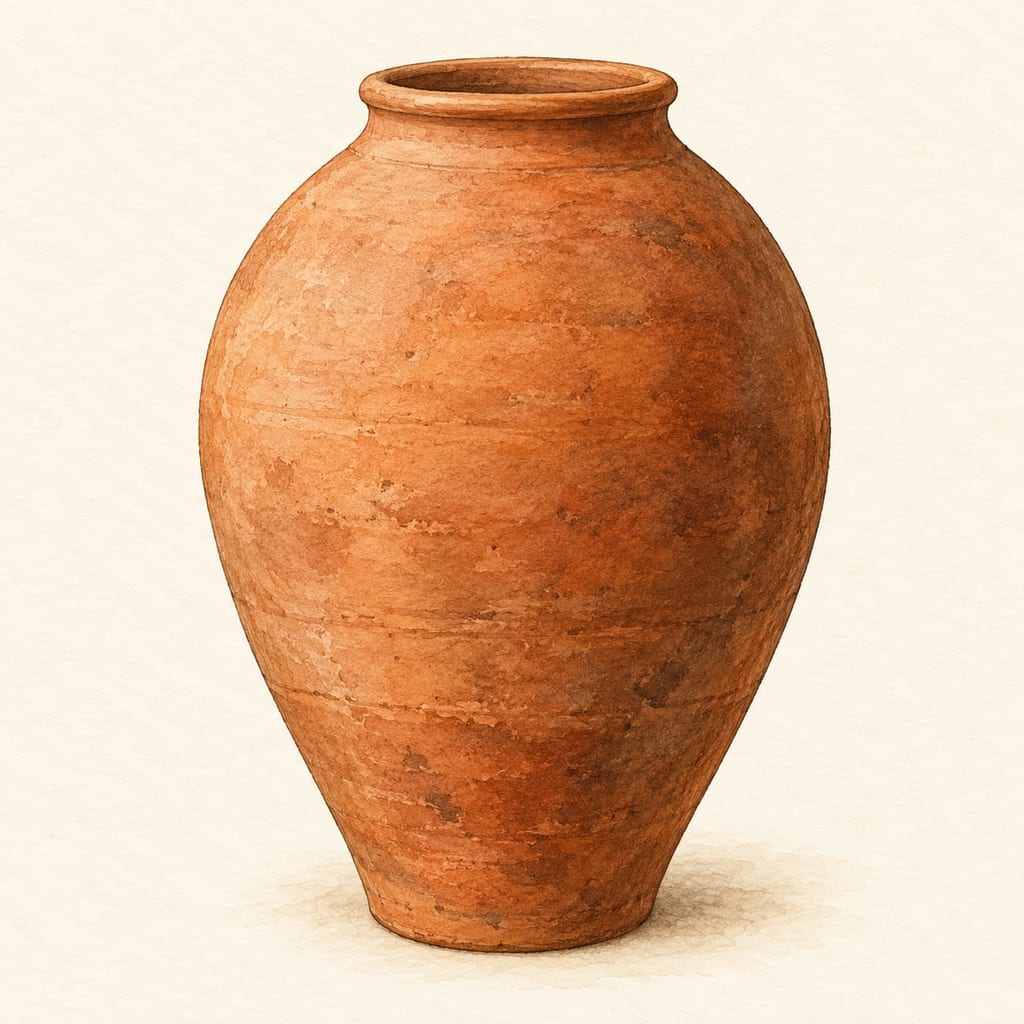
A tinaja is a fired-clay jar used in Spain for wine making and storage, with a particularly well-documented hand-building tradition in La Mancha. Sizes range from domestic vessels to monumental winery jars.

Soft, spreadable Calabrian pork sausage made with a great deal of red chilli and fatty pork, stuffed into natural casings, sometimes smoked and matured while staying soft.

A way to add independent temperature logging to an existing food dehydrator without changing its built-in controls or protections. It is a monitoring method, not a rewiring plan.

Pleurotus cystidiosus is the abalone mushroom, a cultivated oyster-type fungus with dark brown caps that grows more slowly and is more demanding than other Pleurotus species.

A dark, balanced vinegar from Emilia-Romagna made by combining cooked or concentrated grape must with wine vinegar, then acetifying and refining it in wood under a protected specification.

A living dairy inoculum that starts controlled cream fermentation, developing acidity and aroma before sour cream or cultured butter is finished.

A small electric incubator holds jars at a selected temperature for yogurt and other documented warm food preparations. Controls, capacity and vessel arrangement vary by model.

Adygean salt is a seasoned table salt associated with Adygea and the wider North Caucasian culinary tradition. Salt is blended with garlic and a variable selection of herbs and spices; the exact mix depends on the named style and maker.

The African Caesar-group mushroom, Amanita masasiensis, is a wild ectomycorrhizal species of central and southern African woodlands, eaten locally. The genus contains deadly poisonous species, so identification needs care.
No community contributions have been published for this entry yet.
Sign in to contribute. Published comments and photos are free to read.
Molecules 26(3), article 554 (2021)Documented use · Materials · Wine chemistry · Geography
Chemical and Physical Implications of the Use of Alternative Vessels to Oak Barrels during the Production of White WinesThe study fermented and aged the same Sauvignon Blanc juice in triplicate cylindrical stainless tanks, oval concrete vessels, oval polyethylene vessels and clay jars.
The wines from concrete vessels had the highest pH and lowest titratable acidity in this trial, likely related to inorganic compounds released from concrete; this is study-specific.
Grapes came from Leyda Valley, Chile, and the trial took place at Miguel Torres Winery in Curicó, Maule.
Cited in: A family of shapes, not one universal tank; Thermal mass and contact chemistry depend on the build
Foods 10(1), article 140 (2021)Materials · Contact properties · Limits
Characterization of the Oxygen Transmission Rate of New-Ancient Natural Materials for Wine Maturation ContainersConcrete tank materials differ by manufacturer and are produced with molds and interior/exterior finishes.
Concrete samples can be impermeable to liquid while permitting oxygen passage; porosity, concrete formulation and coatings affect oxygen transfer.
The authors caution that actual oxygen-transfer behavior must be measured under conditions resembling vessel use.
Cited in: Thermal mass and contact chemistry depend on the build; What the historical record and care sources support
Nico Velo S.p.A.Manufacture · History · Materials
CompanyThe manufacturer says it was founded in Fontaniva in 1943 and began producing cement tanks for water and wine.
It reports a series of monolithic vats for a French winery in 2009, several current vat forms, and optional epoxy or cement-based interior finishes.
Cited in: Concrete is a structure as well as a vessel; What the historical record and care sources support
Nico Velo S.p.A.Form · Materials · Acquisition
Products: concrete wine vatsThe manufacturer offers rectangular, cylindrical, truncated-pyramid and truncated-cone designs as distinct models; these describe one maker's catalogue, not a universal standard.
Cited in: Concrete is a structure as well as a vessel; A family of shapes, not one universal tank
Nico Velo S.p.A.Capacity · Dimensions · Form
Quadra parallelepiped vatsNico Velo lists Quadra parallelepiped vats from 10 to 300 hectolitres with model-specific dimensions and weights; this range is not general to all concrete tanks.
Cited in: A family of shapes, not one universal tank
Wikimedia Commons; photograph by Ryan O'ConnellVisual reference · Form · Geography
File:Concrete fermentors at Calvet-Thunevin winery in Maury.jpgThe file identifies concrete fermentors at Calvet-Thunevin winery in Maury and is dated 25 December 2009; it shows large concrete tank tops with broad rims and access openings.
The file page states CC BY-SA 2.0.
Cited in: Concrete is a structure as well as a vessel; What the historical record and care sources support
Wikimedia Commons; photograph by Antoine BertierVisual reference · Form · Geography
File:Château Gazin fermentation tank.jpgThe file identifies a concrete fermentation tank at Château Gazin in Pomerol, photographed 15 January 2010; the photograph shows a rectangular tank face with a stainless access door and lower fittings.
The file page states CC BY 2.0.
Cited in: Concrete is a structure as well as a vessel; What the historical record and care sources support
Wikimedia Commons; photograph by JordiferrerHistorical attestation · Materials · Geography
File:V2016 - Celler Cooperatiu d'Igualada 09 Inscripció en una tina.jpgThe page says the Celler Cooperatiu d'Igualada was built in 1921–1922 and that the photographed inscription is on an original 1922 reinforced-cement vat lid.
The file page states CC BY-SA 4.0.
Cited in: What the historical record and care sources support