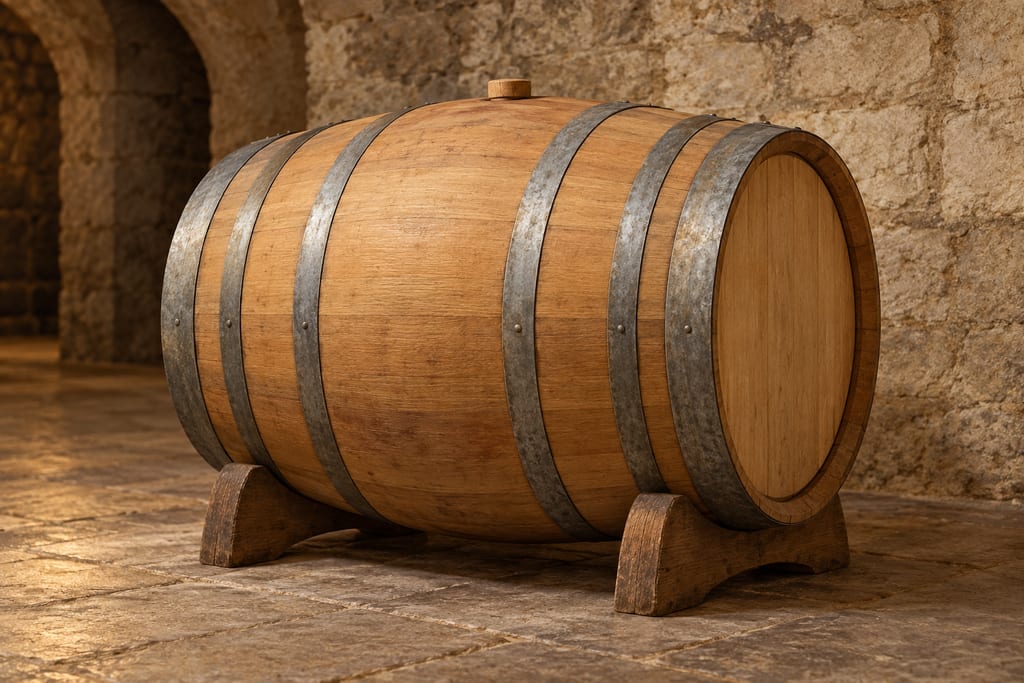
Coopered barrel, cask and large wooden vat
Coopered vessels use shaped staves and hoops, but portable barrels, large foeders and upright wooden vats serve different roles. Materials and uses vary by place and process.
 FermenteaWhere food goes to change
Equipment · Barrels and casks
A Jerez bota is a coopered oak butt used for wine ageing. In a criaderas-and-solera array, butts at successive ages are arranged in scales and partly drawn and replenished; the bota's capacity and fill depend on the documented system.
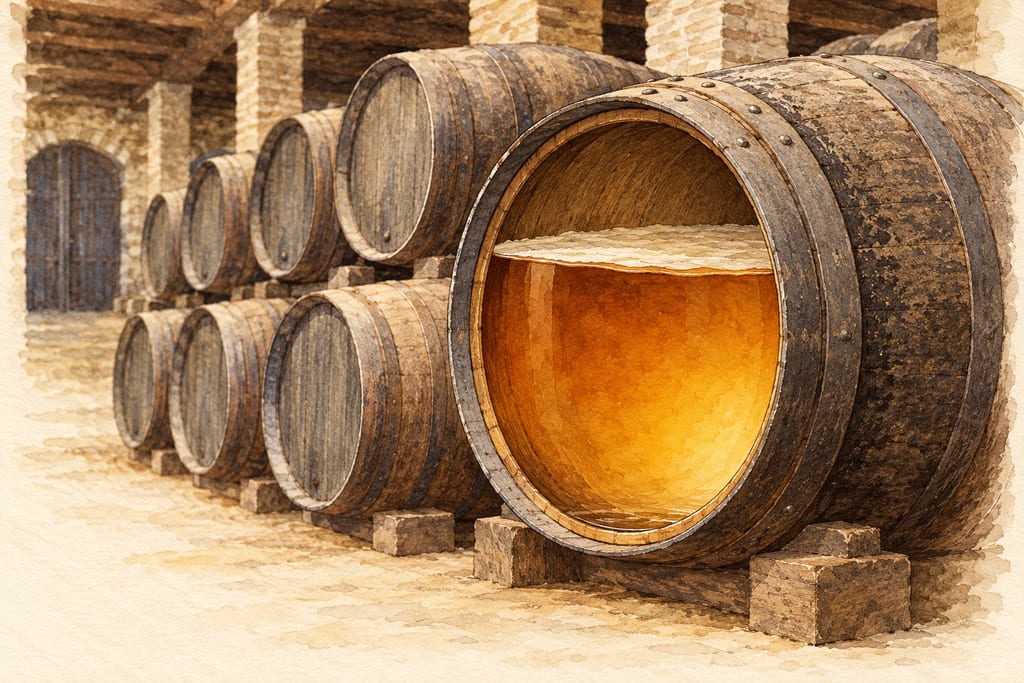
Bota is the traditional name in the Jerez area for the oak barrel used to mature protected wines. The 2022 consolidated DOP specification sets a maximum of 1,000 litres for the standard ageing bota, while allowing larger historically recognised exceptions. The Consejo Regulador describes an American-oak bodega butt of 600 litres as the most common present-day form. That variety of sizes matters: a solera is a working cellar system, not a row of one universally sized barrel.
The Council's account describes a longer history in which ceramic jars and amphorae preceded wooden casks. It places wooden shipping casks in Jerez from the Middle Ages and says their transport advantages later led to use for storage and ageing. The cited description does not give a first date for the particular bota form or the solera array, so this record leaves their earliest attestation unknown.
For biological ageing, the Council reports filling a common 600-litre bota to about 500 litres, leaving an air space above the wine. A thin living veil of flor develops at the wine's surface. The headspace and exposed surface therefore have a practical role in this particular cellar method; the bota is not simply filled to its brim like a transport vessel. The illustration's cutaway shows this relationship as an interpretive view, not a preserved transparent cask.
The same barrel can take part in a different kind of ageing. Biological ageing proceeds beneath flor, while oxidative ageing takes place without the veil and with direct exposure to air. The DOP specification recognizes both systems and also permits ageing by vintage without mixing different harvest years. It would be inaccurate to present every Sherry bota as a flor vessel or every Sherry wine as a solera wine.
A criaderas-and-solera system groups botas into scales according to the wine's relative age. The oldest scale, the solera, stands at floor level; progressively younger criaderas sit above it. The exact number of scales and casks varies, and the official description does not prescribe one universal stack. A photograph of a bodega can show real casks, but one cellar's layout is not a blueprint for every solera.
At intervals, workers withdraw part of the wine from the solera in a saca. The space is replenished with wine drawn from the next younger scale; that scale is then replenished from the one above it, continuing toward the youngest wine. These additions are called rocíos. The system continually combines wine from different stages rather than emptying and restarting each cask as a separate annual batch. The sequence is managed across the array, so the linked recipe identifies the specific flor-ageing preparation rather than a generic wooden barrel method.
The Council describes careful transfers as important to maintaining the system: workers seek to mix wine after replenishment without disturbing the flor veil or fine deposits that settle in the cask. These are skilled cellar operations, not a claim that the equipment itself carries out the transfers automatically.
The Consejo Regulador describes the wooden butt as permeable rather than inert: oxygen can pass through wood, and water evaporates from the wine over time. It reports that the familiar 600-litre American-oak bota is wine-seasoned before use and explains that bodega humidity affects the rate of volume loss. These observations connect the cask with its cellar environment, but they do not specify a universal wood species for every historical butt or a single maintenance routine.
The official linked bota photograph and the Commons cellar image ground the visible materials and horizontal, hoop-bound arrangement. The Commons photograph is credited to Falkue and licensed CC BY-SA 3.0 and GFDL; it remains a link to the source rather than media Fermentea owns. The generated watercolor combines those references into a clearly interpretive two-tier cutaway: its apparent row length, cellar wall and cut-open barrel are explanatory, not a claim about a named bodega or a particular historical specimen.
The consolidated DOP specification defines the Jerez production area through named municipalities and gives a smaller wine-ageing zone, principally Jerez de la Frontera, El Puerto de Santa María and Sanlúcar de Barrameda. It also makes an allowance for some Moscatel ageing in Chipiona and Chiclana. This regional record uses Marco de Jerez as its location; it does not attribute a particular bota to a single town or maker.
The Council describes criaderas and solera as the characteristic dynamic system in Jerez and specifically connects it with biological ageing, while the specification also recognizes oxidative ageing and vintage-based storage. The linked recipe is a candidate entry for Sherry's biological flor ageing. The equipment relationship records the documented connection to that preparation, not a claim that all wine from the region follows one identical process.
The Consejo Regulador's account describes ceramic vessels in earlier Sherry history and the use of wooden casks from the Middle Ages for transport and later storage or ageing. This does not date the first bota or the origin of the criaderas-and-solera system.
The 600-litre common butt and 500-litre flor fill are Council descriptions of a widespread bodega form, not exact dimensions or capacities for every cask in every solera.
Source →The 2022 DOP specification caps standard ageing botas at 1,000 litres but allows verified historic exceptions. It does not establish that all Sherry uses the solera system or that all ageing occurs under flor.
Source →The external cellar photograph shows a particular bodega arrangement; it does not establish a required number of tiers, butts, supports or a universal room layout. The generated cutaway is interpretive and is not an identified historic artifact.
Source →This is a regional association with Sherry ageing, not all casks or wineries in Andalusia.
Coopered vessels use shaped staves and hoops, but portable barrels, large foeders and upright wooden vats serve different roles. Materials and uses vary by place and process.
No community contributions have been published for this entry yet.
Sign in to contribute. Published comments and photos are free to read.
Consejo Regulador of the Sherry Denominations, Sherry WinesForm · Materials · Capacity · Use · History · Ageing · Cellar context
Ageing | ProductionThe Council describes a common American-oak bodega butt as 600 litres, typically filled to 500 litres for biological ageing to leave a headspace for flor; many other cask types, capacities and woods have been used.
The Council describes criaderas and solera as tiers of butts holding wines at successive ages, with partial saca withdrawals and rocío replenishments from the next younger tier; it states the system is traditional and used to support biological ageing, while oxidative ageing can also be static.
The Council describes wood permeability, air exposure, evaporation and cellar conditions, and gives a medieval horizon for wooden transport casks becoming storage or ageing vessels after earlier ceramic vessels.
Cited in: The bota: a wooden butt with a regional name; Air space and the veil of flor; Scales of younger and older wine; Wood, bodega and limits of the image; A method tied to the Marco de Jerez
Consejería de Agricultura, Pesca, Agua y Desarrollo Rural; Consejo Regulador de las Denominaciones de Origen del Marco de JerezDefinition · Equipment capacity · Process · Geography · Limits
Pliego de condiciones de la Denominación de Origen Protegida Jerez-Xérès-Sherry (consolidated following the Order of 4 October 2022)The consolidated specification defines botas as oak barrels with capacity no greater than 1,000 litres, subject to a verified historical exception, and describes criaderas-and-solera as partial withdrawals and replenishments between scales of different ages.
The Jerez ageing zone is defined through named municipalities rather than all of Spain or all of Andalusia; the document also defines the delimited production area and its relation to the Marco de Jerez.
It distinguishes biological ageing under a surface veil of flor from oxidative ageing without that veil, and recognizes both criaderas-and-solera and vintage ('añadas') systems.
Cited in: The bota: a wooden butt with a regional name; Air space and the veil of flor; Scales of younger and older wine; A method tied to the Marco de Jerez
Wikimedia CommonsHistorical visual reference · Array form
Sherry cellar, Solera system 2, 2003.jpgThe Commons file page captions the photograph as a cellar with Sherry casks and records Falkue as photographer; the category and file record place it among Jerez Sherry wineries and barrels.
The page lists CC BY-SA 3.0 and GNU Free Documentation License; the image is linked externally and is not copied into the public item as owned media.
Cited in: Wood, bodega and limits of the image