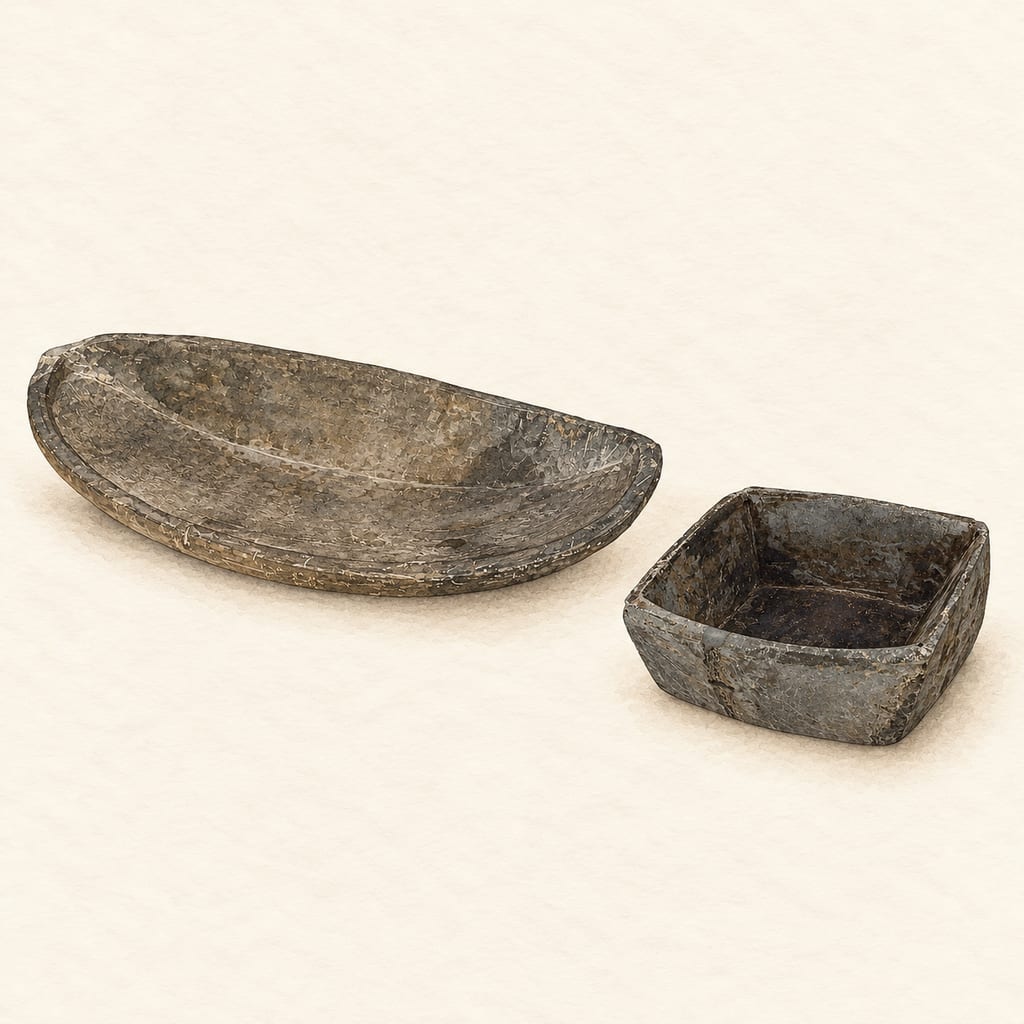
Qulliq and ukkusik
A qulliq oil lamp and a separate ukkusik cooking pot form an Inuit heat-processing pair. Sources document soapstone forms, animal-oil lighting and cooking uses, and museum objects from the Eastern Arctic.
 FermenteaWhere food goes to change
Equipment · Skins and bladders
kiviaq seal-skin bag · kiviak pouch
At Siorapaluk in northwestern Greenland, a seal hide is documented as a flexible, sewn vessel for kiviaq. Local accounts show the pouch made from a whole skin and buried beneath stones; its dimensions and capacity are not recorded.
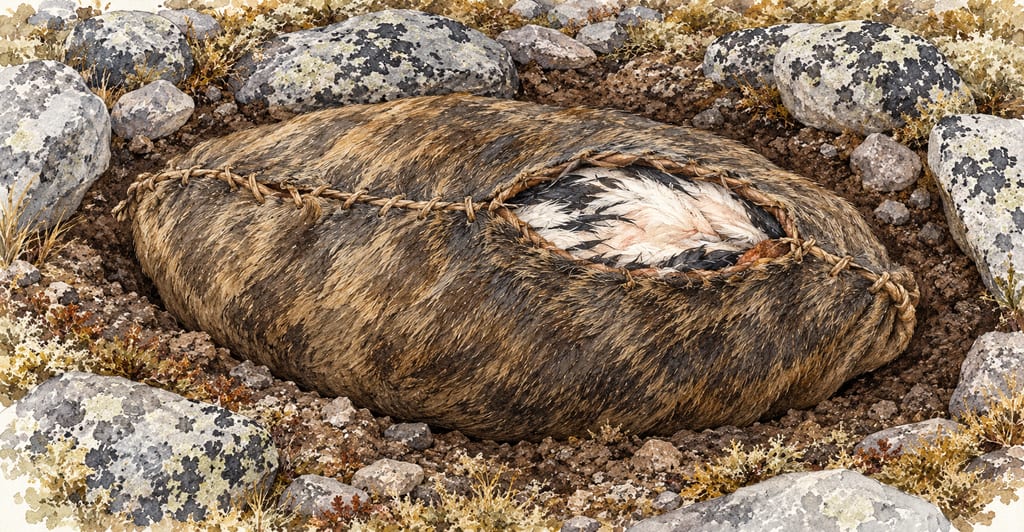
The kiviaq pouch documented at Siorapaluk is a flexible seal-hide enclosure, not a seal stomach or intestinal casing. In the local account, a whole skin is emptied of its head, tail, limbs and internal organs, leaving a hide that can be filled and sewn. This makes a broad, soft bag whose size follows the harvested skin rather than a standard manufactured shape.
The hide is the vessel wall. Thick thread joins openings at the former limb positions, while seal blubber is described around the sewn openings. The accounts give no pattern, seam measurements, exact closure design, dimensions or measured capacity. A single described pouch therefore cannot establish a universal Inuit or Greenlandic template.
The most specific documentation here comes from Siorapaluk in northwestern Greenland. A Visit Greenland account follows a named local maker preparing kiviaq and records one pouch made for that occasion. Its size determined how many little auks it held, and once filled it was heavy enough for two adults to carry. That observation conveys the scale and flexibility of the hide vessel without turning one maker's batch into a standard capacity.
Aviaja Lyberth Hauptmann also describes a Siorapaluk kiviaq and discusses the hide as a vessel for seabirds. The accounts support the same basic form while preserving local specificity; they do not establish one design for every community or occasion. Hauptmann's sewing example uses guillemot (appa); she distinguishes appa kiviaq from little-auk appaliearsuk kiviaq, so the pouch is not specific to one seabird.
After filling and sewing, the pouch is documented beneath stones. Hauptmann describes it placed in a very shallow pit in the ground, with the sewn areas covered in seal blubber and rocks above. The Visit Greenland account likewise records a filled bag buried under stones. The hide pouch remains a portable object; the ground feature is a separate, site-made part of the arrangement.
The accounts give no standard depth, stone layout, soil profile or measured size. They support the relationship between the hide vessel, ground and stones, not a fixed excavation plan. One photograph also shows the stuffed hide resting on a modern crate; that support is not part of the described traditional pouch.
The documented pouch is sized by its hide, and the reported number of birds varies with that skin's size. No capacity in litres, dimensions, maker's specification, current buying route or care instructions are given. The accounts describe a specific North Greenlandic use and do not establish that all Inuit communities make kiviaq in the same way.
The cited Siorapaluk accounts describe this hide pouch as the vessel used to prepare kiviaq. This page describes the pouch as equipment and does not turn a local account into a general preparation guide.
Contemporary local accounts document this vessel in Siorapaluk but do not establish when the practice began.
Both sources describe kiviaq practice in Siorapaluk; locality is documented use, not universal origin.
A qulliq oil lamp and a separate ukkusik cooking pot form an Inuit heat-processing pair. Sources document soapstone forms, animal-oil lighting and cooking uses, and museum objects from the Eastern Arctic.
No community contributions have been published for this entry yet.
Sign in to contribute. Published comments and photos are free to read.
Visit GreenlandHistory · Form · Use · Geography
Discover Siorapaluk: Greenland’s northernmost settlement and the traditional delicacy KiviaqA named Siorapaluk account describes seal skin transformed into a bag after the head, tail, limbs and internal organs are removed.
The hide bag's size determines the number of little auks it can hold; a particular bag in the account was heavy enough for two adults to carry.
The account describes thick thread sewing, seal blubber around the sewn openings, and a filled pouch buried under stones.
Cited in: A whole hide made into a vessel; The Siorapaluk record; A portable pouch in a shallow burial; Scale and practical limits
FermentologyHistory · Form · Use · Imagery
Inuit Fermentation: Animal-Based & ArchaicHauptmann discusses a kiviaq made in Siorapaluk using a seal skin filled with seabirds and sewn closed.
Her account describes a shallow pit in the ground, stitched parts covered in seal blubber, and rocks placed above.
The page credits kiviaq images to Daniel Hauptmann, © Aviaja Hauptmann, and states a CC BY 4.0 license.
The sewing example is guillemot (appa) kiviaq; the account distinguishes it from little-auk appaliearsuk kiviaq.
Cited in: A whole hide made into a vessel; The Siorapaluk record; A portable pouch in a shallow burial; Scale and practical limits