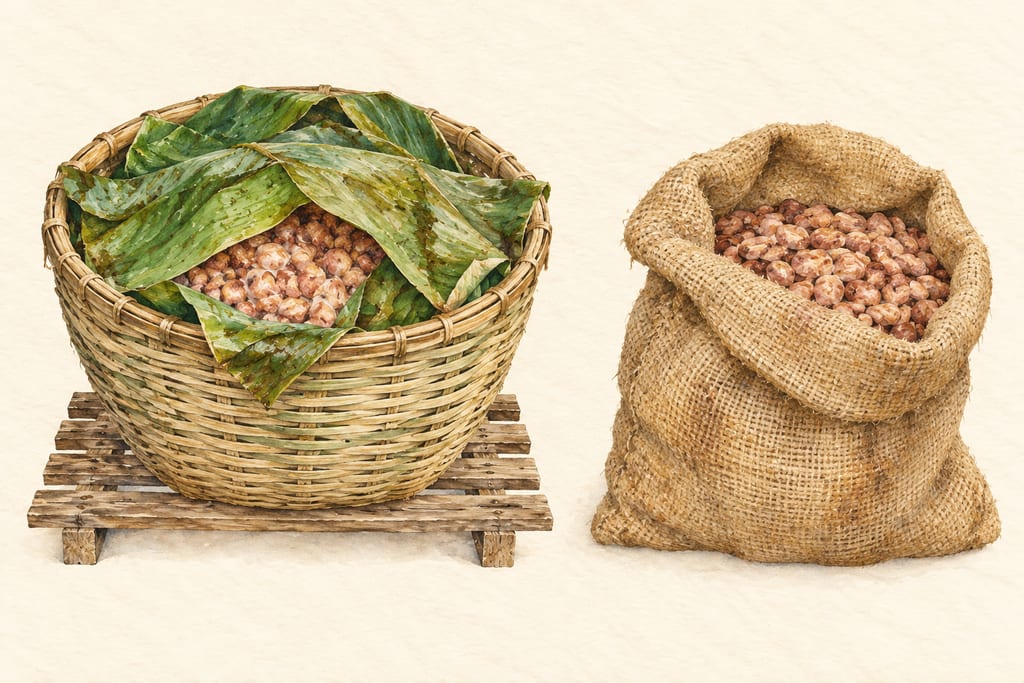
Cacao basket and jute sack
In Liberia, wet cacao is fermented in a leaf-lined woven basket; an Ecuador study documents jute sacks. These vessels differ in form and in the practices documented around them.
 FermenteaWhere food goes to change
Equipment · Jars, pots and crocks
Muits
A muits is a large Shuar clay vessel associated with chicha. The Sucumbíos life-plan gives its size and profile; sources describe both storing and fermenting chicha, but do not establish one uniform form or use across Shuar communities.
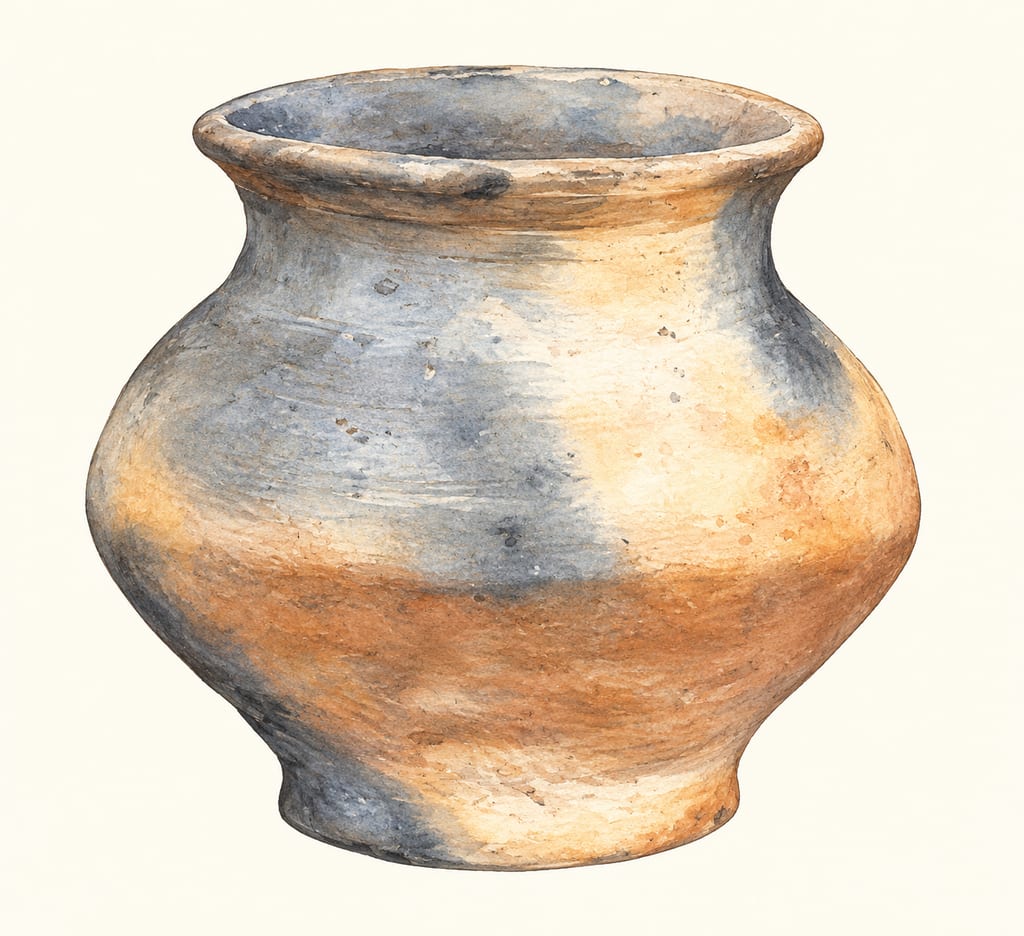
The Sucumbíos Shuar life-plan describes muits as a large clay vessel for nijiamánch (chicha). It gives a height of 45–60 cm and diameter of 50–65 cm. These are ranges, not one standard size, and no capacity is recorded. The same page illustrates a broad rounded body with sloping shoulders, a short narrower neck, and a flared lip. That is the profile of the source’s example, not evidence that every muits was identical.
The page also distinguishes muits from the ichinkian cooking pot, pinink plate, and amámuk serving bowl. It says Shuar women made pottery from nuwe, or clay, but does not specify this jar’s clay preparation, firing, surface finish, or tools.
The Sucumbíos account says muits served exclusively to store nijiamánch. A separate Ecuadorian bilingual-education volume says muits is used to ferment chicha. Neither source explains whether the same vessel moved from fermentation to storage, or how practice varied between communities. A study of cassava chicha in Morona-Santiago separately notes ceramic fermentation vessels and contemporary plastic buckets, without naming the sampled pots muits. The evidence supports a named clay vessel associated with chicha, not one universal household setup.
Muits is a named Shuar pottery form, not a generic bucket. The sources do not date its earliest use or describe cleaning, repair, food-safety limits, or how a reader might obtain one today. The generated hero is an interpretive illustration guided by the labelled Sucumbíos page image, not a photograph or identification of a particular archaeological object.
The Plan de Vida is specific to the Shuar nationality of Sucumbíos; it does not establish one uniform form across every Shuar community.
In Liberia, wet cacao is fermented in a leaf-lined woven basket; an Ecuador study documents jute sacks. These vessels differ in form and in the practices documented around them.
No community contributions have been published for this entry yet.
Sign in to contribute. Published comments and photos are free to read.
SIL Sucumbíos (document platform copy)Traditional use · Form · Dimensions · Materials
Plan de Vida de la Nacionalidad Shuar de SucumbíosThe page describes muits as a large clay vessel used exclusively to store nijiamánch (chicha), gives a height of 45–60 cm and diameter of 50–65 cm, and shows a labelled illustration of its profile.
The page describes Shuar pottery and distinguishes muits from the other named cooking and serving vessels.
Cited in: Form and scale; Storage and fermentation; A distinct ceramic vessel
Ecuadorian bilingual-intercultural education service (educacion.gob.ec)Traditional use · Fermentation use
Sabiduría de la Cultura Shuar, tomo 2Page 104 says that muits is used to ferment chicha and places it among ceramic utensils in the Shuar household.
The source does not specify the beverage substrate, dimensions, or whether its use is the same as the Sucumbíos Plan de Vida account.
Cited in: Storage and fermentation
PeerJ / PubMed CentralBeverage context · Vessel distinction
Local domestication of lactic acid bacteria via cassava beer fermentationThe study identifies Shuar cassava chicha as nijiamanch and samples households in two neighboring villages in Morona-Santiago, Ecuador.
It distinguishes traditional ceramic fermentation vessels from contemporary plastic buckets, without naming the muits or identifying the sampled vessels as muits.
Cited in: Storage and fermentation