← Equipment

Equipment · Baskets, trays and beds

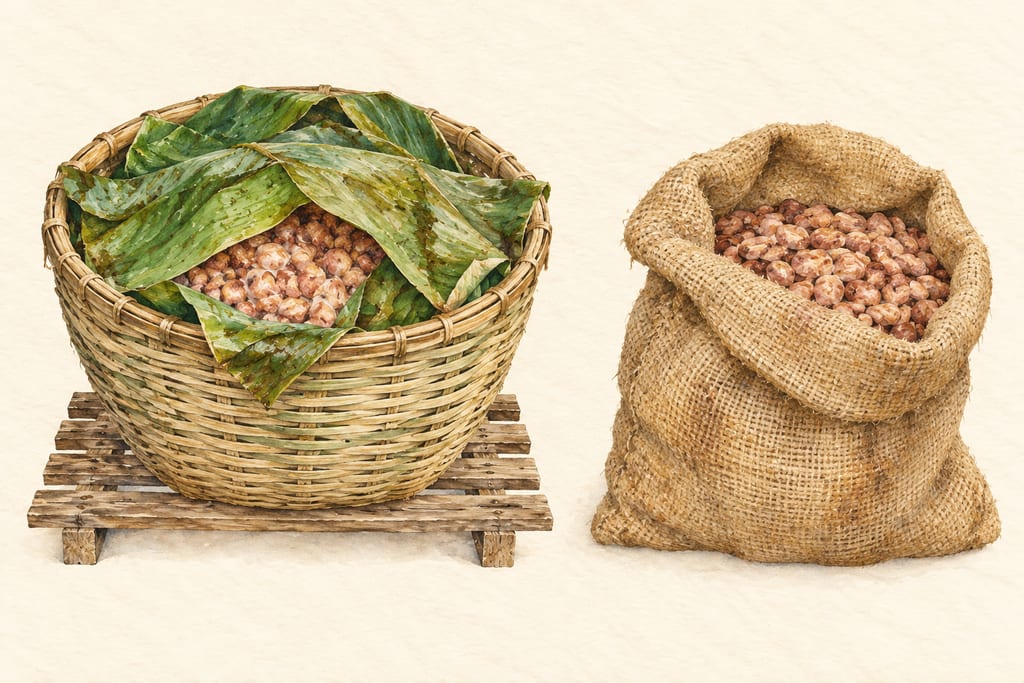
Cacao basket and jute sack

Loading ratings…

In Liberia, wet cacao is fermented in a leaf-lined woven basket; an Ecuador study documents jute sacks. These vessels differ in form and in the practices documented around them.

Watercolor comparison of a leaf-lined woven cacao basket on a wooden platform and a separate coarse jute sack.

Two different forms of fermentation vessel

This record covers two distinct receptacles for wet cacao: a woven basket and a flexible jute sack. A basket holds a shape on its own; a sack folds and bulges around its load. Their openings, drainage, heat retention and handling are not interchangeable simply because both can hold beans. Sources that describe a sack used to store or ship dried beans do not, by themselves, show that the sack was used to ferment wet beans.

The sources do not give a standard capacity or set of dimensions for either form. Local construction and batch size matter, and no single basket or sack profile can be assigned to every cacao-growing region.

Sources for this section

The leaf-lined basket documented in Liberia

A Liberia Ministry of Agriculture farmer-training manual describes basket fermentation as the most common way smallholders ferment small quantities. It names a basket made from oil-palm-frond midribs, lined with banana or plantain leaves. Wet beans are put inside; the leaf ends are folded over them and weighted with a stone or piece of wood. The basket sits on a wooden platform so liquid and pulp can drain away.

In that manual’s described schedule, the package is opened and the beans are turned and mixed on the third and fifth days, with the beans expected to be ready on the seventh day. These are the manual’s instructions for that practice, not a universal rule for every basket or harvest. A 2008 Liberian sector assessment separately records fermentation in hanging banana-leaf-covered baskets and in leaf-wrapped ground heaps, with reported durations ranging from two days to a week. The sources therefore show more than one Liberian arrangement and timing.

Sources for this section

Jute sacks in a different documented setting

Jute-bag fermentation is documented in an Ecuadorian study of cacao Nacional at locations in Manabí and Los Ríos. The study compared different post-harvest variations, including jute bags, wooden boxes and plastic bags, with different combinations of pre-drying, turning and fermentation time. A jute bag in the study is a flexible fermentation device; a dry-bean shipping sack is a different stage and use.

The Ecuador results cannot be read as a controlled comparison of jute fibre alone: the procedures varied in more than vessel material. They also should not be carried across the map as a description of Liberia. The Liberian Ministry manual mentions jute for packaging processed dry beans, while its account of fermentation describes baskets, heaps and boxes.

Sources for this section

Shape, batch size and what the evidence can say

A vessel’s shape and the amount of wet beans inside it affect how the ferment retains and loses heat and how liquid drains. A farmer-training guide from Sierra Leone favors cylindrical leaf-lined baskets and explains that too little bean mass may fail to warm quickly; it cautions that broad-topped baskets can lose heat. Those points describe the guide’s training context, not a single specification for all cacao baskets.

A 2023 study found different microbial communities in the heap, box and jute-bag methods it examined. That is evidence of method-associated differences under the study conditions, not proof that jute, a basket or a box alone determines the result everywhere. The references establish no universal capacity, dimensions, cleaning schedule or service life for these baskets and sacks.

Sources for this section

Equipment details

CapacityThe sources do not give a capacity for the basket or jute sack.
SizeNo dimensions are reported for these receptacles.
PowerNo power These are passive receptacles; the sources describe no powered mechanism.
How you get oneNot established The sources describe materials and use but do not say how the baskets or sacks are obtained.
CareThe inspected sources describe leaf lining, turning, and reuse of jute bags in one Ecuador study, but do not establish a general cleaning, drying, repair, or storage routine for the equipment.

Made of

  • Oil-palm-frond midrib — woven basket structure
    Liberian Ministry guidance names this material for the basket; it gives no basket dimensions.
  • Banana or plantain leaves — basket liner and cover
    The Liberian guidance describes folded leaf ends covering the wet beans.
  • Jute fibre — flexible sack
    An Ecuador study documents used jute bags as a fermentation device; it describes separate jute-bag variations.
Risks and precautions · Standard risk
Hot fermenting beans

The farmer-training guide warns that a fermenting bean mass can be very hot when it is turned.

Hazard source

Use a wooden paddle or handle the hot mass carefully when turning it.

Control source

Limits

A small load may not heat rapidly enough to ferment well. The Sierra Leone farmer-training guide says basket batch size affects heat development; this is training guidance for that setting, not a universal capacity limit.

Source →

The Sierra Leone guide cautions that broad-top baskets lose heat more readily than cylindrical baskets. It does not establish that one basket shape suits every place or batch.

Source →

Places

Liberia

Documented use · Country evidence

Liberian sources document leaf-lined baskets for fermentation; they do not establish that every producer uses them.

Manabí Province

Documented use · Region evidence

The study includes jute-bag variants at location A in Manabí; this is not a claim that the method is used by all producers in the province.

Los Ríos Province

Documented use · Region evidence

The study includes jute-bag variants at location E in Los Ríos; this is not a claim that the method is used by all producers in the province.

Related

Community

No community contributions have been published for this entry yet.

Share what you made

Sign in to contribute. Published comments and photos are free to read.

Sources