A small box for Cotignac
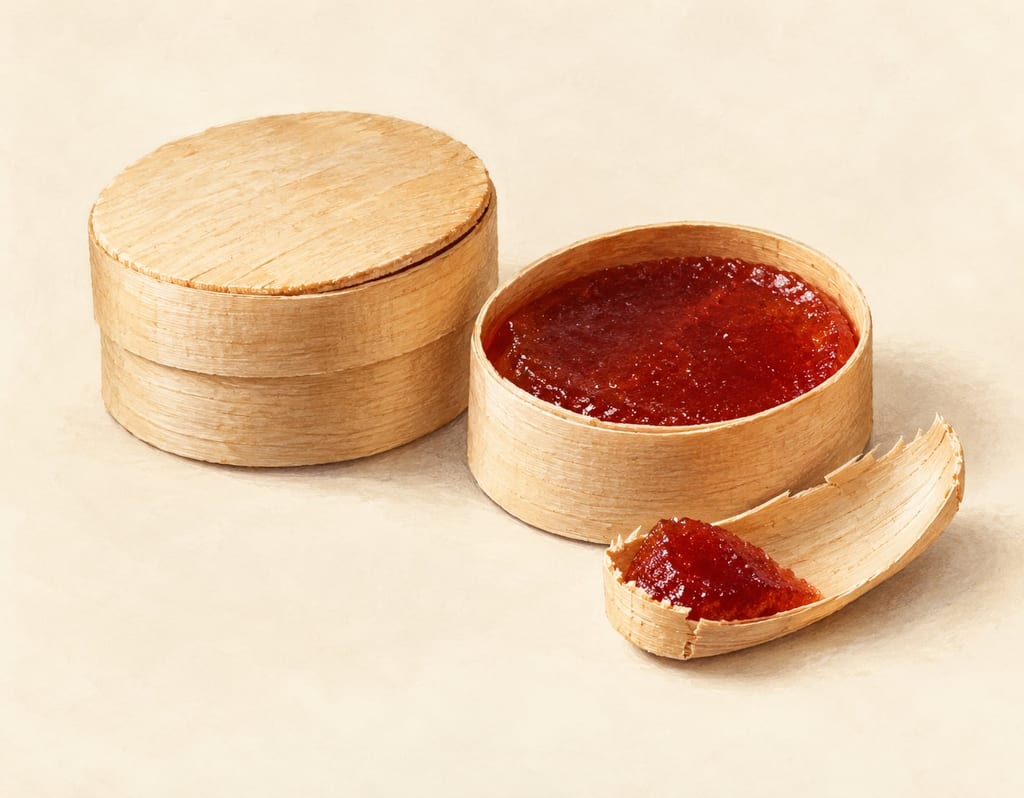
The friponne is a small round spruce box used to present Cotignac d’Orléans, a quince confection associated with the Orléanais. The package’s documented role is presentation of a finished sweet: it is not a cooking vessel, fermenter or part of Cotignac’s preparation. Today’s Maison Gouchault version is a soft quince confection between jelly and fruit paste, sold in a box of spruce bark bearing Joan of Arc on the lid. The regional tourism description calls the traditional material spruce wood, while the current product listing specifies spruce bark; neither gives the box’s thickness, joinery or dimensions.
The name friponne refers to the traditional small spruce box. The sources do not establish that every historical box shared one exact construction or that the current bark package is identical to an old specimen. The item is therefore best understood as a named regional packaging form tied to Cotignac, with evidence for both an older spruce-wood presentation tradition and a current spruce-bark example.
Sources for this section
A lid that becomes a spoon
The lid is part of the serving gesture: local custom is to break it off and use it as a spoon. This gives the package a second role at the moment of eating. No closure mechanism, lid thickness or method for forming the box is specified, and the sources do not show that spruce itself preserves the confection. Its documented job is to hold and present the ready-made Cotignac.
Current Cotignac listings offer 40 g, 80 g and 160 g product formats; those figures describe the confection, not the empty box’s measured capacity. The product listing locates its confection-making in Lailly-en-Val, Loiret. Contemporary lid imagery, including the Joan of Arc effigy, belongs to current branded examples and should not be treated as a design shared by every traditional friponne.
Sources for this section
Place, history and limits
Regional tourism guidance places Cotignac in the Orléanais from the late Middle Ages, but that reported history concerns the confection, not a dated surviving friponne. No first attestation for the box itself, named box maker, standard form, reuse practice or storage conditions are established here. The package remains a distinct part of the sweet’s regional presentation tradition, while its date and detailed manufacture are unknown.
The inspected sources also do not establish food-contact specifications or whether current bark boxes are intended to be reused. A contemporary bark package demonstrates one present-day presentation; regional guidance supplies the local name and lid-as-spoon custom. Keeping those claims separate avoids treating a branded retail box as an unchanged historic artifact.
Sources for this section
History
Tourisme Loiret describes Cotignac as present in the Orléanais since the late Middle Ages and says it is presented in small round spruce boxes called friponnes. This regional account dates the confection tradition, not a surviving box or the first use of spruce packaging. A current tourism-office listing describes Maison Gouchault Cotignac as a soft quince confection packed in a spruce-bark box bearing Joan of Arc.
Equipment details
CapacityThe sources do not give box volume or capacity.
SizeThe sources describe small, round boxes but provide no measurements.
PowerNo power This is a package for finished confection, not powered equipment.
How you get oneNot established The tourism-office shop lists Cotignac packed in a spruce-bark box, but does not offer the empty boxes separately.
CareNo cleaning, reuse or storage procedure for the box is specified by the inspected sources.
Made of
- Spruce bark / spruce wood — Box body and lid
Tourisme Loiret describes the traditional round box as spruce wood; the current Orléans Métropole tourism shop specifies spruce bark. Neither source gives thickness, dimensions or construction details.
Places
Orléans
Traditional use · Locality evidenceRegional tourism guidance documents the package with the Orléanais confection, but does not establish where every box was made.
Lailly-en-Val
Documented use · Locality evidenceThe shop says Cotignac is made in Lailly-en-Val and packed in spruce bark; this associates current package use with the confection, not manufacture of the box itself.