A cask built around an exposed surface
The Orléans vinegar barrel belongs to a slow wine-vinegar method associated with the French city of Orléans. In the 1884 engraving of a local vinegar works, barrel heads face the viewer and rows of casks rest horizontally in tiered wooden racks. The word “mother” also names the working cask in older accounts: it holds vinegar and wine through repeated replenishment rather than simply storing a finished liquid. A short French name found in descriptions is mère, the “mother” cask; the item's inherited alias vaisseau means vessel, and should not be mistaken for a unique model name.
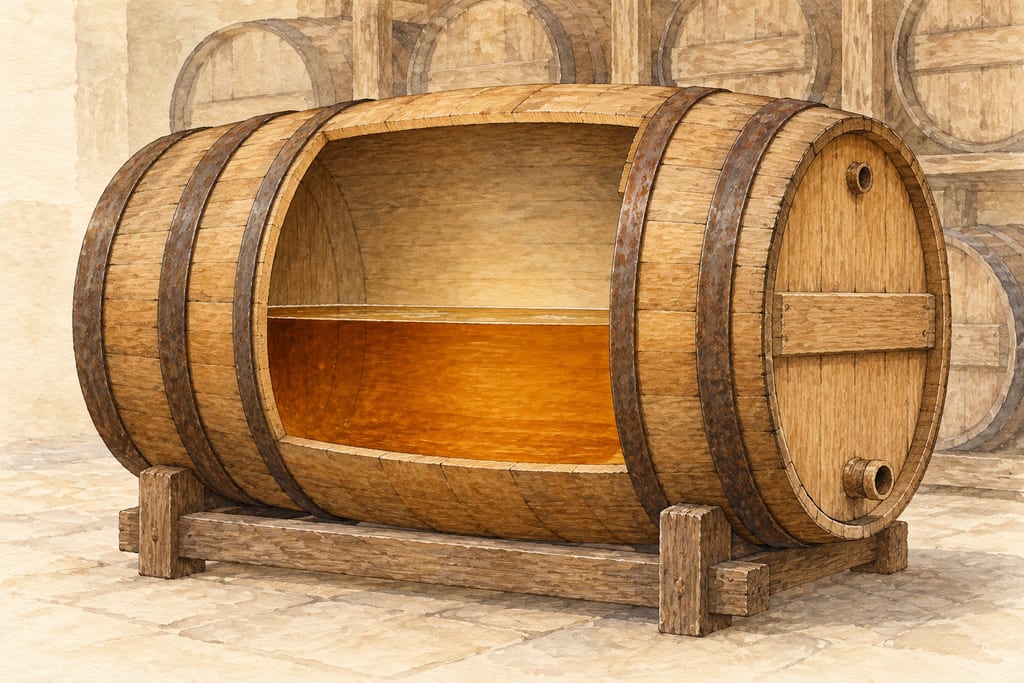
Orléans makers were writing about their method by 1800. An 1886 account describes casks arranged in tiers, each with a large opening in the head for a funnel or siphon and a smaller adjacent opening called a fausset for air. It gives 230 litres for that example and says the casks were half full. That capacity and arrangement belong to the described installation; they are not a universal barrel specification.
Sources for this section
Why the air chamber matters
Wine vinegar forms through acetification: acetic-acid bacteria oxidize ethanol, using oxygen. In traditional surface culture the bacteria work at the boundary between the liquid and the air. The historical account describes a delicate “flower of vinegar” on the surface; modern scientific reviews describe this as a bacterial biofilm or mother. It is a thin living layer, not a cork, solid lid or sediment bed. The barrel's unfilled upper space and its protected openings let the surface remain connected to air.
This geometry explains why an airtight, completely full wine barrel is not interchangeable with an Orléans cask. The vessel is not merely a container made of oak; it controls the interface on which this process depends. If liquid is drawn or added, the surface culture can be disturbed, which is why one documented standardized design adds wine near the bottom rather than pouring it across the surface. The detail is a documented design choice, not an instruction that every historical producer used identical fittings.
Sources for this section
A working barrel is not an ageing barrel
Descriptions of the Orléans method separate the cask where wine is converted from the wooden vessels used after acetification for maturation. Martin-Pouret, founded in 1797, says its present house continues the Orléans method of fermentation and oak-cask ageing. The maker's statement supports a living tradition, while the exact historic cask details come from period accounts. It should not be used to infer that the contemporary setup is identical to an 1880s cellar.
This distinction also changes how to read photographs. A room full of barrels may contain active mother casks, wine waiting for acetification, or vinegar ageing in wood. Without a caption or technical description, the barrel's appearance alone cannot identify its contents or stage. The 1884 engraving documents the cellar and tiered casks, but does not show the cask interior or prove that every pictured vessel is at the same point in the process.
Sources for this section
How the process shaped the work
In Vallery-Radot's 1886 account, the cask is drawn from and replenished at intervals; establishing a stable mother takes time, and continued activity depends on regular feeding. He describes those demands as drawbacks of the traditional system. The point of the barrel is therefore linked to the rhythm of a cellar: the maker manages a living surface culture and keeps a working vessel in service, rather than sealing a batch away and forgetting it. Exact schedules in nineteenth-century accounts are historical observations, not a universal modern operating recipe.
The same account notes that the Orléans mother could not simply be moved once established. This is a reminder that the vessel and its settled surface community were treated as a working unit. The scientific review situates the method among static vinegar cultures and explains the role of air, wood contact and maturation in the final profile. It does not establish that oak alone creates a particular flavour or that all Orléans vinegar uses one barrel design.
Sources for this section
Place, period and limits of the record
The name points to Orléans, in the Loire region of France, where the historic method was documented and became a defining local trade. The 1800 agricultural reference explicitly discusses the practice of Orléans vinegar makers, and the 1884 image is captioned as a vinegar works in Orléans. Martin-Pouret's current website calls Orléans the historic capital of vinegar and describes the house's continuing method. This page uses Orléans as the historical location of the tradition; it does not place the modern producer's factory at a street address in the city.
The written record gives examples rather than one permanent standard: cask capacity, filling level, opening layout, additions and cellar arrangement vary across descriptions and periods. The sources do not settle a single exact set of dimensions, a universal cleaning routine or a current source for purpose-built traditional mother casks. The cutaway illustration is an explanatory reconstruction of a partly filled, air-accessible wooden cask; the separate 1884 engraving is the documentary image of the historic cellar.
Sources for this section
History
The 1800 Cours complet d’agriculture describes the practice of Orléans vinegar makers; Vallery-Radot's 1886 account gives a detailed cask description. These attestations date written descriptions, not the invention of the vessel.
Equipment details
Capacity230 L Vallery-Radot's 1886 description reports 230 litres for its Orléans cask example. Other published descriptions report different sizes, so this is not a universal specification.
PowerNo power The cask itself is unpowered; it depends on air access and the cellar setting, not a mechanical drive.
How you get oneBought from a maker The form is a coopered barrel. The sources consulted do not identify a specific historic cooper or guarantee a present supplier for a cask built for this method.
CareThe historical description documents regular replenishment and withdrawal as part of keeping a mother cask active, but does not give a modern cleaning schedule or a complete care protocol. Follow a maker's instructions for an actual barrel; no cleaning or sanitizing procedure is inferred here.
Made of
- Coopered wood, including oak in the continuing Martin-Pouret practice — Cask body
The 1884 engraving shows wooden casks; Martin-Pouret describes the current Orléans method as fermentation and ageing in oak casks. - Hoops — Hold the staves together
Visible on the 1884 casks; the cited description does not identify the hoop material.
Limits
A full, airtight storage barrel is not equivalent to an Orléans vinegar cask: the surface culture requires oxygen access.
Source →Do not assume every cellar barrel is fermenting; historical accounts distinguish mother casks from storage or ageing vessels.
Source →Places
Orléans
Historical attestation · Locality evidenceThis is the historical location of the method; it does not assert the modern producer's present factory is within Orléans city.