Beer
This is a process overview, not a complete batch recipe: key quantities, yield and packaging directions are absent. The AHA tutorial uses Hop Hammer Imperial IPA as an example; this page is not that full formulation.
 FermenteaWhere food goes to change
Equipment · Tanks and vats
Cylindroconical fermenter · Stainless conical fermenter
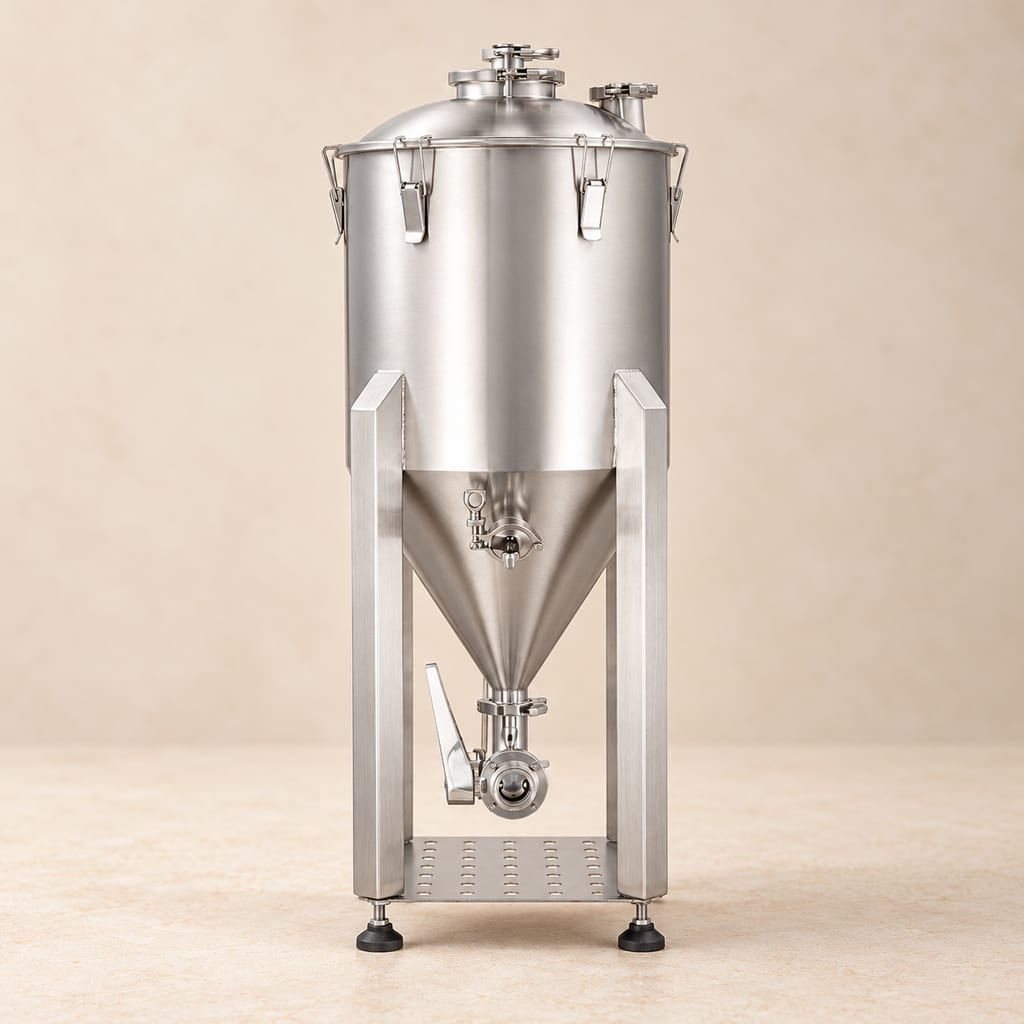
A stainless fermentation tank with a cylindrical upper body and a conical bottom, used to collect sediment at the low point; fittings, temperature control and pressure rating vary by model.
The consulted manufacturer and supplier catalogues document current stainless cylindroconical tanks for homebrew and brewery settings. They do not establish a first date or inventor for the vessel form, so this entry describes the documented present-day equipment without assigning an origin.
A cylindroconical fermenter combines a vertical cylindrical body with a sloping cone that narrows to a low point. In the Brew Monk C60 example, the supplier describes a 60-degree cone and a butterfly valve where settled yeast can be collected. The cylindrical body and cone define the vessel; sample taps, racking arms, probes, cooling surfaces and covers are model-specific fittings.
Homebrew examples include compact stainless tanks sold by total capacity, while brewery makers describe larger jacketed tanks for managing fermentation and cooling. This is a shared vessel form at different scales, not a uniform specification. A cooling jacket or coil, pressure capability and integrated controls must be checked against the model documentation.
A conical shape does not by itself make a vessel pressure-rated or a unitank. Rolling Beers lists its C60 for atmospheric fermentation and separately lists the double-wall U60 as a pressure-capable unitank. Use the exact pressure rating and operating instructions of the individual vessel; do not infer them from the geometry.
Brew Monk's manual calls for cleaning the fermenter and fittings, checking the assembled tank for leaks with water before transferring wort, and placing it on a stable, level support. For the listed model it also cautions against overfilling and sharp metal cleaning tools. Apply those instructions to that model; follow the documentation supplied with other tanks.
The consulted product and manufacturer sources document contemporary tanks but do not establish the first date or inventor of the cylindroconical fermenter.
The listed C60 is specified for atmospheric fermentation, while the separately listed U60 has a stated pressure rating; one model's rating must not be transferred to another.
Hazard sourceThe Brew Monk manual instructs users to place the listed fermenter on a stable, level support before use.
Hazard sourceUse only the exact pressure rating and operating instructions supplied for the individual tank.
Control sourceSet up the listed Brew Monk model on a stable, level support and perform the manual's water leak check before transferring wort.
Control sourceThe Brew Monk C60 listed by Rolling Beers is specified for atmospheric fermentation and is not pressure-resistant; this rating is product-specific.
Source →The separately listed Brew Monk U60 is pressure-rated to a recommended 1 bar; its pressure rating must not be applied to ordinary conical models.
Source →The cited supplier and manufacturer pages identify current Czech and German model examples but do not establish the geographic origin, manufacture across models or full distribution of the cylindroconical fermenter class.
This is a process overview, not a complete batch recipe: key quantities, yield and packaging directions are absent. The AHA tutorial uses Hop Hammer Imperial IPA as an example; this page is not that full formulation.
No community contributions have been published for this entry yet.
Sign in to contribute. Published comments and photos are free to read.
Rolling BeersProduct specification
Brew Monk C60Homebrew conical tank; 60° bottom, fittings, 60-litre full volume, dimensions, stainless construction and atmospheric/non-pressure classification for this model.
Cited in: History and scope; Form and operation; Homebrew and brewery scales; Pressure is model-specific
Rolling BeersProduct specification
40 L stainless steel fermenter40-litre homebrew conical example with steep cone, valves and stand; its specifications belong to that model.
Cited in: Form and operation
Rolling BeersProduct specification · Comparison
Brew Monk U60 UnitankSeparate pressure-capable 60-litre conical model; manufacturer-listed 304 stainless and recommended working pressure 1 bar, showing that unitank/pressure features are not universal.
Cited in: Pressure is model-specific
Pacovské strojírnyManufacturer technical context
Beer brewing industryBrewery-system maker describes cylindrical-conical fermentation tanks and cooling zones in brewery installations.
Cited in: History and scope; Homebrew and brewery scales
BrouwlandProduct family
Brew MonkBrew Monk C-series homebrew conical fermenters and model-dependent capacities and fittings.
Cited in: Homebrew and brewery scales
BrouwlandCare · Use instructions
Brew Monk Conical Fermenter manualManual specifies preparation, leak check, not overfilling the listed model, stable level support and soft cleaning tools. These instructions are model-specific.
Cited in: Cleaning and setup
Speidel Tank- und BehälterbauComparison
Fermentation tanksSpeidel differentiates its PE homebrew conical Kellermeister from other tank designs; not a stainless specification.