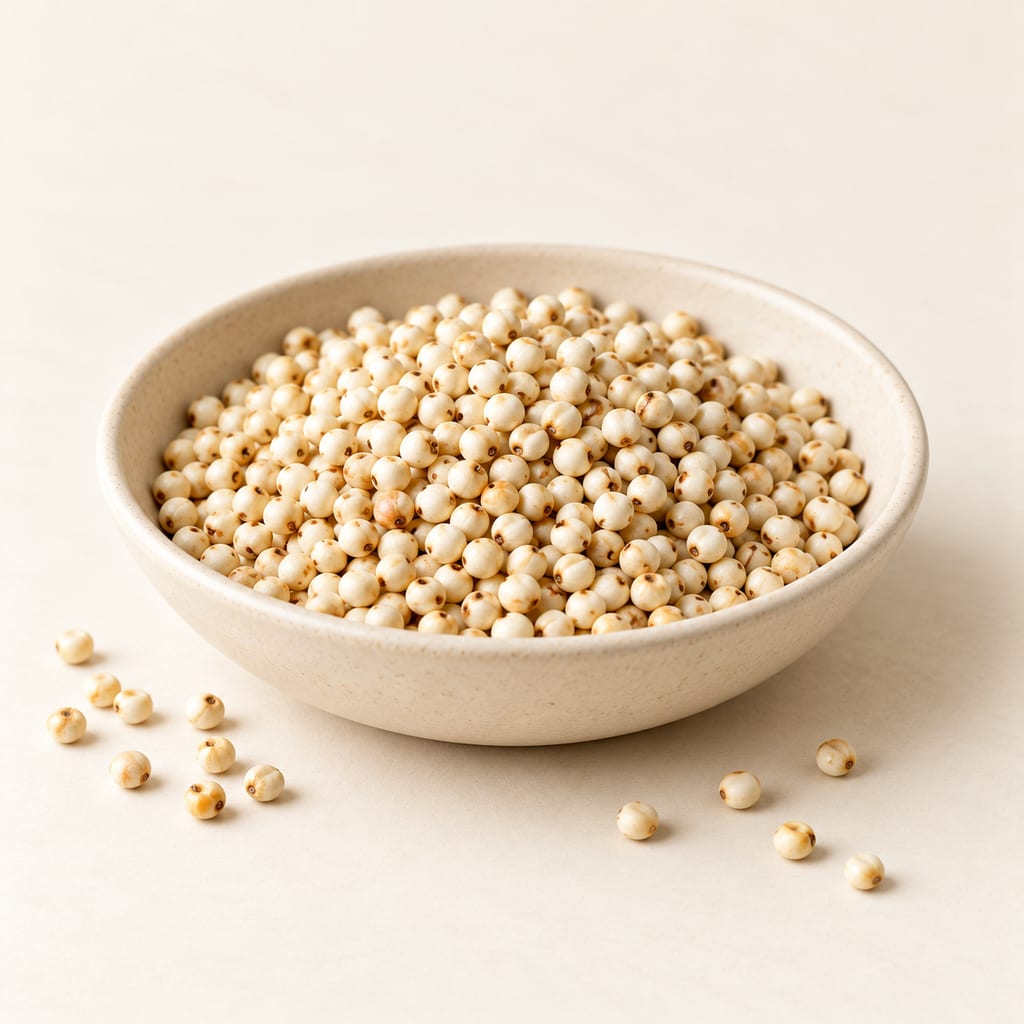
Sorghum
Sorghum is the grain of Sorghum bicolor, a variable African-origin cereal used whole, milled, malted and cooked in distinct fermented foods and drinks.
 FermenteaWhere food goes to change
Built structures · Pits and cavities
matmora · matmora (Sudan)
A Prolinnova-Sudan field catalogue describes a community matmora grain pit, 1.25 m deep and holding 16 tonnes of sorghum as a drought reserve. It gives no village, diameter or construction specification.
A Prolinnova-Sudan catalogue identifies a community grain-store pit called a matmora. Its entry says the store held sorghum for food security in times of drought and likens it to a savings bank for a time of need. The source presents this as a local innovation documented through field research, not a standardized national granary design.
The catalogue gives one example as 1.25 metres deep with capacity for 16 tonnes. It does not provide a diameter, shape, lining, roof or construction sequence, so the recorded depth and capacity should not be turned into an invented plan.
The entry is placed under the catalogue's Central region section, headed “Sinnar and Blue Nile Areas.” No village or individual storage site is named. The field catalogue describes this Sudanese case separately from the Algerian matmor/matmora association with Hamoum; the shared name does not establish identical local use or form.
The Prolinnova page says its exploratory Sudan field study ran around 2005–2007, but it does not date the origin of this storage practice. It supplies no grain-moisture, ventilation, pest-control or safe-entry detail. This entry records the stated storage purpose and example figures; it is not a construction or operating guide.
Prolinnova-Sudan says the exploratory field study ran around 2005–2007; this is a documentation date, not the origin of the practice.
A build is made where it stands: moving it means building it again.
The catalogue is a field description, not a construction or grain-safety specification.
The entry is within the catalogue's “Central region / Sinnar and Blue Nile Areas” section, but no village or exact site is given.
Sorghum is the grain of Sorghum bicolor, a variable African-origin cereal used whole, milled, malted and cooked in distinct fermented foods and drinks.
No community contributions have been published for this entry yet.
Sign in to contribute. Published comments and photos are free to read.
Prolinnova-SudanForm · Use · Geography · Capacity · History
Prolinnova-Sudan field study leads to catalogue of ITK/local innovationsThe catalogue calls the structure a grain-store pit (matmora) and reports a 1.25 m depth and 16-tonne sorghum capacity for one community example.
It identifies drought food security and reserve storage as the purpose; it does not give a village, diameter or construction materials.
The entry appears in the catalogue's Central region, Sinnar and Blue Nile Areas section; the surrounding text says the field study was conducted around 2005–2007.
Cited in: A community sorghum reserve; Reported scale and location; Limits of the record