Borno and Yobe underground grain pits
A 2007 survey reports underground grain pits in Nigeria’s Sudan Savanna, especially Borno and Yobe. It describes lined pits storing threshed millet, sorghum and cowpea.
 FermenteaWhere food goes to change
Substrates
Sorghum is the grain of Sorghum bicolor, a variable African-origin cereal used whole, milled, malted and cooked in distinct fermented foods and drinks.
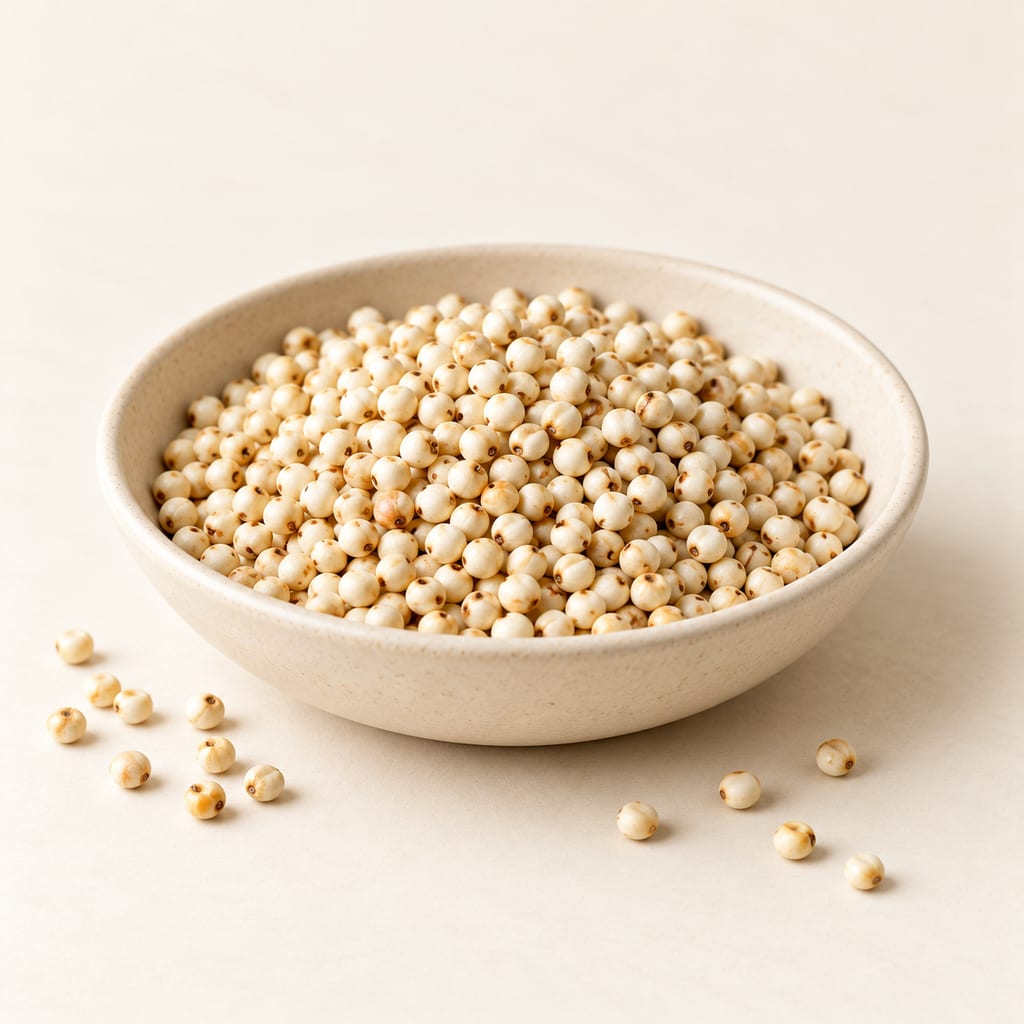
Sorghum in food usually means the mature grain of Sorghum bicolor (L.) Moench, a grass in the Poaceae family. It is an annual cereal crop selected in many different environments. The word can also refer to other members of the genus, including forage types and wild or weedy relatives, so a recipe that says only “sorghum” does not by itself identify a cultivated race, colour, or milling grade.
A sorghum kernel is a small rounded caryopsis partly enclosed by its outer coverings. The colour ranges among white, cream, yellow, red, brown and deep purple-brown; size, shape, hardness and the amount of attached glume vary. Those visible differences are not just decorative. They can track cultivar, endosperm structure and the presence of a pigmented testa. FAO’s food account distinguishes grain sorghums intended primarily for food from sweet-stemmed, forage, broom-corn and other specialized types.
The grain is sold and used whole, dehulled or pearled, cracked, coarsely milled, finely milled into flour, or germinated and dried as malt. These forms are not interchangeable. Milling changes particle size and the rate at which water reaches the grain; removing outer layers changes the material carried into a ferment; germination changes the enzyme system. Sorghum flour and sorghum malt therefore have their own ingredient records. They are processed forms made from grain, not names for every raw sorghum seed.
Names change across language and context. FAO records great millet and guinea corn in West Africa, dura in Sudan, mtama in eastern Africa, jowar in India, kaoliang in China, and milo in the United States. Some historical South African English texts use “kafir corn”; that term is now dated and can be offensive, so it is not used here as a current name. Durra also names one of the five broad morphological races used in older crop classification; the Sudanese word dura is a regional common name. A name alone cannot prove which race or variety a source means.
Sorghum is widely described as a crop of African origin, with the northeast of the continent an important area of cultivated and wild diversity. The precise place and date of domestication remain debated. FAO’s older synthesis places domestication roughly five to seven thousand years ago in Northeast Africa, while later reviews discuss archaeological evidence and competing arguments about eastern Sudanese savannah, Ethiopia and other regions. These are research hypotheses, not a dated event at one named settlement. The crop’s long movement through African trade, migration and cultivation makes a single national origin especially misleading.
Cultivation later spread beyond Africa through trade and shipping. Indian sorghum developed its own diversity and food traditions; the crop also became established in China and, much later, in the Americas. These movements help explain the range of names and uses but do not make every preparation a shared recipe. A sorghum beer, a sour porridge, a cooked whole-grain dish and a crop grown for syrup may use different plant types and different processing.
Kew lists the accepted species Sorghum bicolor and gives its native range as Africa and the Indian subcontinent. FAO describes cultivated sorghum as widely grown in seasonally dry areas well beyond those native regions. The two statements answer different questions: a native range is not a current supply map, and the places where grain is grown do not establish the origin of a dish made from it.
Within Africa, cultivation spans distinct ecological and agricultural zones. FAO describes a northern belt from West Africa toward the Sahara and east through Sudan and Ethiopia, and another belt extending from Ethiopia through eastern and southern Africa. The crop’s races and local varieties differ across these areas. A trade sack labelled only “sorghum” may not disclose whether its grain is a West African guinea type, a southern African kafir type, a durra type, a hybrid, or another selection.
The ingredient’s links to named preparations are more precise than any single crop-origin story. The research atlas documents sorghum in Sudanese kisra, hulu-mur and merissa; Ghanaian pito; Beninese gowé and akpan; Botswana ting; South African umqombothi; Namibian oshikundu or ontaku; and other foods and drinks. These are records of use, not proof that each household grew the grain itself or that a modern commercial batch uses local grain. The recipe pages carry those preparation geographies separately.
Sorghum contributes starch, protein, minerals, fibre and grain structure. In a sour slurry, ground grain provides fermentable and non-fermentable carbohydrates, nutrients and solids. Lactic acid bacteria use available sugars and produce organic acids; yeasts may grow alongside them and can contribute gas, aroma compounds or alcohol depending on the process. The grain’s form, water content, heat history, accompanying ingredients and microbial community all affect which changes occur. A souring observation in one meal or flour cannot be treated as a universal sorghum culture.
Malted sorghum has a different job in brewing. During controlled germination, the grain develops enzymes that can break down starch. In a mash, the brewer makes starch accessible and manages heat so that active enzymes convert some of it into smaller sugars that yeast can ferment. Traditional African beer methods may combine malt with cooked unmalted grain or cereal fractions. If all the grain is heated in a way that disables the enzymes before conversion, a process that relies on malt will not produce the same sugar supply. The pito literature documents deliberate starch cooking and enzyme management; it warns against treating intact grain plus yeast as an equivalent mash.
Sorghum also determines texture and body. Coarse meal can leave particles in a porridge or beer; fine flour makes a smoother, more cohesive batter; a thinly spread sour batter cooks into a flexible sheet. Grain colour by itself does not specify sweetness, tannin level, brewing yield or fermentation speed. The source must identify the actual variety and process before such effects are assigned.
Sorghum appears in African fermentations with different starting materials and endpoints. In Sudanese kisra, flour is made into a batter, soured and cooked as a thin bread. A 2020 study tested a specific household starter and a specific temperature-and-time schedule; those measurements describe that study batch, not a general home formula. The authors also studied hulu-mur, where malted and unmalted sorghum feature in a spiced, fruit-containing preparation that is fermented, cooked into sheets and dried. The dried sheets are later soaked to make a drink. That drink is not simply an actively fermenting sorghum beer.
In pito, malted sorghum supplies enzymes while cooked grain contributes starch. The documented mash treatment matters because starch must become accessible and then be saccharified before yeast can make alcohol from the resulting sugars. The primary study compares a traditional fermentation with a defined-culture process and examines storage; the atlas reports distinct measured outcomes for its tested batches. Such numbers must remain attached to the exact study and must not be read as a stable alcohol strength or shelf life for every pito.
Other beer names describe related but distinct traditions. Dolo, tchoukoutou, tchapalo, burukutu, merissa, ikigage, umqombothi and others may use sorghum malt or grain, but their combinations of cereal, malting, cooking, souring and fermentation differ. Umqombothi commonly combines maize meal with sorghum malt and staged fermentation; it is not a sorghum-only drink. Merissa sources document distinct stages for souring, starter activation and the main fermentation. Their grain lines should point to raw sorghum or malt according to the exact source, not collapse both into one ingredient.
Not all fermented sorghum is beer. Botswana ting begins as a sorghum-flour-and-water mixture that sours before it is cooked into porridge. South African and nearby sour grain foods have their own names and methods. Namibian oshikundu or ontaku can combine pearl millet, sorghum malt and other cereal materials. The malt can contribute enzyme activity and microorganisms, while millet or sorghum flour supplies much of the body. The selected recipe determines which ingredient is linked.
Choose the form named by the preparation. Whole grain, meal, flour and malt have different particle sizes and histories. A brewing formula that depends on malt enzymes cannot be reproduced by substituting untreated flour without process evidence. A batter formula that specifies flour cannot be assumed to behave the same with whole kernels. Colour and a general label such as “red sorghum” are not enough to identify a variety or its functional properties.
For dry grain, FAO post-harvest guidance stresses drying promptly and keeping grain dry during storage; mould growth and mycotoxin production are associated with inadequate drying and moisture ingress. The Ghana Ministry of Food and Agriculture guide recommends clean, dry storage and hermetic storage methods for extended cereal storage. Those are general grain-storage recommendations from their respective authorities, not a guarantee that any bag, jar or batch is safe. The source material for some sorghum beer and flour records gives no validated moisture or storage-life specification, so this page does not invent one.
Store grain sealed from pests and damp, using a clean food-suitable container and the supplier’s or local agricultural extension guidance. Keep opened flour and malt protected from moisture, insects and strong odours; follow the package’s storage direction because milling and malt production alter how the product keeps. Discard grain that is wet, visibly mouldy, insect-damaged or contaminated rather than relying on smell, rinsing or roasting to establish that it is safe. A pleasant odour, bubbling ferment or home acidity reading does not validate the grain or a fermentation.
Sorghum is naturally gluten-free as a grain, according to the Celiac Disease Foundation. That does not make every sorghum flour, beer, porridge or prepared food gluten-free: a recipe can add wheat or barley, and grain can meet gluten-containing cereals during growing, milling, transport, storage or preparation. People who must avoid gluten should check the full ingredient list and choose products labelled or otherwise verified to meet the applicable local standard. NIDDK identifies cross-contact as possible at several points in the food chain.
Sorghum is not a major allergen named on the U.S. FDA’s major-allergen list, but people can have individual sensitivities, and packaged products can contain other declared allergens. This page describes the raw cereal, not a packaged product’s complete allergen profile. Fermentation does not automatically remove an allergen from the rest of a recipe.
The record links sorghum to selected preparations that name the grain in their source material. Read each linked recipe for its specific flour, malt or whole-grain form. The linked examples include kisra and hulu-mur, pito, ting, umqombothi and oshikundu. Other records such as dolo or merissa may name sorghum malt as a separate ingredient. The shared word “sorghum” does not erase those distinctions.
A dish’s place comes from the people, language and documented preparation associated with it; it does not follow automatically from the crop’s botanical range. Conversely, a crop’s current global cultivation does not make every local recipe global. The recipe pages preserve their own names, regional associations and process evidence.
The broad botanical identity and African importance of cultivated sorghum are well established. The precise domestication site, sequence of dispersal, age of particular named races and ancestry of local varieties are less certain. Sources differ in how they interpret archaeobotanical remains and historical crop movement; this account keeps that uncertainty rather than selecting one exact birthplace.
Microbial findings belong to their sampled foods. The kisra study reports its identified community and method; pito papers describe their own cultures and mashes; ting and umqombothi studies likewise describe particular samples or trials. A species found in one sample is not a universal starter for sorghum. A measured pH or alcohol result in a study is not a safety endpoint for a different grain, recipe, vessel or temperature history.
This record describes raw sorghum and the documented roles of its processed forms. It is not a universal recipe for milling, malting, brewing, souring, storage duration or food safety.
Regional association for sorghum cultivation and use, not the birthplace of every sorghum recipe or a claim that each named preparation uses locally grown grain.
Kew records this within the species' native range and FAO documents cultivation and the name jowar; this is not the origin of African recipes.
A 2007 survey reports underground grain pits in Nigeria’s Sudan Savanna, especially Borno and Yobe. It describes lined pits storing threshed millet, sorghum and cowpea.

A hermetic grain bag stores suitably dried grain in an airtight, multilayer package. The PICS design pairs two inner liners with a woven outer sack; it is a storage tool, not a fermenter or dryer.
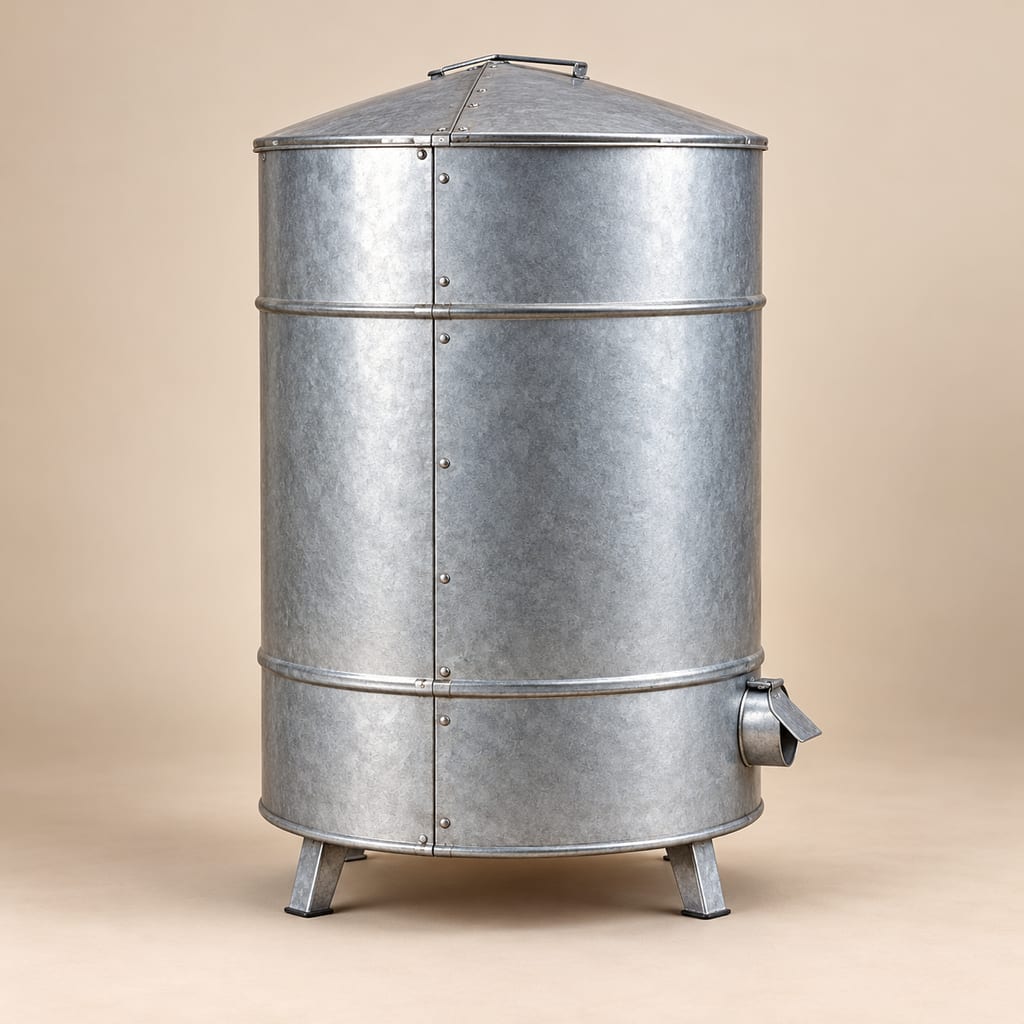
A locally fabricated galvanized-metal vessel for dry-grain storage. Household models sit on raised platforms and seal at inlet and outlet; they are movable containers, not granary buildings or fixed industrial installations.
A Prolinnova-Sudan field catalogue describes a community matmora grain pit, 1.25 m deep and holding 16 tonnes of sorghum as a drought reserve. It gives no village, diameter or construction specification.
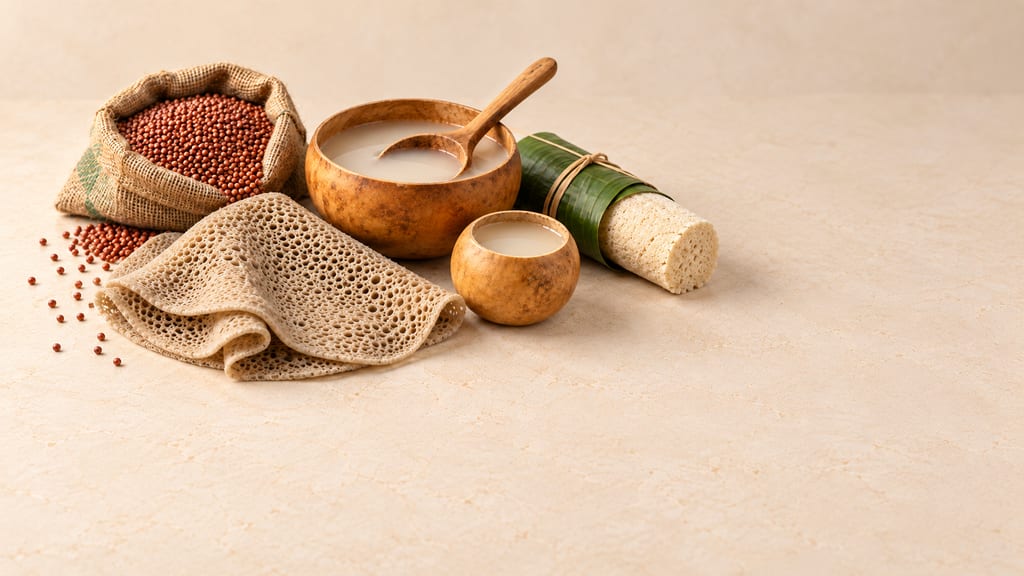
From sour breads and milk to savoury seeds, cassava staples and living beers, African fermentation follows the crop, the community and the work of transformation.
Every preserved food is a stack of barriers against microbes, enzymes, air and time. This is how they work, what a recipe's numbers measure, and how cooks worldwide build them.

At North Abydos in Egypt, a fixed early Dynastic brewery comprised parallel semi-subterranean installations with rows of ceramic mash vats; excavation reports revise their number, scale and estimated batch capacity.

Ají amarillo is the orange-yellow Peruvian chilli cultivar group of Capsicum baccatum, used to colour and season huancaína sauce and ají de gallina. Published heat estimates do not establish one range for the named cultivar.

Toasted almonds are whole sweet almond kernels dry-roasted until golden to brown. Heat replaces their marzipan note with a roasted, nutty one; they thicken and flavour romesco.

Kodiak salmon, halibut and cod cut as seg'aq and hung on an initaq rack to become tamuuq, with kac'amaasaq and kupcuunaq named as different results.

Aniseed is the dried ripe fruit of Pimpinella anisum, an aromatic Apiaceae spice commonly called a seed. It adds a sweet, warm aroma to breads such as Moroccan krachel and South African mosbolletjies, and is distinct from star anise.

A fixed Late Chalcolithic installation in Areni-1 cave combined a shallow clay pressing basin with a large jar set into the cave floor and storage vessels nearby.

Ripe avocado flesh is the soft, buttery, fat-rich pulp of Persea americana, eaten raw. It is low in acid, so it is a fresh ingredient that needs care in chilled dishes.

A portable dome and pan used over a hearth, with embers on the lid and heat from below. Regional peka and saç forms share this principle while differing in materials, pan shape and how the food is cooked.
No community contributions have been published for this entry yet.
Sign in to contribute. Published comments and photos are free to read.
Food and Agriculture Organization of the United NationsIdentity · Names and forms · History · Cultivation · Preparation · Fermentation role
Sorghum and millets in human nutritionSpecies name and cereal identity; regional common names; broad morphological races; kernel appearance and food-use classifications; crop history, spread, grain forms and processing context.
Cited in: A grain with many forms; Names and crop history; Where it is grown and sourced; What the grain contributes; Choosing, preparing and storing grain
Plants of the World Online, Royal Botanic Gardens, KewIdentity · Cultivation · Geographic association
Sorghum bicolor (L.) MoenchAccepted scientific name, family, native range and broad uses.
Cited in: A grain with many forms; Where it is grown and sourced
Food and Agriculture Organization of the United NationsHistory · Cultivation
The Biology of SorghumClassification and distribution of cultivated and wild sorghums; the source presents domestication dates and locations as debated research hypotheses.
Cited in: Names and crop history; Evidence and uncertainty
Canadian Food Inspection AgencyIdentity · History · Cultivation
The Biology of Sorghum bicolor (L.) MoenchBotanical identity; northeastern African origin and diversity; archaeological evidence and dates are reported with uncertainty.
Cited in: Names and crop history; Evidence and uncertainty
Journal of the Institute of BrewingFermentation role · Process
Pito fermentation with selected cultures and shelf-life assessmentSorghum malt and mash management in pito; comparison of selected-culture and traditional processes; results are specific to the studied batches.
Cited in: What the grain contributes; Fermented foods and drinks that use sorghum; Evidence and uncertainty
Journal of the Institute of BrewingFermentation role · Process · Geographic association
Pito fermentation with traditional and commercial pure culturesPrimary comparison of Ghanaian pito batches made with traditional and commercial pure cultures; process details and measured outcomes belong to those trials.
Cited in: Fermented foods and drinks that use sorghum; Recipes that use it
Annals of MicrobiologyFermentation role · Process · Geographic association
Kisra and hulumur microbial communitiesStudy methods and microbial observations for Sudanese kisra and hulu-mur; evidence does not establish a universal household formula or safety limit.
Cited in: What the grain contributes; Fermented foods and drinks that use sorghum; Recipes that use it; Evidence and uncertainty
International Journal of Food Microbiology; PubMed recordFermentation role · Process · Geographic association
Microbiological and chemical characterisation of tingBotswana household and starter-culture observations for fermented sorghum ting; sampled values are not universal control limits.
Cited in: Fermented foods and drinks that use sorghum; Recipes that use it
FermentationFermentation role · Process · Geographic association
Nutritional Compositions of Optimally Processed UmqombothiSouth African maize-and-sorghum beer process comparison; sorghum malt is one part of a multi-grain preparation.
Cited in: Fermented foods and drinks that use sorghum; Recipes that use it
University of NamibiaFermentation role · Process · Geographic association
Oshikundu/ontaku processing researchNamibian processing research describes pearl millet, sorghum malt and variation; the names refer to related traditions rather than one invariant formula.
Cited in: Fermented foods and drinks that use sorghum; Recipes that use it
Food and Agriculture Organization of the United NationsStorage · Safety
Mycotoxins in GrainPrompt drying and maintenance of dry storage conditions reduce fungal growth and mycotoxin production; the source does not establish a sorghum-specific universal storage duration.
Cited in: Choosing, preparing and storing grain
Ghana Ministry of Food and AgricultureStorage · Preparation
Appropriate Postharvest Practices for Improved Food SecurityGhanaian post-harvest guide discusses cleaning, dry grain handling and hermetic storage for cereals; its handling recommendations are contextual, not a universal home fermentation limit.
Cited in: Choosing, preparing and storing grain
Celiac Disease FoundationAllergen · Dietary context
Gluten-Free FoodsSorghum is listed among naturally gluten-free grains; grain products can be cross-contacted, and the source advises verified products for people who need a strict gluten-free diet.
Cited in: Allergens and dietary context
National Institute of Diabetes and Digestive and Kidney DiseasesAllergen · Dietary context
Eating, Diet, & Nutrition for Celiac DiseaseCross-contact with gluten can occur during growing, processing, storage, preparation or service; the source gives advice for people with diagnosed celiac disease.
Cited in: Allergens and dietary context
Food and Agriculture Organization of the United NationsCultivation · Geographic association
SorghumFAO crop wild relatives account identifies sorghum as a major regional crop and describes the African regions and countries where it is cultivated.
Cited in: Where it is grown and sourced