What toasted almonds are
Toasted almonds are whole sweet almond kernels that have been heated dry until they turn golden to deep brown, with the thin brown skin still on. Toasting is the same operation the industry calls dry roasting: kernels are heated without oil or water, typically at 130 to 150°C. It changes the colour, the crunch and above all the smell of the nut, and it is a different treatment from blanching, which uses hot water to slip the skin off, from pasteurisation, which is aimed at microbes, and from salting or flavouring, which add something. The almonds described here are plain: whole, unsalted and toasted.
In Catalan the nuts are ametlles torrades and in Spanish almendras tostadas. They are the nut of the Catalan kitchen’s best-known cold sauce, romesco, where they are toasted and then ground.
Sources for this section
The almond before toasting
The almond is the seed of a drupe, a stone fruit, and not a true nut. It belongs to the rose family and is related to the peach, plum, apricot and cherry. The tree, Prunus dulcis, is native to the Middle East and South Asia, and almonds have been eaten since the Early Bronze Age, 3000 to 2000 BCE. A 2025 population-genetic study of 209 wild and cultivated almonds, scored at 23 microsatellite markers, supports a single domestication in the Middle East from either Prunus orientalis or Prunus turcomanica, followed by gene flow from other wild species, and describes the process as complex and protracted. The cultivated almonds fell into four genetic clusters, Turkish, Caucasian–Central Asian, southern Spanish, and European and North American, which shows how far the crop spread and diverged after it left the Middle East.
Domestication selected the sweet kernel. Wild almonds are bitter because they carry amygdalin, a compound that releases benzaldehyde, and a little hydrogen cyanide, when the tissue is crushed. UC Davis measurements of amygdalin give the scale: about 63 milligrams per kilogram in commercial sweet varieties, about 990 in semi-bitter types, and about 40,000 in bitter types. The sweet kernel is a single-gene trait in which bitterness is recessive, and it remains the main breeding target. Semi-bitter almonds are sometimes used in processing for their marzipan-like taste; the toasted almond in a sauce is the sweet kind.
What the sweet kernel tastes of, raw, is mostly fat. California-grown almonds range from 35 to 66 percent lipids, 16 to 23 percent protein, 2.1 to 7.4 percent sugars and 11 to 14 percent fibre. The oil is mainly oleic acid, 62 to 80 percent, and linoleic acid, 10 to 18 percent. Fat creates the rich taste, a lack of acid lets the sweetness of the starch and sugars show, any bitterness comes from amygdalin, and the astringency comes from tannins in the skin. A raw almond has a faint aroma, with one exception: of 41 volatile compounds identified in raw Butte and Padre almonds, benzaldehyde, with its marzipan-like note, is the predominant one, at roughly 2,900 parts per billion.
Sources for this section
Varieties and the aroma they carry
Almonds differ by variety in ways a cook can taste. California grows about 30 varieties; the three leading ones in the symposium figures were Nonpareil at 39 percent of the crop, Monterey at 12 percent and Carmel at 9 percent, and California supplied about 80 percent of world almond production in 2015. Varieties differ in how much amygdalin and benzaldehyde they hold, and the two move together: UC Davis found a strong correlation between amygdalin and benzaldehyde levels. Among commercial varieties benzaldehyde ranges from about 0.6 to 18 milligrams per kilogram. Fritz had the highest average amygdalin, 76.5 milligrams per kilogram, and about 18 milligrams of benzaldehyde, while Nonpareil had about 18.6 of amygdalin and 2.8 of benzaldehyde. A variety rich in benzaldehyde has more marzipan aroma to lose in the roaster, and one poor in it is closer to a blank sheet for roast notes.
The skin matters too. The brown skin carries the tannins that give a raw almond some astringency, and it takes up colour in the roaster; in the Portuguese cultivar study the sensory panel scored skin colour and skin roughness as separate attributes, and cultivars differed in both. Toasted almonds with the skin on therefore look and taste different from blanched ones that are then toasted.
Sources for this section
What heat does
Roasting turns an almond’s plain, creamy flavour into a roasted, nutty one. When the kernel is heated, three kinds of chemistry produce new volatile compounds: oxidation of lipids, pyrolysis of sugars, and the Maillard reaction between sugars and amino compounds. The flavours that result are described as malty, roasted, chocolate and nutty, and the range and levels of the volatiles depend on the roasting conditions.
Researchers at UC Davis roasted Butte and Padre almonds at 138°C in a rotary roaster for 28 minutes (a light roast), 33 minutes (medium) and 38 minutes (dark), and compared the volatiles with those of raw almonds. Up to 17 new volatile compounds appeared that were not found in raw almonds, including pyrazines, furans, pyrroles, ketones, aldehydes and alcohols, and the concentration of many rose with roasting time. The pyrazines, key to roasted-nut aroma, come from Maillard sugar–amine reactions and Strecker degradation. The furans come from the thermal breakdown of sugars. The alcohols and aldehydes come from lipid oxidation. Some of the changes are large: 2-methylbutanal rose from 14 to between 1,500 and 6,600 nanograms per gram, 3-methylbutanal from 32 to between 910 and 4,300, and 2,5-dimethylpyrazine from 11 to between 16 and 67; 2-methylpyrazine, undetectable in raw almonds, appeared at all three roast levels, and trimethylpyrazine in the medium and dark roasts.
The marzipan note is what the heat takes away. Benzaldehyde fell from 2,900 nanograms per gram in the raw almonds to between 250 and 370 after roasting, a drop of about 90 percent. A toasted almond therefore tastes of roast, caramel and nuts rather than of marzipan and cherry. This is also why a recipe that wants the sweet-almond aroma and one that wants a roasted aroma call for different nuts.
A Portuguese study put medium roasting, 138°C for 33 minutes, to the test on raw kernels with the skin on. It found that the levels of bioactive compounds and antioxidant activity generally increased with roasting, that the share of polyunsaturated fatty acids rose, and that roasting improved the perceived skin colour and sweetness of two of the cultivars and the skin roughness of two others. The same study also tested blanching; this page concerns the roasted nut with its skin.
Sources for this section
How far to take it
Roast is a matter of degree, and the studies give anchors. Common temperatures for dry roasting run from 130 to 150°C. The UC Davis volatile study used 138°C for 28, 33 and 38 minutes. Another experiment on dehulled Nonpareil almonds used 115°C for 60 minutes for a light roast and 152°C for 15 minutes for a dark roast. A light roast at one temperature and time is not the same as a light roast at another: colour and volatile profile follow both temperature and time, and neither is a stand-in for the other.
In the Nonpareil experiment, consumers rated light and dark roasts after storage and found no significant difference in liking by roast level. They did find a significant difference over time: samples stored for 0, 2, 4 and 6 months were rated differently, and ratings at 6, 8 and 10 months were not. For the eater, freshness mattered more than the degree of roast.
Sources for this section
Toasted almonds in romesco
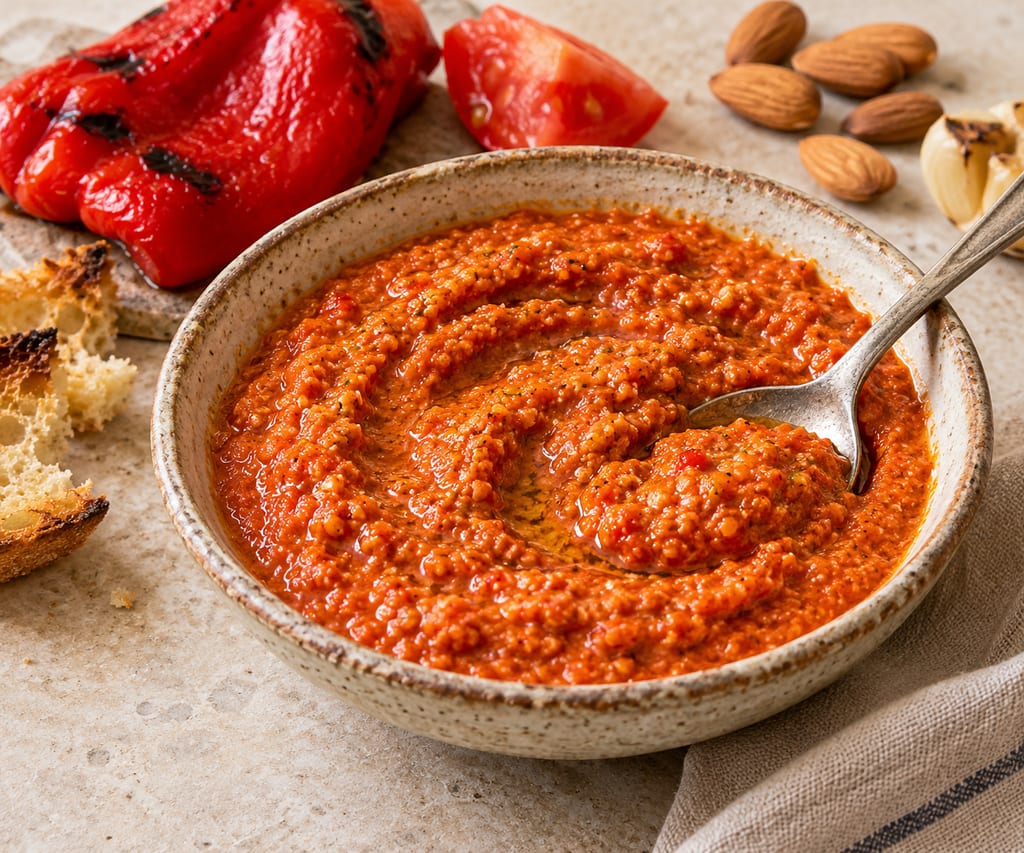
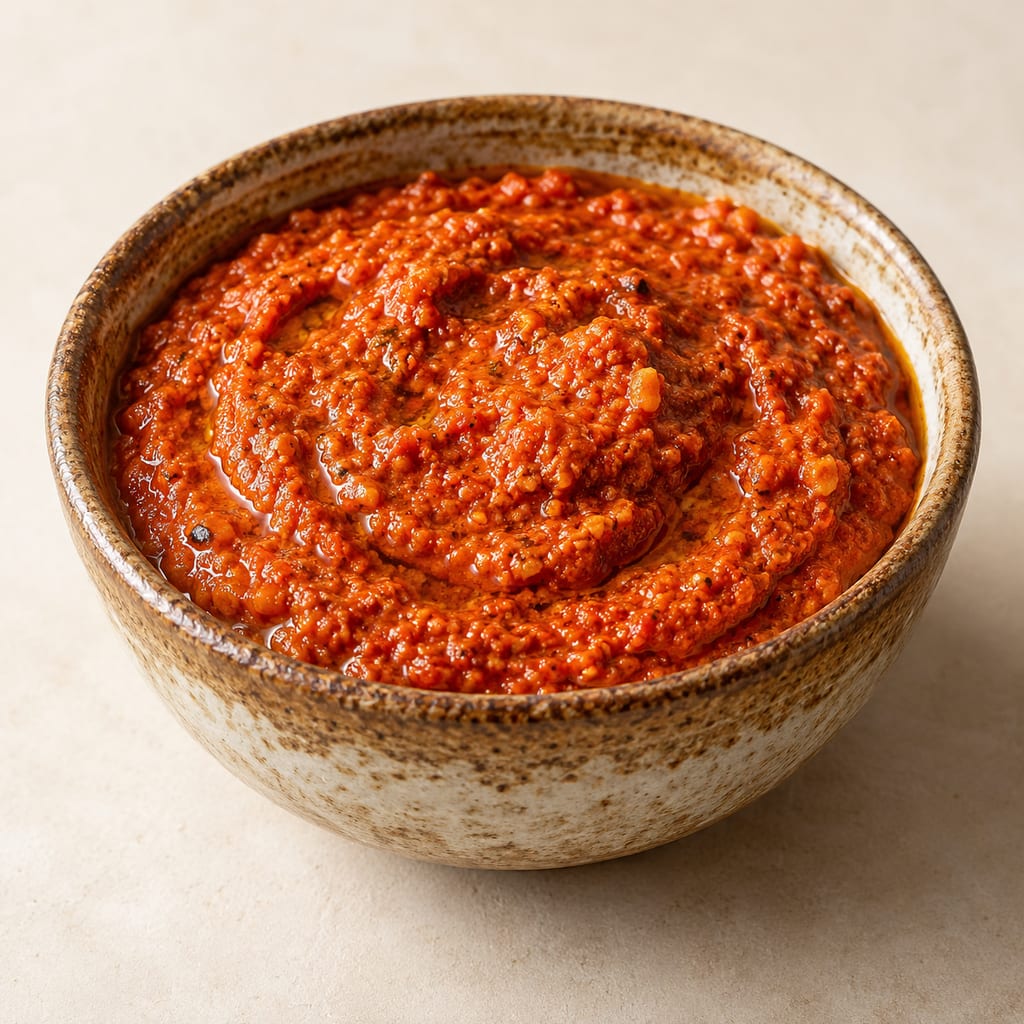
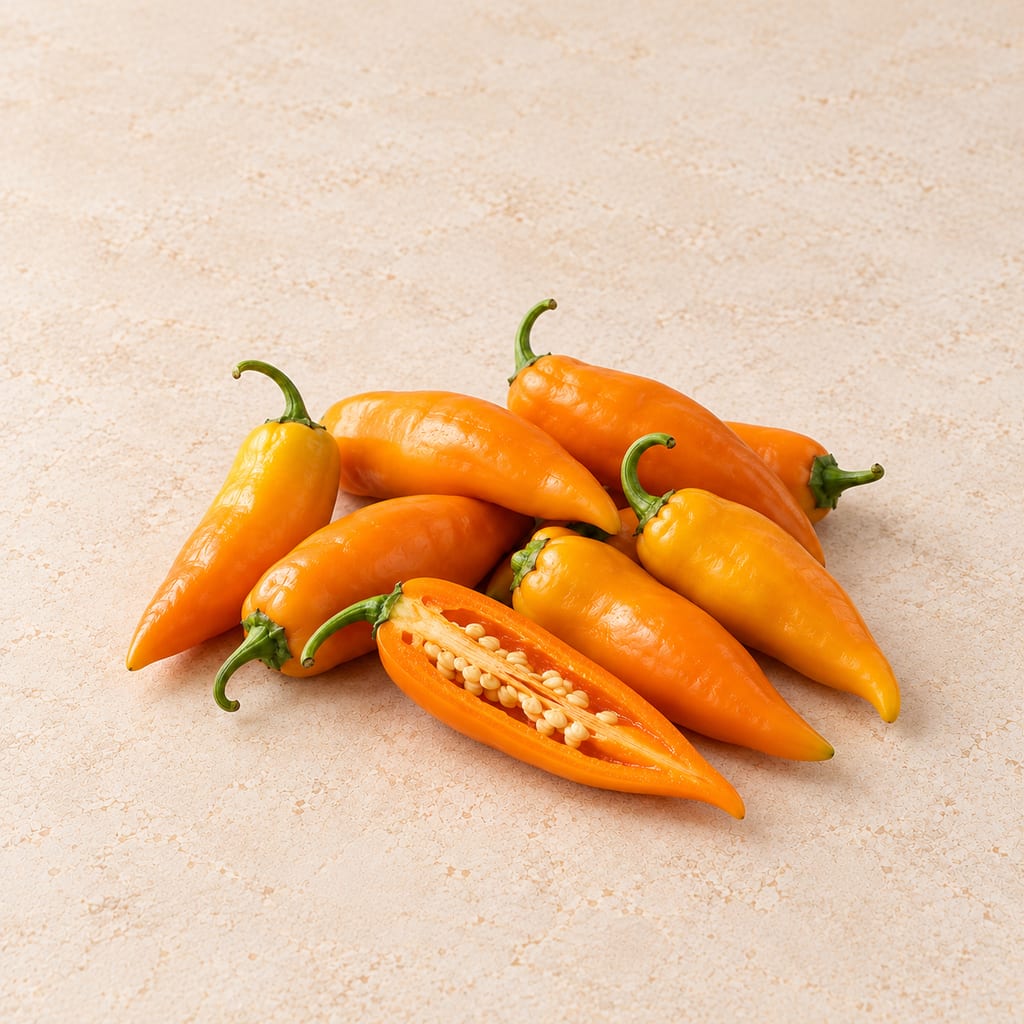
Romesco is the sauce of the Camp de Tarragona in Catalonia. Its core is a paste, the picada, of dried romesco or nyora peppers, garlic, roasted tomatoes and toasted, chopped almonds or hazelnuts, with oil and vinegar for the cold sauce, and often parsley, pepper and a little toasted bread. It goes with fish, meat or calçots, the grilled spring onions of Catalonia, alike. The name covers two things: the cold sauce, salsa de romesco, and the romescada, a fish stew cooked from the same picada. The stew is probably the older of the two.
Its origin is traditionally placed among the fishermen of Tarragona, in the seafaring Serrallo quarter, who wanted a food that would keep for many days at sea without refrigeration, and whose ingredients all keep well. It may be older than the arrival of the pepper and the tomato from the Americas, after Columbus’s second voyage in 1493, since the pepper served as a cheaper substitute for black pepper. The Catalan word itself is of uncertain origin; Joan Coromines traced it to a Romance-Andalusi word for large fish such as tuna, which passed from the fish to the sauce that accompanied it and then to the dish.
The written record is more recent. The earliest citation of the stew is from 1887, in Joan Pons i Massaveu’s Colla de carrer. The gastronome Ángel Muro reviewed romesco in La Vanguardia on 4 May 1892 and printed the recipe as “Lo romesco” in El Practicón in 1894, describing a strong, simple, forceful dish. Ignasi Domènech’s La Teca (1924) placed it among the sauces, for grilled octopus or squid, and Ferran Agulló’s Llibre de cuina catalana (1933), in “Peix amb romesco”, names almonds and hazelnuts, which stirred some controversy at the time. The cold sauce became a restaurant staple from the mid-1960s. The Mestres Romescaires contest was first won in 1951 by Carme Brull Zaragoza, and in 2025 Tarragona held the first Congrés del Romesco.
No single recipe is correct. The nuts may be almonds, hazelnuts or both; the sauce takes its sweetness from tomato, wine and nyora, and its colour from the same peppers. Toasted and ground, the almonds add fat, protein and fibre, and a roasted flavour that raw ones lack, with the pyrazines and furans that heat forms. A romesco-style sauce that uses 35 grams of toasted almonds is working from this tradition.
Sources for this section
Almonds in Spain and Catalonia
The almond has been grown in Spain for more than 2,000 years, probably introduced by the Phoenicians and spread by the Romans, both of whom traded it, as the remains in sunken ships show. Cultivation began on the coast, where it is still concentrated, and today Spanish production centres on the Mediterranean regions: Catalonia, Valencia, the Balearic Islands, Andalusia and Aragón. In Catalonia the tree grows in the Camp de Tarragona and the Terres de l’Ebre, the same country that gave the world romesco. Spain is a large consumer as well as a producer, using almonds as an aperitif, as an ingredient and in the traditional torró (nougat), marzipan and pastry trades.
Spain has more than a hundred almond varieties, of which five commercial types are defined: Marcona, Largueta, Planeta, Comuna (or València) and Mallorca, with Marcona, Largueta and Planeta native. The tree is robust, lives 60 to 80 years in the Mediterranean basin, likes full sun and deep, calcareous, well-drained, rather sandy soil, and tolerates drought and some frost, though repeated frosts at flowering damage the crop.
In FAOSTAT’s 2024 figures Spain produced 369,700 tonnes of almonds in the shell from 766,070 hectares, third in the world behind the United States (2,000,340 tonnes) and Australia (370,000 tonnes), with Türkiye (200,000), Morocco (163,616) and Iran (132,106) next. World production was 3,951,576 tonnes, five times the 756,588 tonnes of 1961. Spain’s harvested area is almost four times its 1961 area of 203,600 hectares, but its output is only 1.8 times its 204,000 tonnes of 1961, and its yield, 483 kilograms per hectare, is under a third of the world average of 1,646.
Sources for this section
Buying, keeping and safety
A toasted almond keeps worse than its crispness suggests. Rancidity in almonds is chiefly the oxidation of oleic and linoleic acids, started by heat, moisture and oxygen, and heat treatments including pasteurisation, blanching and roasting are among the things that can start it. The problem is greatest in storage and humidity and occurs in raw and roasted almonds alike. The industry has no single standard test for it: an informal benchmark is a peroxide value below 5 milliequivalents per kilogram and free fatty acids below 1.5 percent, but the markers shift as oxidation proceeds and few correlate well with what consumers notice. In the storage experiment, peroxide values climbed far faster in dark-roasted almonds than in light-roasted ones, and alpha-tocopherol, the form of vitamin E that protects the oil, declined in both over the year. In the Nonpareil experiment, almonds stored for a year at 39°C in open bags, with the maximum exposure to oxygen, were rated lower by consumers as the months went by.
A federal rule published in March 2007 sets a mandatory treatment criterion of at least a 4-log reduction of Salmonella on almonds. The Almond Board lists validated processes that meet it, among them oil roasting, dry roasting and blanching, and steam and moist-heat treatments, and it records that two minutes or more in water at 190°F or above gives a 5-log reduction and may be labelled pasteurised. Commercial dry roasting is thus one of the validated routes, and toasting a handful in a home pan is not a validated process.
Almond is a tree-nut allergen. In the United States, tree nuts are major food allergens, and a packaged food must name the particular tree nut on its label. Bitter almonds, which contain amygdalin, are a separate toxicity concern; the almonds sold for eating are the sweet kind.
Sources for this section
Open points
The degree of roast for the almonds in the romesco-style sauce is not recorded, so the temperatures above anchor the range and do not prescribe a schedule. The date when Catalan cooks began toasting almonds for the sauce is not recorded either; the 1933 recipe is the earliest mention of the nut found.
Sources for this section
Allergens
tree nuts (almond)
Places
Camp de Tarragona
Traditional preparation · Region evidenceHome of romesco and of Catalan almond growing, with the Terres de l’Ebre; the date of toasted almonds in the sauce is not recorded.
Spain
Modern adaptation · Country evidenceThird-largest almond producer in 2024, 369,700 tonnes in the shell.
United States
Modern adaptation · Country evidenceThe largest producer, 2,000,340 tonnes in the shell in 2024.
Middle East
Historical attestation · Region evidenceThe almond tree is native to the Middle East and South Asia, and the 2025 genetic study places a single domestication in the Middle East.