
Barley and oat porridge (Viking Age)
Crushed or milled barley cooked in water until the starch softens and the mixture thickens, the plainest way a northern household turned stored grain into a meal, here with apple and hazelnut.
 FermenteaWhere food goes to change
Substrates
Barley is a hardy cereal, domesticated in the Middle East over 10,000 years ago, eaten whole, pearled or milled, malted for brewing, and grown with koji mold for barley miso.
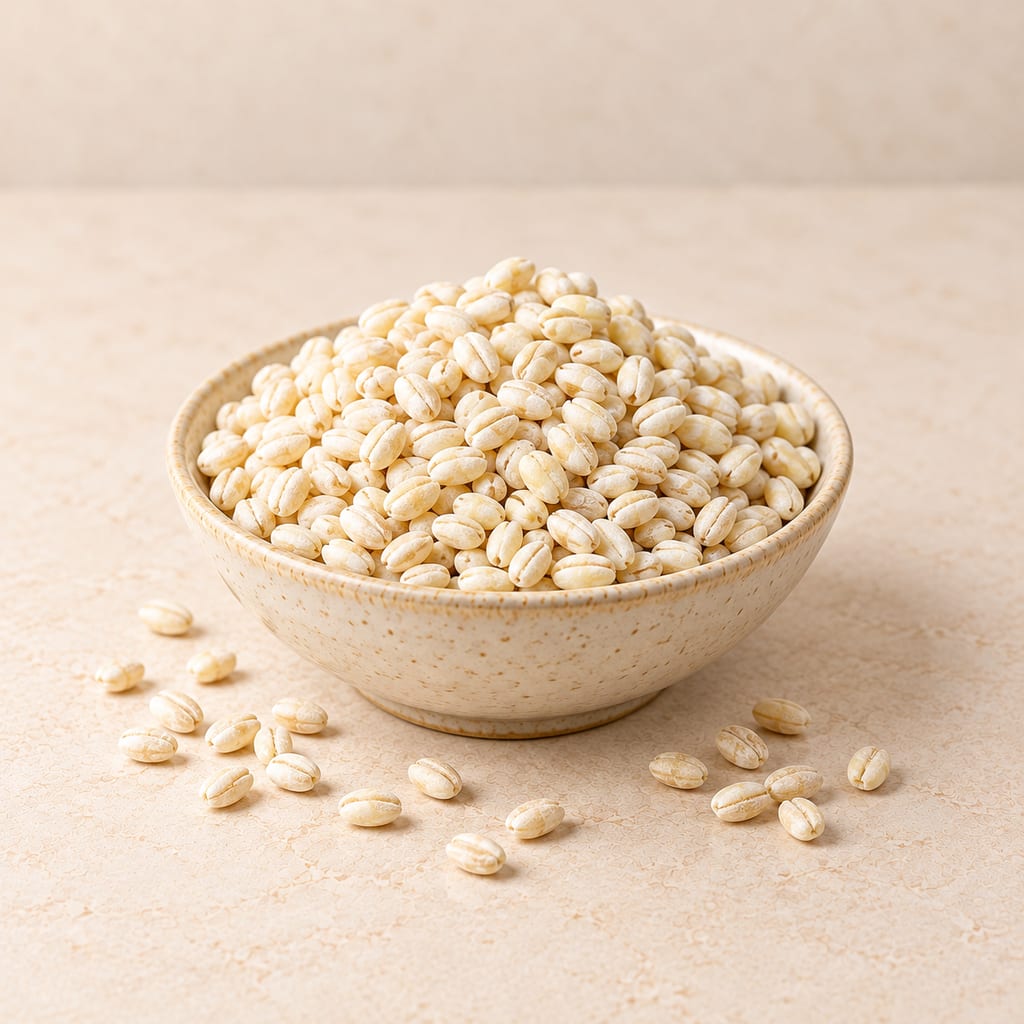
Barley, Hordeum vulgare, is a cereal grass in the same tribe as wheat and rye, and every cultivated form belongs to the one species. Its grain is long and slightly twisted, and most of its weight is endosperm, the starchy store, at about 77 per cent. The husk takes about 13 per cent, the pericarp and testa 3.3 per cent, the aleurone layer 5.5 per cent and the germ 3 per cent. Barley is sorted by how many rows of grain the head carries, two or six; by whether the husk stays glued to the kernel (covered) or falls free on threshing (naked or hulless); and by whether it is sown in spring or winter. Brewers prefer two-row types, and six-row types are mostly fed to livestock.
The names follow it across the Caucasus and Asia: keri (ქერი) in Georgian, gari in Armenian, arpa in Azeri, and qingke in Chinese or nas in Tibetan for the hulless six-row barley that feeds the Tibetan Plateau. Barley is not wheat. Its storage proteins are hordeins rather than the gliadins and glutenins of wheat, so a barley dough forms far less of a stretchy gluten network, and barley flour is usually blended with wheat flour for bread.
Barley is one of the oldest crops. Its wild ancestor, Hordeum vulgare ssp. spontaneum, was first described from Turkey by the German botanist Carl Koch, and the first definite sign of cultivation in the arc of the Middle East is more than 10,000 years old. Domestication left traces in the grain. Wild barley shatters, scattering its seed; cultivated barley holds its grain on a tough stalk so that it can be harvested, and spikes of this kind turn up at Tell Abu Hureyra about 9,500 years ago. Naked kernels, which thresh free of the husk, appear at Ali Kosh about 8,000 years ago. The most striking change was the six-row head, which carries three times as many seeds as the two-row head it came from, and the gene behind it suggests that this change was made more than once. The first domesticated barleys were probably winter types; spring barley, sown in spring, came later through a mutation that arose many times.
From the Middle East barley followed farmers into Europe, Africa and Asia. In Tibet the hulless six-row type became the principal cereal at least 3,500 years ago, and genetic evidence shows it arrived in the southern plateau between 4,500 and 3,500 years ago from the eastern part of barley’s range, not from a local domestication. In the Southern Caucasus barley has been cultivated for thousands of years because it tolerates cold winters and poor conditions. In Georgia it is among the oldest cultivated crops: mountain communities grew it for forage, bread and beer, used it in traditional rituals and folk medicine, and kept many varieties. Breeders’ varieties now dominate, and only a few landraces survive on very small areas in the high mountains of Khevsureti and Tusheti. The area under barley in the decade before the national report was between 75,000 and 100,000 hectares.
Barley was probably first a human food, and it has remained the most important food source of some cultures, especially in Asia and North Africa. As wheat displaced it from the bread of richer regions, barley found new work as the feed grain of livestock and as the raw material of malt. Ancient Arabic, Chinese, Egyptian, Ethiopian and Greek writers praised it for strength and stamina and used it in medicine. Much of the world’s barley grows where maize and rice do not thrive. It is among the best-adapted cereals, grown in climates from subarctic to subtropical.
The modern trade reflects those choices. World production was about 147 million tonnes in 2021/22 after about 160 million the year before, with the European Union the leading producer at 52.75 million tonnes. Only about 6 per cent of the crop becomes human food, mostly in soups and some flour. The rest is split between animal feed and the malting and brewing industry, which wants a two-row barley with a modest protein level and a plump, uniform kernel.
Starch is the main component. Whole-grain barley contains about 58 to 61 per cent starch, 12 to 15 per cent protein, 2.5 to 2.7 per cent fat, and 17 to 21 per cent dietary fiber, of which beta-glucan is 4.8 to 5.7 per cent, depending on whether the barley is covered or naked. Naked barley has more protein, fat and soluble fiber than covered. Barley starch normally holds amylopectin and amylose in a ratio of about three to one, though waxy types are 95 to 100 per cent amylopectin and some cultivars have 40 to 70 per cent amylose.
Beta-glucan, a gummy fiber in the cell walls of the endosperm, is barley’s distinguishing nutrient. It dissolves into a viscous solution that slows the absorption of glucose, and the U.S. Food and Drug Administration and the European Food Safety Authority have approved health claims linking barley beta-glucan to lower blood cholesterol. The same fiber causes trouble in the brewery, where it thickens the wort. Protein runs from about 7 to 25 per cent across more than 10,000 genotypes tested and sits at 9 to 13 per cent in typical barley; high-protein barley suits food and feed, while low-protein barley suits malting.
Covered barley must lose its husk before it can be eaten. Dehulled grain with the bran layer largely intact is chewy and slow to cook. Pearling grinds off more of the husk, bran and germ in stages: the first stage gives pot barley, with most of its bran, and further polishing gives white pearled barley, the most common form, which cooks faster, with fewer nutrients, and is used as a substitute for rice and in soup. Naked barley needs no dehulling, and its bran layer stays on unless it is pearled. Flakes are barley steamed and rolled like oats; grits are cut, roasted or steamed pieces; flour is made by roller-milling pearled barley; and roasted covered barley makes the tea called mugi-cha in Japan.
Malted barley is a separate product: sprouted grain dried in a kiln. Ground into malt flour it comes in two kinds: diastatic, with active enzymes, which is added to flours that have little natural diastatic activity, and non-diastatic, which has none and is used for its flavor, in malted milk and for a softer crumb and glossier surface in baked goods.
Barley bread is not one worldwide formula. Barley flour behaves differently from wheat flour because it does not make the elastic, extensible gluten network that supports a tall, open loaf. Bakers use it as a share of a wheat dough, shape it into flat breads that need less expansion, or dry baked loaves a second time. These are different choices, not interchangeable recipes. Flat-bread research distinguishes batter from firm dough, leavened from unleavened dough, and griddle or hearth baking from oven baking; some forms depend on gluten while others use non-wheat flours.
Iranian jow is a place-specific barley bread named in a review of traditional flat breads: jow is Persian for barley, and the review describes this leavened, single-layered flatbread as made from barley flour. It sits alongside, rather than representing, Iran’s better-known wheat breads. The same review explains why flat breads accommodate diverse grains: a thin sheet or batter can be cooked quickly on a griddle or other hot surface, while a high, elastic loaf depends more heavily on its flour’s dough structure.
In Orkney, the Rowett Institute gives a beremeal bannock formula using 115 g beremeal or barley flour with 115 g plain white flour, baking powder, salt, vegetable oil spread and milk. The wheat flour shares the dough; baking powder raises it chemically, so this recipe is not a fermentation. The source shapes the mixture into two thick rounds and cooks them on a griddle or in an oven. It describes bannocks as a broader Scottish, Irish and northern English family, with Orkney’s beremeal version as one regional member.
Lapin ohrarieska offers a different balance: the published Finnish Lapland batch uses barley flour alone with cold water, salt and baking powder. The instructions keep the dough cold, mix it only until it holds together, press two rounds by hand and bake them on a preheated sheet for 5–8 minutes at the hottest practical oven setting. The author gives soft and crisp cooling options. This is a documented modern formulation for Lapland rieska, not a general formula for every bread called rieska.
Cretan rusks show barley in a mixed-grain bread that is baked twice. A regional booklet describes cutting bread into slices and baking it again to dry, and associates dakos with Crete. One current Cretan producer lists wholegrain barley flour, wheat flours, barley sourdough, barley malt, yeast and salt in its Ntakos-style barley rusks. That ingredient list is a producer’s formula, not a universal rusk recipe. The dry rusk is served with salads; the second bake is a drying stage, distinct from the sourdough and yeast activity in the dough.
Taken together, these cases show barley as an entire flour in one flatbread, a half-share in a chemically raised bannock, and a major grain in mixed sourdough rusks. Their differing structures and stages explain why a single barley-to-wheat ratio cannot be prescribed for all baking. Home preparation is supported where a source gives a specific batch and method; the quantities and conditions belong to that version only. Barley contains gluten-related proteins and is not suitable for people who must avoid gluten.
Malting is germination under control, not fermentation. The grain is steeped in water at 14 to 16 °C until it holds 42 to 48 per cent moisture, which wakes the embryo, and it is allowed to germinate. In the sprouting grain enzymes dismantle the cell walls and part of the protein of the endosperm, which is called modification, and build up the starch-splitting enzymes that will be needed later. Kilning then dries the green malt to 4 to 6 per cent moisture, which fixes the enzymes and develops color and flavor. Over- or under-modified malt gives too much or too little protein and dextrin in the beer, and kilning can also start lipid oxidation, which makes the stale cardboard flavor of trans-2-nonenal.
The malt’s enzymes do their work in the mash. Milled malt is stirred into water and heated for hours, and alpha-amylase chops the long starch chains into smaller pieces for beta-amylase, which snips off maltose, a sugar yeast can ferment. Together with limit dextrinase and alpha-glucosidase these enzymes make up what brewers call diastatic power. The husks form a filter bed through which the sweet liquid, the wort, drains; about 60 to 70 per cent of the dry matter goes into the wort and the rest remains as spent grain. A good malt yields at least 80 per cent extract on a dry basis. The amino acids released from the protein, measured as free amino nitrogen, feed the yeast that ferments the wort, and beta-glucan left undegraded makes wort slow to run and can haze the beer. Wort is a prepared substrate; yeast turns it into beer only afterward.
The second large role of barley is as a bed for koji. Koji is the mold Aspergillus oryzae grown on steamed or boiled grain; on barley it is called barley koji, and on rice, rice koji. As the mold grows it secretes amylases, which break starch down to sugars, and proteases, which break protein down to amino acids and peptides, and these enzymes do the work in the later miso or sauce. Koji is a mold culture that supplies enzymes; the later fermentation of the miso is a separate stage.
Japan’s agriculture ministry sorts miso by the grain of its koji. Barley miso, also called country-style or inaka miso, is made with barley koji, salt and steamed soybeans, and its production is limited to Kyushu, Shikoku and Chugoku and part of Kanto. Its table lists two barley types, amakuchi, with a koji-to-soybean ratio of 15 to 25 and salt of 9 to 11, and karakuchi, with a ratio of 8 to 15 and salt of 11 to 13; barley miso is light-colored or red. Without temperature control it needs at least 8 months, spanning one summer, or about six months held at 27 °C, and it tastes best after about a year and a half to two years. It is eaten across Japan and is most popular in Kyushu.
Choose barley by the job. Pearled barley suits soups and rice-style dishes; hulled or hulless barley keeps more bran and chew; malt is bought as a brewing grain or as a malt flour, and the diastatic or non-diastatic label says whether it carries working enzymes. Keep dry grains in airtight containers that exclude moisture, dust and insects. Follow the date on the package for dry barley, and keep cooked barley as you would any cooked grain.
Barley contains gluten. The protein is hordein, and the National Institute of Diabetes and Digestive and Kidney Diseases names barley with wheat and rye as the grains whose gluten triggers celiac disease, which is treated with a strict gluten-free diet. Foods made from the grain, such as malt, should be assumed to contain it unless the label says otherwise.
barley, gluten
Area where barley was first cultivated; the sources do not fix a single site or date of domestication.
Cultivation and traditional use for food, forage, beer and ritual; separate from the preparations that use barley.
Hulless six-row qingke barley; introduced, not domesticated locally.
Regions where barley miso, made with barley koji, is produced; the ministry also lists parts of Kanto.
The Rowett Institute's Orkney recipe names bere/barley flour for its bannock; it does not establish a unique origin for bannocks.
A named Lapland variation of rieska made entirely with barley flour in the published batch; this is a documented preparation, not a claim that rieska is unique to Lapland.
Regional booklet describes the second-baking of rusks and reports early barley bread in finds without a specific date or recipe; producer documents a current barley-wheat rusk.
The review reports jow, a leavened barley-flour flatbread, but this source does not identify a narrower region.
Crushed or milled barley cooked in water until the starch softens and the mixture thickens, the plainest way a northern household turned stored grain into a meal, here with apple and hazelnut.
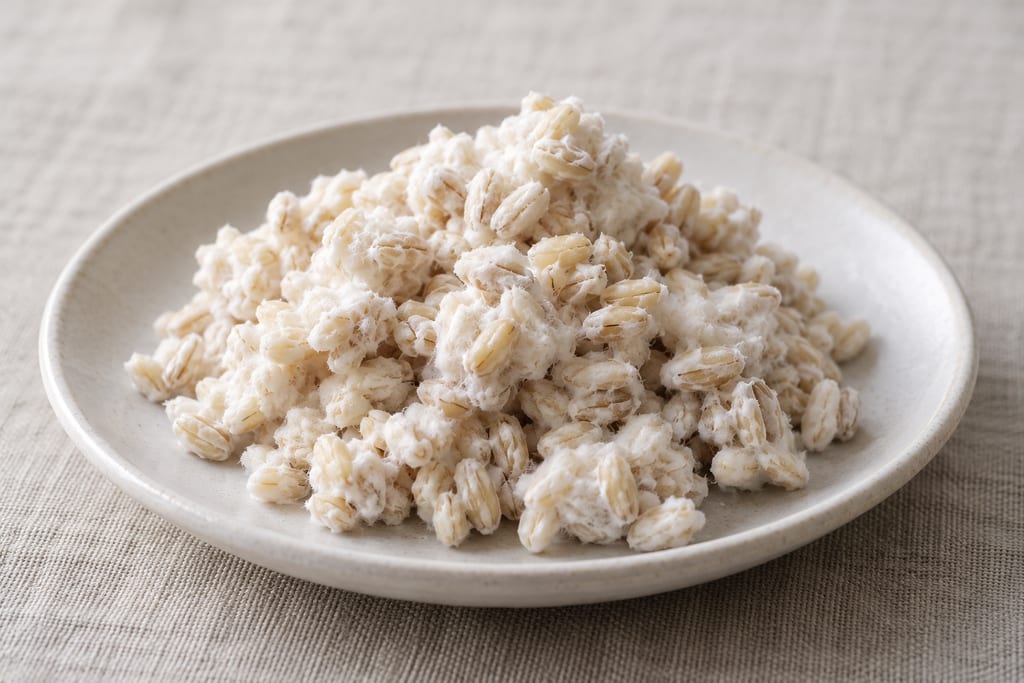
Steamed pearled barley grown into a white koji cake with Aspergillus oryzae over about 36 hours in a 30 °C chamber, turned three times under a damp cloth.
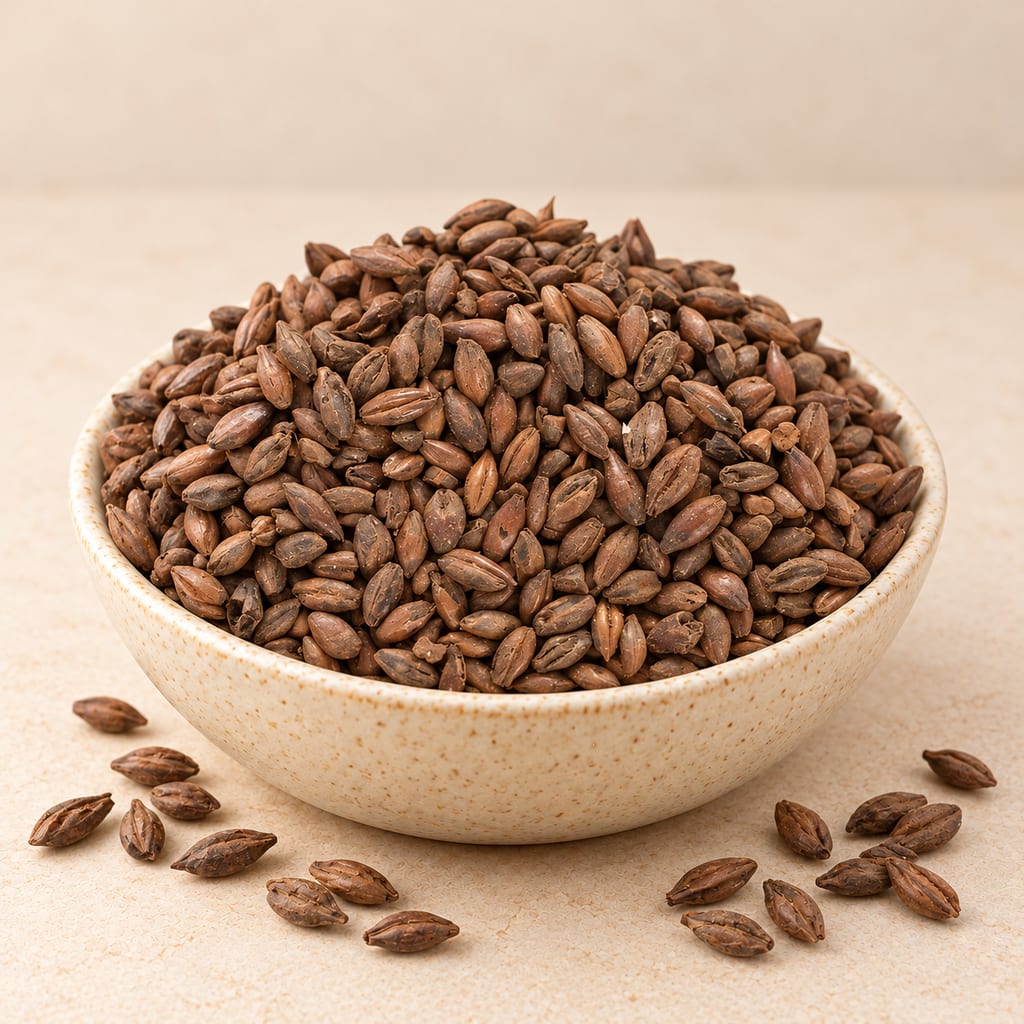
Chocolate malt is barley that has been malted and then roasted to a dark brown, used in porters, stouts and brown ales for colour and a bitter-cocoa, roasted-coffee flavour. It contains no cocoa.
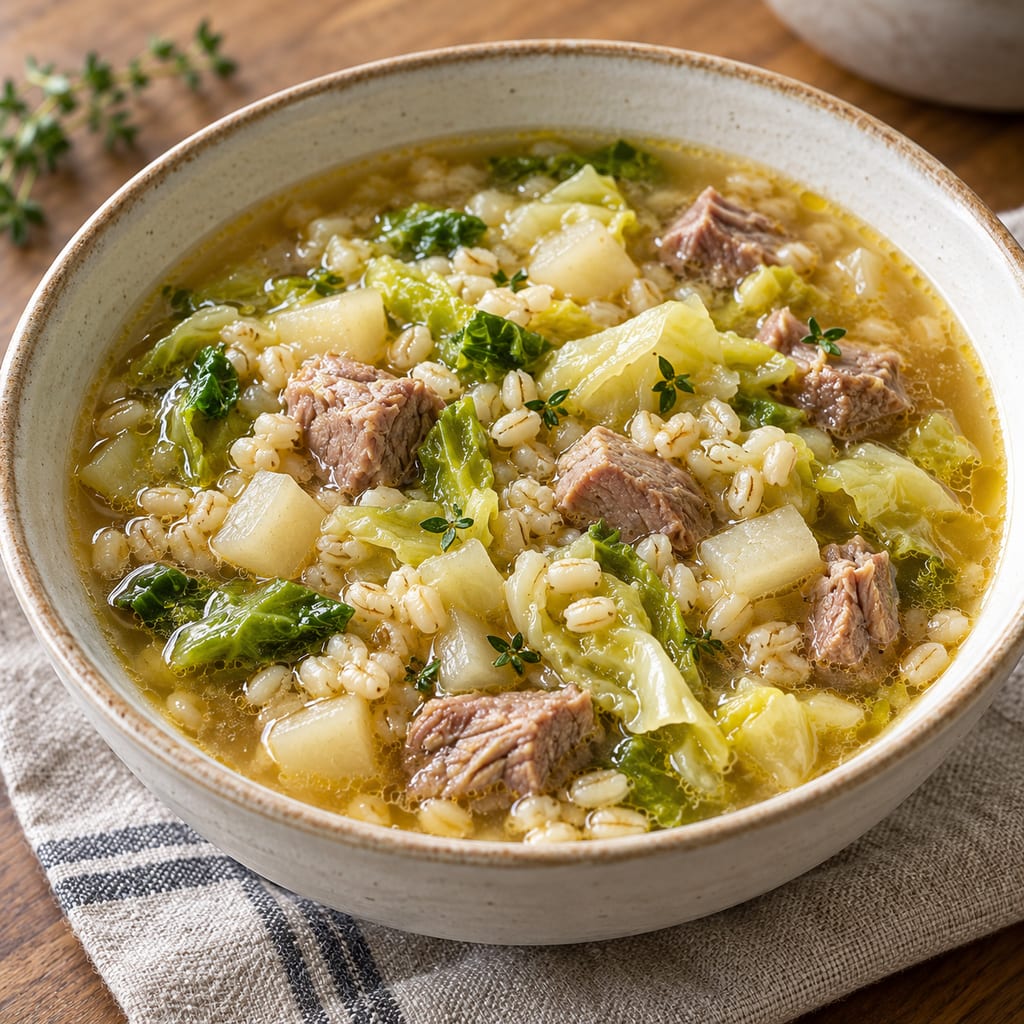
Lamb shoulder simmered with pearl barley, turnip and leafy cabbage in one pot, a present-day reconstruction built from the animals, grains and vegetables of northern European farming.
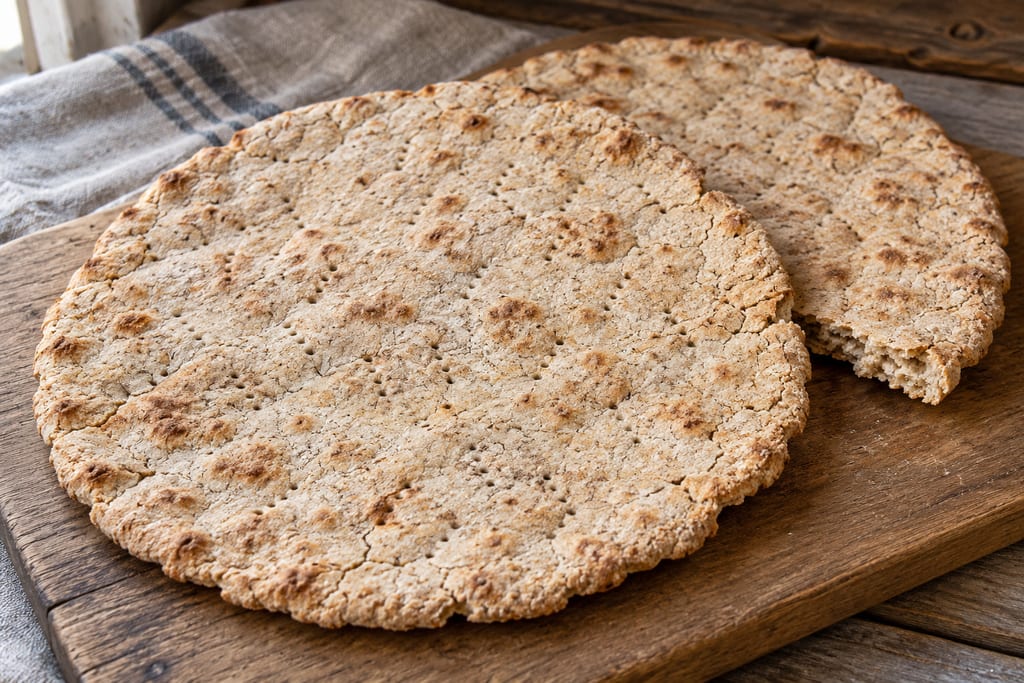
Two barley flatbreads made with cold dough and baked rapidly on a hot sheet, following Timo Lepistö's northern Finnish formula.
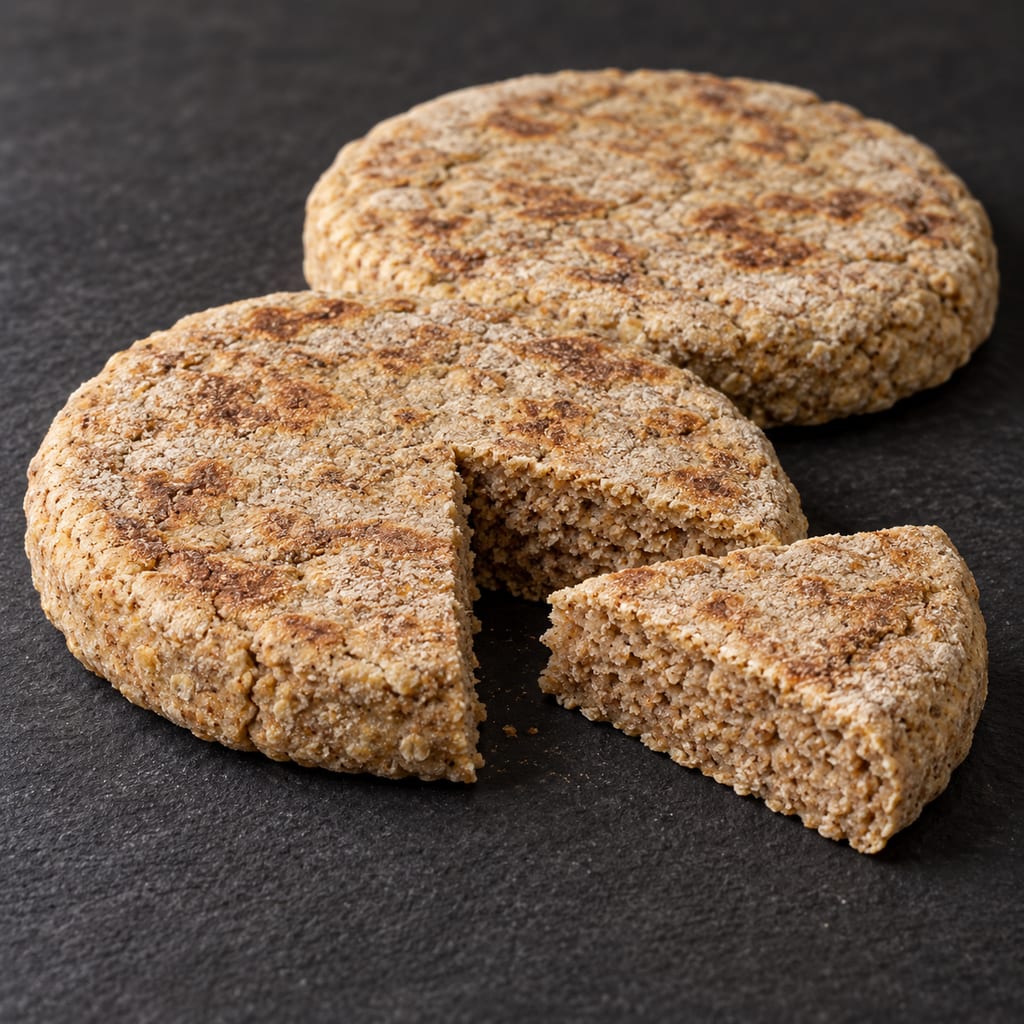
Two round, chemically raised bannocks made with equal weights of white flour and beremeal, barley flour or oat flour, following Anne Johnson's Orkney formula.
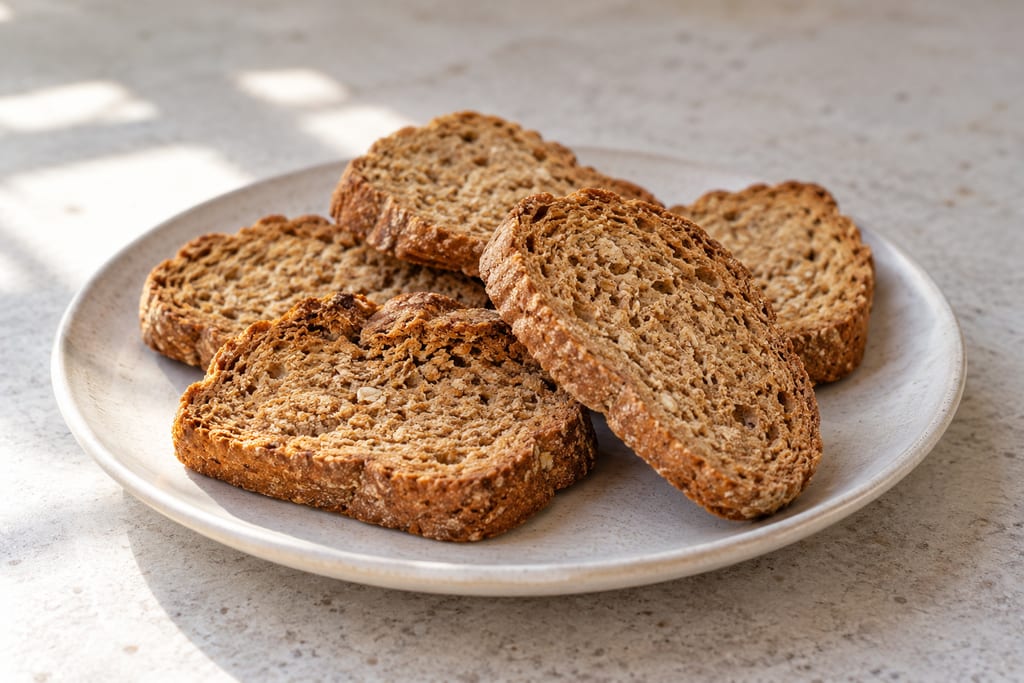
Elena Paravantes gives a modern 50/50 whole-grain barley and wheat rusk recipe, shaped as one scored loaf, baked, separated into slices and dried in a low oven. The second rise has no stated duration.
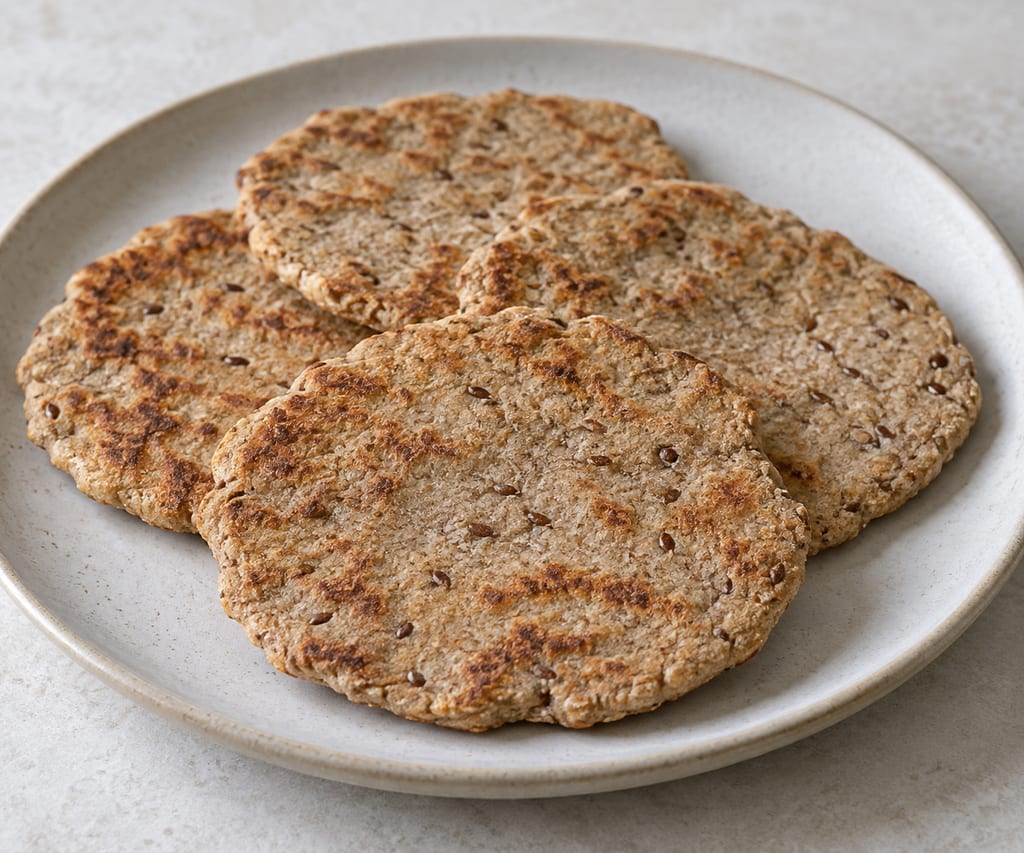
A small, dense cake of ground barley mixed with liquid and cooked against a hot surface, the form a low-gluten northern cereal takes when a household turns stored grain into bread.
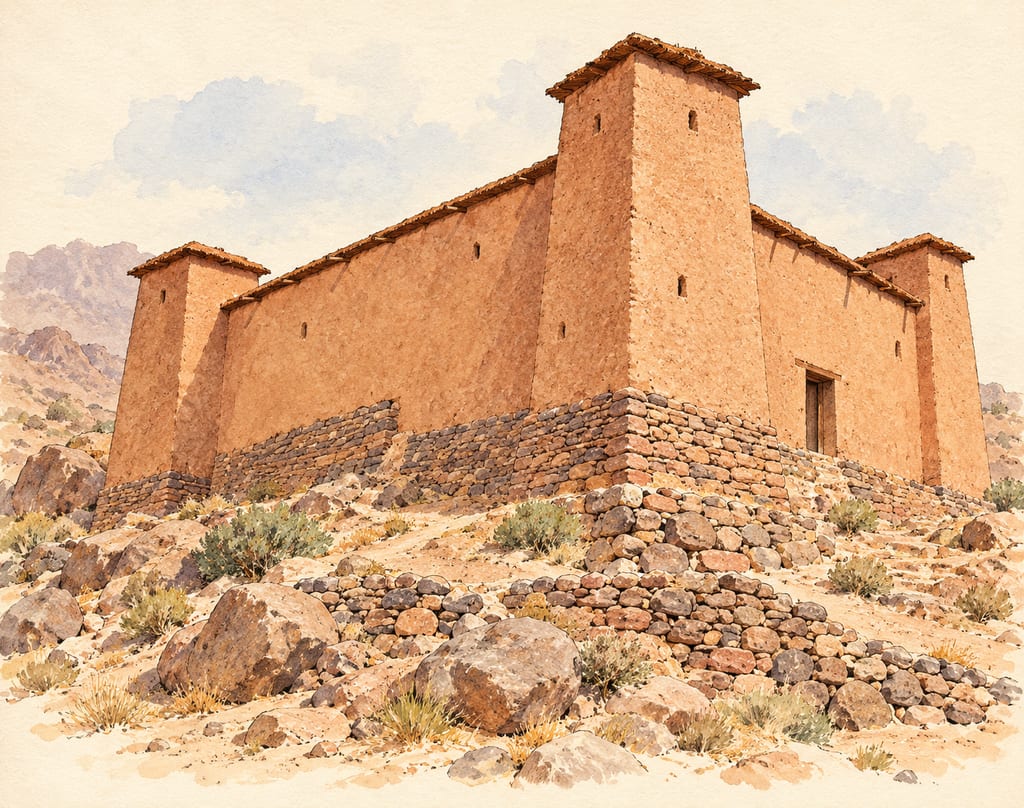
An agadir (plural igoudar) is a fixed Amazigh communal storehouse in Morocco for harvests and other valuables. Layout, materials and community rules vary by site; no single plan describes every granary.
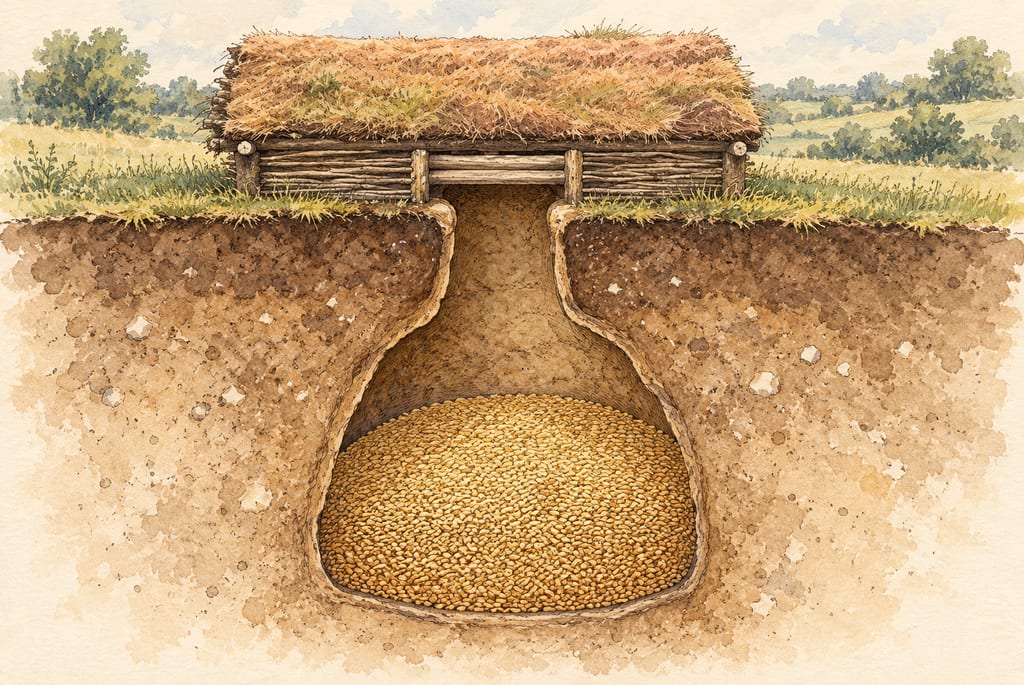
An underground grain-storage pit is a dug cavity for keeping dry grain, distinct from raised granaries and portable silos. Iron Age British examples are archaeological interpretations; experimental forms and results varied.
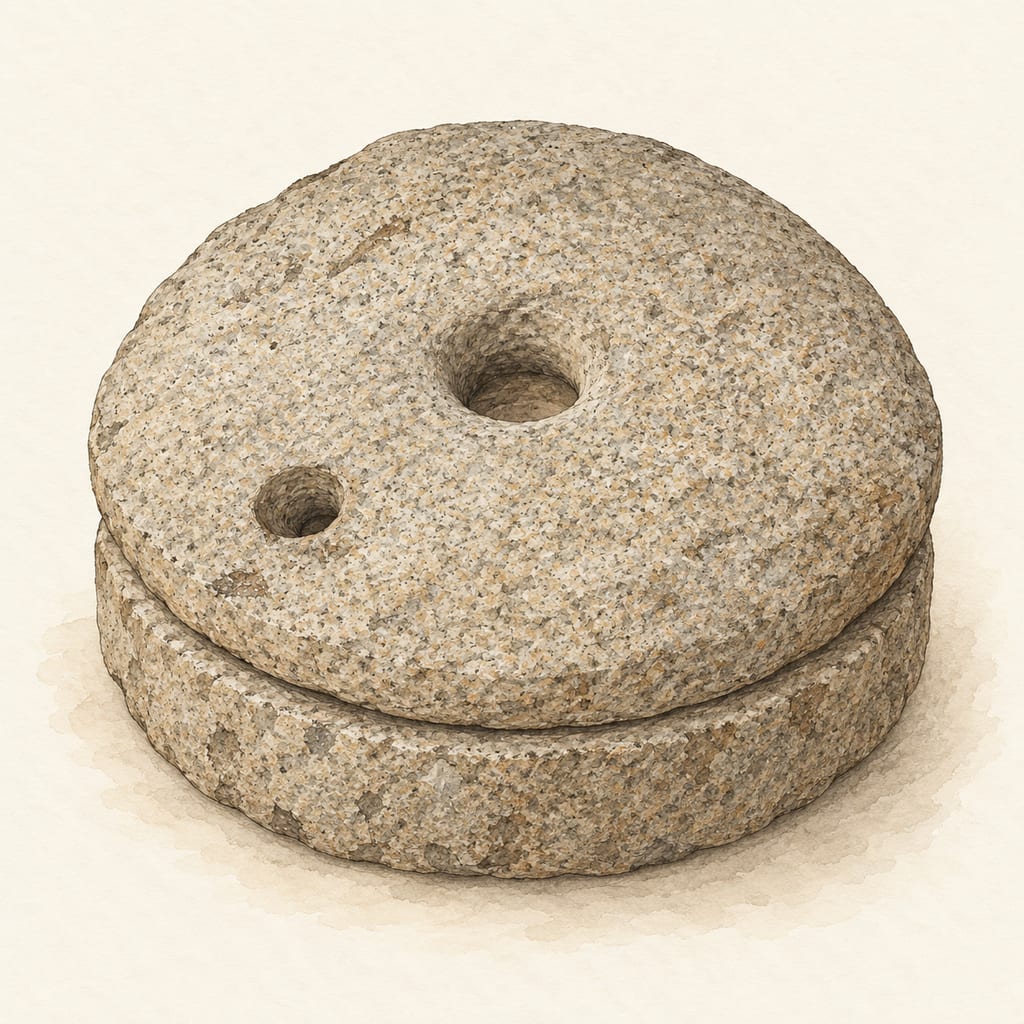
A rotary quern is a hand-operated mill with a runner turning over a fixed bedstone to grind grain. Scandinavian household use of rotary querns increased around the beginning of the Viking Age.
Neolithic underground grain-storage pits in Egypt's Fayum, identified through basketry linings and remains of emmer and hulled barley.
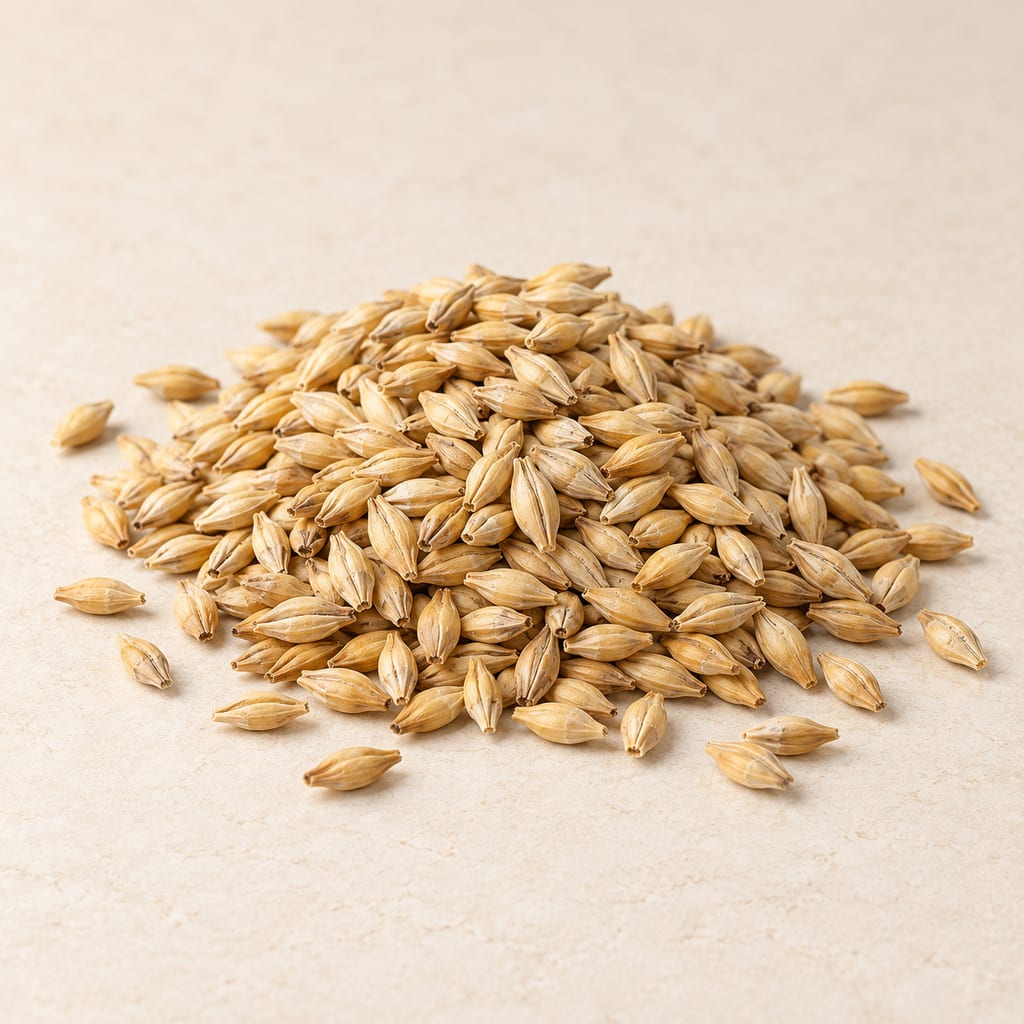
A lightly kilned brewing base made from two-row barley. It supplies starch and enzymes for the mash, with the maltster’s product and lot analysis defining its brewing properties.
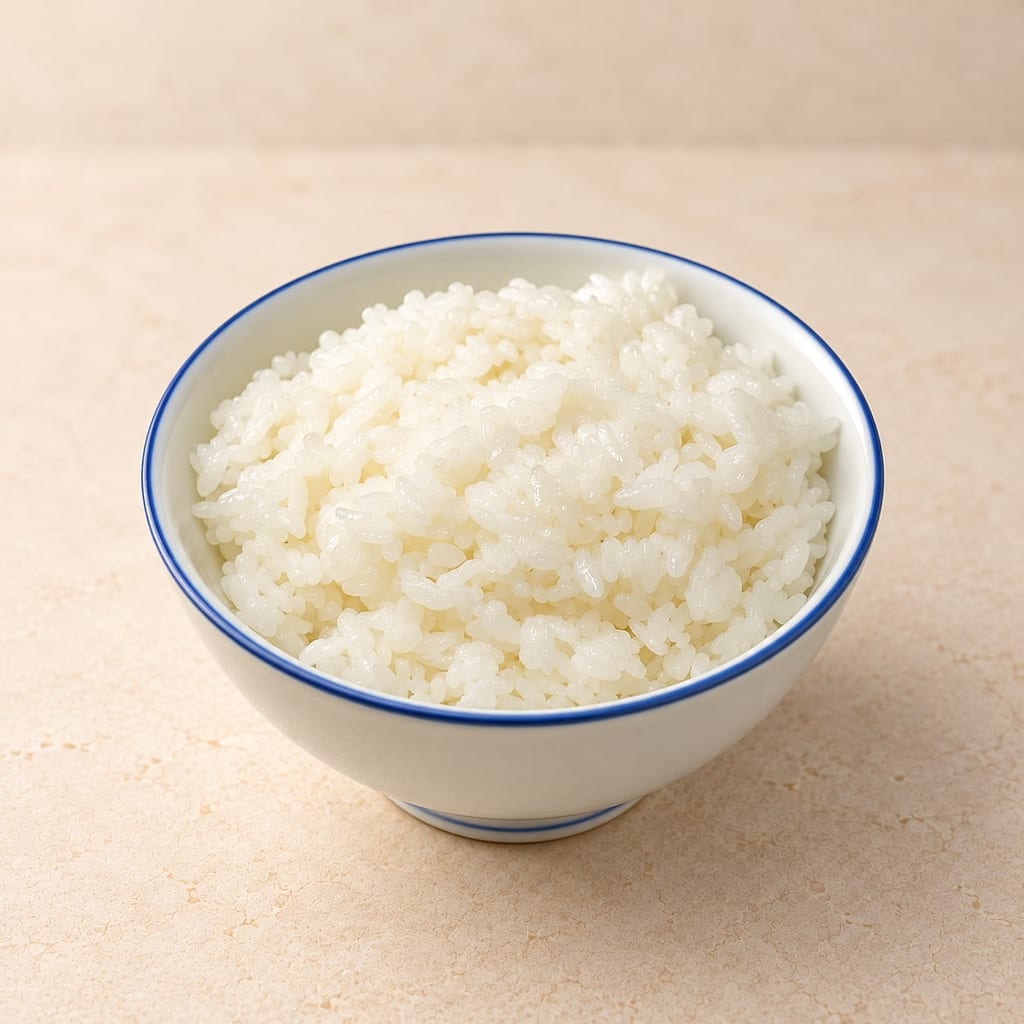
Cooked rice is rice grain heated in water until its starch gelatinizes; in Thai sour sausage it feeds the bacteria that acidify the meat.
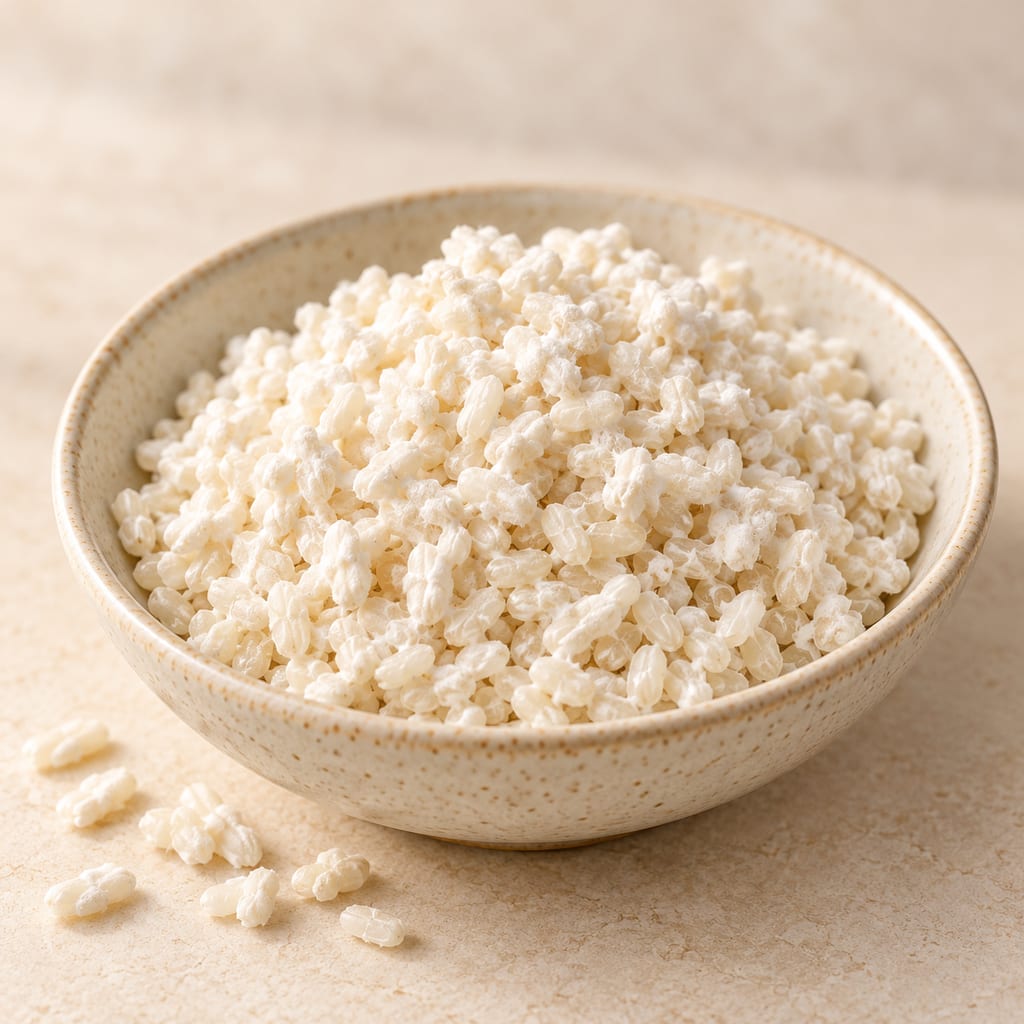
Koji is steamed grain — rice, barley, soybean or wheat — grown out with a food-grade Aspergillus mold until the kernels carry working enzymes. It is bought or cultivated, and it converts starch and protein for the foods that follow.
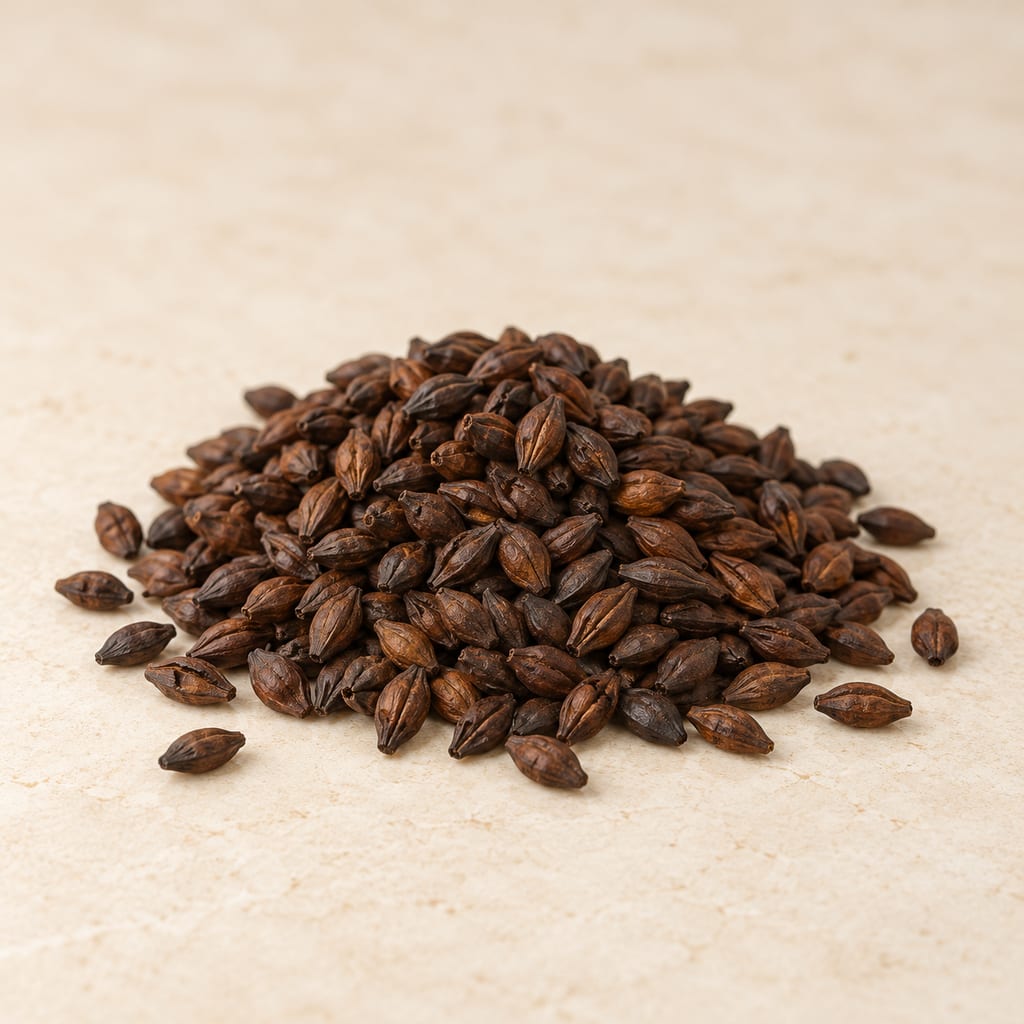
Dark-roasted unmalted barley used for colour and a dry roasted edge in stout, with other roast grades used in grain infusions and foods.

From sour breads and milk to savoury seeds, cassava staples and living beers, African fermentation follows the crop, the community and the work of transformation.
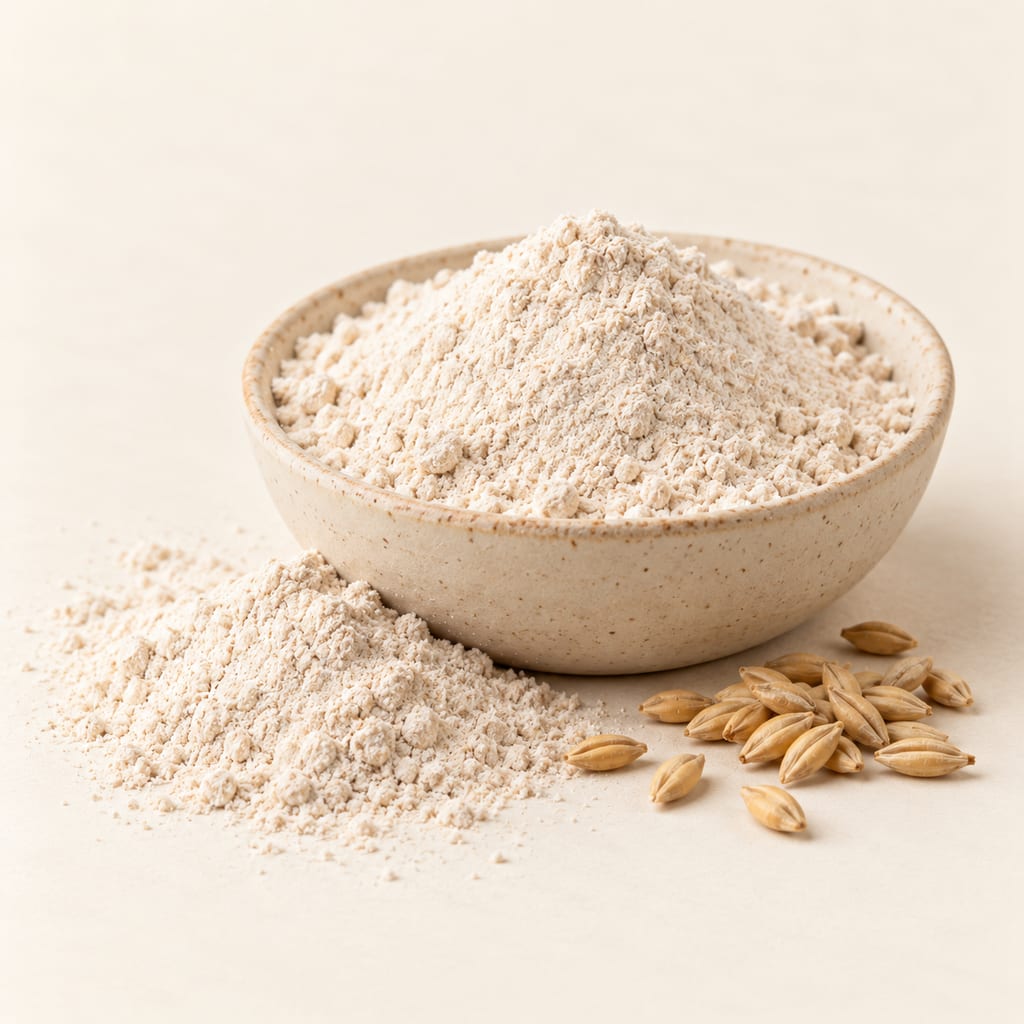
Barley flour is ground barley grain; whether it comes from pearled or hulless kernels, its milling and limited wheat-like gluten-forming ability shape the doughs and foods it can make.
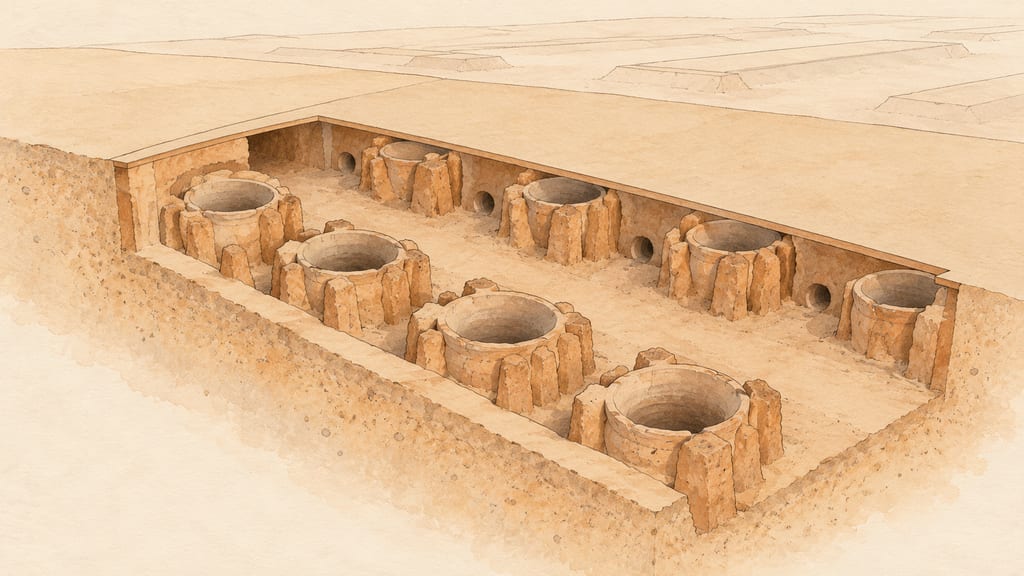
At North Abydos in Egypt, a fixed early Dynastic brewery comprised parallel semi-subterranean installations with rows of ceramic mash vats; excavation reports revise their number, scale and estimated batch capacity.
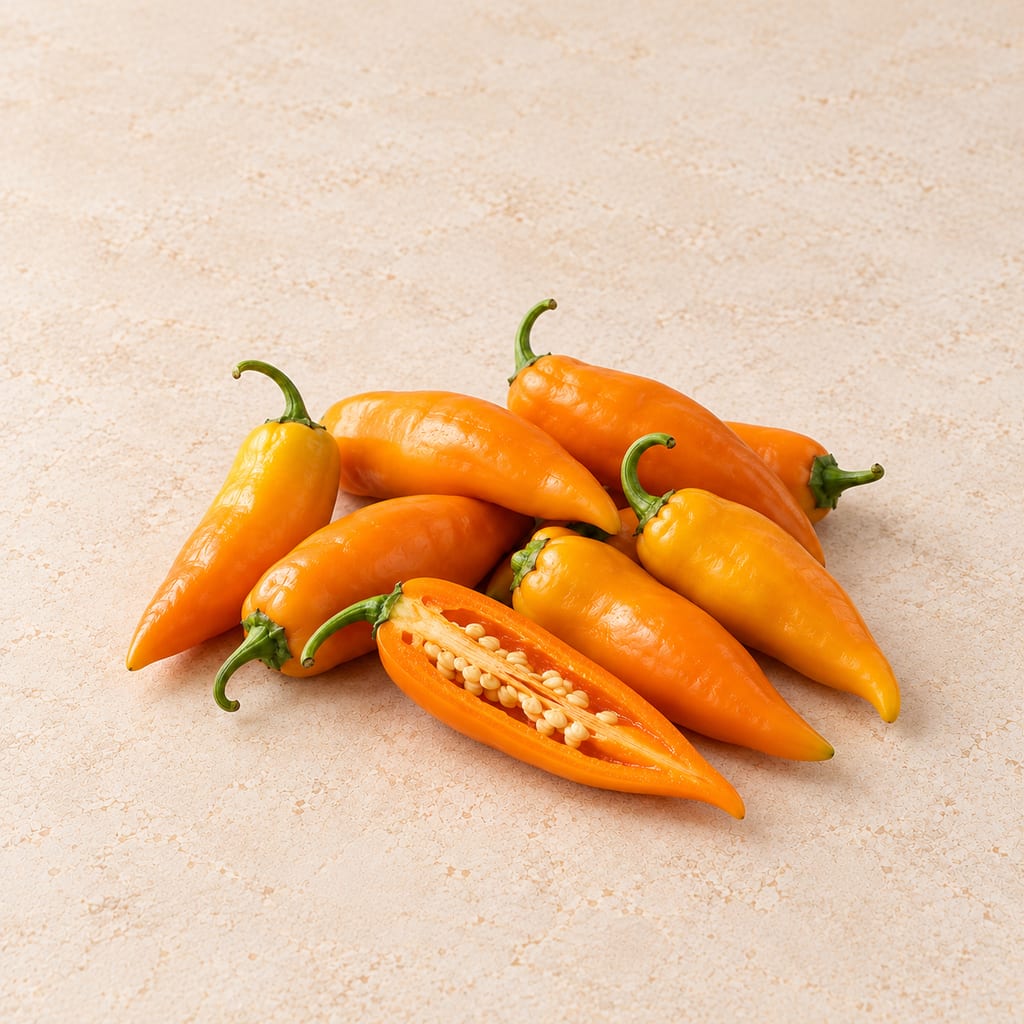
Ají amarillo is the orange-yellow Peruvian chilli cultivar group of Capsicum baccatum, used to colour and season huancaína sauce and ají de gallina. Published heat estimates do not establish one range for the named cultivar.

Toasted almonds are whole sweet almond kernels dry-roasted until golden to brown. Heat replaces their marzipan note with a roasted, nutty one; they thicken and flavour romesco.

Kodiak salmon, halibut and cod cut as seg'aq and hung on an initaq rack to become tamuuq, with kac'amaasaq and kupcuunaq named as different results.

Aniseed is the dried ripe fruit of Pimpinella anisum, an aromatic Apiaceae spice commonly called a seed. It adds a sweet, warm aroma to breads such as Moroccan krachel and South African mosbolletjies, and is distinct from star anise.
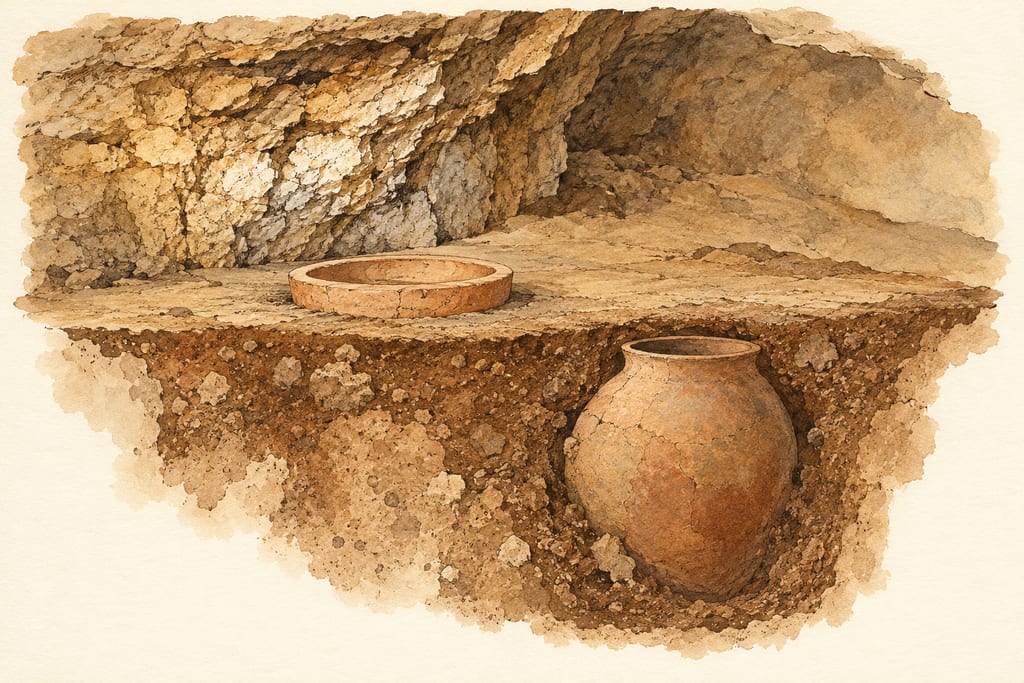
A fixed Late Chalcolithic installation in Areni-1 cave combined a shallow clay pressing basin with a large jar set into the cave floor and storage vessels nearby.

Ripe avocado flesh is the soft, buttery, fat-rich pulp of Persea americana, eaten raw. It is low in acid, so it is a fresh ingredient that needs care in chilled dishes.
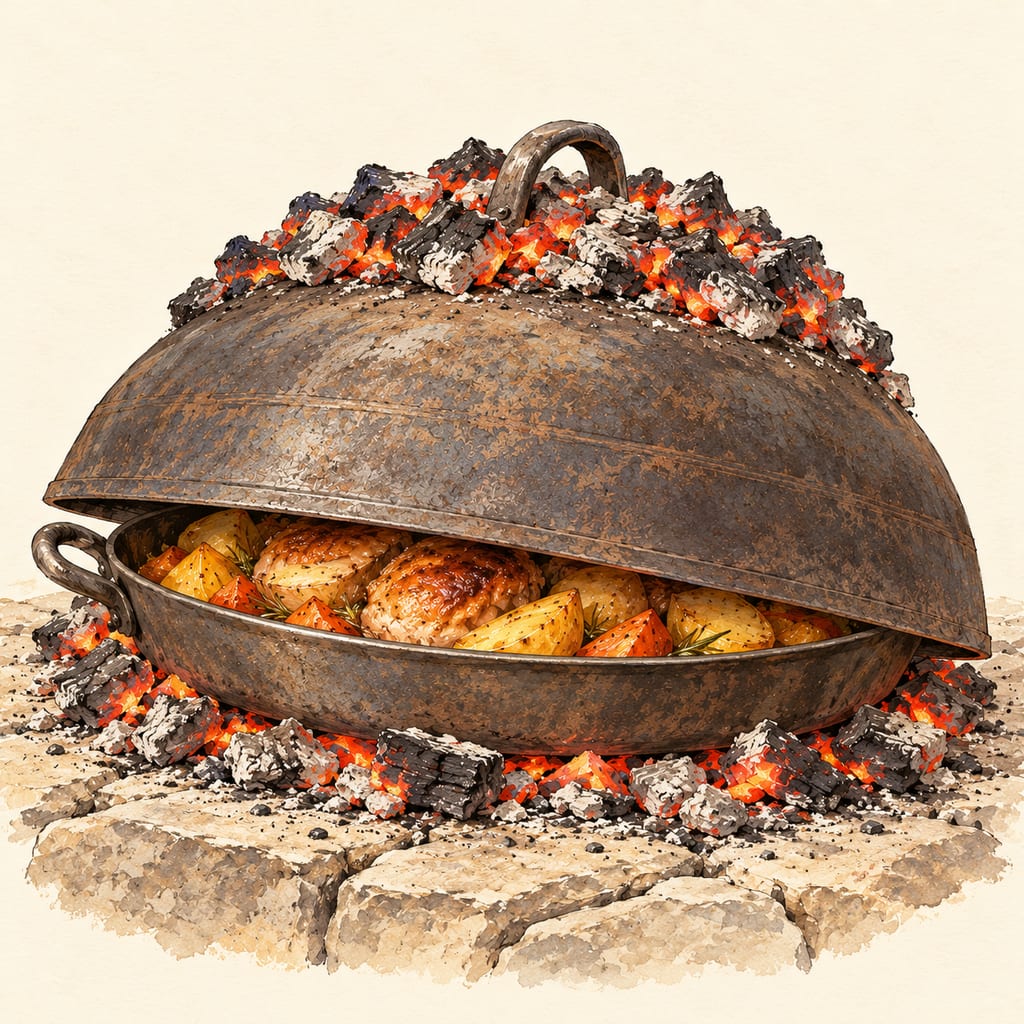
A portable dome and pan used over a hearth, with embers on the lid and heat from below. Regional peka and saç forms share this principle while differing in materials, pan shape and how the food is cooked.
No community contributions have been published for this entry yet.
Sign in to contribute. Published comments and photos are free to read.
Plants (MDPI)Identity · Composition · Forms
Barley in the Production of Cereal-Based ProductsBarley (Hordeum vulgare) was probably first used for human consumption and later became a feed and malt crop as wheat took over the human diet; world production was 147.05 million tonnes in 2021/22, with the European Union the leading producer at 52.75 million tonnes; only about 6 percent goes to human food.
Grain weight is about 77.2% endosperm, about 13% husk, 3.3% pericarp and testa, 5.5% aleurone and 3% germ; whole-grain barley holds 57.7–60.7% starch, 12.2–15.1% protein, 4.8–5.7% beta-glucan and 16.6–20.6% dietary fiber, depending on covered or naked type.
Forms include covered (hulled) barley, pot barley, pearled barley, naked barley, flakes, grits, flour, bran, roasted barley used for mugi-cha, malt and malted flour, sprouts and brewers’ spent grain.
Barley flour contains hordeins rather than gliadins and forms less gluten network than wheat flour.
About 60–70% of the dry matter of mashed malt passes into the wort and the rest remains as brewers’ spent grain.
Cited in: A hardy grain with many faces; From staple to malt; What is in the grain; Forms and how to cook them; Barley in bread and the kitchen; How malt works in fermentation; Choosing it, storing it and who cannot eat it
Annals of BotanyOrigin
The importance of barley genetics and domestication in a global perspectiveThe wild ancestor is Hordeum vulgare ssp. spontaneum, first described from Turkey; the first definite sign of barley cultivation in the Middle East arc is more than 10,000 years old.
Non-brittle spikes (an easier harvest) appear at Tell Abu Hureyra about 9,500 years ago, naked kernels at Ali Kosh about 8,000 years ago; six-rowed barley, with three times as many seeds per spike, arose from two-rowed barley and was domesticated more than once.
Cited in: Where barley comes from
Nature CommunicationsSpread
Origin and evolution of qingke barley in TibetTibetan hulless six-rowed barley (qingke in Chinese, nas in Tibetan) has been the principal cereal of the Tibetan Plateau for at least 3,500 years, and reached southern Tibet between 4,500 and 3,500 years ago from the east of the barley range.
Cited in: A hardy grain with many faces; Where barley comes from; From staple to malt
Frontiers in Plant ScienceMalting · Enzymes
Variation in quality of grains used in malting and brewingMalting steeps barley at 14–16 °C to 42–48% moisture, germinates it, and kilns it to 4–6% moisture; kilning sets color and flavor.
Diastatic power is the combined activity of alpha-amylase, beta-amylase, limit dextrinase and alpha-glucosidase; beta-amylase releases maltose and is denatured at about 65 °C in the late mash.
Milled malt is mashed in water for several hours (saccharification) and the sugary wort is drained from the husks and spent grain; barley beta-glucan makes wort viscous; a malt extract of at least 80% is the standard; lipid oxidation in kilned malt can form trans-2-nonenal.
Cited in: How malt works in fermentation
Georgian national authorities via FAOCultivation
Country Report on the State of Plant Genetic Resources for Food and Agriculture: GeorgiaBarley is one of the oldest cultivated crop plants of Georgia; the mountain population used it for forage, food and beer, in traditional rituals and in folk medicine; breeders’ varieties now dominate and a few landraces survive in Khevsureti and Tusheti; barley covered 75,000–100,000 ha in the decade before the report.
Cited in: Where barley comes from
Food and Agriculture Organization of the United NationsNames · Cultivation
Gardens of Biodiversity, chapter 4Barley (Hordeum vulgare L.) is one of the most important cereals of the Southern Caucasus, cultivated for thousands of years for its rusticity and resistance to extreme seasonal variations; the names are Gari (Armenian), Arpa (Azeri) and Keri (Georgian).
Cited in: A hardy grain with many faces; Where barley comes from
Ministry of Agriculture, Forestry and Fisheries, JapanMiso types and regional variation
Traditional Japanese Food: Soy Sauce and MisoMiso is made from koji, salt and steamed soybeans; barley miso uses barley koji and is also called country-style (inaka) miso; production is limited to the Kyushu, Shikoku and Chugoku regions and parts of Kanto.
The ministry lists mildly salty barley miso (koji-to-soybean ratio 15–25, salt 9–11) and salty barley miso (ratio 8–15, salt 11–13), without stating units.
Cited in: How koji works on barley
British Columbia Centre for Disease ControlKoji
Fermented Foods Guideline 3.10: Koji and MisoKoji is Aspergillus mold grown on steamed or boiled rice, barley or wheat; grown on barley it is called barley koji; the mold secretes amylases, which break starch into sugars, and proteases, which break proteins into amino acids and peptides.
Cited in: How koji works on barley
The Japanese Food LabBarley miso method
Barley Miso RecipeA producer’s guide gives at least 8 months for barley miso without temperature control (including one summer) or about 6 months at 27 °C, a prime flavor after about 1.5 to 2 years, and a minimum salt of 175 g per kilogram of cooked soybeans; barley miso is found throughout Japan and most popular in Kyushu.
Cited in: How koji works on barley
U.S. National Institute of Diabetes and Digestive and Kidney DiseasesDietary context
Definition & Facts for Celiac DiseaseGluten, a protein in wheat, barley and rye, triggers celiac disease, which is treated with a strict gluten-free diet.
Cited in: Choosing it, storing it and who cannot eat it
Clemson Cooperative ExtensionStorage · Use
Selecting & Storing Cereals & GrainsPearl barley is used mainly in soups; barley flour makes a sweet, light bread but has no gluten of its own and is mixed with white flour; cereals are kept in airtight containers that exclude moisture, dust and insects.
Cited in: Forms and how to cook them; Barley in bread and the kitchen; Choosing it, storing it and who cannot eat it
University of Aberdeen, Rowett InstituteRecipe · Use · Geography
BannocksThe Rowett Institute describes bannocks as flatbreads traditionally found in Scotland, Ireland and Northern England; the Orkney beremeal version uses bere barley flour.
The supplied Orkney recipe lists 115 g beremeal/barley flour with 115 g plain white flour, baking powder, salt, vegetable oil spread and milk; it gives griddle or oven methods.
Cited in: Barley in bread and the kitchen
ThisisFINLAND, Ministry for Foreign Affairs of FinlandRecipe · Use · Geography
Delicacies from the top of the world go down well: northern Finnish recipesLapin ohrarieska is identified as a barley flatbread from Finnish Lapland; the source presents it as one regional version within a wider rieska family.
The listed batch uses 1 kg barley flour, 1 litre cold water, salt and baking powder; it is mixed quickly while cold, formed into two 30 cm rounds and baked on a preheated sheet for 5–8 minutes at the hottest practical oven setting. The source says 300 °C would be ideal but gives 275 °C as a common home-oven maximum.
The author gives soft and crisp cooling options; this is a chemically raised bread, not a fermented dough.
Cited in: Barley in bread and the kitchen
Region of Crete / Incredible CreteHistory · Use · Geography
The Cretan Diet: Locally Sourced ProductsThe Region of Crete booklet says barley bread appears among early simple breads in Minoan finds, without specifying the find, date or recipe.
It describes traditional Cretan rusks as bread cut into slices and baked again to dry; it identifies dakos as a PGI Cretan rusk and gives tomato-and-soft-cheese service context.
Cited in: Barley in bread and the kitchen
Karamolegos bakeryIngredients · Modern preparation · Use · Geography
Barley rusksThe producer identifies its Ntakos-style Cretan barley rusks as double-baked, made with wholegrain barley flour (70%), two wheat flours, barley sourdough, barley malt, yeast and salt.
The product is served with salads; this is one current producer formula, not a universal Cretan rusk recipe.
Cited in: Barley in bread and the kitchen
Journal of Ethnic FoodsBread traditions · Process comparison · Geography
Traditional flat breads spread from the Fertile Crescent: Production process and history of baking systemsThe review identifies Iranian jow as a leavened, single-layered flatbread whose name comes from the Persian word for barley and that is prepared from barley flour.
The review distinguishes flatbreads by batter or dough consistency, whether leavened, and baking method; some use flour other than wheat, while those rolled as elastic sheets depend on gluten.
The review situates traditional flatbreads across the Near East, Central Asia, the Mediterranean, Arabian Peninsula and Indian subcontinent, while treating particular breads as place-specific examples.
Cited in: Barley in bread and the kitchen