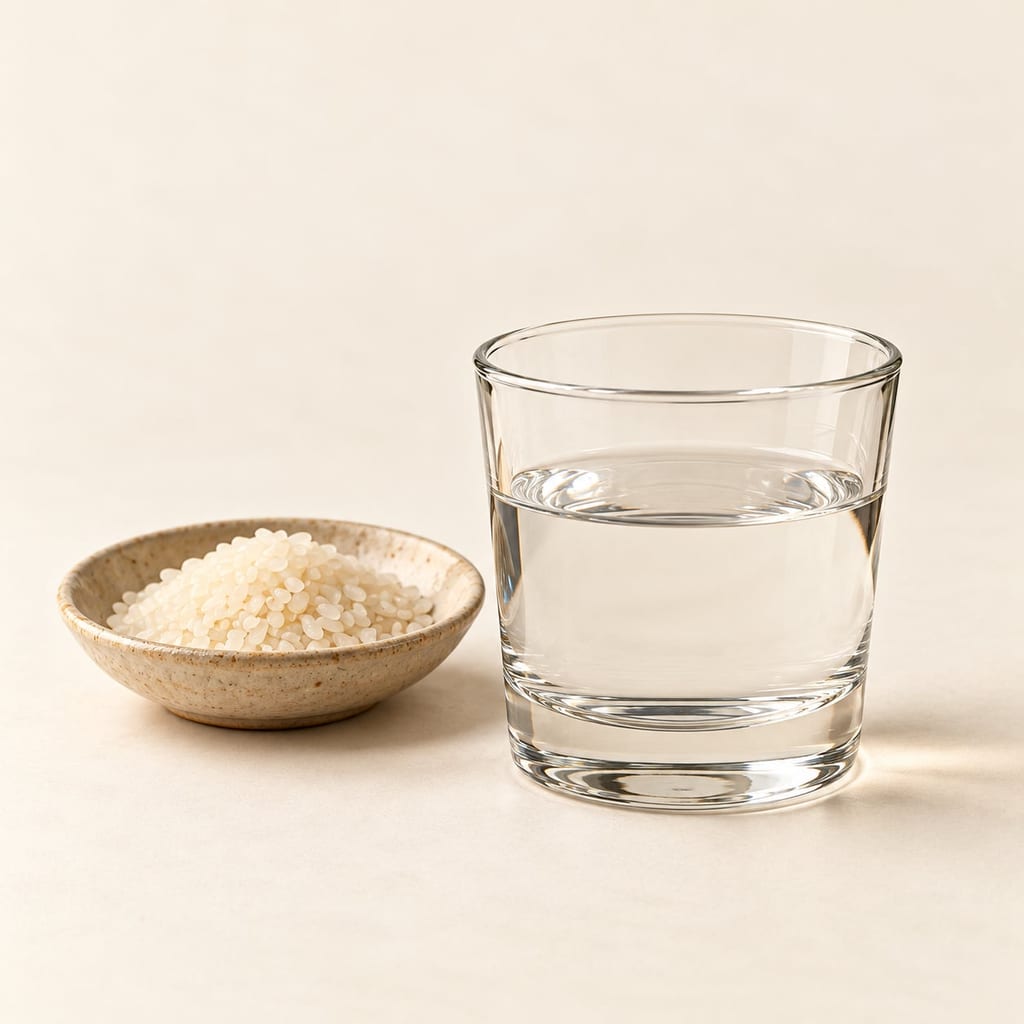
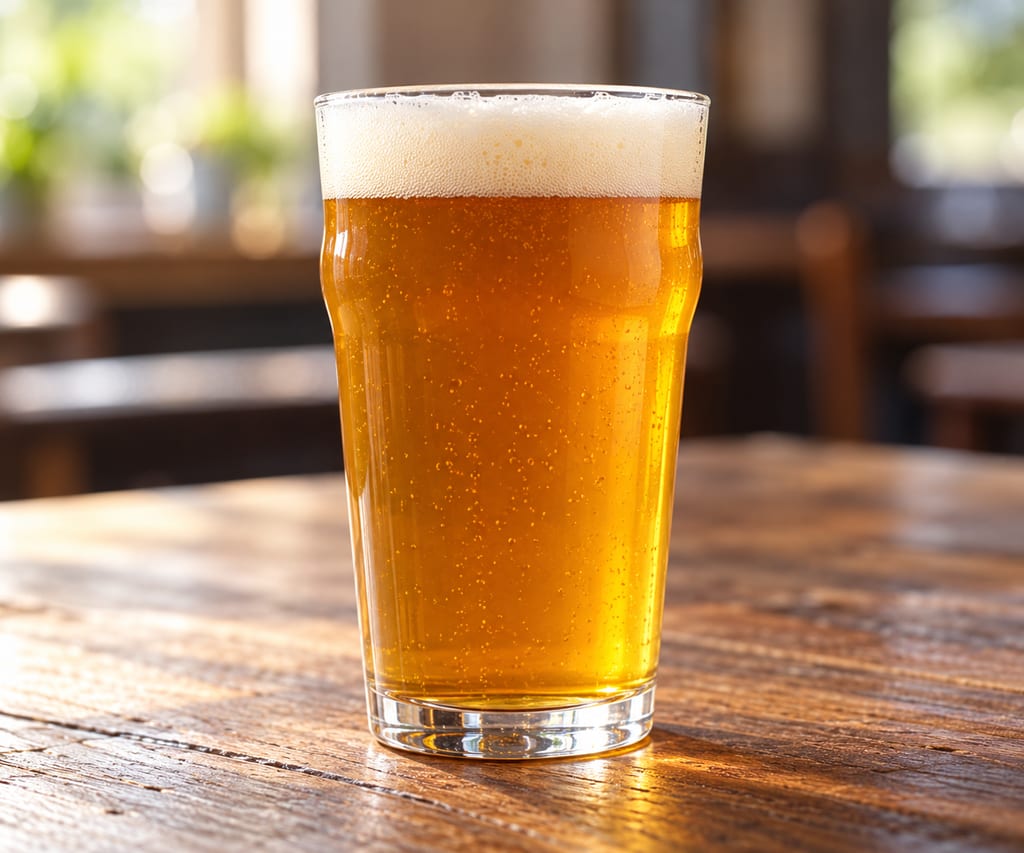
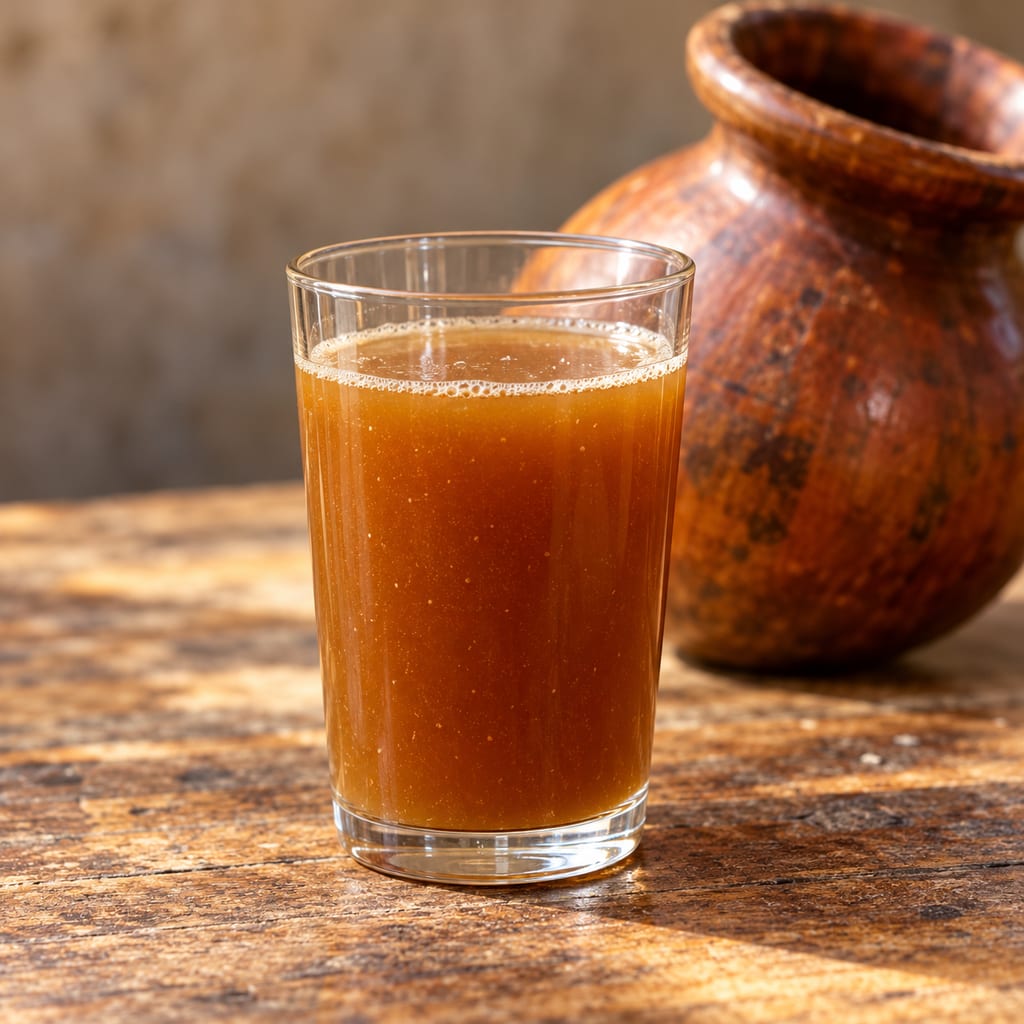
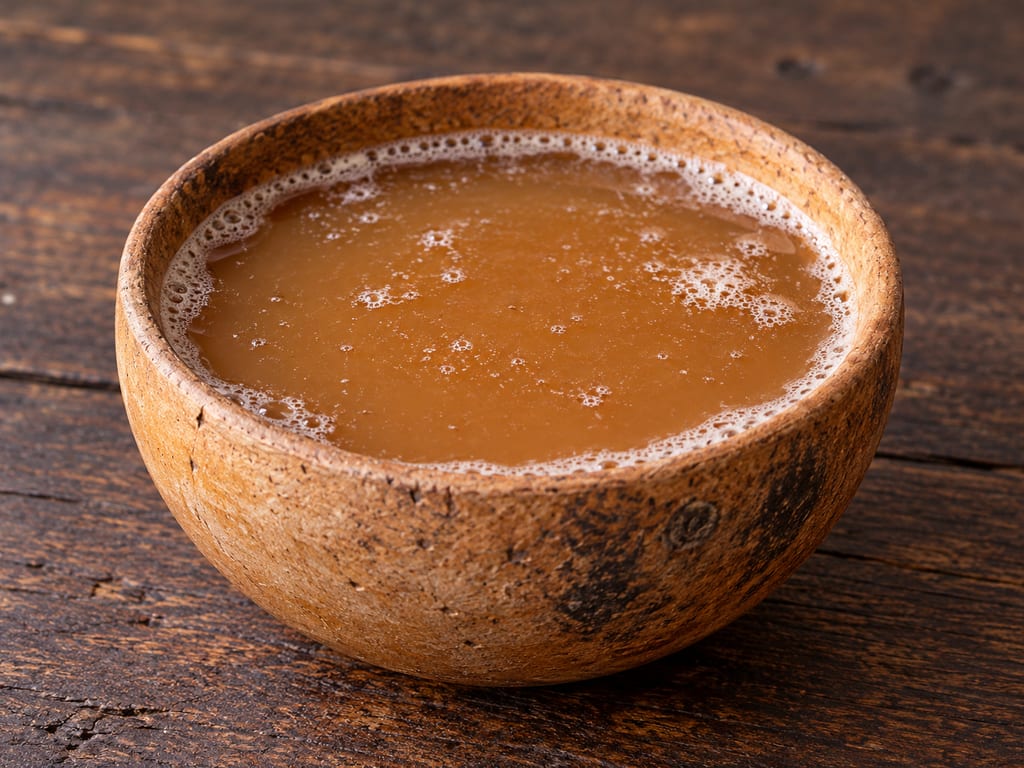
A 2005 Tibetan account describes cooked barley mixed with changdzi, fermented as moist grain, then steeped in water for an alcoholic drink. Grain and water amounts, starter dose and a verified safety endpoint are absent.
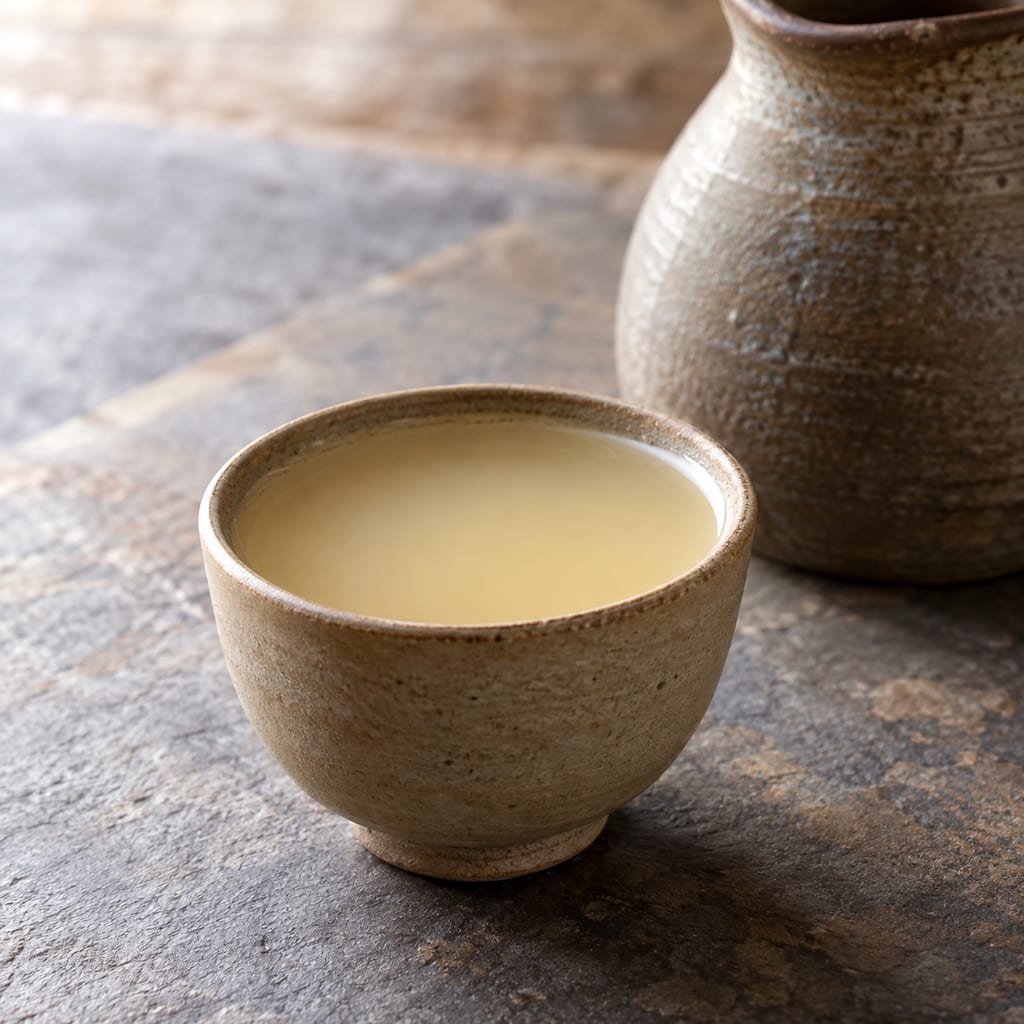
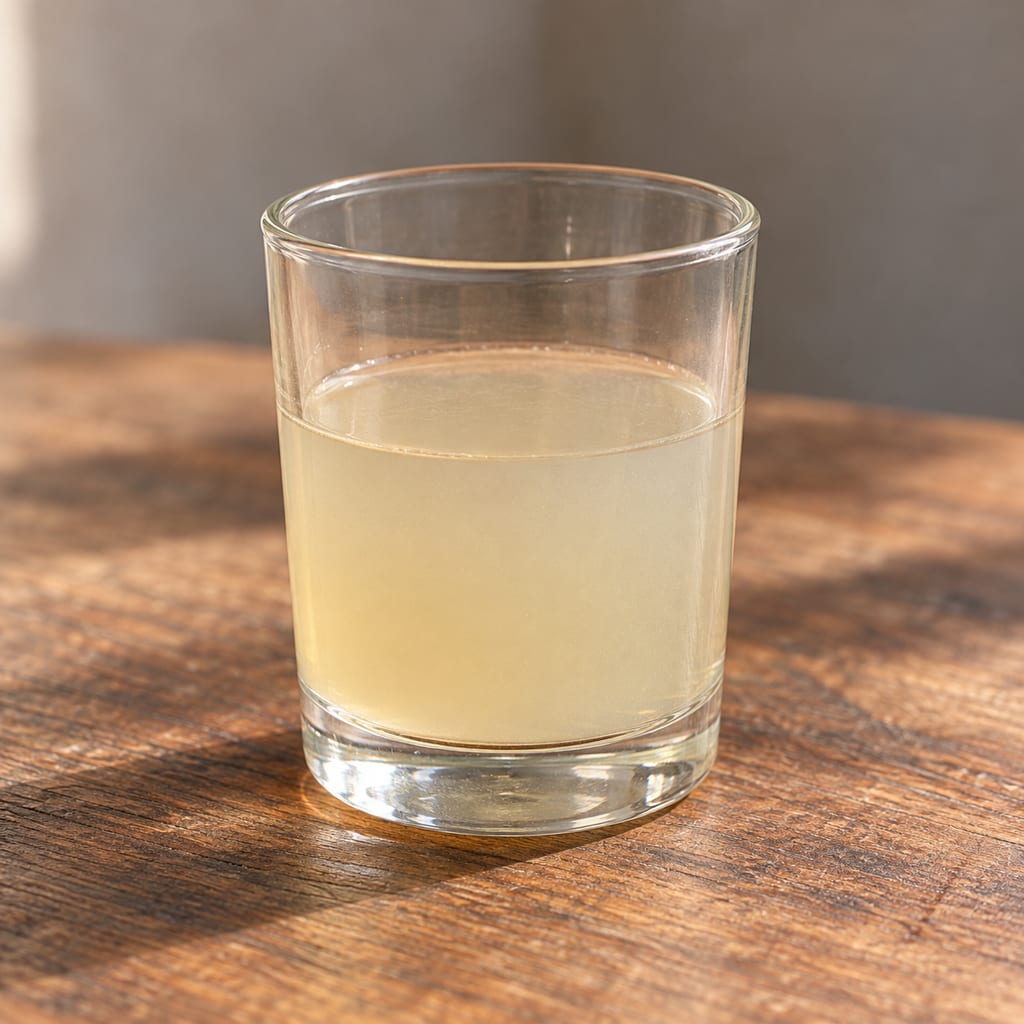
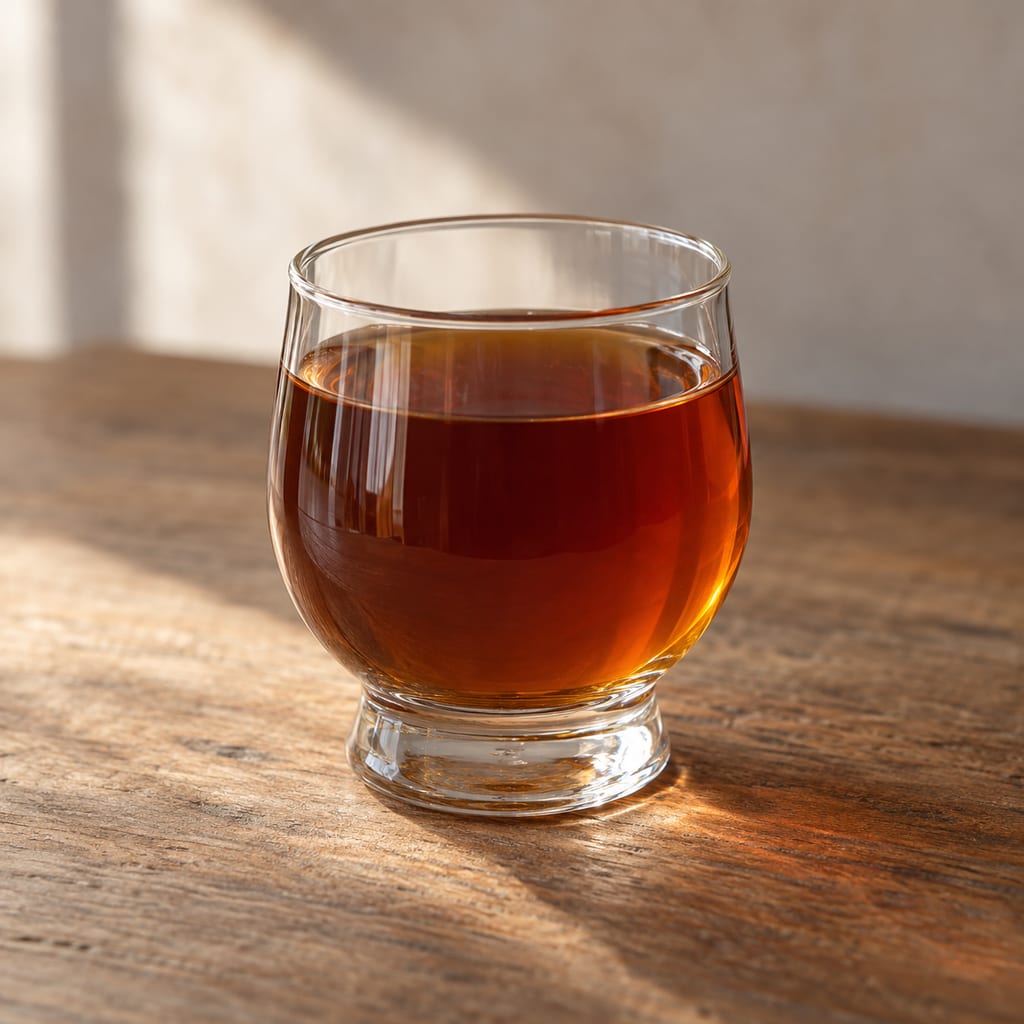
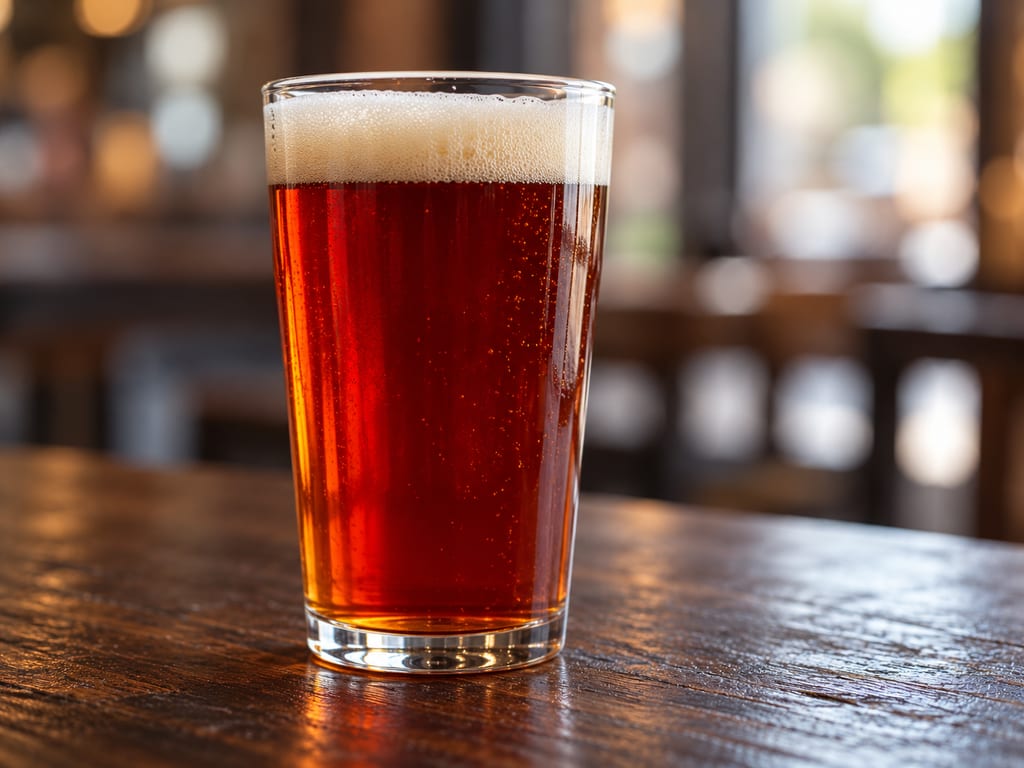
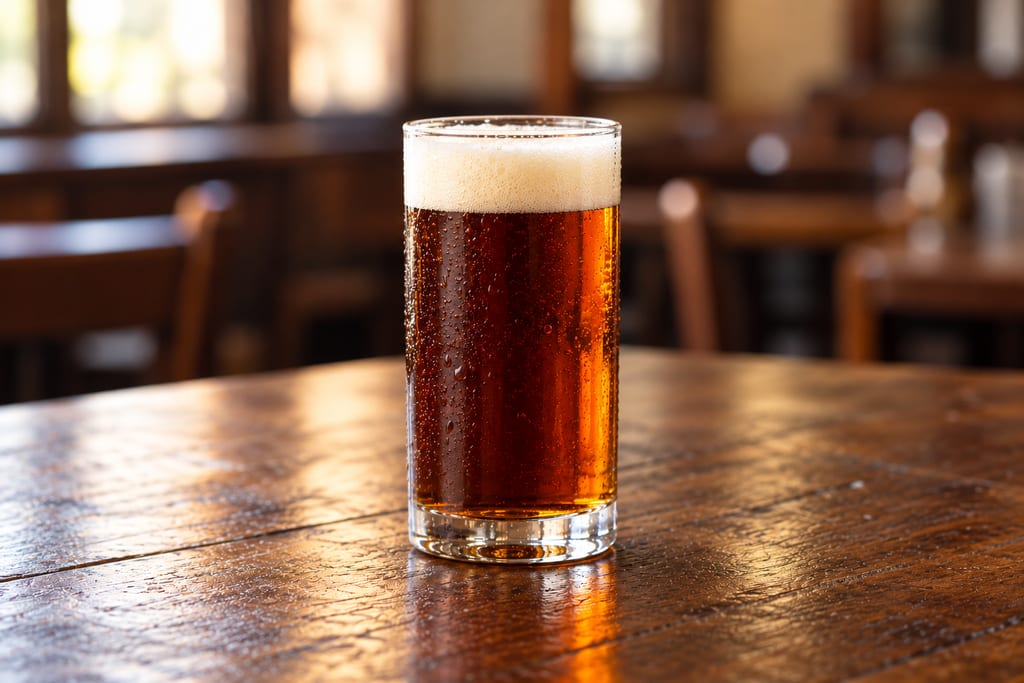
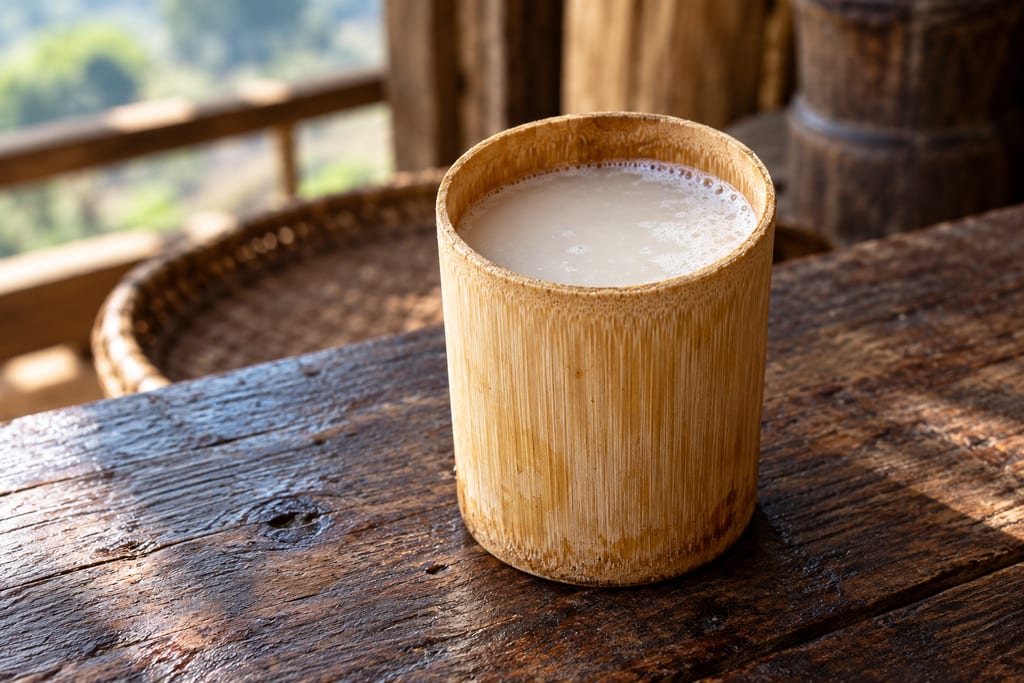
Chang (ཆང་) is the traditional alcoholic drink of the Tibetan Plateau. It is most often made from qingke (青稞), the hulless barley grown at high altitude. The grain is cooked, mixed with a powdered starter and left to ferment as moist grain with no free liquid. Water is then added to wash the sweet, sour, alcoholic material out of the grain, and the cloudy liquid is strained off. The drink is usually described as mildly sweet and sour, grain-scented and low in alcohol. Its strength depends on the fermentation and on how much water is drawn through the grain.
Qingke is a cultivated form of Hordeum vulgare, called Tibetan hulless or naked barley in English. Its hull separates easily from the grain, which suits it to tsampa as well as to chang. The Tibetan word for barley is nas (ནས་). Chang is the drink and qingke is the grain. Qingke jiu is the Chinese term for highland barley alcohol. It can mean fermented barley wine, but it is also used for distilled spirit, so how a product is made has to be checked.
The starter is part of the definition. Studies of Tibetan barley wine use the term Zangqu (藏曲), including qingke xiaoqu, for a mixed starter of moulds, yeasts and bacteria. Ethnographic accounts record powdered starters under names such as changdzi. In neighbouring Himalayan traditions the starter cakes are called phab or phabs. These are not interchangeable, because the raw materials, plants, microbes and local techniques differ. What they share is a culture that breaks barley starch into sugar and supports alcoholic fermentation.
Traditional chang is made in two stages: a solid fermentation, then a water extraction. The cooked, inoculated grain develops sugar, alcohol and acid while little free liquid is present. It is then steeped in water and strained, and more water can be added to the same grain for further extractions of falling strength. Conventional beer separates sweet wort from the grain before it ferments, which chang does not, and qingke baijiu is distilled to concentrate alcohol, which chang is not.
Qiangqin, also written Qiangji, in Qonggyai County, Shannan, is one well-documented place. Government accounts describe household barley wine, inherited techniques and a modern brewery that makes new products alongside the traditional ones. Chang is best treated as a regional family of fermentations, each with its own barley, starter and extraction method, and not as one recipe used by every Tibetan community.
The history of chang is separate from the much older history of barley on the plateau. Genetic and archaeological work shows qingke has been grown in Tibet for at least 3,500 years. A 2018 study in Nature Communications reconstructed the crop's ancestry and suggested that domesticated barley reached southern Tibet from the west between about 4,500 and 3,500 years ago. That dates the grain, not the drink. Growing barley, malting it and fermenting cooked barley with a mixed starter are different skills.
Early Tibetan texts mention drinking barley alcohol. A Chinese Tibetology article discusses the Old Tibetan historical documents kept at Dunhuang, including an account in which an elderly minister from the reign of Songtsen Gampo prepares barley alcohol for a royal gathering. It also names Tibetan-period wooden documents from Miran that list provisions of alcoholic drink. These are stronger evidence of early brewing than a modern origin story, but they give no full chang recipe. Their dates, terms and translations need checking against the primary texts before an earliest century can be named.
Qonggyai keeps an origin legend about Princess Wencheng, who married the Tibetan ruler Songtsen Gampo in the seventh century. Local accounts say she made barley wine from local grain and spring water, introduced a method of saccharifying and fermenting together, and taught village women to make it. County and Shannan descriptions of Qiangqin tell the story. No dated seventh-century document describes her making chang. The marriage is history and the invention is legend.
A second Qiangqin story tells of a visiting Buddhist teacher who praised the village's wine and so helped give it its reputation and name. A 2019 county publication presents both stories as local explanations. They show oral tradition and do not date the wine.
Technical documentation is much more recent. Nyima Tashi's account, in the 2005 ICARDA volume Food Barley: Importance, Uses and Local Knowledge, describes cleaning and cooking barley, adding powdered starter, several days of solid fermentation and extraction with water. The volume came out of a 2002 workshop supported by ICARDA and FAO.
Qonggyai's present-day records show the tradition alive. County publications describe brewing displays and vessels at Qiangqin, and a December 2024 Tibet Daily report describes household production, named practitioners and a new local brewery. The Qiangqin company was set up in 2019 and was running experimental modern production by 2024. This is recent development and not proof that the recipe has stayed the same for thirteen centuries. A 2024 ethnography of Tibetan-speaking communities in Nepal records the social role of chang there, which shows a wider Himalayan brewing culture and not a single origin.
Chang needs starch conversion and alcoholic fermentation to happen together. Barley stores most of its carbohydrate as starch, and brewer's yeast cannot ferment starch directly. Cooking hydrates and gelatinises the starch so that enzymes from the starter can reach it. Fungal amylases cut the starch into dextrins and fermentable sugars. Yeasts turn some of those sugars into ethanol and carbon dioxide, while bacteria add organic acids and other compounds. In traditional production all of this happens inside the cooked grain, before water is added to extract the drink.
A study of sixteen Zangqu samples from seven places in Tibet found Saccharomycopsis, Rhizopus and Aspergillus among the main fungi, with Lactobacillus and Leuconostoc prominent among the bacteria. Of 57 isolated strains, Rhizopus oryzae M12 had particularly strong saccharifying activity and Bacillus amyloliquefaciens Q4 had high protease activity. These are strains from particular starters, not required ingredients of every starter.
The enzymes do different jobs. Alpha-amylase cuts the inner bonds of starch chains into shorter carbohydrates, glucoamylase releases glucose from starch and dextrins, and other enzymes deal with branched starch. Proteases break barley protein into peptides and amino acids, which feed the microbes and add to taste and aroma. How active these enzymes are decides how fast the grain softens and how much sugar becomes available.
Yeast does the alcoholic work. Saccharomyces cerevisiae turns glucose into pyruvate by glycolysis. Pyruvate becomes acetaldehyde, releasing carbon dioxide, and alcohol dehydrogenase then reduces the acetaldehyde to ethanol and regenerates the NAD+ that glycolysis needs. Yeasts also convert amino acids into higher alcohols by the Ehrlich pathway, and these alcohols react with organic acids to form esters. That is why the drink can smell of fruit and flowers as well as cooked barley.
The bacteria matter too. A 2020 study followed the microbes through a highland barley wine fermentation. Rhizopus and Saccharomyces were the main fungi throughout. The bacteria changed a great deal: after 48 hours Acetobacter made up 74.60% and Leuconostoc 13.53% of the bacterial sequencing reads in the sampled fermentation. Those are shares of the reads in one experiment, not shares of living cells and not a standard starter makeup. Acetobacter can make acetic acid where oxygen is present, and Leuconostoc and related lactic acid bacteria add organic acids.
Chang is more than a solution of ethanol. A 2020 sensory and chemical study of Tibetan qingke jiu, using four commercial highland barley wines, identified 66 aroma compounds, 17 of them above their calculated odour thresholds. They included phenylacetaldehyde, beta-phenylethanol, ethyl acetate, ethyl butanoate, methional, methionol, sotolon and furaneol. The wines tasted of fruit, cooked potato, honey, sweetness, sourness and caramel.
Barley also brings beta-glucans, proteins and phenolic compounds. Beta-glucans affect the thickness of the mash and how well it extracts, and they are not fermentable glucose until enzymes break them down. Sequencing shows which organisms are present, but culture and biochemical tests are needed to show what each one does.
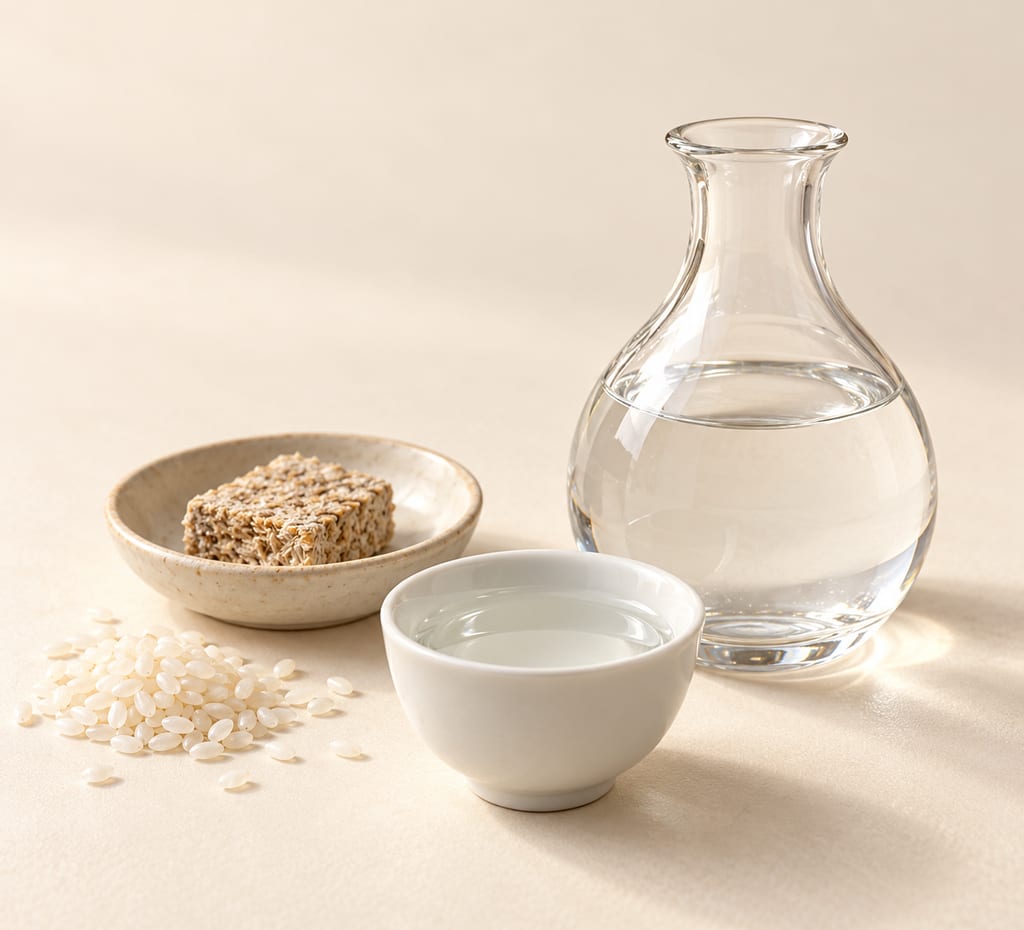
The 2005 account names barley, water and powdered changdzi. Barley provides the grain, the starter supports starch conversion and fermentation, and water is used in cooking and later extraction. Starter composition differs between producers and cannot be rebuilt from a list of organisms found in other samples.
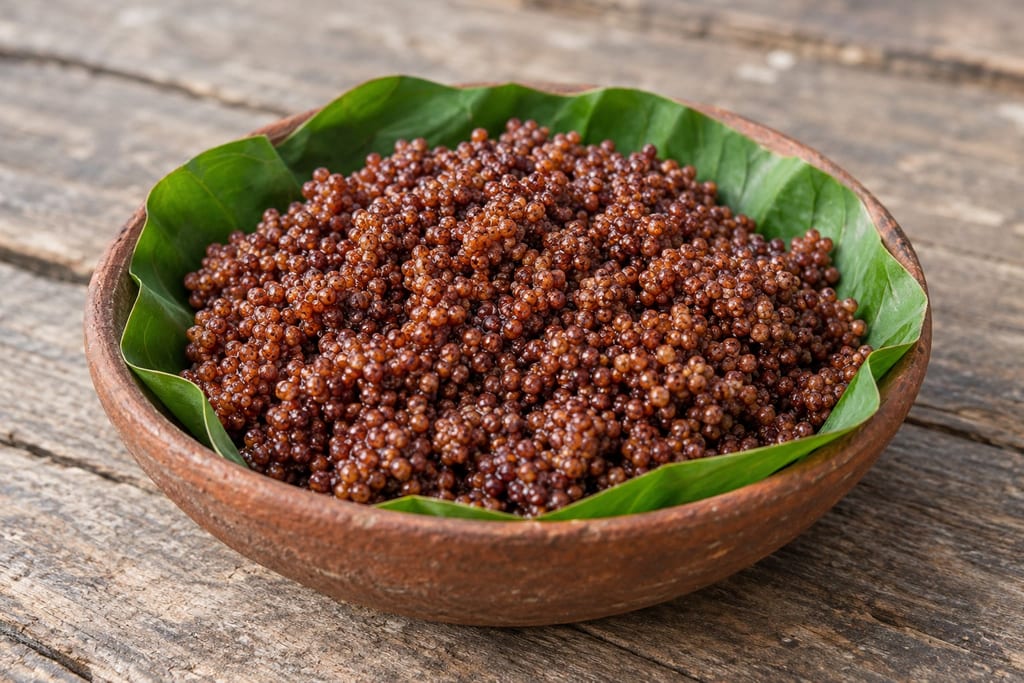
Nyima Tashi's account in the 2005 ICARDA volume begins by cleaning and washing the barley. Some brewers prefer purple barley for its flavour and appearance, and many mix malting barley and hulless barley at a ratio of 1:2. The prepared brewing grain is called changdru. It is boiled for 2 to 5 hours, which softens the kernels and opens the starch to the starter's enzymes. The boiled barley, poub, is cooled before the powdered starter, changdzi, is mixed in.
The inoculated barley ferments for 3 to 5 days as grain, with no free liquid left. The fermented grain is called lenmar, and small amounts can be eaten. To make the drink, the lenmar goes into an earthenware pot, water is added and the mixture steeps for 6 to 10 hours. The liquid is then strained. More water added to the same grain gives three or four extractions.
A description of production in Qonggyai County follows a close sequence. Cooked barley is spread on woven bamboo while still warm so that it loses some moisture. A fermentation cake is ground to powder and mixed into the grain, which goes into a covered, insulated ceramic jar for about two to three days in summer and three to four days in winter. Water is then drawn through the grain repeatedly, giving a first, second and third wine of falling strength. Quantities, vessels and conditions differ from Nyima Tashi's account, so the two are kept apart.
A 2020 study of Tibetan qingke jiu describes another method: the barley is washed, soaked for about 24 hours, steamed and cooled to 30 °C before Zangqu is added, and then ferments in solid state for three days. This is a variant and not the household method above.
Each step has a job. Washing removes debris, soaking and cooking hydrate the barley, and cooling protects the culture from heat. Mixing spreads the starter through the grain, and the solid fermentation lets the enzymes work. Water added later carries sugars, acids, alcohol and aroma out of the grain, and each extraction takes more of the soluble material, which is why extractions differ in strength and flavour. Times, temperatures and quantities have to stay with the method they were recorded for.
Traditional descriptions give no standard starter dose, water quantity, grain temperature or fermentation end point. Modern producers in the area use controlled cooking, mechanical processing, clarification, cold storage and microbial stabilisation. These make the product more consistent and are not part of a historical household recipe.
Chang differs by place, barley, starter and extraction. Qiangqin (Qiangji) village in Qonggyai County is a well-documented centre of household production, where each family's wine tastes different. A December 2024 report names Lobsang Dorje as a recognised practitioner and describes efforts to change sweetness, acidity and colour while keeping parts of the traditional method. These are modern changes and not a single historical formula.
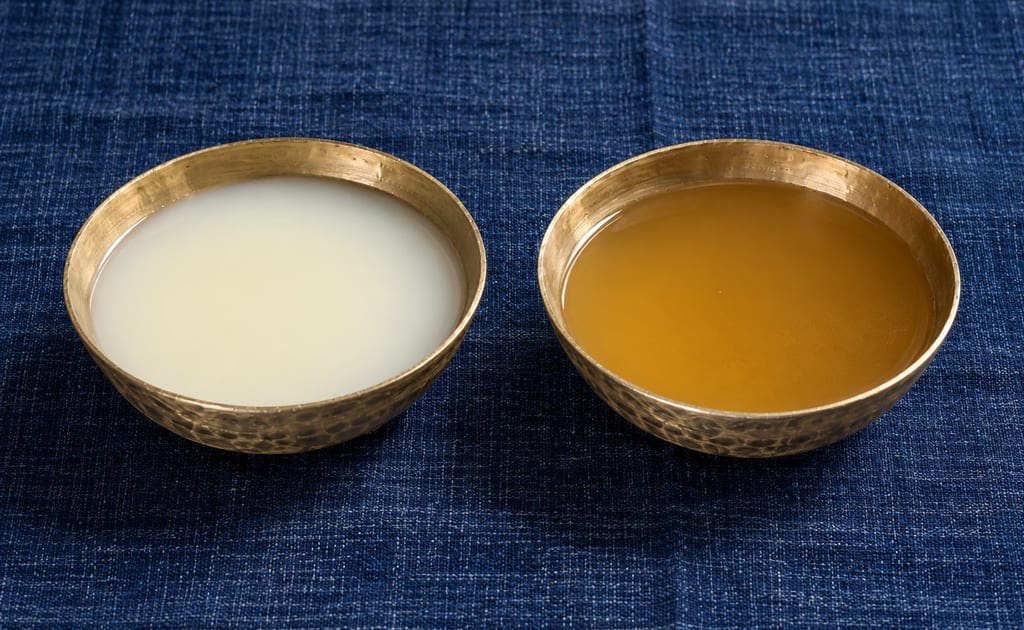
In the Qonggyai account the first extraction is aromatic, sweet and full-bodied, the second is lighter and refreshing, and the third is weaker. All of them come from one fermented grain and not from separate fermentations. Nyima Tashi likewise records three or four additions of water and reports about 7% alcohol in the first extraction and 5% in the second. Those are observations, not specifications for every region.
Barley colour matters. Nyima Tashi records a preference for purple barley, and Qonggyai producers describe the wine's colour changing with the proportions of dark and pale qingke. One practitioner makes a wine the colour of red wine without brown sugar or artificial colouring, which is a modern product and not evidence that red chang was ever standard. Rice, wheat and mixed-cereal versions exist, but barley defines this entry.
Nyima Tashi describes sanchang as a western Tibetan relative made from tsampa, the roasted flour of highland barley. Tsampa is mixed with warm water and powdered starter, fermented for about three days, then cut and dried. Some people eat the semi-fermented pieces and others steep them in water to make a drink. It uses roasted flour and not the cooked whole grain, and it deserves its own record.
Across the Himalaya the names chang, chhang and chyang can mean a drink of barley, rice, finger millet or mixed cereals. Ladakh has barley brewing with local starters, including methods that use malted grain, and communities in India, Nepal and Bhutan also brew from rice and millet. A 2016 study of chyang used finger millet and mixed cereals with marcha starter, and its results cannot be applied to Tibetan qingke chang. Phab from Bhutan or nearby cannot be assumed to match a given Tibetan Zangqu either. A study of plateau starters reports a barley-and-pea starter at 7:3, and in Sapi, Ladakh, the phap starter is made from wheat flour and local plants, moulded and dried.
Tibetan cultural writing names zla-chang, month-aged wine, and lo-chang, year-aged wine, which involve keeping the fermented grain for longer before extraction. They show that ageing and storage varied, but no tested ageing schedule exists. Tibetan communities also distil spirit from fermented grain. A distilled barley spirit, including products sold as qingke baijiu, is not ordinary chang just because it uses the same grain.
Qiangqin's brewery, set up in 2019, uses a more mechanised line and has tried changes to processing, colour, clarity and refrigerated distribution. Laboratory studies elsewhere test other starter blends and controlled fermentation. These show the tradition developing and do not define one authentic modern recipe.
Chang is mostly drunk as an alcoholic drink, often fresh and cloudy and not clarified and bottled like commercial beer. Depending on the fermentation and extraction it is sweet, slightly sour, grain-scented and light. Nyima Tashi reports about 7% alcohol in the first extraction and 5% in the second, and says people commonly drink chang of about 5% or less. Four commercial highland barley wines in a 2020 study measured 3.0 to 3.5%. These are examples and not a standard.
Chang is a customary offering to guests in Qonggyai and appears at gatherings, weddings and festivals. Government accounts describe etiquette in which cups are offered, the drink is taken in stages and a little wine is used in a symbolic gesture before drinking; Qiangqin Village is known for presenting three cups. These customs vary by community and occasion and are not required of every Tibetan or at every event.
Tibetan cultural writing documents chang in offerings, celebrations and communal exchange. A 2024 ethnography of Tibetan-speaking communities in the Nubri Valley of Nepal examines fermented and distilled drinks in household ritual, labour exchange, social relations and obligation. The authors also note that drinking alcohol is contested within Tibetan religious life, so chang has ceremonial roles in some communities without being accepted or required by all.
Barley wine is shared at Losar, the Tibetan New Year, at weddings and at household celebrations, and offered to honoured guests. Qiangqin Village has built tourism and cultural events around its brewing reputation. These practices show chang's importance now, not that each custom is unchanged since the Tibetan empire.
The fermented grain is food too. Nyima Tashi says lenmar is eaten in small amounts and can be fried in oil and served with sugar. He also describes changuel, made by boiling chang and tsampa with cooked rice, dried cheese and sugar for about ten minutes. Tsampa may also be mixed with chang as a soft grain dish. These foods keep more of the cereal solids than strained chang does.
Modern barley wine is sold in restaurants, to visitors and in packages. A stabilised bottle should not be assumed to have the microbial activity or serving character of freshly extracted household chang.
Claims that chang aids digestion, prevents altitude illness or has medicinal value need their own evidence. Qingke barley contains beta-glucans, phenolic compounds and other nutrients, but that does not show how much remains in strained alcohol or that drinking it helps anyone. Chang is an alcoholic drink whatever its grain.
A good fermentation brings several changes together: the grain softens, starch breaks into sugar, alcohol develops, and microbes make acids and aroma. A sweet taste or an alcoholic smell does not show that fermentation is finished or safe. Because chang is drawn out of solid grain, the amount of water added and the number of extractions change the strength and flavour of what is served.
The starter varies most. The Zangqu study of sixteen samples from seven Tibetan places found wide fungal and bacterial diversity, and isolated strains differed in saccharifying and protease activity. Dose alone therefore cannot guarantee the same result: a culture with weak amylase activity may release little sugar even if it holds living yeast.
Temperature affects microbes and flavour. The December 2024 Qonggyai report names too high a fermentation temperature as a cause of unwanted sourness, and says uneven cooking gives grain of uneven texture and overcooking can give cloudy or scorched results. Other producers say small differences in processing change bitterness and sourness. These are producers' observations and not tested limits, and no safe upper fermentation temperature is given for the local inherited starter.
Acid needs careful reading. Lactic acid bacteria can add mild acidity, and acetic acid bacteria can give a sharper, vinegar-like note where oxygen is present. A high share of Acetobacter after 48 hours in one 2020 fermentation shows an active bacterial population but does not show that the finished drink is spoiled. Measurements can describe a batch, but no safe threshold is established for this method.
No single smell proves safety. A harsh solvent smell, a strong smell of rot or unexpected growth on the surface calls for investigation, not for a longer fermentation or more sugar. Barley variety, starter and heating all change the normal aroma, so a defect has to be judged against the actual process.
Mixed starters can carry unwanted microbes next to the useful ones. Tibet's health authorities issued food-safety standards for brewing Zangqu in 2024 and for traditional highland barley wine xiaoqu in 2025, covering production, inspection and storage. These show that starter quality is regulated and do not make uncontrolled household mould safe. The hazards include unwanted bacteria, mycotoxin-producing fungi and contaminated grain, and finding Rhizopus or Aspergillus in a culture does not make an unidentified culture safe.
Renewed fermentation is a documented problem in Qonggyai. A 2024 account from the local brewery says one additive-free refrigerated product kept only 7 to 10 days and that fermentation starting again was a major technical problem. That is one producer's experience and not a shelf life for chang in general. Leftover carbohydrate and living yeast can start fermenting again, changing the sweetness and alcohol and making carbon dioxide, and a sealed container can build pressure.
Appearance does not show alcohol content. Within one traditional account, extractions from the same grain differ in strength, and industrial processing, longer fermentation and different water additions change it further. Chang should not be called alcohol-free or safe for people who avoid alcohol. Claims that it protects against cold, speeds recovery from drunkenness or has medicinal effects are cultural reports and not clinical evidence.
No universal finishing pH, minimum alcohol, pathogen limit or household shelf life exists for Tibetan chang. A fully measured laboratory fermentation with a commercial yeast gives technical guidance, but it cannot stand in for an inherited Qonggyai starter without new testing.
Old Tibetan documents from Dunhuang and Miran mention barley alcohol prepared for a royal gathering and provisions of drink. They show early Tibetan brewing but give no recipe, and no exact date can be set from them. The 2005 ICARDA account is the first technical description of the method used here. The Princess Wencheng origin is a local legend.
No total weight is given. Some brewers prefer purple barley for its flavour and colour. Malting barley here is not stated to have been germinated.
Changdzi starter
Amount not stated
Changdzi is translated as powdered yeast, but it is a mixed traditional culture and not necessarily purified Saccharomyces cerevisiae. No weight, base material, organisms or dose is given.
No cooking-water volume, water-to-grain ratio or extraction volume is given. The fermented grain steeps for 6 to 10 hours, and water is added three or four times.
Method
Risks and precautions
Unknown makeup and contamination of the starter
Changdzi and related Tibetan cereal starters are mixed cultures. The ICARDA account gives no organisms, activity or contamination limits. Mould growing on grain is not the same as a verified brewing starter.
Hazard source
Aflatoxin in cereal starters
A Tibetan standard addresses aflatoxin testing for regulated Zangqu starter. Its requirements do not establish that an unidentified changdzi or household batch is safe; an apparently active starter can still be contaminated.
Hazard source
Unwanted bacteria in cooked barley
Cooked barley is moist and rich in nutrients, so unwanted bacteria can grow if the starter does not establish. The traditional method gives no pathogen control, pH target or starter dose, and has not been tested for controlling Bacillus cereus or other unwanted bacteria while the grain cools and ferments warm.
Hazard source
Continuing fermentation and carbon dioxide
The extracted drink can keep fermentable sugar and living microbes. Local producers report fermentation starting again in storage. It can change the alcohol and acidity and make carbon dioxide, which builds pressure in a sealed container.
Hazard source
Uncertain alcohol content
Successive extractions from the same grain differ in strength. The reported 7% and 5% are examples, not specifications. The actual figure depends on the grain, starter, fermentation and the water used.
Hazard source
Barley gluten
Barley contains gluten proteins that matter to people with coeliac disease and barley allergy. Fermenting or diluting the drink does not make it gluten-free.
Hazard source
The 2005 chang account supplies no validated household limits for starter identity and quality, cooked-barley handling, fermentation, extraction or storage.
Control source
This is a documented traditional preparation, not a tested home-brewing or commercial food-safety protocol.
The published account gives no total barley weight, starter dose, cooking-water volume, extraction-water volume or finished yield.
The 1:2 ratio is of malting barley to hulless barley. It does not show that the malting barley was germinated.
The 3 to 5 days of fermentation is a recorded duration, not a tested safety end point.
Do not take fermentation temperatures from modern Tibetan barley wine experiments and apply them to this method.
The 7% and 5% alcohol values are approximate. They do not show that a batch is low in alcohol or suitable for people who avoid alcohol.
No pasteurising, storage, bottling or refrigerated shelf-life method is given.
Barley chang is not gluten-free.
Traditional claims about the medicinal or nutritional value of barley do not show a clinical benefit from drinking alcoholic chang.
An unidentified starter, a reported time or a pleasant aroma cannot establish a safe batch. The account gives no pressure-management or safe storage method.
Nyima Tashi's 2005 account describes barley cleaned and washed, with some brewers mixing malting and hulless barley at 1:2. It does not establish a total batch weight or say that the malting barley was germinated.
In that account, the barley was boiled for two to five hours, cooled and mixed with powdered changdzi. The starter's amount, composition and safe grain-handling conditions are not specified.
The inoculated grain, called lenmar after fermentation, was held for three to five days. This is a recorded duration, not a validated fermentation endpoint or home safety control.
The fermented grain was steeped in water for six to ten hours and strained. Some producers made three or four water extractions. Neither water volume nor finished yield was supplied.
The first two extracted drinks were reported at about 7% and 5% alcohol in this account. These are observations, not targets or assurances for another batch. No safe storage or bottling procedure is documented.
Places
Qiangqin (Qiangji) Village, Qonggyai County
Traditional preparation · Locality evidence
The best-documented place of household and modern brewing. The times and steps in the recipe come from the ICARDA account and are not tied to this village.
Finger millet fermented with marcha in surveyed Darjeeling and Sikkim communities. Tongba is the later warm-water extraction from the fermented grain. The cited accounts do not establish a complete or validated home batch.
Apong names Mising rice beverages in Assam, including pale Nogin and ash-associated Po:ro. Sources describe distinct preparations and do not establish one unified household recipe or validated safety endpoint.
Judima is a Dimasa fermented rice drink from Assam. A 2022 Dhansiri account describes humao starter and rice fermentation, but sources disagree on the thembra bark species and do not provide a complete or validated home batch.
Musalais is a fermented grape drink documented among Uyghur producers in A’wati, southern Xinjiang. A studied process combines grape juice and heated pomace extract before spontaneous fermentation.
A Chinese fermented soybean condiment in which Bacillus-led bacteria, not moulds, drive the fermentation. Documented in Zunyi, Guizhou, and kept separate from mould-led douchi.
This Shaanxi-associated yeast flatbread uses a simple water dough, coiled shaping and a skillet bake. It is the bread used in roujiamo, not the filled meat dish.
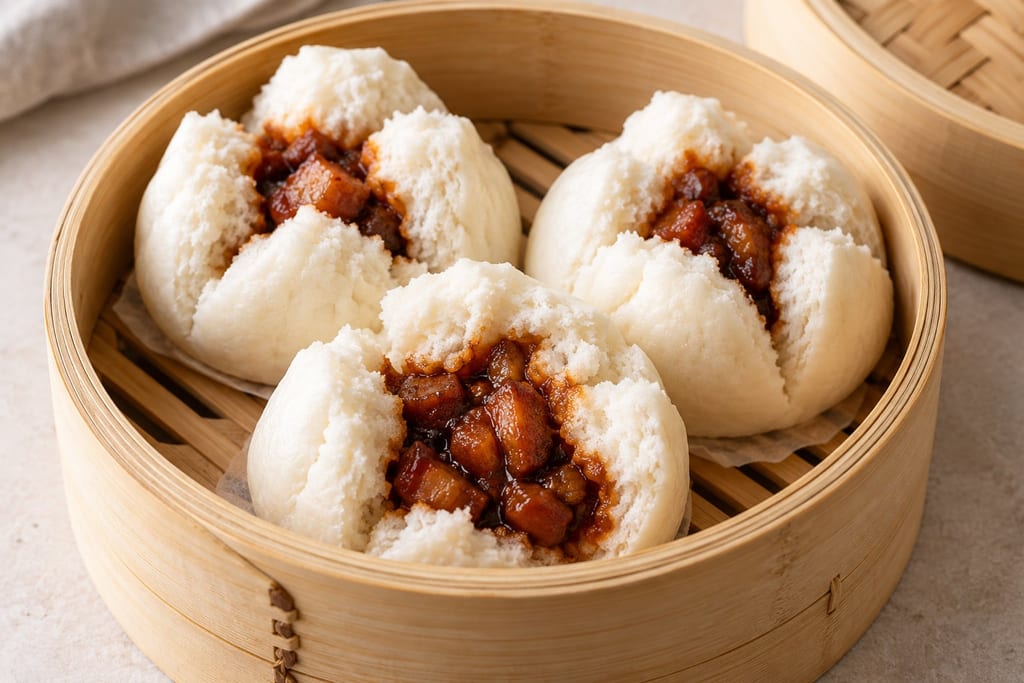
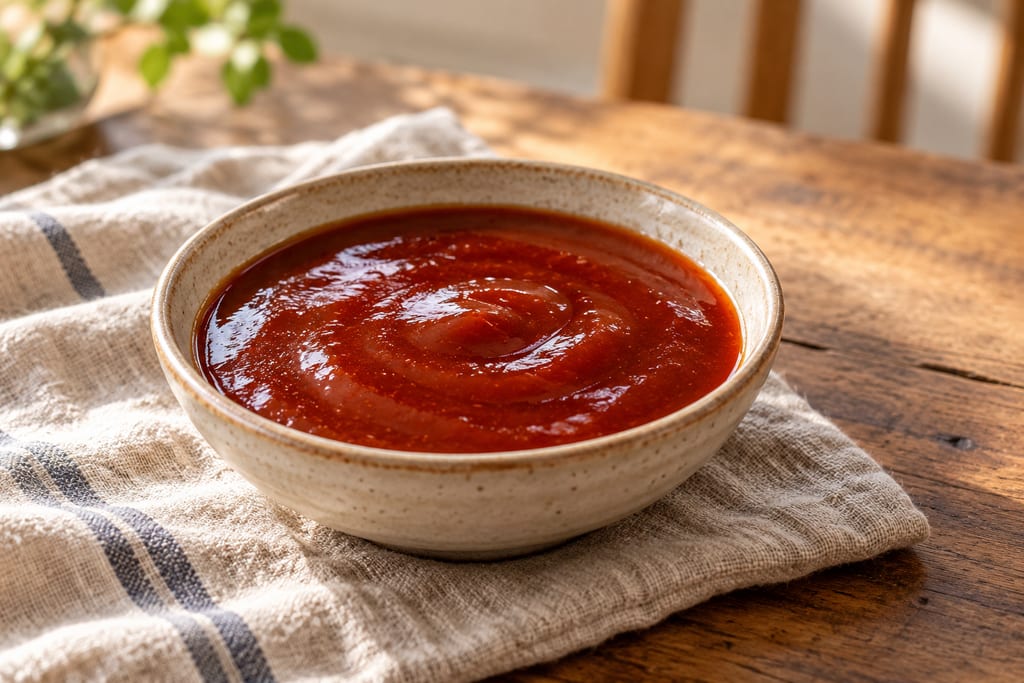
A smooth, tomato-based sweet-and-sour sauce of sugar, vinegar, tomato paste and soy sauce, thickened with starch for dipping or coating; it is not the sauce on Hangzhou's sweet-and-sour ribs.
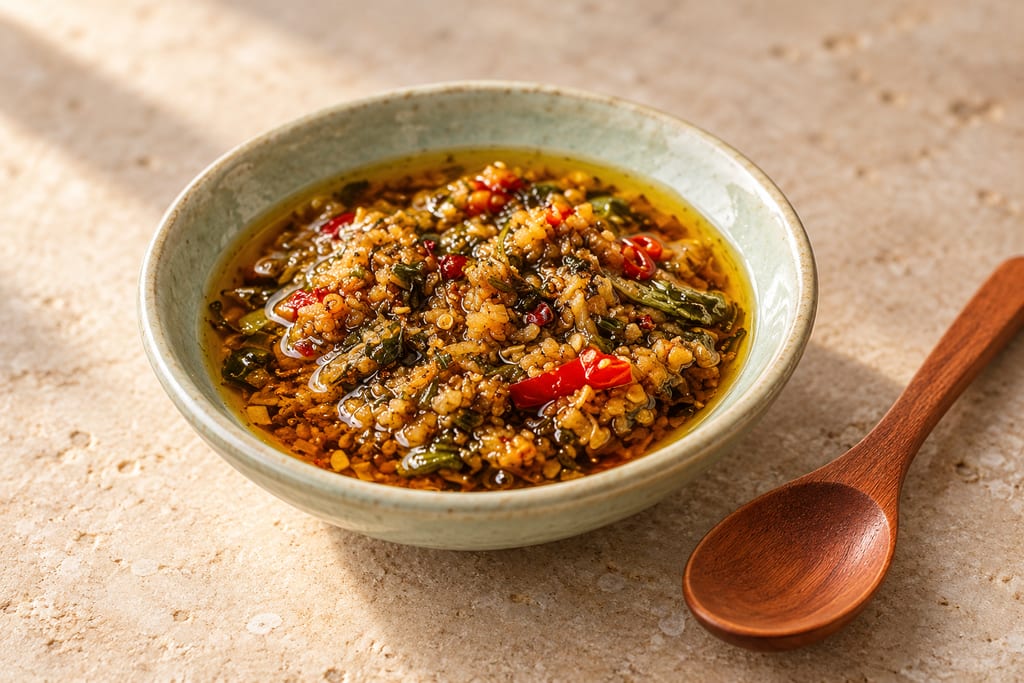
A Cantonese condiment of ginger, garlic, scallion and fresh chilli fried slowly in oil and seasoned with soy sauce, sugar, wine and salt, served over roast meats and poached chicken.
A source-specific modern extract adaptation of Düsseldorf Altbier, with specialty malts, two hop additions and an ale yeast. It is distinct from a brewery's commercial Altbier process and from Kölsch.
Andong soju is a rice spirit from North Gyeongsang, distilled from steamed rice and wheat nuruk. This method makes the starter before fermenting the rice mash in a jar.
Angami rice beer from Nagaland. A surveyed method mixed cooked rice with piazu, fermented it for about four days in summer or a week in winter, then added water and filtered it. The starter ratio leaves the rice-weight basis unclear.
This is a process overview, not a complete batch recipe: key quantities, yield and packaging directions are absent. The AHA tutorial uses Hop Hammer Imperial IPA as an example; this page is not that full formulation.
A darker Ethiopian maize tella, brewed from maize baked into a hot, dry kita pancake and then fermented in three stages with barley malt, gesho and water.
Protected Italian vinegar made only from cooked grape must, fermented and aged in a battery of wooden barrels for at least 12 years: sweet, sharp and syrupy.
Appam, or hoppers, are South Indian and Sri Lankan rice pancakes made from a fermented coconut-and-rice batter and cooked in a curved pan to a crisp lacy rim and a soft, spongy centre.
Auricularia tremellosa is a wood ear fungus of the genus that supplies most dried wood ear sold in China; its own food record is thin, and the culinary practice described here comes from the closely related wood ear species.
Ayran is Turkey’s cold, savoury yogurt drink: plain yogurt is loosened with water and lightly salted, then whisked smooth or aerated into a soft cap of foam.
A thin stone griddle used over an open hearth. Norwegian archaeology documents the established tradition from the early Middle Ages; a Viking-period origin is only a cautious suggestion linked to Shetland.
Crushed or milled barley cooked in water until the starch softens and the mixture thickens, the plainest way a northern household turned stored grain into a meal, here with apple and hazelnut.
Black carrot is the anthocyanin-pigmented Eastern carrot (Daucus carota var. atrorubens), the purple root that preceded orange types and still colours kanji and şalgam.
Community
No community contributions have been published for this entry yet.
Share what you made
Sign in to contribute. Published comments and photos are free to read.
International Center for Agricultural Research in the Dry Areas (ICARDA), proceedings of a 2002 workshop organised with FAO, published 2005Method · History · Science
A documented chang sequence: clean and wash barley, boil for two to five hours, cool, add powdered changdzi, ferment moist grain for three to five days, steep in water for six to ten hours, strain, and draw three or four runs. It omits a complete batch and validated safety limits.
Many brewers mix malting barley and hulless barley at 1:2; some prefer purple barley.
Names: changdru for the brewing grain, poub for boiled barley, lenmar for fermented grain, changdzi for the starter.
About 7% alcohol in the first extraction and 5% in the second; people commonly drink chang of about 5% or less.
Lenmar is eaten in small amounts, and sanchang is a western Tibetan relative made from tsampa.
No total grain weight, starter dose, extraction volumes or fermentation temperature are given.
Cited in: What it is; History; Recorded sequence and what remains unknown; Regional and historical variations; How it's eaten and used; Reading results and problems
Accessed 2026-10-27
LWT - Food Science and Technology, Volume 136, Article 110342, Elsevier, January 2021Science
Zangqu is a Tibetan barley wine saccharification starter.
Sixteen Zangqu samples from seven Tibetan locations: Saccharomycopsis, Rhizopus and Aspergillus among the main fungi; Lactobacillus and Leuconostoc prominent among bacteria.
57 strains isolated; Rhizopus oryzae M12 had strong saccharifying activity and Bacillus amyloliquefaciens Q4 had high protease activity.
Samples differ, so the detected organisms do not give one universal starter formula.
Cited in: What it is; How it works; Reading results and problems
Accessed 2026-10-27
Food Research International, Volume 130, Article 108971, Elsevier, April 2020Science
Household production across Qiangji Village; Lobsang Dorje named as a recognised practitioner; the Qiangqin company set up in 2019.
Producers say uneven cooking gives uneven grain, overcooking can scorch, and too high a fermentation temperature gives unwanted sourness.
Colour varies with the proportions of dark and pale barley; one practitioner made a red-wine-coloured wine without brown sugar or artificial colour.
Modern processing, clarification and cold storage; one additive-free refrigerated product kept 7 to 10 days, with renewed fermentation a major problem.
The Princess Wencheng account is a local tradition, not verified recipe history.
Cited in: What it is; History; Recorded sequence and what remains unknown; Regional and historical variations; How it's eaten and used; Reading results and problems
Accessed 2026-10-27
Xinhua News Agency, republished by Tibet Headlines, 18 June 2023History · Method
Officially indexed title and metadata identify this as DBS 54/2007-2025, Traditional Highland Barley Wine Xiaoqu, published 10 October 2025 and effective 10 April 2026. The PDF could not be opened during this session, so no requirements or process limits are asserted from it. It governs the named starter standard and does not establish validated household controls for the fermented drink.
Bacillus cereus is a spore-forming foodborne bacterium; boiled or fried rice has been implicated after inadequate holding. This is a general cooked-grain hazard, not validation of a Tibetan barley-chang process.