A Norwegian stone griddle
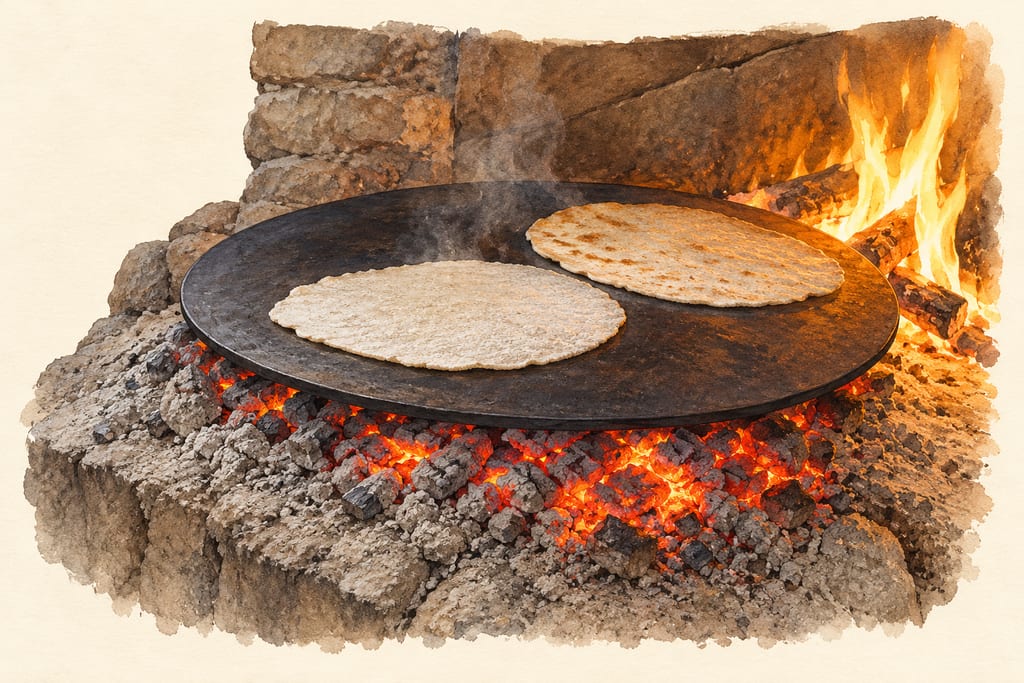
A bakestone was a thin slab, usually circular or oval, used as a cooking surface over an open fire, commonly on a hearth. In the archaeological account of northern Norwegian examples, stones range from about 250 to 550 mm across and about 4 to 25 mm thick. Soapstone was used for some, but most were made from chlorite-rich talc-amphibole schist, often shortened to chlorite schist. Its mineral properties suited high temperatures and low thermal expansion, while its layered structure made it easier to extract as a thin slab than soapstone.
Grooves, quarrying and heat
Incised grooves on one or both faces are a defining feature. They were created while quarry workers thinned and finished the slab, and they also helped prevent bread from sticking. The marks therefore record both manufacture and use. Thin slabs could be heated over a hearth and provide a broad surface for cooking; the archaeological evidence does not supply a single standard size, fire arrangement or operating temperature. Bakestones should not be confused with later iron takker or griddles, nor should every flat stone in an excavation be identified as one.
When and where the tradition is visible
The Norwegian bakestone tradition is most securely placed in the early Middle Ages. At Ølve-Hatlestrand, on the western side of Hardanger Fjord, extraction began around AD 1030–1100 and grew into the largest known production landscape. Two other Norwegian quarry areas are known: Øye in Trøndelag and Ertenstein in Rogaland, with more limited production. From the 1100s, bakestones became common in rural and urban Norwegian households. Finds from Bergen, Oslo and Trondheim, and later coastal sites in northern Norway, show a widely distributed utensil rather than a single local curiosity.
Bread, households and exchange
Bakestones are associated with hard, unleavened flatbread, a major bread form in medieval Norway. Barley and oats were important cereals in Norway and Sweden; their low gluten content produces dough that does not rise like wheat bread. The stone’s broad heated face suited thin breads cooked without an oven. Historical written descriptions of flatbread baked on thin rounded stone griddles become clearer in the early modern period, so those descriptions illuminate a continuing practice but do not prove every detail of Viking Age baking.
Trade and archaeological limits
Bakestones travelled beyond their quarries. Bergen became an important distribution centre, and evidence from northern Norwegian coastal settlements connects the stones with maritime trade routes and fishing communities. Stephen Wickler’s analysis finds the number of northern sites with bakestones rising substantially from the twelfth to thirteenth centuries, alongside growth in production at Ølve-Hatlestrand. Most analysed fragments are consistent with a western Norwegian source, though some remain unexplained. Reused fragments with drilled holes and iron fittings show that a broken stone could retain value; their exact secondary function is inferred rather than certain.
What the Viking label can and cannot mean
The item’s date range includes the Viking Age because a possible antecedent has been proposed in Viking-period Shetland, and because older iron pans and regionally varied stone cooking surfaces complicate a sharp boundary. The better-supported Norwegian grooved bakestone is early medieval. It is misleading to picture this specific Norwegian commercial product as a standard utensil in every Viking household. Archaeological finds are uneven, and most known bakestones come from medieval contexts.
History
The best documented large-scale production began at Ølve-Hatlestrand in western Norway around AD 1030–1100, and bakestones became common household utensils in Norway from the 1100s. Their origins may reach further back: soapstone implements from Viking-period Shetland have been proposed as possible predecessors, but that connection is not established. Earlier iron pans and regional stone forms caution against treating one utensil as universal across Viking Scandinavia.
Equipment details
SizePublished northern Norwegian examples range approximately 250–550 mm in diameter and 4–25 mm thick; measurements vary by specimen.
PowerFire or solid fuel Heated over an open fire, usually on a hearth.
How you get oneNot obtainable today This page describes an archaeological and historical utensil; cited sources do not establish a contemporary maker or purchase route for this specific type.
CareThe sources describe archaeological production and use, not a modern care or seasoning protocol.
Made of
- Chlorite-rich talc-amphibole schist (chlorite schist) — Main documented stone material
Most reported bakestones are made from this rock; some are soapstone.
Limits
The evidence does not establish one universal Viking-period design or prove that the later Norwegian grooved bakestone was common throughout Viking Scandinavia.
Source →Places
Norway
Documented use · Country evidenceBakestones occur at Norwegian urban and rural sites; this country-level association does not claim a single origin.
Ølve-Hatlestrand
Manufacture · Region evidenceThe principal large-scale quarry landscape discussed in the sources; the period is the start of extraction, not a claim about every specimen.
Øye
Manufacture · Region evidenceA documented quarry area with more limited production.
Ertenstein
Manufacture · Region evidenceA documented quarry area with more limited production.