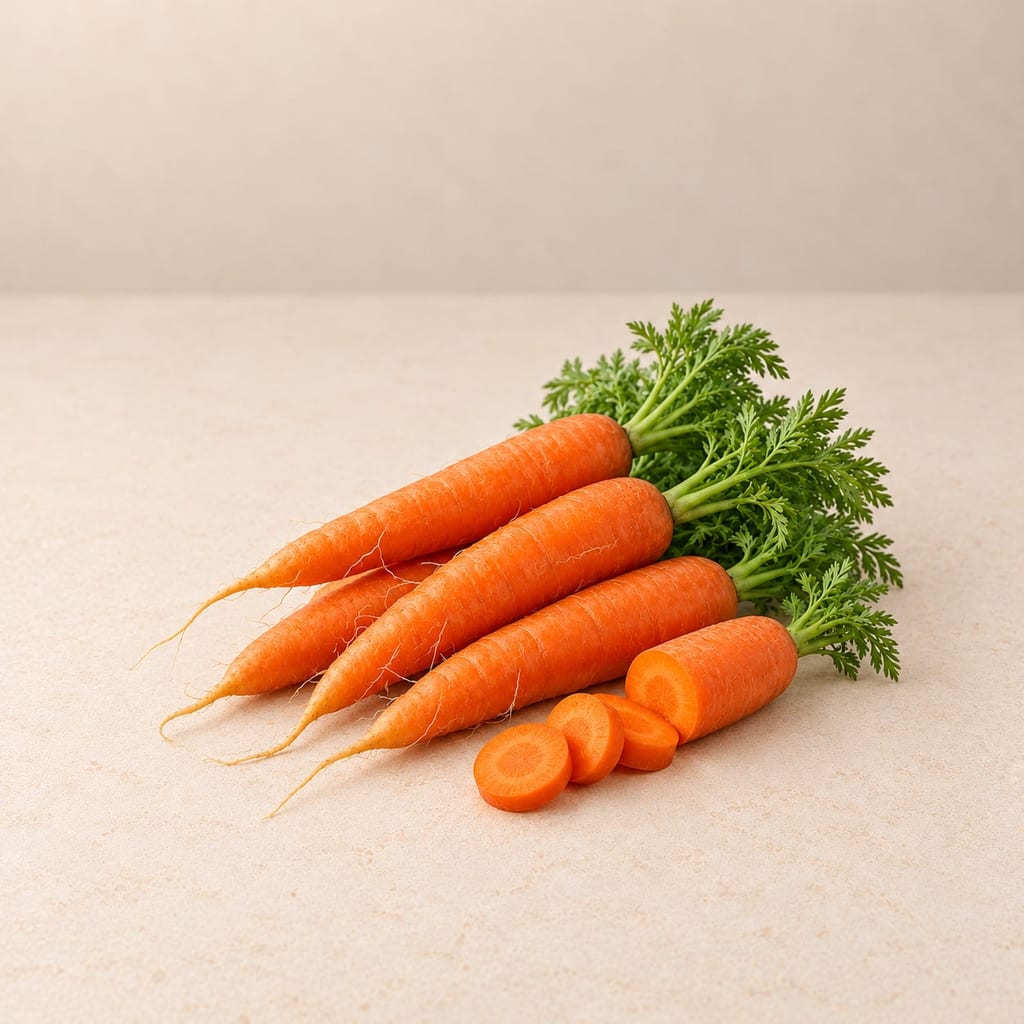
Carrot
Carrot is the sweet taproot of Daucus carota subsp. sativus, domesticated in Central Asia, and the raw material of kanji and a common companion in fermented vegetable mixes.
 FermenteaWhere food goes to change
Substrates
Black carrot is the anthocyanin-pigmented Eastern carrot (Daucus carota var. atrorubens), the purple root that preceded orange types and still colours kanji and şalgam.
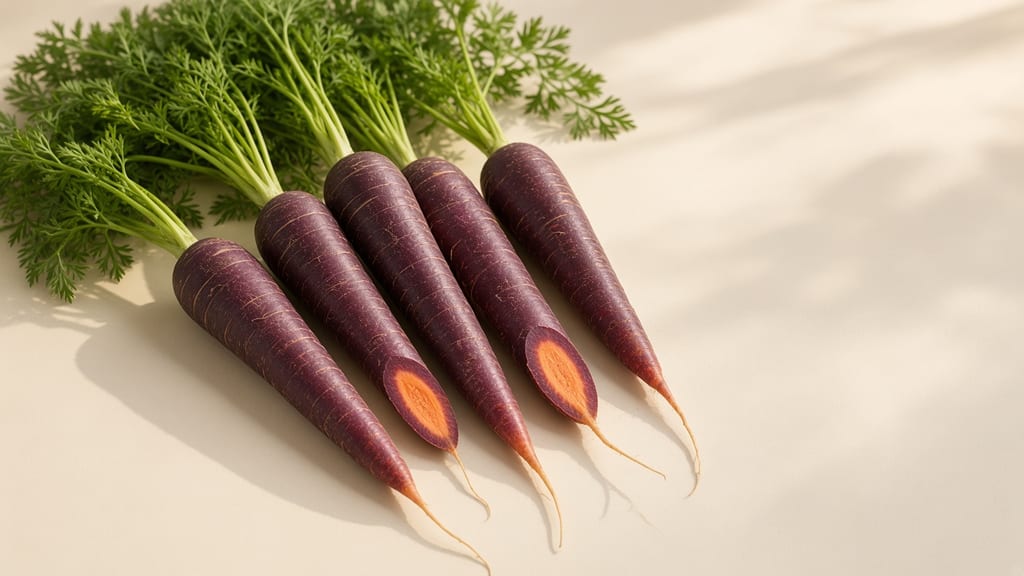
Black carrot is the cultivated form of Daucus carota whose taproot is coloured by anthocyanins rather than by carotene. Horticultural writers place these roots in the Eastern or Asiatic group, often named Daucus carota var. atrorubens. The roots look purple to near-black on the outside; cut open they may be solid purple or purple only in the outer layers, with a paler core.
The colour is water-soluble. In an acid brine or ferment the pigment bleeds into the liquid and turns it red-purple. That is why black carrot, not orange carrot, is the colouring root in North Indian kanji and in Turkish şalgam. Orange carrot, by contrast, keeps most of its pigment in the flesh because carotene is fat-soluble.
Names vary by language and market. In Punjabi and Hindi the dark roots sold for kanji are often called kali gajar. English sources say black carrot or purple carrot for the same anthocyanin type. The word black here means deep purple, not a separate species.
Botanically it remains Daucus carota. The atrorubens label marks a colour and geography group, not a claim that every dark root in a Punjabi market is genetically identical. Market bunches sold as kali gajar can include solid-purple roots and purple-skinned roots with paler flesh; both release colour when cut or grated into brine.
In commerce the same root may be sold washed and topped, or still muddy with leaves attached. For ferment drinks the leaves are discarded. Residual soil must be washed off; FAO's kanji description begins with thorough washing before grating, which is ordinary produce hygiene rather than a fermentation control by itself.
Stolarczyk and Janick summarise the crop history as a move from white or pale wild roots to purple or yellow domesticates centred on Afghanistan and the wider Iranian Plateau, with a later Western group based on yellow, orange and red carotenoid roots. They place the Eastern group's centre of diversity in the Himalayan–Hindu Kush region and around Turkestan, and they note that orange types displaced purple forms in Europe and the Mediterranean by the seventeenth century.
Banga's 1957 Euphytica paper reaches a related European conclusion from written sources. He finds no secure evidence that the Romans knew the modern cultivated food carrot, and he traces the first clear descriptions of cultivated red and yellow carrots to Arab agricultural writing after the spread of Islam. Citing Laufer, he dates Persian acquaintance with the cultivated carrot to the tenth century and finds no valid evidence that the carrot was known in India before that time. The Nabathean agriculture material quoted through Ibn al-Awwam describes a juicier red root and a coarser green-to-yellow root eaten with vinegar, salt and oil.
European documents then name carrots from the thirteenth century in Italy and the fourteenth in France, Germany and the Netherlands. Early European colour words such as atrorubens, blackish red and redder than a red beet point, in Banga's reading, to purple roots rather than to modern orange. Orange selection in the Low Countries later became the commercial standard; purple types did not disappear in South and West Asia.
Mackevic's 1929 survey of Afghan carrot diversity, cited by Stolarczyk and Janick, helped fix Afghanistan in the Eastern group's story. Vavilov's gene-centre list, which Banga also quotes, runs through Asia Minor, Transcaucasia, Iran, Turkmenistan, north-west India, Afghanistan, Tadjikistan, Uzbekistan and western Tian-Shan. Anatolia holds unusual cultivated variety and is a candidate cradle for the western sativus complex.
None of these sources dates a first Punjabi kanji jar. They date the root. The drink's paper trail on Fermentea's inspected set begins later: a 1953 CFTRI catalogue entry noted in the vegetable-atlas dossier, FAO's late-twentieth-century chapter, and twenty-first-century food-science papers on black-carrot kanji.
Painting and herbal evidence collected by Stolarczyk and Janick shows purple and yellow roots in European art before orange became dominant. Dutch and Spanish still-life painters of the seventeenth century already show the orange types that breeders in the Low Countries had pushed forward. The visual record matches Banga's documentary timeline: purple first in the medieval descriptions, orange later as the market favourite.
South Asia kept the dark root in seasonal kitchens even after orange cultivars spread through colonial and twentieth-century seed trade. Kanji is one reason: a drink that wants purple-red liquor has little use for a carotene carrot. Şalgam is another. The ingredient's survival is not nostalgia alone; it is functional colour chemistry tied to lactic beverages.
Stolarczyk and Janick note that purple Eastern types often store poorly and grow erratically compared with modern Western orange cultivars, and that anthocyanin pigment browns on cooking and stains hands and cookware. Growers who keep black carrot for ferment drinks usually harvest for fresh use rather than long cold storage.
In North India the dark roots used for kanji are a winter-to-spring crop. Sharma, Sahota and Kaur used the Punjab variety Punjab Black Beauty for a laboratory kanji study; that name records a regional breeding line, not a universal market grade. Fresh, firm, deeply coloured roots without soft spots are the usual kitchen choice.
Where winters are cool enough, Eastern purple carrots are a cool-season crop like their orange cousins. The leaf canopy of Eastern types is often greyer and more pubescent than the bright yellow-green Western leaf. Bolting tendency is higher in the Eastern group, which matters to seed savers more than to a cook buying roots for a single ferment.
After harvest, keep roots cool and moist for short holding. Long storage is the weak point Stolarczyk and Janick flag for purple types. For a ferment drink the kitchen goal is fresh sugar and bright pigment, not cellar months.
Seed catalogues now sell named purple cultivars such as Purple Haze for gardeners outside South Asia. Those garden roots can look the part in a photograph and may work in a kitchen ferment, but they are not automatically identical to Punjab Black Beauty or to Turkish black-carrot landraces used by şalgam producers. An ingredient page records the type; a recipe must name the root it actually tested.
Black carrot supplies water, fermentable sugar, a firm cell wall and a large dose of anthocyanin. FAO's chapter on bacterial vegetable ferments describes kanji made from deep-purple carrot grated into salted water with crushed mustard seed and chilli; the finished drink is slightly acidic and purple-red. The chapter's batch figures are a traditional description, not a validated home process control.
A separate modern laboratory formulation reported in the soft-drinks research atlas used 500 g black carrot, 25 g black salt, 50 g mustard powder, 10 g red-chilli powder and 3 L boiled cooled water. That is a studied recipe card, not interchangeable with the FAO batch and not a safety-validated household method. Culinary household versions sometimes substitute red carrot plus beetroot when black carrot is scarce; the atlas treats that as a common replacement, not as the defining historic substrate.
In southern Turkey, black carrot is likewise the main colouring and sugar substrate of şalgam, even though the drink's name refers to turnip. The two ferments are regional cousins that share a purple-carrot logic rather than one shared recipe.
Mustard matters as much as the root in the North Indian drink tradition. Crushed seed or powder contributes pungency and a microbial neighbourhood that food-science papers discuss without turning those observations into a home critical-control chart. Salt concentration in the FAO account is high relative to many cabbage ferments when read as grams per litre of water; the AM43 card uses a different salt identity (black salt) and a different denominator. The two formulations must stay separate on the page.
Şalgam's food-science literature, summarised in Fermentea's BATCH-016, likewise treats black carrot as the sugar and colour base, with bulgur dough or a direct method as regional process variants among commercial producers. Turnip is minor in those accounts. The shared lesson for an ingredient page is simple: purple carrot travelled with lactic drinks across a wide belt from Punjab to Çukurova, while orange carrot took the European table.
Compared with cabbage or beet, black carrot brings a sharper mustard partnership in the North Indian drink and a grain-dough partnership in traditional şalgam. The root is not a neutral purple dye packet. Its sugar profile and indigenous microbes shape the early fermentation, which is why laboratory papers isolate LAB from kanji itself rather than assuming any brine will behave the same.
Anthocyanins shift colour with acidity. In a lactic ferment the falling pH pushes the liquid toward a bright red-purple rather than a dull blue. Sharma and colleagues recorded finished kanji at pH 3.47 with measurable flavonoids, phenols and antioxidant activity in their Punjab Black Beauty batch; those figures describe that study, not every home jar.
Because the pigment is water-soluble, grated or chopped black carrot colours a brine quickly. Orange carrot will not do the same job. Beetroot can tint a jar red, which is why some modern Punjabi household drinks combine red carrot and beet when kali gajar is unavailable, but that mix is a substitute colour strategy, not the Eastern carrot itself.
Plant physiologists distinguish purple-periderm types from solid-purple types. Both can look nearly black until cut. In a jar, fine grating exposes more surface, so colour extracts faster than from large chunks. If the brine stays pale, the root was likely low in anthocyanin or was an orange or yellow carrot mislabelled in the market.
Cooks notice staining on boards and cloths. That is the same water-soluble chemistry that colours the drink. Acid helps keep the hue bright; a ferment that fails to acidify may look duller as well as being unsafe for reasons that go beyond colour. Colour is not a safety test.
Look for deep purple to blackish skin and strong colour when cut. Avoid soft, mouldy or bitter green cores. Wash thoroughly; traditional kanji method accounts grate the root finely so sugar and pigment enter the liquid quickly.
Mustard seed or mustard powder is the companion spice in the North Indian drink tradition; salt sets the brine; chilli is optional heat. None of those condiments replaces the need for a source-backed, tested process if the drink is to be presented as a safe home ferment. Black carrot is the substrate page; the safety limits belong on the recipe, and for kanji those limits are not yet established for household use on Fermentea.
If black carrot is unavailable, a cook may reach for red carrot and beetroot to approximate colour. That substitution is recorded as common practice in the soft-drinks atlas; it is not the historical Eastern carrot and it changes sugar, earthiness and pigment chemistry. For an ingredient page the honest line is: black carrot is the named substrate of the traditional purple drinks; replacements are replacements.
Weight matters for scaling. FAO's account is built per kilogram of grated carrot. Laboratory cards may start from a few hundred grams. Household blogs often use a bunch and a jar. None of those formats should be mashed into one ratio without citing which source owns which numbers.
Stolarczyk & Janick place primary diversity and early purple/yellow domesticates here; Banga cites Vavilov gene-centres including Afghanistan and N.W. India.
FAO associates deep-purple carrot kanji with Northern India and Pakistan; Sharma et al. used Punjab Black Beauty.
Tanguler and Erten food-science accounts treat black carrot as the major raw material of şalgam in Çukurova.
Carrot is the sweet taproot of Daucus carota subsp. sativus, domesticated in Central Asia, and the raw material of kanji and a common companion in fermented vegetable mixes.
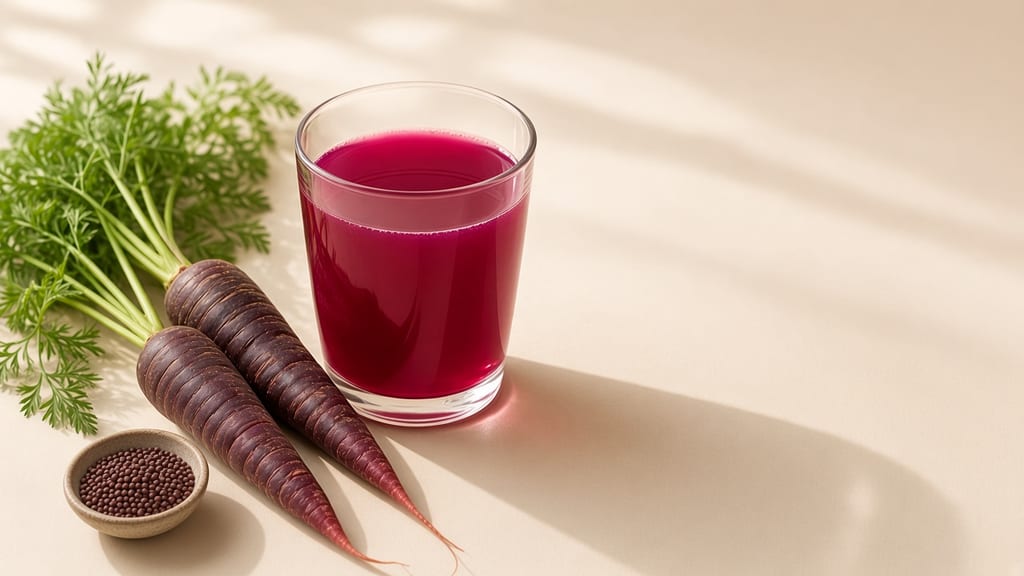
Purple and yellow carrots preceded Europe's orange root. In Punjab, kanji kept kali gajar working as a lactic drink substrate long after orange took the supermarket.

A gelling polysaccharide extracted from red seaweeds, sold as kanten strips or powder; it sets firm at a low concentration and stays solid until about 85 °C.
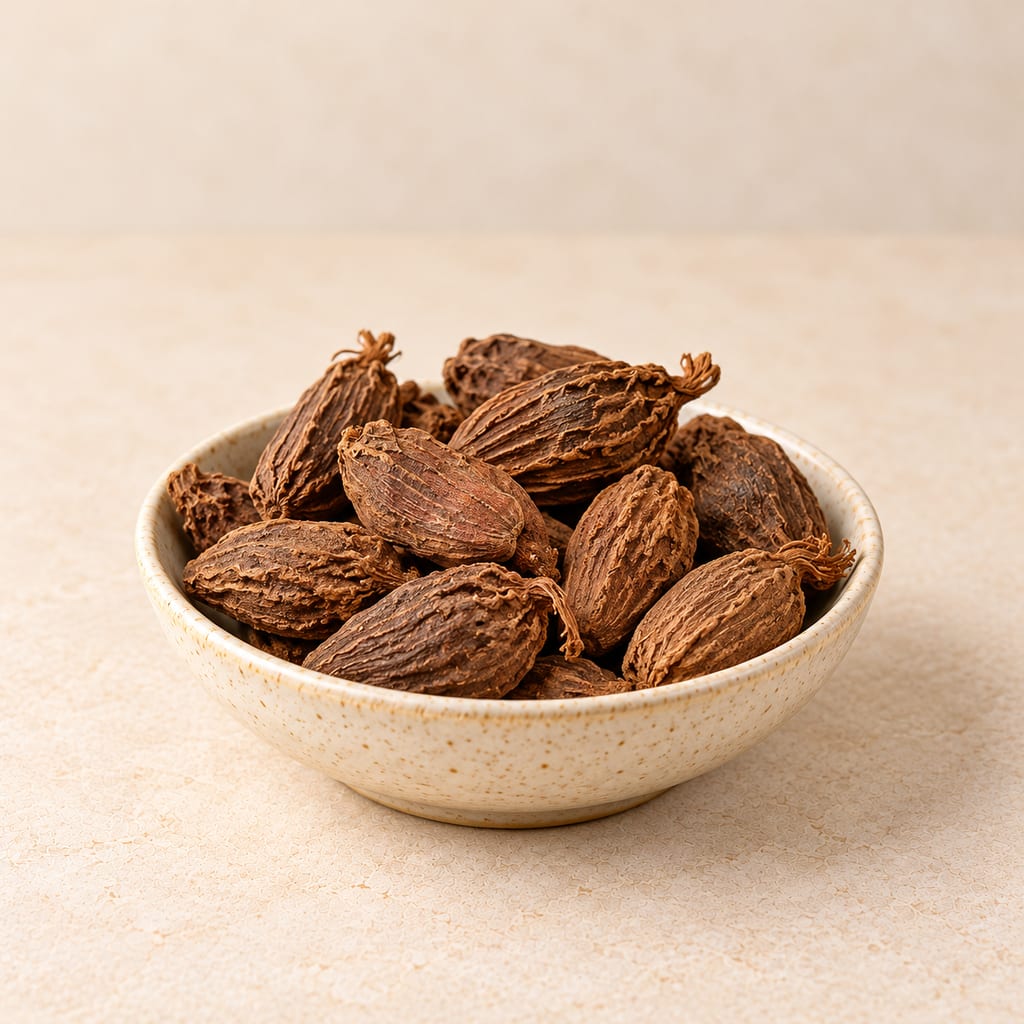
Alainchi is the large or black cardamom of the eastern Himalaya, the dark, smoke-dried pods of Amomum subulatum. Its camphor-cool, smoky seeds season Himalayan and North Indian cooking and a sweet Nepali lapsi achar.
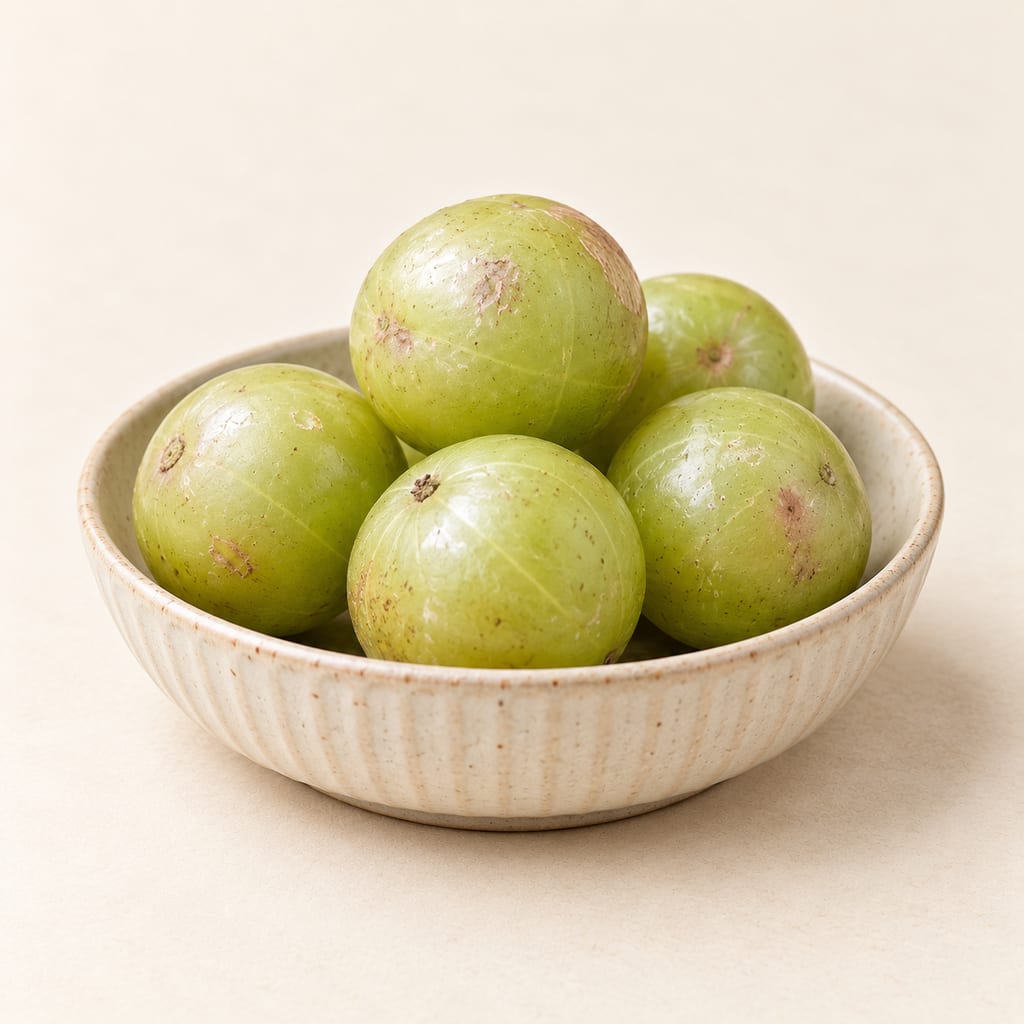
Amla is the firm, sharply sour fruit of Phyllanthus emblica. Cooks transform it into murabba, pickles, chutneys, drinks and dried snacks.
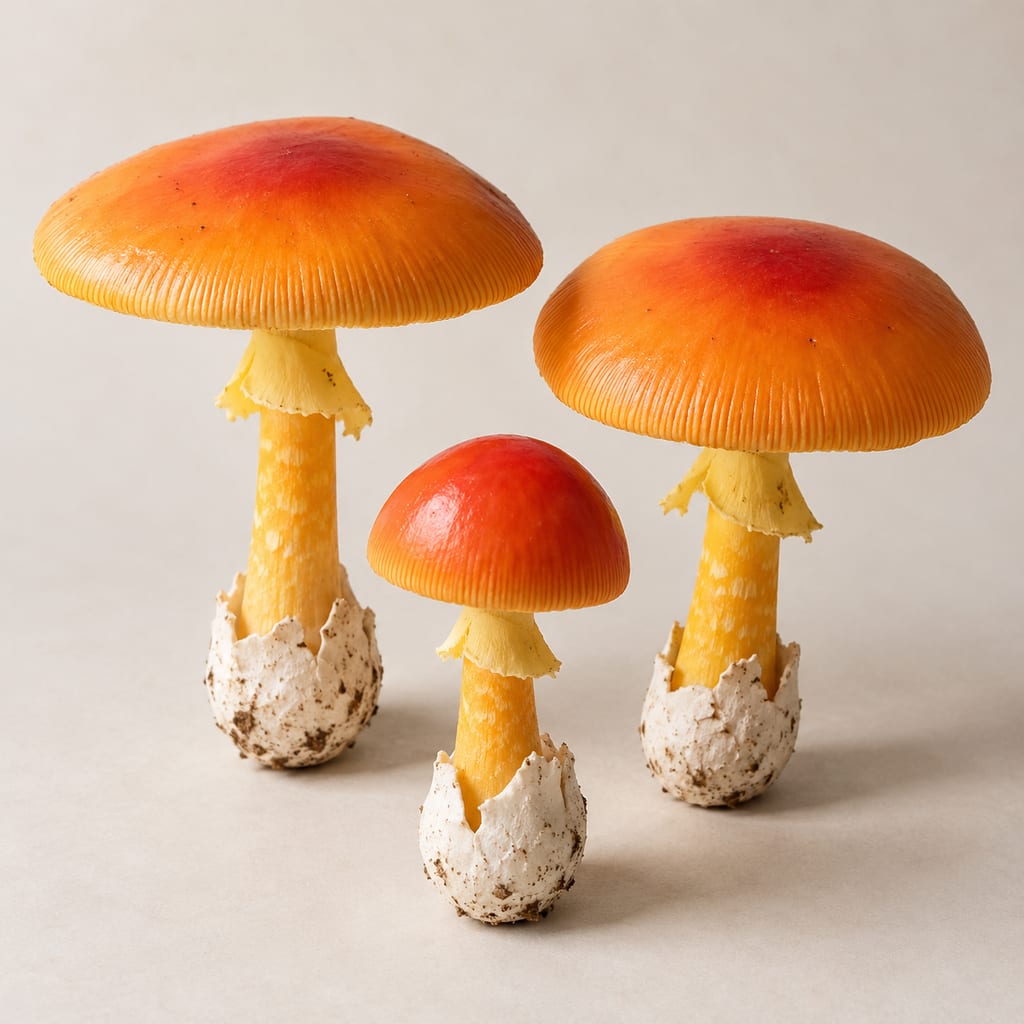
A wild Asian Amanita reported as food in regional literature and listed in China’s edible-fungi catalogue. Lookalikes include lethal species; this record is not a guide to identifying wild mushrooms.
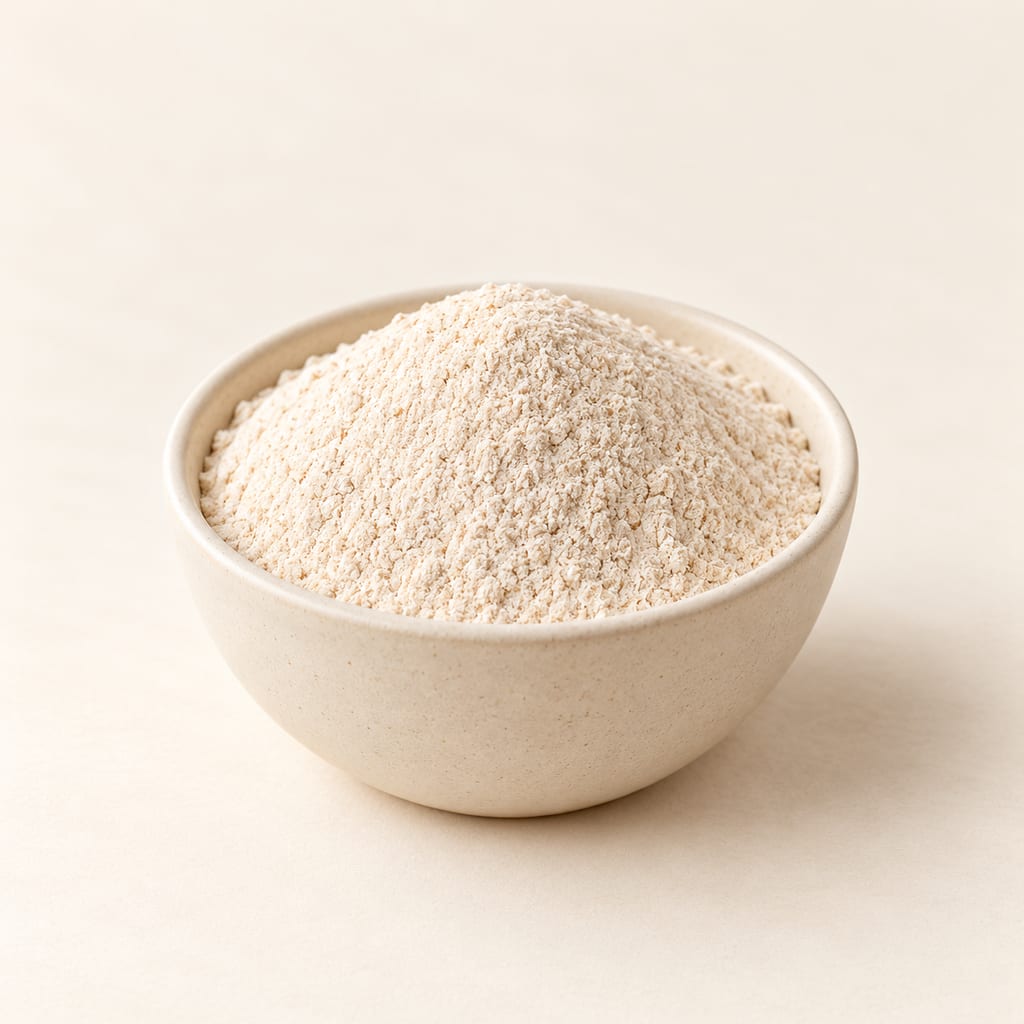
Atta is wheat flour used across South Asian bread traditions. Indian standards distinguish wheat flour (atta) from resultant atta; milling route and particle size shape its behavior in chapati dough.
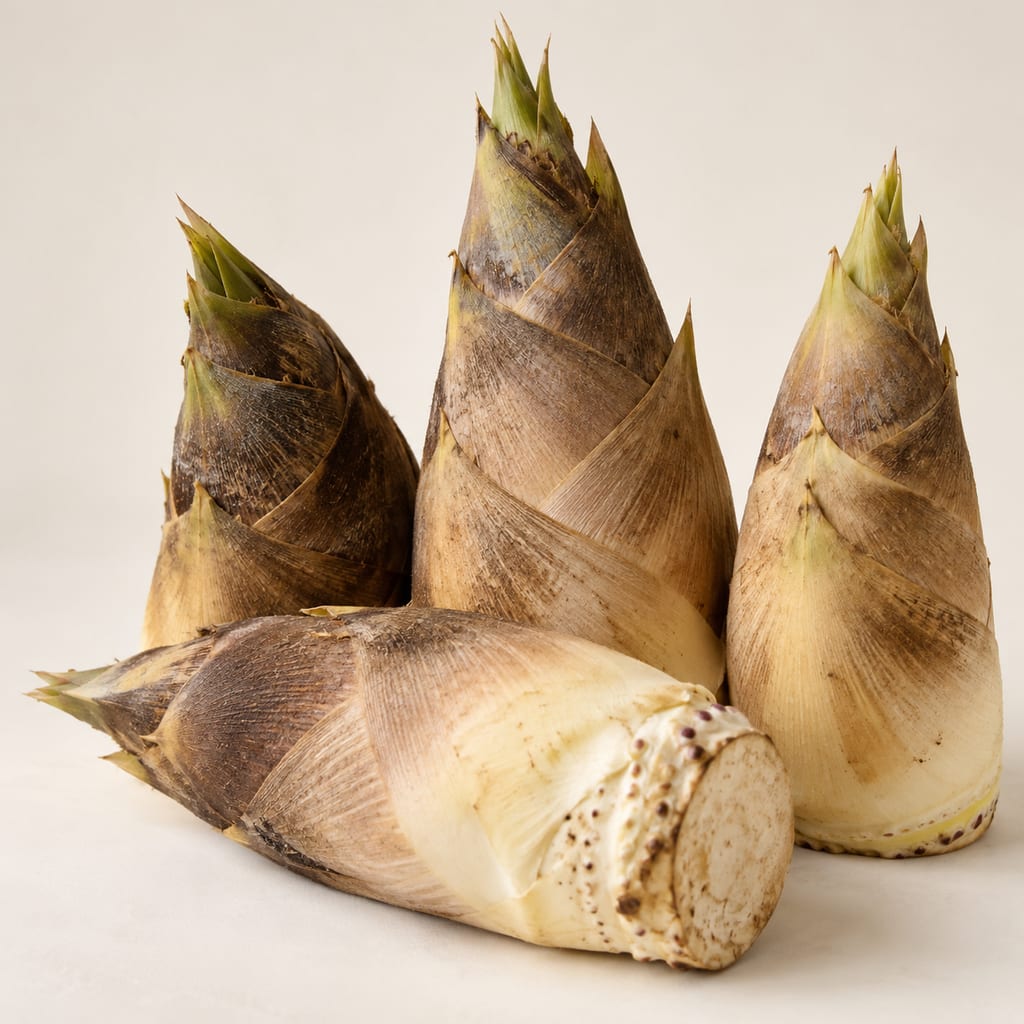
Bamboo shoots are the young culms of many bamboo species, eaten after boiling or leaching in Asia, and fermented into sour and preserved foods in the Himalayas, northeast India and Burma.
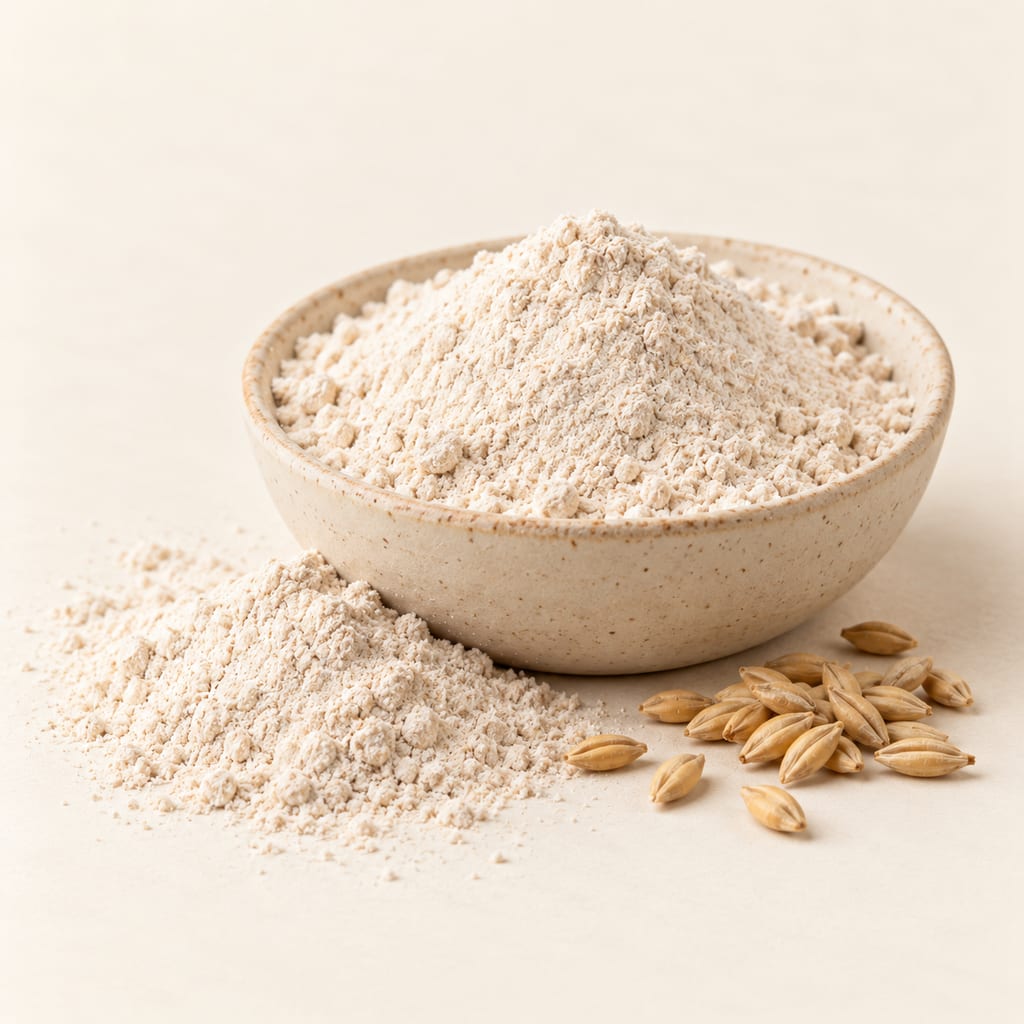
Barley flour is ground barley grain; whether it comes from pearled or hulless kernels, its milling and limited wheat-like gluten-forming ability shape the doughs and foods it can make.
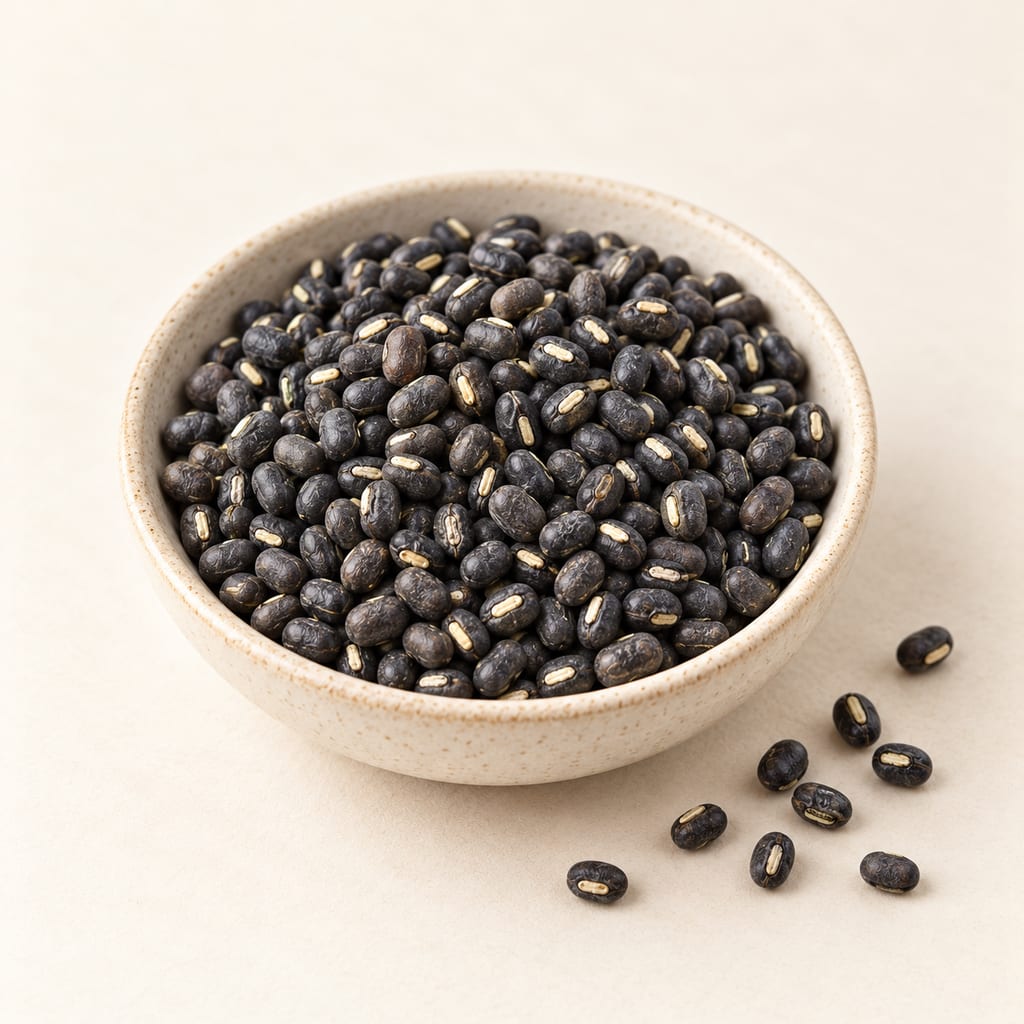
Black gram, or urad, is a South Asian pulse whose whole dark seeds and dehulled white dal make distinct cooked and fermented foods.

Protected Italian vinegar made only from cooked grape must, fermented and aged in a battery of wooden barrels for at least 12 years: sweet, sharp and syrupy.
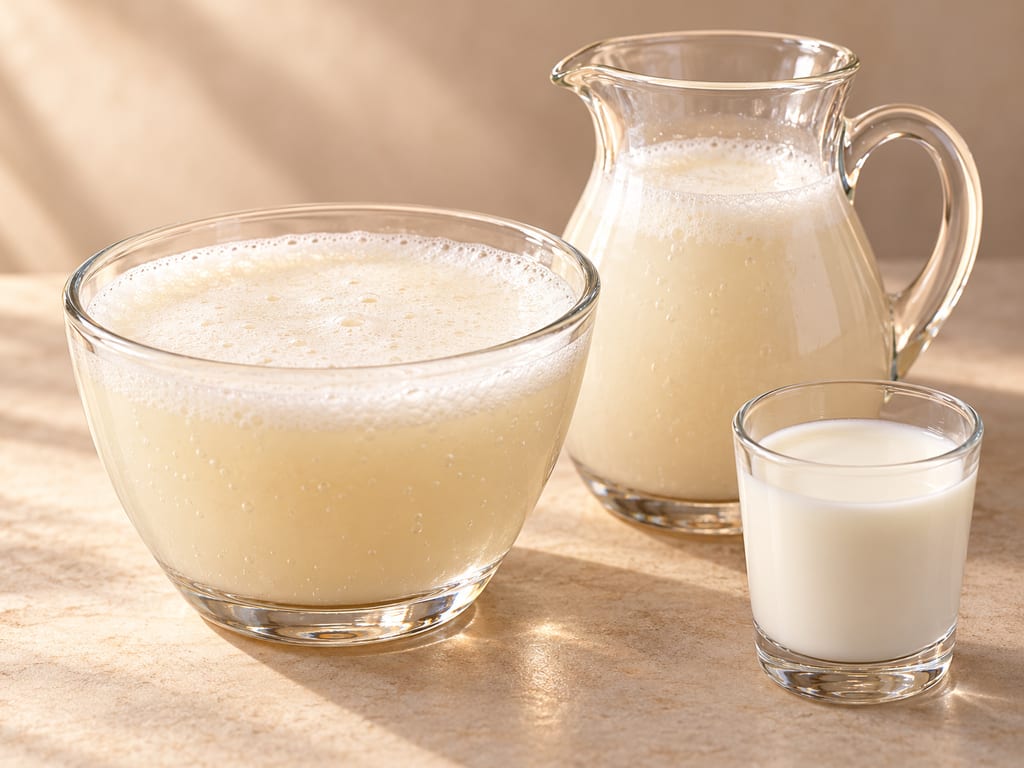
Airag is Mongolia’s fermented mare’s-milk drink, traditionally churned with saved starter in a reusable cowhide khokhuur.

Appam, or hoppers, are South Indian and Sri Lankan rice pancakes made from a fermented coconut-and-rice batter and cooked in a curved pan to a crisp lacy rim and a soft, spongy centre.
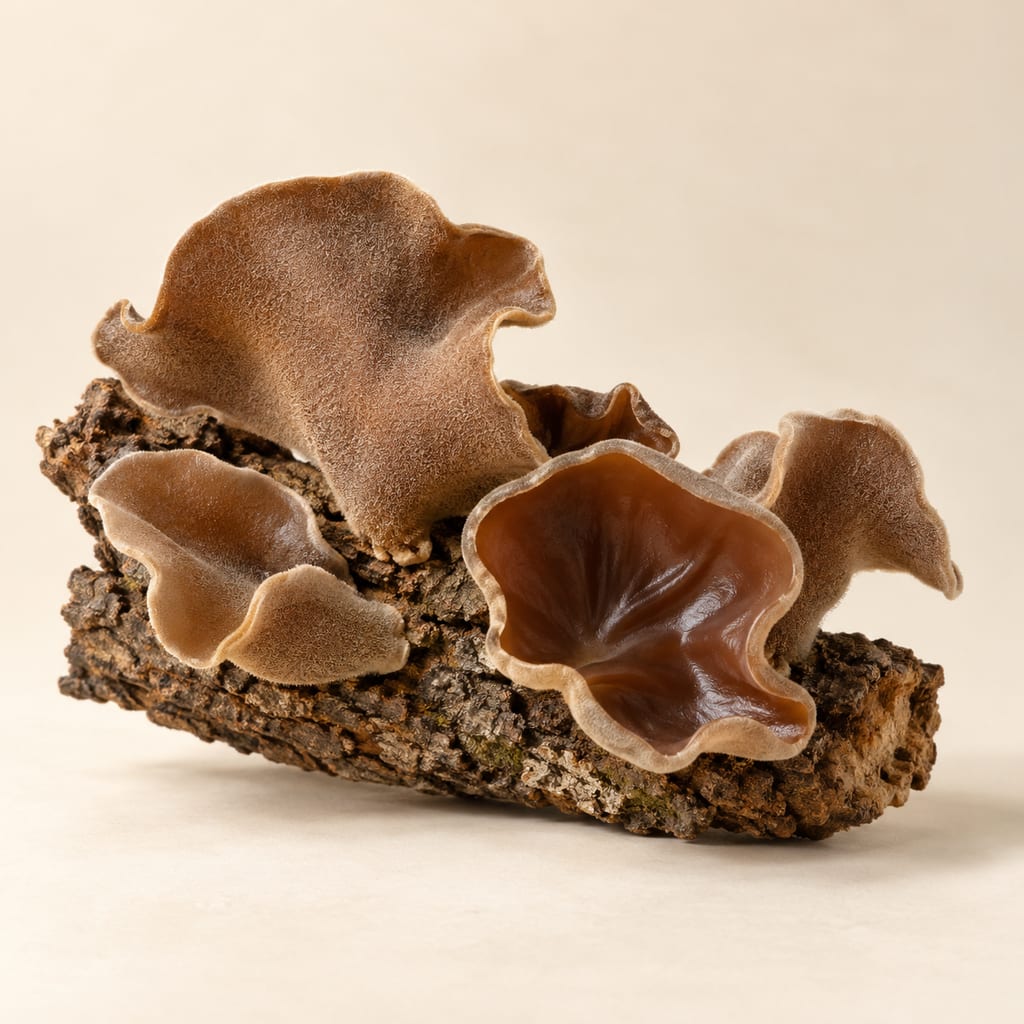
Auricularia tremellosa is a wood ear fungus of the genus that supplies most dried wood ear sold in China; its own food record is thin, and the culinary practice described here comes from the closely related wood ear species.

Ayran is Turkey’s cold, savoury yogurt drink: plain yogurt is loosened with water and lightly salted, then whisked smooth or aerated into a soft cap of foam.
A thin stone griddle used over an open hearth. Norwegian archaeology documents the established tradition from the early Middle Ages; a Viking-period origin is only a cautious suggestion linked to Shetland.

Crushed or milled barley cooked in water until the starch softens and the mixture thickens, the plainest way a northern household turned stored grain into a meal, here with apple and hazelnut.
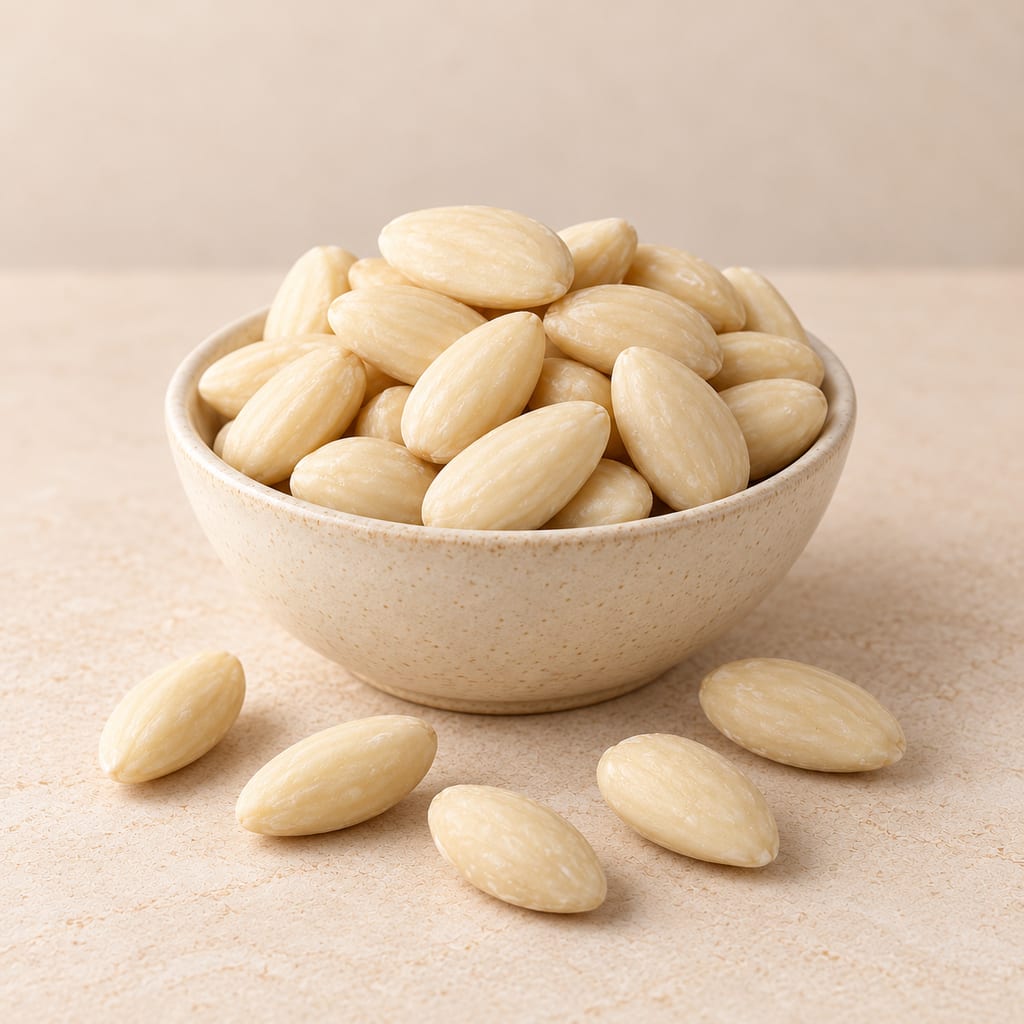
Blanched almonds are sweet almond kernels with the brown seed coat removed. A documented amla murabba cooks ten optional slivered kernels into the finishing syrup with spices and saffron.
No community contributions have been published for this entry yet.
Sign in to contribute. Published comments and photos are free to read.
Stolarczyk J. & Janick J., Chronica Horticulturae 51(2):13–18, 2011History · Botany
Carrot: History and IconographyEastern/Asiatic anthocyanin-pigmented domesticates; Afghanistan primary centre of diversity
Purple or yellow as first domesticated colours; orange displaced purple in Europe by 17th century
Purple types: poor storage, erratic growth; anthocyanin browns on cooking
Cited in: What black carrot is; Where purple came before orange; Growing and handling; Colour chemistry in the jar
Banga O., Euphytica 6:54–63, 1957History
Origin of the European cultivated carrotNo secure Roman cultivated food carrot; purple/yellow from Arab countries
Laufer: Persians acquainted with cultivated carrot in 10th century; no valid evidence for India before that
Nabathean/Ibn al-Awwam red and yellow-green types; European documents 13th–15th centuries
Early European 'red' colour words read as purple
Cited in: What black carrot is; Where purple came before orange
Wageningen University & Research depot reprint of Euphytica 6 (1957)History
Origin of the European cultivated carrot (WUR reprint PDF)Full-text verification of the 1957 Euphytica paper used for quotations and page claims
Cited in: Where purple came before orange
Battcock M. & Azam-Ali S., FAO, 1998Method · History
Fermented Fruits and Vegetables: A Global Perspective, Chapter 6 §6.3.5 KanjiDeep-purple carrot kanji in Northern India and Pakistan
Traditional batch description: 1 kg grated carrot, 7 L water, 200 g salt, 40 g crushed mustard, 8 g chilli; 7–10 days; strain; drink within 3–4 days
Yield just over 7 L per kg; lactic fermentation; no storage temperature or measured endpoint
Cited in: What black carrot is; What it brings to a ferment; Choosing roots for kanji or şalgam
Sharma C., Sahota P.P. & Kaur S., Bulletin of the National Research Centre 45:143, 2021Method · Science
Physicochemical and microbiological evaluation of antioxidant-rich traditional black carrot beverage: KanjiPunjab Black Beauty black carrot used for laboratory kanji
Finished study beverage pH 3.47, lactic acid 0.99%, high antioxidant activity reported for that batch
Spontaneous LAB fermentation of grated black carrots with condiments
Cited in: What black carrot is; Growing and handling; What it brings to a ferment; Colour chemistry in the jar; Choosing roots for kanji or şalgam
ScienceDirect record S1878450X18300763 (study formulation as summarised in Fermentea atlas)Method · History
Primary study formulation of kanji cited as AM43 in Fermentea soft-drinks atlasStudied formulation quantities: 500 g black carrot, 25 g black salt, 50 g mustard powder, 10 g red-chilli powder, 3 L boiled cooled water
Not interchangeable with other salt denominators or with the FAO batch
Cited in: What it brings to a ferment
Tanguler H. & Erten H., Journal of Food Quality, 2012Method · History
Chemical and Microbiological Characteristics of Shalgam (Şalgam): A Traditional Turkish Lactic Acid Fermented BeverageŞalgam is a lactic-fermented beverage made with black carrot as major raw material
Core popularity in Çukurova (Adana, Mersin, Hatay)
Cited in: What it brings to a ferment
PMC5495728Science
Aroma composition of shalgamSupports black-carrot şalgam as a documented lactic beverage tradition