
Abalone mushroom
Pleurotus cystidiosus is the abalone mushroom, a cultivated oyster-type fungus with dark brown caps that grows more slowly and is more demanding than other Pleurotus species.
 FermenteaWhere food goes to change
Mushrooms
A wild Asian Amanita reported as food in regional literature and listed in China’s edible-fungi catalogue. Lookalikes include lethal species; this record is not a guide to identifying wild mushrooms.
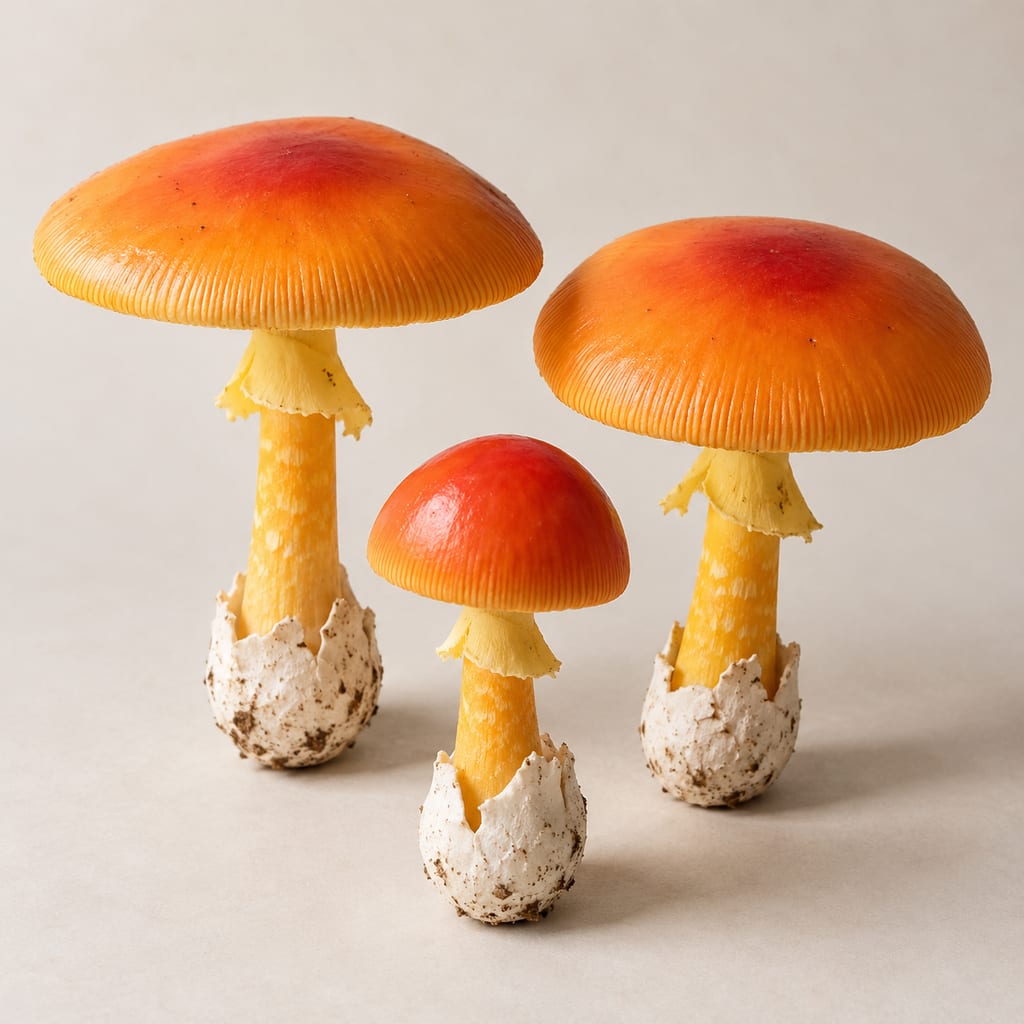
Amanita hemibapha (Berk. & Broome) Sacc. is a wild forest mushroom reported in taxonomic and food literature from parts of Asia. “Asian Caesar mushroom” is a useful English common name, but common names are not controlled taxonomic names. Caesar mushrooms in different places may belong to different species, and a shared name does not prove shared identity, preparation, or food history.
The northern Thailand study treats A. hemibapha as a distinct taxon using descriptions of collected material and molecular comparison. The paper’s taxonomic context matters because species names in Amanita have shifted as researchers compared morphological characters with sequence evidence. The entry therefore follows the voucher-based Thai usage for its scientific name while retaining the common name only as a search and reading aid.
Japanese reports illustrate why names need care. The red-cap mushroom called Tamagotake was long assigned in some literature to A. hemibapha; a morphological and phylogenetic reassessment identified the Japanese material as A. caesareoides. Accordingly, Japanese Tamagotake reports are not used as distribution or food-use evidence for A. hemibapha here. The distinction prevents a familiar name from silently broadening the species’ range.
Published descriptions report an orange-red cap centre, yellow outer area, pale free gills, yellow ring, yellowish stem and sack-like volva. These are descriptive characters from identified collections. They are not a simplified field key: colour changes as a fruit body ages, photographs may omit the base or underside, and similar Amanita species can share visible traits. The description is included to explain the scientific literature, not to help a reader decide whether an unknown mushroom is edible.
The clearest geographically precise records reviewed are from northern Thailand. Kumla and colleagues report collections in Chiang Mai and Lamphun provinces, including named districts and a campus collection. Their work is a survey of edible Amanita and includes taxonomic identification of collected material. These records support occurrence at the stated collection places. They do not establish that the mushroom grows throughout Thailand, occurs at every site in those provinces, or is abundant in any given year.
The study combines local collections and other sampling contexts, so a place row should not be read as a universal origin claim. A voucher-backed collection means the scientific name is attached to examined material; it does not automatically document household use, a market chain, or a preparation tradition at the collection site. The wording keeps these evidence types separate.
A review of Indian edible mushrooms describes A. hemibapha as a valued food and source of income across several states, and summarizes a broad distribution from Himalayan areas to the Western Ghats. This is evidence of reported traditional use at a country-level synthesis. It is secondary literature drawing together earlier records, not a new standardized survey of every state or an assertion that use is uniform. The regional names reproduced in that review are tied to their reported states and spellings; they should not be presented as one pan-Indian name.
The 2026 Chinese national catalogue lists A. hemibapha among edible and medicinal fungi. That is a catalogue-level food classification and supports China as the scope of the listing. On its own, the catalogue row does not identify a collection locality, market, community, dish, preparation procedure, or direct consumption episode. For those reasons the China location is explicitly qualified and is not described as local culinary practice.
These sources give distinct strengths of evidence: examined Thai collections, review-level Indian food-use context, and a Chinese catalogue listing. They should not be flattened into a single list of equivalent food traditions. The reviewed set is also too small to define a complete range. Countries or regions absent from this draft are not thereby proven to lack the species; they simply are not added without adequate source support.
The Thai voucher collections include late-July and August dates. The Indian review gives July through September as a broad season. Together these records are consistent with warm, rainy-season fruiting in some local settings, but they do not establish a single season across South and Southeast Asia. Monsoon timing, elevation, forest conditions and local rainfall differ, and a collected specimen date is not a guarantee of annual availability.
The Indian review’s seasonal synthesis is useful as regional context, but it should be presented as a reported period rather than a dependable harvest calendar. The Thai study’s dates describe its own sampled fruit bodies, not the first and last day of a local fruiting season. A catalogue page should not turn either source into a prediction for a particular year or village.
The mushroom is reported from forest settings. Ectomycorrhizal association appears in the supplied research lead, while the Indian review gives conflicting ecological classifications in its prose and table. This draft therefore avoids a definitive host list and does not claim that the fungus depends on any specific tree based solely on the reviewed secondary account. Stronger host claims would need direct species-level evidence connected to examined collections.
All verified supply statements concern wild collection or occurrence. No cultivation process for A. hemibapha was established in the reviewed sources. Calling supply wild describes the literature; it is not an invitation or recommendation to collect it. The distinction is especially important for Amanita, where identification errors can have severe consequences.
Seasonal records are especially easy to overstate. A voucher date is a point observation tied to the place, year and survey conditions; a review’s seasonal window may summarize several regions and earlier studies. Neither establishes continuous fruiting through the listed months or predicts the next season. If later work identifies a month for one district, it should remain attached to that district and source rather than replacing the broad qualification. The same rule applies to elevation and habitat: a collection’s conditions describe where that material was found, while a range-wide ecological preference needs broader comparative evidence.
The Indian review reports A. hemibapha as an appreciated food and a source of income in several areas. The Chinese catalogue includes it in an edible-and-medicinal fungi list. These are meaningful reports of food context, but neither source as reviewed here supplies a complete species-specific recipe. The evidence supports careful wording about reported use, not a claim that all parts of the range share the same custom.
The Thailand paper is an edible-Amanita survey and includes nutritional and biochemical analyses of collected mushrooms. Laboratory composition and assay results do not demonstrate health benefits, a clinical effect, or a safe home preparation. Those measurements answer research questions about analyzed samples; they should not be rewritten as claims that eating the mushroom improves health or treats a condition.
No species-specific dish, cooking schedule, drying practice, pickling method, brine, fermentation, or preservation procedure was verified in the passages reviewed. A method reported for a related Amanita cannot be assigned to A. hemibapha merely because the mushrooms share a genus or common-name element. The absence of a detailed method in these sources is kept visible rather than filled with a generic mushroom instruction.
Likewise, inclusion in an edible list is not equivalent to a controlled food-safety evaluation. It does not identify an unknown specimen, specify a safe preparation endpoint, or address contamination, storage, individual reactions, or regional regulatory requirements. This record describes what the literature says about named taxa and contexts; it is not a practical recipe or a guarantee for a product bearing a similar name.
Amanita contains species that are lethally poisonous. The Thai survey discusses edible taxa alongside dangerous relatives, and the Indian review warns of resemblance to another Amanita. This makes it inappropriate to write a quick consumer checklist from a few colour and veil traits. A scientific description belongs with taxonomic material and examined specimens; it does not turn an online page into a safe identification tool.
No photograph, red or yellow colour, ring, volva, local name, market label, catalogue entry, smell or taste can establish that an unknown mushroom is A. hemibapha or safe to eat. Photos can fail to show key structures, may depict a different growth stage, and cannot reproduce the microscopy, voucher comparison or sequencing underlying some published identifications. Even a correctly captioned image documents the pictured specimen only to the extent of the identification evidence behind that caption.
The Japanese Tamagotake case also shows that a deeply familiar local name can be attached to a taxon later resolved as different. This is not merely a spelling issue: transferring the associated food-use reports could incorrectly expand the record. Scientific names, common names, image captions and traditional knowledge all need context and source boundaries.
Reader-facing copy should say that this named mushroom is reported as food in specific regional literature while making clear that the entry is not advice for collecting or identifying wild Amanita. It should avoid language such as “safe if,” “easy to recognize,” or claims that one visual feature rules out a deadly species. Any commercial food context requires a reliable, legally compliant supply chain and professional identification; the page itself cannot certify a specimen.
Further improvement should prioritize primary, voucher-backed ethnomycological accounts that describe who uses the mushroom, where, under what local name and how it is prepared. The Indian review can guide those searches, but more precise claims should be added only when the underlying source is inspected. Similarly, the Chinese catalogue’s cited source chain should be traced before describing a particular Chinese tradition. This preserves useful existing evidence without turning a bibliography lead into a stronger claim than it supports.
The evidence reviewed here answers several different questions. A voucher and a locality support an occurrence record; a food-use review supports a statement about reported use; a national catalogue supports the narrower claim that a name appears in a compiled list. None of these alone answers all the others. In particular, a species can occur at a research site without being eaten there, and a food label does not supply a recipe or an identification method.
The Indian review brings together regional literature and names, but its synthesis does not make the underlying observations identical in date, method or taxonomic certainty. A reader should understand “reported across states” as a summary, not a count of confirmed populations or a map of uniform practice. Place detail should be added only when the cited source names and supports it.
The Thai collections offer a more direct chain from a scientific name to examined material, yet their strength is also specific: they support the cited collection records and the study’s taxonomic comparisons. They do not make every image labelled A. hemibapha equally reliable. Evidence quality attaches to a particular specimen and method, not automatically to every later use of the name.
The Chinese list is useful for catalogue discovery and may lead to sources that document local practice. Until that chain is traced, it should remain a catalogue-scope fact. Editorial precision means preserving what each source can establish, even when the resulting account is narrower than a broad common name or continental range might suggest.
Voucher-backed collections from Chiang Mai and Lamphun in an edible-Amanita survey; does not claim national abundance or local consumption at every collection site.
Country-level traditional food-use synthesis in a secondary review; not a locality-specific use record.
Country is catalogue scope only; listing does not establish a collection locality or direct local consumption.
Pleurotus cystidiosus is the abalone mushroom, a cultivated oyster-type fungus with dark brown caps that grows more slowly and is more demanding than other Pleurotus species.
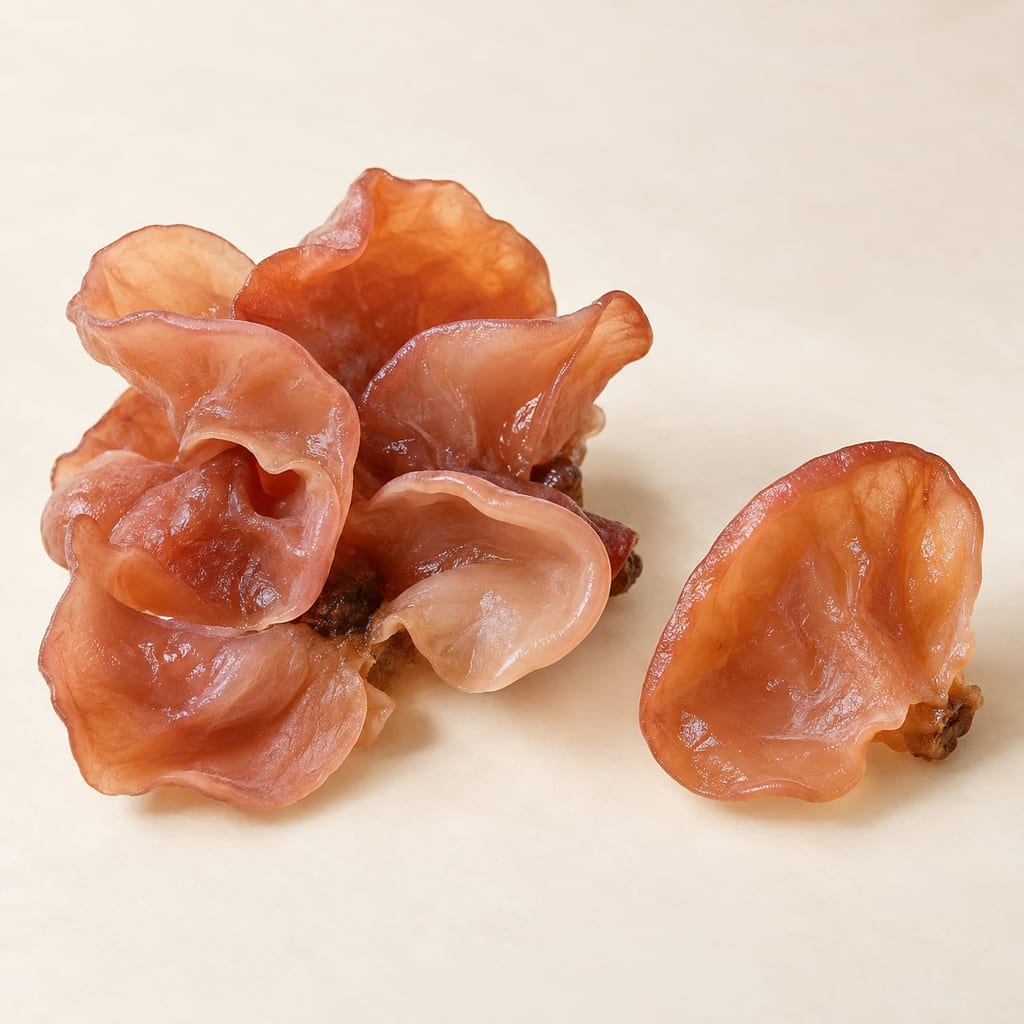
Auricularia thailandica is a thin, gelatinous wood ear described from Southeast Asian collections. Research reports it edible and experimentally cultivable, but species-specific recipes and everyday handling guidance are scarce.
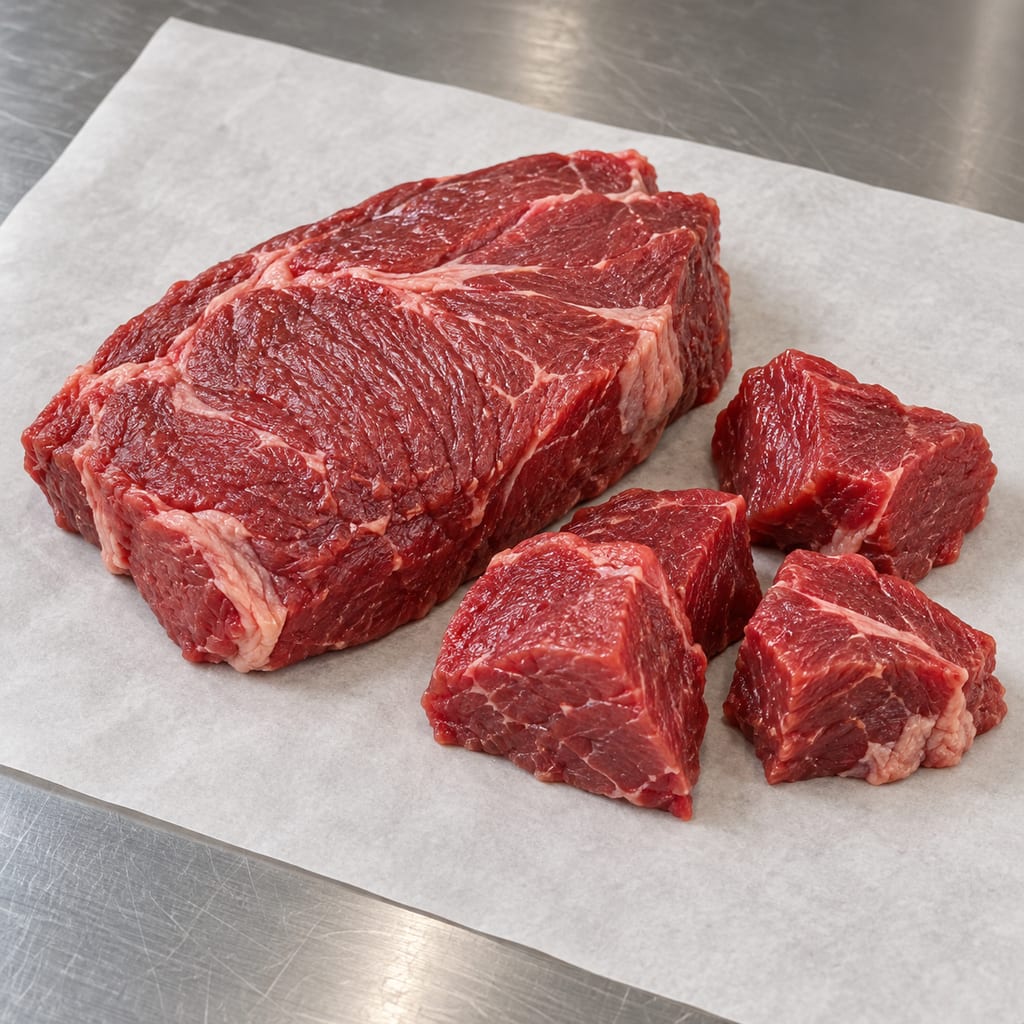
Water-buffalo meat, often called carabeef, is the flesh of Bubalus bubalis; its colour, texture and fat vary with animal, cut and production system. “Buffalo” can also mean bison or African buffalo in other contexts.
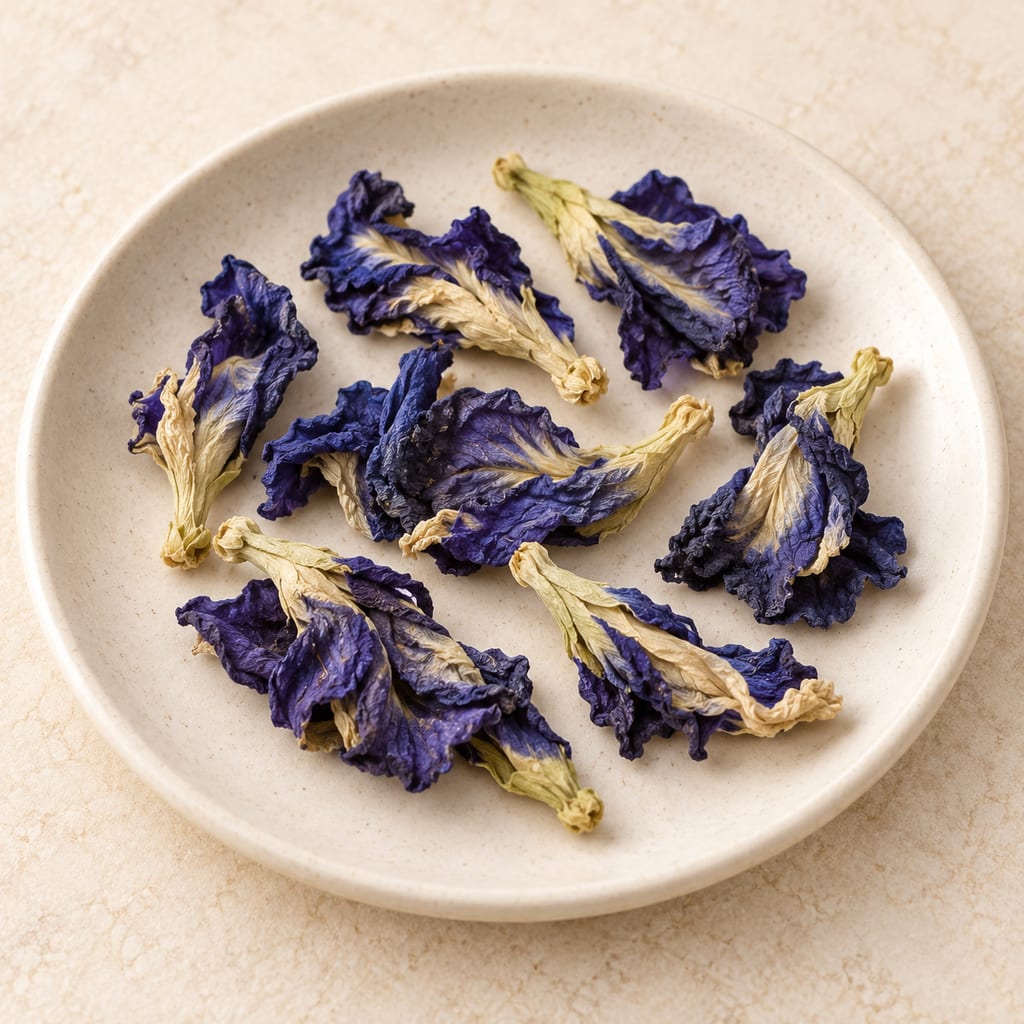
Clitoria ternatea's blue flower is used as a colourant and appears in a Thai dried-flower tea product. Food use is preparation-specific; EFSA raised safety objections to a dried-flower traditional-food notification.
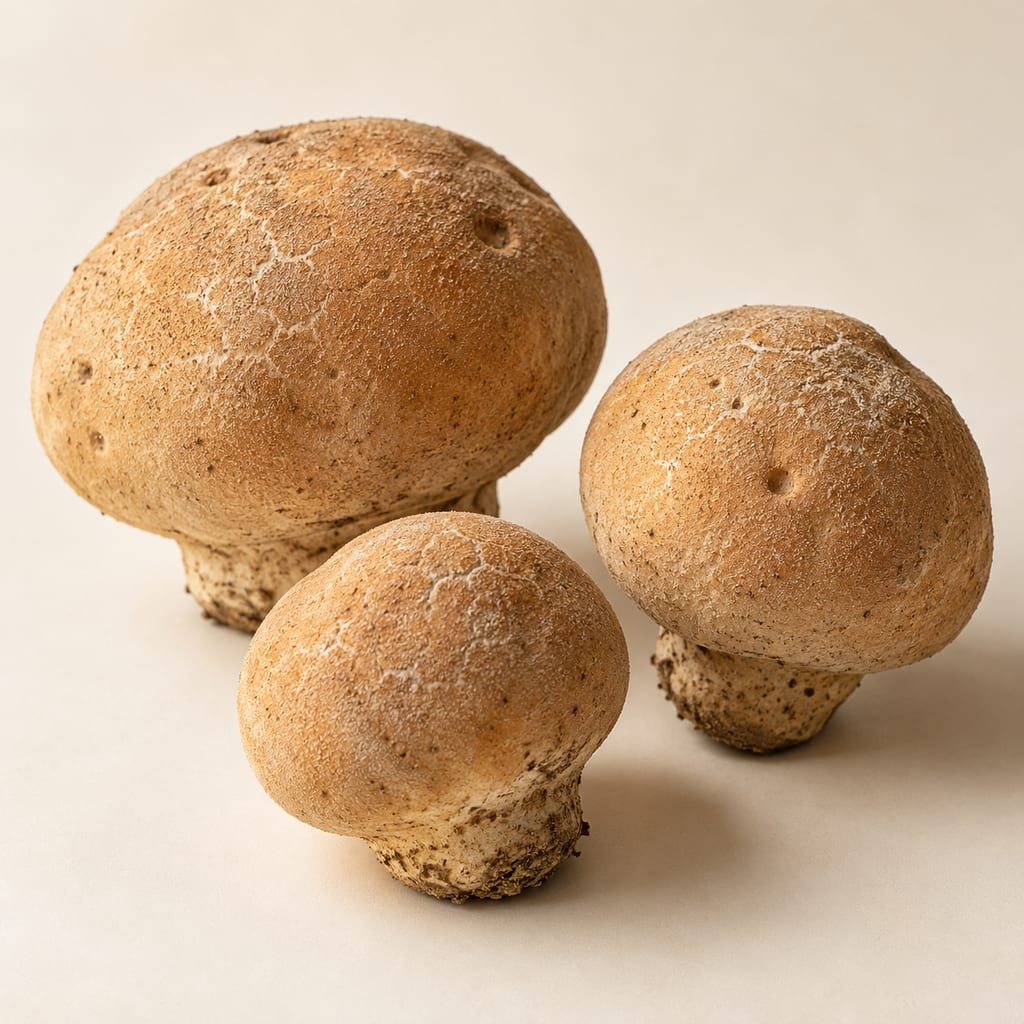
Calvatia boninensis is a large puffball described from the Bonin (Ogasawara) Islands of Japan, reported as edible in some catalogues and local accounts, with no species-specific safety or preparation study.
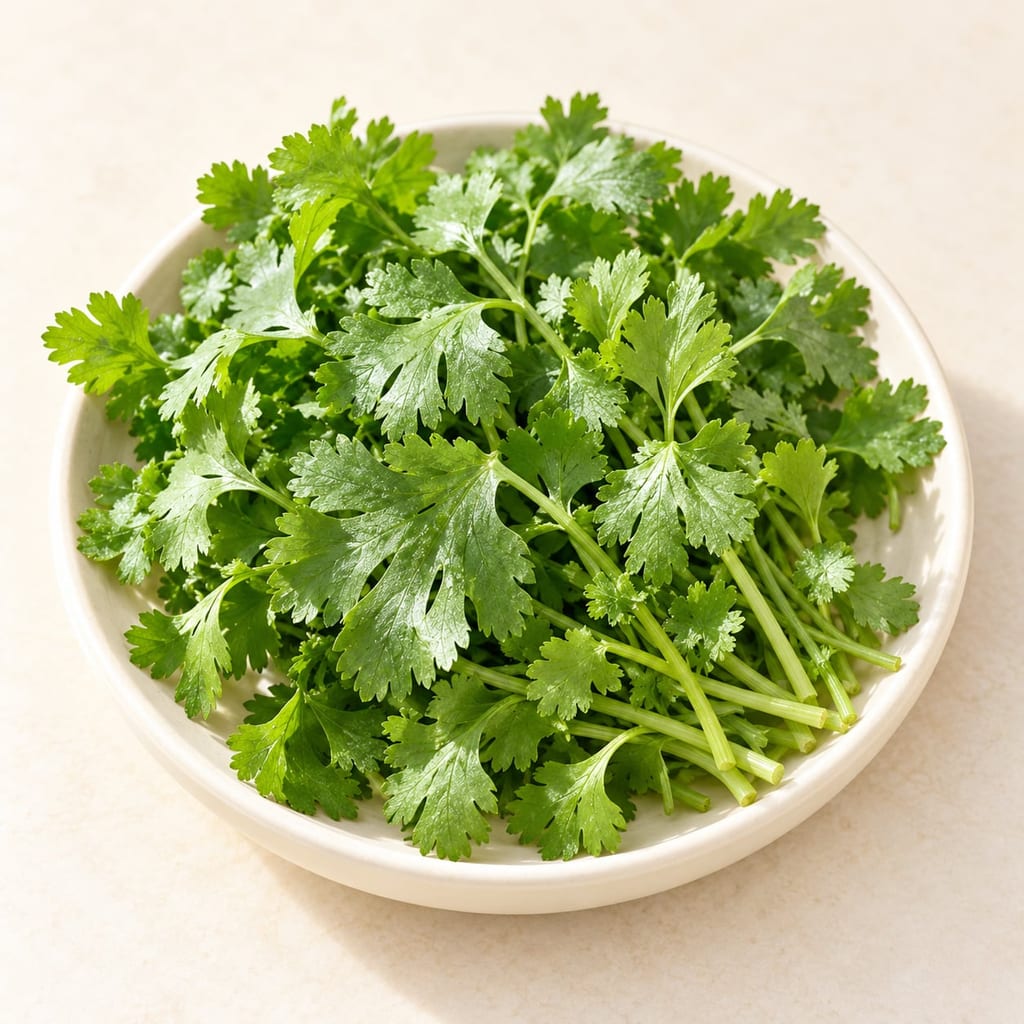
Cilantro is the fresh leafy herb of Coriandrum sativum, the same annual plant that produces coriander spice. Its green, aromatic leaves and fine stems bring a vivid herbal note to foods such as sai krok Isan.
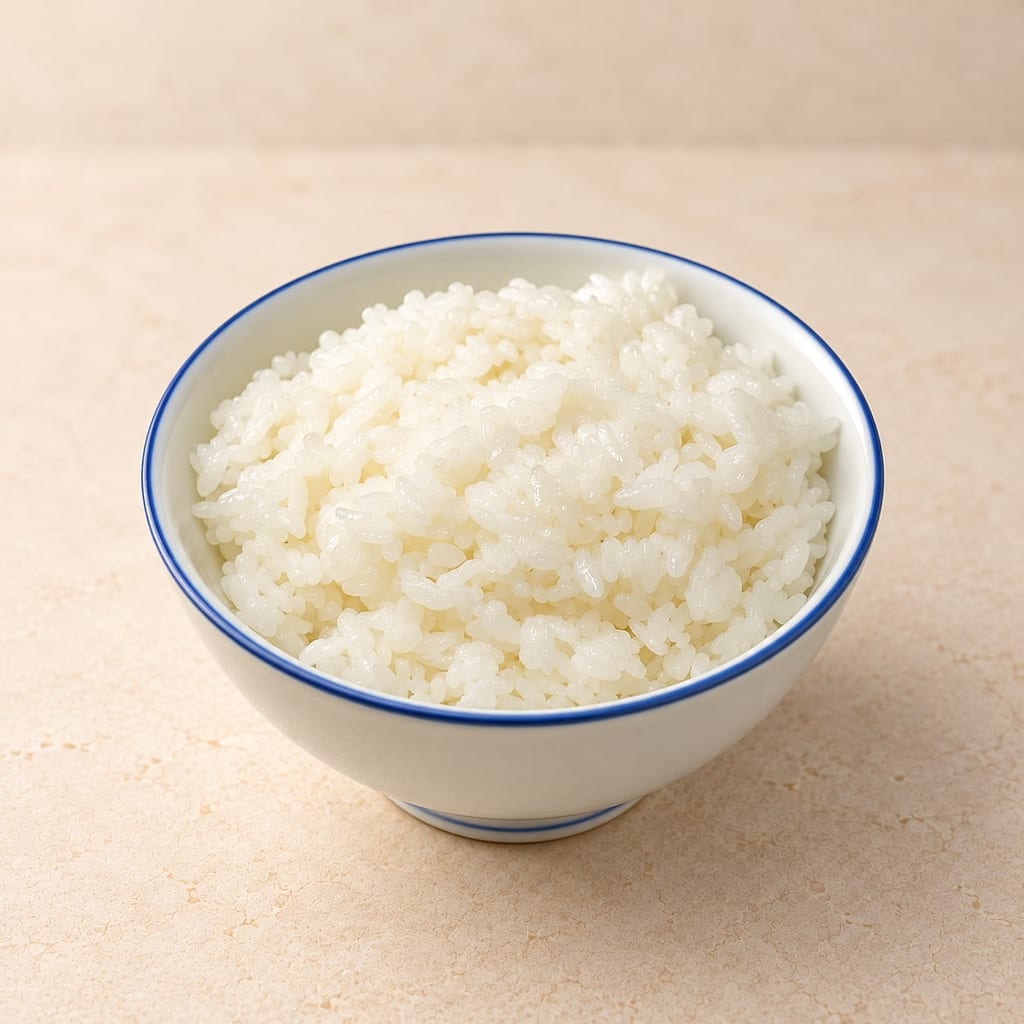
Cooked rice is rice grain heated in water until its starch gelatinizes; in Thai sour sausage it feeds the bacteria that acidify the meat.
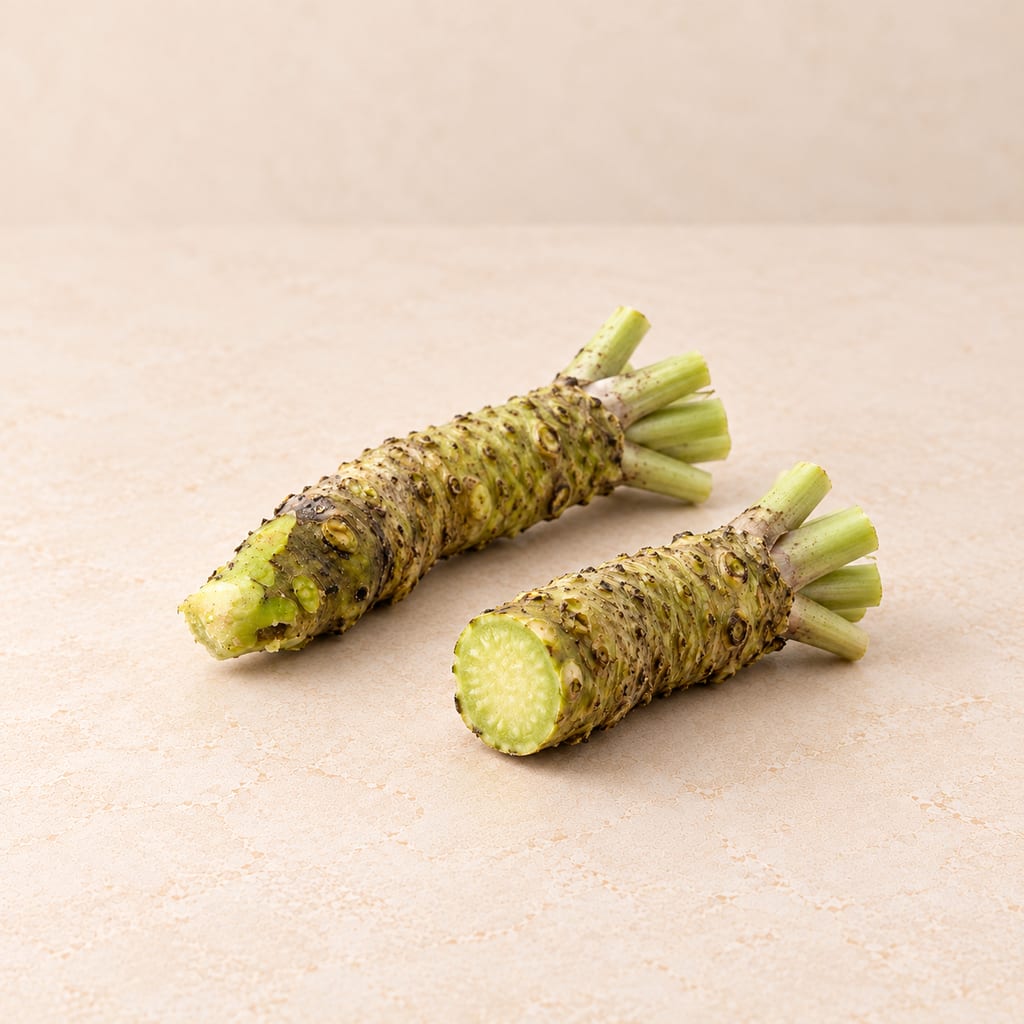
Wasabi is the enlarged stem of Eutrema japonicum, a pungent perennial in the mustard family. Fresh rhizome is grated as a Japanese condiment; powder and prepared paste are separate products.
No community contributions have been published for this entry yet.
Sign in to contribute. Published comments and photos are free to read.
MycosystemaFood use · Geography
Species cataloging of edible and medicinal fungi in ChinaThe 2026 national catalogue lists Amanita hemibapha among edible and medicinal fungi; this is catalogue inclusion, not a species-specific preparation or local-consumption account.
Cited in: Evidence and geography; Food use and what remains undocumented; How to read the records
Journal of FungiTaxonomy · Identity · Geography · Seasonality · Safety
Survey of Edible Amanita in Northern Thailand and Their Nutritional Value, Total Phenolic Content, Antioxidant and α-Glucosidase Inhibitory ActivitiesVoucher collections from Chiang Mai and Lamphun were identified using morphology and molecular evidence; collection dates include late July and August. The study compares similar taxa. Laboratory measurements are not recipes, health outcomes or guarantees of safety.
Cited in: Name and taxonomic scope; Evidence and geography; Season and ecological setting; Food use and what remains undocumented; Identification risk and safe reading; How to read the records
Mushroom ResearchFood use · Geography · Seasonality · Names · Safety
A perspective on Indian edible mushrooms with traditional knowledgeSecondary review reports A. hemibapha as valued food and income source in India and gives broad distribution, July–September season, regional names and a lookalike warning. Ecology entries conflict, so no definitive host is asserted.
Cited in: Evidence and geography; Season and ecological setting; Food use and what remains undocumented; Identification risk and safe reading; How to read the records
MycoscienceTaxonomy · Identity
Taxonomic consideration of the Japanese red-cap Caesar’s mushroom based on morphological and phylogenetic analysesJapanese Tamagotake long referred to as A. hemibapha was resolved as A. caesareoides; these Japanese records are excluded from this species’ distribution and food-use claims.
Cited in: Name and taxonomic scope; Identification risk and safe reading