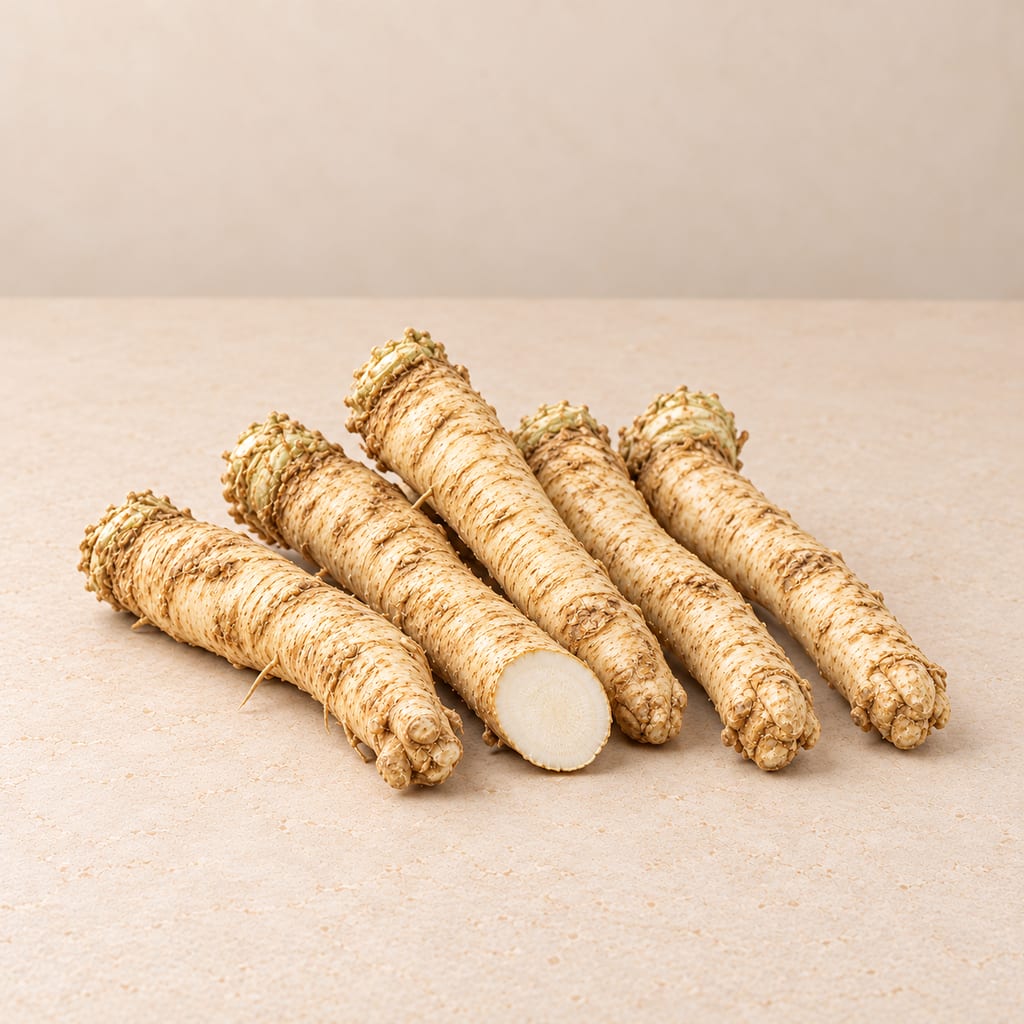
Horseradish root
Horseradish is the long white root of Armoracia rusticana, a perennial of the mustard family. Grated, it releases a sharp, nose-clearing heat that vinegar fixes in the sauce.
 FermenteaWhere food goes to change
Spices and aromatics
Wasabi is the enlarged stem of Eutrema japonicum, a pungent perennial in the mustard family. Fresh rhizome is grated as a Japanese condiment; powder and prepared paste are separate products.
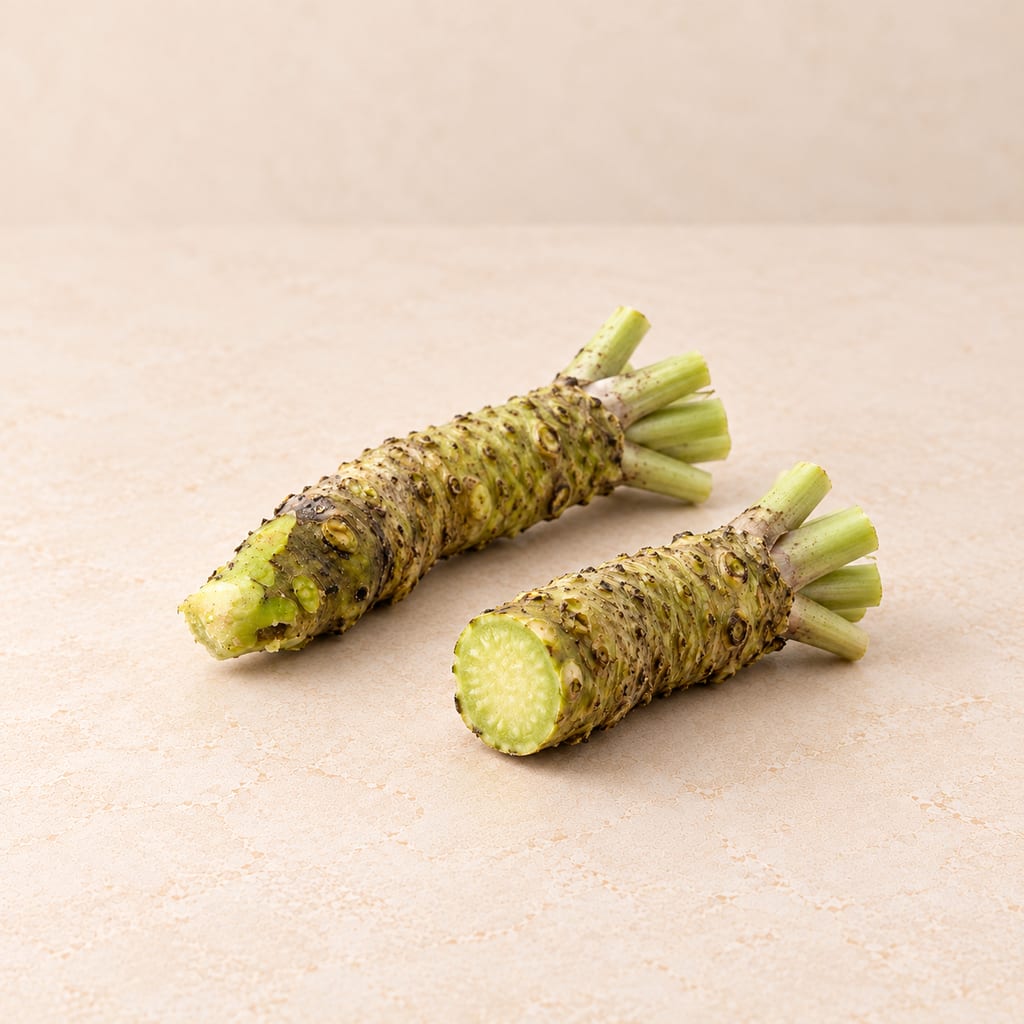
The earliest record of wasabi as an herb dates to the sixth or early seventh century CE in Japan. This is an attestation of the plant and its name in a historical record; it is not a proven date for domestication, cultivation, or the first use of grated rhizome.
The earliest culinary use may have been in soup during the latter half of the Kamakura period, in the thirteenth century. Wasabi appears as a condiment with sushi and soba in accounts of the Edo period, in the eighteenth and nineteenth centuries. The earliest food use remains uncertain.
The first cultivation and domestication are associated with Utogi in Shizuoka during the first half of the Edo period. Abundant spring water there made commercial production for Edo possible. This is a documented cultivation association. It does not establish that E. japonicum first evolved there or that every later cultivation method began in the same locality.
Historical dates for a plant’s use describe different events. The sixth- or early-seventh-century record is an herb attestation; the thirteenth-century soup use is a possible food reference; the Edo-period account concerns an established condiment and expanding cultivation. They should not be compressed into one date for the invention of wasabi.
The distinction among plant range, cultivation history and recipe history matters on a map. Japan is the source-supported association for the culinary history in this article. The species’ native range is broader. Utogi is recorded separately as a historical cultivation place rather than as an exact botanical origin.
Wasabi is the enlarged stem, or rhizome, of Eutrema japonicum, a perennial in the mustard family, Brassicaceae. The thickened stem is the part most often grated for the familiar pungent condiment. It is a stem, not a true root, even though common English names and shop descriptions sometimes call it a root.
Eutrema japonicum (Miq.) Koidz. is the accepted scientific name. Wasabia japonica is a botanical synonym that remains common in older botanical and food writing, so both scientific names can appear on labels and in research.
The English name Japanese horseradish refers to flavour and culinary role, not to the species. European horseradish is Armoracia rusticana. Fresh wasabi rhizome should not be confused with European horseradish root or with a green paste formulated from other ingredients.
The Japanese name is written わさび or ワサビ. The character 山葵 is also used. Scientific sources may use Eutrema japonicum or its older synonym Wasabia japonica; both names refer to the same accepted species.
Fresh rhizome, grated wasabi, powdered wasabi, and prepared paste are distinct forms. Fresh condiment comes from grated enlarged rhizome. A prepared paste or powder may use other ingredients, and a product name alone does not establish how much true wasabi it contains. Read the package ingredient list when a recipe specifically requires fresh rhizome.
Some powdered or tubed products blend wasabi with horseradish, mustard, starch or coloring. Formulas differ by maker and market. A photo of a green paste or a front-of-package claim does not identify its full composition; the label is the appropriate source for the ingredients of that product.
The plant has other edible parts in some culinary traditions, but they are not substitutes for the enlarged rhizome in a recipe that names fresh wasabi. A close relative, Eutrema tenue or yuriwasabi, is also pungent, but its rhizome is not enlarged in the way that gives cultivated wasabi its market form.
Several plants in the genus Eutrema occur in East Asia. Eutrema japonicum and Eutrema tenue are Japanese species; Eutrema yunnanense is a related Chinese species. The names distinguish plants rather than market forms of a single condiment.
Eutrema tenue, called yuriwasabi in Japanese, grows wild in Japan and has a pungent flavour similar to wasabi in field observations. No evidence in the cited paper suggests it was domesticated for that flavour. Its rhizome is not enlarged, a visible distinction from the cultivated E. japonicum stem sold as fresh wasabi.
Eutrema yunnanense is gathered and eaten in Yunnan, including in pickled forms and cooked dishes. Survey respondents did not describe its taste as hot, unlike the pungency associated with Japanese wasabi. These local uses belong to E. yunnanense; they should not be transferred to fresh E. japonicum rhizome.
The linked Commons photograph shows a fresh thickened stem with leaf-scar rings. Four other linked photographs show flowers and wild plants identified as E. japonicum; they document botanical context, not the harvested rhizome. None of the images establishes where the pictured crop grew.
The pungent flavor is associated with Japanese Eutrema japonicum. Field observations of wild wasabi from Hokkaido south to Kumamoto found considerable variation in pungency. This means a single sensory description should not be treated as a guaranteed strength for every rhizome.
Field observations also describe Eutrema tenue as pungent, while respondents in a Yunnan survey did not describe E. yunnanense as hot. These are field and interview observations, not a blinded sensory test of market samples. They distinguish the species in the study but do not establish a universal scale for the strength of fresh wasabi.
Grating fresh wasabi makes the pungent condiment from its enlarged stem. When tissue is disrupted, precursor glucosinolates can release volatile isothiocyanates. The cited work supports the sharp pungent character; it does not give a reliable number of minutes for how long a particular grated rhizome keeps its aroma.
Prepared products can taste different from fresh rhizome because their ingredients and processing vary. Horseradish is one common replacement in powders and prepared products. The difference is relevant to flavor and identity, but it is not evidence that every product sold under a wasabi name is a substitute.
Fresh wasabi rhizome is plant material and a condiment, not a fermentation culture. Grated wasabi is documented with sushi, sashimi and soba. That culinary association does not mean the rhizome is itself fermented or that it starts fermentation.
The sources used here do not establish a household amount of fresh wasabi that controls fermentation, preserves a fermented food, or makes one safer. Add wasabi for its culinary role and pungency, not as a substitute for a tested preservation process or food-safety control.
Other dishes can pair wasabi with fermented ingredients, but a pairing does not create a new fermentation method. Fermentea's linked recipe pages record actual recipe use; they do not change the ingredient's identity or establish an origin claim for the condiment.
The current Kew entry includes Japan, Korea and southern Sakhalin in the native range of Eutrema japonicum. A 2024 plastome paper traces its natural range from Sakhalin Island to Kyushu, Japan. An earlier ethnobotanical paper describes wasabi and yuriwasabi as endemic to Japan. These accounts differ in how broadly they describe the native range; the disagreement is kept in the evidence notes.
Native range is a botanical statement. It does not show that every community across that range used the rhizome as a condiment, and it does not identify one place as the birthplace of wasabi cuisine. The culinary and cultivation history in the cited sources is Japanese.
A 2016 journal article reports that, by the early twenty-first century, wasabi was cultivated outside Japan in China, Australia, New Zealand, Ecuador, Belgium, Vietnam, Canada, Thailand, French Polynesia, Chile, Indonesia, the Philippines and Mexico, as well as on the Pacific Coast of the United States. This is a period-specific list cited from earlier work, not a present-day production ranking or proof that every region still has commercial production.
Japanese cultivated material includes Mazuma and Fujidaruma, used as research lines at the Izu Agricultural Research Center in Shizuoka. Cultivar names describe selected plant material; they do not by themselves identify a recipe's geographic tradition. A retailer's shipping location likewise does not establish where the crop grew.
The country list above records places reported in a published article, not an exhaustive map of farms. The available source does not give coordinates for every operation, verify the current commercial status of each country, or distinguish all water-grown and soil-grown production areas. Those details remain unknown in this record.
Wash the fresh rhizome before grating. Practical guidance for fresh wasabi leaves the skin on, trims small projections and uses a fine-toothed grater shortly before serving. Fresh grating releases the pungent condiment; the choice of grater and trimming directions are household guidance.
Household advice commonly recommends wrapping a whole rhizome for refrigerator storage. It may also be frozen and grated while frozen. A thin dried or browned surface can be trimmed before grating the exposed stem after storage.
A fine-toothed grater makes a paste-like condiment. Foodal describes slow, light, circular strokes and notes sharkskin graters as a traditional tool, with metal and ceramic alternatives now used. This is practical preparation advice; the sources do not show that one grater changes the ingredient’s safety or validates a particular process.
These directions do not establish a measured shelf life under a specified refrigerator temperature, nor a standard period during which grated wasabi keeps its flavor. Follow the supplier's advice and local food-handling guidance. Do not treat a general online time estimate as a tested limit.
Powder and prepared paste have separate storage instructions set by their product labels. They are manufactured forms with different ingredients and packaging from a fresh rhizome; a fresh-rhizome storage recommendation should not be applied to them.
Eutrema japonicum belongs to Brassicaceae, the mustard family. The botanical and ethnobotanical sources used here do not establish an allergen declaration or guarantee that fresh wasabi is suitable for a particular diet. A plant-family relationship is not enough to make a categorical allergen claim.
Powder and prepared paste may contain ingredients besides wasabi. Anyone avoiding a particular ingredient should read the package label and ask the producer when the composition is unclear. The ingredient identity on this page does not certify a packaged product.
Fresh grated rhizome is documented as a condiment for sushi, sashimi and soba. Prepared wasabi paste is a separate form that may include other ingredients. Link a recipe to the rhizome only when its source names fresh rhizome or grated fresh wasabi; a recipe that specifies prepared paste belongs with that prepared form.
The 2016 article draws on genetic comparisons among three Eutrema species and interviews with 35 residents of Yunnan. Its account is useful for species distinction and culinary history, but the interview group is not a global survey and the plant samples are not a representative test of all commercial wasabi.
The evidence used here supports the accepted plant name, an enlarged stem used as fresh condiment, its pungent character, Japanese culinary and cultivation history, and a broader native range in Kew's current record. It does not support a single exact birthplace for wasabi, a universal sensory description, current production volumes in every country, or a measured home storage life.
An earlier ethnobotanical paper describes E. japonicum as endemic to Japan; Kew's current range entry includes Korea and southern Sakhalin. These are differing botanical range claims, not competing accounts of where sushi or wasabi cuisine began. This article keeps Japanese culinary history separate from the species' wider range.
The linked gallery has one CC0 photograph of a fresh wasabi rhizome and four CC0 views of flowering or wild E. japonicum plants. Those plant views are labeled as botanical context rather than harvested product; none of the photographs establishes where an ingredient was grown. The approved generated illustration remains the article's own image.
Kew lists Japan in the botanical native range. The historical source documents Japanese culinary use and cultivation; neither identifies an exact birthplace.
Kew records Korea in the botanical native range; the sources used here do not establish a regional recipe use or cultivation tradition.
Kew and the plastome study include Sakhalin in the botanical range; the sources used here do not establish a local culinary use.
The source associates first cultivation and domestication with Utogi; this is a cultivation history, not a botanical birthplace.
The 2016 paper reports cultivation in this country at the time. This is a sourcing association, not a recipe origin or a claim of current commercial output.
The 2016 paper reports cultivation in this country at the time. This is a sourcing association, not a recipe origin or a claim of current commercial output.
The 2016 paper reports cultivation in this country at the time. This is a sourcing association, not a recipe origin or a claim of current commercial output.
The 2016 paper reports cultivation in this country at the time. This is a sourcing association, not a recipe origin or a claim of current commercial output.
The 2016 paper reports cultivation in this country at the time. This is a sourcing association, not a recipe origin or a claim of current commercial output.
The 2016 paper reports cultivation in this country at the time. This is a sourcing association, not a recipe origin or a claim of current commercial output.
The 2016 paper reports cultivation in this country at the time. This is a sourcing association, not a recipe origin or a claim of current commercial output.
The 2016 paper reports cultivation in this country at the time. This is a sourcing association, not a recipe origin or a claim of current commercial output.
The 2016 paper reports cultivation in this country at the time. This is a sourcing association, not a recipe origin or a claim of current commercial output.
The 2016 paper reports cultivation in this country at the time. This is a sourcing association, not a recipe origin or a claim of current commercial output.
The 2016 paper reports cultivation in this country at the time. This is a sourcing association, not a recipe origin or a claim of current commercial output.
The 2016 paper reports cultivation in this country at the time. This is a sourcing association, not a recipe origin or a claim of current commercial output.
The 2016 paper reports cultivation in this country at the time. This is a sourcing association, not a recipe origin or a claim of current commercial output.
The 2016 paper reports cultivation along the Pacific Coast. It gives no farm-level locality and this does not establish recipe origin or current commercial output.
Horseradish is the long white root of Armoracia rusticana, a perennial of the mustard family. Grated, it releases a sharp, nose-clearing heat that vinegar fixes in the sauce.

A gelling polysaccharide extracted from red seaweeds, sold as kanten strips or powder; it sets firm at a low concentration and stays solid until about 85 °C.

Akahatsu, Lactarius akahatsu, is a wild milkcap of East Asian pine and mixed forests that is sold in Yunnan markets, with its edibility and identity still needing species-level review.

The almond mushroom, Agaricus subrufescens, was cultivated in eastern North America in the 1800s, lost its market, and returned as a cultivated mushroom from Brazil, where it is grown under several names.
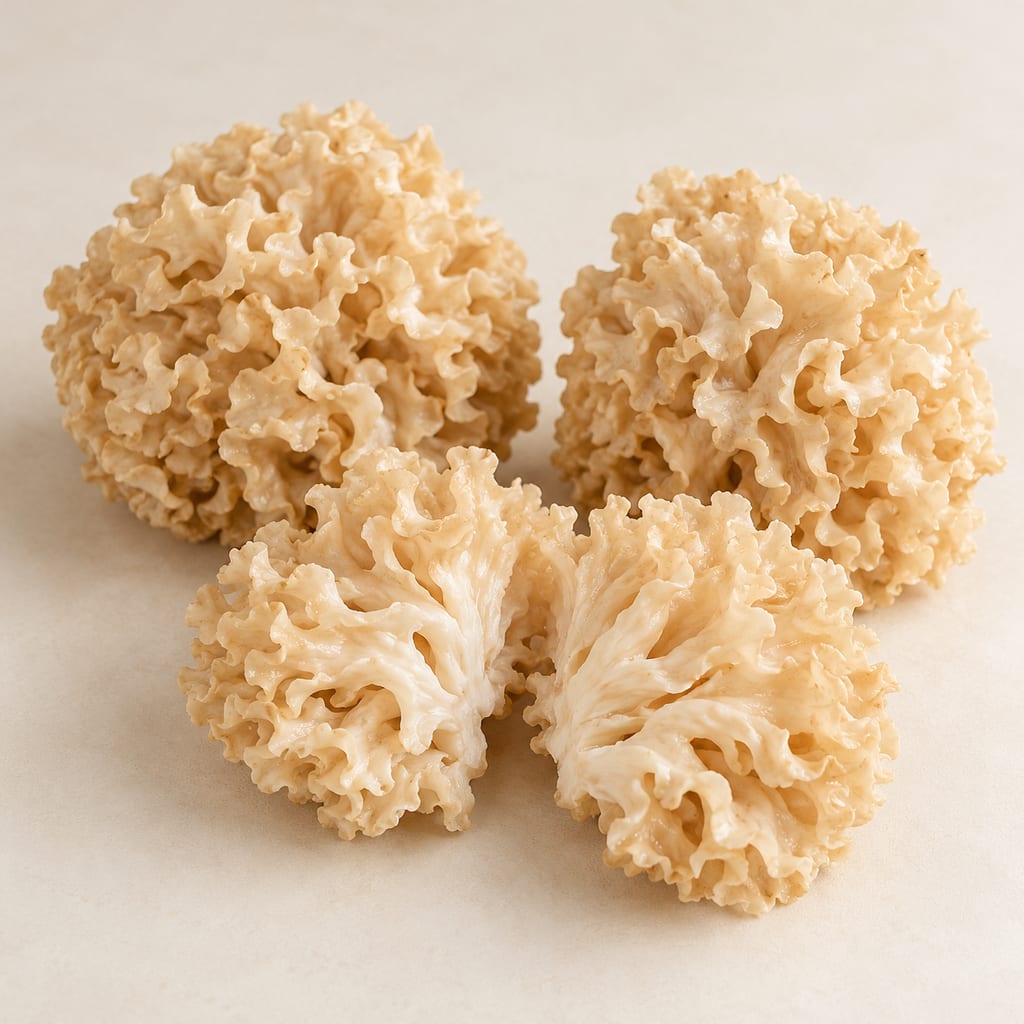
The Asian cauliflower mushroom, Sparassis latifolia, is a cultivated fungus with a frilled, fronded form that is eaten in China, Japan and Korea. Many Asian records under the name Sparassis crispa refer to this species.
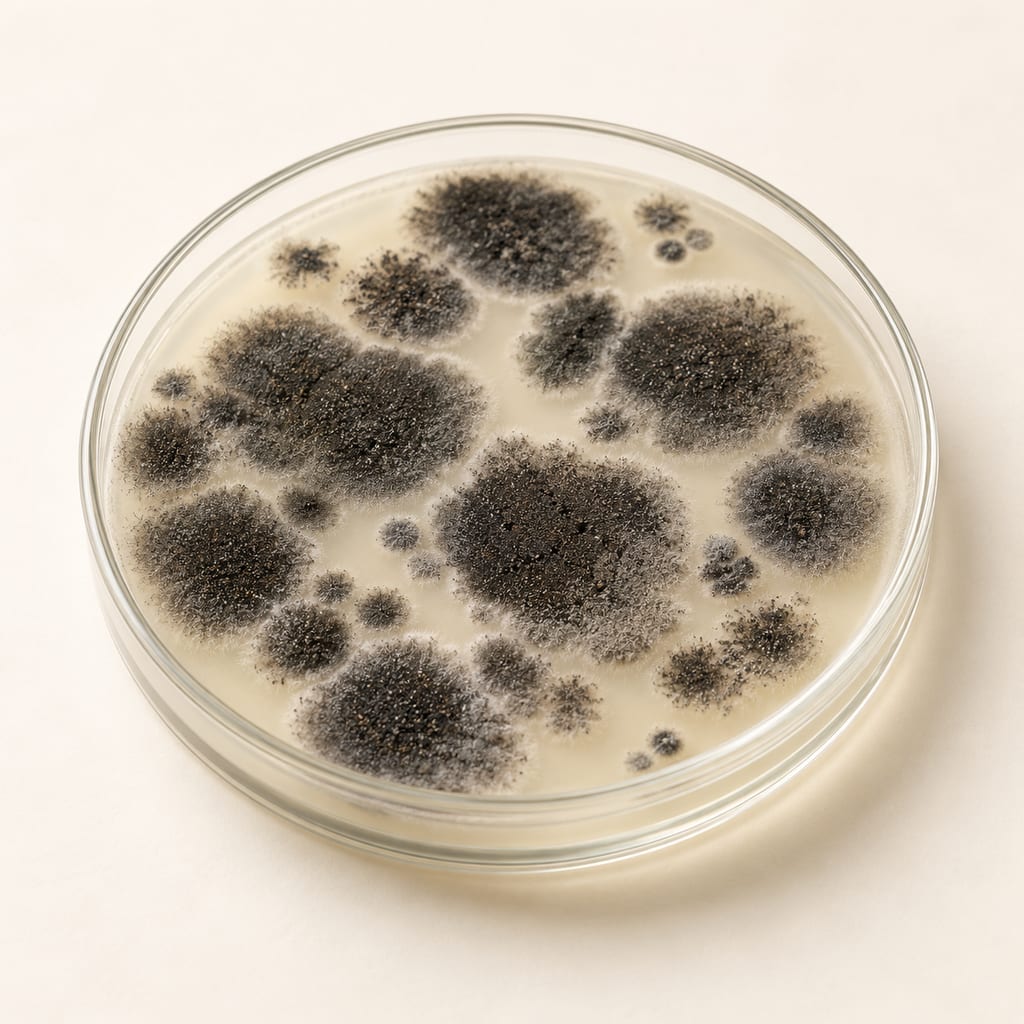
Aspergillus luchuensis is the black koji mould used in Japanese shochu and awamori, valued for the citric acid it makes alongside the starch-converting enzymes of koji.
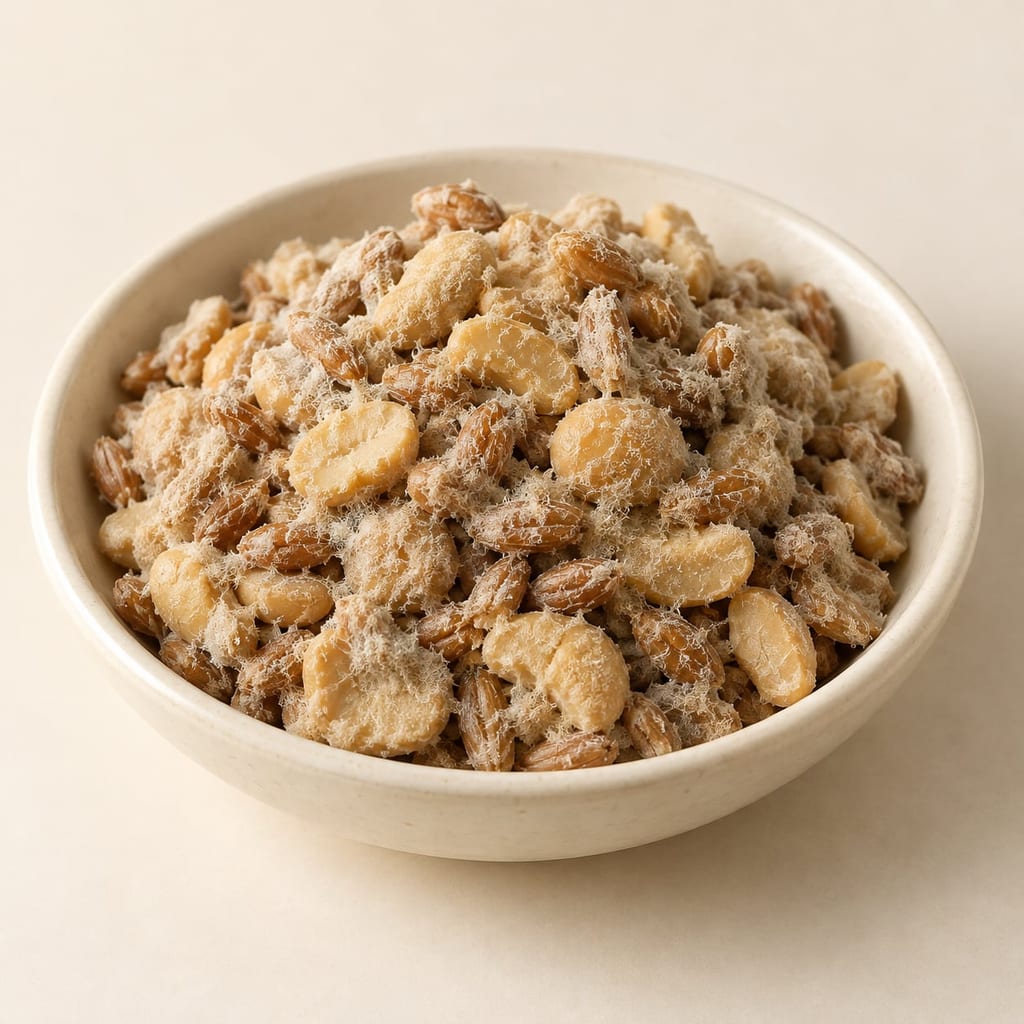
Aspergillus sojae is a koji mould of the Aspergillus flavus group, closely related to A. oryzae, used as a starter in soybean fermentations such as Korean meju, doenjang and ganjang.
Awamori yeast ferments sugar released from rice koji in the Okinawan spirit’s mash. Sakimoto names the ingredient but gives no strain, form, supplier or dose.
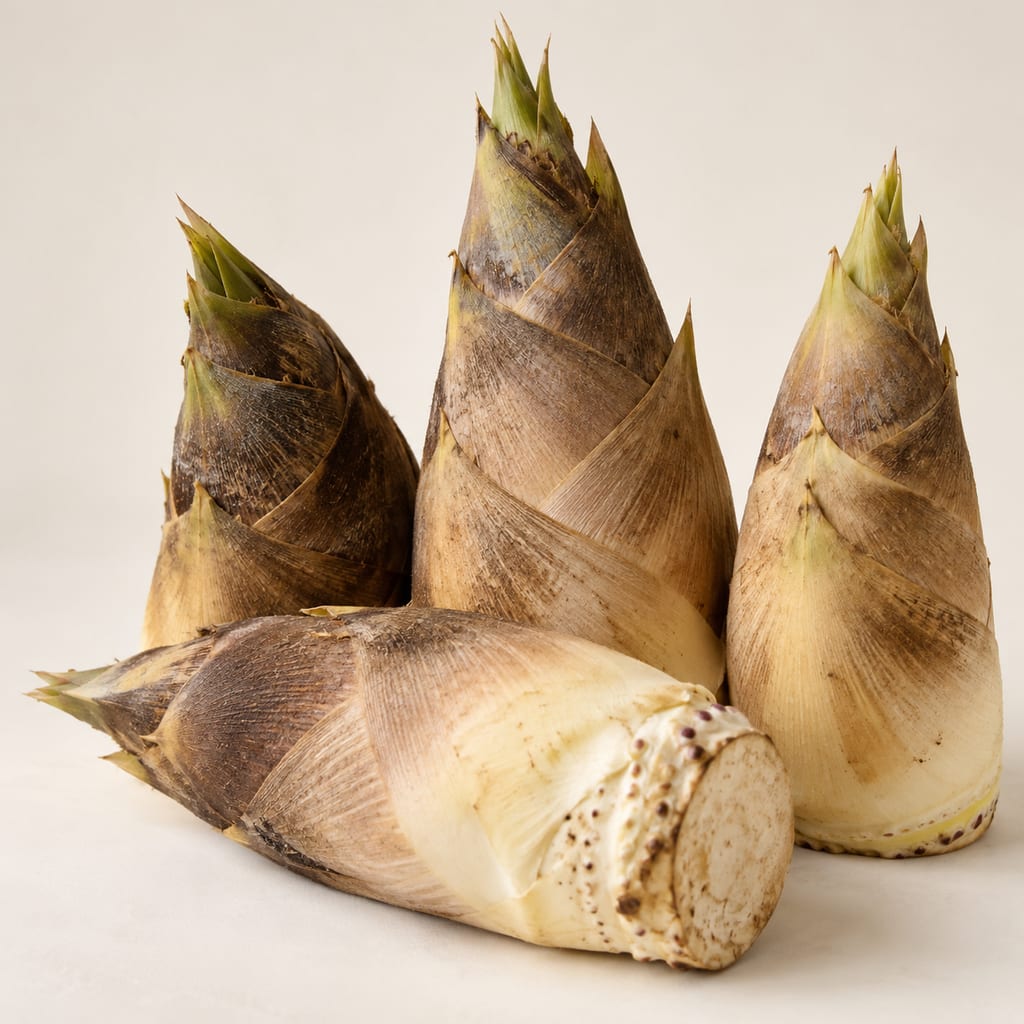
Bamboo shoots are the young culms of many bamboo species, eaten after boiling or leaching in Asia, and fermented into sour and preserved foods in the Himalayas, northeast India and Burma.

Protected Italian vinegar made only from cooked grape must, fermented and aged in a battery of wooden barrels for at least 12 years: sweet, sharp and syrupy.

Airag is Mongolia’s fermented mare’s-milk drink, traditionally churned with saved starter in a reusable cowhide khokhuur.

Appam, or hoppers, are South Indian and Sri Lankan rice pancakes made from a fermented coconut-and-rice batter and cooked in a curved pan to a crisp lacy rim and a soft, spongy centre.

Auricularia tremellosa is a wood ear fungus of the genus that supplies most dried wood ear sold in China; its own food record is thin, and the culinary practice described here comes from the closely related wood ear species.

Ayran is Turkey’s cold, savoury yogurt drink: plain yogurt is loosened with water and lightly salted, then whisked smooth or aerated into a soft cap of foam.
A thin stone griddle used over an open hearth. Norwegian archaeology documents the established tradition from the early Middle Ages; a Viking-period origin is only a cautious suggestion linked to Shetland.

Crushed or milled barley cooked in water until the starch softens and the mixture thickens, the plainest way a northern household turned stored grain into a meal, here with apple and hazelnut.

Black carrot is the anthocyanin-pigmented Eastern carrot (Daucus carota var. atrorubens), the purple root that preceded orange types and still colours kanji and şalgam.
No community contributions have been published for this entry yet.
Sign in to contribute. Published comments and photos are free to read.
Plants of the World Online, Royal Botanic Gardens, KewIdentity · Taxonomy · Geography
Eutrema japonicum (Miq.) Koidz.Accepted name Eutrema japonicum; family Brassicaceae; native range includes Japan, Korea and southern Sakhalin; Wasabia japonica is a synonym.
Cited in: Historical record in Japan; What it is; Names and forms; Where it is native and grown; Allergens and dietary relevance; Recipes and evidence limits
Horticulture Journal 85(1), 2016, pp. 46–54; Yamane et al.Identity · Geography · History · Culinary · Taste
Genetic Differentiation, Molecular Phylogeny, and Ethnobotany of Japanese Wasabi (Eutrema japonicum and E. tenue) and Chinese Wild Relatives (E. yunnanense)Fresh enlarged rhizome is grated for the condiment; use with sushi, sashimi and soba; pungency varies in wild wasabi; earliest record is sixth or early seventh century; cultivation and domestication began at Utogi, Shizuoka, in the first half of the Edo period.
Cited in: Historical record in Japan; What it is; Names and forms; Wasabi and its close relatives; Pungency and taste; Role in fermented foods; Where it is native and grown; Preparation and storage; Recipes and evidence limits
Genes 15(3), 2024; Yang, Park, Cho and KimTaxonomy · Geography
Wasabi Gone Wild? Origin and Characterization of the Complete Plastomes of Ulleung Island Wasabi (Eutrema japonicum; Brassicaceae) and Other Cultivars in KoreaEutrema japonicum natural range described from Sakhalin to Kyushu; Ulleung Island specimens are probably escaped cultivars.
Cited in: Where it is native and grown; Recipes and evidence limits
Foodal; Nikki CervonePreparation · Storage · Secondary
Spicy Wasabi: A Rare Rhizome with Huge FlavorClean and grate the rhizome before serving; products sold as wasabi may contain other ingredients; household refrigeration and freezing guidance is not a measured shelf-life study.
Cited in: Names and forms; Pungency and taste; Preparation and storage; Allergens and dietary relevance; Recipes and evidence limits
iNaturalistImage reference · Image rights
Observation 264142795: Eutrema japonicum (Wasabi)Research-grade identification as Eutrema japonicum; observation date, wild status and Washington location; per-photo CC0 licenses for the four linked botanical-context images.