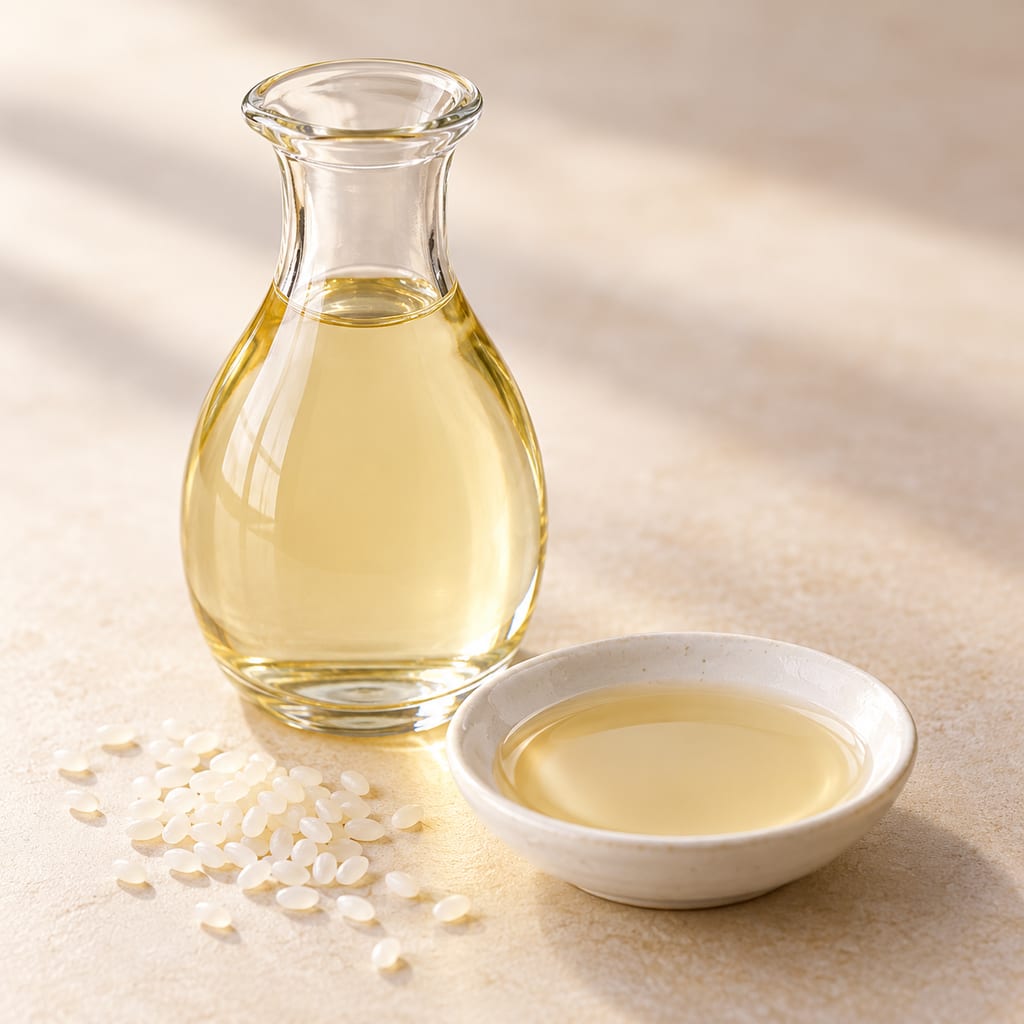
Unseasoned rice vinegar
Japanese komezu is a pale, unseasoned rice vinegar made through alcoholic and acetic fermentation; rice, water, koji and yeast shape its character.
 FermenteaWhere food goes to change
Traditional method
おきゅうと · おきうと · おきゅうと · おきうど · okyūto · okyuto · okyouto · okyuto jelly · Hakata okyuto · 博多おきゅうと · 箱崎おきゅうと · Hakozaki okyuto · エゴノリ · えご草 · ego-nori · ego jelly · うけうと · ukeuto · 沖独活 · 沖人 · 救人 · 御救人 · いごねり (related Niigata preparation) · えごねり (related preparation) · うご (related Tango preparation) · Japanese egonori jelly · Fukuoka seaweed jelly
A traditional Fukuoka seaweed jelly made by boiling dried egonori, sometimes with igisu, until it forms a thick extract that sets into soft sheets, eaten cold with soy sauce, vinegar and aromatic condiments.
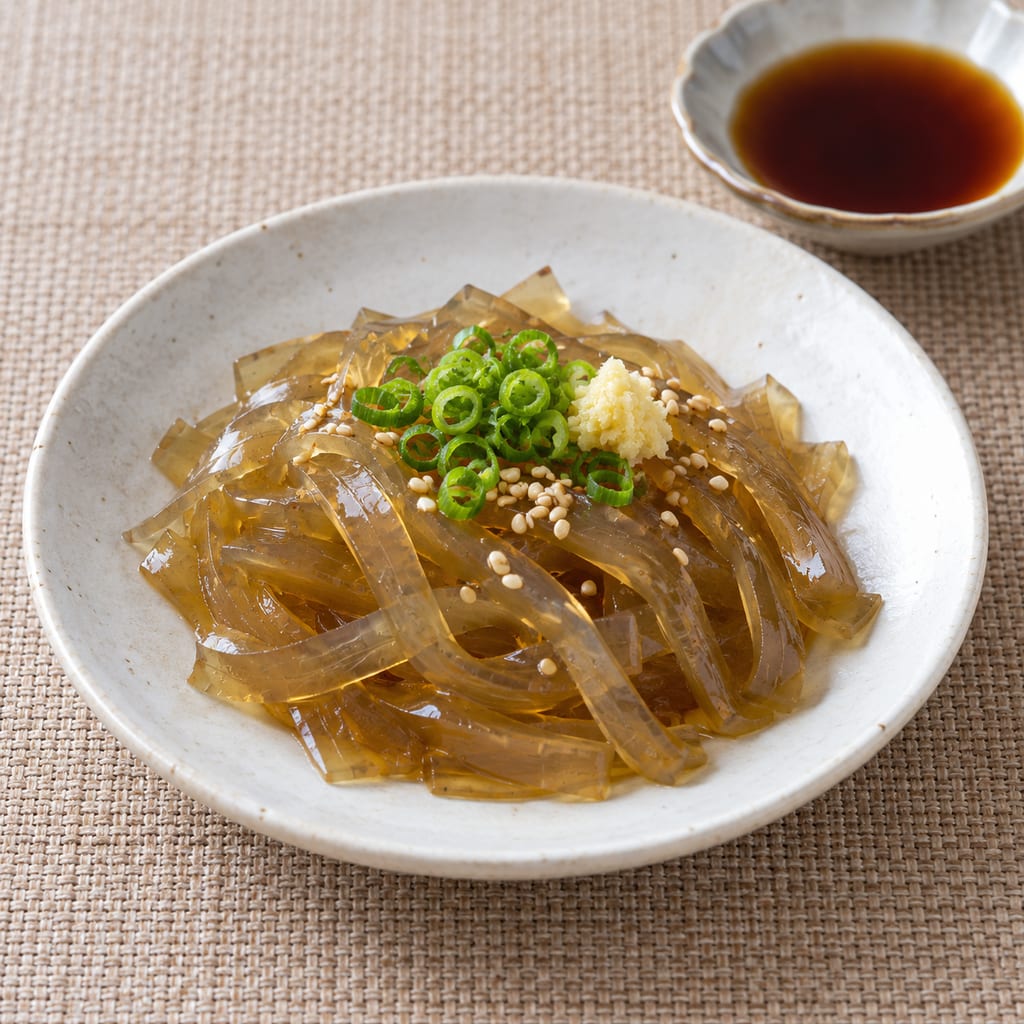
Okyūto, おきゅうと, is a traditional Japanese seaweed jelly associated with Fukuoka City and the historic Hakata area. Dried red seaweed is washed, simmered until its gel-forming components disperse into the cooking water, strained or pressed, and allowed to cool into thin sheets. The finished preparation is commonly brownish green, grey-brown or amber, with a moist, yielding texture. It is cut into narrow strips and eaten cold, usually with soy sauce, vinegar, ginger, sesame or other condiments.
The principal seaweed is egonori, エゴノリ, scientifically Campylaephora hypnaeoides, a red alga in the family Ceramiaceae. Some Fukuoka producers blend egonori with another seaweed called igisu or kebokusa.
Fukuoka okyuto is often made as a thin oval or oblong sheet. Traditionally, individual sheets were rolled into small cylinders for sale. The roll is unwrapped, sliced and dressed immediately before eating. The appearance is different from the familiar long strands of tokoroten, although both are seaweed-derived gels. Okyuto is firmer and more elastic, sometimes slightly coarse, depending on the seaweed blend and processing.
The term ego needs geographical qualification. On Sado Island and elsewhere in Niigata, related preparations are called igo, egoneri or igoneri. In the Tango region of Kyoto, another related preparation is called ugo. These foods share egonori and broadly similar extraction chemistry, but they differ in proportions, filtration, texture, shape and serving customs.
Okyuto is non-fermented. It requires no yeast, bacteria, koji or starter culture. Its solidification is a physical process involving seaweed polysaccharides extracted by heat and organised into a gel as the mixture cools. The addition of vinegar during cooking does not make it an acetic fermentation. The soy sauce served with it is a fermented seasoning, but the seaweed itself is not fermented.
The preparation has a mild seaweed taste and is eaten as much for its smooth, slightly springy texture as for its flavour. It has a recognised place in Fukuoka breakfast culture and is also served as a cold side dish or appetiser. The jelly is mostly water, so the sauce and toppings supply most of the flavour and salt.
Okyuto is closely associated with the coastal food culture of historic Chikuzen Province, especially Hakozaki and Hakata in present-day Fukuoka City. Its origin is unknown, but there is firmer evidence than the usual claim that it is simply ancient. Two Edo-period descriptions of a seaweed called ukeuto lead the way, followed by household manufacture and a large local street trade.
The Fukuoka manufacturer Hayashi Ryūzō Shōten reproduces a passage from Kaibara Ekiken's Chikuzen no Kuni Zoku Fudoki, a regional geographical and natural-history work compiled between 1688 and 1709. The quoted text mentions ukeuto in connection with igisu-like seaweeds and describes its purple thread-like appearance. It also includes a warning about toxicity.
A stronger processing description appears in Chikuzen no Kuni Sanbutsuchō, a regional product inventory submitted in 1738. The passage reproduced by the same manufacturer describes a pale-purple marine organism with many branches that becomes gelatinous after prolonged boiling. That is a direct record of the seaweed turning to jelly when boiled. The passage also comments unfavourably on its taste.
Modern accounts frequently explain the name through famine relief. In one version, a seaweed food saved people from hunger, producing the name 救人 or 御救人, meaning a person or thing that rescues others. Another derives the name from 沖独活, interpreted as sea-grown udo, while a third uses 沖人, referring to a person arriving from offshore. Fukuoka Prefectural Library reviewed these explanations in 2019 and located them in published regional food and cultural histories.
Later Edo-period and Meiji-era production centred on Hakozaki. Local producer history says families made okyuto alongside other marine products and sold it from shallow wooden boxes. The sheets were rolled individually, making them easy to carry and sell in small quantities. Vendors called through neighbourhoods in the morning, and children from merchant families sometimes participated before school.
Japan's Ministry of Agriculture confirms that itinerant morning sellers remained familiar before the Second World War. Okyuto was then an ordinary accompaniment to breakfast rather than a rare ceremonial dish. A 2017 university food-culture survey visited Hayashi Ryūzō Shōten and recorded its continuing production, including direct-fire cooking and mechanical forming. A 2025 Kyushu Asahi Broadcasting report covered the family business and the fall in local supplies of seaweed.
The regional trade has changed considerably. Historical producers relied on seaweed from local coastal waters, but the Hakozaki manufacturer reports obtaining egonori from Niigata and Ishikawa as local catches diminished. Manufacture continues, while supermarkets, school meals and restaurants provide new outlets. These present-day distribution methods document adaptation of the older food, not an unchanged continuation of every historic manufacturing step.
The central transformation in okyuto is the extraction and gelation of polysaccharides from red seaweed. Egonori contains high-molecular-weight carbohydrates that can form a continuous network within water. Heating allows gel-forming material to disperse from the algal tissues into the cooking liquid. As the mixture cools, interactions between the polysaccharide chains create a structure capable of holding large quantities of water. No microbial acid production, alcoholic fermentation or deliberate enzymatic saccharification is involved.
Red algae contain several structurally different galactan polysaccharides, and the proportions and molecular architecture depend on the species. Some produce agar-type materials, while others produce carrageenan-type or related sulphated galactans. The Japan Society for Applied Glycoscience explains this species-specific variation. Okyuto resembles tokoroten in its physical transformation, but its principal species, texture and extraction behaviour differ from conventional Gelidium-based tokoroten.
A 1987 study by Setsuko Imada and Masayuki Takahashi of Notre Dame Seishin University. The authors compared gels prepared from Campylaephora hypnaeoides, Gracilaria verrucosa and Ceramium boydenii. They examined the effects of vinegar and rice-bran extract on gel formation and used high-performance liquid chromatography to examine polysaccharide molecular-weight distributions. They found that adding vinegar accelerated setting of the Campylaephora gel, while the response of Gracilaria was different. The molecular-weight distribution of Campylaephora polysaccharides was also distinctly different from those of the comparison algae.
These results help explain the traditional addition of vinegar. In egonori jelly vinegar is more than a seasoning: under the conditions studied it changes how the gel forms. Acid concentration, heating duration, molecular weight and seaweed composition all matter. Too much acid can break down some gelling polymers, so keep to the recipe's vinegar quantity.
Raw-material selection also affects the structure. A technical reference prepared with the Niigata Prefectural Fisheries and Marine Research Institute reports that thicker egonori generally holds more gelling material, and that harvest place and season affect quality. Producers may blend seaweed from different origins to achieve consistent results. The Fukuoka manufacturer Hayashi Ryūzō Shōten likewise blends different egonori lots and combines them with igisu.
Washing and repeated exposure to sunlight can lighten the seaweed. During extraction, stirring helps expose material to hot water and prevents dense solids from burning on the bottom of the pot. Filtration removes coarse residues and creates a smoother jelly. If part of the softened seaweed remains in the product, the texture can be more granular or coarse. Once poured into a thin mould, the hot mixture sets as it cools. Unlike konnyaku, okyuto does not require alkaline calcium treatment to form its characteristic structure.
A modern study of Campylaephora hypnaeoides examined extracted polysaccharides and their chemical properties, including sugar composition, sulphate content and molecular-mass distribution. Statements about the finished jelly's structure should therefore remain connected to the actual species and process rather than assuming it is chemically identical to purified agar or carrageenan.
Traditional okyuto manufacture begins with dried edible red seaweed. The main ingredient is egonori, and some Fukuoka producers also include igisu or kebokusa. The seaweed is selected for its appearance and suitability for forming a gel. Hayashi Ryūzō Shōten in Hakozaki describes combining egonori from different sources because individual lots behave differently.
Before cooking, the seaweed is cleaned and sometimes repeatedly washed and sun-dried. The Hakozaki producer describes drying, washing, soaking and drying again over two to three days. These repeated treatments turn the original reddish-brown material paler. The prepared seaweed is washed again and soaked for approximately 30 minutes before cooking. Soaking rehydrates the material and allows more even contact with the hot extraction water. The producer does not publish a complete ingredient-weight formula for this manufacturing process.
A quantified preparation comes from Hattoriya, a Fukuoka-area supplier of okyuto seaweed. Its recipe uses approximately 100 g mixed egonori and kebokusa, five litres water and three tablespoons vinegar. The seaweed is washed and added to boiling water with the vinegar, then cooked over medium heat for approximately one and a half to two hours while being stirred. This prolonged extraction allows the seaweed to soften and the gel-forming material to disperse into the liquid.
The hot mixture is strained into a tray and allowed to cool until firm. Hattoriya recommends cutting it using a tokoroten press or a knife. In the Hakozaki commercial process, the boiled material is passed through a straining device and shaped by machinery into thin sheets. The manufacturer explains that traditional rolls were convenient for street selling and that the rolled format remains common for supermarket products. Sheets intended for shipping may be kept flat to avoid damage.
Vinegar does a job in the pot as well as flavouring: experiments with Campylaephora hypnaeoides show it affects how the gel sets. The small amount added while boiling does not make the finished jelly safe to keep. The jelly remains a high-moisture food even when vinegar has been used during extraction.
A related Niigata method provides a useful comparison. The producer Inokai publishes an egoneri recipe using 50 g dried egonori and one litre water. The washed seaweed is boiled and stirred, then worked over low heat for approximately 10–15 minutes after it dissolves. A small quantity of vinegar is recommended only if the seaweed does not dissolve readily. The hot mixture is transferred to a mould, cooled and refrigerated until set. This method has a different concentration, cooking sequence and treatment of the remaining seaweed from the Fukuoka-area formula.
The precise thickness of the jelly affects its handling. Thin sheets are suited to rolling and slicing, whereas thicker moulded blocks can be cut into rectangular pieces. Insufficient extraction may give a weak gel, while excessive evaporation can create a denser product. A smooth final texture depends partly on filtration. The original recipes give visual endpoints, such as the mixture setting or the seaweed dissolving, rather than measured viscosity or gel strength.
The finished okyuto is typically served without further cooking. It is cut into strips and dressed shortly before eating. Japan's Ministry of Agriculture provides a serving recipe using 200 g ready-made okyuto for three people, with vinegar, soy sauce, sesame, spring onion, ginger and bonito flakes.
Fukuoka's okyuto is part of a wider Japanese family of red-seaweed jellies, but it has a distinctive local identity. The traditional Hakozaki product combines egonori with other gelling seaweeds, is strained to produce a relatively smooth texture and is formed into thin sheets that can be rolled. It was historically sold for breakfast in Fukuoka City and remains available through specialist makers and food retailers. The rolled shape is especially characteristic of the local commercial tradition.
The relationship with Niigata's egoneri or igoneri is close but not identical. In Sado, dried egonori is boiled and worked into a gel, often spread thinly, rolled and sliced into strands. On the Niigata mainland, thicker rectangular blocks are common. Japan's agriculture ministry describes Sado's rolled style as a regional presentation. It also records the use of the dish at weddings, funerals and other occasions, mostly in autumn and winter, before modern commercial manufacture made it widely available throughout the year.
The historical direction of transmission is disputed. The Ministry of Agriculture reproduces an account in which okyuto culture travelled from Hakata through the Noto Peninsula to Sado and then across Echigo, aided by shipping. A 2026 technical entry prepared with the Niigata fisheries research organisation presents the relationship from the other direction, describing egoneri techniques as having reached Fukuoka.
Other related foods occur along the Sea of Japan coast. The Niigata technical reference lists production in Ishikawa, Yamagata, Akita, Aomori and Nagano. In the Tango region of Kyoto Prefecture, egonori jelly is known as ugo. Kyoto's marine research centre describes the seaweed being dried, boiled with a little vinegar and cooled, sometimes without complete straining so that small fragments remain in the finished gel. Ugo has also been associated with ceremonial meals and household snacks. These preparations are related by raw material and technique rather than identical names or formulations.
Tokoroten is commonly prepared from Gelidium and other agar-producing red algae, while the characteristic Fukuoka and Niigata jellies use egonori. The resulting mouthfeel and colour differ. Okinawan mozuku, brown-seaweed preparations and konnyaku are different foods despite occasional visual similarities.
Present-day manufacturers also differ in their ingredient selections. Hakozaki producers describe blending egonori and igisu, whereas a Yamaguchi producer sells okyuto listing only egonori and brewed vinegar as principal ingredients. Hattoriya's recipe uses a named egonori-and-kebokusa mixture. These are genuine product-level differences.
The decline in local raw-material availability has altered production geography. Hakozaki's Hayashi Ryūzō Shōten reports using egonori from Niigata and Ishikawa after local supply diminished. A 2025 regional television report covered the firm's continued production and its worry over smaller harvests. This modern change separates the historical place of preparation from the present-day origin of its ingredients.
The traditional Fukuoka way of eating okyuto is simple. A rolled or flat sheet is cut into narrow strips, placed in a small bowl and dressed with soy sauce or vinegar-soy sauce. Grated ginger, spring onion, sesame and bonito flakes are familiar accompaniments. The dressing provides much of the flavour, while the jelly contributes a mild marine aroma and a soft, slightly elastic texture.
Hayashi Ryūzō Shōten recommends cutting okyuto into strips approximately 5–7 mm wide and adding the soy sauce immediately before eating. The producer explains that adding sauce too early causes it to soak into the jelly. Its traditional serving suggestion combines ground sesame, bonito flakes, grated ginger and soy sauce, with spring onion or dried young sardines as alternatives.
Other established condiments include ponzu, ginger-soy sauce, mustard-soy sauce and mustard-vinegar miso. Some versions are eaten with plain soy sauce, while others include sesame-based or citrus dressings. The food dictionary Nihon no Tabemono records karashi-shoyu, mustard mixed with soy sauce, among the recognised accompaniments. These seasonings are added to the already prepared gel; they do not initiate fermentation or cause the jelly to set.
Okyuto was historically a breakfast food in Hakata. It was sold early in the morning, often in individual rolls, and eaten with rice, miso soup or other simple dishes. The agriculture ministry notes that it was once a breakfast staple and is still sold in supermarkets and served in school lunches. The same preparation now appears in restaurants and izakaya as a small cold appetiser served with alcoholic drinks.
The official Fukuoka regional recipe specifies 200 g ready-made okyuto for three people, dressed with 50 mL vinegar, 50 mL soy sauce, and 3 g each of sesame, spring onion, ginger and bonito flakes. They should not be confused with a recipe for manufacturing the gel itself, and the vinegar in the dressing does not establish a preserved-food shelf life.
Modern serving variations include salads with lettuce, mizuna, cucumber, wakame, shiso or myoga. The Hakozaki producer documents these uses alongside the older simple soy-sauce preparation. Related Niigata egoneri may be served as thin strands with noodle dipping sauce, while thicker regional ego is sliced and served with vinegar miso. Sweet versions with kuromitsu, kinako or ice cream are also documented in modern Niigata food culture.
Nutritionally, plain okyuto is largely water. Soy sauce, sesame, bonito flakes and other toppings change the nutritional composition and introduce possible allergens.
A successful okyuto should set into a coherent gel that can be lifted, sliced and served without breaking apart immediately. Its texture is normally soft and yielding rather than brittle. Firmness varies with the egonori, the presence of additional gelling seaweeds, the ratio of seaweed to water and the extraction method. A smooth, strained Fukuoka product may differ noticeably from a thicker Niigata preparation containing more suspended seaweed material. Neither texture is automatically defective.
Failure to set can result from insufficient gel-forming material, incomplete extraction or excessive dilution. The Hattoriya recipe uses about 100 g mixed seaweed to five litres of water. Results depend on the seaweed mixture and on evaporation during the long simmer.
Vinegar affects the process, but not in a simple way. The 1987 study of Campylaephora hypnaeoides found that vinegar speeded gel setting under its test conditions. The effect differed from that observed with other red algae. It would be inaccurate to claim that vinegar is merely a preservative or that increasing it always improves the gel. If a formulation is changed, the resulting acidity, extraction behaviour and final texture may all change.
Scorching is another practical problem. As the cooking mixture thickens, solid material can settle against the hot base of the pot. Hattoriya instructs continuous stirring during its long cooking stage, and the Hakozaki manufacturer emphasises careful fire management. Burnt material can give the product an unwanted taste and colour. Straining out debris matters because the raw seaweed may contain sand, attached organisms and other unwanted material.
Gel setting and microbiological safety are separate questions. Okyuto is a high-moisture ready-to-eat food, with the Japanese composition table reporting 96.9% water. Heat extraction reduces many vegetative microorganisms, but contamination can occur later through strainers, moulds, packaging, cutting implements or handling.
The traditional sources do not give measured finished pH values. Commercial refrigeration and shelf life depend on the producer's formulation, packaging and handling. A Yamaguchi manufacturer, Senzaki Kaisan, specifies refrigeration at 10°C or below and a seven-day shelf life from manufacture for its own egonori-and-vinegar okyuto.
For homemade preparations without validated product data, the conservative approach is to cool promptly and refrigerate as a perishable ready-to-eat food. General FoodSafety.gov guidance recommends refrigeration at 4°C or below and placing perishable food in refrigeration within two hours, or one hour during very hot conditions above 32°C.
Freezing may affect texture. Senzaki Kaisan specifically warns against freezing its finished okyuto because the texture changes. This is consistent with the possibility of damage to a hydrated gel during ice formation and thawing, although the exact structural changes were not measured in the cited product information.
Use only properly identified food-grade algae. Kyoto Prefecture describes egonori as an alga that grows on larger seaweeds, especially Sargassum, around Japanese coasts. Harvest location, raw-material quality and contamination controls matter.
The finished food is often eaten with soy sauce, mustard, sesame or bonito flakes. Soy, wheat, sesame, mustard and fish allergen information therefore depends on the chosen dressing. A plain jelly product may have a much shorter ingredient list. Nutrition and safety information should follow the actual formulation rather than assume that all okyuto products share the same additives, allergens or storage requirements.
Finished pH, water activity, gel strength and validated shelf life are not established. The traditional process and several regional recipes are documented, but no single commercial preservation method is validated.
Kaibara Ekiken's Chikuzen no Kuni Zoku Fudoki (compiled 1688 to 1709) mentions a seaweed called ukeuto, but not a prepared jelly. The 1738 Chikuzen no Kuni Sanbutsuchō describes ukeuto as a branched, pale-purple marine plant that turns to jelly when boiled for a long time. Both passages are quoted by the Hakozaki producer Hayashi Ryūzō Shōten. They are firmer evidence than the undated stories of a famine invention or a fisherman's discovery. Edo-period and Meiji manufacture and twentieth-century breakfast vending are documented through local producer history and modern food-culture surveys.
Okyuto is a high-moisture cooked jelly that is commonly eaten without further heating. Contamination can occur after extraction through the sieve, mould, cutting equipment, packaging or handling. Successful gel formation is not proof of microbiological safety.
Hazard sourceThe traditional recipe adds vinegar during extraction but does not supply a final measured pH, equilibrium acidity or microbiological validation. Vinegar's role in gel-setting chemistry must not be confused with a demonstrated food-preservation process.
Hazard sourceThe finished jelly remains moist and perishable. A manufacturer of a different egonori-based okyuto requires refrigeration and specifies a short product-specific shelf life. The extraction and setting procedure alone does not establish ambient storage stability.
Hazard sourceThe source names a specific dried seaweed mixture. Other marine algae may not have equivalent culinary safety or gelling behaviour. Unidentified material may also contain sand, attached organisms or environmental contaminants.
Hazard sourceThe process involves approximately five litres of boiling or simmering liquid, followed by hot filtration into a tray. Splashing or tipping the cooking vessel can cause serious burns.
Hazard sourceSenzaki Kaisan warns that freezing its finished okyuto changes its texture. This manufacturer-specific finding is relevant to quality but does not establish the exact physical changes in the Hattoriya formulation.
Hazard sourcePlain egonori jelly and dressed okyuto have different ingredient profiles. Sesame introduces a sesame allergen, while bonito-based sauces contain fish and may contain soy and wheat. Other dressings may contain mustard.
Hazard sourceUse the specific food-grade raw seaweed mixture described by the source and wash it thoroughly.
Control sourceUse the documented extraction formulation.
Control sourceFollow the source's extraction and filtration procedure.
Control sourcePrevent secondary contamination during filtration, moulding, cooling and cutting.
Control sourceCool and refrigerate the prepared jelly promptly.
Control sourceMaintain cold storage for homemade okyuto that has no validated packaged-food process.
Control sourceUse any manufacturer-declared shelf life only for its exact commercial formulation and packaging.
Control sourceKeep prepared condiments separate until serving.
Control sourceDo not assign shelf stability from the presence of vinegar without a validated finished-product process.
Control sourceDocumented Fukuoka producer recipe, not a validated shelf-stable preservation process.
The 100 g is the combined egonori and kebokusa mixture, not 100 g of each.
The vinegar in the pot gives no validated finished pH or preservation.
The seven-day shelf life declared by Senzaki Kaisan belongs to that manufactured product and does not apply to a homemade batch.
A firm, normal-smelling or pleasantly sour jelly is not necessarily microbiologically safe.
Freezing damages the texture; the freezing warning comes from one producer.
Soy sauce, bonito sauces, sesame and mustard are common allergens, depending on what is served.
Use only identifiable food-grade seaweed, never unidentified beach-collected algae.
Japanese komezu is a pale, unseasoned rice vinegar made through alcoholic and acetic fermentation; rice, water, koji and yeast shape its character.
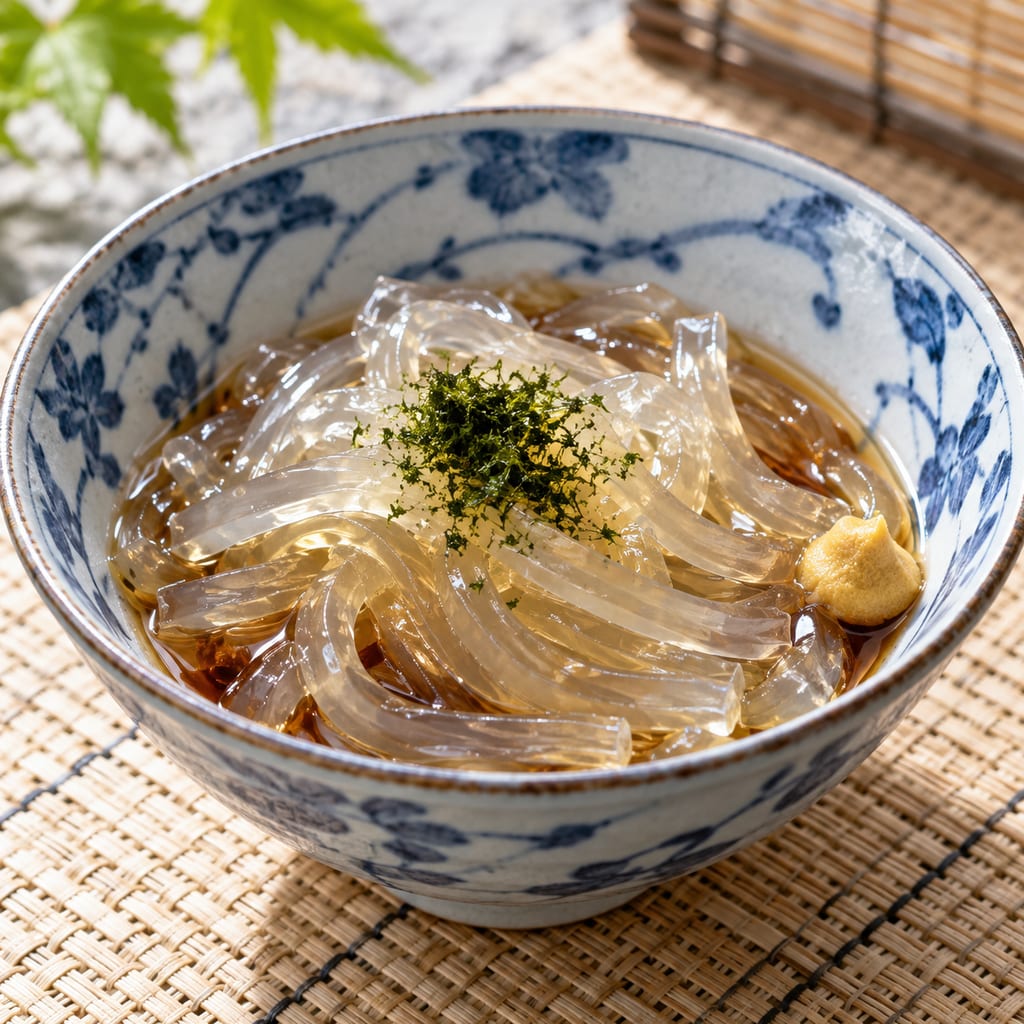
A Japanese jelly made by boiling agar-rich red seaweed, straining the extract and letting it set, then pressing it into strands served with vinegar-soy sauce or sweet syrup.
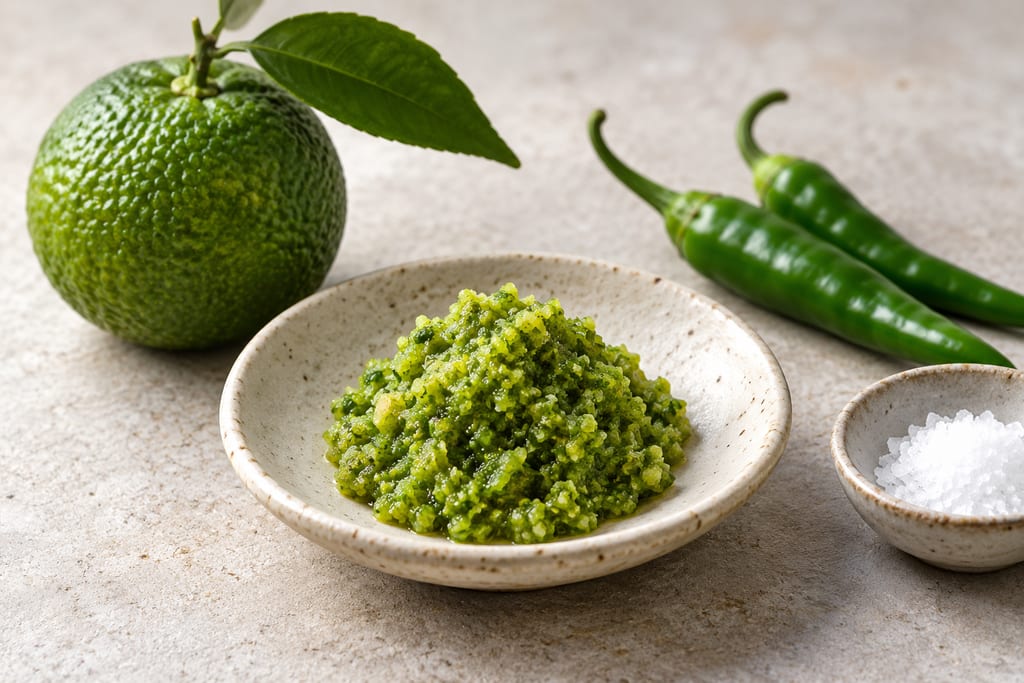
A fresh, uncooked yuzu and green chilli paste inspired by Kyushu’s yuzu kosho, made here as an untested small-batch seasoning rather than a preservation formula.
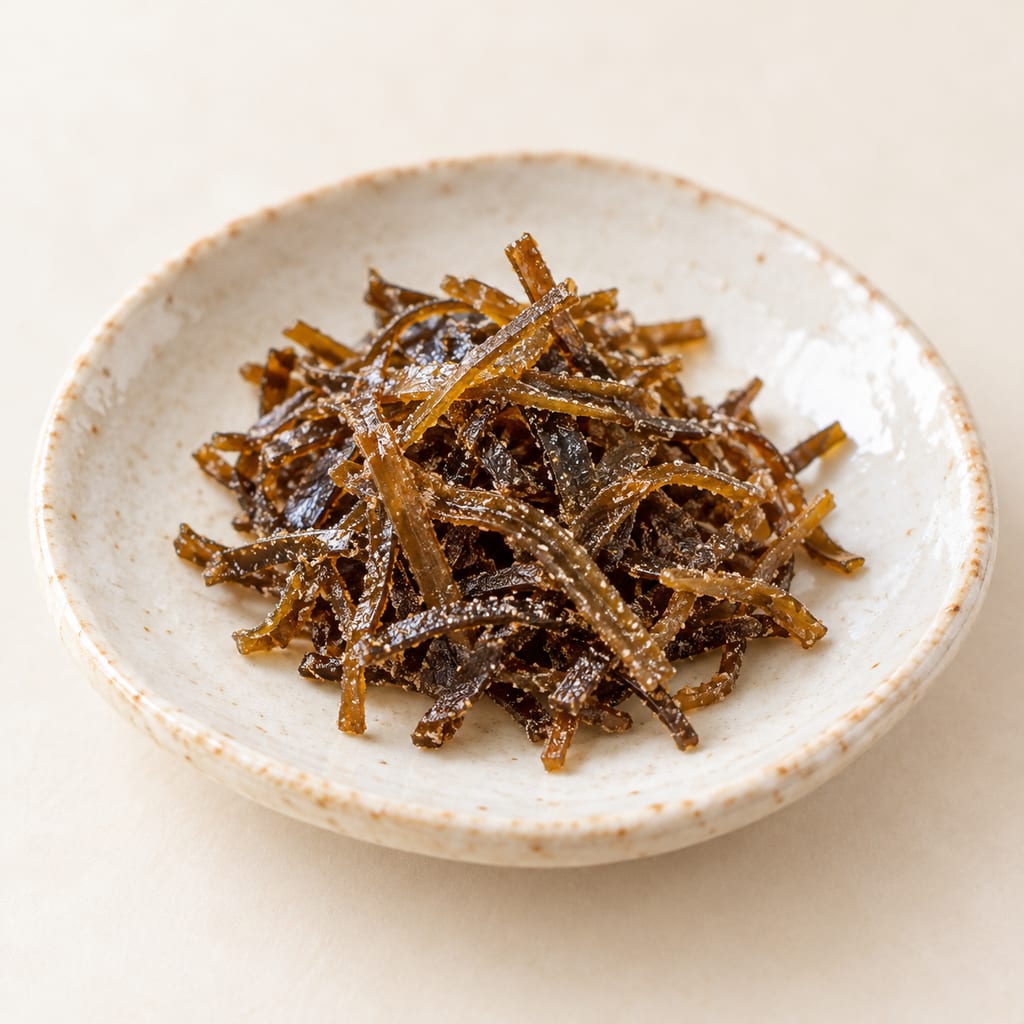
Japanese kelp simmered in soy sauce and seasonings, sometimes dried and salted, eaten with rice or used as an umami seasoning.
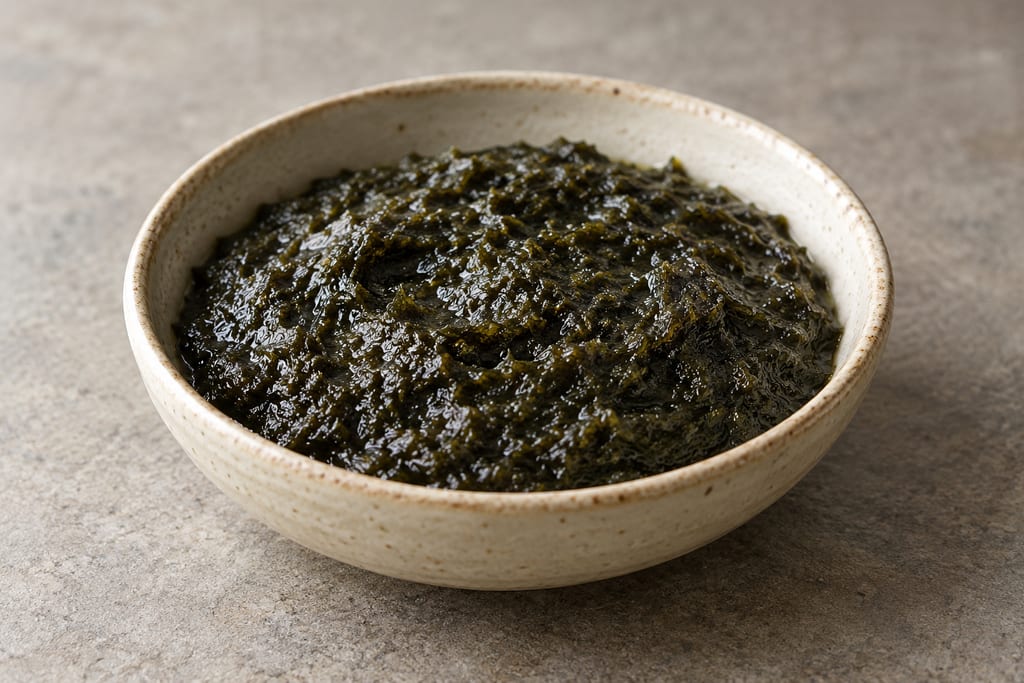
Welsh laverbread is hand-gathered purple laver slowly cooked to a dark green-black paste, eaten with oatmeal, bacon and cockles or on toast.

A gelling polysaccharide extracted from red seaweeds, sold as kanten strips or powder; it sets firm at a low concentration and stays solid until about 85 °C.

A Dominican table and seasoning condiment of sour orange juice, mixed with lime and salt and bottled raw; garlic, oregano or a hot pepper may be added for meat or a spicier bottle.

Cicerbita alpina is an alpine perennial whose tender shoots and leaves have been eaten raw or cooked. Sámi milk preparations and modern Carnian dishes are distinct uses, with serious identification and preservation limits.

Japanese skipjack tuna cooked, then repeatedly smoked and dried over a wood fire by the hand-fired tebiyama method into a hard block for shaving into dashi: the first stage of katsuobushi.

A Swedish-style spirit vinegar made by fermenting neutral alcohol with live vinegar bacteria, with a separate guide to commercial ättika strengths.

A yeast-raised wheat ring shaped from a firm dough, briefly boiled and baked. This source-batch formula gives a gently malted crust and a chewy crumb.

A warm dip of garlic, anchovy and olive oil, often enriched with butter, that Piedmont serves over a flame with raw and cooked vegetables and bread.

Bechamel is a white sauce of milk thickened with a butter and flour roux, one of the French mother sauces, and the base from which Mornay and other cheese and cream sauces are made.
No community contributions have been published for this entry yet.
Sign in to contribute. Published comments and photos are free to read.
Hattoriya (服部屋), Funakoshi, Itoshima, Fukuoka PrefectureReference
おきゅうと作り方 — 服部屋のおきゅうと草Primary Block C raw-seaweed manufacturing recipe
Approximately 100 g combined egonori and kebokusa
5 litres water and 3 tablespoons vinegar
Thorough washing of dried seaweed
Adding seaweed and vinegar to boiling water
Medium-heat cooking for approximately 1½–2 hours
Stirring during extraction
Straining through a sieve into a shallow tray
Cooling until the extract forms a jelly
Cutting with a knife or tokoroten press
Optional spring onion, wasabi, ground sesame and bonito-flavoured tsuyu
No numerical setting temperature or finished yield
Photographs of the actual production stages
Cited in: How it is made and why each ingredient and step matters; Regional and historical variations; Reading results and problems
Ministry of Agriculture, Forestry and Fisheries, Japan; Our Regional CuisinesReference
おきゅうと — 福岡県Official recognition of okyuto as a Fukuoka regional food
Egonori as the principal ingredient
Drying, boiling and setting into thin oval sheets
Traditional rolling and slicing before serving
Historical morning street vending
Breakfast, school-lunch and restaurant contexts
Competing explanations for the product's name
Separate serving recipe using 200 g prepared okyuto for three people
50 mL vinegar and 50 mL soy sauce in the serving recipe
Three grams each of sesame, spring onion, ginger and bonito flakes
Original photographs credited to Nakamura Gakuen University's Faculty of Nutritional Sciences
Explicit warning that MAFF photographs cannot be reused without following its copyright conditions
Cited in: What it is; History; How it is made and why each ingredient and step matters; Regional and historical variations; How it is eaten and used
Hayashi Ryūzō Shōten (林隆三商店), Hakozaki, FukuokaReference
おきゅうとの作り方Traditional Hakozaki commercial manufacturing process
Use of egonori and igisu
Blending different egonori lots
Repeated washing and sun-drying over two to three days
Approximately 30 minutes preliminary soaking
Cooking in a large directly heated kettle
Importance of controlling the flame
Straining and pressing cooked seaweed material
Mechanical shaping into thin sheets
Cooling and gelation
Traditional rolling and modern packaging
Photographic documentation of equipment and production
Cited in: What it is; How it works: chemistry and gelation; How it is made and why each ingredient and step matters; Regional and historical variations; Reading results and problems
Hayashi Ryūzō Shōten (林隆三商店), FukuokaReference
おきゅうとの歴史Local historical account of okyuto production in Hakozaki
Passage concerning ukeuto from Kaibara Ekiken's Chikuzen no Kuni Zoku Fudoki
Compilation of that work between 1688 and 1709
Passage from the 1738 Chikuzen no Kuni Sanbutsuchō describing seaweed becoming gelatinous when boiled
Distinction between historical written attestations and later origin stories
Competing explanations involving famine relief, offshore fishermen and sea-grown udo
Edo- and Meiji-period household production
Traditional wooden boxes and street vending
Morning sales of rolled sheets
Cited in: History; Regional and historical variations
Hayashi Ryūzō Shōten (林隆三商店), FukuokaReference
美味しい食べ方Traditional serving recommendations
Cutting the finished jelly into approximately 5–7 mm strips
Ground sesame, bonito flakes, grated ginger and soy sauce
Adding soy sauce immediately before eating
Spring onion and dried young sardines as alternatives
Wakame, cucumber and mustard-vinegar miso serving variation
Ponzu and tuna variation
Contemporary salad serving with lettuce, mizuna, myoga and shiso
Distinction between preparation of the gel and final serving
Cited in: How it is eaten and used; Reading results and problems
Journal of the Japanese Society of Nutrition and Food Science, Volume 40, Issue 5, 1987Reference
Effects of Extract of Rice Bran and Vinegar on the Texture of Agar Gel of the Seaweeds Gracilaria verrucosa and Campylaephora hypnaeoidesExperimental investigation of seaweed gel formation
Campylaephora hypnaeoides as the raw material for egoneri
Comparison with Gracilaria verrucosa and Ceramium boydenii
Effects of rice-bran extract and vinegar
Vinegar accelerating gel setting in the Campylaephora treatment
Different response of the Gracilaria treatment
Polysaccharide molecular-weight analysis
Importance of seaweed species in interpreting traditional extraction
Evidence that vinegar can affect gel chemistry without causing microbial fermentation
Cited in: How it works: chemistry and gelation; How it is made and why each ingredient and step matters; Reading results and problems
Kyoto Prefectural Agriculture, Forestry and Fisheries Technology Center, Fisheries Technology DepartmentReference
エゴノリScientific identification as Campylaephora hypnaeoides
Taxonomic placement among red algae
Distribution from Hokkaido to Kyushu
Growth attached to larger Sargassum seaweeds
Greater importance of the Sea of Japan coastal distribution
Traditional cooking and setting of dried egonori
Use of a little vinegar
Optional filtration of seaweed solids
Tango regional preparation called ugo
Relationship between Kyoto, Niigata and Fukuoka regional preparations
Cited in: What it is; How it works: chemistry and gelation; Regional and historical variations; How it is eaten and used; Reading results and problems
Inokai Co., Ltd. (株式会社猪貝), Nagaoka, Niigata PrefectureReference
「えご」の作り方Related Niigata egoneri manufacturing method
50 g dried egonori with 1 litre water
Washing and removing foreign material
Cooking while stirring
Approximately 10–15 minutes further cooking after dissolution
Optional vinegar if the seaweed does not dissolve readily
Refrigerated gel setting
No fixed vinegar quantity
Differences between Niigata and the primary Fukuoka-area recipe
Evidence that extraction ratio and stirring affect the finished texture
Cited in: How it is made and why each ingredient and step matters
Ministry of Agriculture, Forestry and Fisheries, Japan; Our Regional CuisinesReference
いごねり — 新潟県Niigata igoneri and ego as related regional foods
Sado Island preparation
Thin rolled sheets and thicker rectangular preparations
Traditional use at ceremonies and family gatherings
Ginger-soy sauce, ponzu and vinegar-miso accompaniments
Modern sweet presentations with syrup and kinako
Historical coastal-trade transmission theory
Distinction between historical transmission accounts and proven origins
Evidence that regional recipes differ from Fukuoka okyuto
Cited in: Regional and historical variations; How it is eaten and used
水産加工品図鑑 (Japanese Aquatic Food Products and Processing Encyclopedia)Reference
えごねりTechnical classification of egonori jelly
Dry egonori extraction and gelation
Brown-green colour and elastic texture
Comparison between egoneri and Fukuoka okyuto
Refrigerated storage category
Northern Sea of Japan production regions
Regional terms including igo, ego, ugo and related forms
Square and rolled product styles
Distinction from Gelidium-based tokoroten
Cited in: What it is; How it works: chemistry and gelation; How it is made and why each ingredient and step matters; Regional and historical variations; Reading results and problems
Institute of Science Tokyo, School of Life Science and Technology; collaborative food-culture research with GurunaviReference
福岡県の食文化 — 食文化調査2017 field investigation of Fukuoka food culture
Visit to Hayashi Ryūzō Shōten
Use of egonori and igisu
Producer selection of raw seaweed from Sado Island
Repeated washing and sun-drying
Approximately 30-minute rehydration
Traditional direct-fire cooking
Straining and mechanical shaping
Modern packaging and distribution
Producer efforts to sustain a declining local food tradition
Contemporary serving with ponzu
Cited in: History; How it is made and why each ingredient and step matters
Kirishima Shuzo Co., Ltd., Kyushu Food Discovery MediaReference
おきゅうと — 九州の味とともにContemporary regional food documentation
Okyuto as a traditional Hakata breakfast accompaniment
Blending egonori with igisu
Cooking, straining and setting in thin oval shapes
Rolling the jelly for sale
Historical street vending
Soy sauce, vinegar, bonito, spring onion, ginger and sesame serving methods
Modern consumption as a side dish
Cited in: What it is; History; How it is eaten and used
Senzaki Kaisan Co., Ltd., Nagato, Yamaguchi Prefecture; official Rakuten shopReference
手作りおきゅうと 巻き — 仙崎海産Contemporary commercially manufactured egonori jelly
Ingredient declaration of Yamaguchi egonori and brewed vinegar
Thirty rolled portions weighing approximately 1.8 kg in the identified product
Product-specific refrigerated storage at 10°C or below
Declared shelf life of seven days from manufacture
Producer warning that freezing changes the jelly's texture
Product formulation without a disclosed secondary seaweed
Distinction between commercial shelf life and homemade storage validation
Cited in: Reading results and problems
FoodSafety.gov, United StatesReference
4 Steps to Food SafetyCleaning food-contact surfaces and utensils
Prevention of secondary contamination
Prompt chilling of perishable food
Refrigeration within two hours under ordinary conditions
One-hour limit under conditions above 32°C
Recommended refrigeration at 4°C or below
General food-safety controls separated from a validated okyuto-specific storage process
Cited in: Reading results and problems
Fukuoka City Government, JapanReference
おきゅうと(2011) — 福岡市写真ギャラリーOfficial municipal photograph identifying prepared Fukuoka okyuto
Finished seaweed jelly served with green onion, sesame, ginger and bonito flakes
Photograph dated 2011
Municipal image-use attribution requirement
Image reuse limited by the Fukuoka City photography conditions
Confirmation that free downloading is not equivalent to a Creative Commons licence
Fukuoka City Government, JapanReference
About this Site, Use of PhotographsFukuoka City photograph reuse conditions
Free downloading for uses promoting Fukuoka
Mandatory credit Photograph(s) provided by Fukuoka City
No unrestricted open licence
Restrictions on modification
Prohibition on direct image hotlinking
No requirement for prior application when all stated conditions are met
Wikimedia CommonsReference
File:Okyuto.JPGIndependently identified photograph of Fukuoka okyuto
Original photograph dated 10 August 2008
Seaweed jelly served in strips with bonito flakes
Photographer identification
Verified Creative Commons Attribution-ShareAlike 3.0 Unported licence
Freely reusable image subject to attribution and share-alike obligations
DELISH KITCHEN, JapanReference
くせになる食感♪ おきゅうとContemporary recipe using already-made okyuto
160 g okyuto for two servings
Bonito flakes, spring onion, ginger and sesame
Cutting jelly into thin strips
Serving as a breakfast dish or savoury accompaniment
Photographic documentation of the finished food
Recipe authorship distinguished from unverified image authorship
Ministry of Education, Culture, Sports, Science and Technology, JapanReference
Standard Tables of Food Composition in Japan: egonori and okyutoCited in: What it is; How it is eaten and used; Reading results and problems
National Diet Library, JapanReference
Reference Collaboration Database entry on okyutoCited in: History
Ministry of Agriculture, Forestry and Fisheries, JapanReference
Fukuoka: Our Regional CuisinesCited in: History
Kyushu Asahi BroadcastingReference
Report on okyuto productionCited in: History; Regional and historical variations
PubMed CentralReference
Study of Campylaephora hypnaeoides polysaccharidesCited in: How it works: chemistry and gelation
Japan Society of Agricultural GlycoscienceReference
Egonori technical referenceCited in: How it works: chemistry and gelation
Senzaki Kaisan (Rakuten)Reference
Okyuto product listingCited in: Regional and historical variations
Ministry of Agriculture, Forestry and Fisheries, JapanReference
Seaweed foodsCited in: Reading results and problems
Tokyo Metropolitan Government Bureau of Public HealthReference
Food ingredient notesCited in: How it works: chemistry and gelation