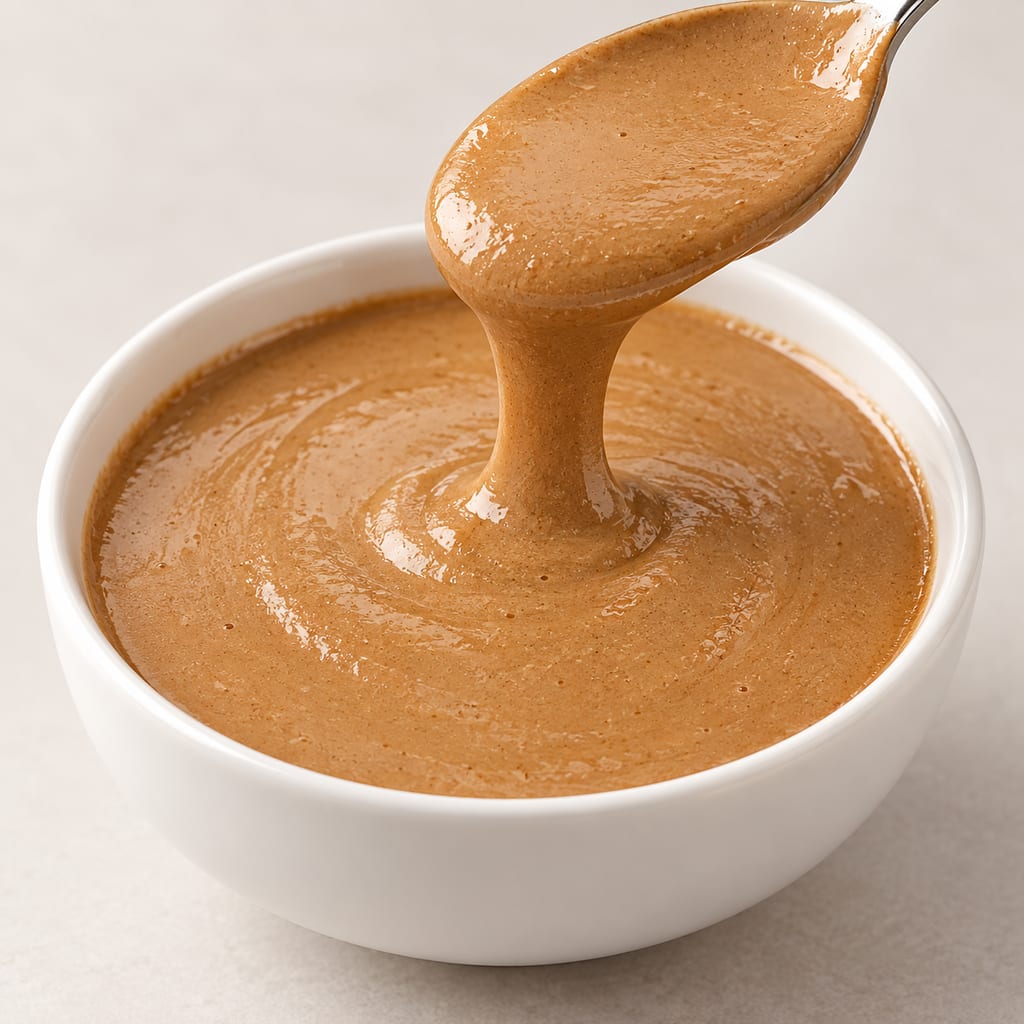
Chinese sesame paste
Chinese sesame paste (zhīma jiàng, 芝麻酱) is a thick paste ground from toasted sesame seeds. Roast, texture and added ingredients vary by product.
 FermenteaWhere food goes to change
Substrates
Sesame seed, from Sesamum indicum, is about half oil and is eaten whole, ground into paste or pressed into oil. It was a crop of South Asia by the Harappan period and reached Mesopotamia before 2000 BC.
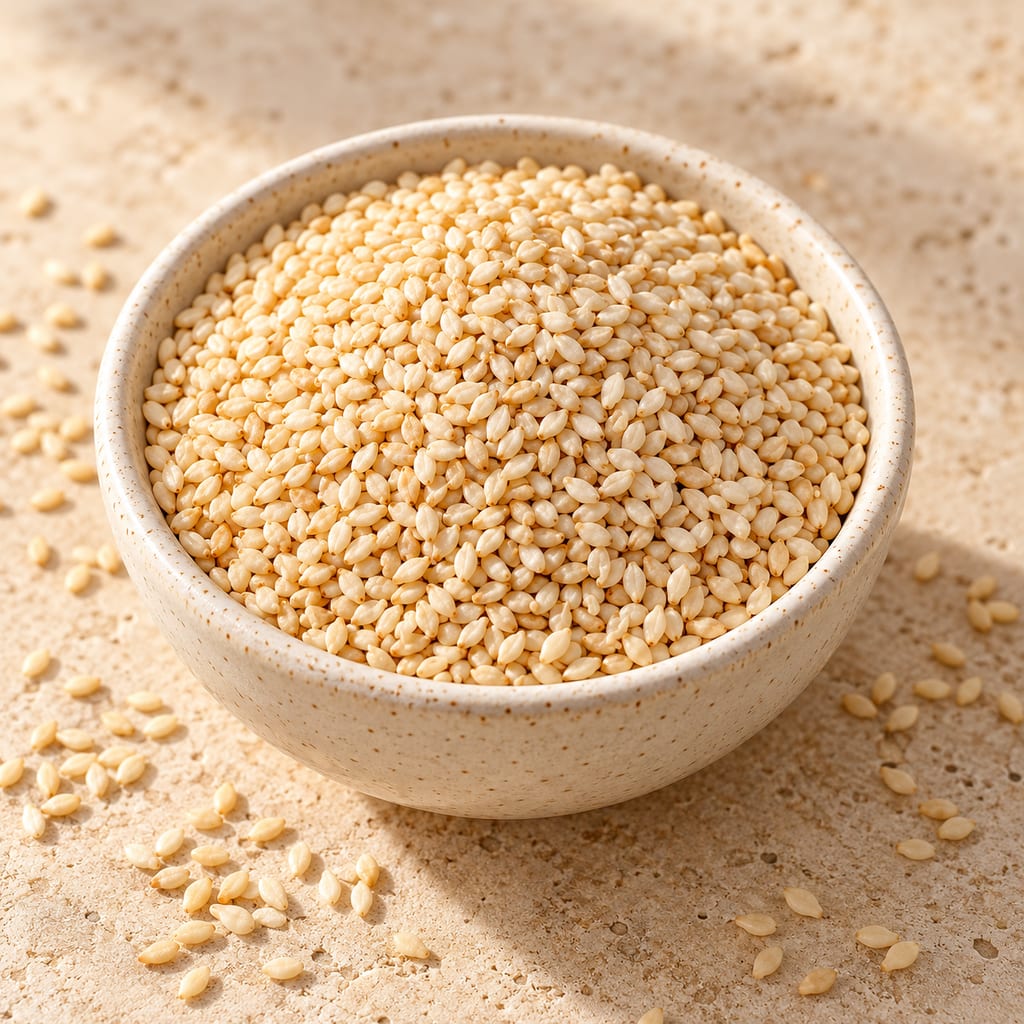
Sesame seed comes from Sesamum indicum, an annual herb of the family Pedaliaceae that the older literature also calls Sesamum orientale. It goes by several names: gingelly, til, benniseed and simsim, and in the Mizo language of north-east India chhawhchhi. The seeds ripen in small capsules and come in pale, brown and black forms; the colour is one of the first things a cook or buyer notices, though it says little about flavour on its own.
What makes sesame unusual is its oil. Texas A&M's production guide puts the seed at about half oil by weight, calls anything below 50 percent unacceptable for the crop and says most current varieties give 50 to 55 percent; Oklahoma's extension sheet on sesame oil gives a wider range of 40 to 60 percent oil together with about 25 percent protein. That composition is why one seed serves as topping, paste, oil and the pressed meal left behind. A pressed meal is no longer the seed, a paste is not the oil, and the nutrient figures of one cannot be carried over to another.
Sesame is also one of the most drought-tolerant crops in cultivation. Texas guidance says it needs 110 to 150 frost-free days, germinates poorly when the soil is below about 70 °F, and does best with daily average temperatures of 86 to 92 °F. Plants use about half the water of cotton and a quarter of the water of corn, and suit regions with 16 to 18 inches of annual rain, but they die if left standing in water for more than a few hours.
The crop's origin is a question that archaeobotanists argued over for a long time. Many scholars had suggested that sesame was first domesticated in Africa. Dorian Fuller's 2003 review of the evidence, drawing on finds from 22 sites, concluded otherwise. Cultivated sesame derives from wild populations native to South Asia, especially the western Indian peninsula, the Punjab and parts of Pakistan, where a wild plant known as Sesamum malabaricum or S. mulayanum, which Fuller treats as synonyms, still grows. Genetic diversity is much higher in South Asia than elsewhere, which points the same way.
The wild type resembles the crop but has smaller, highly rugose seeds with sharp margins, usually purple rather than white flowers, lobed leaves and longer beaked capsules. It grows in the wet tropical regions of the western Indian peninsula, often as a weed of wasteland, and in semi-arid zones of the northwest. Some South Asian landraces keep a few of these features, such as black seeds with a somewhat rugose coat, which is part of the evidence that the crop descends from this plant. Because spontaneous populations readily establish themselves around fields, it is hard to say how much of the wild plant's range is true wild and how much is feral escape from cultivation.
The oldest charred seeds come from northwestern South Asia. Sesame seeds from the Harappan city of Harappa were once dated to the late fourth millennium BC, but Fuller notes that the date was a guess made before radiocarbon dating; the layer belongs to the mature Harappan period, between 2500 and 2000 BC. A better-documented find at the Harappan site of Miri Qalat in Baluchistan dates to the same period, and sesame is absent from the site's earlier layers back to 4000 BC, so it arrived there with the Harappans. In the second millennium BC the crop turns up across India: Sanghol in Punjab (1900 to 1400 BC), Malhar in the Gangetic basin at about 1600 BC, Imlidh-Kurd before 1300 BC, and Inamgaon in Maharashtra at 1500 to 900 BC.
West of the Indus the record is thinner but clear. Charred seeds from Abu Salabikh in Iraq show sesame in Mesopotamia by about 2300 BC, which supports reading the Assyrian word shamas-shammu and perhaps the earlier Sumerian she-gish-i as sesame. By about 1400 BC it was grown in Bahrain, and a burnt storage context at Sabir in Yemen of about 900 BC held large quantities of sesame beside linseed and mustard. Oil-pressing equipment at Karmir Blur shows that sesame oil was being pressed in the early first millennium BC. Textual evidence in Egypt appears in the Greek period, from the fourth to the first century BC. Egypt's earlier record is more contested. Seeds from the tomb, from Deir el Medina and from Amarna suggest sesame reached Egypt by the later fourteenth century BC, though some Egyptologists doubt that the New Kingdom word for an edible oil refers to sesame. The seeds from Tutankhamun's tomb have a distinctly reticulate coat, which is unusual for cultivars but is a feature of the wild type and of some Indian landraces, so it does not argue against their identification.
Fuller's review points out two cautions. One is that sesame is hardly a domesticate in the strict sense, because its capsules split as they ripen and seed is lost, a problem breeders still fight; the other is that the earliest finds come from northwestern South Asia but that region need not be where the crop was first grown. The African evidence that does exist is late: the earliest seeds south of Egypt come from Qasr Ibrim in Nubia at 300 to 500 AD, and by the twelfth century Arabic sources attest the crop in West Africa. In short, sesame is old, South Asian in origin, and widely carried by about 2000 BC, but the first field has not been found.
Harvest decides how much of the crop reaches the market. Ripe capsules split, and in older varieties much of the seed fell to the ground before it could be gathered. Texas growers once lost heavily to shatter, until the discovery of an indehiscent gene in 1943 and a seamless gene in 1986 led to varieties that open slightly and keep their seed, even through six weeks of rain; strictly indehiscent lines held their seed too well and were abandoned commercially because they were hard to thresh without damage.
Growers plant seed three-quarters of an inch to an inch and a half deep once the soil has held an average of 68 °F at eight in the morning for ten days, about two to three weeks later than cotton. Dryland yields in Texas ran from 300 to 1,200 pounds an acre and irrigated crops from 800 to 1,700 pounds. A commercial variety takes 90 to 110 days to physiological maturity and then 20 to 40 days to dry down in the field. Combines are run slowly with loose concaves so that no more than two seeds in a hundred are broken, and the seed is cleaned afterwards in separate equipment. Seed must be kept from rain and dew, because wet seed heats faster than most seed. Dark seed spoils the white lots, since the colour of black seed bleeds into the kernel and cannot be removed by dehulling; optical sorting removes it.
Most sesame eaten in the United States is whole seed, scattered on buns and snack foods, which Texas guidance gives as the primary use. Ground to a paste, sesame becomes tahini, which is normally made with hulled and lightly roasted seed; ingredient lists should still be read, since not every paste follows one recipe. Sweetened and pounded, it makes halva and similar confectionery.
Oil is the most processed form. A pale refined oil pressed from raw seed is used for cooking and frying. An amber oil pressed from toasted seed has a strong nutty aroma and serves as a seasoning rather than a frying medium. The pressing leaves a meal, whose composition differs from that of the whole seed. Sesame also contains lignans, a group of compounds that includes sesamin and sesamolin.
Heat changes those lignans. A comprehensive review of sesame lignans reports that roasting converts sesamolin into sesamol, and that refining alters the lignan profile, so a toasted oil does not have the same chemistry as raw seed. The review also finds that the lignan contents of sesame samples vary and that comparisons do not support a universal ranking of black, white and brown seed.
Sesame is rarely a fermented food in itself. Its role in ferments and condiments is as an oily, aromatic ingredient that carries other flavours, and the best-documented examples are dry seasonings. Gomasio, the Japanese sesame and salt condiment (gomashio), pairs tan or black seeds with salt. In one preparation both are toasted separately and then ground together by hand in a suribachi, the ridged Japanese mortar. Grinding breaks the hulls and releases oil, giving a coarse, fragrant powder that is sprinkled over grains and vegetables. Japan's Ministry of Agriculture describes a Hokkaido serving of sekihan, the festive red rice, topped with black sesame ground with salt.
The Mizo people of north-east India ferment sesame. Their word for it is chhawhchhi, and it comes in two kinds, chhibung and chhipui. Chhi-um, the fermented sesame, is made from chhibung: the seed is heated, crushed in a wooden mortar and kept in a closed container on top of the fireplace, and after three days it is used as a taste enhancer. Chhipui is heated and pounded with salt until it turns oily and sticky and is eaten as a side dish; the stickiness comes from released oil and does not signal fermentation. Ai-um combines sesame with crab: thumb-sized river crabs are killed with hot water, ground and mixed thoroughly with chhawhchhi, kept in a closed container above the fireplace and opened after about three days, and the paste is then dried in the sun or over the fire and served as a side dish.
Sesame garum, a Goodlok seasoning, uses sesame seed as a named input alongside barley-groat koji, the base of a fermented liquid seasoning; the producer does not publish the proportions or the process.
Sesame is a recognised food allergen, and its presence matters whether a food shows visible seeds or contains tahini, oil or paste. In the United States, sesame became the ninth major food allergen when the FASTER Act took effect on 1 January 2023, so packaged foods must declare it in the ingredient list or in a Contains statement; products sold before that date did not have to be relabelled. Other jurisdictions have their own rules, and unpackaged foods may be subject to different requirements. A sesame declaration and a gluten or barley declaration answer different questions about a finished food: the gluten declared on that garum belongs to the barley-groat koji and not to the seed.
The oil that makes sesame valuable also makes it prone to going rancid. Keep seed in a closed container and cool, and treat whole seed, paste and oil as different foods with different keeping times; the sources give no single figure. A toasted aroma is a flavour, and stale oil is a fault. Wet seed deteriorates quickly: a Kansas case in which a hard freeze caught green plants with wet seed led to rancidity weeks later, whereas dry seed showed no problem.
Dryness does not make sesame sterile. A review of sesame food safety identifies Salmonella as the main hazard in seed and sesame products and traces it to outbreaks, including 47 confirmed cases in five European countries in 2016 and 2017 linked to sesame paste from Greece and seed from Nigeria, and 135 confirmed cases between January 2019 and October 2021 linked to halva and tahini imported from Syria. Sesame products have a water activity below 0.70 and several months of shelf life, which stops bacteria from growing but not from surviving, and the oil can shield them from heat treatment and irradiation. Many sesame foods are eaten as they are, without a further step that would inactivate bacteria, so the safety of the supply chain matters more than any step in the kitchen.
The date and place of first domestication remain open, as does the route sesame took between the Indus and Mesopotamia. The Mizo methods are traditional household practice with no measured acidity or safety limits, and the recipe for sesame garum is unpublished.
Whole sesame seeds are also a topping for breads in several documented preparations. A recipe published by Thessaloniki’s Network of Creative Cities of Gastronomy dips shaped koulouri rings in sugared water, coats them in sesame and bakes them at 200 °C for about 15 minutes. Luay Ghafari’s home recipe for ka'ak al-Quds mixes untoasted sesame with honey and hot water, then dips the shaped rings in the mixture before baking; this is a contemporary recipe, not a complete history of Palestinian bread practice.
Judy’s Shanghai da bing recipe brushes the folded dough with water, adds toasted sesame seeds and bakes the pancakes. The Woks of Life describes da bing as one of Shanghai’s breakfast foods, often served with you tiao. These examples show different uses for whole sesame on bread; they do not establish one method for every sesame-topped bread.
sesame
Earliest archaeological finds of cultivated sesame, including Harappa and Miri Qalat; Fuller notes this region need not be where the crop was first domesticated.
Charred sesame seeds show the crop in Mesopotamia; not a claim of origin.
Regional sesame names and preparations, including chhibung, chhipui and ai-um, recorded in an ethnographic account of Mizo food.
Black sesame and salt top the regional sekihan serving; a culinary association, not a growing origin.
Documented commercial sesame production with shatter-resistant varieties.
Chinese sesame paste (zhīma jiàng, 芝麻酱) is a thick paste ground from toasted sesame seeds. Roast, texture and added ingredients vary by product.
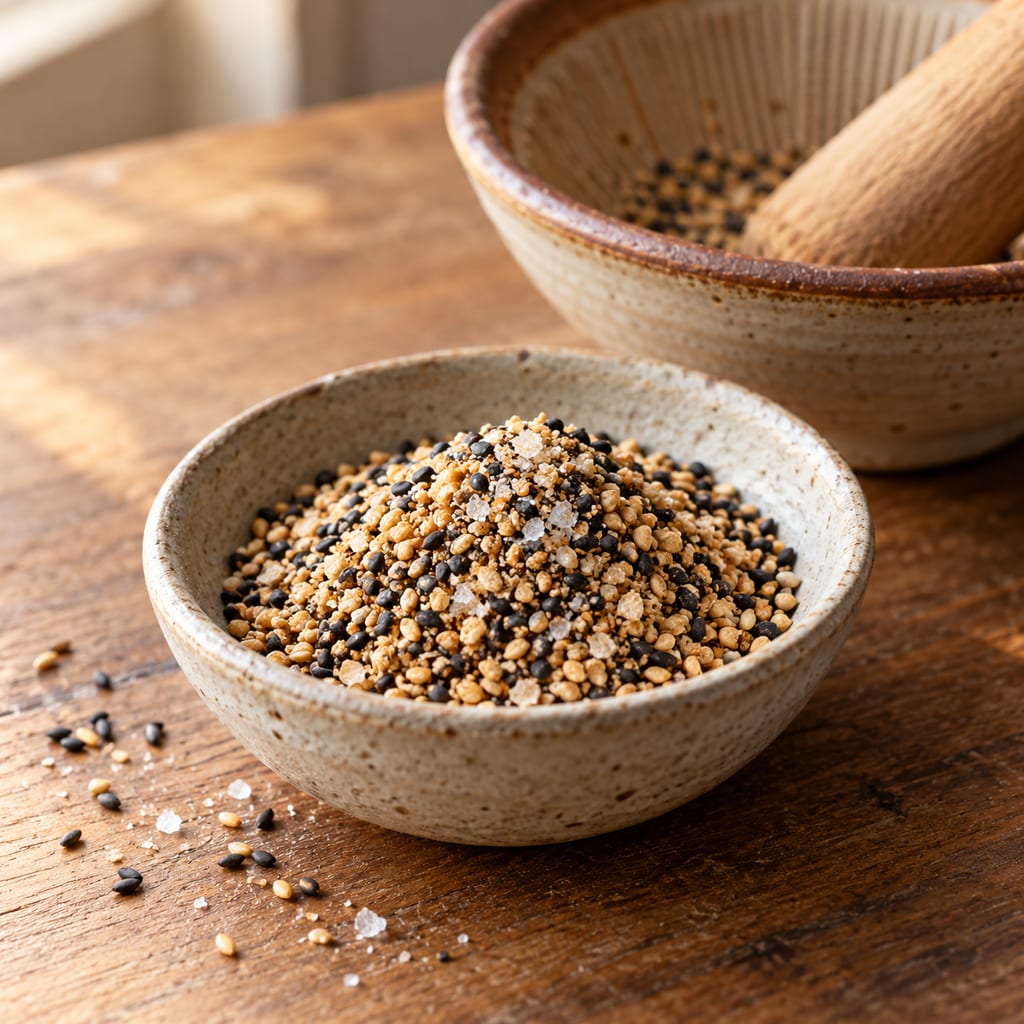
Toasted sesame seeds and sea salt are ground together into a coarse seasoning for rice. This small pan-roasted batch keeps most of the seed texture.
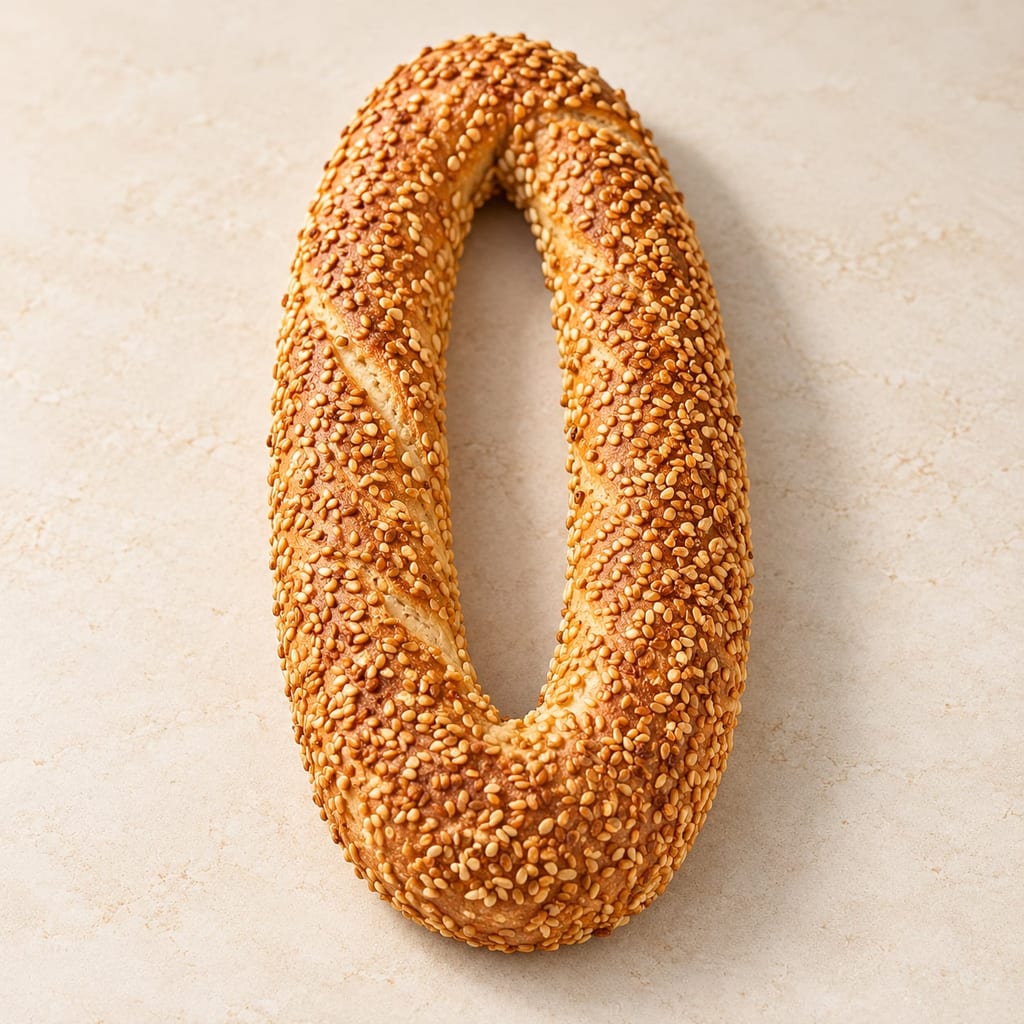
Palestinian milk-enriched wheat rings coated in sesame and grape molasses, shaped into long ovals and baked without a bagel-style boil.
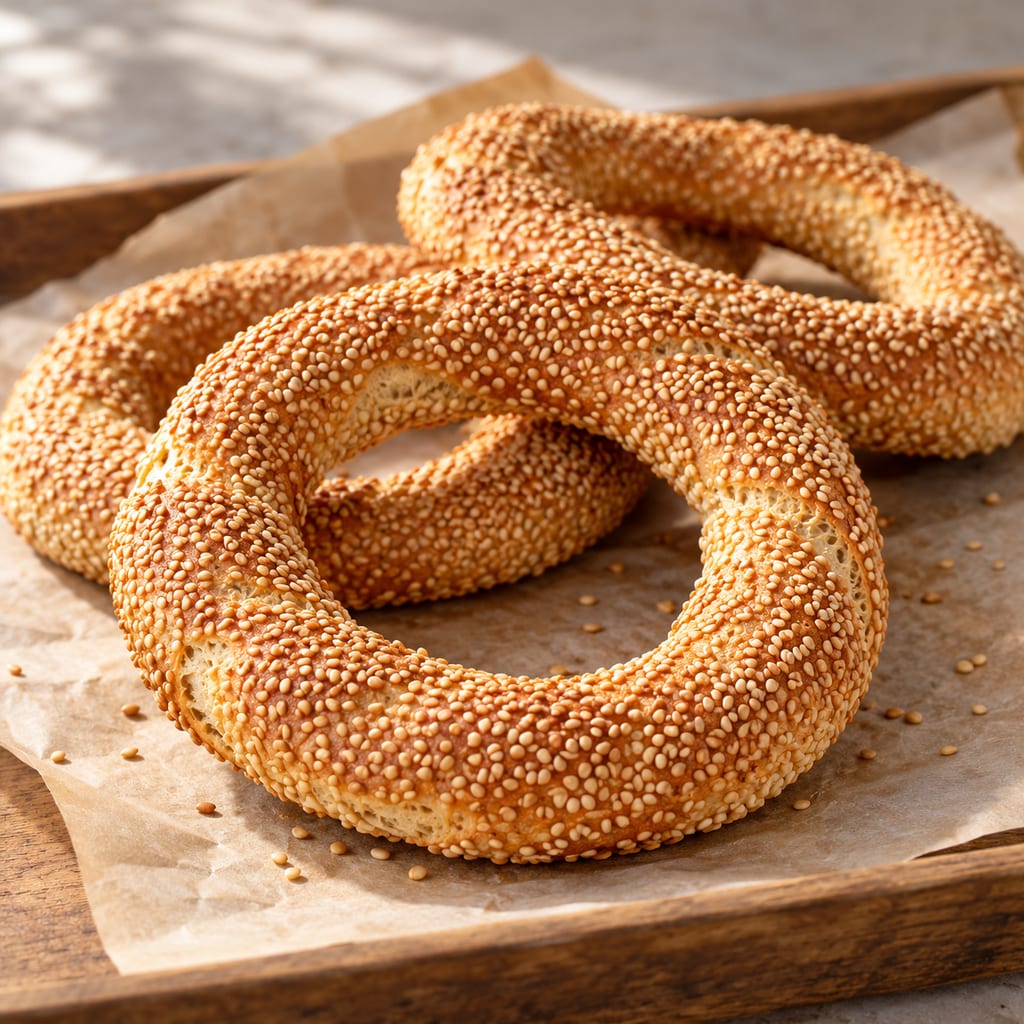
The Thessaloniki City of Gastronomy page gives a 15–18-ring yeast dough, dipped in sweetened water and sesame before baking. Its fresh yeast is listed as one dice without a mass, which remains unresolved.
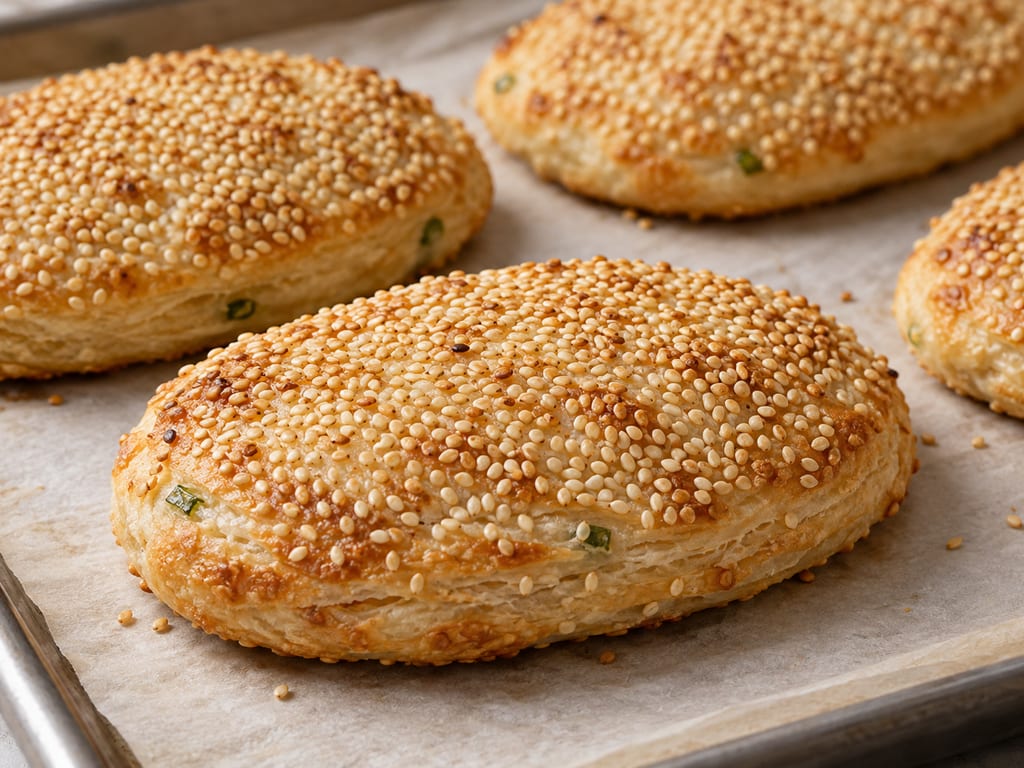
Shanghai breakfast flatbreads layered with butter, scallion and pepper, then topped with sesame and baked.
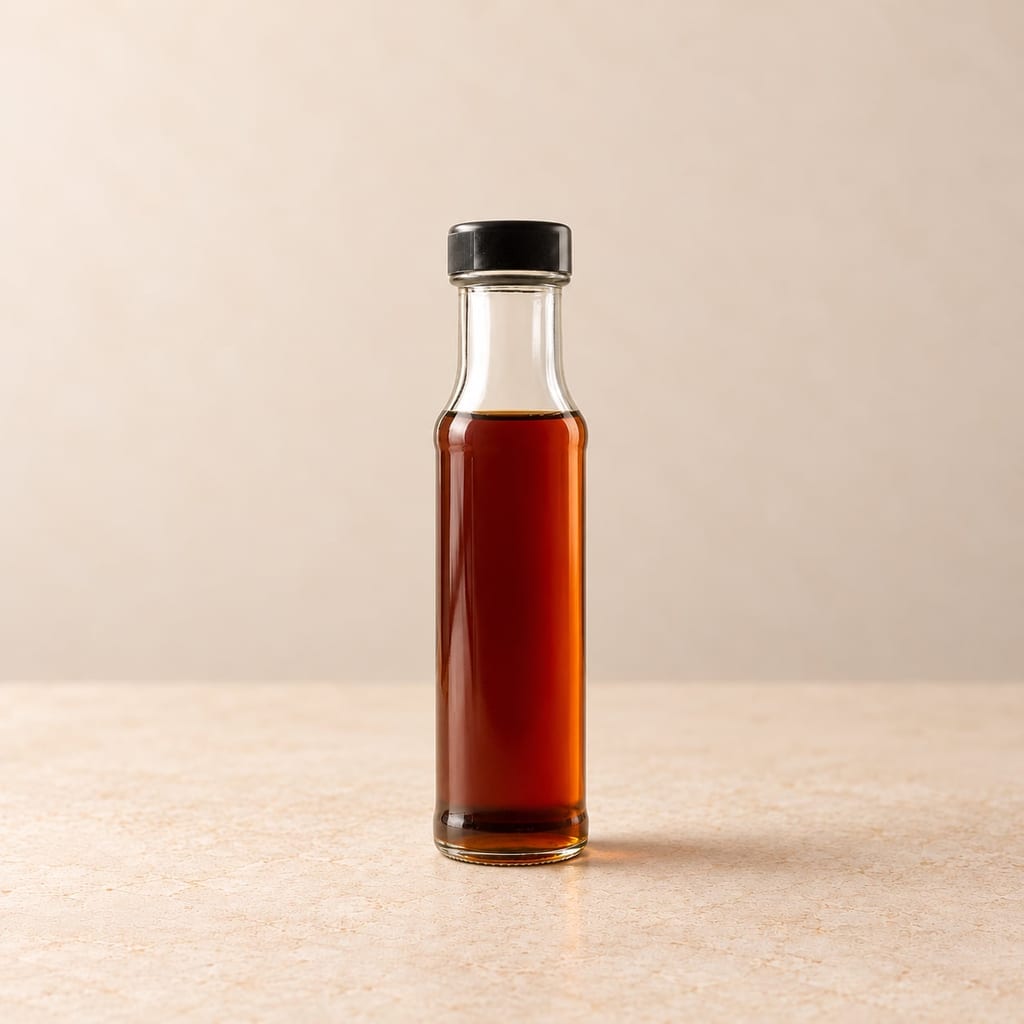
Dark, strongly scented oil pressed from roasted sesame seed, used as a last-minute seasoning in East Asian sauces, dips and dressings rather than as a frying oil.
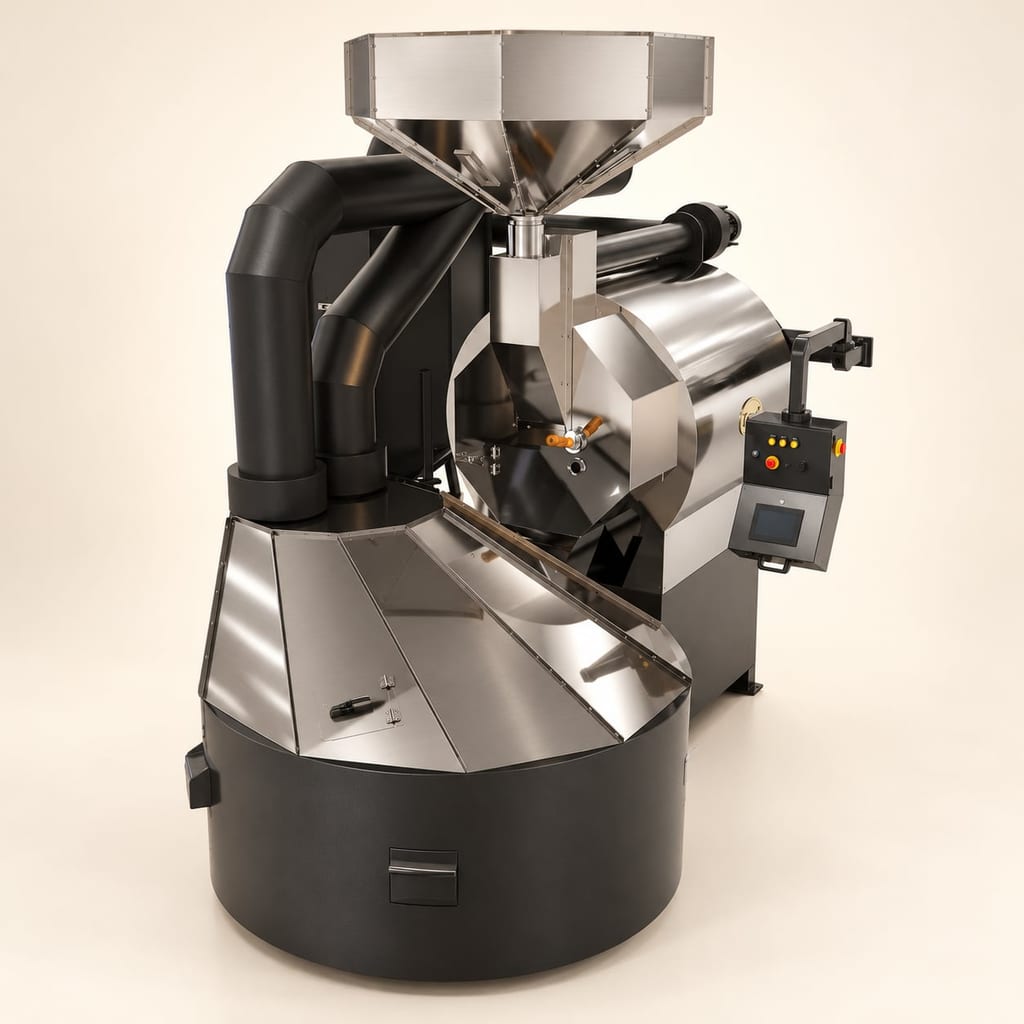
A food roaster is a machine class rather than one fixed design: batch drums, hot-air chambers and continuous lines heat and move different seeds, nuts, grains or beans.

From sour breads and milk to savoury seeds, cassava staples and living beers, African fermentation follows the crop, the community and the work of transformation.
Dawdim is a dried rice-beer starter cake from Mizoram. Laboratories have listed its yeasts and moulds; no source gives how it is made, kept or used safely.

At North Abydos in Egypt, a fixed early Dynastic brewery comprised parallel semi-subterranean installations with rows of ceramic mash vats; excavation reports revise their number, scale and estimated batch capacity.

Ají amarillo is the orange-yellow Peruvian chilli cultivar group of Capsicum baccatum, used to colour and season huancaína sauce and ají de gallina. Published heat estimates do not establish one range for the named cultivar.

Toasted almonds are whole sweet almond kernels dry-roasted until golden to brown. Heat replaces their marzipan note with a roasted, nutty one; they thicken and flavour romesco.

Kodiak salmon, halibut and cod cut as seg'aq and hung on an initaq rack to become tamuuq, with kac'amaasaq and kupcuunaq named as different results.

Aniseed is the dried ripe fruit of Pimpinella anisum, an aromatic Apiaceae spice commonly called a seed. It adds a sweet, warm aroma to breads such as Moroccan krachel and South African mosbolletjies, and is distinct from star anise.

A fixed Late Chalcolithic installation in Areni-1 cave combined a shallow clay pressing basin with a large jar set into the cave floor and storage vessels nearby.

Ripe avocado flesh is the soft, buttery, fat-rich pulp of Persea americana, eaten raw. It is low in acid, so it is a fresh ingredient that needs care in chilled dishes.

A portable dome and pan used over a hearth, with embers on the lid and heat from below. Regional peka and saç forms share this principle while differing in materials, pan shape and how the food is cooked.
No community contributions have been published for this entry yet.
Sign in to contribute. Published comments and photos are free to read.
GoodlokResearch intake · Producer description
Goodlok Play — Sesame garumGoodlok / Goodlok Play names sesame seeds as an actual input to sesame garum. The webpage declares sesame, while the package separately names barley-groat koji and gluten. Seed form, proportions, cultivar, origin and complete process are unspecified.
Cited in: Sesame in condiments and ferments
Asian Agri-HistoryHistory
Further Evidence on the Prehistory of SesameCultivated sesame derives from wild South Asian populations (S. malabaricum or S. mulayanum, treated as synonyms); archaeological finds reviewed from 22 sites
Harappan finds in northwestern South Asia by 2500 to 2000 BC; Miri Qalat; second-millennium finds across India
Mesopotamia by about 2300 BC (Abu Salabikh); Bahrain about 1400 BC; Sabir, Yemen about 900 BC; Egypt in the later fourteenth century BC is credible but contested
African finds are late: Qasr Ibrim 300 to 500 AD; West Africa by the twelfth century
Cited in: An old crop with a South Asian start; What the sources leave open
Oklahoma Cooperative Extension ServiceIngredient context
Sesame Seed Oil Properties — FAPC-238Sesamum indicum L., an annual of the Pedaliaceae, formerly Sesamum orientale; also called gingelly, til, benniseed and simsim; roughly 40 to 60 percent oil and about 25 percent protein
Whole seeds, paste, oil and meal; refined cooking oil versus aromatic oil pressed from toasted seeds
Cited in: A small seed that is half oil; Whole seed, paste, oil and meal
Texas A&M AgriLifeIngredient context
Sesame Production GuideAbout 50 percent oil; most varieties 50 to 55 percent; 110 to 150 frost-free days; drought tolerant; daily average 86 to 92 F favoured
Shatter, indehiscent and seamless genes; 90 to 110 days to maturity plus 20 to 40 days of drydown; combine settings; seed kept from rain and dew; black-seed colour bleeds into white lots
Whole-seed condiments are the main US use
Cited in: A small seed that is half oil; Capsules, shatter and harvest; Whole seed, paste, oil and meal; Keeping sesame and keeping it safe
MoleculesIngredient context
Lignans of Sesame (Sesamum indicum L.): A Comprehensive ReviewRoasting and refining transform sesame lignans. Composition varies among seed samples, and comparisons do not establish a consistent universal ranking of seed colours by lignan content.
Cited in: Whole seed, paste, oil and meal
Science VisionCulinary use
Traditional Food Processing Techniques of the Mizo People of North East IndiaChhawhchhi is the local name for sesame, with kinds chhibung and chhipui; chhibung is heated, crushed in a wooden mortar, kept closed on top of the fireplace and used as a taste enhancer after three days (Chhi-um, fermented sesame); chhipui is heated and pounded with salt until oily and sticky and eaten as a side dish; ai-um: thumb-sized river crabs killed with hot water, ground, mixed with chhawhchhi, kept closed above the fireplace for about three days, then dried and served as a side dish
Cited in: Sesame in condiments and ferments; What the sources leave open
Ministry of Agriculture, Forestry and Fisheries, JapanCulinary use
Sekihan (Red rice) — Our Regional CuisinesA Hokkaido sekihan example serves cooked rice with black sesame and salt; regional and household variation is acknowledged.
Cited in: Sesame in condiments and ferments
US Food and Drug AdministrationAllergen · Safety
Allergic to Sesame? Food Labels Now Must List Sesame as an AllergenUS packaged-food sesame allergen declaration requirements took effect on 1 January 2023. The guidance explains ingredient-list and Contains declarations, changing formulations and the different context of unpackaged foods.
Cited in: Sesame as an allergen
Ask ExtensionIngredient context
storing Sesame Seeds — Question 289037Sesame oil makes rancidity a quality concern; closed containers and cool storage protect keeping quality
Cited in: Keeping sesame and keeping it safe
HeliyonSafety
Food safety issues associated with sesame seed value chains: Current status and future perspectivesSalmonella is the main hazard; 47 cases in five European countries in 2016 and 2017 and 135 cases in 2019 to 2021 linked to halva and tahini from Syria
Low water activity (below 0.70) prevents growth but not survival; oil may protect pathogens from heat and irradiation; many products are ready to eat without an inactivation step
Cited in: Keeping sesame and keeping it safe
Eating for Your HealthCulinary use
GomasioThis recipe uses whole tan or black sesame seeds with hulls, separate toasting of seed and salt, hand grinding in a suribachi, and serving over grains or vegetables. It documents this condiment rather than a universal sesame method.
Cited in: Sesame in condiments and ferments
Network of Creative Cities of Gastronomy — ThessalonikiCulinary use · Contemporary recipe
Sesame Bread Rings from Thessaloniki (Koulouri Thessalonikis)The recipe uses 2 cups sesame for 15 to 18 rings. The shaped dough is dipped in sugared water, put into sesame and baked at 200 °C for about 15 minutes.
The source says koulouri arrived in Thessaloniki with emigrants from Minor Asia and became a local traditional product; a separate city page says its invention place is unknown.
Cited in: Sesame on breads
Urban Farm and KitchenCulinary use · Contemporary recipe
Easy Jerusalem Bagels (Kaak Al Quds Recipe)The author identifies the bread as ka'ak al-Quds and describes untoasted sesame as the traditional topping for this bread. The recipe mixes sesame with honey and hot water and dips the shaped rings before baking.
This is a contemporary home recipe; it does not independently establish the entire history of the Palestinian bread.
Cited in: Sesame on breads
The Woks of LifeCulinary use · Contemporary recipe
Shanghai Sesame Pancakes (上海大饼)The page identifies this as the author’s Shanghai da bing recipe and places it among Shanghai breakfast foods served with you tiao.
The method brushes rolled dough with water, sprinkles toasted sesame seeds and bakes the pancakes.
Cited in: Sesame on breads