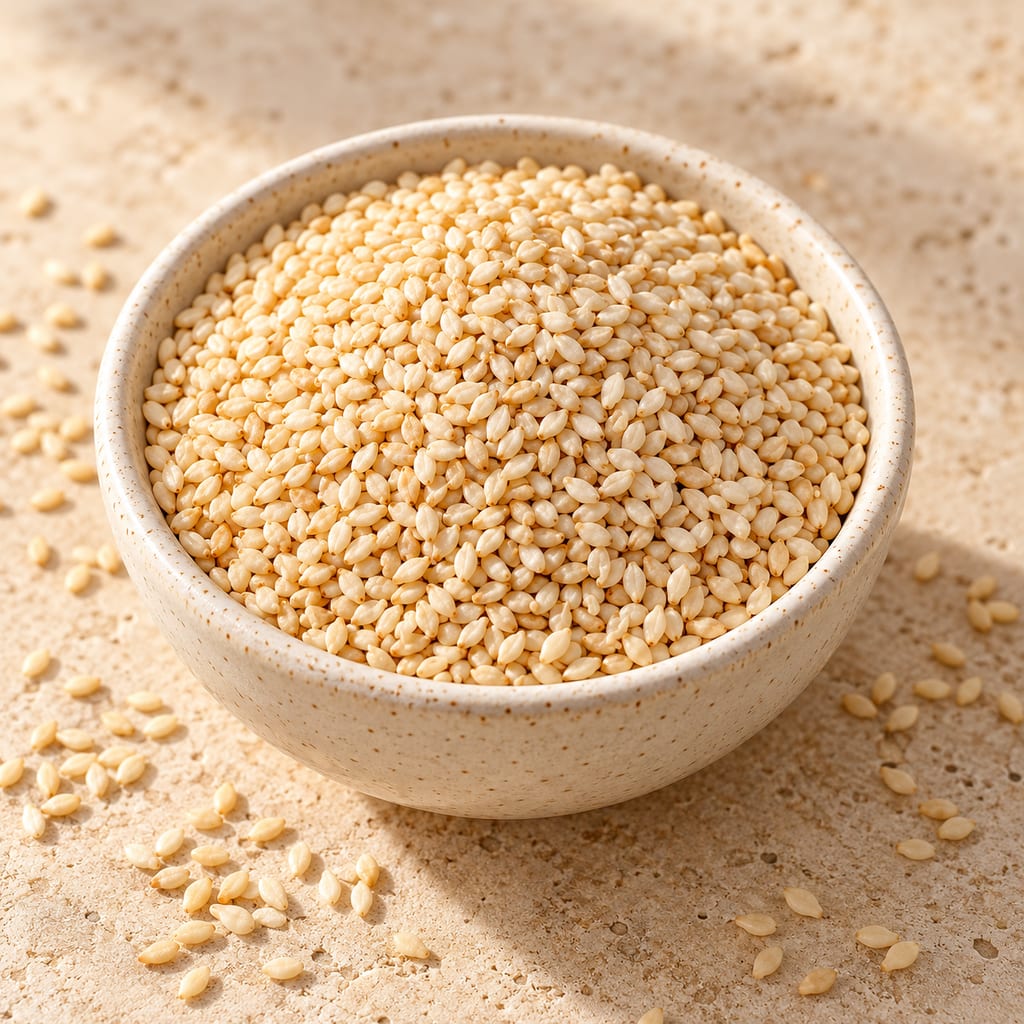
Sesame seeds
Sesame seed, from Sesamum indicum, is about half oil and is eaten whole, ground into paste or pressed into oil. It was a crop of South Asia by the Harappan period and reached Mesopotamia before 2000 BC.
 FermenteaWhere food goes to change
Other
Chinese sesame paste (zhīma jiàng, 芝麻酱) is a thick paste ground from toasted sesame seeds. Roast, texture and added ingredients vary by product.
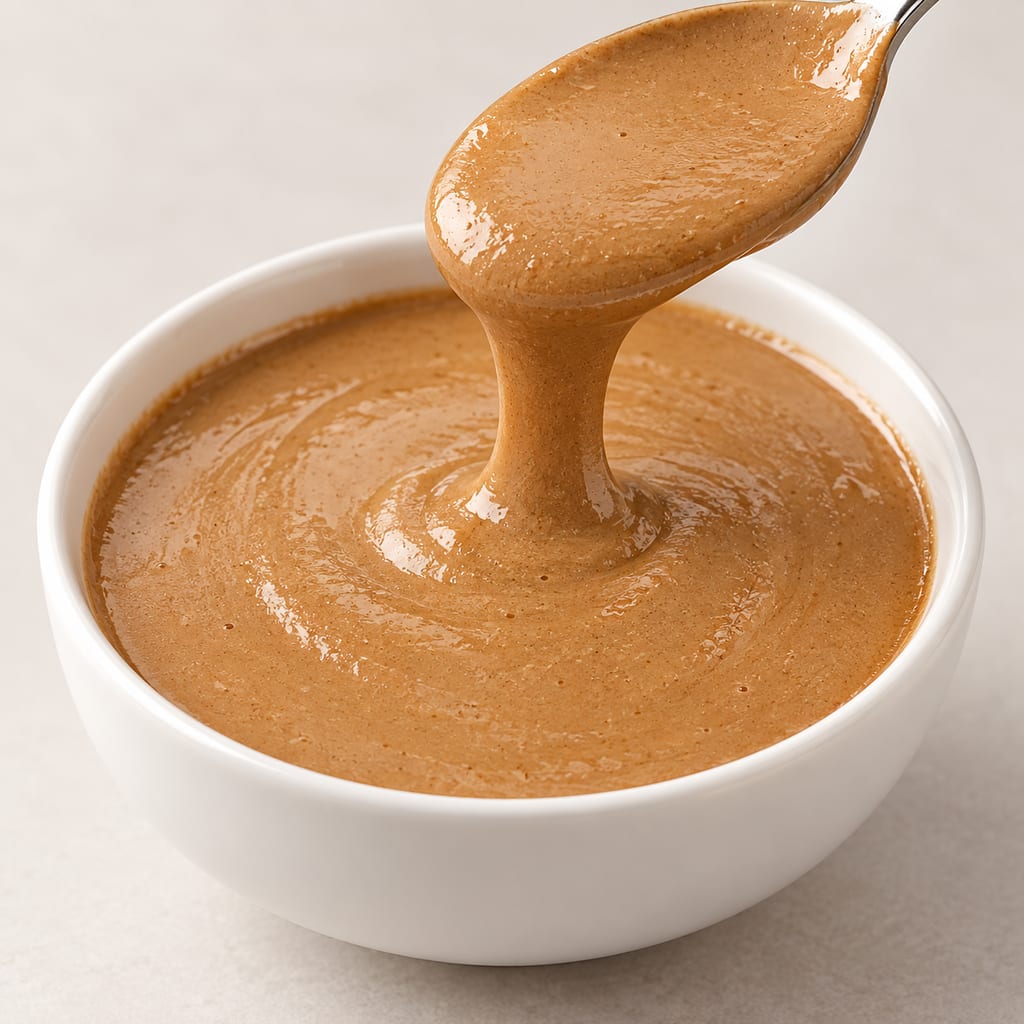
Chinese sesame paste is a thick food paste made by grinding toasted sesame seeds. Its Chinese name is zhīma jiàng (芝麻酱); the pinyin is also written without tone marks as zhima jiang. In English, it may be called Chinese sesame paste, Chinese roasted sesame paste or sesame sauce. These names are useful for locating the ingredient, but a jar’s ingredient list is still needed to tell whether it contains only sesame or a blend.
The Woks of Life describes a common version as a richly flavoured, dense paste from toasted white sesame seeds. A second Chinese cooking source describes ordinary savoury sesame paste as roasted white sesame, while noting that black sesame pastes are often used for sweets. These accounts describe common product families, not a universal manufacturing specification. Seed colour alone does not establish roast, grind, flavour or a recipe’s intended use.
Grinding turns the seed’s oil and solids into a cohesive paste. Products may be stone-ground or milled by other equipment, and they can differ in how finely the seed is ground, the amount of separated oil, the roast depth and the final flow. One manufacturer or seller’s description should be read as a claim about that product, not as a definition for every Chinese sesame paste.
芝麻酱 is commonly romanised zhīma jiàng or zhī ma jiàng. The first two syllables mean sesame; jiàng is used in the name of a paste or sauce. Chinese sources use 芝麻酱 for the ingredient. In recipes written in English, the shorter “sesame paste” can also refer to tahini, Japanese nerigoma, black sesame dessert paste, or an already-seasoned sesame sauce. Check the source and ingredient list before treating those phrases as interchangeable.
Chinese sesame paste is distinct from tahini as a product category, but the boundary is not captured by a simple raw-versus-toasted rule. The Woks of Life compares a strongly roasted Chinese paste with a lighter tahini made from hulled, raw seeds. Soom’s own product FAQ, however, says its tahini is made from hulled, dry-roasted sesame. This manufacturer example shows why the label “tahini” cannot by itself determine whether seeds were roasted.
Commercial Chinese sesame paste may be made from sesame alone or from sesame with peanuts or other additions. Pure sesame paste and a peanut-sesame blend are different ingredients: they differ in allergens, flavour and how much sesame they contribute. Some sellers also offer black sesame pastes for sweet foods. Those may share the broad idea of ground sesame, but they should not automatically be substituted for the toasted white paste used in a savoury noodle sauce.
Chinese sesame paste is used in sauces for cold noodles, hot-pot dips and dressings. The Woks of Life names these uses in its ingredient guide. Omnivore’s Cookbook also documents it in noodle sauces, hot-pot dips, fillings and other dishes. These sources show a range of uses; neither establishes a single national formulation or a fixed ratio for a sauce.
A Hubei provincial government account describes sesame paste as an accompaniment to Wuhan hot dry noodles. This supports a documented association with Wuhan, Hubei. It does not make Wuhan the unique birthplace of sesame paste, nor does a dish’s location prove where the seeds for a particular jar were grown. The geographic location on this ingredient page records use, not origin.
The sesame plant itself has a wider geography than this paste style. Kew’s Plants of the World Online lists Sesamum indicum as native to the Indian subcontinent and records it as introduced across many other regions. That botanical range is not a current crop map and does not tell us where a particular Chinese paste producer buys seed. One retailer describes its own Chinese paste as made from Chinese-grown sesame; that is a product-specific sourcing statement, not a rule for the category.
Product sourcing can therefore only be stated at the level a source supports. A jar may name its seed origin, processing location and manufacturer, or omit some of them. The sources consulted do not establish that all Chinese sesame paste uses locally grown seed, one sesame cultivar, or one processing centre. Keep the seed’s cultivation location separate from the culinary geography of a paste or dish.
The sesame crop and sesame oil have histories much longer than any one modern paste style. Evidence that sesame seeds or oil were known in China would not, on its own, establish when Chinese sesame paste first appeared. A recipe or historical claim about the plant is not automatically evidence about a finished paste made by grinding the seeds.
The sources consulted here do not provide an early primary document that establishes the invention date or first place of Chinese sesame paste. A 1976 entry in Mrs. Chiang’s Szechwan Cookbook, republished by ckbk, is one dated record of the named ingredient in an English-language cookbook. It describes sesame paste as a bottled Chinese-market ingredient and compares it with Middle Eastern tahini. That record confirms the ingredient was discussed in that cookbook by 1976; it does not prove that the paste originated then or that this is the earliest written attestation.
Modern ingredient guides show how the paste is recognised and used today, but not when it began. A seller's reference to a centuries-old stone-grinding technique is a claim about a production tradition, not a dated primary record of the paste's first use. Without earlier, specific evidence, the exact chronology and birthplace remain unknown.
Many Chinese sesame pastes have a deep roasted aroma and a fuller, darker flavour than mild sesame pastes. Recipe writers describe notes as nutty, smoky or strongly toasted; these are tasting descriptions, not measured chemical properties. The same sources warn that density and flavour vary by brand. A jar’s colour can offer a clue, but it does not identify the seed variety or prove a particular roasting method.
Bitterness, roast intensity, thickness and oil separation all affect how a sauce behaves. A strongly roasted paste can stand up to soy sauce, vinegar and garlic, while a pale or mild paste may recede. A coarse paste may need more mixing or gradual thinning. Added peanut butter changes both flavour and allergen status. These differences matter when following a source recipe that names a particular paste rather than just “sesame paste.”
Tahini can work in some recipes when Chinese sesame paste is unavailable, but substitution changes the result. One cookbook entry calls tahini a less aromatic substitute; The Woks of Life says it may be milder; a manufacturer’s roasted tahini illustrates that the roast varies too. Compare the actual products and taste them before adjusting the sauce. A pale tahini may produce a lighter, less roasted sauce, while another tahini may have a substantial roast of its own.
A finished tahini sauce is also a different product from a jar of tahini. Water, lemon juice, garlic, salt or herbs turn concentrated paste into a fresh sauce and change its texture, taste and handling. A recipe for Chinese sesame dip may likewise thin the paste with water, soy sauce, vinegar, stock or other ingredients. Those mixtures are serving sauces, not new names for the plain paste.
Sesame paste supplies concentrated sesame flavour, richness and body in sauces. Documented uses include noodle sauces, hot-pot dips and dressings; some accounts also list fillings and sweets. A recipe’s choice of pure sesame paste or a peanut blend should be kept explicit, since the flavour and allergen information differ.
In a northern Chinese hot-pot bowl, prepared sesame paste is mixed fresh with shacha, soy sauce and fresh aromatics, in proportions that differ from one diner to the next; one family member uses peanut butter instead, and the paste is sometimes thinned with water. Those bowls are serving mixtures, separate from making the seed paste.
The paste itself is made by roasting and grinding sesame, so the sources reviewed do not describe it as a fermentation. A sauce that contains sesame paste may also contain soy sauce, miso or another fermented ingredient. That does not mean the paste has fermented, and it does not mean the mixed sauce is preserved. The examples here provide no validated preservation process for sesame paste sauces.
Some products include added oil or peanuts, while other jars contain only sesame. The additions can alter texture and how the oil separates. If an ingredient line says only “sesame paste,” use a source that matches the recipe’s intended form or record that the exact product is unspecified. The ingredient does not determine the provenance or fermentation status of every dish in which it appears.
An agricultural-academy account of the water method for small-mill sesame oil, from Henan, describes roasting and grinding the sesame before water is used to separate the oil. It stresses that roasting for an edible paste is not the same as roasting for oil extraction, and its later water-addition and oil-separation stages are not a recipe for a finished paste. It shows that roast and grind are separate, adjustable steps, and that the same seed can be taken toward oil or toward paste.
China's national standards platform lists the industry standard LS/T 3220-2017, Sesame paste, as current, issued in 2017 and effective from 20 December 2017. Its scope covers terminology, quality, inspection, labels, packaging, storage and transport. The numeric clauses of the standard have not been read, so no quality limit is quoted here. A separate official reply from the national grain and reserves administration discusses packaging material and light exposure for sesame and peanut paste; it gives no shelf-life interval.
Natural sesame paste can separate as oil rises above denser seed solids. Stir the paste thoroughly before measuring when a recipe or label directs; this redistributes the oil and solids for a more consistent spoonful. Some products can thicken after refrigeration, and the texture may be harder to work with while cold. A brand’s instructions should take priority over a generic rule.
Storage advice in the sources differs. The Woks of Life recommends refrigerating a Chinese sesame paste after opening. The 1976 cookbook excerpt describes its product as not needing refrigeration. A current Chinese sesame paste seller also says its own product can be kept in a cool, dark place and stresses using a clean spoon. These are product or author recommendations, not a controlled comparison that establishes one safe, long-term method for every jar.
Follow the storage directions on the package and use clean, dry utensils. Do not apply a jar’s storage guidance to a diluted sauce, dip or dressing: adding water, broth, garlic or other ingredients changes the mixture. The sources consulted do not establish a universal shelf life for opened Chinese sesame paste or for a sauce made with it.
Sesame is an allergen. In the United States, sesame became the ninth major food allergen under the FASTER Act, with packaged-food labelling provisions effective from 1 January 2023. The FDA notes that some older products may still be in commerce without the newer sesame allergen declaration, so people with a sesame allergy should read the ingredient list and contact the manufacturer when the information is unclear.
Some Chinese sesame paste products blend in peanuts. That means “sesame paste” on a menu or recipe does not guarantee a sesame-only product, and a pure-sesame jar should not be assumed from the name alone. Check the brand’s ingredient list and allergen statement each time, particularly when the recipe uses a different supplier or when food is served outside the home.
A sesame paste made only from sesame seeds contains no animal-derived ingredient, but other versions may include additional ingredients. This page does not make a blanket dietary certification for every brand. Confirm the particular label before describing a product as vegan, peanut-free, gluten-free or suitable for a specific allergy.
The sources support the name, a common toasted-sesame identity, regional culinary uses and notable variation among products. They do not establish one recipe, seed cultivar, roast level, grinding specification, manufacturing geography, first-use date or universal storage interval. The 1976 cookbook entry is a dated attestation, not an origin claim.
Ingredient pages should keep Chinese sesame paste, tahini, black sesame dessert pastes and diluted sauces distinct. Links to recipes should be added when a recipe item names this ingredient or a clearly matching product. A shared sesame base is not enough to merge these products or to infer that every sesame recipe uses the same paste.
sesame, peanut added to some products
Hubei Government identifies sesame paste in Wuhan hot dry noodles. This is a regional use, not a claim about the paste's exclusive origin or sesame cultivation.
Sesame seed, from Sesamum indicum, is about half oil and is eaten whole, ground into paste or pressed into oil. It was a crop of South Asia by the Harappan period and reached Mesopotamia before 2000 BC.
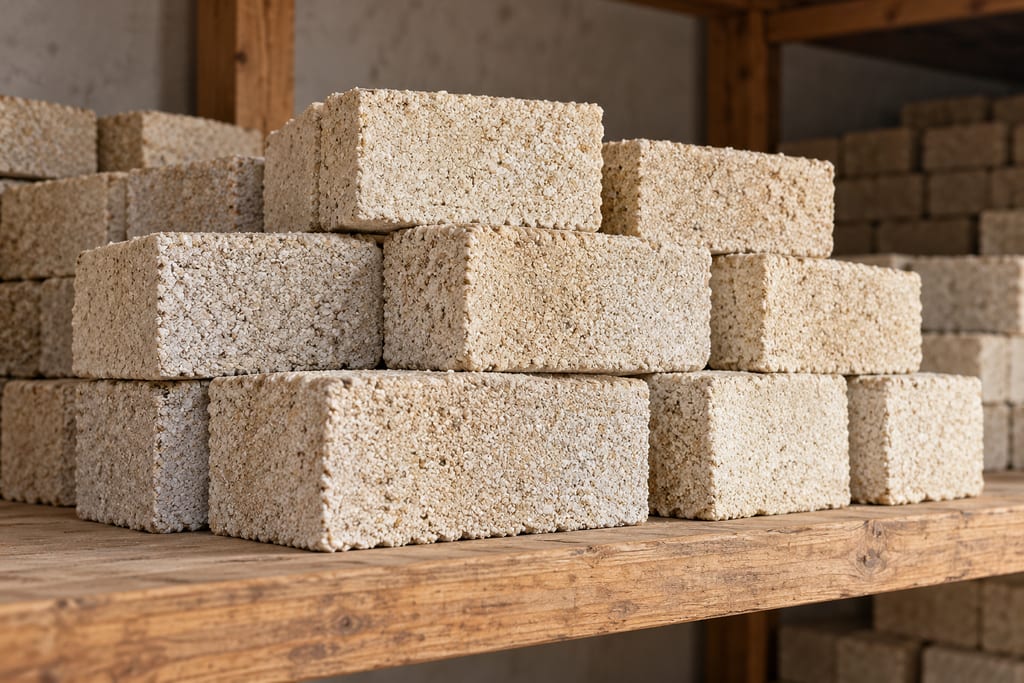
A shaped grain starter (daqu) from Chinese baijiu production, classed as low-temperature because its bricks reach the lowest peak temperatures of the three daqu types; used mainly for light-flavor baijiu.
No community contributions have been published for this entry yet.
Sign in to contribute. Published comments and photos are free to read.
The Woks of LifeIdentity · Culinary use · Preparation · Storage · Allergen
Chinese Sesame Paste: Ingredients GlossaryIdentifies zhīma jiàng (芝麻酱) as thick paste made from toasted white sesame; compares it with tahini; describes noodle sauces, hot-pot dips and dressings; says some brands add peanuts; discusses oil separation and product-specific storage advice.
Cited in: What Chinese sesame paste is; Names, forms and near relatives; Where it is used and sourced; A cautious history; Flavour, texture and choosing a substitute; Use in recipes and fermentation; Preparation and storage; Allergens and dietary context; Evidence and open questions
Omnivore's CookbookIdentity · Forms · Culinary use · Preparation · Storage
Chinese Sesame Paste (芝麻酱)Describes toasted white-sesame paste as the usual savoury form, distinguishes black sesame dessert pastes, lists sauces for noodles and hot pot, fillings and dressings, notes peanut blends and oil separation, and gives its own product storage advice.
Cited in: What Chinese sesame paste is; Names, forms and near relatives; Where it is used and sourced; Flavour, texture and choosing a substitute; Use in recipes and fermentation; Evidence and open questions
Soom FoodsComparison · Storage
Frequently Asked QuestionsSoom states its tahini is made from hulled, dry-roasted sesame seeds, showing that tahini is not universally raw; its storage advice concerns its own products.
Cited in: Names, forms and near relatives; Flavour, texture and choosing a substitute
Soom FoodsComparison
11oz Premium TahiniThe named Soom product lists sesame seeds as its ingredient and describes its own roasted-seed process; not a definition of all tahini.
Foreign Affairs Office of Hubei Provincial People's GovernmentCulinary use · Geography
Hot Dry NoodlesDescribes sesame paste in Wuhan hot dry noodles; supports documented use in Wuhan, not a unique origin claim.
Cited in: Where it is used and sourced
Plants of the World Online, Royal Botanic Gardens, KewBotany · Cultivation context
Sesamum indicum L.Kew lists the accepted species and native range as the Indian subcontinent and many introduced regions. This is botanical range context, not proof of current commercial seed sourcing.
Cited in: Where it is used and sourced
ckbkHistory · Comparison · Storage
Sesame Paste — Mrs. Chiang’s Szechwan CookbookA 1976 cookbook entry records Chinese sesame paste and compares it with tahini; this is a dated attestation, not proof of first use or origin. The excerpt gives product-specific room-temperature storage advice.
Cited in: A cautious history; Flavour, texture and choosing a substitute; Preparation and storage; Evidence and open questions
The Mala MarketIdentity · Sourcing · Uses · Storage · Allergen
Chinese Roasted Sesame Paste (Zhi Ma Jiang) | Stone-GroundThe seller describes its own paste as single-origin Chinese sesame, names a Shandong product association, describes roasting and stone grinding, noodle and hot-pot uses, oil separation, clean-spoon handling, cool-dark storage and a sesame-only ingredient list. Those are claims for this product only.
Cited in: What Chinese sesame paste is; Where it is used and sourced; A cautious history; Use in recipes and fermentation; Preparation and storage; Allergens and dietary context
US Food and Drug AdministrationAllergen
The FASTER Act: Sesame Is the Ninth Major Food AllergenFDA says packaged food and dietary supplements must label sesame as an allergen from 1 January 2023, with transition details on the page.
Cited in: Allergens and dietary context
National Public Service Platform for Standards Information, State Administration for Market RegulationIdentity · Standard
LS/T 3220-2017 芝麻酱 (Sesame paste)Lists LS/T 3220-2017 as current, issued in 2017 and effective from 20 December 2017; scope covers terminology, quality, inspection, labels, packaging, storage and transport. The full clauses were not inspected.
Cited in: How the seed becomes paste, and the national standard
Henan Academy of Agricultural Sciences / National Oil Processing Technology R&D SubcentreProcess
水代法生产小磨香油技术 (Water-method production of small-mill sesame oil)Describes roasting and grinding sesame before water-assisted separation of sesame oil, and distinguishes roasting for edible paste from roasting for oil extraction; the later stages are not a finished-paste recipe.
Cited in: How the seed becomes paste, and the national standard
National Food and Strategic Reserves Administration, PRCStandard · Storage
关于刘青泉同志来信的答复(芝麻酱、花生酱行业标准包装材料)An official response about package material and light exposure for sesame and peanut paste; it gives no shelf-life interval.
Cited in: How the seed becomes paste, and the national standard
The Woks of LifeCulinary use
How to Make a Hot Pot Dipping SauceHot-pot bowls combine prepared sesame paste with shacha, soy sauce and fresh aromatics in different proportions; one family member uses peanut butter instead; the paste is sometimes thinned with water.
Cited in: Use in recipes and fermentation