Sesame seeds
Sesame seed, from Sesamum indicum, is about half oil and is eaten whole, ground into paste or pressed into oil. It was a crop of South Asia by the Harappan period and reached Mesopotamia before 2000 BC.
 FermenteaWhere food goes to change
Cultures
Dawdim is a dried rice-beer starter cake from Mizoram. Laboratories have listed its yeasts and moulds; no source gives how it is made, kept or used safely.
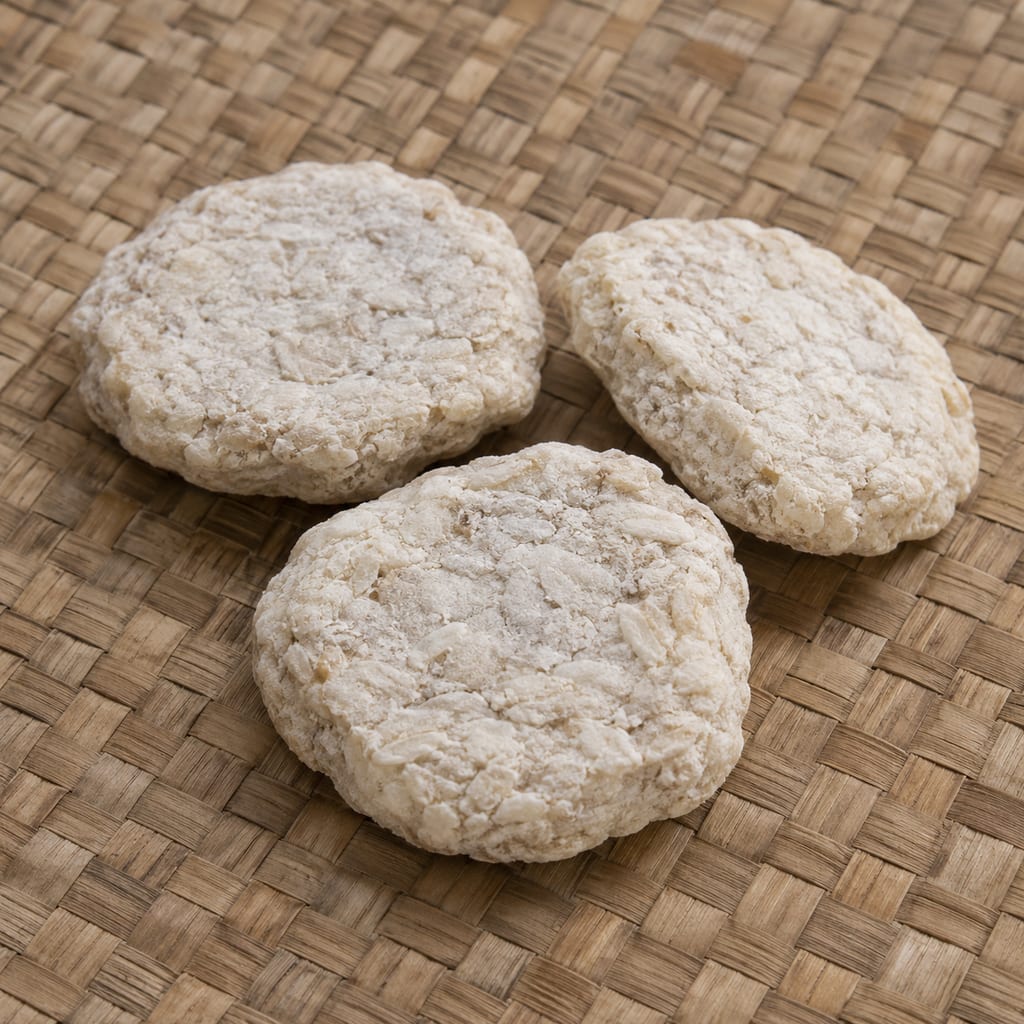
Dawdim is a dried starter cake from Mizoram, in Northeast India, used for rice beer. A dry starter carries living moulds and yeasts from one brew to the next. Dropped into cooked rice, the moulds help break the grain's starch into sugar, and the yeasts turn sugar into alcohol. That two-step logic runs through the dry starters of the whole region. No source has measured how much of it dawdim does, or with which organisms.
The name is unsettled. One laboratory team writes "dawdim" in one place and "dowdim" in another, where it places the starter in Mizoram. A reference work on Mizo rice beer gives a third form, dawidim, and a second name, chawl. Nothing found settles whether these are spellings of one cake, names from different villages, or different cakes.
The least documented part is the recipe. One reference work describes the starter as a traditionally prepared dried cake made from the bark of a climber called zangzu, nilengthlum or hawhmathlum. Those are Mizo names, and none has been matched to a botanical species in anything found, so no Latin name is given here.
The laboratory studies that sampled dawdim describe the cakes they tested and their methods, not how the cakes were made. No account found names the herbs, gives quantities, or says how long the cakes dry or how big they are. Whether the bark is the main ingredient, a seasoning, or one plant among several is not recorded.
A team at Sikkim University and the National Centre for Cell Science in Pune collected forty dried starters from local people in eight Indian states, five of each of eight kinds. The Mizoram kind they called dawdim. They grew yeasts and moulds from all forty cakes and read the DNA of 46 representative isolates. Across the eight starter types they identified six yeasts: Wickerhamomyces anomalus, Pichia anomala, Saccharomycopsis fibuligera, Pichia terricola, Pichia kudriavzevii and Candida glabrata. A second method read DNA straight from the cakes. Averaged over all the starters, Saccharomyces cerevisiae made up 16.5% of the yeast signal, S. fibuligera 15.3%, S. malanga 11.7% and W. anomalus 11.3%. Among the moulds, Aspergillus penicillioides averaged 5.0% and Rhizopus oryzae 3.3%. These are averages across starters, not a portrait of dawdim.
For dawdim itself, a 2021 review of Northeast Indian beverages lists four yeasts living together in it: W. anomalus, C. glabrata, P. anomala and S. fibuligera.
A 2019 study sequenced fungal DNA from one dawdim sample from Mizoram, with no village given, alongside five other starter types. Sequencing sees everything in the sample, including fungi that will not grow on a plate. It found 750 distinct sequence groups, which the authors counted as 108 species. Thirty-nine of those species were rare, under 1% of the reads, and 21 appeared in the dawdim sample and in none of the other five starters. Across all six starters, Ascomycota, the group that holds most yeasts, made up 67-99% of the reads.
A 2020 study looked at three dawdim cakes collected in Saitual, Mizoram, at 438 m above sea level. They held 13.7% moisture, had a pH of 6.2 and carried about 740,000 fungal colony-forming units per gram. The filamentous fungi grown from them were Mucor circinelloides, Rhizopus microsporus, Penicillium chrysogenum and Bjerkandera adusta, and the text also records basidiomycetes in the dawdim samples. Rhizopus is a genus long linked to starch-splitting in Asian rice starters, but nobody has measured what these isolates do in dawdim.
Each result describes particular cakes tested by particular methods: three cakes from one town, one cake of unrecorded origin, five collected for a survey. Together they show that a dawdim cake can hold a crowded community of yeasts and moulds. They do not give a fixed formula, a set of organisms to aim for or a safety standard. A fungus on the list is not an endorsement, and one missing from it is not ruled out. Twenty-one species found only in the dawdim sample, among six starters, suggest that cakes differ even between types. A starter cake bought elsewhere, even one sold for rice beer, is not dawdim, and it cannot be assumed to carry the same organisms or behave the same way in a mash.
The 2021 review links dawdim to three Mizo drinks: zupui, zufang and rakzu. It treats them as products of a starter in which several yeasts coexist, and goes no further on how each is brewed or how strong it is.
A reference work on the Mizo drink zu says every variety rests on this kind of starter. Zupui was historically the rice beer most widely used among the Mizos and at their festivals. Zufang began as a drink made from Job's tears and later moved to glutinous rice, buhban, and is a sweet, low-alcohol drink. Zulawm is brewed for children. Rakzu is distilled, and the Mizos are said to have learned distillation from Indians in the plains and valleys.
No source gives a storage time for dawdim, a way to wake the cake before brewing, a way to keep a line of cakes going, or a control that makes it safe. Smell, taste and bubbles do not establish safety in any fermentation, and the laboratory counts above are not a test a household could run. The knowledge that would close these gaps sits with the Mizo households that make the cakes and the drinks, and it has not been written down in a form others can check.
The sources place the starter in Mizoram and in Mizo rice-beer making. One study sampled cakes in Saitual, Mizoram, which shows where those cakes were collected, not where dawdim originated. No earlier place or date is established.
Sesame seed, from Sesamum indicum, is about half oil and is eaten whole, ground into paste or pressed into oil. It was a crop of South Asia by the Harappan period and reached Mesopotamia before 2000 BC.
No community contributions have been published for this entry yet.
Sign in to contribute. Published comments and photos are free to read.
Frontiers in MicrobiologyMicrobiology · Geography
Diversity of Yeasts and Molds by Culture-Dependent and Culture-Independent Methods for Mycobiome Surveillance of Traditionally Prepared Dried Starters for the Production of Indian Alcoholic BeveragesForty dried starters from eight Indian states; the Mizoram kind named dawdim; yeasts identified and average community shares across starters.
Cited in: What it is; What goes into it; What laboratories found; What the lists can and cannot say; Storage and safety
Frontiers in Microbiology; PubMed CentralMicrobiology
Mycobiome Diversity in Traditionally Prepared Starters for Alcoholic Beverages in India by High-Throughput Sequencing MethodOne dawdim sample from Mizoram sequenced: 750 sequence groups counted as 108 species, 21 found only in dawdim.
Cited in: What goes into it; What laboratories found; What the lists can and cannot say; Storage and safety
Frontiers in Microbiology; PubMed CentralMicrobiology · Geography
Diversity of Filamentous Fungi Isolated From Some Amylase and Alcohol-Producing Starters of IndiaThree dawdim cakes from Saitual, Mizoram: moisture, pH, fungal counts and filamentous fungi isolated.
Cited in: What goes into it; What laboratories found; What the lists can and cannot say
Frontiers in Sustainable Food SystemsMicrobiology · Uses
Linking the Diversity of Yeasts Inherent in Starter Cultures to Quorum Sensing Mechanism in Ethnic Fermented Alcoholic Beverages of Northeast IndiaFour yeasts listed in dawdim; link to zupui, zufang and rakzu.
Cited in: What laboratories found; Drinks it starts
WikipediaNames · Uses
Zû (beverage)Alternative names dawidim and chawl; description as a dried cake of climber bark with three Mizo names; descriptions of zupui, zufang, zulawm and rakzu.
Cited in: What it is; What goes into it; Drinks it starts