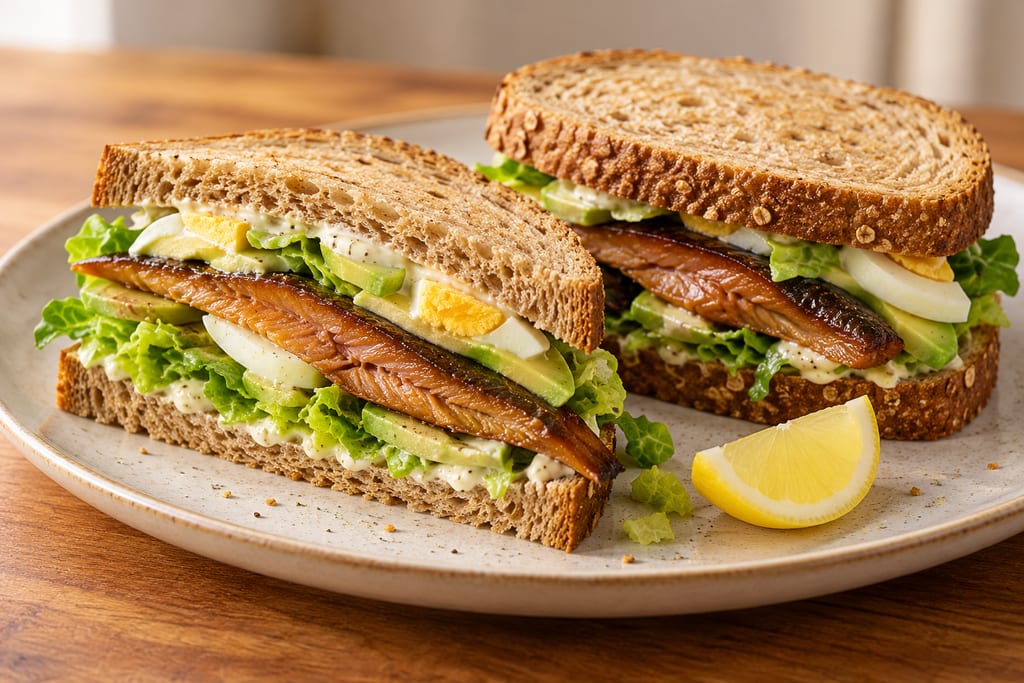
Craster kipper club sandwich
A warm club sandwich of oak-smoked Craster kipper fillets layered with soft-boiled egg, romaine, avocado and lemon mayonnaise on brown bread.
 FermenteaWhere food goes to change
Substrates
Ripe avocado flesh is the soft, buttery, fat-rich pulp of Persea americana, eaten raw. It is low in acid, so it is a fresh ingredient that needs care in chilled dishes.

The avocado, Persea americana, is a tree of the laurel family, Lauraceae. It is an evergreen 9 to 20 metres tall, and its fruit is botanically a single-seeded berry, usually 7 to 20 centimetres long and weighing 100 to 1,000 grams, around a seed 5 to 6.4 centimetres long. Ripe flesh is soft, smooth and buttery, and it is eaten raw. A hundred grams of raw flesh holds about 73 grams of water and 14.7 grams of fat, of which 9.8 grams is monounsaturated, with 8.5 grams of carbohydrate, of which fibre is 6.7 grams and sugars only 0.66, and 2 grams of protein, for 160 kilocalories. About three-quarters of the energy comes from fat, mostly oleic acid.
Those figures are an average, and the fruit varies widely. A study of eight avocado varieties grown in Morocco found moisture from 57.9 to 84.7 grams per 100 grams and oil from 8.4 to 30.4, and moisture fell as oil rose. Ettinger was the richest at 30.4 grams of oil and 57.9 of water, Maluma Hass the leanest at 8.4 and 84.7, and Hass, the common commercial variety, sat in the middle at 13.5 grams of oil and 76.0 of water. Unsaturated fatty acids made up 77 to 85 per cent of the fatty acids in those varieties. A ripe avocado can therefore be a wet, lean pulp or a dense, oily one, and in every case the flesh is almost free of sugar. It supplies pantothenic acid, potassium and folate, at 28, 16 and 20 per cent of the daily value per 100 grams, and vitamin K.
The fruit has many names. Spanish has aguacate, and palta in Argentina, Chile, Peru and Uruguay; Portuguese has abacate; "avo" is common in Britain and South Africa; and "butter fruit" is used in India and Hong Kong.
The avocado is a Mesoamerican crop. Wild avocados range from Mexico through Central America and into South America, and the evidence suggests the trees began in central Mexico at middle elevations and spread south. Three horticultural groups are recognised: the Mexican group, from the subtropical highlands of Mexico at 1,500 to 3,000 metres; the Guatemalan group, first found in the highlands of Guatemala at 1,000 to 2,300 metres; and the Lowland group, below 1,000 metres from Mexico through the Caribbean and northern South America. Genetic work indicates the groups were already separate in the Pleistocene, long before agriculture, and that avocados were domesticated independently at least three times.
Archaeology gives the fruit a deep history. Avocado pits between 11,000 and 9,000 calendar years old have been found in Peru at Huaca Prieta, in Colombia at San Isidro, in Honduras at El Gigante and in Mexico at Coxcatlán, and these show people living alongside wild stands. The best record comes from the El Gigante rockshelter in the highlands of western Honduras. A study dated 56 avocado pits and rinds directly, among 292 radiocarbon dates for the site, and identified 1,725 avocado fragments from the last 11,000 years, mostly rind. Over that time the rinds grew thicker and the seeds larger, which the authors read as a long process of tree keeping and selection for larger, tougher fruit, and they locate an early centre of domestication in western Honduras. Thicker rind makes the fruit less prone to damage, lets it stay on the tree longer and makes the flesh easier to scoop out. A second account links domestication to the Tehuacán Valley in Puebla, Mexico, where pits at Coxcatlán are 9,000 to 10,000 years old, though a re-evaluation of the Tehuacán dates puts documented exploitation there at 7,000 to 6,000 years ago.
The word avocado comes from Spanish aguacate, from the Nahuatl āhuacatl. Martín Fernández de Enciso described the fruit in 1519 and Gonzalo Fernández de Oviedo gave the first unambiguous description in 1526. Hans Sloane used the English term in a 1696 index of Jamaican plants, and the earliest English use cited is 1697, as "avogato pear". In 1915 the California Avocado Association promoted the name avocado. The tree reached Spain in 1601, Indonesia around 1750, Mauritius in 1780, Brazil in 1809, the American mainland in 1825, Florida and Hawaii in 1833 and California in 1856.
Most avocados sold today are one variety. Hass makes up about 80 per cent of cultivated avocados by one count and about 90 per cent of the industry by another, and every Hass tree descends from a single mother tree raised by Rudolph Hass, a mail carrier, in La Habra Heights, California. He patented it in 1935, and the original tree was cut down in September 2002. Hass is a Type A variety. Fuerte, a Type B brought from Atlixco, Mexico, in 1911, was the dominant commercial variety in the United States for the first half of the twentieth century. The two types open their flowers as female and male on opposite days, and a tree is only partly self-pollinating. Other varieties include Reed, Maluma, Choquette, Gwen, Pinkerton, Lula and, in Queensland, Sharwil.
Avocado growing is now a global business. World output was about 9 million tonnes in 2022 and 11.2 million tonnes in 2024, when Mexico produced about a quarter of it, 2.76 million tonnes, followed by Colombia, the Dominican Republic, Peru, Indonesia and Kenya. Michoacán in Mexico supplied about three-quarters of Mexican avocados, and about 90 per cent of avocados consumed in the United States in 2024 came from Mexico. The crop is demanding: a tree in California needs about 20 US gallons a day, and an avocado needs about three times the water of an apple. Trees grown from seed take 4 to 6 years to fruit, sometimes 10, so commercial trees are grafted onto rootstocks, and Hass in particular bears heavily in one year and lightly in the next.
The avocado is climacteric: it ripens after picking. Growers harvest it hard and green and keep it at 3.3 to 5.6 °C until it reaches its destination, then it softens over one to two weeks at room temperature, faster beside apples or bananas, which give off ethylene, the plant hormone that triggers ripening. Commercial ripening rooms using ethylene were pioneered in the 1980s.
The softening is the work of enzymes in the fruit's own cell walls. A study of two Yucatán landraces, Lagunero and Criollo, describes the pectic compounds of the wall being broken down by pectinases, polygalacturonases, cellulases and amylases, so that the wall comes apart and the flesh goes soft. Over four days of ripening, the soluble sugars in Lagunero tripled, from 1 to 3 degrees Brix, and its titratable acidity fell as the fruit used its organic acids in respiration, which raised the pH. The landraces were softer at the ready-to-eat stage than the firmness range cited for Hass, 70 to 80 newtons.
Cut avocado flesh turns brown within minutes, and cooks add lime or lemon juice to slow it. The browning is enzymatic. Polyphenol oxidase, an enzyme in the cells, acts on phenolic compounds when the tissue is cut and oxidises them to o-quinones, which go on to form the brown pigments. Ascorbic acid and L-cysteine are the usual anti-browning agents, and acids, heat and high hydrostatic pressure are others that have been studied. Heat has a second effect on avocado: it makes the flesh inedible, though Hass can be cooked briefly, so the fruit is eaten raw.
There is a point where avocado touches fermentation directly, and it is the seed and not the flesh. Colombian researchers fermented ground Hass avocado seed, with a particle size of 2.5 millimetres or less and 60 per cent moisture, with the mould Aspergillus niger GH1 for 168 hours in a solid-state fermentation; the radical-scavenging capacity of the fermented seed rose by 33 per cent and 77 per cent in two assays. An extract of it inhibited polyphenol oxidase from avocado pulp and was tested as an anti-browning treatment for avocado, apple and banana pulps. It is an example of a food by-product made useful by a mould, and it has no bearing on the flesh as an ingredient except that it addresses the flesh's one great weakness.
Avocado flesh is not acidic. In a Listeria growth study, mashed avocado had a pH of 6.82 and a water activity of 0.996, which is as wet and as close to neutral as a food gets, and conditions in which bacteria grow. Mixed with other ingredients into guacamole it is more acid: a formulation of 71 per cent mashed avocado, 10 per cent diced tomato, 8 per cent onion, 5 per cent lemon juice, 3.5 per cent jalapeño, 1.5 per cent cilantro and 1 per cent salt had a pH of 4.82.
The practical result is that plain avocado is a hospitable medium for Listeria monocytogenes, the bacterium that grows at refrigerator temperatures. When it was added at about 2 log CFU per gram to mashed avocado stored at 10 °C, the count rose by 0.67 log per day, a tenfold increase in about a day and a half, to more than 8 log. In the guacamole formulation growth was slower, 0.34 log per day after a lag of nearly five days, and a tenfold increase took about 8 days, but it still grew. In 2017 two guacamole products were recalled over possible Listeria contamination. A second study found that adding citric acid with chitosan or mastic oil to a guacamole made with avocado, tomato, cilantro, onion, jalapeño, lemon and salt, and holding it at 4 °C, reduced Salmonella, E. coli O157:H7 and Listeria monocytogenes at 4 °C, but the effect varied with temperature, and some treatments increased Salmonella growth at 10 °C.
For a cook the practical conclusion is to treat avocado dishes as perishable and to keep them cold. The results bear on the fermented kitchen too. Avocado has almost no sugar, 0.66 grams per 100 grams, so there is little for yeasts or lactic acid bacteria to work on, and it does not ferment into anything on its own. It is eaten with fermented foods, in sandwiches and beside cultured dairy, and it brings its low acidity with it. Mixed with citrus juice, as in guacamole, the dish is more acidic and in the Listeria trial supported slower growth, though not none.
Commercial avocados are picked hard, so a shop fruit usually needs a week or two at room temperature to ripen, and it ripens faster kept beside an apple or a banana. Cold storage slows ripening, which is why growers keep fruit at 3.3 to 5.6 °C in transit. Ripeness is a matter of firmness, which research papers measure in newtons and cooks judge by hand.
Once cut, the flesh browns, so it is cut and used, with lime or lemon juice if it must wait. The leaves of the Mexican variety, drymifolia, are used as a spice with an anise-like flavour, and leaves or seeds can be made into tea.
People allergic to pollen may react to the fruit with mouth and throat symptoms. Avocado is also involved in latex-fruit syndrome, in which people allergic to natural rubber latex react to certain fruits, with hives, abdominal pain and vomiting, and the reaction can be life-threatening. The leaves, bark, skin and pit contain persin, which is toxic to animals including horses, dogs, cats, cattle, goats and birds, so the fruit and its parts should not be fed to pets or livestock. Cutting the fruit by hand is a recognised hazard: injuries known as avocado hand rose in the United States from 1998 to 2017.
The sources differ on where and how often avocados were domesticated: one places an early centre in western Honduras on archaeological evidence, another links it to the Tehuacán Valley, and the genetic evidence suggests at least three episodes. The figure for Hass's share of the crop varies from about 80 to about 90 per cent depending on how it is counted. Composition varies with variety, growing conditions and ripeness, and the nutrition values quoted here are averages and single studies.
A dated sequence of avocado remains with thicker rinds and larger seeds; proposed as an early centre of domestication in western Honduras.
Avocado pits from Coxcatlan Cave; the traditional domestication site, with a disputed chronology.
Early avocado use; not a claim of domestication there.
About three-quarters of Mexican avocados in 2024.
Introduced in 1856; the home of the Hass mother tree at La Habra Heights.
Source of the eight varieties analysed for composition.
A warm club sandwich of oak-smoked Craster kipper fillets layered with soft-boiled egg, romaine, avocado and lemon mayonnaise on brown bread.
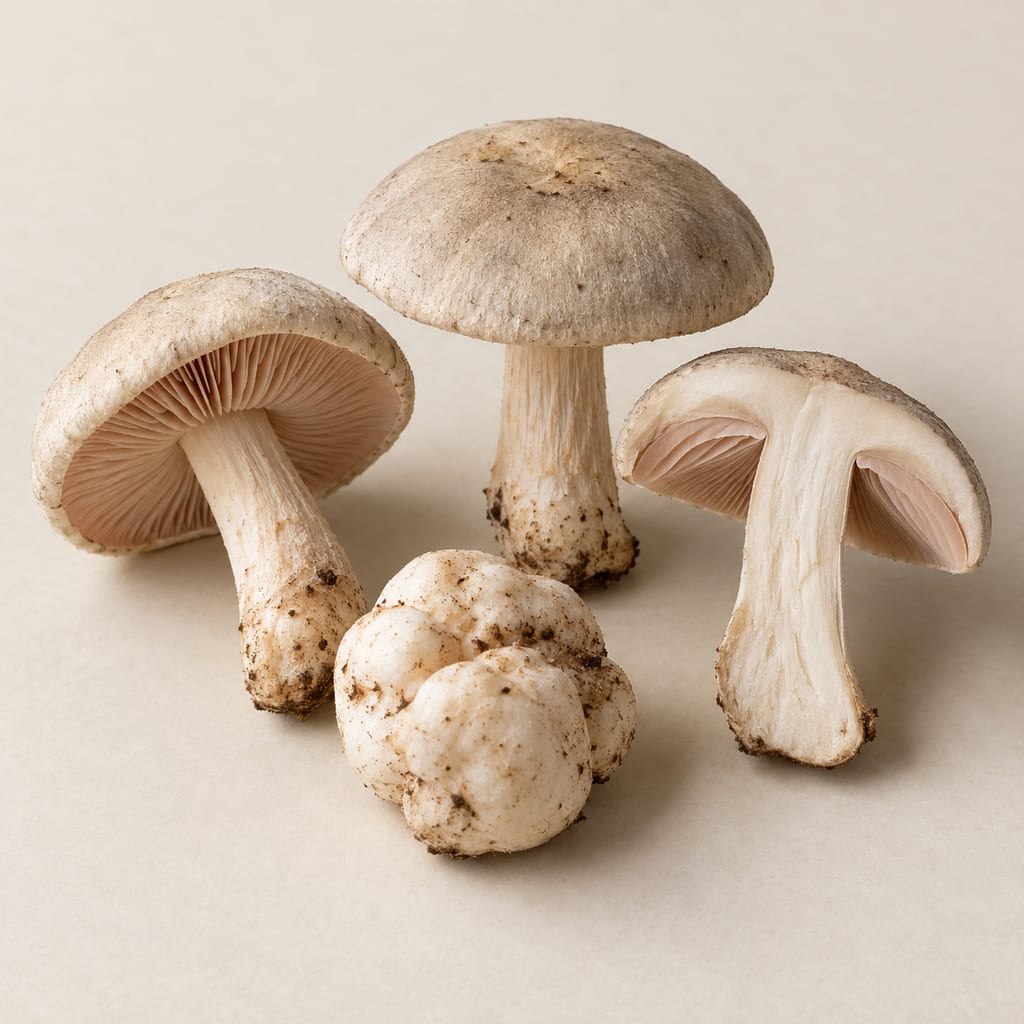
Entoloma abortivum is a woodland mushroom recorded as food in Puebla, Mexico, and in China’s edible-fungi catalogue; the latter is a checklist entry, not a safety assessment.

At North Abydos in Egypt, a fixed early Dynastic brewery comprised parallel semi-subterranean installations with rows of ceramic mash vats; excavation reports revise their number, scale and estimated batch capacity.

Ají amarillo is the orange-yellow Peruvian chilli cultivar group of Capsicum baccatum, used to colour and season huancaína sauce and ají de gallina. Published heat estimates do not establish one range for the named cultivar.

Toasted almonds are whole sweet almond kernels dry-roasted until golden to brown. Heat replaces their marzipan note with a roasted, nutty one; they thicken and flavour romesco.

Kodiak salmon, halibut and cod cut as seg'aq and hung on an initaq rack to become tamuuq, with kac'amaasaq and kupcuunaq named as different results.

Aniseed is the dried ripe fruit of Pimpinella anisum, an aromatic Apiaceae spice commonly called a seed. It adds a sweet, warm aroma to breads such as Moroccan krachel and South African mosbolletjies, and is distinct from star anise.

A fixed Late Chalcolithic installation in Areni-1 cave combined a shallow clay pressing basin with a large jar set into the cave floor and storage vessels nearby.

A portable dome and pan used over a hearth, with embers on the lid and heat from below. Regional peka and saç forms share this principle while differing in materials, pan shape and how the food is cooked.
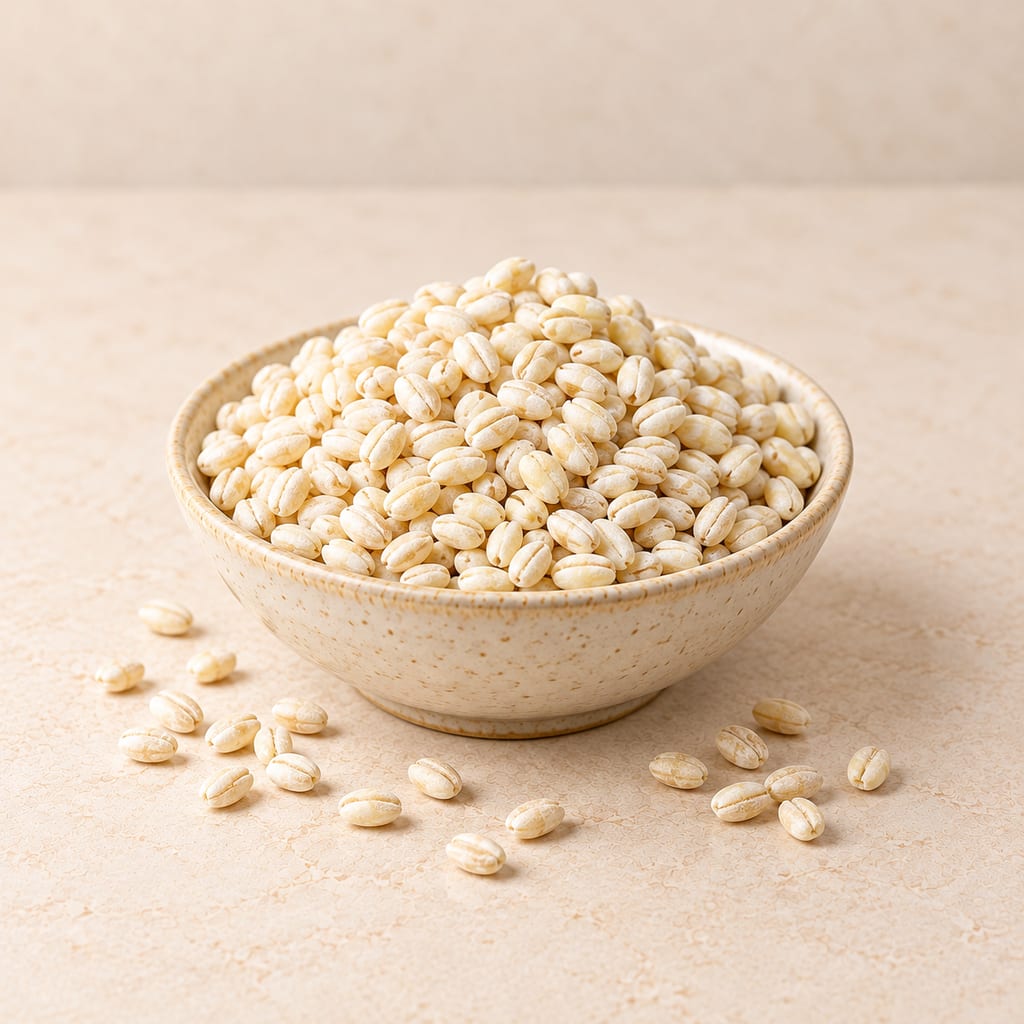
Barley is a hardy cereal, domesticated in the Middle East over 10,000 years ago, eaten whole, pearled or milled, malted for brewing, and grown with koji mold for barley miso.
No community contributions have been published for this entry yet.
Sign in to contribute. Published comments and photos are free to read.
WikipediaIdentity · History · Production · Nutrition · Secondary
AvocadoBotany; names; cultivars; Hass history; ripening and storage; production figures; nutrition per 100 g; introduction dates; uses; allergy and toxicity.
Cited in: A fruit that is mostly fat and water; Eleven thousand years of avocados; One mother tree; Ripening, the quiet work of enzymes; Browning, acid and a fermented extract; Choosing, ripening and storing; Allergy, toxicity and cautions; Open points
Proceedings of the National Academy of Sciences, 2025 (VanDerwarker and colleagues)History · Archaeology
Early evidence of avocado domestication from El Gigante Rockshelter, HondurasThree horticultural groups and elevations; multiple domestications; pits 11,000 to 9,000 cal BP at four sites; El Gigante sequence of 1,725 fragments and 292 radiocarbon dates; thicker rinds and larger seeds; 9 million tonnes in 2022; Hass 90 per cent.
Cited in: Eleven thousand years of avocados; One mother tree; Open points
Scientific Reports, 2023 (Nasri and colleagues)Composition
Proximate composition, lipid and elemental profiling of eight varieties of avocado (Persea americana)Moisture 57.88 to 84.71 and oil 8.41 to 30.44 g per 100 g in eight Moroccan varieties; Hass values; unsaturated fatty acids 76.89 to 84.7 per cent.
Cited in: A fruit that is mostly fat and water; Open points
Plants (Basel), 2025 (Zapata-Luna and colleagues)Ripening
Morpho-Physicochemical, Nutritional Composition and Phenolic Compound Profile of Two Avocado Landraces in Different Ripening StagesSoftening through pectic hydrolysis by pectinases, polygalacturonases, cellulases and amylases; soluble solids tripled; titratable acidity fell; firmness range for Hass.
Cited in: Ripening, the quiet work of enzymes; Choosing, ripening and storing
Heliyon, 2025 (Yepes-Betancur and colleagues)Fermentation · Browning
Inhibitory effect of fermented avocado seed extract (Persea americana Mill. cv. Hass) on polyphenol oxidase and its application as anti-browning agent in avocado, apple, and banana pulpsAnti-browning agents; solid-state fermentation of Hass seed with Aspergillus niger GH1 for 168 h; radical scavenging up 33 and 77 per cent; inhibition of polyphenol oxidase.
Cited in: Browning, acid and a fermented extract
PLoS One, 2020 (Salazar and colleagues)Safety
Listeria monocytogenes growth kinetics in refrigerated ready-to-eat dips and dip componentsAvocado pH 6.82, water activity 0.996; guacamole formulation and pH 4.82; Listeria growth rates at 10 C in avocado and guacamole; 2017 guacamole recalls.
Cited in: A low-acid fruit and what that means in the kitchen
Foods, 2024 (Al Daour and colleagues)Safety
Survival of Salmonella spp., Escherichia coli O157:H7, and Listeria monocytogenes in Ready-to-Eat "Guacamole": Role of Added AntimicrobialsGuacamole formulation; citric acid, chitosan and mastic oil reduced pathogens at 4 C; effect varied at 10 C.
Cited in: A low-acid fruit and what that means in the kitchen