
Avocado (ripe flesh)
Ripe avocado flesh is the soft, buttery, fat-rich pulp of Persea americana, eaten raw. It is low in acid, so it is a fresh ingredient that needs care in chilled dishes.
 FermenteaWhere food goes to change
Mushrooms
Entoloma abortivum is a woodland mushroom recorded as food in Puebla, Mexico, and in China’s edible-fungi catalogue; the latter is a checklist entry, not a safety assessment.
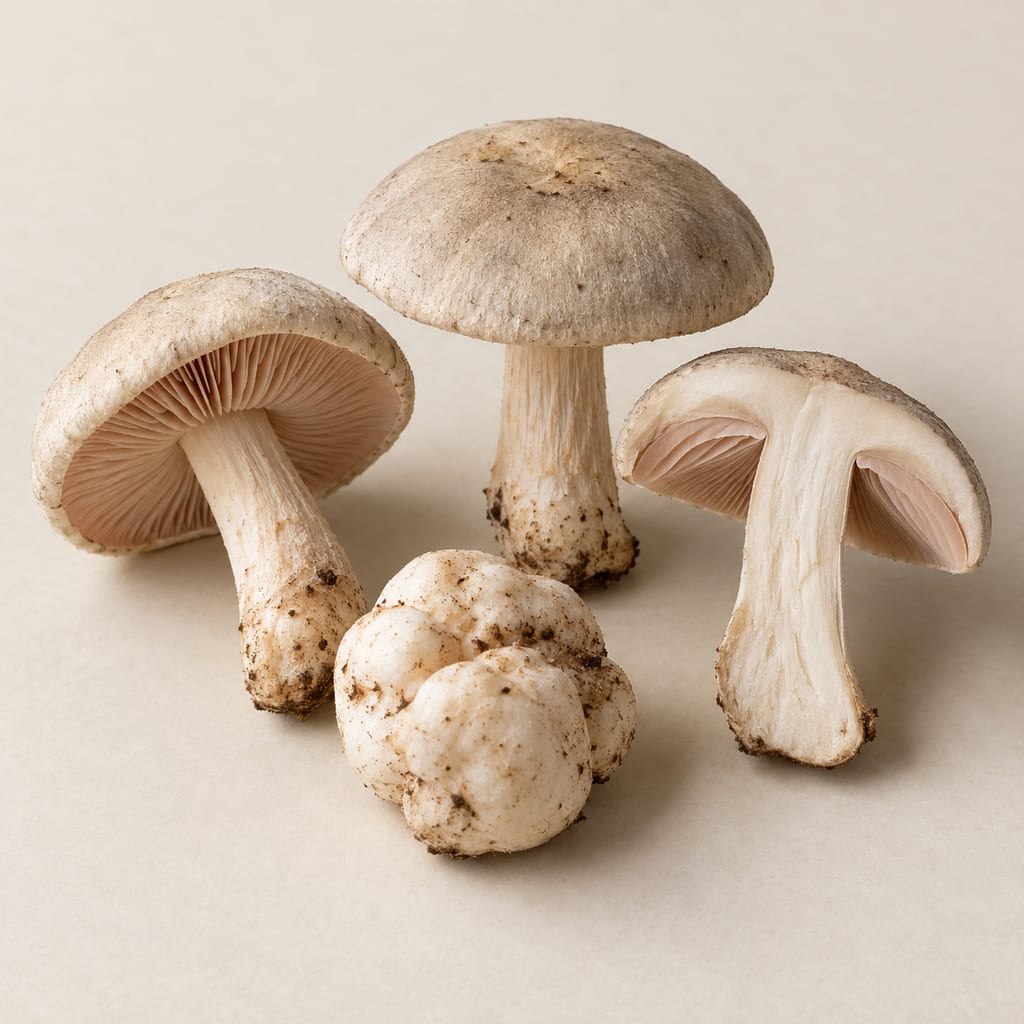
The accepted name is Entoloma abortivum (Berk. & M.A. Curtis) Donk; Clitopilus abortivus is a synonym. It belongs to Entolomataceae. Accounts describe a conventional gray-brown, gilled form and an irregular, pale aborted form associated with Armillaria fruit bodies. The forms are part of the species’ unusual biology, but appearance alone is not a safe means of identification.
The name has a longer history than the modern genus. Berkeley and Curtis described the fungus as Agaricus abortivus in 1859, and Donk’s 1949 combination gives the current name. Older regional literature uses names such as Rhodophyllus abortivum. In popular usage the name also covers the irregular pale masses that form when the fungus parasitizes Armillaria fruit bodies. Those masses are mainly altered host tissue rather than a typical gilled Entoloma, so the shape of a specimen cannot confirm the species, and parasitized fungi can themselves be misidentified.
Transcriptomic analysis of the carpophoroid form supports a close interaction and putative mycoparasitism involving Armillaria. Parts of the mechanism remain unresolved.
Ethnomycological research records the mushroom as an edible wild food called totolcozcatl in Puebla, Mexico. A study of a market in northwestern Puebla records its sale among local mushrooms. A Mexican edible-mushroom account documents consumption in Ocampo, Puebla, and notes that it is valued in local celebrations. A separate study describes totolcozcatl as a wild food resource in the cloud-forest setting around Xaltepuxtla, Puebla, and discusses harvest pressure.
In the northwestern Puebla market study the mushroom was scarce and was described as edible and valued for its flavour. Sale was recorded at 100 to 150 Mexican pesos per kilogram. A broad list of mushroom cooking methods in the same market study does not say which dish, if any, was made from this species.
These sources establish particular food-use records; they do not establish a standardized recipe or a general recommendation to gather it. The market paper discusses preparations for several species, but the reviewed material does not securely assign a specific dish or process to E. abortivum, so no recipe is attributed here.
A 2026 Chinese catalogue lists E. abortivum among edible and medicinal fungi. This is a country-level checklist record. It does not identify a specific Chinese collection locality or food preparation and is not an independent toxicological assessment.
Regional North American field accounts describe fruiting in late summer and autumn. One gives a broad August-to-November or December window; a Wisconsin account notes September and October, often after the first autumn frost. These are regional observations rather than a global calendar. The reviewed sources do not establish a season specific to the Puebla food-use locations or to the Chinese catalogue entry.
The fungus grows in hardwood or mixed woods, on buried wood, rotten stumps and logs, often in association with Armillaria. The normal gilled form is gray to gray-brown, with pale gills that turn pinkish as the spores mature. The aborted form may be irregular and pale, and it may lack recognizable gills or a stem. These descriptions come from the literature and are not an identification key.
The records support food use around Puebla, Mexico, and a checklist presence in China. The supplied expanded research index additionally carries historical food-use annotations for Mexico and China; its supplied claims are retained with their qualifiers. No coordinates or localities are inferred from a country-level checklist.
Field records from Pennsylvania, Ontario, Michigan, Connecticut and British Columbia document temperate North American occurrence. They support the range of the species and not the Mexican food-use claims. The 2023 Xaltepuxtla study describes overcollection of totolcozcatl in the cloud forest, which makes harvest pressure a conservation question as well as a food one. A 2018 Chinese macrofungal red-list appendix lists the name as Least Concern. That is a conservation assessment, not a food-safety result.
Entoloma includes poisonous lookalikes, and a regional Michigan State University Extension guide warns about confusing edible mushroom claims with toxic Entoloma species. E-Flora British Columbia also conditions its brief edibility note on accurate identification. These are cautions about identification and regional guidance, not evidence that every E. abortivum specimen is toxic or that another regional population is safe.
Michigan State University Extension states that most Entoloma species are poisonous and advises against eating non-aborted E. abortivum, which can be confused with poisonous species. Photographs and the presence of nearby honey mushrooms do not verify a specimen. Anyone who has eaten a wild mushroom and feels unwell should contact local poison services at once.
The food-use records above are cultural and catalogue evidence, not a safety guarantee. The sources reviewed do not establish toxicology, diagnostic field procedures, or a universally safe preparation for this ingredient. This account is not a field-identification guide and does not recommend collecting or eating wild specimens.
No fermentation, curing, or preservation role for this ingredient was documented in the reviewed sources. It is classified as fungi and as an ingredient not assigned a fermentation role by default. This records the limits of the evidence reviewed; it does not claim that no community has ever preserved or fermented it.
Food-use and market records in this state; does not imply uniform statewide practice.
Coordinates and local fruiting calendar are not supplied.
Wild food resource context; not a preparation or safety claim.
Catalogue checklist only; no specific locality or collection is stated and no consumption event is inferred.
Ripe avocado flesh is the soft, buttery, fat-rich pulp of Persea americana, eaten raw. It is low in acid, so it is a fresh ingredient that needs care in chilled dishes.
No community contributions have been published for this entry yet.
Sign in to contribute. Published comments and photos are free to read.
NCBI TaxonomyTaxonomy
Entoloma abortivum taxonomyaccepted name and synonym Clitopilus abortivus
Cited in: Identity and forms
MycosystemaFood use · Catalogue
Species cataloging of edible and medicinal fungi in ChinaChina checklist listing; no locality or safety assessment inferred
Cited in: Food records; Season and range; Fermentation and preservation
Scientia FungorumFood use · Market
Etnomicología y venta de hongos en un mercado del Noroeste del estado de Puebla, Méxicototolcozcatl food-use record and market context
Cited in: Food records; Fermentation and preservation
Hongos Comestibles de México, UNAMFood use · Culture
Armillaria melleaconsumption in Ocampo, Puebla and local cultural value
Cited in: Food records
Agro ProductividadFood use · Ecology
Microhabitat of Totolcozcatl mushroom (Entoloma abortivum) for restoration in the cloud forestwild food resource and Xaltepuxtla, Puebla context
Cited in: Food records
E-Flora BCTaxonomy · Morphology · Season · Safety
Entoloma abortivumforms, morphology, regional season and identification caution
Cited in: Identity and forms; Season and range; Identification and safety
mSystemsEcology
Transcriptomics Reveals the Putative Mycoparasitic Strategy of the Mushroom Entoloma abortivum on Species of the Mushroom Genus Armillariaevidence for interaction and putative mycoparasitism; limits unresolved
Cited in: Identity and forms
University of Wisconsin–Green BaySeason
Mushroom descriptions D–Hregional September–October observations
Cited in: Season and range
Michigan State University ExtensionSafety
Don't Pick Poison: When Gathering Mushrooms for Food in Michiganregional caution on poisonous Entoloma confusion
Cited in: Identification and safety
NCBI TaxonomyTaxonomy
Entoloma abortivum taxonomyaccepted name Entoloma abortivum (Berk. & M.A. Curtis) Donk and synonym Clitopilus abortivus
Cited in: Identity and forms
Hongos Comestibles de México, UNAMFood use
Armillaria melleaconsumption in Ocampo, Puebla, and local cultural value
Cited in: Food records
Redlist of China’s Biodiversity: MacrofungiConservation
Redlist of China’s Biodiversity: Macrofungi, appendix entry for Entoloma abortivum2018 red-list appendix status Least Concern; a conservation assessment, not a food-safety result