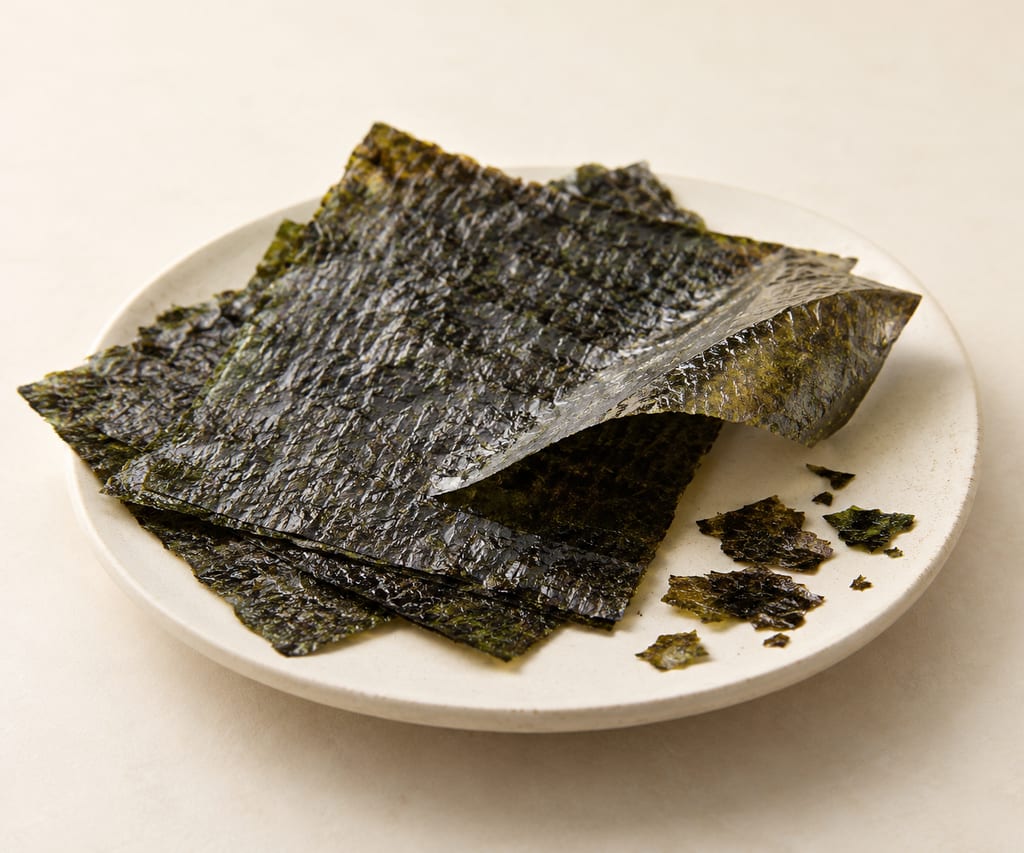
Nori
Nori is a red seaweed farmed in East Asia and dried into thin sheets, prized for its savoury flavour and crisp texture when roasted and used with rice, in soups and as a seasoning.
 FermenteaWhere food goes to change
Traditional method
Bara lawr · Laver bread · Bara lawr · Bara lafwr · bara llavan · bara llafan · llawfan · lhavan · lhawvan · menyn y môr · black butter · Welshman's caviar
Welsh laverbread is hand-gathered purple laver slowly cooked to a dark green-black paste, eaten with oatmeal, bacon and cockles or on toast.
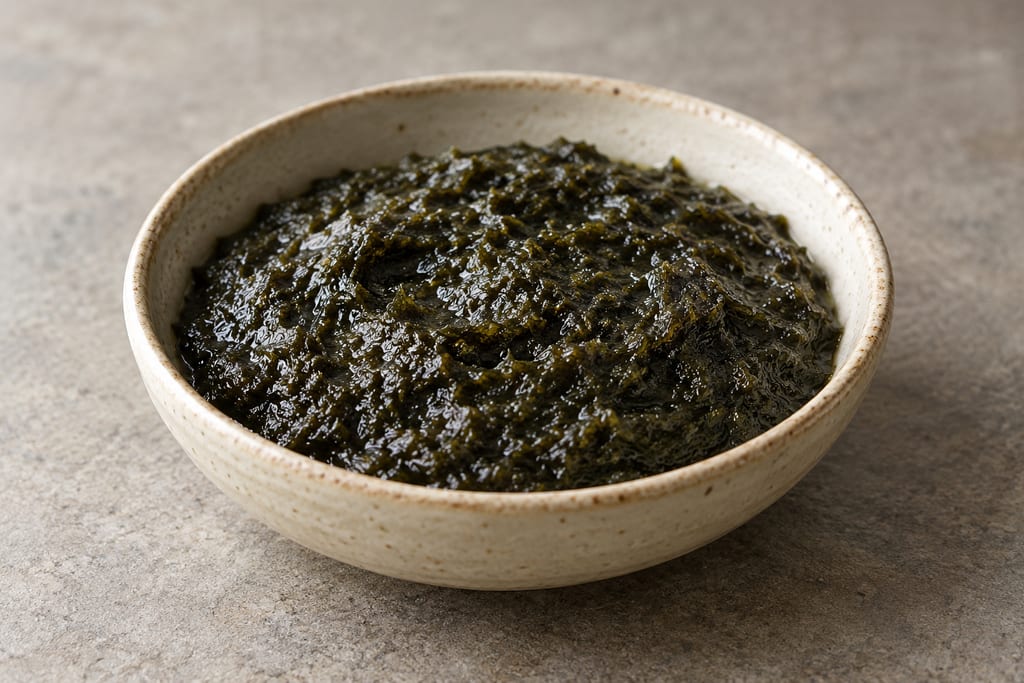
Welsh laverbread is a soft, dark green-black paste made by cooking purple laver, a red seaweed, until it can be chopped or puréed into a cohesive mass. Despite the name it is not a loaf, and it contains no flour, yeast or baking. The seaweed is Porphyra umbilicalis, which grows attached to rocks on Atlantic coasts including Wales. The paste tastes saline, mineral and mildly savoury, and its texture runs from coarse to nearly smooth. It is traditionally eaten with bacon, cockles and oatmeal, but the cooked seaweed itself is what is called laverbread.
The legal specification for the protected name Welsh Laverbread is exact about composition: cooked laver, water and salt, with no other ingredients or additives, and the laver must be gathered by hand from the Welsh coast. Oatmeal is not part of the protected paste. It comes later, when portions are shaped into cakes and fried. Recipes for oatmeal cakes and recipes for the underlying paste are therefore different preparations with different quantities.
Porphyra umbilicalis is a red alga in the family Bangiaceae. The living blade is thin, flexible and irregularly rounded, usually brownish purple with occasional green or olive tones, and it is mostly one cell layer thick, attached to a rock by a small central holdfast. It should not be mistaken for green sea lettuce, Ulva, or equated with the East Asian cultivated seaweeds sold as sushi nori. All are edible, but their species and food traditions differ.
The paste is sometimes called gelatinous, but it contains no animal gelatine and no purified agar. Its consistency comes from cooked seaweed tissue, retained water and hydrated polysaccharides, together with the mechanical breakdown of the blades. Some producers leave visible pieces and others mince it fine. Laverbread is a cooked food, not a fermented one: no yeast, lactic culture or mould starter is used and there is no deliberate microbial stage.
Nobody knows when people in Wales first ate laver. Claims that Vikings brought it, that prehistoric coastal people ate it, or that Gerald of Wales described it in the twelfth century are often repeated without a specific passage to support them. The oldest firm records are from the end of the seventeenth century. A manuscript letter of 1693 mentions an edible black seaweed called llawfan or llafan, and the 1695 edition of Camden's Britannia, expanded by Edmund Gibson with contributions from Edward Lhuyd, carries a detailed account supplied by the Reverend Nicholas Roberts. It describes gathering laver near St Davids in Pembrokeshire, washing and softening it, chopping and kneading it into balls, and sometimes frying it with oatmeal and butter.
That account uses the names lhavan and lhawvan and calls the food black butter. It records a preparation already familiar to coastal people and cannot tell us how old it was. Modern articles often attribute the passage to William Camden's edition of 1607, but the detailed text is firmly documented only in the 1695 edition. Later writers add detail: in 1804 John Evans described laver packed in salt and sent to London to be eaten with lemon juice and oil, in 1805 Walter Davies described bara lawr in Glamorgan, and in 1811 Richard Fenton wrote of it as a sauce for mutton. The food had several uses and no single fixed recipe.
In the eighteenth and nineteenth centuries laver gathering was an established coastal trade in Pembrokeshire, Glamorgan and Anglesey. Museum Wales describes women collecting laver from rocks, washing it over and over to remove sand and grit, and boiling it slowly before chopping it into a dark paste. Some was eaten locally and some sold alongside cockles. In parts of Pembrokeshire the laver was dried in simple coastal huts before being carried inland. In the industrial period laverbread became tied to working-class breakfasts in the South Wales mining valleys, where it was fried in bacon fat and served with bacon, though that was one tradition among several.
The food outlived many small coastal industries and kept selling in markets, fishmongers and specialist shops, with Swansea and the Gower Peninsula the places most associated with it. Producers now sell it loose, chilled, frozen and in tins, and cooks use it in new dishes. Welsh Laverbread was registered as a European Protected Designation of Origin on 17 May 2017, and the United Kingdom registered the name under its own scheme on 31 December 2020. Those dates mark legal recognition and provenance, not invention.
Laverbread comes from long moist heating and mechanical breakdown of seaweed, not from fermentation. A fresh Porphyra blade is a single layer of cells in walls rich in marine polysaccharides, flexible and slightly tough when raw. Heat alters the proteins, membranes and wall structure while water enters the tissue and soluble compounds pass into the liquid. As the blades lose their integrity they can be chopped or minced into one mass. What holds the paste together is hydrated seaweed material, not gluten, starch or a microbial starter.
One important wall polysaccharide in Porphyra is porphyran, a sulphated galactan containing galactose-derived units and 3,6-anhydrogalactose. It is one of several carbohydrate components that hold water in laver tissue. The softness of cooked laverbread reflects the whole matrix of soluble polysaccharides, broken cells and retained water, and it should not be called a pure porphyran gel. Studies of isolated polysaccharides explain the chemistry but do not give a full model of the texture of traditional laverbread.
Heat also changes the colour. Living Porphyra holds chlorophyll a and the phycobiliproteins phycoerythrin and phycocyanin, whose balance gives the purple-red of the raw blade. Cooking breaks down these pigment-protein systems, and the paste turns dark green, olive or nearly black. A study of Porphyra umbilicalis and Porphyra linearis found large falls in several phycobiliproteins after heating at 90 C, and another study of high-moisture laver found that heat degraded phycoerythrin, softened the tissue and changed soluble sugar release.
The taste comes from the seaweed's own soluble compounds, among them free amino acids and salts, which give a saline, savoury flavour without any fermented seasoning. Long cooking also alters which water-soluble vitamins and minerals stay in the food. Heat is there to cook and soften, not to cultivate microbes. Welsh laverbread has no required organism, no starter and no controlled acidification, and it should not be classed as lactic, alcoholic or mould-fermented merely because seaweed polysaccharides could feed microbes in other experiments.
Preparation starts with laver gathered from coastal rocks. The protected specification requires hand collection from the Welsh coast, with records of the gatherer and the collection place. The laver is inspected on arrival and must be clean, dark and fresh-smelling, then washed repeatedly in potable water to remove sand, grit and shell fragments. This matters because folded blades hold particles from the shore, and washing also takes off some surface salt. Large blades may be chopped before cooking, which the specification leaves to the processor, and it allows preliminary chopping of fronds longer than 30 cm.
After washing and draining the laver is cooked at once. Under the specification the only ingredients are laver, water and salt, with added salt at no more than 1% of the final weight. No ratio of seaweed to water is set, since young spring laver is more tender and takes less water than older, tougher material, so the processor adjusts. Permitted cooking is 3 to 4 hours above 98 C, or up to 9 hours at 80 C, and for very small quantities pressure cooking for 20 minutes or until the core reaches 85 C. They are alternative production options, not interchangeable home preservation guarantees.
Long cooking softens the seaweed until it breaks into paste. Enough water stops the blades scorching and carries heat through the mass, and the liquid left at the end decides whether the paste needs draining before mincing. The specification allows a smooth purée from mincing or a coarser chopped version. Mechanical processing spreads the softened tissue and hydrated polysaccharides through the mix. The hot paste goes into shallow trays and is chilled, and commercial processors record cooking and cooling temperatures, trace raw material and test microbiologically.
A distinct household method is recorded by Museum Wales at Rhydlewis in Ceredigion. Washed laver is simmered for several hours in its own moisture, drained and finely chopped, salted, formed into small balls and rolled in oatmeal; no weights or temperature are given. A recipe from Welsh Food and Drink starts with 600 g of fresh laver cooked for six hours over low heat or in a slow cooker until it becomes a dark pulp, and uses the paste with olive oil, lemon juice and seasoning on toast. The ingredient list and steps of this recipe follow that six-hour method for the plain paste and borrow the handling requirements of the specification. The toast quantities are not part of the protected formula.
Laverbread has never been one exact household recipe. The main regional traditions belong to Pembrokeshire, the Gower Peninsula, Glamorgan, Ceredigion and Anglesey. Museum Wales records women in several coastal districts collecting laver from rocks and preparing it to eat or sell. In parts of South Wales the cooked paste was shaped into small portions, coated with oatmeal and fried in bacon fat, while the Ceredigion recipe uses washed laver, salt and oatmeal with no fixed weights. Other accounts describe finely chopped laver eaten as it is, served as a sauce or seasoned differently.
The names changed too. Bara lawr is the familiar modern Welsh name; earlier records have bara llavan, bara llafan, lhavan and lhawvan, and on Anglesey the seaweed preparation was called menyn y môr, sea butter. The 1695 account from Pembrokeshire describes washing the seaweed, softening it between stones, shredding it and kneading it into large balls or rolls, some eaten as they were and some fried with oatmeal and butter. This early method differs from the long boiling of later commercial makers and is best taken as a reported old practice, not a modern procedure.
By the eighteenth and nineteenth centuries laver travelled beyond the shore. John Evans described a salted product sent to London with lemon juice and oil, and later Welsh travel writers describe laver with mutton, eggs and bread. Around Swansea and in Glamorgan laverbread with cockles became especially prominent. The protected-product specification describes a cottage industry in Pembrokeshire between 1800 and 1950 that included collection, drying, transport and later processing in Swansea. Methods and scale varied, and not every gatherer used the same vessel, salt or time.
The protected product is narrower than some dishes sold as laverbread. Welsh Laverbread PDO is cooked, Welsh-gathered laver with water and salt. Oatmeal cakes, seasoned spreads, sauces and other dishes can be made from it, and their extra ingredients belong to those recipes. A product from laver gathered outside Wales may look the same and use the same technique but cannot carry the protected name. Related laver traditions also exist in Ireland, Scotland and elsewhere and are recorded separately.
The best-known way to eat laverbread is in a Welsh breakfast. The paste is mixed with or rolled in oatmeal, shaped into small cakes and fried until the outside has colour and firmness. It comes with bacon and cockles and may go with eggs, sausages, mushrooms and toast. The oatmeal makes a firmer outside around the soft laver, and bacon fat adds flavour and browning to the oat coating. The cooked seaweed was already edible before frying, so frying is a way of serving it, not the step that makes laverbread.
It is also eaten plain. Warmed, it goes with fish, shellfish, meat or eggs, or on buttered toast, and its natural saltiness gives a sea note to a dish without much seafood. Older accounts describe laver served with mutton, including a hot laver sauce in nineteenth-century Welsh travel writing, and salted laver dressed with oil and lemon juice. Plain paste and fried oat cakes differ a good deal in texture, and a serving instruction should say which it needs.
Welsh cooks now stir laverbread into soups and sauces, savoury oatcakes, breads, pastries and seafood dishes, where it gives flavour, colour and a soft thick body. In bread or oatcakes it is one ingredient in a different cooked food and does not leaven or replace flour. A documented Welsh Food and Drink recipe combines freshly cooked laver with olive oil, lemon juice and seasoning on hot buttered toast.
Smooth or coarse paste behaves differently. Fine mince spreads through a sauce or spread, while coarse chopped laver leaves recognisable pieces. A wetter paste stirs into liquid foods but is hard to shape into cakes without draining, and a firmer one portions and takes oatmeal better. Cockles and bacon have their own preparation and storage rules and are no part of the protected manufacturing process.
Finished laverbread is a cohesive, moist mass of softened seaweed, dark green to nearly black, with a clean sea smell. Smooth versions resemble a thick purée and coarse ones hold small soft pieces, and the specification allows both. Large leathery pieces suggest too little cooking or mincing for the intended finish, and a watery paste carries more cooking liquid than wanted and may need draining before chopping or portioning. Texture also depends on the age and condition of the harvested blades, so time and water cannot be judged by the clock alone. Colour describes the product and says nothing about microbial safety.
Problems often start with cleaning. Sand, shell and other grit lodge in folded blades and stay unpleasant after cooking, which is why repeated washing in potable water is part of the protected process. Seaweed that smells putrid, looks deteriorated or is of uncertain identity should not be used. Where it was gathered matters because seaweed can be exposed to pollution, sewage and potentially toxic elements. Natural Resources Wales publishes guidance on hand gathering, including protected areas and licensing, and not every accessible shore is safe or permitted.
Cooked laverbread is moist, so cooling and storage count. Long cooking does not sterilise the product or prevent contamination during mincing, packing and handling. The specification requires recorded cooking and cooling controls, microbiological testing and chilled storage before dispatch, and it describes a six-day use-by arrangement for its commercial process. That is not a validated six-day shelf life for homemade laverbread. UK guidance advises cooling cooked food quickly, refrigerating it within one to two hours and keeping the fridge at 0 to 5 C, and cooked laverbread should not stand at room temperature or be bottled as a shelf-stable jar.
Laverbread should not bubble, swell or become acid. Unexpected gas, swollen packs, mould or a spoilage smell are not signs of maturing, and some contaminated food shows no warning, so good smell and colour are no substitute for proper handling. Sealed or vacuum-packed wet seaweed needs the controls described for reduced-oxygen chilled foods. Laver also contains iodine and can take up elements from its surroundings. Both vary by species and place, so the values for kombu or another kelp cannot be assigned to laverbread, and no universal safe serving weight is established.
A manuscript letter of 1693 mentions the edible black seaweed llawfan, and the 1695 edition of Camden's Britannia carries a detailed account from near St Davids of washing, kneading and frying laver with oatmeal and butter. Welsh Laverbread was registered as a protected name on 17 May 2017 (European Union) and 31 December 2020 (United Kingdom); these are legal dates, not dates of invention.
Scaling: source batch only
The protected product is Porphyra umbilicalis; similar algae may be different species. The specification requires defined raw material and traceability.
Hazard sourceSeaweed can be exposed to pollution, sewage and other environmental hazards.
Hazard sourceLaver from rocky shores holds sand and shell; the specification requires repeated washing in potable water.
Hazard sourceSeaweeds contain iodine at species-dependent levels and excess intake can affect the thyroid; no universal figure or safe serving weight is established for laverbread.
Hazard sourceSeaweed can accumulate elements and other contaminants from its environment.
Hazard sourceCooked laverbread is moist; slow cooling, warm holding and contamination after cooking allow growth.
Hazard sourceCooking and a little salt do not give commercial sterility; sealed or vacuum-packed wet laverbread needs a validated process.
Hazard sourceUse identified, food-grade laver of known origin and follow harvesting permissions
Control sourceWash repeatedly in potable water
Control sourceKeep to the protected composition
Control sourceCook by a documented schedule
Control sourceCool quickly in shallow trays and refrigerate
Control sourceDo not treat the paste as shelf-stable
Control sourceThe six-day use-by in the specification applies to the commercial process and is not a shelf life for homemade laverbread.
Do not keep cooked laverbread at room temperature or in sealed jars.
Do not apply iodine or contaminant figures for kombu to laverbread.
The toast quantities in the Welsh Food and Drink recipe are not part of the protected formula.
Do not gather seaweed without checking local permissions and water quality.
The protected area; not an origin claim.
Place of the earliest detailed account.
Cottage industry between 1800 and 1950.
Continues an older regional industry.
Household method recorded by Museum Wales.
Fried laverbread breakfasts.
Nori is a red seaweed farmed in East Asia and dried into thin sheets, prized for its savoury flavour and crisp texture when roasted and used with rice, in soups and as a seasoning.
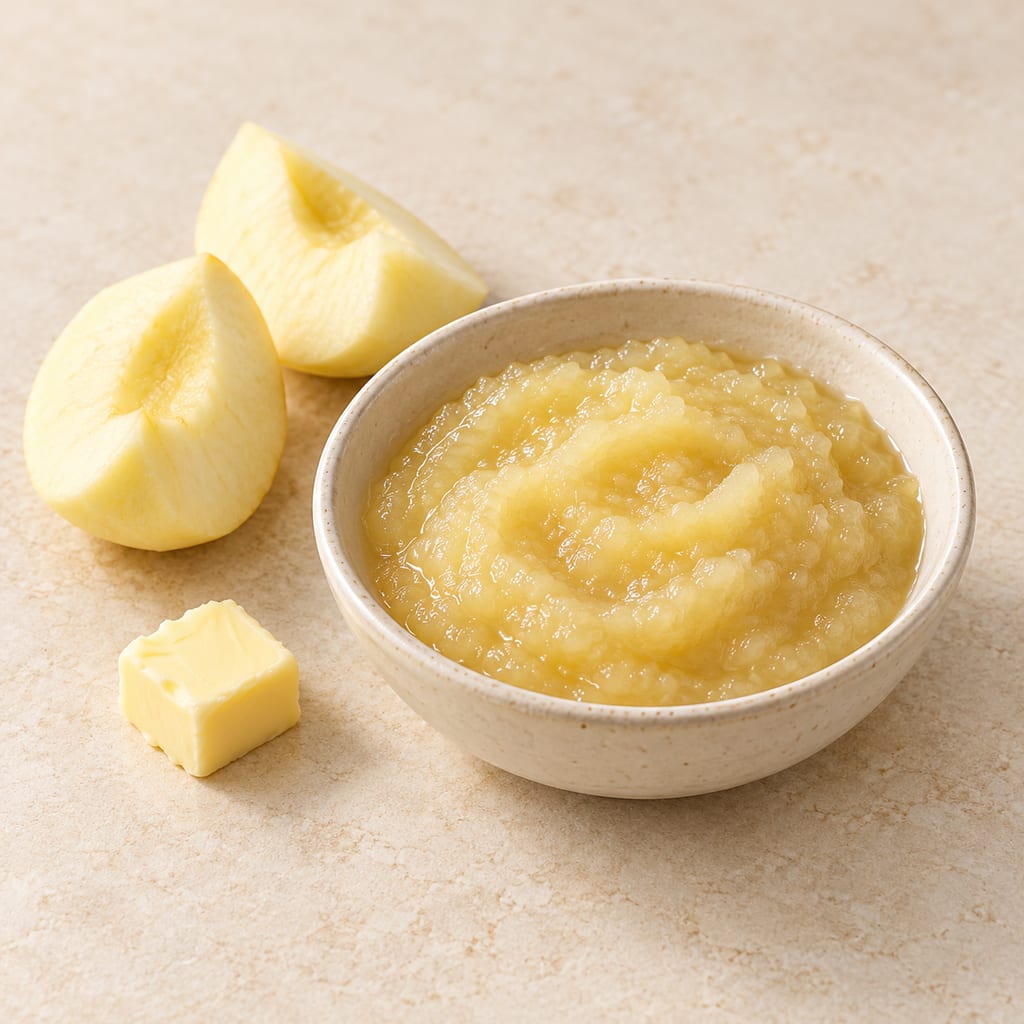
Apple sauce for goose and pork is a plain English accompaniment: cooked apples pulped with water, then sweetened with sugar and finished with a little butter.
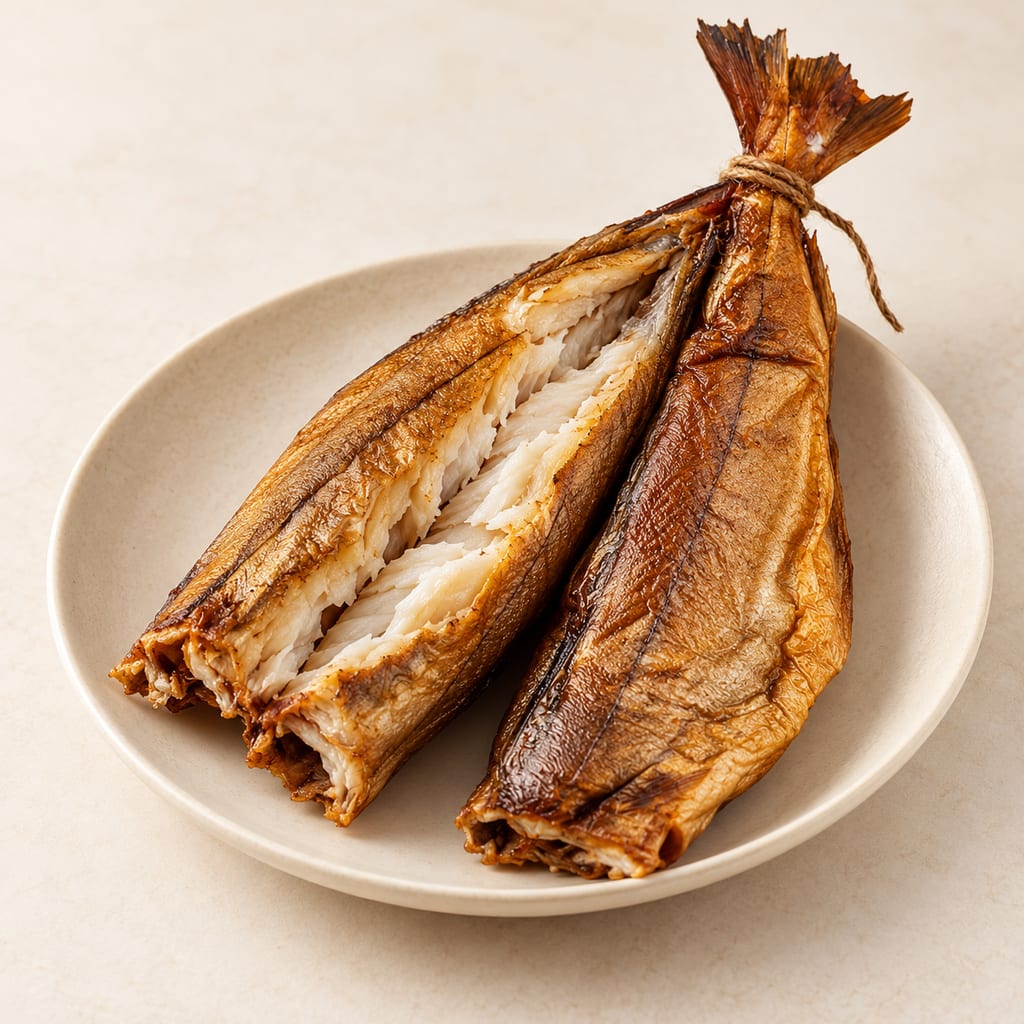
Arbroath smokies are whole haddock dry-salted, paired by the tail and hot-smoked in a protected coastal area. Their recorded history links Auchmithie and Arbroath, though the exact origin is unsettled.
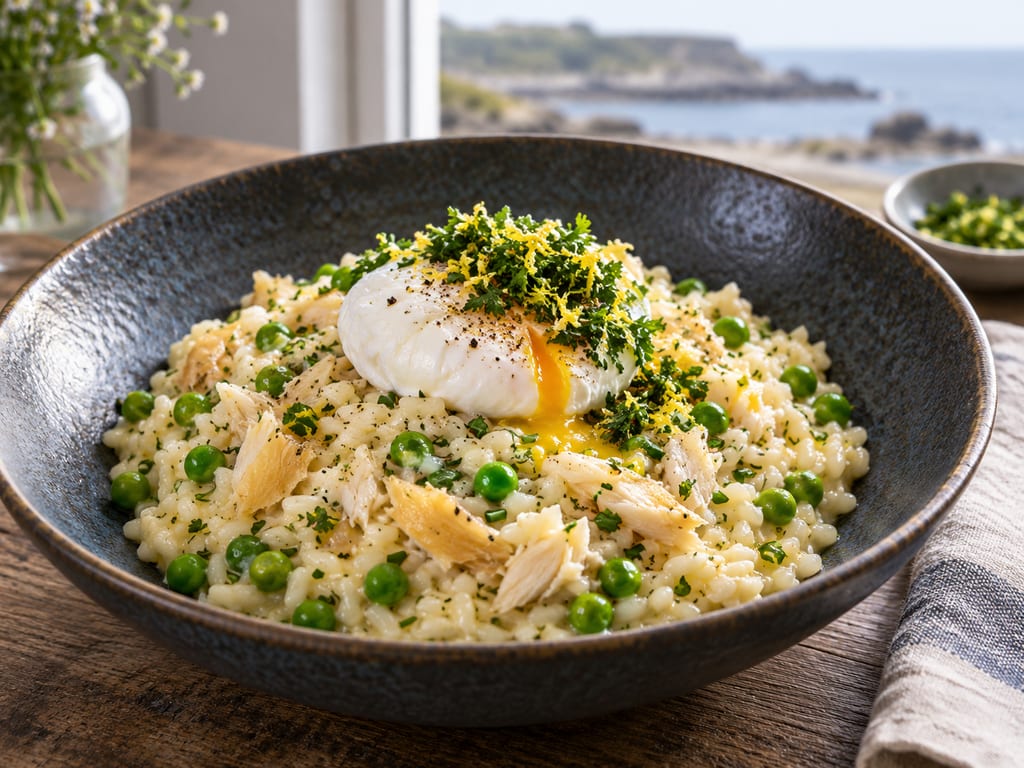
A four-serving risotto published in the 2014 Arbroath Smokie Trail booklet and credited to Hayley Wilkes. It cooks with finished Arbroath smokies; it does not describe smoking fish.
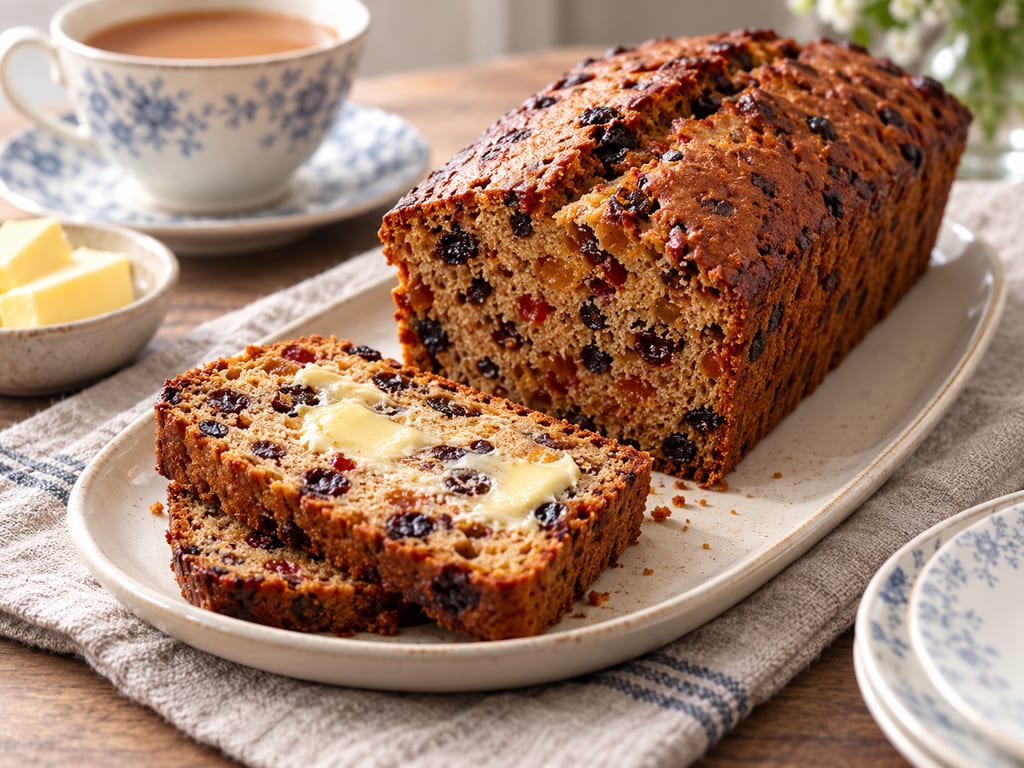
Bara brith is Wales’s speckled fruit loaf, made in both yeasted bread forms and the widely served modern tea-loaf style. This version soaks dried fruit in strong tea before mixing it with self-raising flour, spice, sugar and egg.
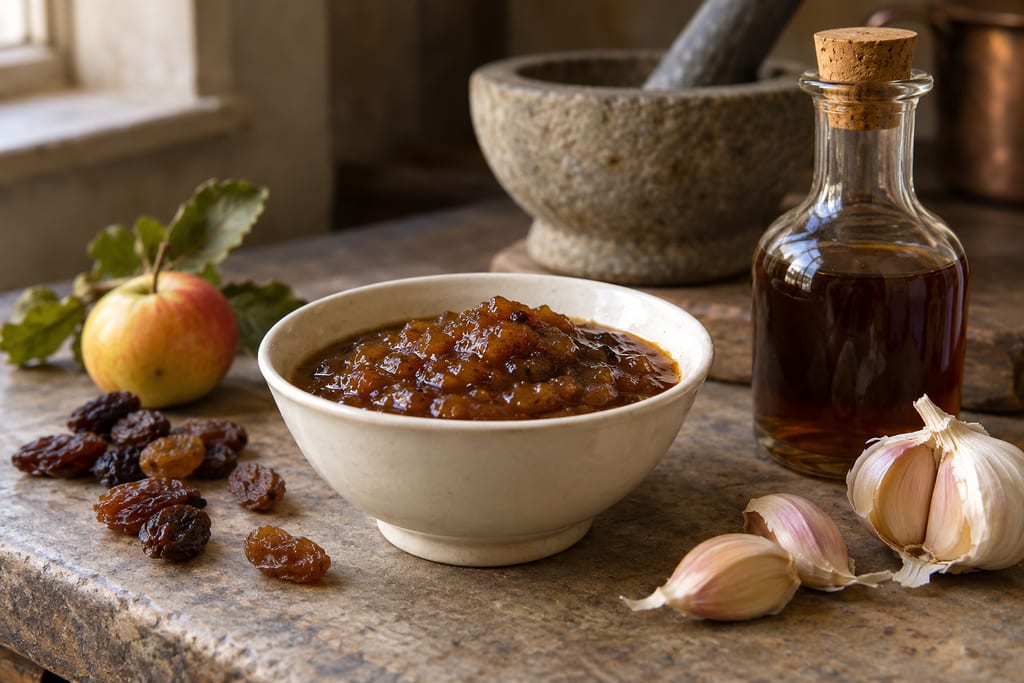
Eliza Acton's Bengal receipt for chetney sauce: stoned raisins and a hard acid fruit pounded with brown sugar, ginger, salt, cayenne and garlic, then thinned with vinegar to the consistence of thick cream.
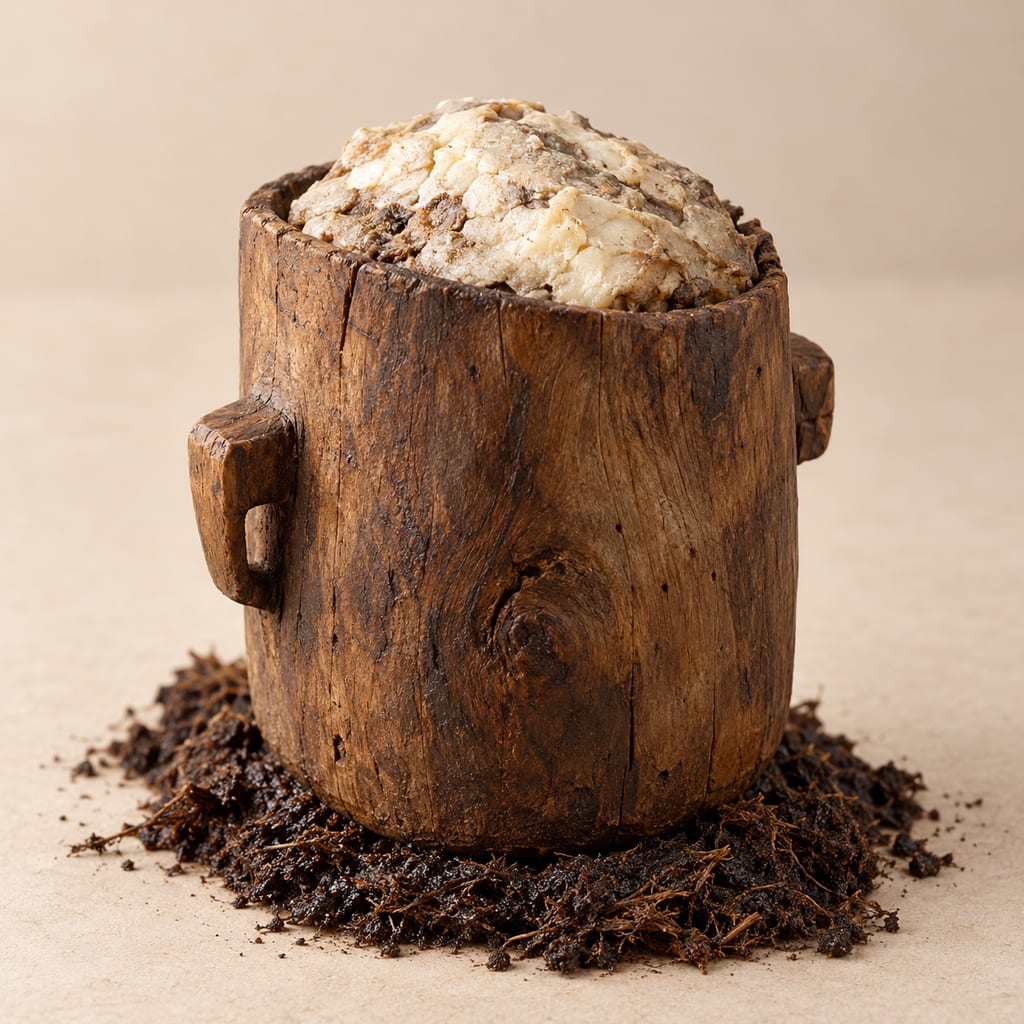
Butter packed into wooden containers and buried in cool, wet peat in Ireland and Scotland, a practice known from finds that may reflect storage, concealment or ritual.
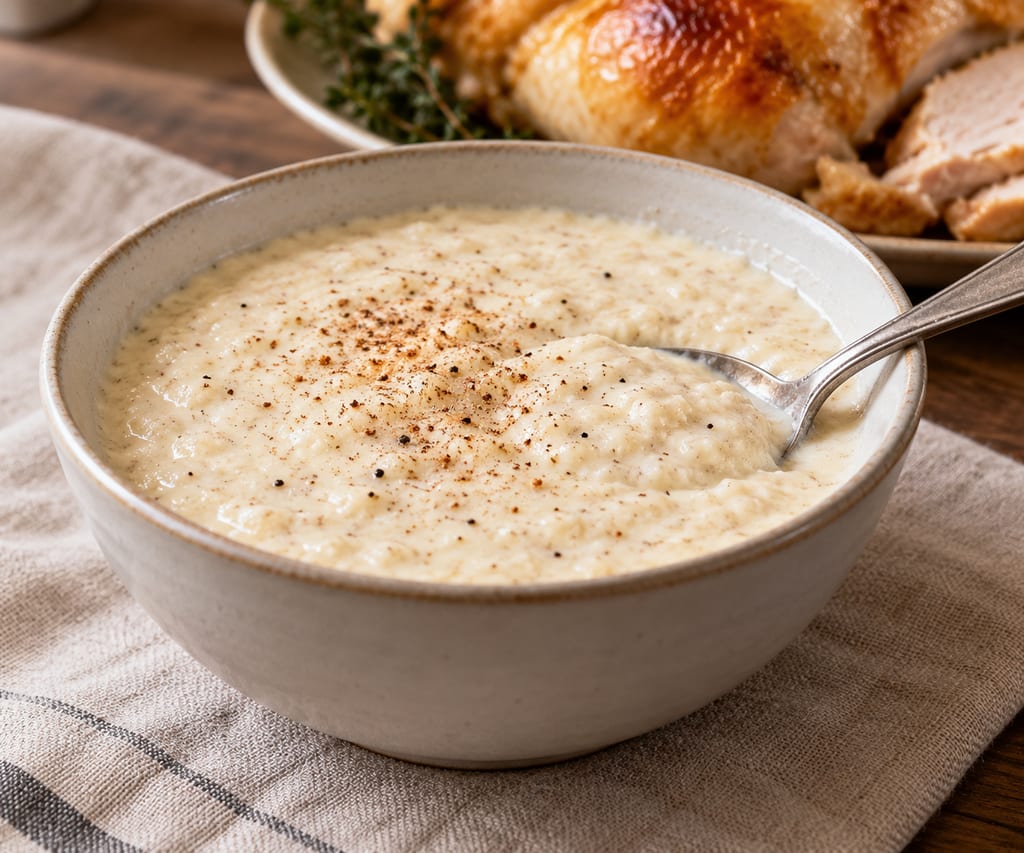
Bread sauce is a British sauce of milk infused with onion, clove and bay, thickened with stale breadcrumbs and finished with butter, served with roast chicken or turkey.
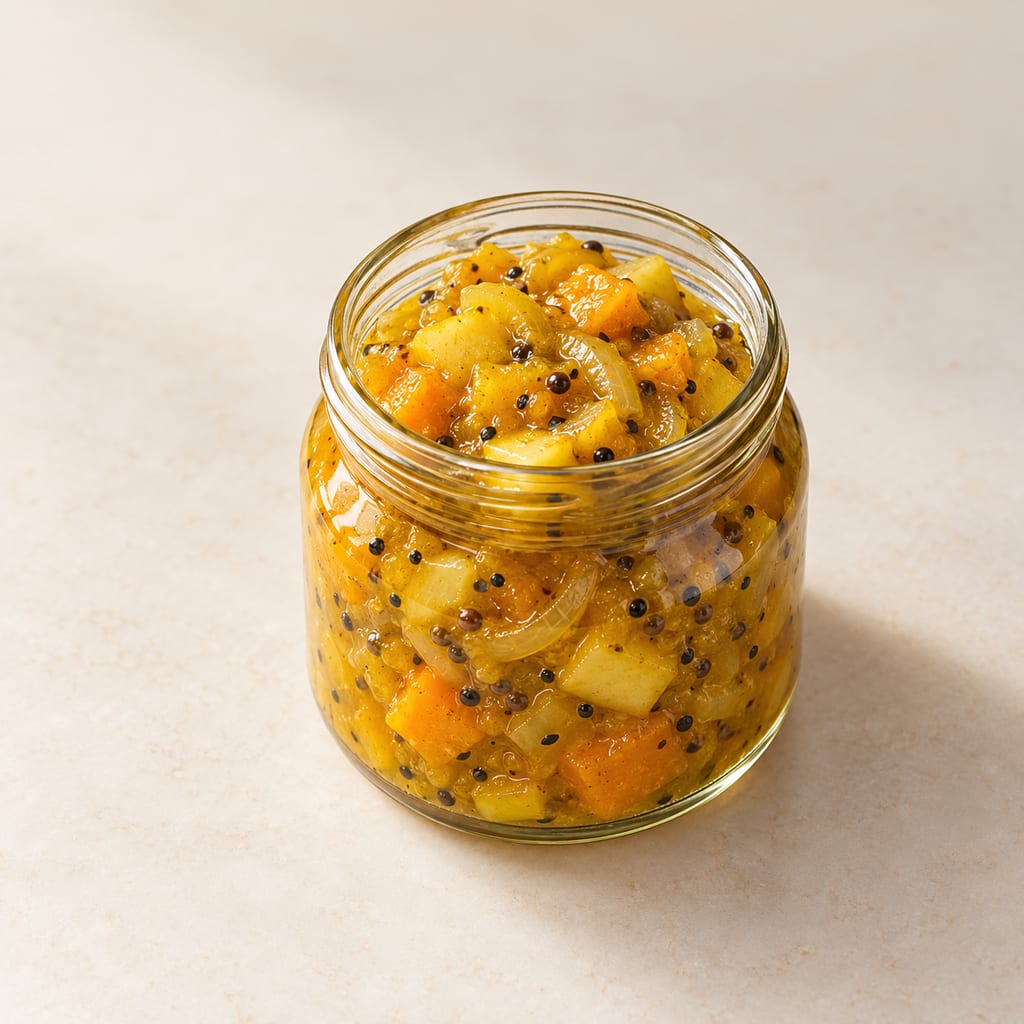
British pumpkin, apple and mustard pickle: Freeze for winter; small fresh portion refrigerated up to 48 hours.
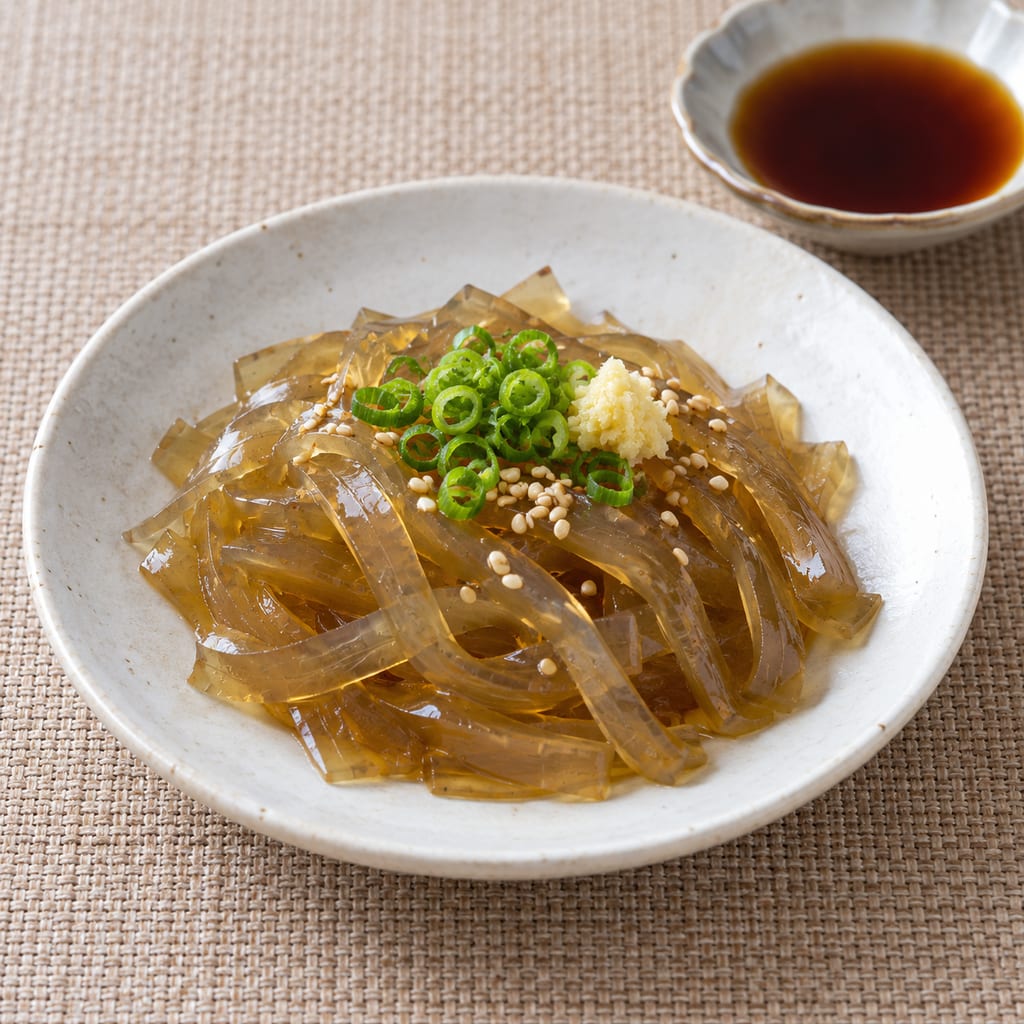
A traditional Fukuoka seaweed jelly made by boiling dried egonori, sometimes with igisu, until it forms a thick extract that sets into soft sheets, eaten cold with soy sauce, vinegar and aromatic condiments.
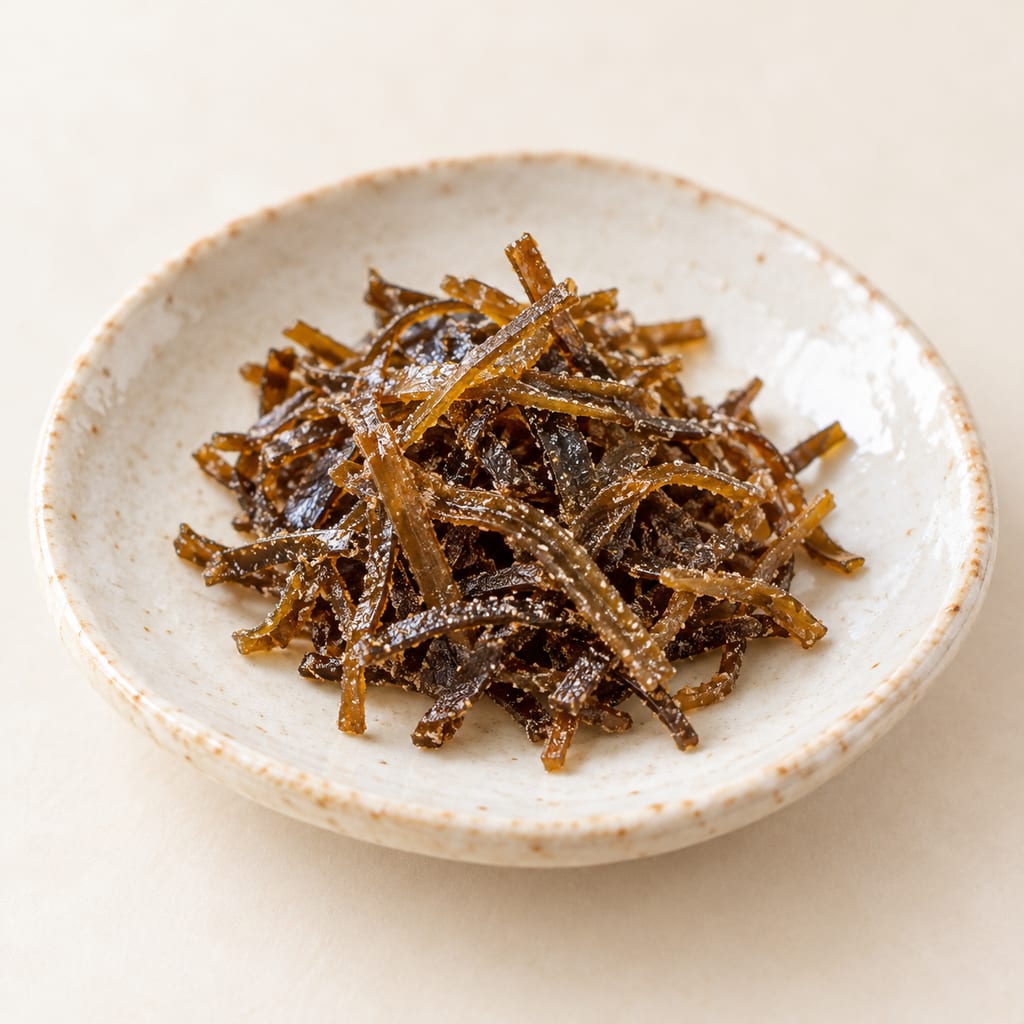
Japanese kelp simmered in soy sauce and seasonings, sometimes dried and salted, eaten with rice or used as an umami seasoning.
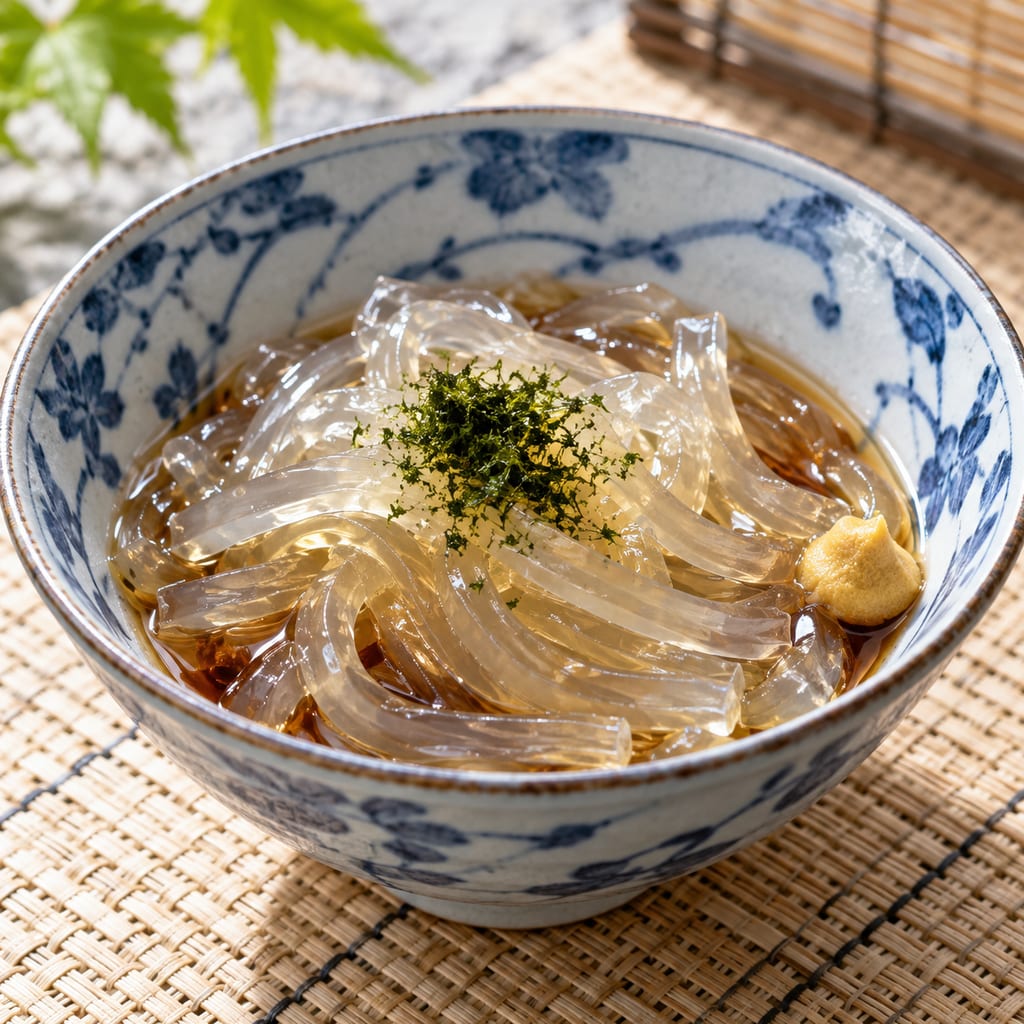
A Japanese jelly made by boiling agar-rich red seaweed, straining the extract and letting it set, then pressing it into strands served with vinegar-soy sauce or sweet syrup.

A gelling polysaccharide extracted from red seaweeds, sold as kanten strips or powder; it sets firm at a low concentration and stays solid until about 85 °C.

A Dominican table and seasoning condiment of sour orange juice, mixed with lime and salt and bottled raw; garlic, oregano or a hot pepper may be added for meat or a spicier bottle.

Cicerbita alpina is an alpine perennial whose tender shoots and leaves have been eaten raw or cooked. Sámi milk preparations and modern Carnian dishes are distinct uses, with serious identification and preservation limits.

Japanese skipjack tuna cooked, then repeatedly smoked and dried over a wood fire by the hand-fired tebiyama method into a hard block for shaving into dashi: the first stage of katsuobushi.

A Swedish-style spirit vinegar made by fermenting neutral alcohol with live vinegar bacteria, with a separate guide to commercial ättika strengths.

A yeast-raised wheat ring shaped from a firm dough, briefly boiled and baked. This source-batch formula gives a gently malted crust and a chewy crumb.

A warm dip of garlic, anchovy and olive oil, often enriched with butter, that Piedmont serves over a flame with raw and cooked vegetables and bread.

Bechamel is a white sauce of milk thickened with a butter and flour roux, one of the French mother sauces, and the base from which Mornay and other cheese and cream sauces are made.
No community contributions have been published for this entry yet.
Sign in to contribute. Published comments and photos are free to read.
Department for Environment, Food and Rural Affairs (Defra), United KingdomIdentity · Method · Safety · History
Welsh Laverbread: Protected Designation of Origin Product SpecificationCooked laver, water and salt only; salt at most 1% of final weight
Hand-gathered from the Welsh coastline, with records of gatherer and place
Cooked 3 to 4 hours above 98 C or up to 9 hours at 80 C, or small quantities pressure cooked 20 minutes or to 85 C core
Minced or purée, or chopped; shallow trays, chilling, recorded cooling
Six-day use-by arrangement for the commercial process
Pembrokeshire cottage industry 1800 to 1950
Cited in: What it is; Story and history; How it works; How it is made and why each step is there; Regional and historical variations; How it is eaten; Reading results and problems
Defra, GOV.UKHistory · Identity
Welsh Laverbread (protected food name)PDO registered 17 May 2017; UK registration 31 December 2020
Cited in: What it is; Story and history; Regional and historical variations
Business Wales, Welsh GovernmentIdentity · History
Welsh Laverbread (PDO)Description of the protected product and its origin area
Cited in: What it is; How it is made and why each step is there
Amgueddfa Cymru, Museum WalesMethod · Variation · History
Welsh Foods: LaverbreadRhydlewis, Ceredigion: laver simmered for hours, chopped, salted, rolled in oatmeal
Women gathering laver; repeated washing
Cited in: What it is; Story and history; How it is made and why each step is there; Regional and historical variations; How it is eaten
Amgueddfa Cymru, Museum WalesHistory · Variation
Museum Wales blog: laver and laverbreadEighteenth and nineteenth-century gathering in Pembrokeshire, Glamorgan and Anglesey
Frying in bacon fat; mining-valley breakfasts
Drying in coastal huts
Cited in: Story and history; Regional and historical variations; How it is eaten
Welsh Food and DrinkMethod · Use
Laverbread: Traditional Welsh Cuisine600 g fresh laver, six-hour low simmer to a dark pulp
Served with olive oil, lemon juice and seasoning on buttered toast
Cited in: How it is made and why each step is there; How it is eaten
Early Tourists in Wales, transcriptions and bibliographyHistory
Laver Bread (Early Tourists in Wales)1693 letter and the 1695 Britannia passage on llawfan near St Davids
John Evans 1804, Walter Davies 1805, Richard Fenton 1811
Cited in: Story and history; Regional and historical variations; How it is eaten
Wales.com, Welsh GovernmentHistory · Use
Why the Welsh Eat SeaweedLaverbread with cockles and bacon; Swansea and Gower
Cited in: Story and history; How it is eaten
Natural Resources WalesSafety
Seaweed HarvestingRules for hand gathering, protected areas and licensing
Cited in: How it is made and why each step is there; Reading results and problems
Food Standards Agency, GOV.UKSafety
How to Chill, Freeze and Defrost Food SafelyCool cooked food quickly and refrigerate within one to two hours
Fridge at 0 to 5 C
Cited in: Reading results and problems
Food Standards Agency, United KingdomSafety
The Safety and Shelf-Life of Vacuum and Modified Atmosphere Packed Chilled Foods with Respect to Non-Proteolytic Clostridium botulinumReduced-oxygen packing of chilled wet foods needs specific controls
Cited in: Reading results and problems
World Register of Marine SpeciesIdentity
Porphyra umbilicalis: taxonomic recordsAccepted names and synonyms
Cited in: What it is
AlgaeBaseIdentity
Porphyra umbilicalis Kützing, 1843Description of the species
Cited in: What it is; How it works
Marine Drugs (MDPI)Science
Dehydration, Rehydration and Thermal Treatment: Effect on Bioactive Compounds of Red Seaweeds Porphyra umbilicalis and Porphyra linearisPhycobiliproteins fall after heating at 90 C
Cited in: How it works
Journal of Food Processing and Preservation (Wiley)Science
Effect of Acidification and Thermal Treatment on Quality Characteristics of High-Moisture Laver (Porphyra spp.)Heating degrades phycoerythrin, softens tissue and changes soluble sugar release
Cited in: How it works
EFSA JournalSafety
Dietary Exposure to Heavy Metals and Iodine Intake via Consumption of Seaweeds and Halophytes in the European PopulationIodine and metal content varies by species and product
Cited in: Reading results and problems
British Dietetic AssociationSafety
Iodine: Food Fact SheetSeaweeds contain iodine in amounts that vary
Cited in: Reading results and problems
Seaweed ScotlandSafety
Understanding the Composition of Seaweed: Advice and GuidanceComposition and contaminant considerations for edible seaweed
Cited in: Reading results and problems
