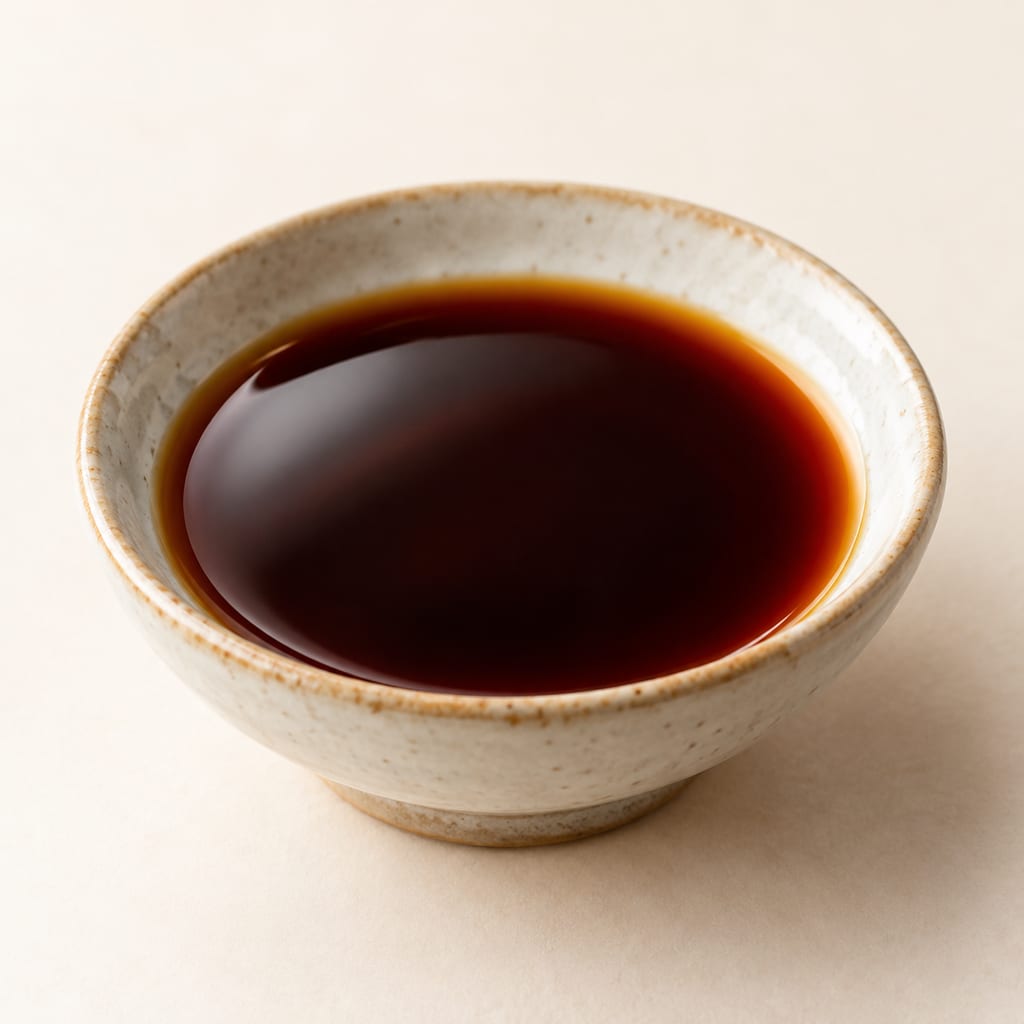
Koikuchi soy sauce
Japan's standard all-purpose soy sauce: soybeans and wheat grown over with koji mould, brined, fermented for months, pressed and usually heated into a reddish-brown, savoury liquid.
 FermenteaWhere food goes to change
Traditional method
ところてん · tokoroten · 心太 · ところ天 · てん · ten · 鏡てん · kagami-ten · こころぶと · kokorobuto · こころてん · kokoroten · 天草ところてん · tengusa tokoroten · Japanese seaweed jelly · Gelidium jelly
A Japanese jelly made by boiling agar-rich red seaweed, straining the extract and letting it set, then pressing it into strands served with vinegar-soy sauce or sweet syrup.
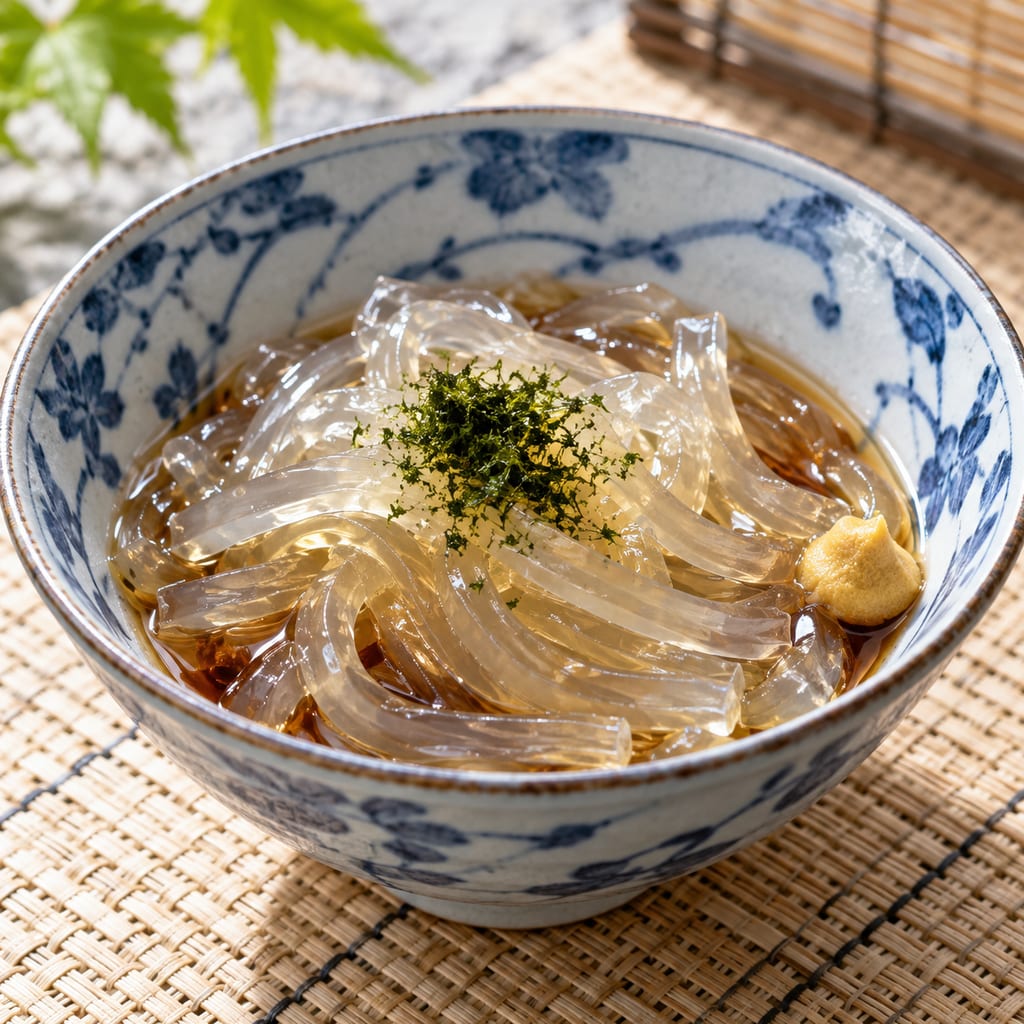
Tokoroten, ところてん or 心太, is a Japanese jelly made by boiling dried red seaweed, straining the liquid and letting it set. The block is cut or pressed through a hand device called a tentsuki, 天突き, which squeezes it out in long square-sided strands. They look like noodles, but they are almost entirely water and seaweed polysaccharide, with no grain flour.
The seaweed is tengusa, 天草. That is a trade name for several agar-bearing red algae, mostly in the family Gelidiaceae, and not a single species. Japan's food composition tables identify the plain jelly as Gelidium jelly and give Gelidium elegans, makusa, as the species. Others used include oobusa (Gelidium pacificum) and onikusa (Gelidium japonicum). The raw material varies with the coast and the maker.
The set jelly breaks cleanly, offers light resistance to the teeth and has a slippery surface. It is nearly colourless to pale amber. Unlike gelatin, which comes from animal collagen, it sets through polysaccharides from algae. Nothing ferments and no culture is added; the gel forms because dissolved polymer chains rearrange as the liquid cools.
Tokoroten, kanten and agar are related but not the same. Tokoroten is the fresh gel set straight from the extract. Kanten, 寒天, is the dried form, traditionally made by freezing, thawing and drying that gel. Agar is the extracted polysaccharide sold as powder, flakes or strips. Powdered kanten can be dissolved and set into tokoroten-shaped strands, but the result is not necessarily the same in taste or texture as a gel made from whole tengusa.
The Japanese tables record 99.1 g of water per 100 g, 2 kcal, 0.6 g of dietary fibre and 240 micrograms of iodine. The plain gel is the food itself. Vinegar-soy dressing and syrup are separate serving components, and the figures do not cover them.
Tokoroten has a long documented history in Japan, but nobody knows when it was invented. Food histories sometimes say it came from China with Buddhism in the sixth century and link the name 心太, read kokorobuto, to the Taiho Code of 701 and to markets in Nara. These statements are repeated in Japanese writing, but they do not prove a sixth-century recipe or a dated introduction from China.
A better lead is the spelling 心太 in the Shosoin documents of eighth-century Nara. A reference answer from Kitakyushu Municipal Central Library, citing an etymological dictionary, reports the spelling and lists several explanations for the move from kokorobuto or kokoroten to tokoroten. The etymology is still debated. It points to old terminology; what the surviving document says about the prepared food is not known.
Japan's agriculture ministry says tokoroten was an established food by the Nara and Heian periods, sold as 心太 in early markets, and familiar enough by the Muromachi period to appear in later food histories. What cannot be established is whether the early product matched modern tokoroten in extraction, firmness or strand shape. The tentsuki presentation should not be read backwards without specific evidence.
The Edo period gives firmer evidence of ordinary trade. The Tokyo Metropolitan Library reports that tokoroten sellers were among the itinerant food vendors permitted in Edo in 1659, and nineteenth-century illustrations by Kitagawa Morisada show them at work. That is a recognisable street trade, not food for courts and temples alone, and the cold jelly became a summer snack.
Kanten came afterwards as a separate technology. A well-known story places its discovery in seventeenth-century Kyoto, where an innkeeper called Minoya Tarozaemon left tokoroten outside in freezing weather and found that freezing and thawing left a dry material that could be dissolved again. The ministry preserves it as a historical tradition, and its details and dates rest on later tradition, not contemporary documents. What it explains is how the fresh jelly became linked with a dried, transportable ingredient.
Tokoroten stays a regional food as well as a commercial one. The Izu Peninsula in Shizuoka produces tengusa, the Sanriku coast keeps a related jelly called ten for Obon, and modern makers range from whole-seaweed extraction to gels from powdered kanten. A shared name does not mean every period and region used the same ingredients or methods.
Tokoroten comes from extraction and physical gelation, not fermentation. The gelling material is agar, a mixture of galactan polysaccharides in the cell walls of certain red algae. It holds a mostly neutral, strongly gelling fraction called agarose and a more heavily substituted fraction called agaropectin. Agarose is built from repeating units of D-galactose and 3,6-anhydro-L-galactose, and the long chains can associate with each other and trap water in a network.
When the dried seaweed boils, hot water enters the tissue and pulls out the soluble polysaccharides. Heating breaks up the contacts between chains and lets them disperse. The seaweed does not need to dissolve completely: most of its structural material stays behind and is strained out. How much gel-forming material ends up in the liquid depends on the quantity of seaweed, how well it was extracted and how much water is left after cooking.
As the extract cools, agarose chains pair into double helices. The helices aggregate into junction zones and bundles that form a continuous three-dimensional network with water held between the strands. Rheology and scattering studies show how much gel strength depends on those helices, their bundles, the molecular weight and the purity of the agar.
Agar shows thermal hysteresis: the temperature that melts a set gel is far above the temperature at which a hot solution sets. Reviews give agarose gelation near 30 to 40 C and melting near 80 to 90 C, varying with concentration, composition and molecular weight. These are general material properties, not measured setting temperatures for a given tokoroten recipe. The gap explains why agar gels survive conditions that soften gelatin desserts.
Many Japanese recipes add a little vinegar during extraction. The Iwate recipe says it makes the seaweed easier to cook. Mild acidity can help extraction, but acid does not make the gel. Too much acid with long heating can break glycosidic bonds in agar, lower the molecular weight and weaken the network; the European Food Safety Authority treats extensive heating below pH 5.5 as the condition where this matters.
Seaweeds differ. Shizuoka's regional description sets makusa, a softer, more adhesive gel, against oobusa, a firmer one, reflecting differences in agar composition, concentration and extraction behaviour. Washing and sun-bleaching alter the colour and flavour of the extract. None of this involves microbes, a starter culture or microbial acid.
The starting point is dried tengusa. The seaweed is gathered from the sea, washed free of salt, sand and attached matter, and dried for storage. Some regions repeatedly wash and sun it to pale it, which changes colour and sea aroma. On the Izu Peninsula harvest generally runs from late spring into early summer, with the seaweed laid out to dry near the shore, so the jelly can be made all year from stored material.
Before extraction the seaweed is washed again, and some recipes soak it. Iwate Prefecture documents a Taneichi method with 50 g of dried tengusa, 2 litres of water and one tablespoon of vinegar. The seaweed is washed and soaked for about 30 minutes, then simmered for about 20 minutes after the water boils. A little liquid is tried on a plate cooled with water, and if it gels the extract is ready to strain. That test is a practical sign that enough gel-forming material has entered the water.
Other official recipes differ. Shizuoka's uses 50 g tengusa in 3 litres of hot water with one and a half tablespoons of vinegar, simmered for 40 minutes, for about ten to twelve servings. An Iwate Sanriku recipe uses 80 g in 4 litres with one tablespoon of vinegar and simmers it for about 50 minutes, down to roughly half the water. The different amounts and times are regional recipes, not stages of one standard, and the right extraction depends on the seaweed and the firmness wanted.
The vinegar assists extraction and affects acidity, but it is not a fermentation starter, and neither Iwate recipe gives the finished pH, so the quantities cannot count as validated preservation. Water is the medium and the seaweed the supplier of polysaccharide. The basic gel needs no sugar, starch, gelatin or culture.
After simmering, the hot extract goes through a cloth bag or filter to remove tough algal residue and fine particles that would spoil the smooth mouthfeel. It is poured into a shallow mould, with bubbles or foam skimmed from the surface for an even finish. On cooling, the dispersed agar molecules form the network and the liquid becomes a self-supporting block. Commercial makers use controlled filtration and moulding, but the principle is the same.
The gel is then cut to fit a tentsuki, a box with a perforated end, and pushed through the grid into strands. Some regions cut it into squares, slices or larger blocks, and cubes go into fruit desserts. Pressing changes the shape of the serving and not the chemistry.
A modern method starts with powdered kanten instead. Kikkoman gives a four-serving recipe using 4 g of powdered kanten and two cups of water, boiled and stirred for two minutes before moulding. It skips whole-seaweed extraction and filtering. Both routes give an agar jelly, but whole seaweed may keep a more distinct sea taste, colour and texture, and the fresh gel is a hydrated food, not the dry kanten ingredient. The Taneichi recipe is given with its own quantities; the Shizuoka and Sanriku figures belong to their own recipes.
The Izu Peninsula in Shizuoka is among Japan's best-known tengusa regions. The agriculture ministry names Toi in the west and Inatori in the east as important centres, and associates makusa with the west and oobusa with the east. Makusa makes a comparatively soft, sticky gel and oobusa a firmer one, and producers may select or blend seaweeds to set the texture.
In Izu the jelly links fishing and home cooking: tengusa is taken from rocky waters, washed, dried and boiled into jelly, once made at home and sold in small shops, including sweet shops where children bought it as a snack. Its commercial standing comes from the supply of suitable seaweed, not from a process unique to the peninsula.
The Sanriku coast of Iwate has its own related tradition called ten. Around Kamaishi families gathered and dried tengusa in summer and boiled it for the Obon season. Iwate describes a square-cut offering called kagami-ten, 鏡てん, placed on household Buddhist altars. That ceremonial shape differs from the strands usually associated with tokoroten, and it is a local practice, not evidence that square-cut jelly was the original form across Japan.
In Taneichi, Hirono, also in Iwate, the local tokoroten is called ten as well. The prefectural recipe soaks the seaweed and simmers it with water and vinegar, and records a former practice of boiling the same seaweed up to three times, reducing the water and adding a little fresh seaweed to later extractions. That is an economical use of the harvest, though gel strength would have varied between extractions.
Serving also differs by region. Vinegar and soy sauce belong to eastern Japan and kuromitsu, a dark brown-sugar syrup, to western Japan and the Kansai region. The rule is loose: Shizuoka makers sell sweet toppings and both styles turn up elsewhere. Broth-based dressings are reported too.
Whole-tengusa tokoroten and tokoroten from manufactured kanten are separate approaches to a related gel. Direct extraction keeps some components that purification and drying may reduce, according to a specialist producer, while powdered kanten is consistent and convenient. The dried kanten branch that began with winter freezing, thawing and drying should be kept as a connected but separate subject from the fresh gel.
Tokoroten is eaten cold as a light snack, side dish or summer refreshment. The strands are pressed into a bowl just before serving and dressed, and since the jelly is mild, the dressing supplies the acidity, sweetness, salt or aroma. Texture is the point: the strands should be soft enough to eat easily and firm enough to keep their shape.
A common savoury dressing is nihaizu, 二杯酢, vinegar and soy sauce. Sanbaizu, 三杯酢, adds sweetness, often from mirin or sugar. Kikkoman gives a nihaizu of two tablespoons of soy sauce and two of vinegar for four servings. Japanese mustard, green laver, sesame and ginger are garnishes. They add flavour and have no part in the gel's structure.
The sweet version takes kuromitsu, sometimes with kinako, roasted soybean flour, and reads as a dessert. The underlying gel can be the same. Shizuoka's recipe gives sanbaizu, mustard, green laver and sesame, or kinako and kuromitsu, and modern specialists add sesame, wasabi, citrus and plum dressings, which are contemporary variations and not records of history.
Iwate records other uses: cut into sashimi-like slices and eaten with soy sauce or miso, cubed with fruit in mitsumame, a jelly and fruit dessert, or square-cut as the Obon offering that is later eaten.
The plain gel is low in energy because it holds so little solid, and its iodine comes from the seaweed. The figures cover the plain jelly only, not a portion with syrup. It is not a probiotic food, since nothing is fermented and the gel needs no live microbes; soy sauce, vinegar or mirin may have fermented in their own manufacture, but that does not make the jelly a ferment.
A good gel holds its shape once cooled, leaves the mould cleanly and goes through a tentsuki without running or breaking into lumps. Firmness depends on seaweed, concentration and processing: a softer, slightly adhesive gel is normal for makusa, a firmer one for oobusa, so the finished jelly should be compared with the intended regional recipe and not with one universal texture.
If the extract does not set, there may be too little dissolved agar for the water left. Incomplete extraction, too much dilution and variation between seaweed batches all change the concentration. Iwate advises trying a small sample on a cooled plate before straining the whole batch. That tests setting and not safety, since a jelly can set well and still be contaminated or stored badly.
Acid and heat also matter. Agar can undergo acid hydrolysis when heated under acidic conditions, shortening the chains that form the network, and EFSA identifies prolonged heating below pH 5.5 as the relevant condition. A little vinegar may assist extraction, but much more acid or a long boil of a highly acidic extract can reduce firmness. That is chemistry, not spoilage.
Foam folded in during boiling or pouring stays as bubbles, and poor filtering leaves seaweed fragments or sand, which is why the traditional washing, inspecting and straining matters for appearance as well as texture. Agar gels can also release a little water over time as the network tightens, called syneresis, which is not by itself a sign of fermentation or bacterial spoilage. Heavy softening, damaged packaging or mould is a different matter.
Safety deserves attention because fresh tokoroten is a high-moisture, ready-to-eat food. EFSA notes that agar solutions and gels can support bacteria and moulds even though dry agar is stable, and boiling the extract does not protect against contamination added afterwards by filters, moulds, water, cutters, packaging or hands.
Japanese hygiene guidance for small commercial makers describes two preservation systems. Products packed in an acidified liquid without a second heat treatment end up below pH 4.0. Products given a second heat treatment may sit at a higher pH, normally not above 4.6, along with a validated heating process and other controls. The guidance is a draft, and the commercial conditions depend on the producer and the formulation. It is not a way to make a homemade batch shelf-stable with a splash of vinegar.
A home jelly set in an open mould, without validated acidification or a controlled packed heat treatment, is a perishable food to keep in the refrigerator, and the vinegar used during extraction cannot be assumed to give the conditions of a measured commercial system. Sand, stones and attached organisms should be washed out before extraction, the seaweed should come from a food-grade source, and the jelly should be made with potable water and clean utensils. Allergen information has to cover the whole packaged product, including soy sauce, mustard or sesame in the dressings.
Japanese food histories link the name 心太 to the Taiho Code of 701 and to the Shosoin documents of eighth-century Nara, but no original passage is cited. The firmest record is the Edo street trade: tokoroten sellers were among the itinerant vendors permitted in Edo in 1659. The tradition that dried kanten arose later in seventeenth-century Kyoto from frozen tokoroten is a story that needs contemporary documents.
Scaling: source batch only
Tokoroten is a hydrated ready-to-eat gel (99.1 g water per 100 g) and can be contaminated during filtering, moulding, cutting, packing or serving after the hot extraction.
Hazard sourceThe tablespoon of vinegar used in extraction does not show the finished gel reached a protective pH. Commercial guidance uses separate acidification and validated heat processes.
Hazard sourceFilters, moulds, cutters, packaging and hands can add microbes; Japanese manufacturing guidance names sanitation and prevention of secondary contamination as key controls.
Hazard sourceDried tengusa can carry sand, stones, shell fragments and attached organisms; traditional instructions call for repeated washing.
Hazard sourceMarine algae can accumulate contaminants by species and place, and the plain jelly carries about 240 micrograms of iodine per 100 g in the Japanese tables.
Hazard sourceA large volume of boiling extract is strained and poured hot and can splash.
Hazard sourceUse food-grade dried tengusa and wash out visible foreign material
Control sourceFollow the documented extraction without treating the vinegar as a preservative
Control sourceUse the documented cooking and setting check
Control sourcePrevent contamination after extraction with clean moulds, cloths and cutters
Control sourceRefrigerate homemade jelly
Control sourceCommercial products without a second heat treatment: acidified packing liquid
Control sourceCommercial products with a second heat treatment: validated pH and heat process
Control sourceThis is a documented traditional preparation and not a validated shelf-stable or packaged-food process.
A gel that sets is not therefore microbiologically safe.
Powdered kanten and dried whole tengusa are not interchangeable by weight.
Do not mix the Iwate simmering time with the Shizuoka water and vinegar amounts without calling it a modified formula.
No refrigerated shelf life, refrigeration temperature or room-temperature storage time was established.
Commercial acidification and secondary heating are separate manufacturing processes that cannot be copied at home without validation.
Discard jelly that is mouldy or otherwise suspect; appearance and smell do not establish safety.
The seaweed species in the Iwate recipe is not given.
Soy sauce dressings can contain soy and wheat, and sesame toppings need allergen identification.
Food composition values for plain jelly do not apply to servings with syrup.
Country-level; the earliest documents are known only through secondary accounts.
Tokoroten vendors permitted in Edo.
A tengusa-producing area; not an origin claim.
Named centre associated with makusa.
Named centre associated with oobusa.
Related jelly called ten, made for Obon.
Source of the recipe on this page.
Associated with sweet kuromitsu servings.
Japan's standard all-purpose soy sauce: soybeans and wheat grown over with koji mould, brined, fermented for months, pressed and usually heated into a reddish-brown, savoury liquid.
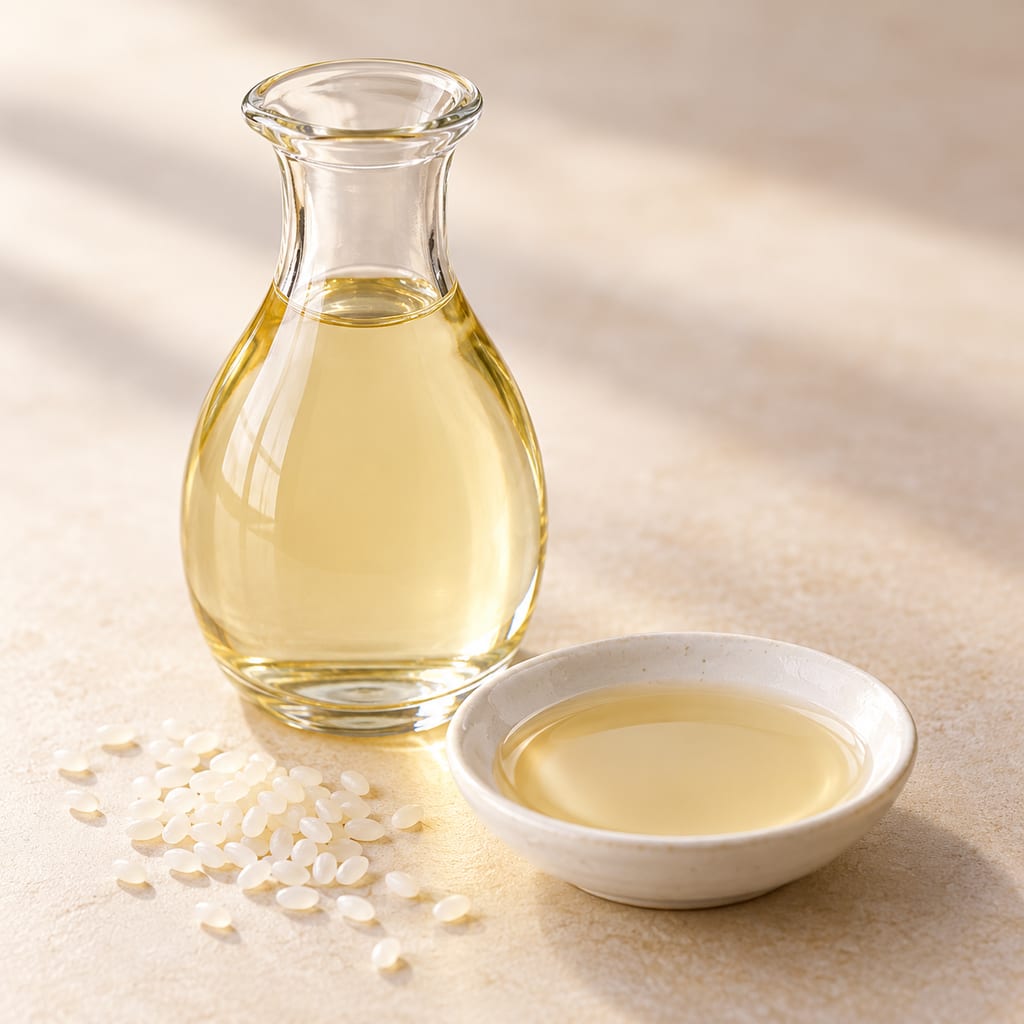
Japanese komezu is a pale, unseasoned rice vinegar made through alcoholic and acetic fermentation; rice, water, koji and yeast shape its character.
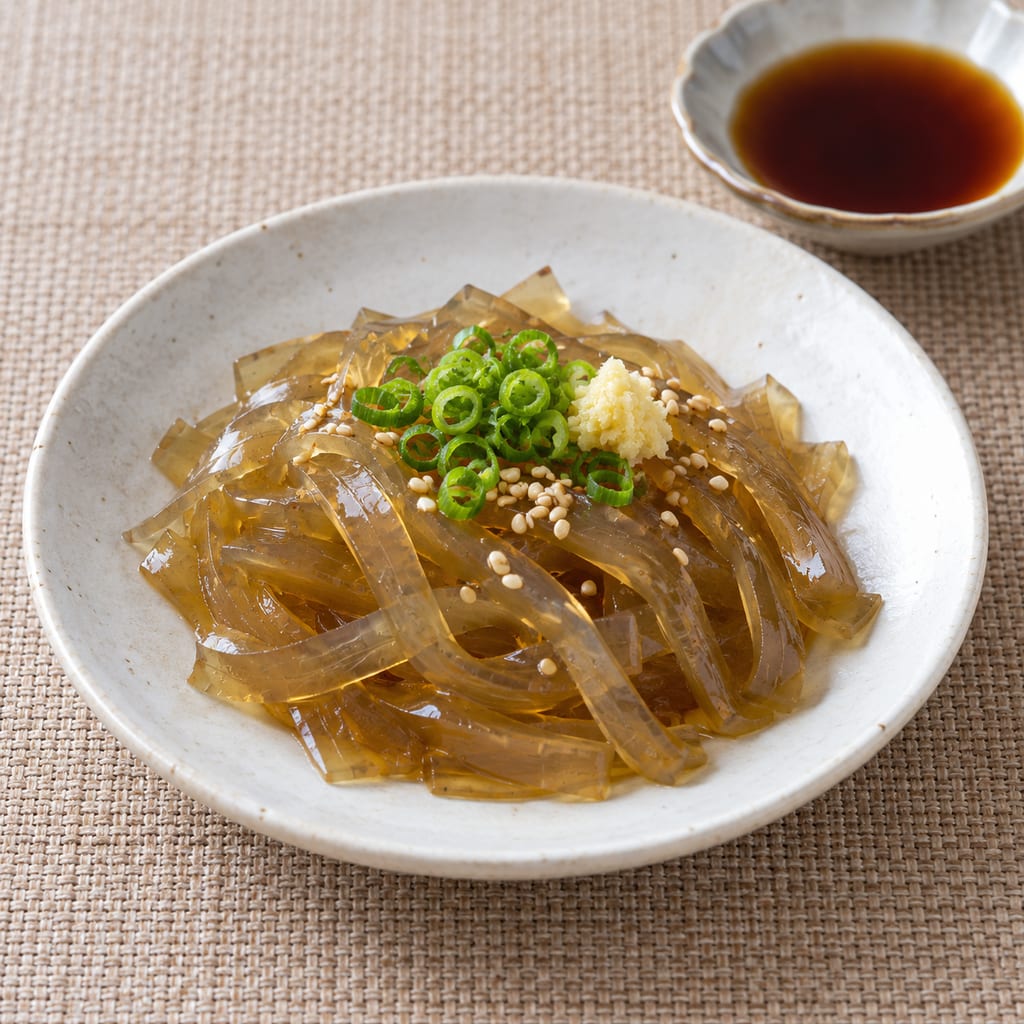
A traditional Fukuoka seaweed jelly made by boiling dried egonori, sometimes with igisu, until it forms a thick extract that sets into soft sheets, eaten cold with soy sauce, vinegar and aromatic condiments.

A gelling polysaccharide extracted from red seaweeds, sold as kanten strips or powder; it sets firm at a low concentration and stays solid until about 85 °C.
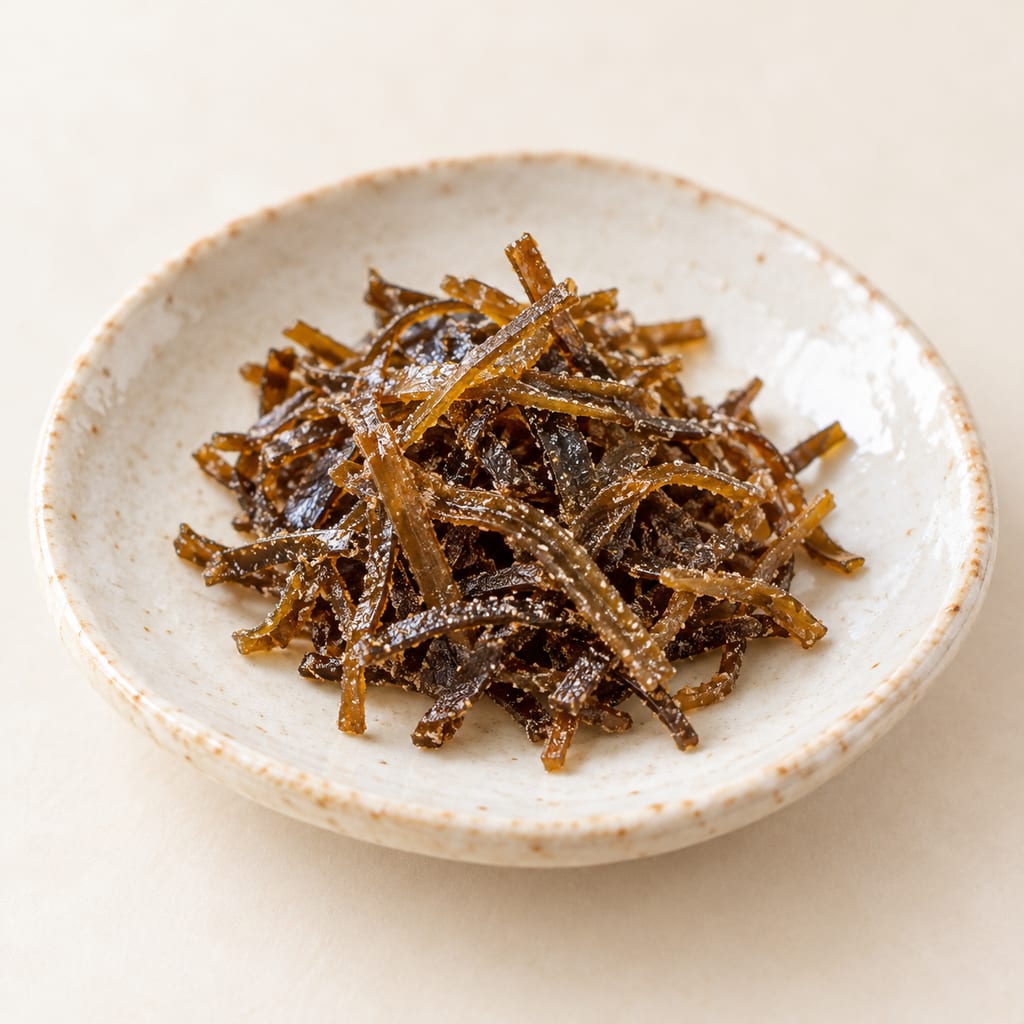
Japanese kelp simmered in soy sauce and seasonings, sometimes dried and salted, eaten with rice or used as an umami seasoning.

Japanese skipjack tuna cooked, then repeatedly smoked and dried over a wood fire by the hand-fired tebiyama method into a hard block for shaving into dashi: the first stage of katsuobushi.
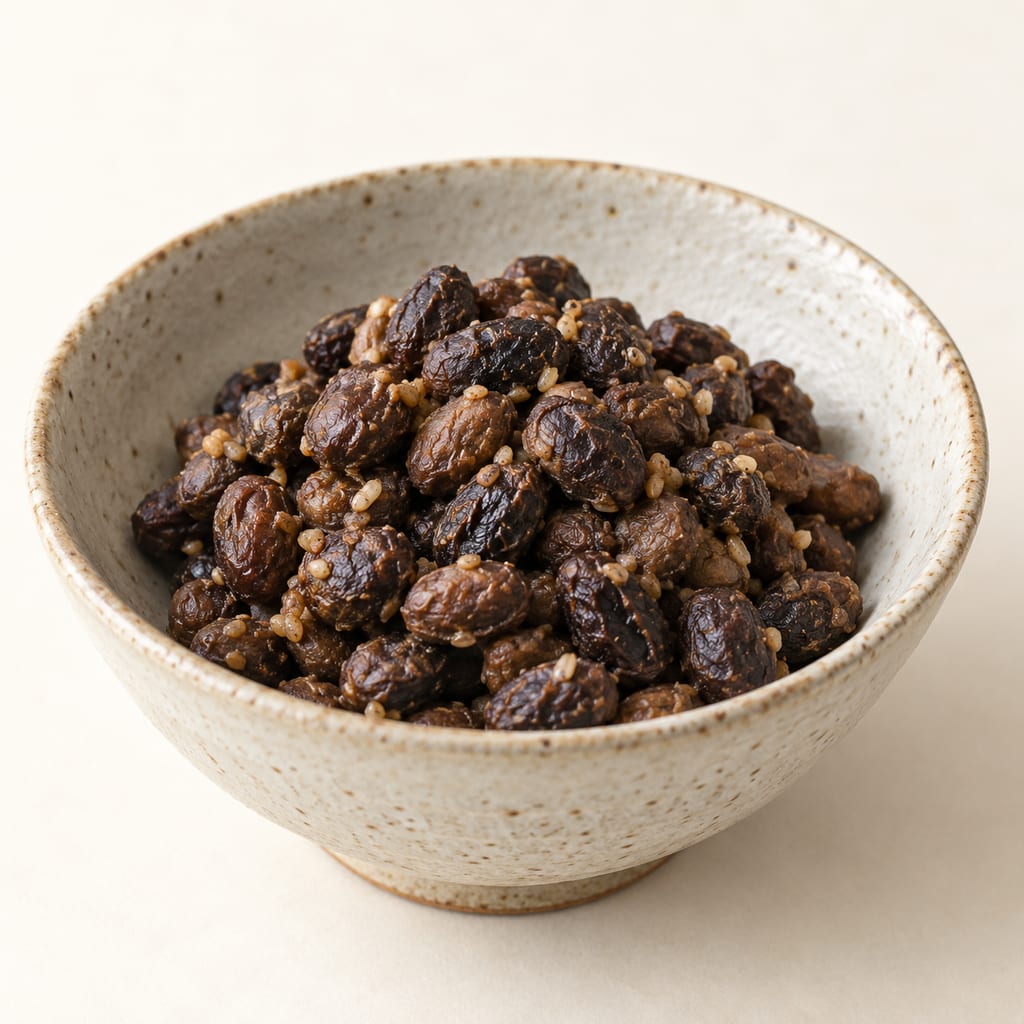
A Japanese family of salted, dark, non-stringy natto made from whole soybeans, roasted grain and salt water, with names such as hama-natto, Daitokuji-natto and tera-natto. Not the sticky Bacillus natto.
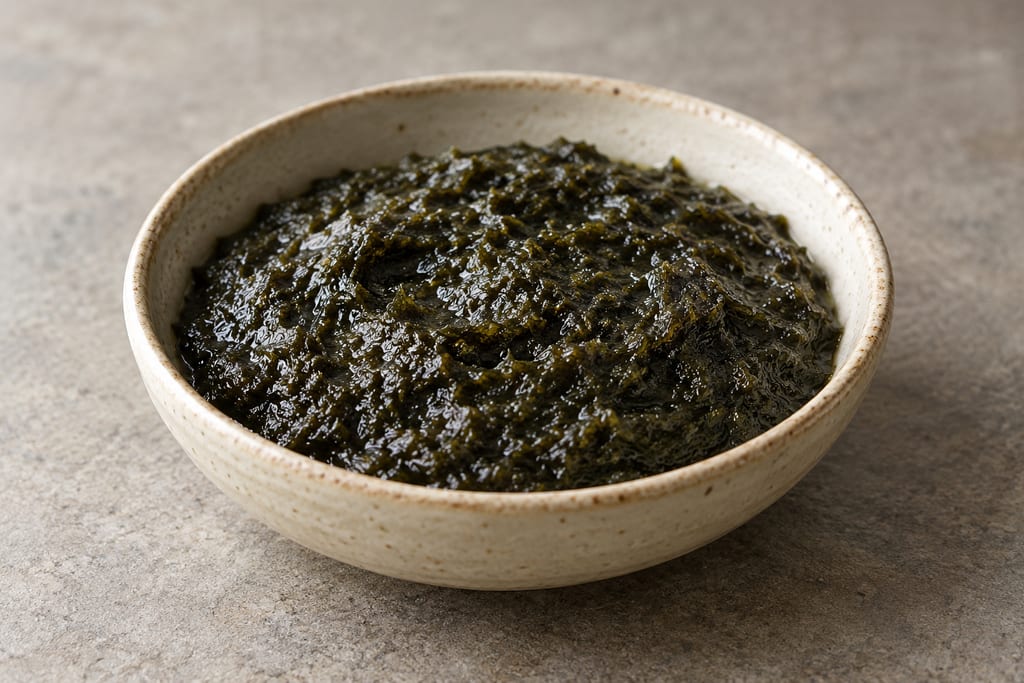
Welsh laverbread is hand-gathered purple laver slowly cooked to a dark green-black paste, eaten with oatmeal, bacon and cockles or on toast.

A Dominican table and seasoning condiment of sour orange juice, mixed with lime and salt and bottled raw; garlic, oregano or a hot pepper may be added for meat or a spicier bottle.

Cicerbita alpina is an alpine perennial whose tender shoots and leaves have been eaten raw or cooked. Sámi milk preparations and modern Carnian dishes are distinct uses, with serious identification and preservation limits.

A Swedish-style spirit vinegar made by fermenting neutral alcohol with live vinegar bacteria, with a separate guide to commercial ättika strengths.

A yeast-raised wheat ring shaped from a firm dough, briefly boiled and baked. This source-batch formula gives a gently malted crust and a chewy crumb.

A warm dip of garlic, anchovy and olive oil, often enriched with butter, that Piedmont serves over a flame with raw and cooked vegetables and bread.

Bechamel is a white sauce of milk thickened with a butter and flour roux, one of the French mother sauces, and the base from which Mornay and other cheese and cream sauces are made.
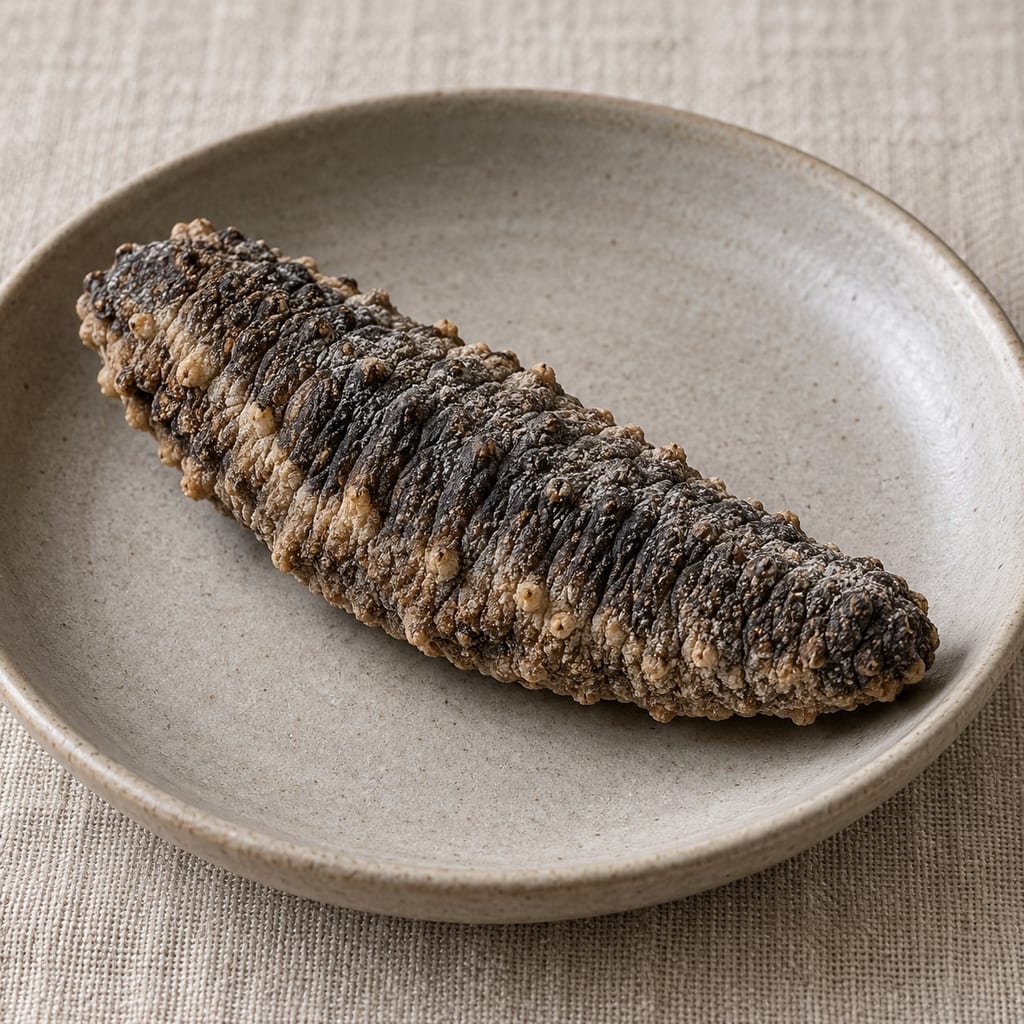
Sea cucumber cleaned, boiled and dried, sometimes with smoke, into a long-keeping trade product; Makassan processing in Arnhem Land is documented from at least the eighteenth century.
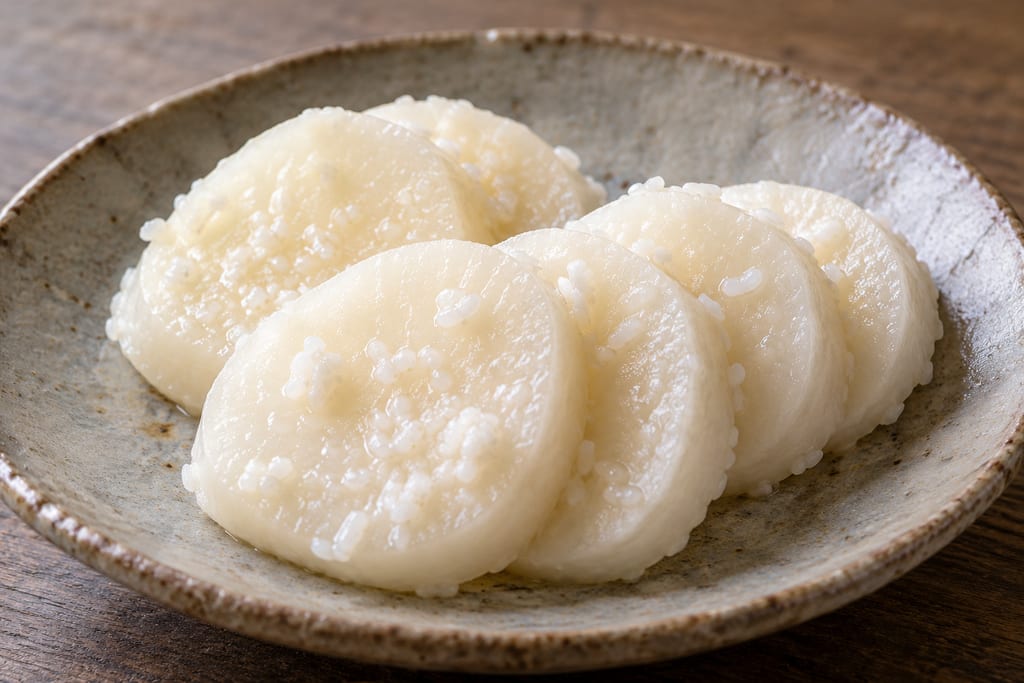
A sweet, crisp Japanese daikon pickle from Tokyo's Nihonbashi district, made by salting fresh radish and dressing it in rice koji, sugar or koji amazake without the heavy drying used for takuan.
No community contributions have been published for this entry yet.
Sign in to contribute. Published comments and photos are free to read.
Iwate Prefectural Government; Kuji Agricultural Extension CentreMethod · Variation · Safety
てん(ところてん)(洋野町種市)50 g dried tengusa, 2 litres water, 1 tablespoon vinegar
About 30 minutes soaking and about 20 minutes simmering after the boil
Setting test with a small sample cooled on a plate
Strain through a cloth bag; 25 cm square mould
Served with vinegar-soy sauce or kuromitsu
Former practice of boiling the same seaweed up to three times
Cited in: How it works; How it is made and why each step is there; Regional and historical variations; How it is eaten; Reading results and problems
Iwate Prefectural Government, Agricultural Extension ServiceMethod · Variation · Use
てん (Iwate regional traditional food)80 g tengusa, 4 litres water and 1 tablespoon vinegar, simmered about 50 minutes
Foam removed from the mould
Kagami-ten, square-cut offering at Obon
Slices served with soy sauce or miso, ginger and cubes in mitsumame
Cited in: Story and history; How it is made and why each step is there; Regional and historical variations; How it is eaten; Reading results and problems
Ministry of Agriculture, Forestry and Fisheries, JapanMethod · Variation · Use · History
ところてん (Shizuoka)50 g tengusa, 3 litres hot water, 1.5 tablespoons vinegar, 40 minutes, 10 to 12 servings
Makusa soft and sticky, oobusa firmer
Toi in western Izu and Inatori in eastern Izu
Savoury and sweet toppings
Cited in: What it is; Story and history; How it works; How it is made and why each step is there; Regional and historical variations; How it is eaten
Kikkoman Corporation, Food Forum, Japanese Style vol. 27Method · Use · Variation
Tokoroten4 g powdered kanten and 2 cups water for four servings
Nihaizu of 2 tablespoons soy sauce and 2 tablespoons vinegar
Savoury east, sweet kuromitsu west
Cited in: What it is; How it is made and why each step is there; Regional and historical variations; How it is eaten
National Konnyaku Cooperative Federation; hosted by the Ministry of Health, Labour and Welfare, JapanSafety
HACCP-based hygiene guide for small tokoroten makers (draft)Contamination after extraction
Acidified packing liquid with final pH below 4.0 for products without a second heat treatment
pH up to 4.6 only with validated secondary heating
No universal heating schedule
Cited in: Reading results and problems
Ministry of Education, Culture, Sports, Science and Technology, JapanIdentity · Nutrition
藻類/てんぐさ/ところてん (Standard Tables of Food Composition in Japan)Gelidium jelly, Gelidium elegans
Water 99.1 g, energy 2 kcal, fibre 0.6 g, iodine 240 micrograms per 100 g
Cited in: What it is; How it is eaten
Izu Kappa (traditional tokoroten producer)Method · Variation
ところてんと寒天の違いTokoroten versus kanten
Direct extraction versus commercial kanten
Cited in: What it is; How it is made and why each step is there; Regional and historical variations
Ministry of Agriculture, Forestry and Fisheries, JapanHistory · Identity
寒天について教えてくださいTokoroten in Nara and Heian markets as 心太
Kanten made by freezing, thawing and drying tokoroten
Tradition of the Kyoto innkeeper Minoya Tarozaemon
Cited in: What it is; Story and history; How it is made and why each step is there; Regional and historical variations
Marine Drugs (MDPI), via PubMed CentralScience
Algal Polysaccharides-Based Hydrogels: Extraction, Synthesis, Characterization, and ApplicationsAgar and agarose structure
Double helices aggregating into a gel network
Gel strength and extraction conditions
Cited in: How it works; Reading results and problems
EFSA Journal 2016Science · Safety
Re-evaluation of agar (E 406) as a food additiveAcid hydrolysis of agar on prolonged heating below pH 5.5
Agar solutions and gels can support bacteria and moulds
Cited in: How it works; Reading results and problems
tenki.jp, Japan Weather AssociationUse · Variation
ところてんに何をかける? 酢じょうゆ? 黒蜜? だし汁?Regional dressings: vinegar-soy sauce, mustard, kuromitsu, broth
Cited in: Regional and historical variations
National Diet Library Collaborative Reference DatabaseHistory
Reference entry on the word 心太 (Kitakyushu Municipal Central Library)心太 reported in the Shosoin documents of the eighth century
Disputed etymology kokorobuto, kokoroten, tokoroten
Cited in: Story and history
Ministry of Agriculture, Forestry and Fisheries, JapanHistory
Seaweed Products: Traditional Foods in JapanSeaweed in Japanese food culture; tokoroten in early markets
Cited in: Story and history
Tokyo Metropolitan LibraryHistory
Tokyo Metropolitan Library: Edo itinerant food vendorsTokoroten among permitted street-vendor categories in Edo in 1659
Cited in: Story and history