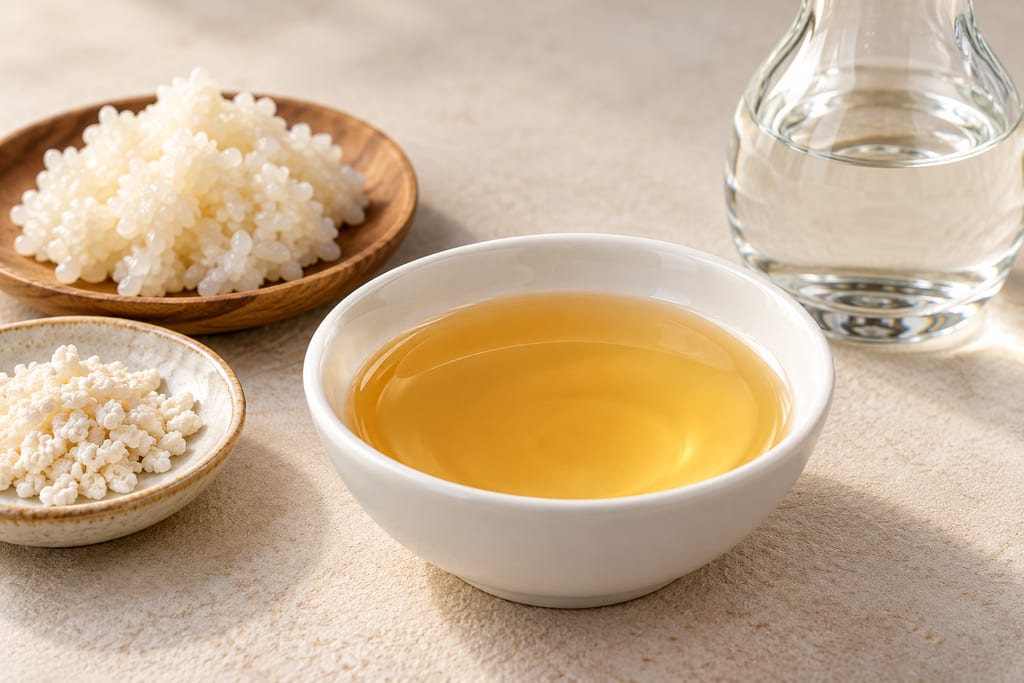
Mirin
Hon-mirin is a Japanese rice seasoning made by saccharifying glutinous rice with rice koji in shochu, then pressing and usually heating the mash.
 FermenteaWhere food goes to change
Traditional method
べったら漬け(べったらづけ) · Bettarazuke · Bettara zuke · Bettara pickle · べったら漬 · べったらづけ · ベッタラ漬 · 東京べったら漬 · Tokyo bettara-zuke · Tokyo bettara pickle · Koji-pickled daikon · Sweet koji daikon pickle
A sweet, crisp Japanese daikon pickle from Tokyo's Nihonbashi district, made by salting fresh radish and dressing it in rice koji, sugar or koji amazake without the heavy drying used for takuan.
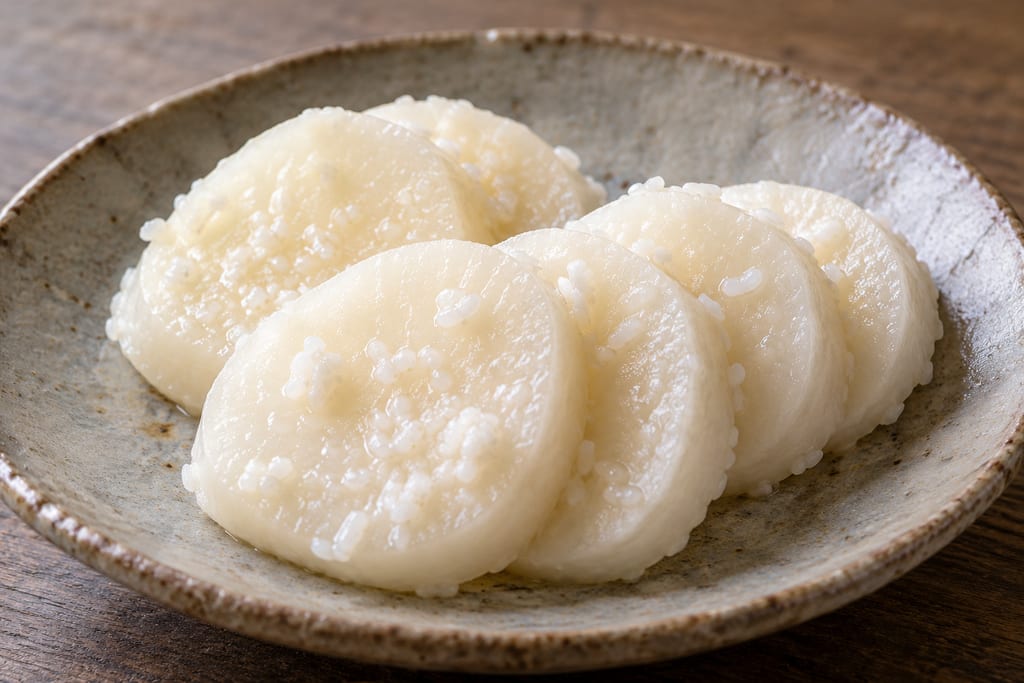
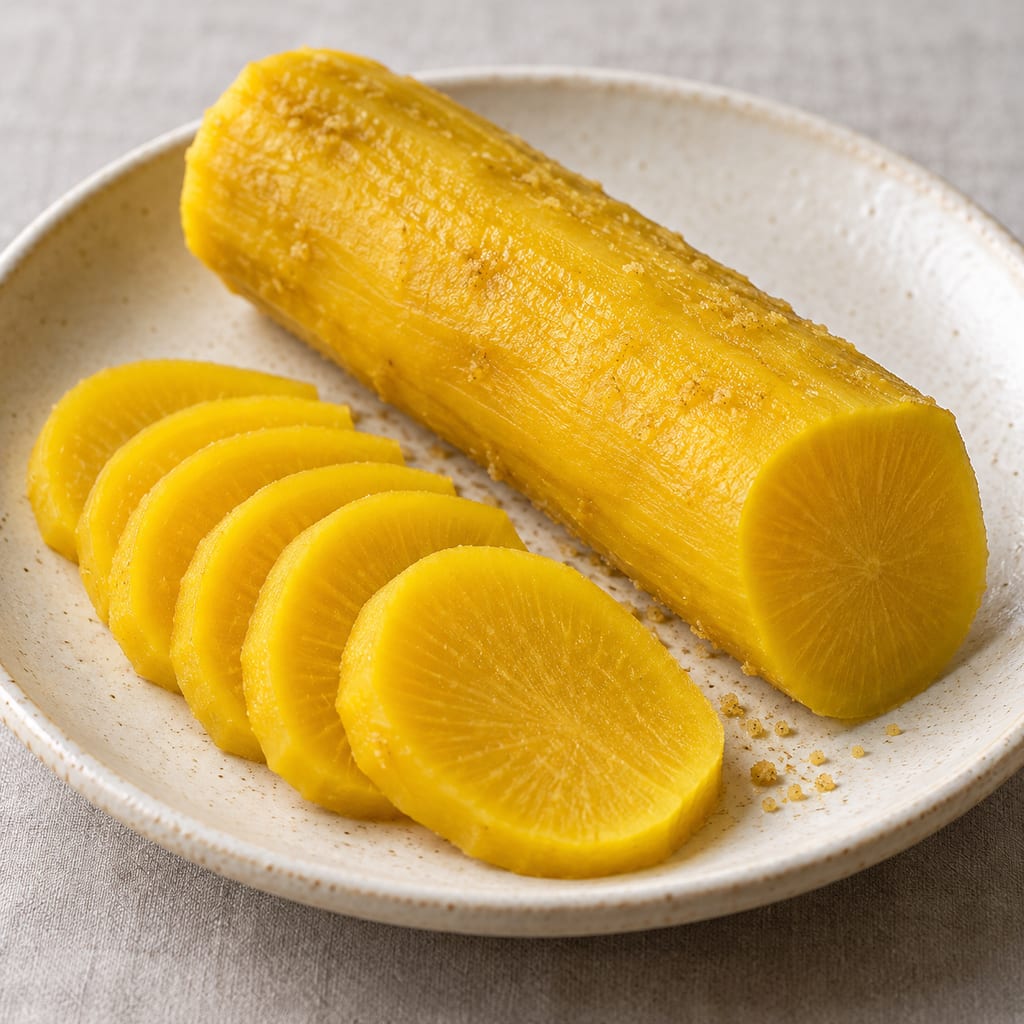
Bettara-zuke is a sweet Japanese pickle made from fresh daikon radish that has been salted to remove some of its water, then dressed or pickled in a sweet rice-koji mixture. It is particularly associated with Nihonbashi in Tokyo, where it has long been sold at an autumn market. The finished radish is usually pale, moist and crisp, with a sweet surface coating and a comparatively gentle saltiness. The Japanese name, べったら漬け, is commonly explained by the sticky coating of koji and sugar that clings to the radish.
The principal vegetable is Japanese daikon, Raphanus sativus Daikon Group. MAFF identifies white-necked daikon, 白首大根, as a common traditional choice. The rice used to make koji belongs to Oryza sativa. The principal cultivated organism responsible for producing the enzymes in rice koji is Aspergillus oryzae. This mould is grown on steamed rice before the rice koji is used in the pickle. It is not normally necessary or desirable to cultivate a new layer of mould directly on the raw radish.
Bettara-zuke belongs to the Japanese category of koji pickles, 麹漬け, but the word fermented requires qualification. Its essential preparation consists of salting, moisture movement, enzymatic sugar production and seasoning. Some versions undergo additional microbial activity, including acid production, while others are prepared rapidly under refrigeration. A pickle made with pre-sweetened koji amazake may require little further starch breakdown. A version using rice koji directly can allow additional enzyme activity in the dressing. Neither method establishes that the finished radish contains a large population of living lactic-acid bacteria.
The defining difference from most traditional takuan is the treatment of the radish. Bettara-zuke uses fresh radish that is not extensively dried. Takuan is historically associated with drying daikon and pickling it in a mixture containing rice bran and salt, although modern industrial takuan also includes undried and salt-dehydrated versions. Bettara-zuke preserves more of the fresh radish's moisture and is valued for its light, crisp bite rather than the denser texture of strongly dried pickles.
The sweet coating may contain rice koji, sugar, mirin, kombu and chilli. Some contemporary recipes replace the koji-and-sugar preparation with koji amazake. These ingredients are not interchangeable in their chemistry: sugar supplies sweetness directly, while rice koji supplies enzymes capable of producing sugars from rice starch. Mirin contributes sweetness, flavour and potentially alcohol, depending on the product. Kombu and chilli are optional seasonings, not the defining fermentation agents.
Bettara-zuke is normally eaten as a ready-to-eat pickle rather than cooked. Its moisture is high and its salt and acid levels vary, so a homemade version is not shelf-stable; the final pickling is done in the refrigerator and the pickle is eaten promptly.
Bettara-zuke is closely connected with the development of pickle selling in Edo, the city now called Tokyo. During the Edo period, urban households increasingly purchased prepared pickles rather than making everything themselves. Farmers and specialised sellers supplied the city with seasonal vegetables, salted foods and other preserved products. Daikon was an important crop, and the use of koji offered a way to make an appealing sweet pickle from the newly harvested roots. The history of pickled radishes in Japan is considerably older, but this wider history does not establish when the particular sweet pickle now called bettara-zuke was invented.
MAFF gives the traditional origin account: from around the middle Edo period, farmers sold lightly pickled daikon prepared with sweetener and rice koji at the festival market associated with Takarada Ebisu Shrine in Nihonbashi Odenmacho. The market served people buying supplies for Ebisu-ko, a commercial and religious observance associated with prosperity in trade. It took place around 19–20 October. The autumn timing was also connected with the beginning of the daikon harvest. The exact date when the sweet koji version was first sold is not established.
A more useful piece of written historical evidence occurs in the nineteenth-century Morisada Manko, a description of everyday customs in Edo and other Japanese cities. A passage reproduced by the Tokyo historical merchants' association describes newly pickled radishes being sold at the night market. It identifies preparations using salted, bran-treated daikon and notes that adding koji was considered especially desirable. This is valuable evidence for the association between the market and koji-enhanced radish pickles, but it is not a complete recipe for modern bettara-zuke.
The name of the market has a separately dated written attestation. The Seisenban Nihon Kokugo Daijiten cites the tenth issue of Fuzoku Gaho, published in 1889, as an early example of the name Bettara-ichi. The quoted passage describes a market selling lightly pickled takuan on the evening of the nineteenth. The passage shows the market name in use by 1889; it does not date the name's origin or list the ingredients of the pickles sold.
Several explanations survive for the name bettara. One derives it from the sticky koji dressing coating the radish. Another describes vendors calling out to customers and joking about getting the sticky pickle on their clothing. MAFF and local historical accounts preserve these explanations as traditions. Neither anecdote is a verified historical event. Both preserve the association between the pickle's sticky coating and the atmosphere of the autumn market.
The market and the pickle continued into the modern period. Tokyo Niitakaya traces its business origins to 1930, when its predecessor began selling prepared foods and pickles. Its company history records that the founders began producing bettara-zuke commercially after the Second World War and assisted the revival of the Nihonbashi Bettara Market in 1947. The market remains associated with Takarada Ebisu Shrine and is traditionally held on 19–20 October. Bettara-zuke is now manufactured and sold beyond Tokyo, but its cultural identity remains strongly attached to the old Nihonbashi festival.
Bettara-zuke develops through several different processes: salt-driven movement of water, changes in the radish's cellular structure, enzymatic conversion of starch in the koji dressing, movement of sugars and other dissolved substances, and sometimes additional microbial fermentation. These processes should be distinguished because the sweetness and texture of the finished pickle do not require all of them to occur simultaneously. In particular, a sweet pickle does not necessarily indicate substantial alcoholic or lactic-acid fermentation.
Initial salting establishes an osmotic gradient between the radish tissue and the surrounding liquid. Water moves out of the vegetable as salt enters its tissues. The loss of water changes cell turgor and makes the radish more pliable. Gentle pressure from a pickling weight encourages liquid release and maintains contact with the brine. The radish becomes easier to season, while retaining much of its natural moisture. Because bettara-zuke is not normally extensively dried, the finished texture remains considerably more succulent than that of heavily dried daikon pickles.
Rice koji introduces a different biochemical system. During koji manufacture, Aspergillus oryzae grows on cooked rice and secretes hydrolytic enzymes. Alpha-amylase, EC 3.2.1.1, breaks internal alpha-1,4 bonds in rice starch, generating smaller starch fragments. Glucoamylase, EC 3.2.1.3, releases glucose from starch-derived chains. The glucose contributes sweetness without requiring yeast to ferment it first. Proteases and peptidases can also release smaller peptides and amino acids from proteins in the rice. The effect depends on the enzyme activity remaining in the koji and the temperature, water content and composition of the dressing.
When the dressing is made as koji amazake, much of the starch conversion occurs before the radish is added. MAFF describes rice-koji amazake as a preparation in which enzymes release sugars from rice starch during a warm holding stage. A modern Pal System bettara-zuke recipe applies this principle directly, warming dried koji with sweetened liquid until the mixture thickens. After cooling, the sweet dressing is placed around salted radish in the refrigerator. The final pickling stage is therefore primarily a period of seasoning and equilibration rather than necessarily a vigorous microbial fermentation.
Sugar influences both flavour and the movement of liquid. Dissolved sugars increase the concentration of the surrounding pickling medium and can encourage further movement of water from the vegetable. The liquid produced by the radish also dilutes the dressing. As time passes, sweetness and saltiness become more evenly distributed through the cut surfaces. Mirin can contribute sugars and flavour compounds; kombu contributes glutamate and other soluble material. None of these ingredients creates a reliable antimicrobial barrier simply by being present.
Lactic-acid bacteria may occur, but their role is not established. MAFF warns that continued fermentation can make bettara-zuke more acidic, while its modern short recipe completes the final stage under refrigeration. A Tokyo agricultural research project conducted during 2015–2017 deliberately added freeze-dried Lactobacillus plantarum, now Lactiplantibacillus plantarum, to experimental bettara-zuke. It investigated bacterial survival and control of acidity during refrigerated storage. The addition of a selected culture was an experimental modification, not evidence that the species is the essential traditional starter.
Japan's food composition database reports lactic acid in analysed bettara-zuke, but a finished-food measurement does not identify the microorganism responsible, the stage at which the acid formed, or whether an individual product received added acid. Modern manufacturers also use vinegar or acidity regulators in some formulations. The principal classification is therefore enzymatic koji pickling, with microbial fermentation possible in particular methods.
Bettara-zuke is usually made in two stages. First, the radish is salted to draw out some moisture. Second, the partly dehydrated radish is combined with a sweet koji-based dressing. MAFF describes a traditional-style method in which white-necked daikon is washed, peeled, held in brine for two days, rinsed and placed into a mixture of koji, sugar, mirin and kombu for approximately five to seven days. It gives no complete measured formula. Other documented recipes have shorter times or use koji amazake instead of preparing the dressing from separate ingredients.
The daikon supplies the crisp vegetable body of the pickle. Its size, variety and initial water content affect how it responds to salting. Many recipes peel the radish because the skin can give a different texture and alter the appearance of the finished white pickle. Cutting lengthwise increases the surface available for salt and sugar movement and makes shorter domestic preparation possible. A traditional whole or half-radish preparation will not necessarily absorb seasoning at the same rate as thinly cut pieces.
Salt is added before the sweet dressing because the two stages serve different purposes. Salting releases water, changes tissue firmness and begins seasoning. In a measured producer recipe, Ise Sou specifies 2 kg peeled daikon, 70 g salt and 200 ml water for the initial stage, with two to three days of salting. Pal System instead uses approximately 1 kg daikon and 20 g salt, keeping it refrigerated for two days. These recipes have different moisture and salt conditions. The stated amount of salt applied at the beginning does not establish the final percentage remaining in the radish after draining.
Rice koji supplies enzymes and the characteristic grain aroma. Ise Sou's method combines 200 g koji with 200 ml mirin, 150 g sugar and 100 ml hot water for its dressing. Its instructions soften the koji before adding sugar. Pal System uses 100 g dried koji, 75 g sugar, 75 g mirin and 75 g warm water. The Pal System mixture is held warm for approximately two hours, then cooled before being placed around the radish. The warming stage favours the development of a sweet, thickened koji dressing; it should not be confused with a requirement to incubate the radish itself at that temperature.
An especially simple MAFF regional recipe uses one to one-and-a-half daikon radishes, 35 g salt, 300 g amazake and optional dried chilli. The radish is salted overnight under a weight, drained and lightly rinsed, then refrigerated with the amazake for two to three days. The radish weight and the amazake's sugar and moisture are not given, so the initial salt percentage cannot be calculated.
The type of amazake matters. Rice-koji amazake derives sweetness from enzymatic conversion of rice starch, whereas sake-lees amazake is commonly sweetened by adding sugar to diluted sake lees and may contain alcohol. The former is the relevant replacement for koji and sugar in a conventional bettara-zuke recipe. A substitution using sake-lees amazake would produce a different flavour and ingredient composition.
After the final dressing is added, clean containers and appropriate temperature control matter because the vegetable remains moist and is generally eaten without a cooking stage. Pal System specifies refrigerated final pickling for two to three days and recommends eating the finished pickle within approximately three to four days while refrigerated. Ise Sou describes a different preparation and longer refrigerated storage guidance. These instructions belong to their own recipes and do not combine into one universal process.
The principal historical association of bettara-zuke is Tokyo, especially the Nihonbashi district. The traditional product is a lightly salted, sweetly dressed, comparatively white radish pickle. MAFF places it among Tokyo's representative pickles, alongside takuan. It describes older production using white-necked daikon and a koji dressing containing sugar, mirin and kombu. The recipe varies among households and manufacturers, so the historical identity is better defined by the combination of fresh daikon, initial salting and sweet koji pickling than by a single fixed ingredient ratio.
The radish itself has varied. MAFF discusses Tokyo's historical Nerima daikon and Tokoji daikon traditions, while identifying white-necked daikon as common in contemporary bettara-zuke preparation. These roots differ in size, flavour and texture. Modern producers may source radishes from multiple Japanese growing regions according to season. Tokyo Niitakaya explicitly describes collecting suitable domestically grown daikon from different parts of Japan for its product. A pickle sold as Tokyo bettara-zuke therefore does not necessarily contain radish grown in Tokyo.
Preparation methods also vary. Some recipes salt the radish directly, while others use brine. Some briefly dry the salted surface before adding the koji mixture, but this is not equivalent to the extensive drying historically used for takuan. A traditional-style dressing may contain separate rice koji, sugar, mirin and kombu. A simplified modern dressing may use ready-made koji amazake. Consumer-cooperative recipes also describe controlled warming of dried koji to create sweetness before refrigerated pickling.
The name has spread beyond Tokyo. A Japanese court judgement issued in 2011 records commercial products advertised using regional descriptions including Kishu bettara-zuke, Kyoto bettara-zuke, Higo bettara-zuke and Hokkaido bettara-zuke. These are evidence of modern regional branding and manufacture rather than proof that all the named regions maintained independent Edo-period bettara traditions. Contemporary producers in Niigata and Hyogo also make products labelled bettara-zuke.
Commercial composition now differs substantially between manufacturers. Masuko, a Niigata pickle producer, publishes specifications for bettara-zuke products containing daikon, sugars, rice koji, salt and additional ingredients such as vinegar, hydrolysed protein, alcohol, acidity regulators and sweeteners. One product specification gives approximately 3.0% salt, pH 4.5 and 15.0 degrees Brix. Other products from the same manufacturer have different acidity and sugar specifications. These numbers describe particular commercial products with controlled formulations, not a universal specification for traditional bettara-zuke.
Tokyo Niitakaya also offers citrus variations, including yuzu bettara-zuke. Its contemporary product history documents low-temperature production and packaged versions suitable for modern retail distribution. The company assisted the postwar revival of the Nihonbashi market in 1947, linking its commercial products with the older seasonal tradition. A modern cherry-blossom variation has also been described in Japanese food trade reporting. These flavoured products are current adaptations, not evidence for equivalent ingredients in nineteenth-century versions.
Bettara-zuke is distinct from sagohachi-zuke, nara-zuke and takuan. Sagohachi uses a salt, rice and koji bed; nara-zuke uses sake lees and often undergoes repeated long pickling stages; and traditional takuan is associated with radish drying and rice-bran pickling. The overlapping use of koji or daikon does not make their microbiology, texture or storage characteristics interchangeable.
Bettara-zuke is usually eaten cold or at ambient serving temperature as a side pickle. The simplest serving method is to cut the radish into slices and place it alongside rice and other dishes. MAFF recommends leaving the rice-koji coating on the radish instead of washing it away. The coating is an intended part of the flavour, supplying sweetness and a mild grain aroma. Because the pickle remains moist and crisp, relatively thick slices are common, although narrower pieces are convenient when served with several other pickles.
In Japanese meals it can appear among tsukemono, the small pickled accompaniments that contrast with cooked rice, soup, fish, meat and vegetables. Its sweet taste distinguishes it from a strongly salted vegetable pickle or a sour lactic-fermented pickle. It can balance savoury preparations, but it is not intended to supply the intensity of soy sauce or miso. A relatively small serving may be sufficient because both salt and sugar are already present in the dressing.
MAFF also identifies bettara-zuke as an accompaniment to tea and alcohol. The crisp vegetable provides a change of texture between sips, while the sweet koji coating contributes a different taste from the saltier snacks commonly served with drinks. These uses are not separate recipes. They are established ways of serving the finished pickle, usually sliced immediately before eating.
The pickle has a strong seasonal association with autumn. The Nihonbashi Bettara Market takes place around the October Ebisu-ko observance and is associated with the arrival of newly harvested daikon. Bettara-zuke was therefore historically a seasonal food, although refrigerated production, distribution and commercial sourcing now make it available throughout the year. Contemporary stalls and shops offer both whole or large radish pieces and smaller packaged portions.
The texture of the dressing influences preparation for serving. Traditional koji-rich products may leave grains adhering to the radish, while some modern packaged versions have a smoother or more fluid coating. MAFF's traditional-food description advises eating the coating, but individual commercial manufacturers sometimes recommend briefly rinsing their products. Masuko gives such advice for particular packaged bettara-zuke products. The manufacturer's instructions should take precedence for its own product, while homemade traditional-style pickle can ordinarily be served with its intended koji dressing.
Modern producers offer sliced, bite-sized and whole-radish formats, as well as citrus-flavoured versions. These are convenient serving variations rather than different fundamental fermentations. Additional use in sandwiches, mixed rice or salads is possible as a modern adaptation, but they are not established Edo-period dishes.
Bettara-zuke is a ready-to-eat raw vegetable preparation, so clean handling after opening is important. Its sweet flavour does not mean that it is free of sodium, and the presence of rice koji does not make it automatically probiotic. Some commercial products contain wheat or soy-derived hydrolysed protein, while traditional domestic versions using only daikon, rice koji, salt and sugar need not. Allergen information must therefore follow the actual recipe or product label.
Bettara-zuke is not one chemically standardised product. MAFF describes a traditional version with a long salted and koji-pickled process and a regional version using amazake with a much shorter refrigerated final stage, and Japanese koji makers and consumer organisations publish further measured formulas. Salt levels, sweetening ingredients and maturation conditions all vary.
The microbiology requires particular caution. The presence of rice koji shows that Aspergillus oryzae was used to produce enzymes on rice. It does not prove that actively growing Aspergillus is present during the final vegetable pickling stage. Likewise, a product becoming acidic does not establish which microorganisms were responsible. Lactic-acid bacteria may grow in some preparations, but the short refrigerated methods are not designed around a documented spontaneous lactic-acid fermentation with a specified pH endpoint.
A Tokyo agricultural research project (fiscal 2015 to 2017) tested adding live lactic-acid cultures to traditional Tokyo pickles. For bettara-zuke, freeze-dried Lactobacillus plantarum was added to a prepared sweet pickle, and bacterial survival and acidity were followed during storage at 10°C for 14 days at different starting counts and seasoning-liquid sugar concentrations. Viable lactic-acid bacteria could be maintained while excessive acid development was controlled. The product was deliberately inoculated, so the result does not describe the natural microbial ecology of traditional bettara-zuke.
In that work, seasoning-liquid sugar concentration and initial lactic-acid bacterial count affected later acidity. This is important because sweetness is not only a flavour property: sugar concentration changes the environment in which microorganisms operate. Nevertheless, neither a Brix measurement nor the existence of lactic acid independently proves that a particular batch is safe. Sugar concentration, salt concentration, acidity, water activity and microbial contamination need to be evaluated together.
Japan's Standard Tables of Food Composition provide analytical data for the general product category. The listed bettara-zuke contains 83.1 g water and approximately 0.1 g lactic acid per 100 g edible portion. These are representative composition values, not specifications for every recipe. They also cannot establish whether lactic acid was produced by natural fermentation, added as part of seasoning or introduced through another ingredient. Commercial producer specifications show further variation: Masuko lists different bettara products with pH values around 4.2–4.5 and differing sugar content. Those figures must remain attached to the products analysed.
Food safety is a significant concern because bettara-zuke is commonly eaten without heating. Japan's Ministry of Health, Labour and Welfare treats lightly pickled vegetables as foods requiring strict hygiene and cold-chain controls when no validated preservation process is present. Its pickle hygiene guidance discusses washing, contamination prevention, low-temperature handling and controls for raw vegetables. The importance of these measures was reinforced by a serious 2012 outbreak of enterohaemorrhagic Escherichia coli O157 linked to a different lightly pickled vegetable product in Hokkaido. This outbreak was not attributed to bettara-zuke, but demonstrates why salting and refrigeration cannot be assumed to eliminate pathogenic organisms.
Producer instructions differ widely. One recipe uses fresh koji, another dried koji, and another prepared amazake. Some mature the pickle in a cool room while others refrigerate from the beginning. One producer describes a two-week refrigerated storage period, while Pal System advises consuming its preparation within approximately three to four days. These are formulation-specific instructions. The longer period should not be transferred to a short, low-salt recipe without evidence that the products have equivalent composition and microbiological stability.
Salt concentration, Brix, pH, water activity, microbial counts, lactic acid, ethanol and soluble sugars differ between recipes, and no study has measured them together for a clearly identified home recipe or compared raw rice koji with pre-saccharified amazake. No dated primary record lists the pickle's ingredients before the late nineteenth century. Bettara-zuke is best described as a sweet koji pickle with possible secondary fermentation, not a standardised probiotic lactic-acid ferment.
MAFF gives a traditional origin from the middle Edo period, when farmers sold sweet koji-pickled radish at the Takarada Ebisu Shrine market in Nihonbashi. The nineteenth-century Morisada Manko describes the market and notes that adding koji was especially desirable, and an 1889 issue of Fuzoku Gaho uses the name Bettara-ichi. None of these dates the pickle's invention.
Yield 1 daikon radish · Scaling: source batch only
Bettara-zuke is generally eaten without a cooking step. Vegetables can carry microorganisms from soil, water and handling. Light salting and short refrigerated pickling do not constitute a validated pathogen-killing process. Japanese hygiene guidance identifies microbiological contamination as a particular concern for lightly pickled vegetables.
Hazard sourceThis recipe does not intentionally establish a controlled lactic-acid fermentation. No final pH or titratable acidity target is given. A sweet flavour, the presence of rice koji or successful thickening of the dressing cannot establish that the finished pickle is microbiologically stable.
Hazard sourceThe recipe applies salt at 2% of the original daikon weight, but some dissolved salt is subsequently lost in the expelled liquid. The final salt concentration is not measured and must not be treated as a validated preservation threshold.
Hazard sourceThe final pickle remains moist and is not subjected to a validated preservation process. Storage at inappropriate temperatures can permit growth of harmful microorganisms. Both vegetable pickling stages are done in a refrigerator.
Hazard sourceDirty preparation surfaces, knives, utensils, bags or hands can transfer microorganisms to the raw radish or finished ready-to-eat pickle. Japanese lightly pickled vegetable guidance requires attention to washing, cleaning, disinfection and handling.
Hazard sourceThe selected Aspergillus oryzae used to manufacture rice koji is different from unidentified mould developing on stored radish or its dressing. Fuzzy growth, abnormal odours or unexpected slime can indicate deterioration. Removing visible growth does not validate the remaining product as safe.
Hazard sourceThe recipe contains mirin, but does not specify its alcohol concentration or the alcohol concentration of the finished pickle. Warming the dressing is not proof that all alcohol has evaporated. The result should not be assumed to be alcohol-free.
Hazard sourceThe finished pickle is meant to be eaten within about 3 to 4 days while refrigerated. Longer periods given for other formulations or commercial packaged products are not validated for this recipe.
Hazard sourceCommercial formulations can include vinegar, acidity regulators, alcohol and other ingredients and may be manufactured under tested microbiological specifications. The pH and shelf life of those products cannot be transferred to a homemade koji pickle.
Hazard sourceUse fresh daikon and wash it thoroughly under clean running water before peeling and cutting. Prevent soil and other debris from entering the pickle.
Control sourceApply the specified salt quantity by prepared radish weight rather than an arbitrary amount.
Control sourceCarry out the initial salting in a refrigerator, with the radish contained in a suitable clean food-contact bag.
Control sourceUse food-grade prepared dried rice koji rather than attempting uncontrolled mould cultivation on cooked rice.
Control sourcePrepare the sweet dressing using the published ingredient quantities and separate warm-holding stage.
Control sourceAllow the warm koji dressing to cool before applying it to the salted radish. Use clean equipment and a fresh bag for the final stage.
Control sourceRefrigerate throughout the final pickling stage rather than allowing spontaneous room-temperature fermentation.
Control sourceMaintain a refrigerator temperature within the general recommended household food-safety range and verify it with a thermometer.
Control sourceKeep the completed pickle in its dressing under refrigeration and eat it within the stated period.
Control sourceDiscard the pickle if fuzzy mould, abnormal odour, unexpected slime or other clear signs of spoilage develop.
Control sourceThis is a short refrigerated koji pickle, not a validated room-temperature lactic-acid fermentation.
The 2% salt quantity is the salt applied to the raw radish and is not the final salt percentage.
No verified final pH, water activity, Brix value or microbiological acceptance criterion exists for this recipe.
The warm koji-dressing stage is enzymatic saccharification and is not a validated pasteurisation step.
About 60 °C is given for the warmed liquids; no measured temperature profile covers the whole rice-cooker hold.
Do not substitute raw rice, rice flour or koji starter spores for dried rice koji.
Do not substitute sake-lees amazake for rice koji; it makes a different formulation.
Do not apply the longer maturation or storage times of other producers, MAFF's alternative method or commercial makers to this recipe.
Koji does not make the pickle probiotic or give it a predictable population of beneficial microorganisms.
Commercial bettara-zuke containing added acid or other preservatives cannot validate homemade storage conditions.
The recipe contains mirin, and the final alcohol concentration is unknown.
This ready-to-eat pickle has no final cooking step to remove contamination introduced during cutting, handling or packing.
Fresh appearance and pleasant flavour do not prove microbiological safety.
Hon-mirin is a Japanese rice seasoning made by saccharifying glutinous rice with rice koji in shochu, then pressing and usually heating the mash.

Rice koji is steamed white rice through which koji mold has grown. It carries the enzymes that turn rice starch into sugar, and it is the starting point of sake, sweet miso, amazake and shio koji.
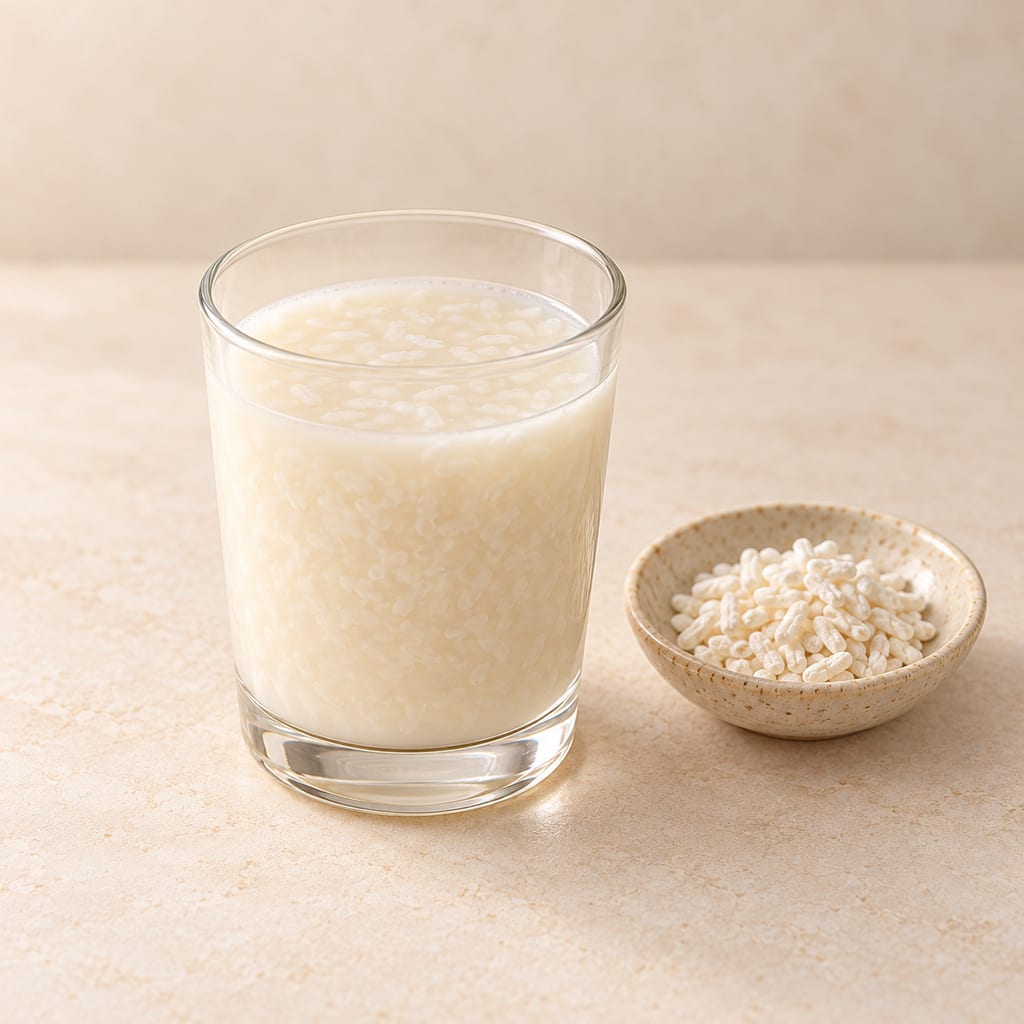
Cooked rice, rice koji and water are held warm for hours so koji enzymes turn the rice starch to sugars, giving a naturally sweet Japanese drink with no added sugar and no second fermentation.
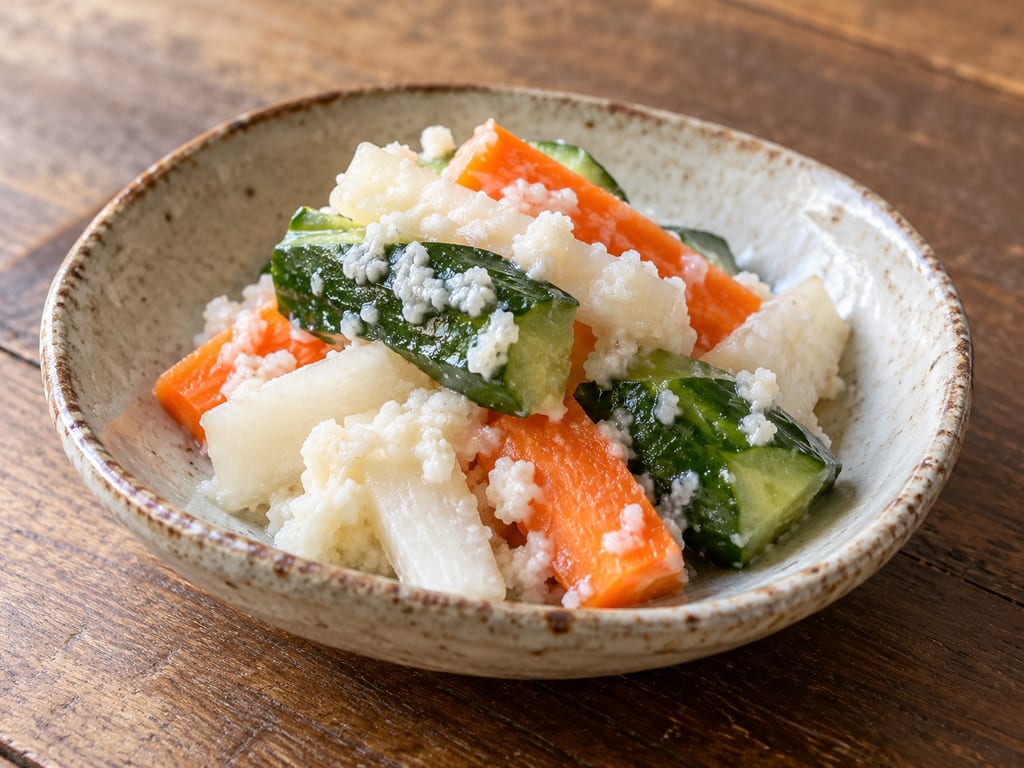
A traditional Japanese koji pickle from the Tohoku region: vegetables pickled in a matured bed of cooked rice, rice koji and salt, where koji enzymes bring sweetness alongside the salt.
Daikon is dried until pliable, then layered in seasoned rice bran and pressed for a long fermentation.

Traditional Japanese sake yeast starters made from steamed rice, rice koji and water, acidified by naturally growing lactic acid bacteria. Kimoto grinds the rice mash with paddles; yamahai omits that step.
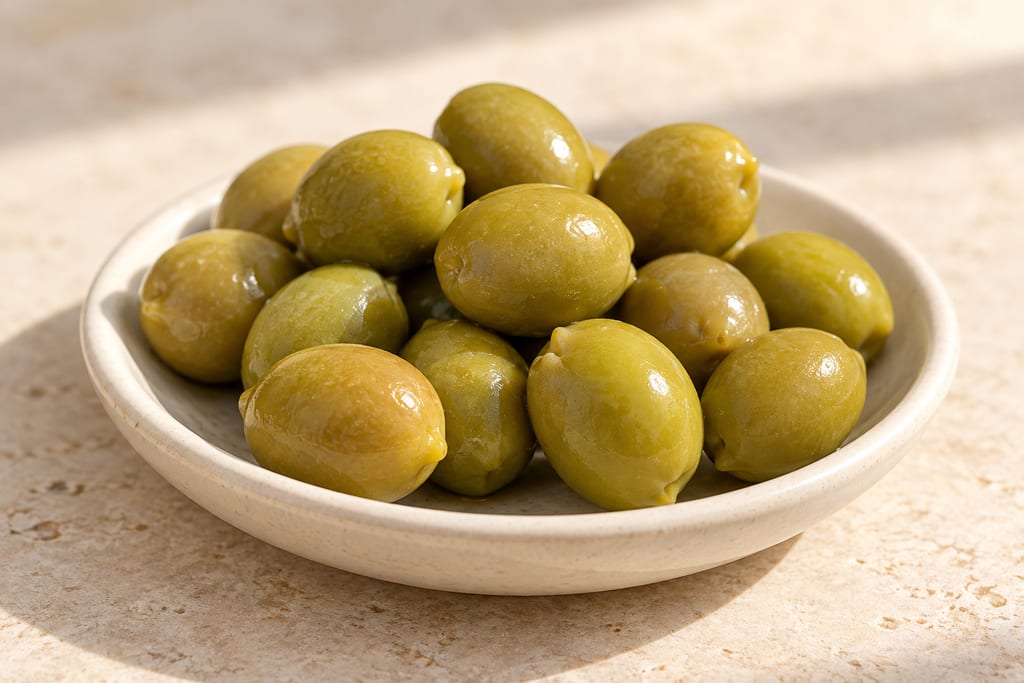
A Portuguese table-olive product from the Negrinha cultivar in northeastern Portugal, sold in three commercial styles, two of them brined fermentations and one oxidised to black.
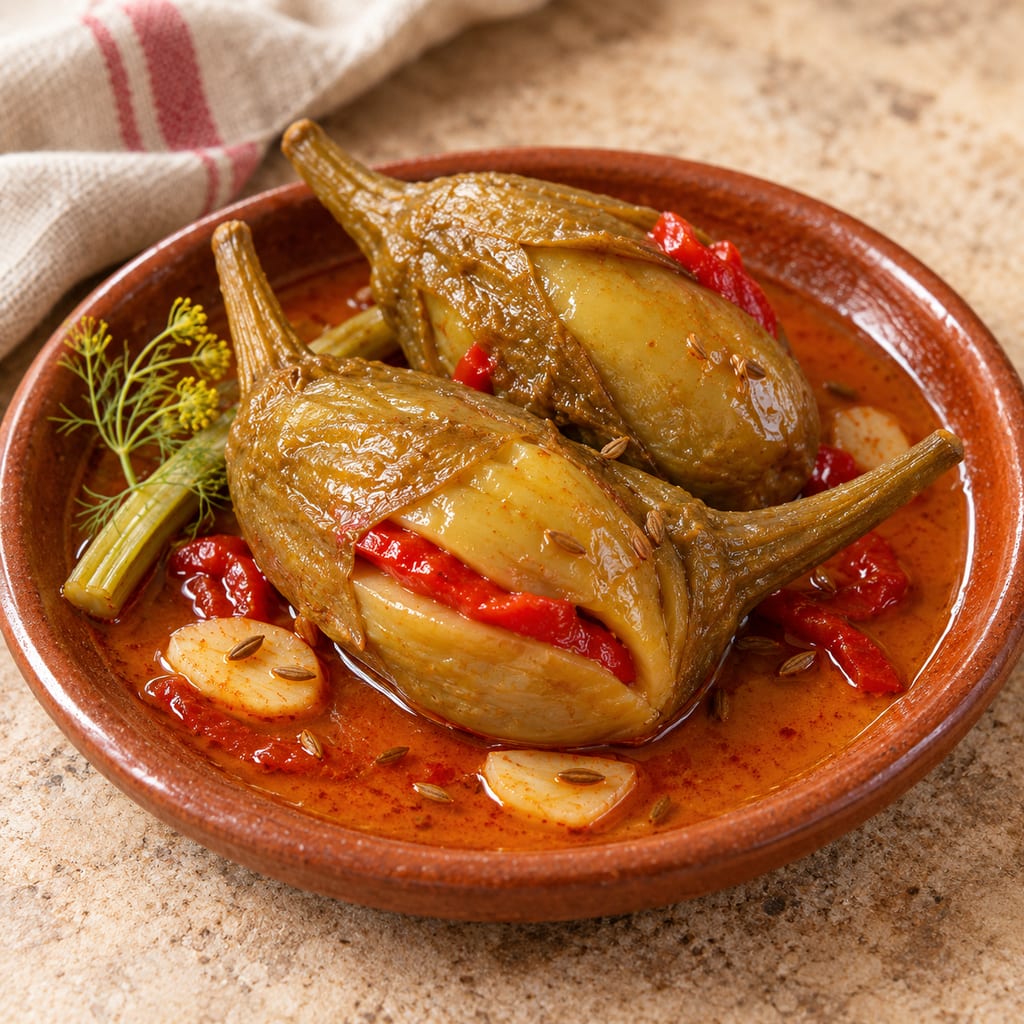
A protected aubergine preserve from Ciudad Real in Spain: tender fruit of the local Dealmagro variety, cooked briefly and then fermented in a vinegared, paprika-seasoned dressing.
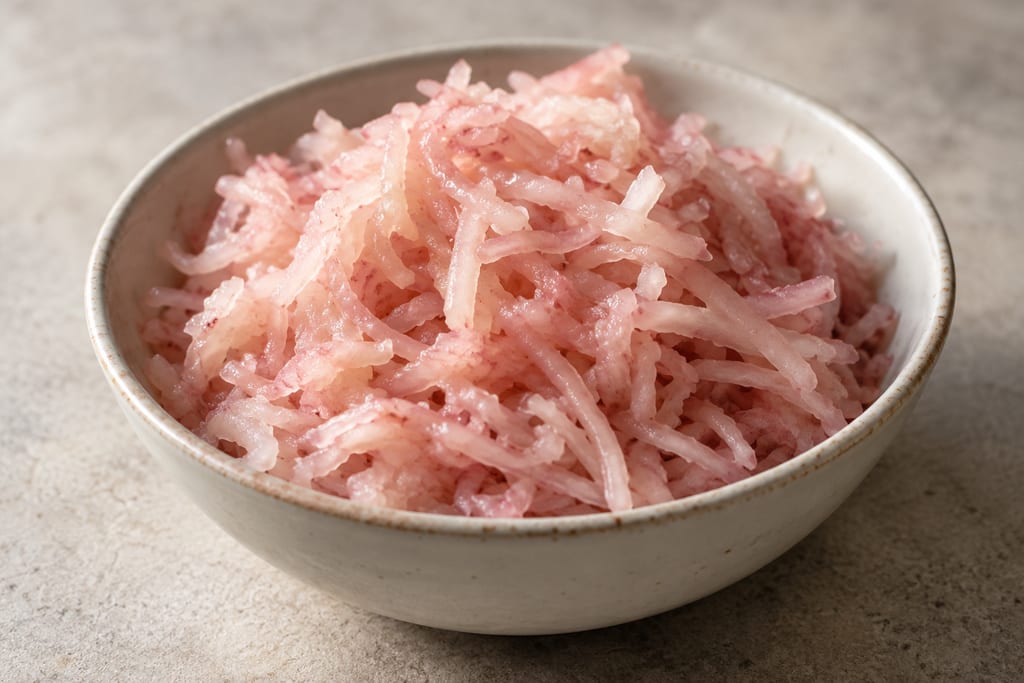
Source-specific Brovada DOP producer method for Friuli Venezia Giulia turnips and red-grape marc. This records a regulated producer process; it is not a validated home-scale recipe.
An industrial fermentation patio places factory-made fiberglass-reinforced polyester olive tanks below floor level, with drainage and transfer infrastructure arranged around the buried vessels.
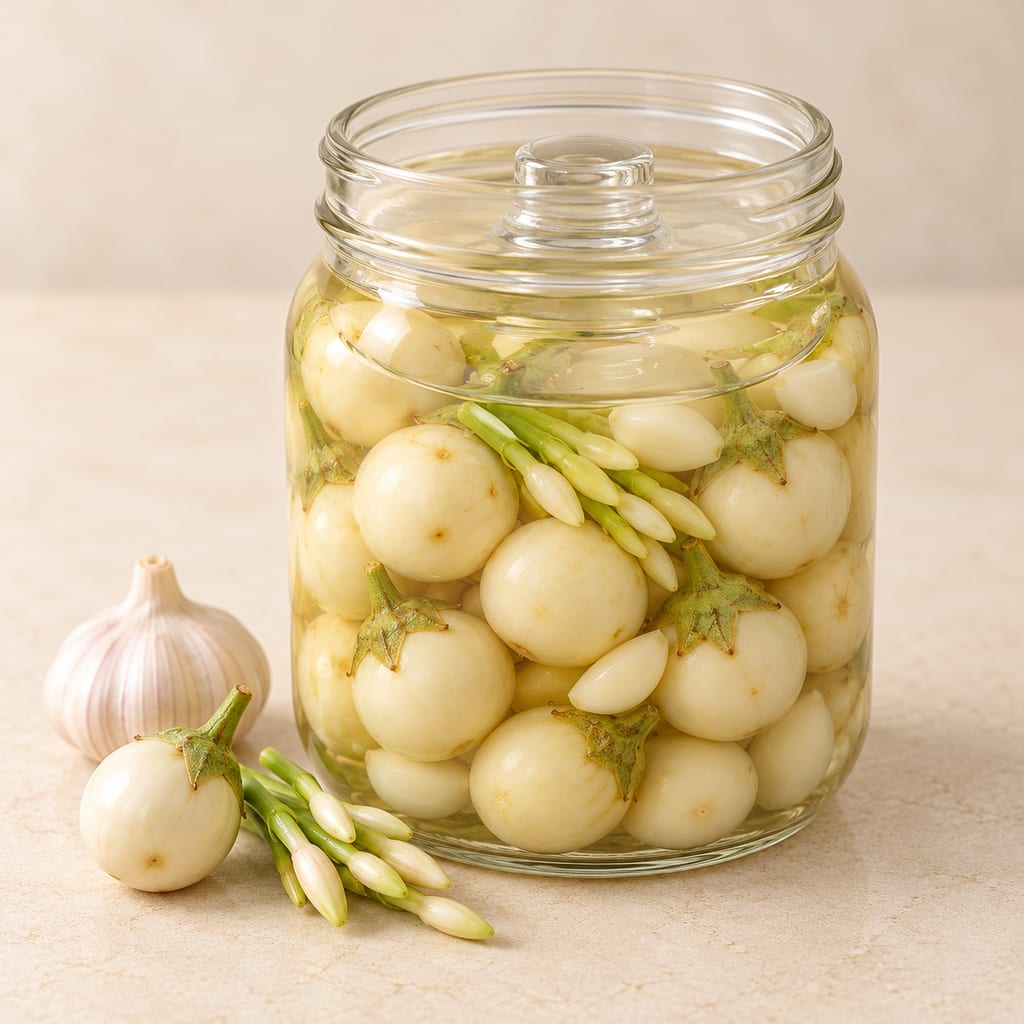
Vietnamese salted and fermented small eggplant, dried on the day of purchase, then held submerged in warm salty water with garlic and galingale flower for a week or longer.
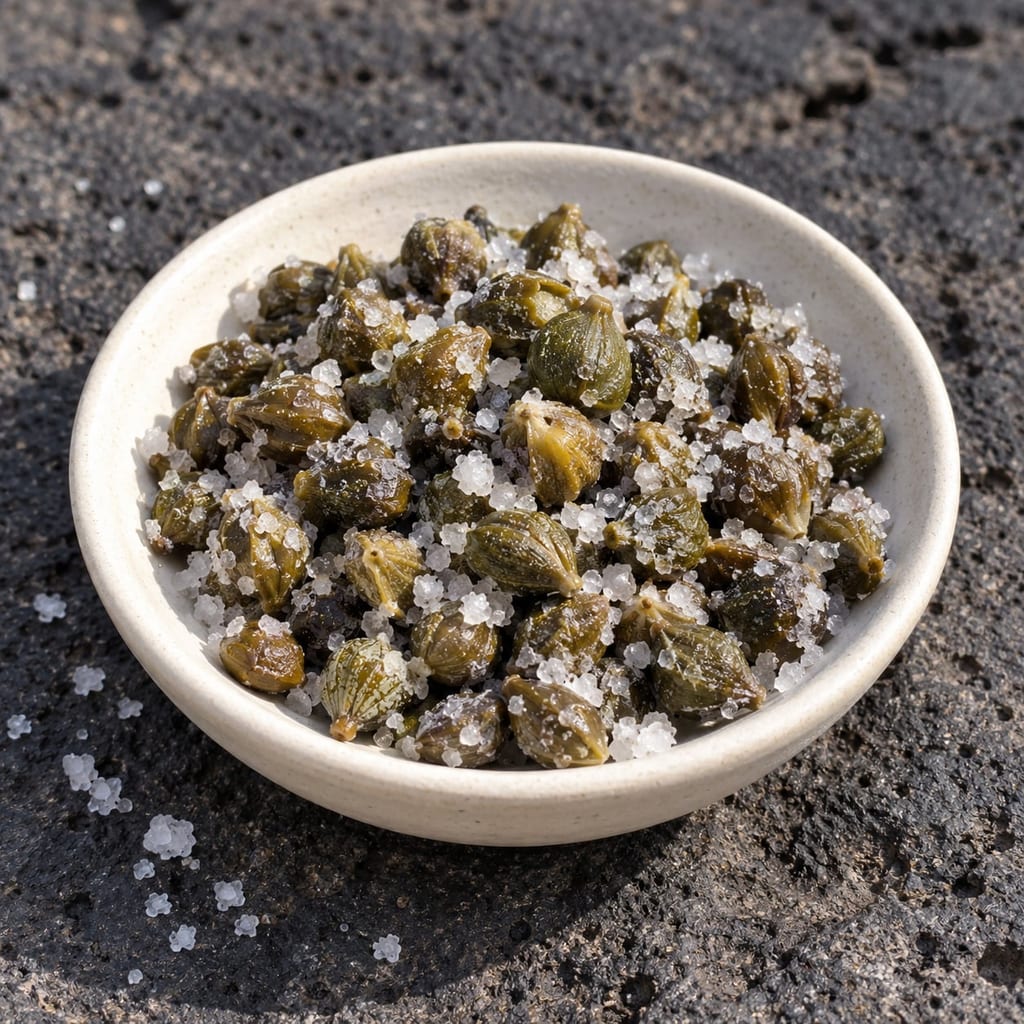
A protected Sicilian product: unopened caper buds from the island of Pantelleria, dry-salted with sea salt in a two-stage process that encourages lactic fermentation.
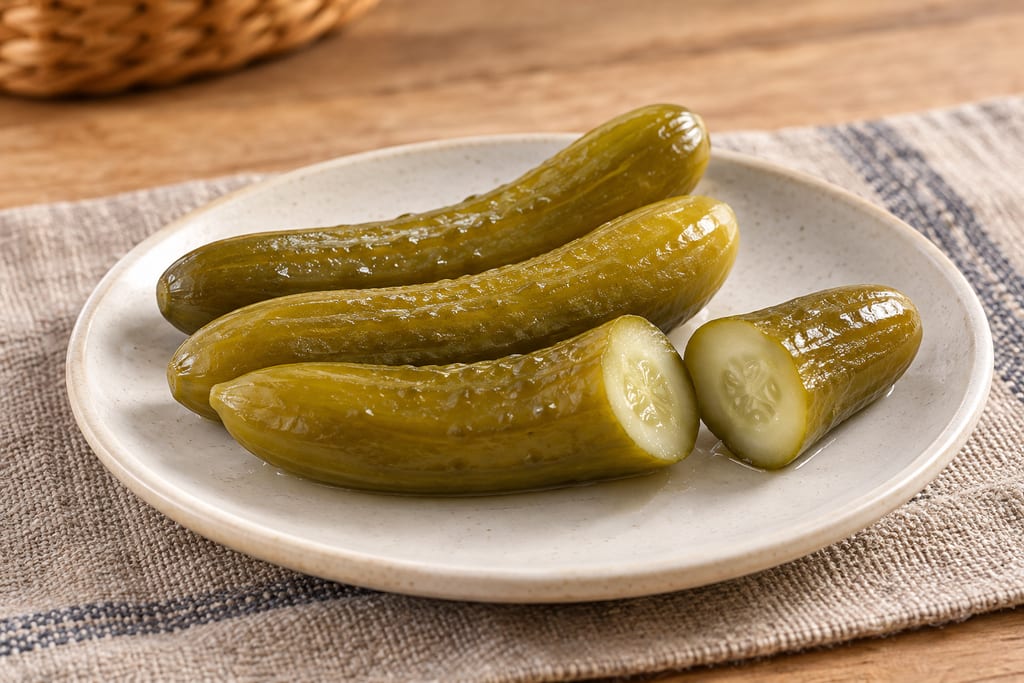
Çubuk turşusu is a registered pickle from Çubuk district in Ankara. Its cucumber variant is sold as Salatalık Turşusu, and a commercial specification sets its brine and room-temperature period.
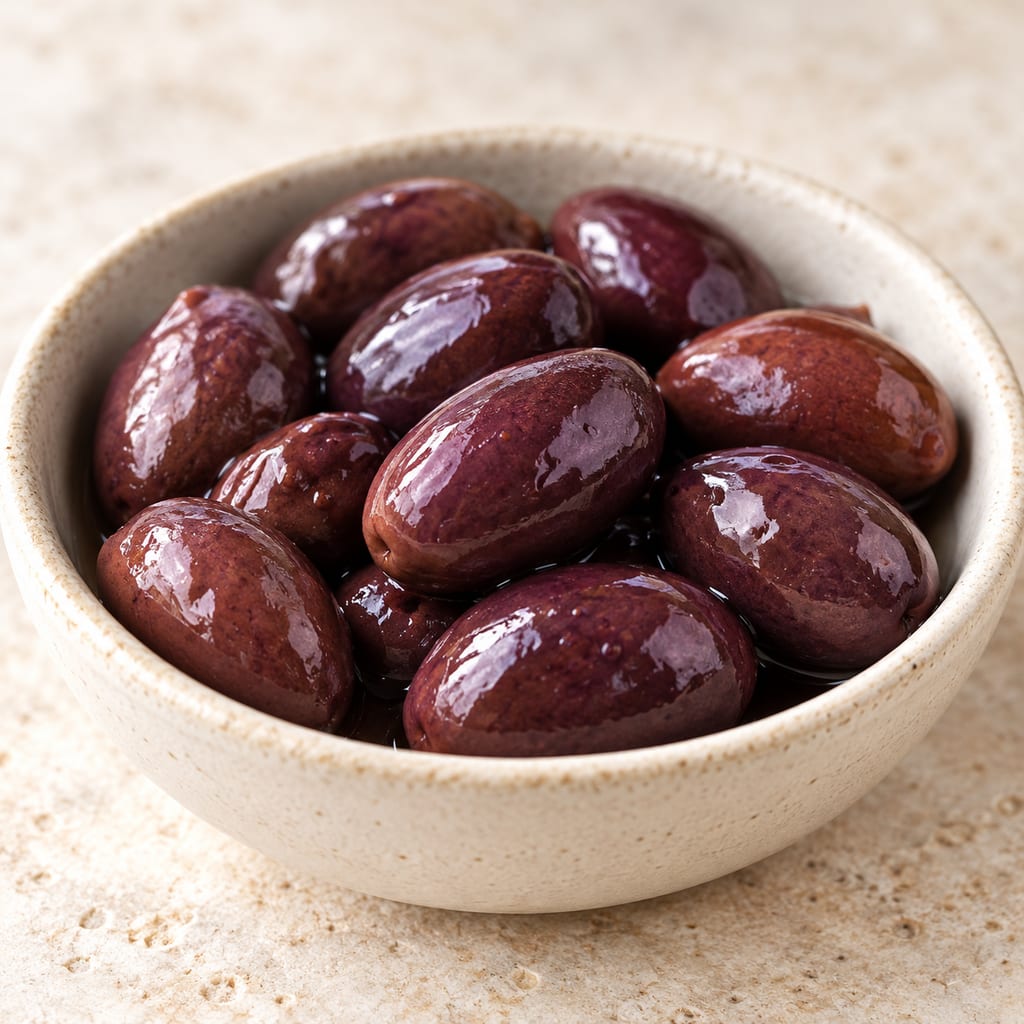
Elia Kalamatas is a Messinia table olive of the Kalamon variety, picked before full ripeness and fermented in brine for six to nine months; it is a PDO product, not a generic black olive.

A gelling polysaccharide extracted from red seaweeds, sold as kanten strips or powder; it sets firm at a low concentration and stays solid until about 85 °C.

A Dominican table and seasoning condiment of sour orange juice, mixed with lime and salt and bottled raw; garlic, oregano or a hot pepper may be added for meat or a spicier bottle.

Cicerbita alpina is an alpine perennial whose tender shoots and leaves have been eaten raw or cooked. Sámi milk preparations and modern Carnian dishes are distinct uses, with serious identification and preservation limits.

Japanese skipjack tuna cooked, then repeatedly smoked and dried over a wood fire by the hand-fired tebiyama method into a hard block for shaving into dashi: the first stage of katsuobushi.

A Swedish-style spirit vinegar made by fermenting neutral alcohol with live vinegar bacteria, with a separate guide to commercial ättika strengths.

A yeast-raised wheat ring shaped from a firm dough, briefly boiled and baked. This source-batch formula gives a gently malted crust and a chewy crumb.

A warm dip of garlic, anchovy and olive oil, often enriched with butter, that Piedmont serves over a flame with raw and cooked vegetables and bread.

Bechamel is a white sauce of milk thickened with a butter and flour roux, one of the French mother sauces, and the base from which Mornay and other cheese and cream sauces are made.
No community contributions have been published for this entry yet.
Sign in to contribute. Published comments and photos are free to read.
Pal System Consumers' Co-operative Union, Daidoko LogMethod · Science
べったら漬けPrimary measured homemade bettara-zuke recipe
Approximately 1 kg daikon radish
20 g salt, specified as 2% of the radish weight
100 g dried rice koji, 75 g sugar, 75 g mirin and 75 g warm water
Peeling and cutting the daikon into large pieces
Initial refrigerated salting for two days
Preparing the sweet koji dressing in a rice cooker
Warming the mirin-and-water mixture to approximately 60°C
Keeping the koji dressing warm for approximately two hours
Cooling the dressing before combining it with the radish
Refrigerated final pickling for two to three days
Keeping the pickle in its dressing under refrigeration
Consumption recommended within approximately three to four days
Finished product and preparation-stage photographs
Cited in: What it is; How it works; How it is made and why each ingredient and step matters; Reading results and problems
Ministry of Agriculture, Forestry and Fisheries of JapanMethod · History · Use
べったら漬け 東京都Tokyo regional identification of bettara-zuke
Historic connection with the Nihonbashi autumn market
Salted daikon subsequently pickled with rice koji and sugar
Alternative measured recipe using one to one-and-a-half daikon radishes, 35 g salt and 300 g amazake
Initial overnight salting under a weight
Draining and lightly rinsing before the final stage
Final refrigerated pickling for two to three days
Possible increase in sourness during continued fermentation
Historical use as an accompaniment to rice
Photograph of finished bettara-zuke
Cited in: What it is; History; How it works; How it is made and why each ingredient and step matters; Regional and historical variations; How it is eaten and used; Reading results and problems
Ministry of Agriculture, Forestry and Fisheries of JapanHistory · Method · Use
べったら漬け(べったらづけ)Official traditional-food description
Association with Nihonbashi and Takarada Ebisu Shrine
Traditional origin account dating to the middle Edo period
Annual Bettara Market on 19–20 October
General process using white-necked daikon
Initial brine salting for approximately two days
Final pickling with koji, sugar, mirin and kombu for approximately five to seven days
Alternative use of prepared amazake
Difference from heavily dried takuan
Characteristic sweetness, moisture and crispness
Serving without washing away the rice-koji coating
Cited in: What it is; History; How it works; How it is made and why each ingredient and step matters; Regional and historical variations; How it is eaten and used; Reading results and problems
Ise Sou, manufacturer of Miyako KojiMethod · Variation
べったら漬けIndependent producer's measured bettara-zuke recipe
2 kg peeled daikon and 70 g salt for initial salting
200 ml water added during initial salting
Initial salting for approximately two to three days
200 g rice koji, 200 ml mirin, 150 g sugar and 100 ml hot water in the seasoning mixture
Use of 70°C water in this version of the recipe
Maturation of the final pickle for approximately two to three days
Producer-specific refrigerated storage recommendation of approximately two weeks
Evidence of substantial differences between producer formulations
Ise SouMethod · Variation
麹の食レシピAlternative mobile-page version of the producer's bettara-zuke instructions
2 kg daikon, 70 g salt, 200 ml initial water and 200 g rice koji
150 ml mirin and 150 g sugar in this version
100 ml water at approximately 60°C
Koji dressing held for approximately two to three hours
Two-to-three-day initial salting and final pickling periods
Documented inconsistency between the manufacturer's separate recipe pages
Need to preserve the exact quantities associated with each version
Ministry of Agriculture, Forestry and Fisheries of JapanScience
塩漬けDistinction between dry salting and brine salting
Osmotic removal of water from vegetable tissue
Differences in salt distribution between salting methods
Importance of initial salting in traditional pickling
Salt application as a process step rather than a direct measurement of final product salinity
Cited in: How it works
All Japan Pickles Cooperative FederationContext
漬物の種類Classification of bettara-zuke as a koji pickle
Definition of koji pickles using koji and optional sugar, mirin or other seasonings
Distinction between koji pickles and rice-bran, sake-lees and vinegar pickles
Bettara-zuke as a representative Tokyo koji pickle
All Japan Pickles Cooperative FederationSafety · Context
よくあるご質問Distinction between fermented pickles and pickles flavoured primarily by seasoning liquid
Importance of salt concentration and preparation method for storage duration
Short refrigerated storage recommendations for lightly pickled vegetables
General home-pickling guidance
Recommendations for discarding pickles with fuzzy mould, abnormal odours or unexpected slime
Explanation that commercial pickle shelf life varies by formulation
Commercial use of added alcohol in some pickle products
Cited in: What it is; How it is eaten and used; Reading results and problems
Ministry of Health, Labour and Welfare of JapanSafety
漬物の衛生規範の改正等についてJapanese hygiene guidance for commercially manufactured lightly pickled vegetables
Microbiological hazards associated with raw vegetable pickles
Importance of washing raw vegetables and excluding soil and foreign matter
Cold handling and storage at 10°C or below in the specified manufacturing guidance
Commercial disinfection and temperature-control requirements
Need to prevent contamination during cutting and packing
Distinction between regulated production controls and a domestic recipe
Absence of a guaranteed pathogen-killing step in ordinary light pickling
Tokyo Metropolitan Agriculture and Forestry Research CenterScience
乳酸菌を利用した漬物加工技術に関する研究Research conducted during fiscal years 2015–2017
Experimental bettara-zuke supplemented with freeze-dried Lactobacillus plantarum
Use of commercial seasoned daikon rather than a reconstruction of the historic recipe
Experimental initial bacterial counts of 1.5 × 10^7 and 1.5 × 10^8 CFU/g
Seasoning-liquid Brix values of 20, 25 and 30
Storage experiment at 10°C for 14 days
Effects of starter concentration and sugar concentration on acidity
Evidence that deliberate lactic-acid bacterial inoculation is a modern experimental modification
Importance of separating measured experimental results from the microbiology of spontaneous traditional preparations
Cited in: How it works; Reading results and problems
Masuko Co., Ltd.Variation · Safety
樽仕込みべったらCommercial Niigata-made bettara-zuke formulation
Ingredients including daikon, rice koji, sugar, salt, vinegar and additional seasonings
Declared wheat and soybean allergens in the commercial product
Reported product salt content of approximately 3%
Reported pH of 4.5 and Brix value of 15
Commercial microbiological specifications
Manufacturer-stated unopened and opened storage periods
Evidence that commercial preservation conditions differ from the homemade Pal System recipe
Cited in: How it works; Regional and historical variations; How it is eaten and used; Reading results and problems
Ministry of Agriculture, Forestry and Fisheries of JapanScience
甘酒と白酒の違いについて教えてくださいDistinction between rice-koji amazake and sake-lees amazake
Enzymatic starch breakdown in rice-koji amazake
Importance of warm saccharification in developing sweetness
Different ingredient composition of sake-lees amazake
Evidence supporting the distinction between enzyme activity and alcohol fermentation
Cited in: How it works; How it is made and why each ingredient and step matters
Marukome Co., Ltd.Science
麹の酵素とそのはたらきRice-koji enzymes and their general actions
Amylase-mediated breakdown of starch into smaller carbohydrates and glucose
Protease-mediated breakdown of proteins
Enzymatic explanation of the sweetness of koji dressings
Distinction between enzyme activity and the separate growth of microorganisms
Food Standards Agency, United KingdomSafety
Storing chilled foods at incorrect temperaturesGeneral refrigerator recommendation of 5°C or below
Increased bacterial growth risk from storing chilled foods too warm
Importance of checking actual refrigerator temperature with a thermometer
Refrigeration guidance applicable to ready-to-eat chilled foods
General food safety advice rather than a validated bettara-zuke fermentation limit
Ministry of Agriculture, Forestry and Fisheries of JapanHistory · Method
Bettara-zuke — Our Regional CuisinesEnglish-language government documentation of Tokyo bettara-zuke
English rendering of the regional history and preparation method
Refrigerated amazake-based recipe
Downloadable government photograph of the finished pickle
Reference to MAFF's image-reuse terms
Ministry of Agriculture, Forestry and Fisheries of JapanContext
Terms of usePublic Data License 1.0 generally applies to eligible MAFF-owned website content
Source attribution requirements
Requirement to indicate modifications
Warning that third parties frequently hold rights in photographs
Need to confirm photograph-specific rights before republication
Wikimedia CommonsContext
File: Bettarazuke.jpgDirectly identified photograph of bettara-zuke
Photograph dated 26 March 2006
Original file dimensions of 666 × 600 pixels
Photographer's explicit worldwide public-domain dedication
Freely reusable photographic reference for the finished food
東都のれん会 (Totō Norenkai)History
江戸の歳時記|10月 べったら市Passage from the nineteenth-century Morisada Manko on the night market, pickled daikon and koji
Cited in: History
コトバンク, quoting the Seisenban Nihon Kokugo DaijitenHistory
べったら市1889 issue of Fuzoku Gaho as an early example of the name Bettara-ichi
Cited in: History; Reading results and problems
All Japan Pickles Cooperative FederationContext · Variation
全国のご当地漬物Bettara-zuke as a representative Tokyo pickle
Cited in: What it is; Regional and historical variations; How it is eaten and used
Masuko Co., Ltd.Variation
Masuko bettara-zuke product page (item 629)Niigata-made commercial bettara-zuke
Masuko Co., Ltd.Variation · Safety
Masuko bettara-zuke product page (item 928)Commercial bettara-zuke specifications with different acidity and sugar values
Cited in: Regional and historical variations; Reading results and problems
Masuko Co., Ltd.Use
Masuko bettara-zuke product page (item 643)Serving and rinsing advice for a packaged bettara-zuke
Cited in: How it is eaten and used
Tegara Shokuhin, HimejiVariation
べったら漬Bettara-zuke made in Himeji, Hyogo
Cited in: Regional and historical variations
Courts in JapanVariation
Court judgement (hanrei 81750) on advertised regional bettara-zuke2011 judgement recording products advertised as Kishu, Kyoto, Higo and Hokkaido bettara-zuke
Cited in: Regional and historical variations
Nippon Traditional Foods Encyclopedia, Ministry of Agriculture, Forestry and Fisheries of JapanContext
漬物Place of bettara-zuke among Japanese pickles
Cited in: What it is; History
Standard Tables of Food Composition in Japan, MEXTScience
野菜類/だいこん類/漬物/べったら漬 (organic acids)Lactic acid content of bettara-zuke per 100 g edible portion
Cited in: What it is; How it works; Reading results and problems
Standard Tables of Food Composition in Japan, MEXTScience
野菜類/だいこん類/漬物/べったら漬 (general components)Water content of 83.1 g per 100 g edible portion
Cited in: Reading results and problems
Chuo City Tourism AssociationHistory · Use
べったら市Bettara market at Takarada Ebisu Shrine on 19 and 20 October
Cited in: History; How it is eaten and used
Chuo City Tourism AssociationUse · Variation
東京べったら漬 | 中央区推奨土産品Tokyo bettara-zuke as a recommended local souvenir
Cited in: Regional and historical variations; How it is eaten and used
Tokyo NiitakayaHistory · Variation
東京べったら漬の東京にいたか屋 設立90周年記念サイトCompany history from 1930 and the revival of the Nihonbashi Bettara Market in 1947
Radish sourced from across Japan; yuzu and other variations
Cited in: History; Regional and historical variations; How it is eaten and used
Nippon Traditional Foods Encyclopedia, Ministry of Agriculture, Forestry and Fisheries of JapanScience
飲料Rice-koji amazake sweetened by enzymes that break down rice starch
Cited in: How it works; How it is made and why each ingredient and step matters
Ise SouMethod
みやここうじのご利用法Producer's koji recipes including bettara-zuke
Cited in: How it is made and why each ingredient and step matters; Reading results and problems
Japan Umami Seasoning AssociationMethod
べったら漬け(東京)Bettara-zuke recipe
Cited in: How it is made and why each ingredient and step matters
Ministry of Health, Labour and Welfare of JapanSafety
漬物の衛生規範 (環食第214号, 24 September 1981)Japan's hygiene code for pickles
Cited in: How it is made and why each ingredient and step matters; Reading results and problems
食料新聞電子版Variation
【バイヤー必見!】 東京にいたか屋「東京べったら漬」Contemporary Tokyo Niitakaya product and its variations
Cited in: Regional and historical variations; How it is eaten and used
Ministry of Health, Labour and Welfare of JapanSafety
Ministry of Health, Labour and Welfare document on the 2012 lightly pickled vegetable outbreak (001493089)2012 enterohaemorrhagic Escherichia coli O157 outbreak linked to a lightly pickled vegetable in Hokkaido
Cited in: Reading results and problems