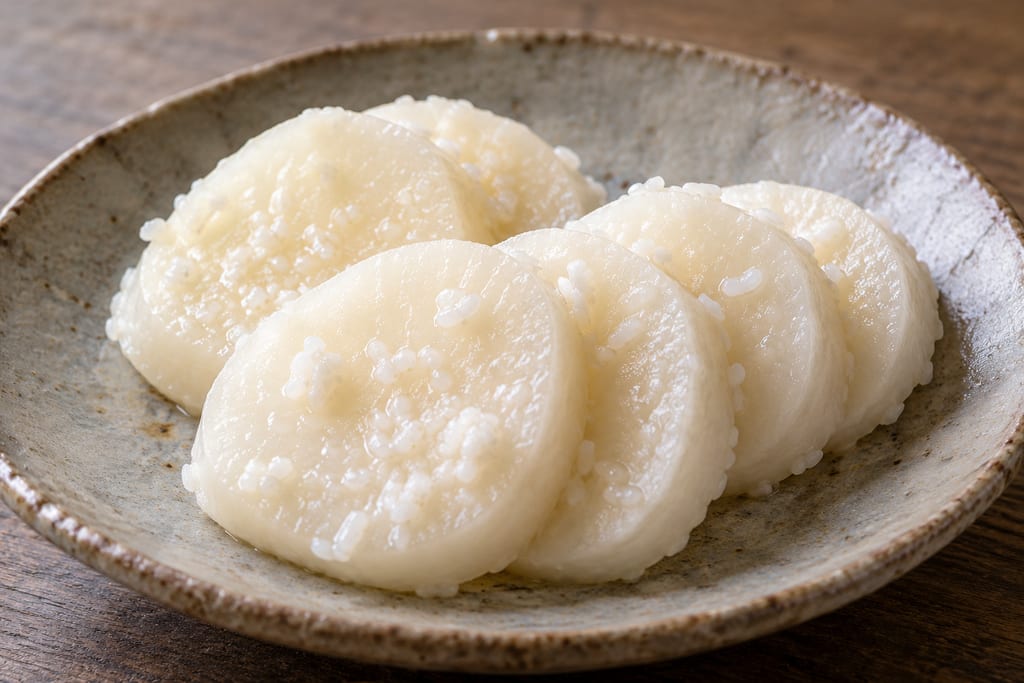
Bettara-zuke
A sweet, crisp Japanese daikon pickle from Tokyo's Nihonbashi district, made by salting fresh radish and dressing it in rice koji, sugar or koji amazake without the heavy drying used for takuan.
 FermenteaWhere food goes to change
みりん (mirin) · hon mirin · hon-mirin · Japanese sweet rice wine
Hon-mirin is a Japanese rice seasoning made by saccharifying glutinous rice with rice koji in shochu, then pressing and usually heating the mash.
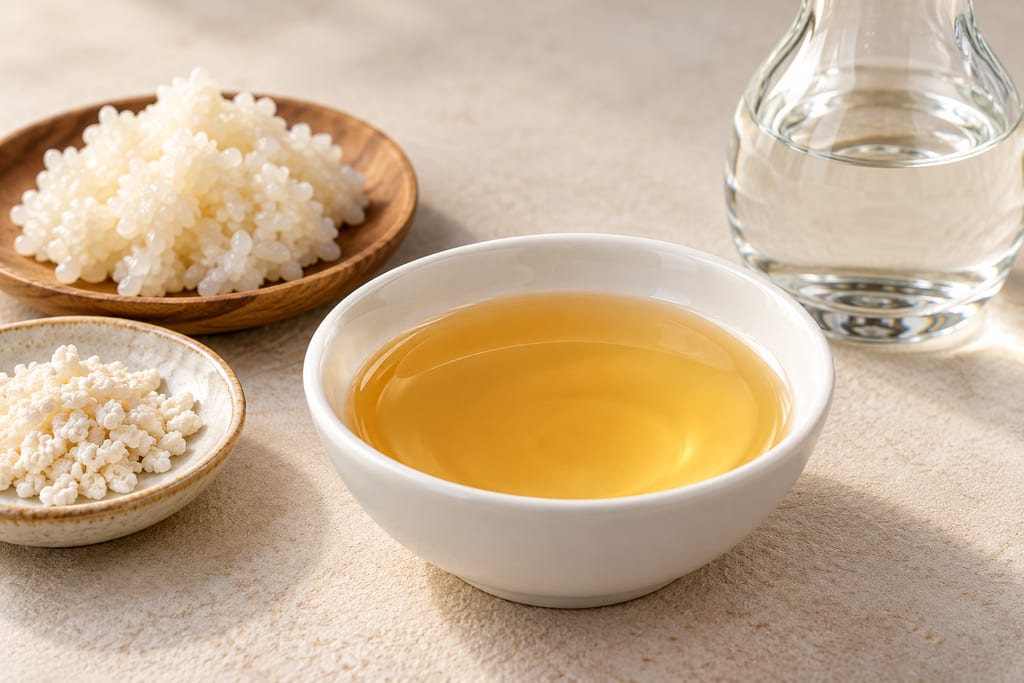
Hon-mirin is a Japanese rice seasoning whose sweetness is created chiefly by enzymes acting on steamed glutinous rice, not by simply adding sugar to a neutral liquid. Rice koji—rice cultivated with food-grade koji mould—supplies enzymes that break starch into sugars and proteins into amino acids and related compounds. Alcohol, traditionally shochu or another alcoholic liquid, is present in the mash. The result is sweet, aromatic and savoury, with a body and flavour distinct from sake or a sweetened substitute. A mirin-style seasoning may imitate sweetness using added sugar and contain little or no alcohol; it is a separate product, not another name for hon-mirin.
The documented commercial process begins with glutinous rice, which is washed, soaked as needed and steamed. Steaming cooks the grain while avoiding the free water that boiling adds. The cooked rice is cooled sufficiently, then mixed with rice koji and shochu or brewed alcohol to form moromi, the mash. Each maker sets a formula: the public sources describe ingredients and stages but not a universal rice-to-koji ratio, alcohol strength or household method. This account therefore preserves those unknowns rather than inventing proportions.
Moromi matures under controlled brewery conditions. In a standard process described by Kikkoman, maturation takes one to two months; a Japanese government feature quoting a producer describes about two months. Koji enzymes release glucose and other sugars from rice starch and amino acids from proteins, creating sweetness and umami. Alcohol suppresses unwanted microbial growth and limits yeast activity so that the sugars remain in the seasoning rather than all being converted into alcohol. The exact result depends on rice, koji, alcohol, time, temperature and the brewer's aims.
Makers press the mature mash to separate liquid mirin from the rice solids, called mirin kasu. The liquid may be heated to stop enzyme activity and filtered to remove suspended material; some makers mature it further. These are descriptions of commercial practice, not a validated household food-safety protocol. Do not infer an unmeasured home process from the outline, and never treat appearance, aroma or bubbles as proof of safety.
Mirin's beginnings remain debated. One theory connects it with sweet drinks described in Chinese texts and their possible movement through the Ryukyu Islands or Kyushu; another proposes that Japanese drinks such as nerizake or shirazake were combined with shochu. Hideaki Otsuka reviews textual evidence and cites a Japanese diary entry from 1593 as an early written mention. That establishes a record of the name, not a definitive origin story. The Cabinet Office account likewise presents competing theories rather than a settled birthplace.
Mirin was once enjoyed as a sweet alcoholic drink. Its culinary role expanded as Edo-period urban food culture grew. In the eighteenth and nineteenth centuries, restaurants and cooks increasingly used it as a seasoning, often together with soy sauce. Sugar was costly, and mirin offered sweetness as well as aroma and body. It became associated with simmered dishes and glazes; the familiar soy-and-mirin brush for grilled eel is one example, though Japanese sauces are diverse and not every glaze contains mirin.
Nagareyama, in present-day Chiba Prefecture, is associated with shiro-mirin, or pale mirin. Kikkoman's history describes a notable clear style linked to Horikiri Monjiro II and 1814, while Chiba's official account presents the regional producers and the style's place in Edo-period food culture. Other records offer different dates for the start of mirin brewing in Nagareyama. It is more accurate to treat the early nineteenth-century style as an influential regional development than as the uncontested invention of mirin. Rice-growing areas, river transport and the large Edo market all supported the region's brewing economy.
In cooking, mirin offers more than sweetness. The sugars can give simmered or grilled food a lustrous surface; alcohol and dissolved flavour compounds can help seasoning penetrate and may reduce some fishy odours. The Japanese MAFF introduction describes these as culinary effects, not guarantees. A sauce's gloss also depends on reduction, heat and sugar concentration. Add mirin to a simmered dish when its sweetness should blend into the broth; for a glaze, reduce it with the other sauce ingredients and apply near the end so the sugars do not scorch.
Mirin is useful in nikujaga and other simmered dishes, noodle broths, marinades and soy-based tare. It does not make spoiled ingredients safe and should not be used to cover spoilage. When alcohol must be avoided, choose a clearly labelled alcohol-free alternative and adjust the recipe to that product's sweetness. Water and sugar can approximate liquid volume and sweetness but cannot reproduce mirin's aroma, savoury notes or alcohol. Hon-mirin contains alcohol—Kikkoman gives around 14 percent for a typical product, but bottles differ. Heating does not guarantee all alcohol disappears. Follow personal, religious or medical requirements and product labels.
When choosing a bottle, look for 本みりん (hon-mirin) and read the ingredient list. The traditional style is based on glutinous rice, rice koji and alcohol; commercial recipes and ageing differ. Cooking sake and mirin-style seasoning are not interchangeable by name alone. Nagareyama's pale style is historically important, but colour does not by itself establish origin or quality. Mirin kasu, the pressed solids, appears in marinades and other preparations, but its texture and concentration differ from the liquid seasoning. Follow the maker's storage directions after opening; the cited sources do not establish one shelf life for every brand. Keep the cap clean and avoid cross-contamination.
Mirin's story joins enzymatic transformation with regional trade. The rice is not merely sweetened, and the finished liquid is not just leftover sake. Koji makes the sugars and savoury depth that cooks prize; in Edo, the liquid found a lasting role beside soy sauce and the foods of a growing restaurant culture. Understanding that process helps a cook choose hon-mirin or a clearly identified alternative and use each for the work it actually does.
The competing origin accounts matter because they caution against turning a national food into a neat invention story. The Chinese-origin theory refers to a sweet drink name that may resemble mirin, while the Japanese-origin theory connects mirin to earlier sweetened rice drinks and the availability of distilled shochu. Similar names alone do not prove the recipes were identical. The secure point is narrower: by the late sixteenth century, written Japanese evidence names mirin, and by later centuries the drink appears in culinary texts and social life. The development of distillation and trade helps explain the possible routes, but the consulted evidence does not settle which route came first.
Nor should the drink's past obscure the condiment's later history. In Edo, mirin's transition into cooking took place alongside the growth of restaurants and a new urban food economy. A sweet alcoholic beverage could supply a concentrated sweetness when refined sugar was expensive, and it paired naturally with the salt and aroma of soy sauce. Recipes changed with regional products and cooks' preferences; this is a history of gradual adaptation rather than a single date when households suddenly began using mirin.
Nagareyama's shiro-mirin demonstrates how local production can become tied to a city's taste. The pale liquid suited cooks who wanted sweetness and flavour without as much dark colour in a dish. Historical accounts associate improvements in rice polishing and filtration with the style's clarity, though the accounts should not be collapsed into proof that colour alone defines a traditional product. The Edo market was accessible by river routes, and Chiba's official history situates mirin alongside local rice-growing and transport. The result was a regional specialty with a broad market, not an isolated village curiosity.
Glutinous rice contributes starch and a cohesive cooked grain. Its sticky texture reflects its starch composition, but the finished mirin is a strained liquid rather than a porridge. Rice koji contributes the enzyme system: the mould's enzymes act on the rice substrate to create sugars and amino acids. The alcoholic liquid contributes solvent, aroma and a microbial environment different from a water-based rice mash. Because makers choose different rice, koji handling and alcohol, two bottles can both be hon-mirin and still differ in sweetness, colour, aroma and weight on the palate.
The word koji can refer to the cultivated grain used in the mash, while the mould itself is a microscopic organism. It is imprecise to say that the rice is simply fermented by a single yeast in the same way as beer. Enzyme action is central to mirin's sweetness; the alcoholic liquid helps restrain further sugar consumption. That distinction explains why the mash's goal is not to ferment every sugar into ethanol. It also explains why adding ordinary table sugar to sake would make a sweet alcoholic liquid but would not recreate the enzyme-generated balance of authentic mirin.
Commercial descriptions refer to careful steaming, mixing, aging, pressing and filtering because the physical state of the rice and the mash affects handling. Too much free water changes concentration, while too little enzyme activity changes how much sweetness and savoury material is extracted. The cited public descriptions do not provide quantitative process controls, target acidity or water activity. Those omissions are meaningful: the reader can understand the craft without treating a short magazine description as instructions for a safe home fermentation.
At the shop, distinguish hon-mirin from mirin-fu or mirin-style seasonings. Product names and labelling conventions vary by market, so inspect the ingredient list and alcohol statement rather than relying on a translation at the front of the bottle. Some alcohol-free seasonings are formulated for cooks who avoid alcohol; their sweetness and salt content may differ, so taste and adjust the dish rather than substituting blindly. A bottle labelled cooking sake is also its own product. It may include salt or other ingredients that change the seasoning balance.
Hon-mirin is a seasoning and should be measured with the same care as soy sauce or salt. It can be used in a marinade, but a long soak does not guarantee that the alcohol is gone or that a food is safe to eat raw. In simmered dishes, use it as one component of the liquid and account for the sweetness it contributes before adding sugar. In a glaze, keep the pan under observation near the end of cooking: concentrated sugars darken quickly and can turn bitter if scorched. The same concentration that produces a sheen also makes over-reduction easy.
Mirin's relationship to soy sauce is especially visible in tare, a seasoned sauce for brushing or serving with grilled foods. Their balance depends on the saltiness of the particular soy sauce, the sweetness of the mirin and the sauce's reduction. There is no single universal tare ratio in the evidence consulted here. Likewise, in noodle broth, sweetness should support rather than bury the dashi and soy. Start from a tested recipe for the dish, then adjust only with an understanding of the exact product in the bottle.
Mirin kasu deserves its own mention because it remains after pressing. It is a moist, grain-rich solid with a different concentration from the liquid and can be used in marinades or other preparations. It is not a substitute for mirin by equal volume. Its existence also reveals something about the process: pressing separates liquid seasoning from a substantial rice fraction, rather than simply filtering a clear beverage. The producer's advice should guide storage and use of both products.
Storage advice varies with whether a product is opened, filtered, heated or sold as a seasoning. The sources consulted do not give one shelf life that can responsibly be applied to every bottle. Follow the maker's directions, keep the closure clean, and avoid returning a used spoon or contaminated utensil to the bottle. Do not extend a product's life based on sweetness, alcohol or a reassuring smell: those qualities are not a validated safety test. Commercial packaging and local regulations determine the appropriate handling information.
Alcohol content is part of the identity of hon-mirin, not a minor incidental trace. A typical figure around 14 percent appears in Kikkoman's consumer reference, but it should not be generalized to all brands. Cooking drives off some alcohol, yet how much remains varies with heating time, surface area, recipe composition and method. A brief simmer is not an assurance that a dish contains no alcohol. For a strict alcohol-free requirement, select a product labelled accordingly and make sure all other ingredients meet the requirement too.
Rice and koji are not among the common major allergens in many jurisdictions, but an individual product can contain additional ingredients or be processed where allergens are present. Check the actual label, particularly when choosing a sweet cooking seasoning. Alcohol avoidance may also be relevant for children, pregnancy, medication, recovery, religious observance or personal preference; these needs are different, and the bottle label is the proper starting point. This recipe account describes a preparation and culinary history, not individualized medical advice.
The finished liquid's clarity is not a measure of authenticity, and colour is not a reliable safety signal. Traditional pale shiro-mirin and other darker or aged products reflect different histories and production choices. A cloudy residue may relate to handling or product type, so follow the producer's guidance instead of relying on appearance. Historical stories about silk filtration or regional rice are useful when tied to the accounts that report them, but they do not let a shopper identify a bottle solely by visual inspection.
Mirin is easiest to appreciate through contrast. Sake supplies a different balance of fermentation products and is not simply a dry version of mirin. A sweetened alcohol-free product can be practical, but does not carry the same enzyme-derived flavour. Rice koji is the active ingredient in the transformation, while rice is the source material; neither is an interchangeable label for the finished seasoning. Those distinctions are helpful both in recipe writing and in a Japanese pantry.
The word is recorded in a Japanese diary in 1593, while competing origin theories remain disputed. Mirin is documented as a drink before seasoning use expanded.
A Japanese preparation; the row does not claim one uncontested origin.
Associated particularly with pale shiro-mirin; not the only place mirin is produced.
A sweet, crisp Japanese daikon pickle from Tokyo's Nihonbashi district, made by salting fresh radish and dressing it in rice koji, sugar or koji amazake without the heavy drying used for takuan.
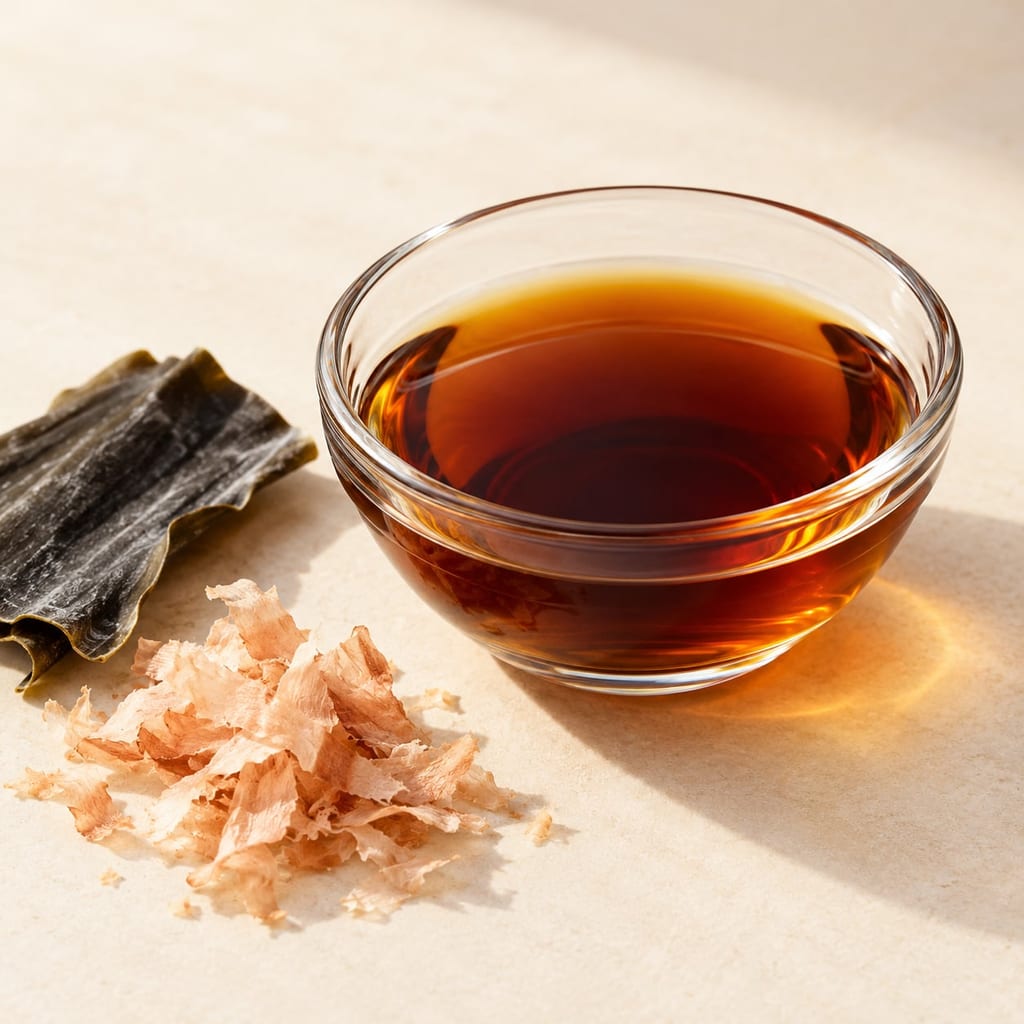
Mentsuyu seasons Japanese noodles with dashi, soy sauce and mirin. Two home formulas are recorded here: a 2012 light-soy and bonito sauce, and a concentrate diluted 1:2 for dipping or 1:4 for hot soup.
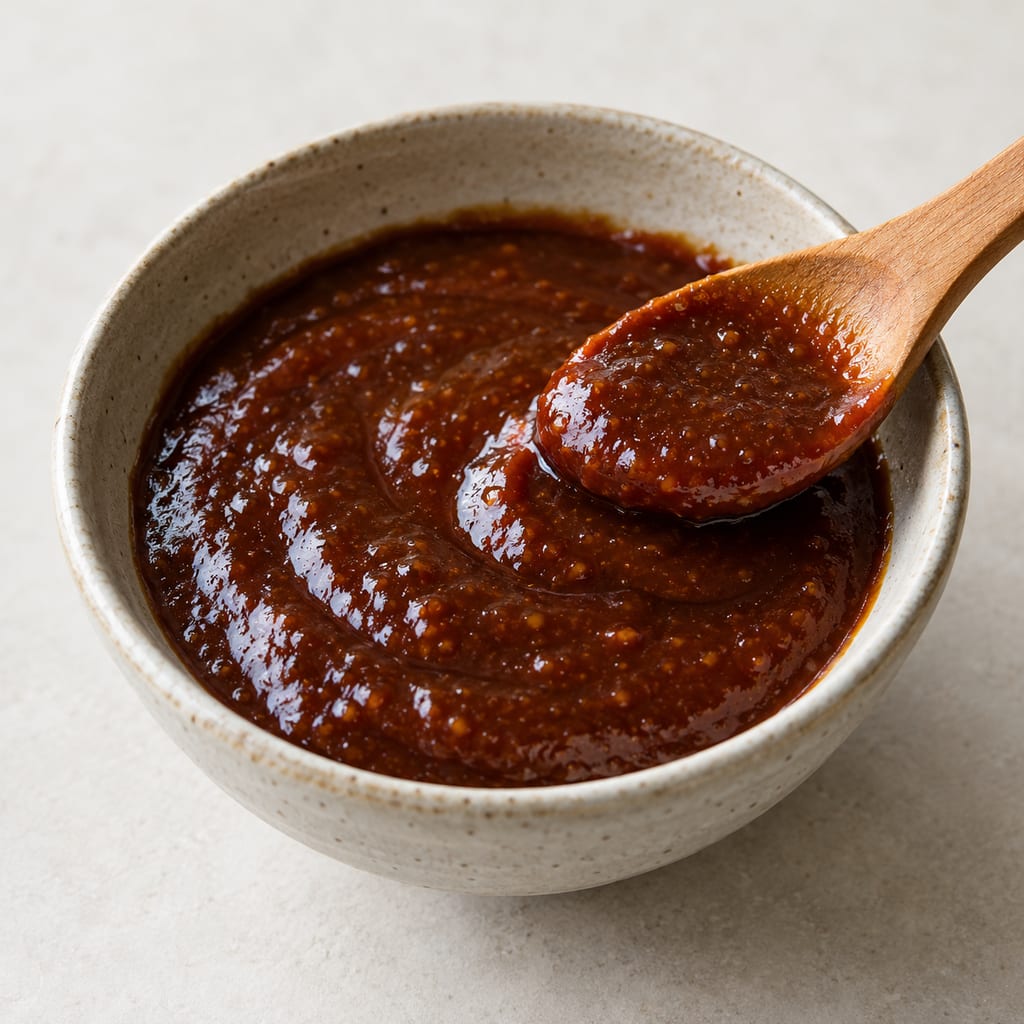
A sweet-salty Japanese glaze of miso, mirin, sake and sugar, warmed until thick and spread on grilled tofu, eggplant, daikon or konnyaku. Regional versions in Aichi use red miso and dashi.
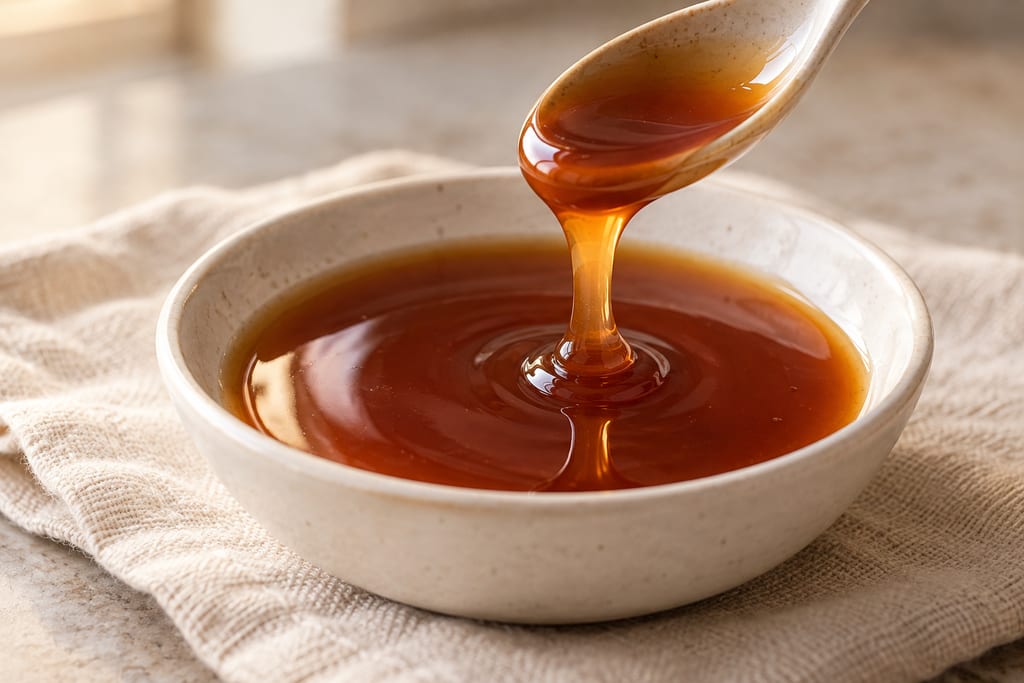
A glossy Japanese glaze thickened with starch, sugar, soy sauce and mirin. Spoon it over cooked rice dumplings while the glaze is still fluid.
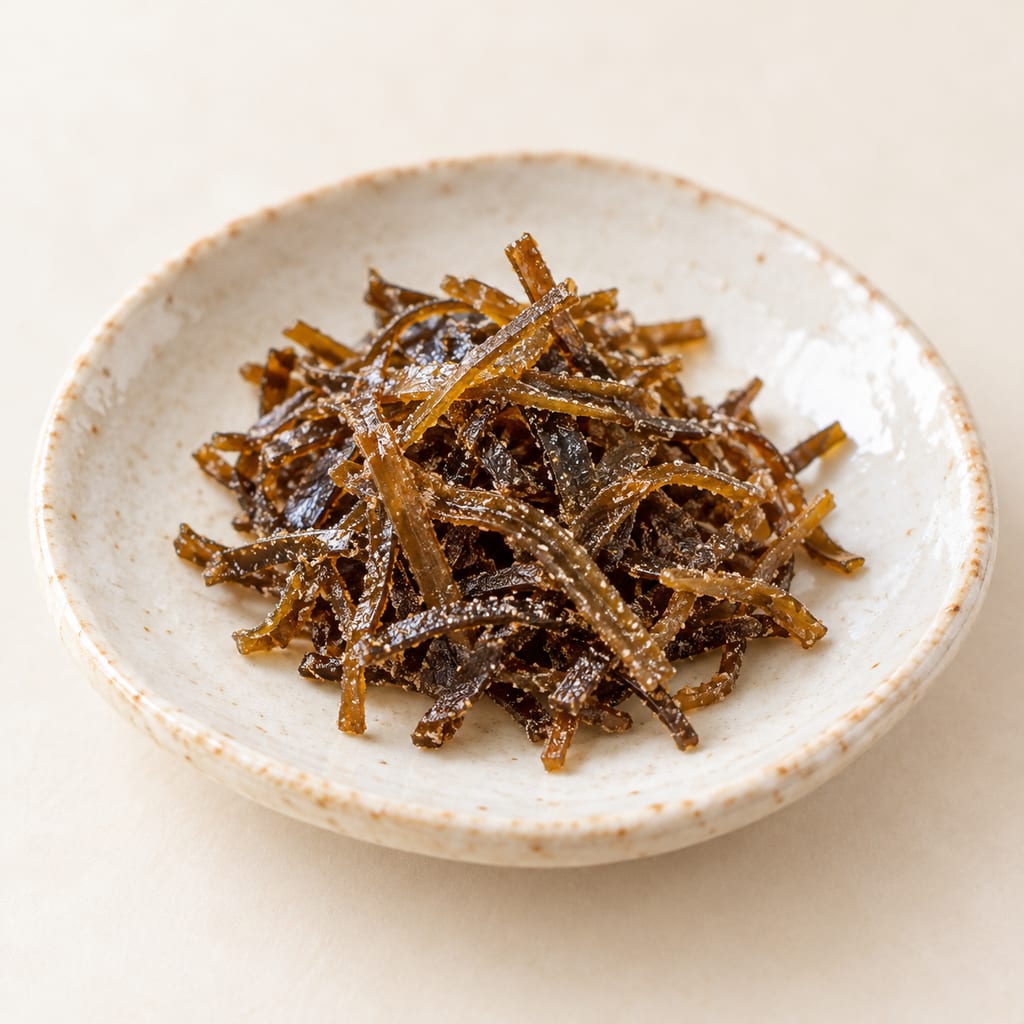
Japanese kelp simmered in soy sauce and seasonings, sometimes dried and salted, eaten with rice or used as an umami seasoning.
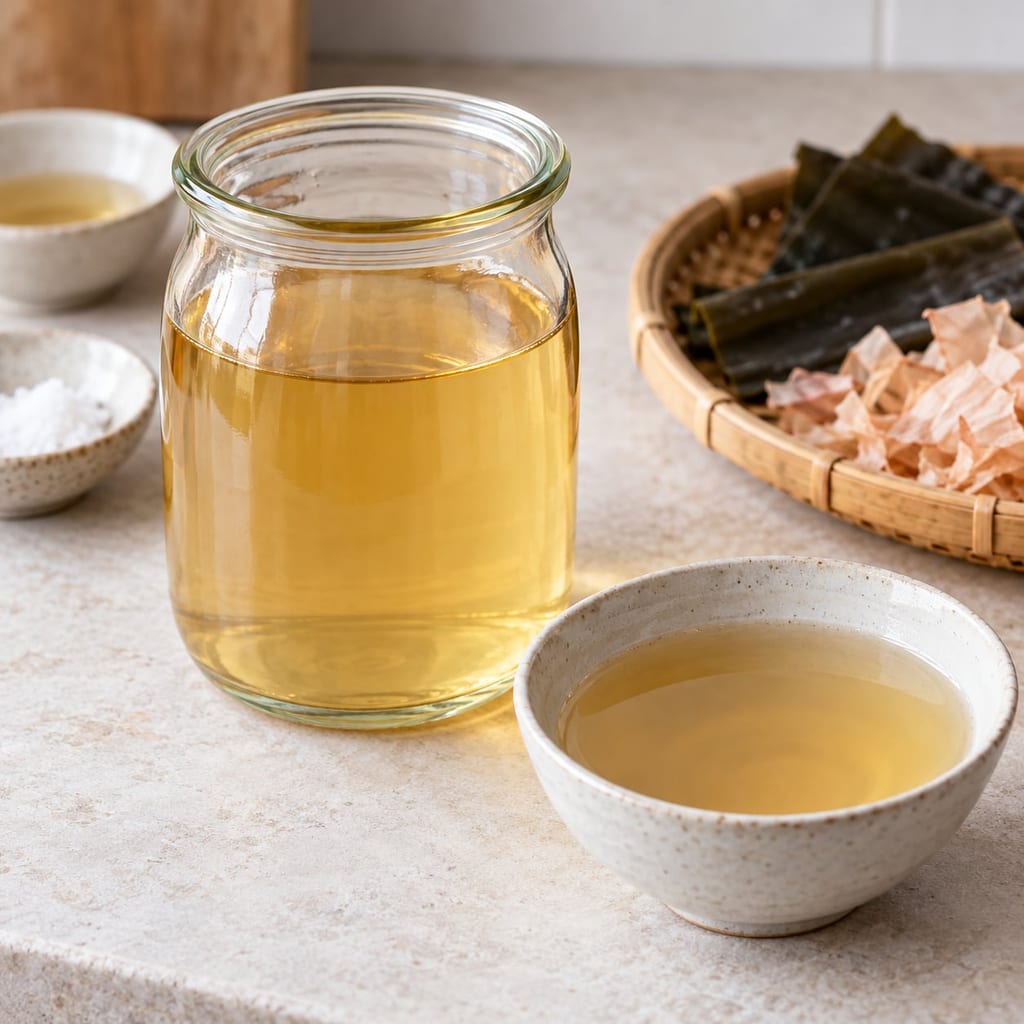
Shiro dashi is a pale Japanese seasoning stock of kombu and bonito dashi, light soy sauce, mirin and salt, used to flavour dishes without darkening them.
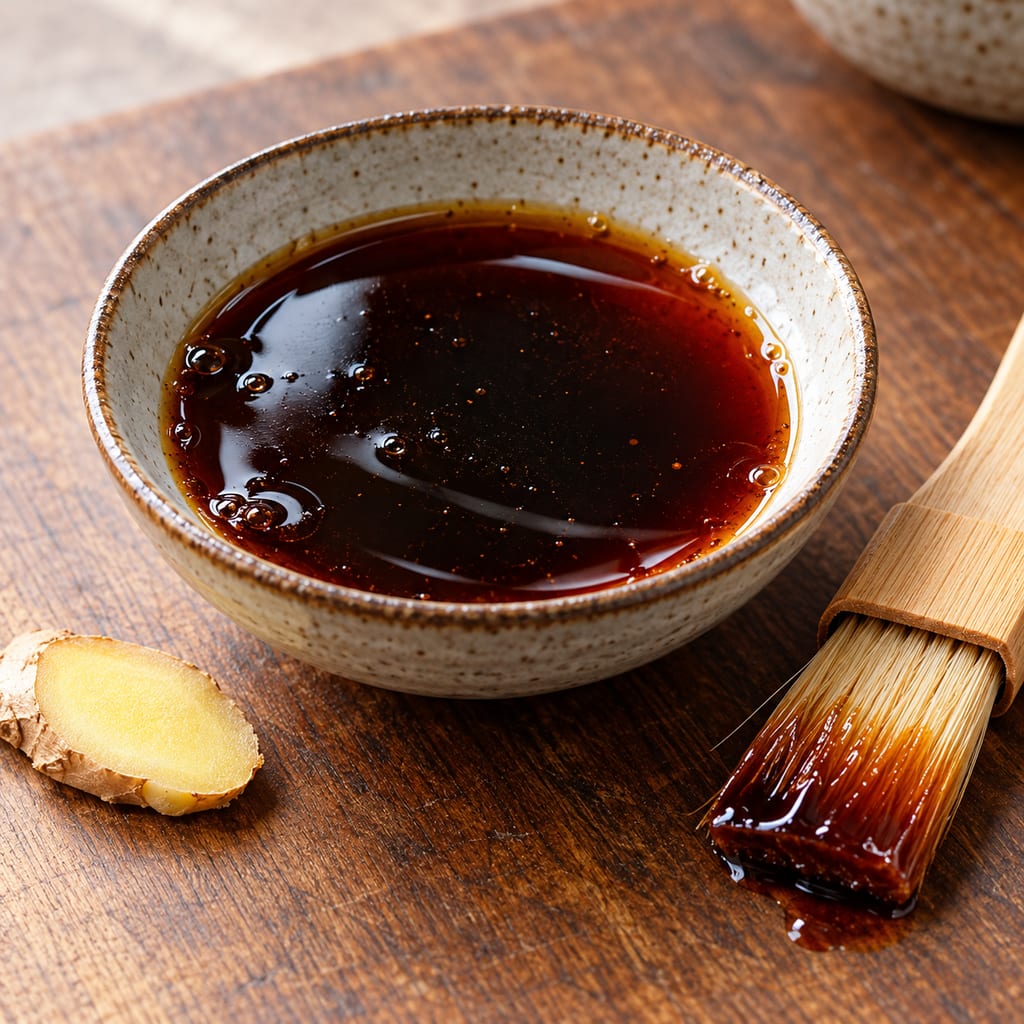
A modern tare-style glaze of koikuchi soy sauce, mirin, water, sugar and optional ginger, gently reduced and brushed onto food near the end of cooking.
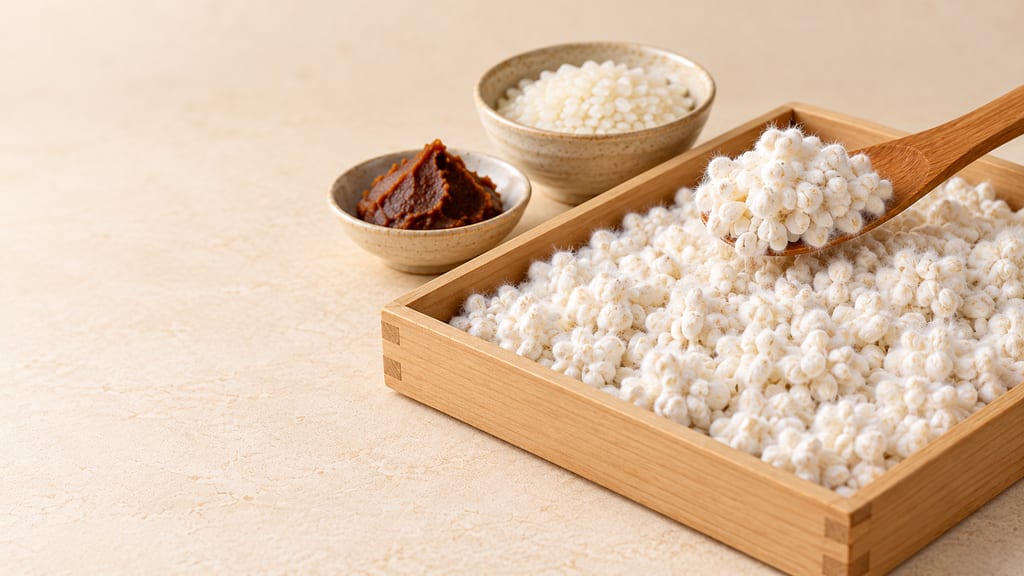
Koji is grain or beans grown with a mould whose enzymes break food down. This guide separates the mould, the starter and the finished koji, and follows them into sake, amazake, miso, soy sauce and shio-koji.

Japanese reddish-brown vinegar from sake lees matured about three years, turned to vinegar by acetic bacteria; the vinegar of Handa and Edomae sushi rice.
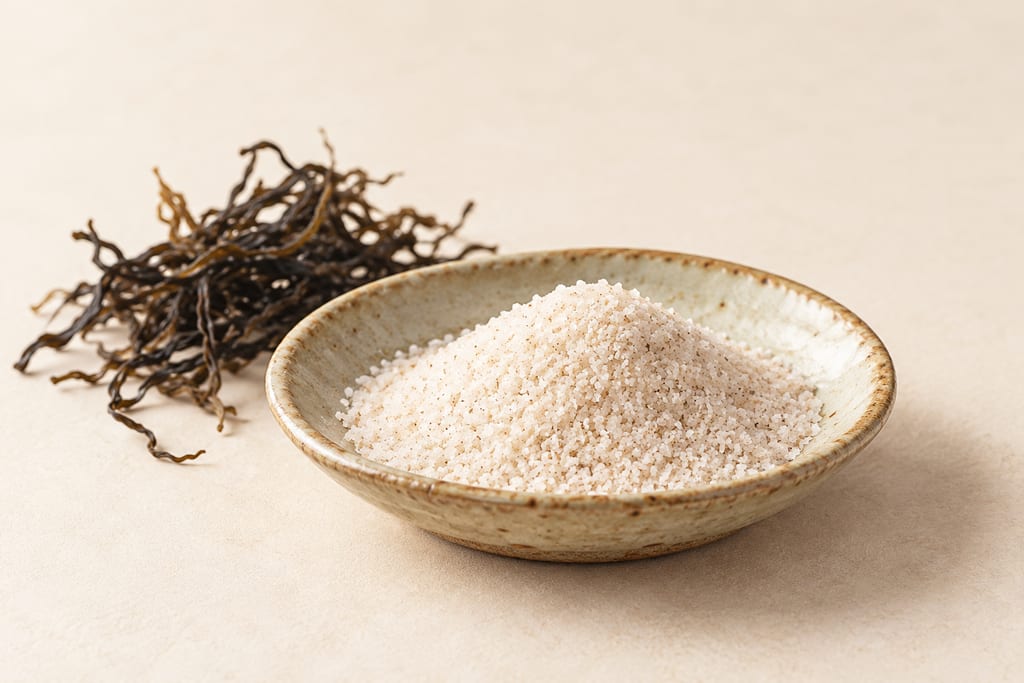
Amabito no Moshio is a modern, pale beige Japanese seaweed salt made from Seto Inland Sea water and hondawara seaweed. Its documented factory method concentrates filtered brine in kettles, then separates and dries the salt.
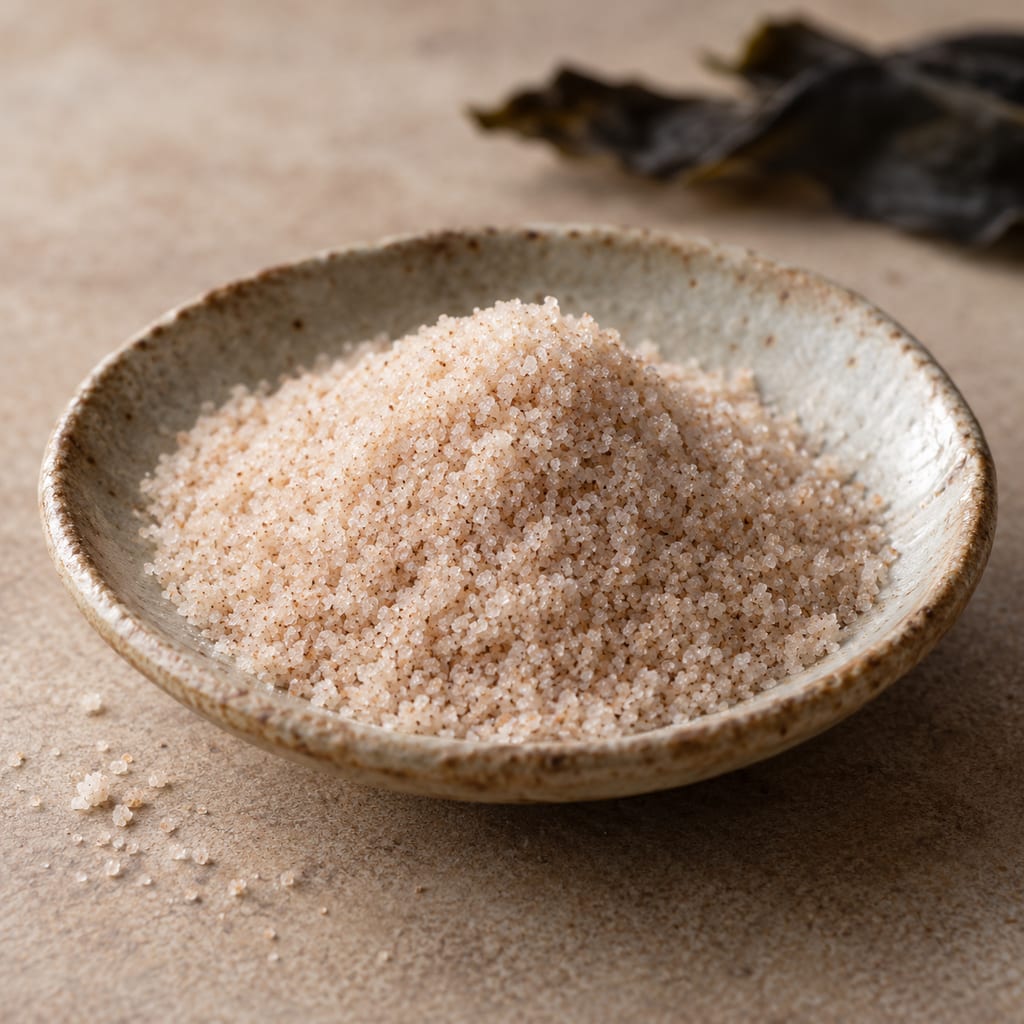
Awaji moshio is a modern Japanese seaweed salt made by TaDa PHILOSOPHY from Awaji Island seawater and seaweed. Its premium process concentrates brine, extracts seaweed flavor, then crystallizes, separates, dries and grades the salt.
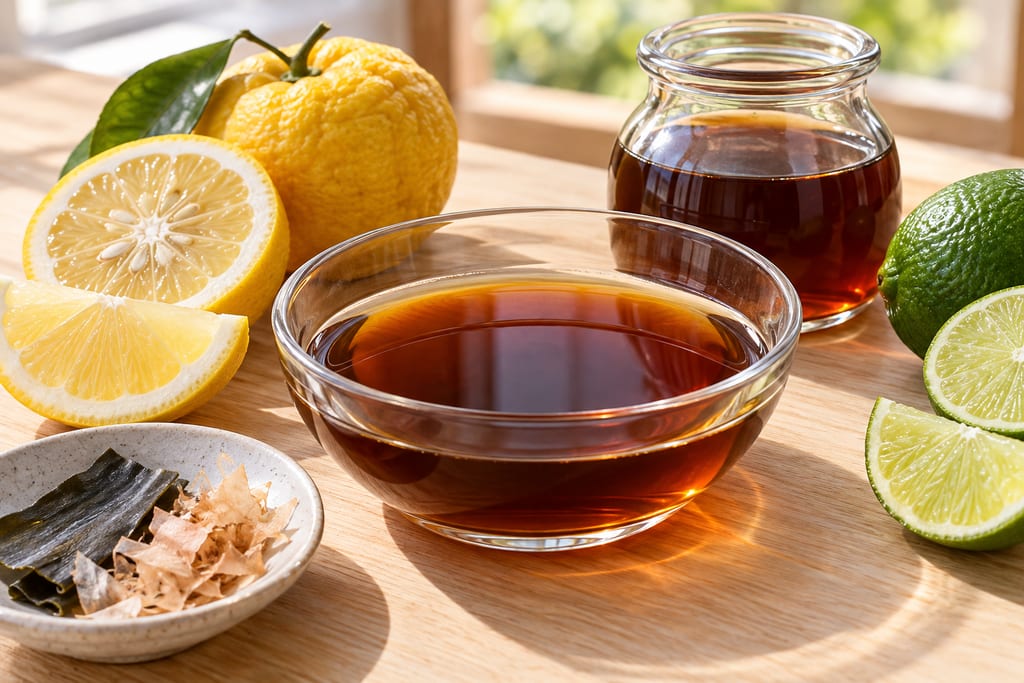
This fresh ponzu-shoyu mixes Japanese koikuchi soy sauce with yuzu or a lemon-lime blend, rice vinegar, water and sugar; optional kombu and bonito give a short chilled infusion.
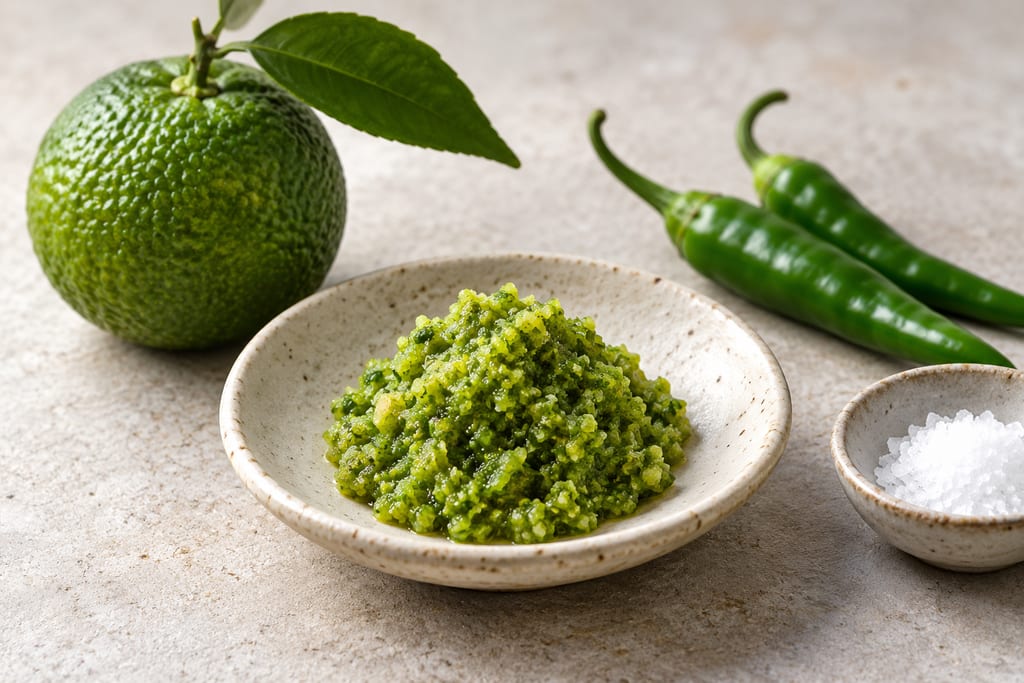
A fresh, uncooked yuzu and green chilli paste inspired by Kyushu’s yuzu kosho, made here as an untested small-batch seasoning rather than a preservation formula.
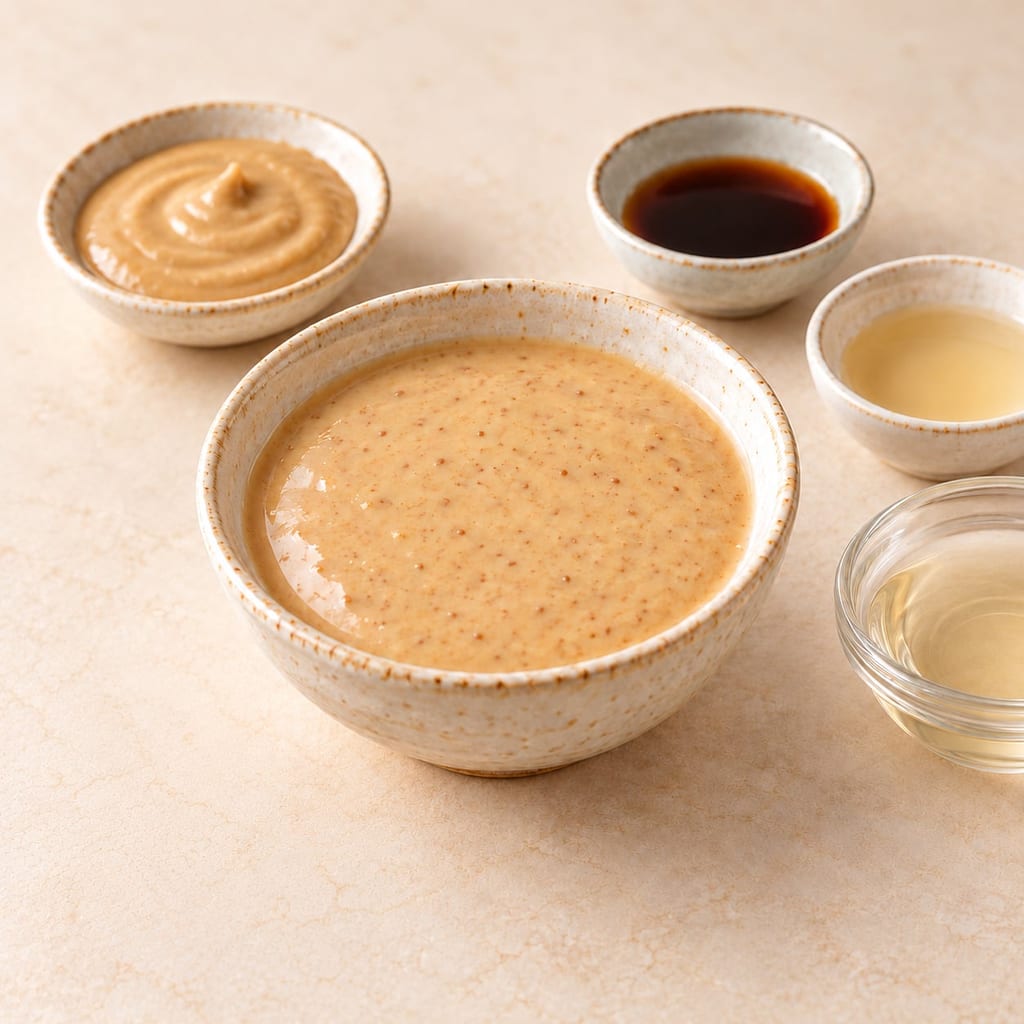
A creamy Japanese sesame dipping sauce with soy, rice vinegar and dashi. Gradual mixing turns the thick sesame paste into a smooth sauce.
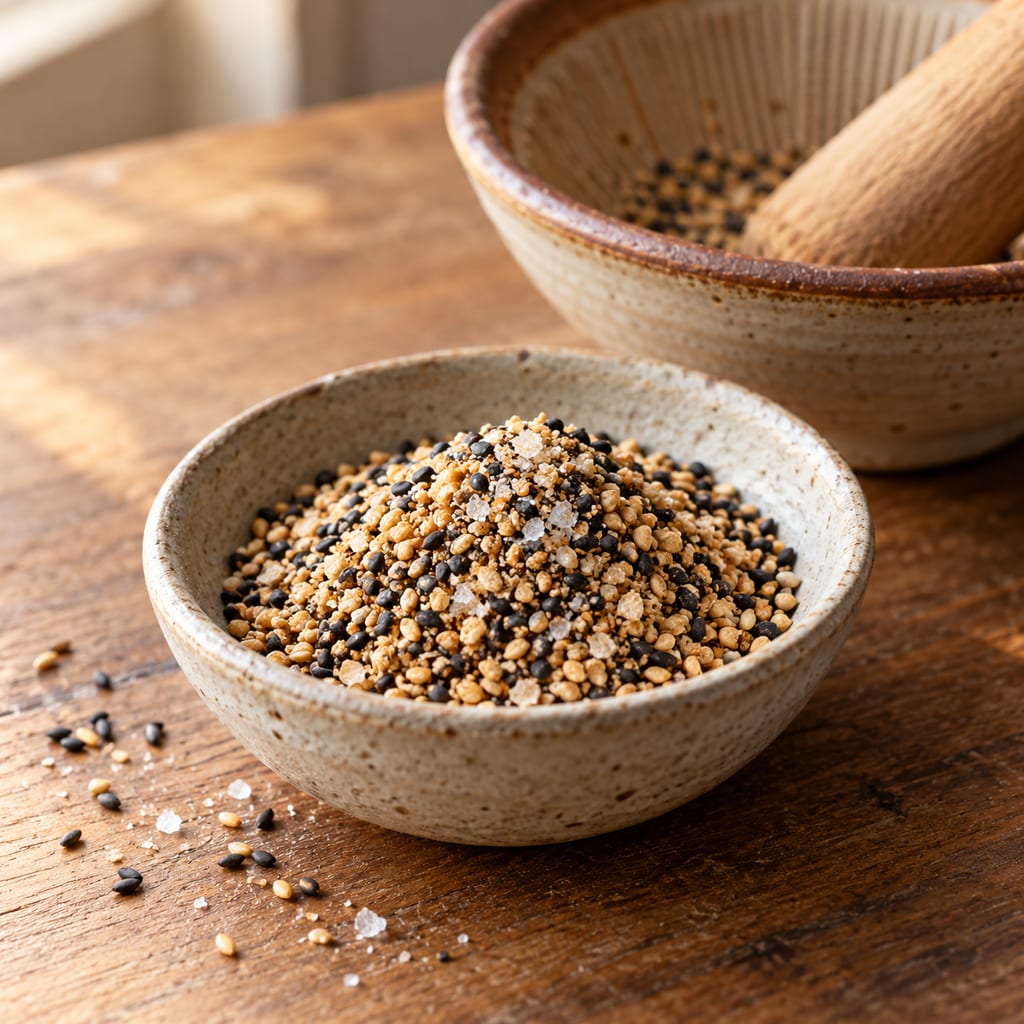
Toasted sesame seeds and sea salt are ground together into a coarse seasoning for rice. This small pan-roasted batch keeps most of the seed texture.
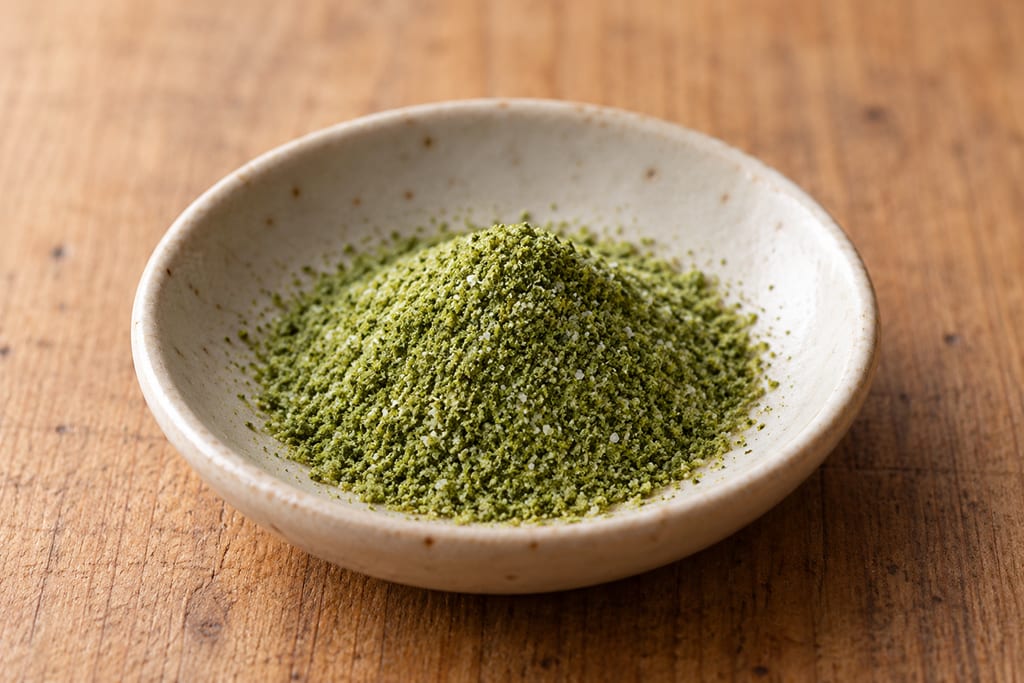
Green tea leaf salt is a dry seasoning made by grinding tea leaves, sieving them and mixing the powder with fine salt. This Japanese-style version follows a documented equal-parts method.
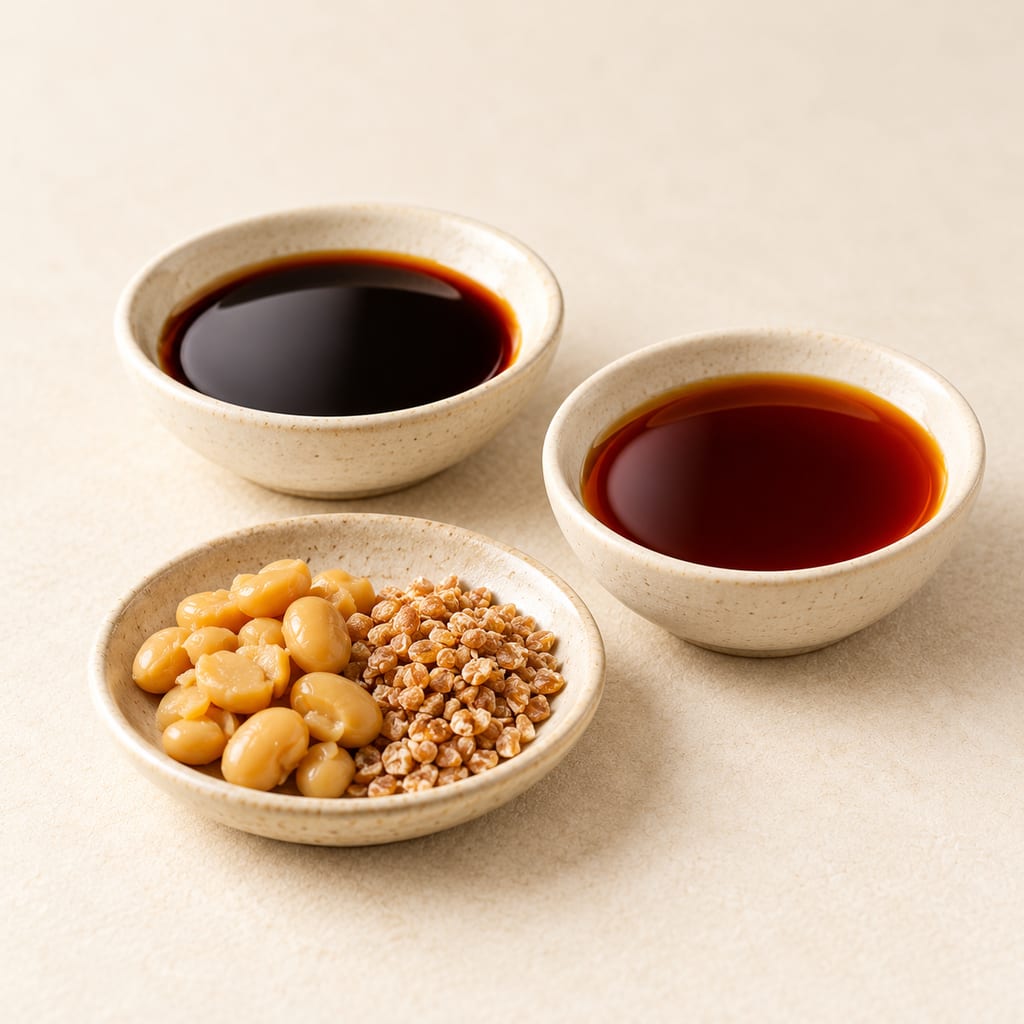
Jiangyou is the Chinese soy sauce family, an umbrella term for light, dark and seasoned sauces made by two main process families: high-salt liquid-state and low-salt solid-state brewing.
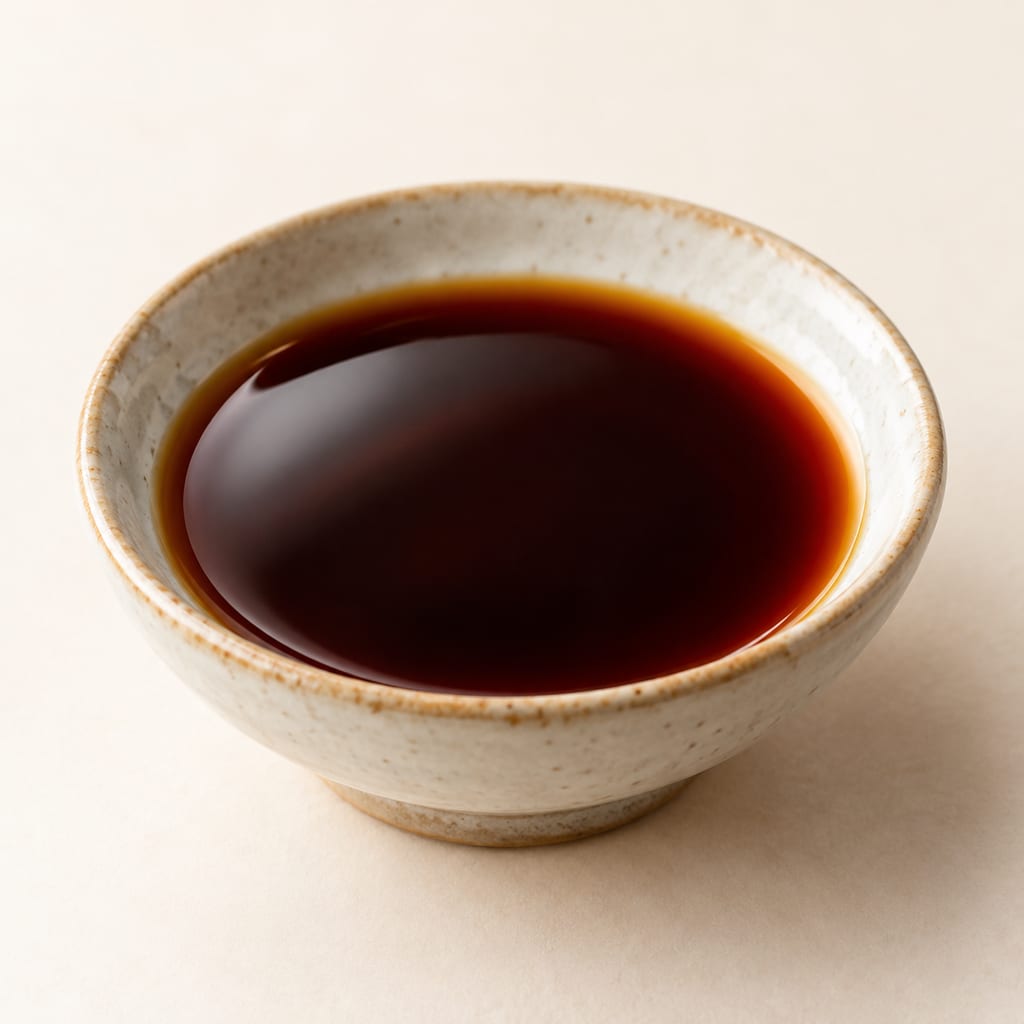
Japan's standard all-purpose soy sauce: soybeans and wheat grown over with koji mould, brined, fermented for months, pressed and usually heated into a reddish-brown, savoury liquid.
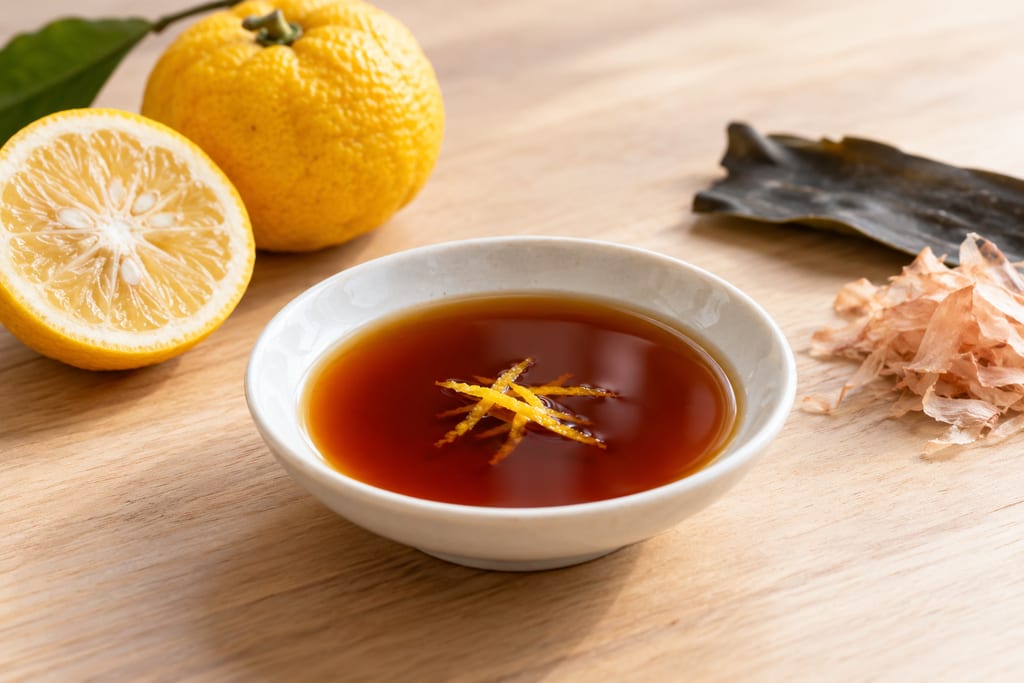
This quick ponzu combines soy sauce, vinegar, hon mirin, kombu, dried bonito and yuzu juice after a brief boil and a warm extraction; the recipe serves five.
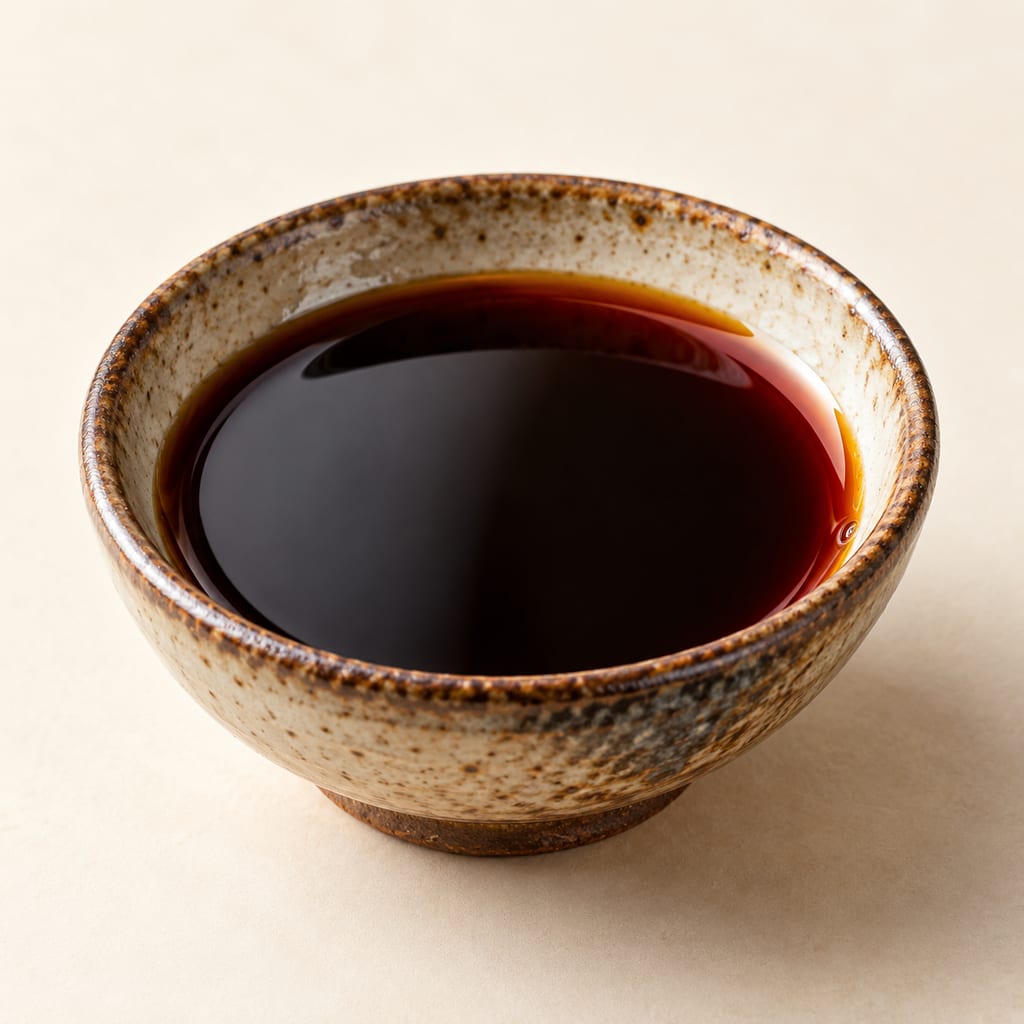
Saishikomi shoyu is a double-brewed soy sauce: a second moromi is made with a finished soy sauce in place of salt water, which makes a dark, concentrated sauce with softer salt.
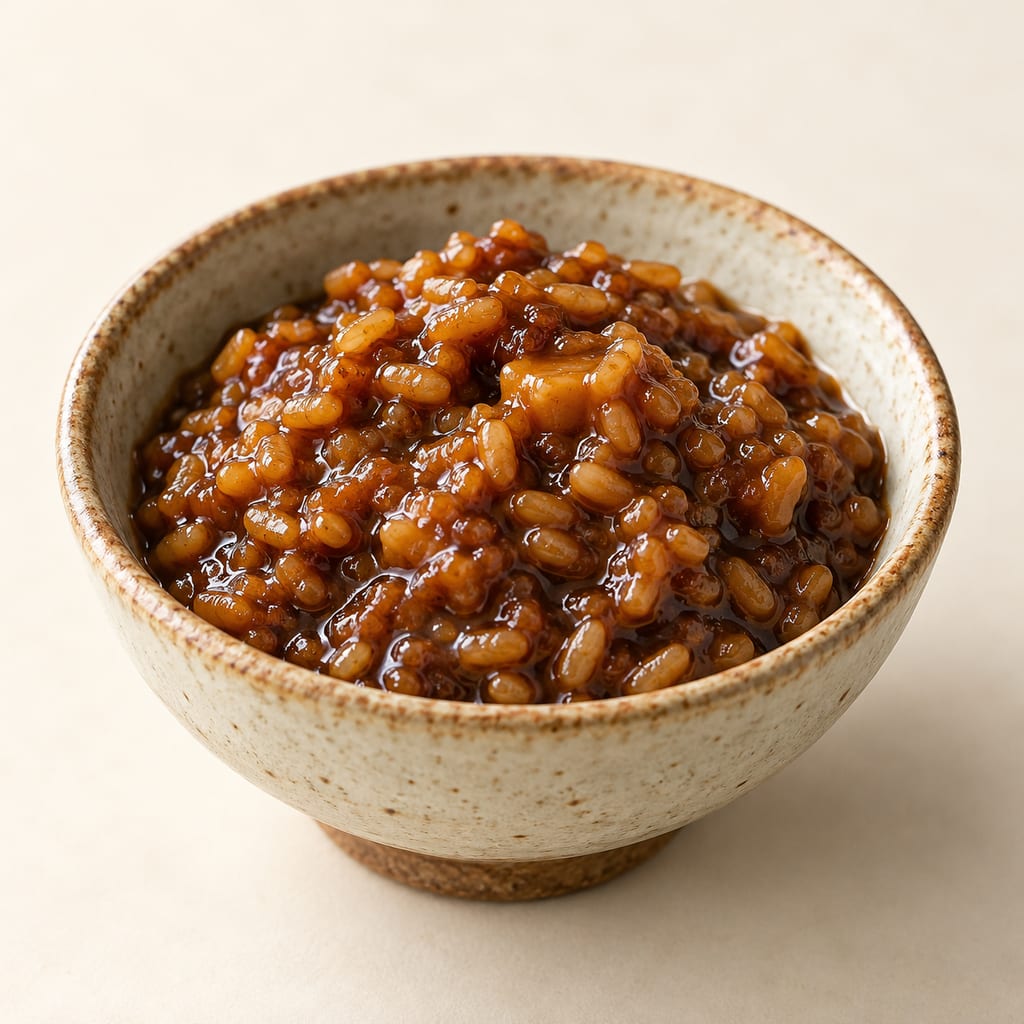
A Japanese kitchen condiment of rice koji matured in soy sauce until the grains turn soft and sweet. The same name also means the mould-grown soybean and wheat used to brew soy sauce.
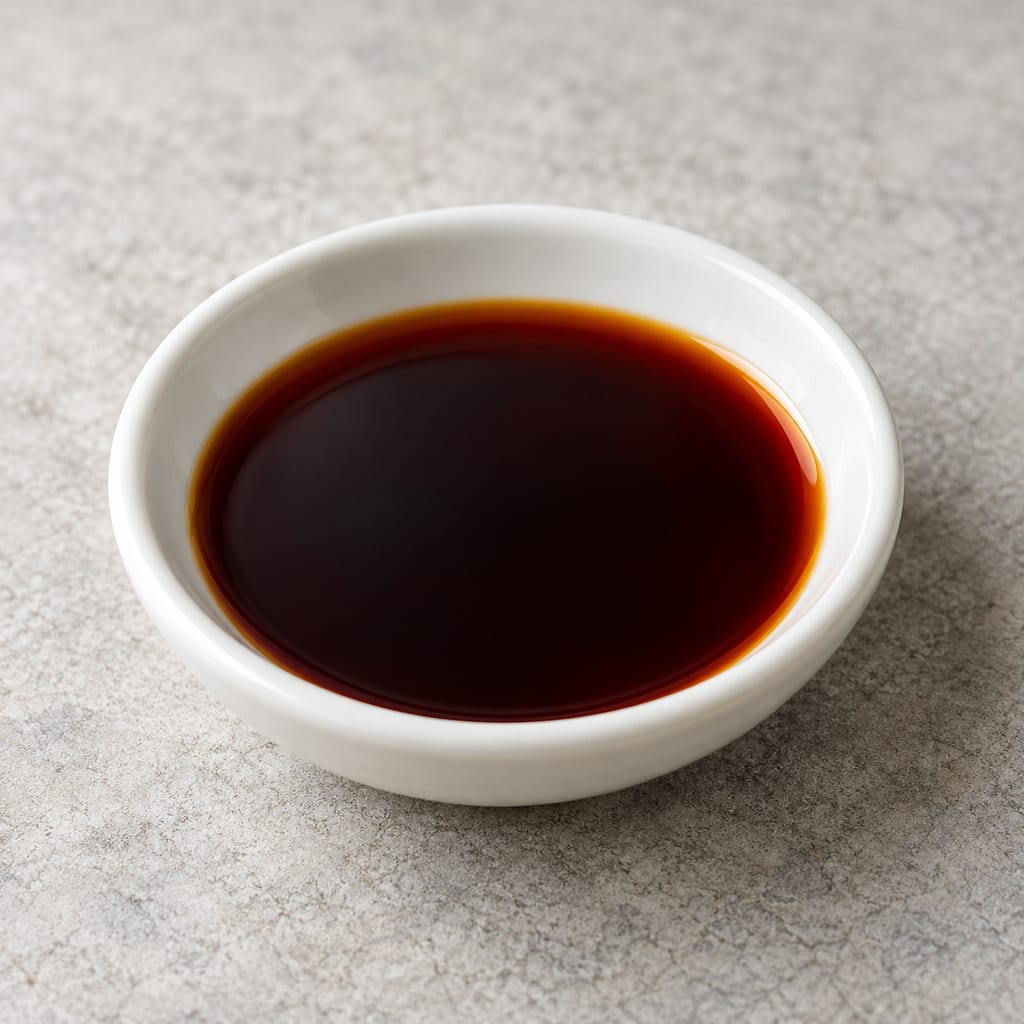
Soy sauce is a salted liquid seasoning made by growing koji mould on soybeans and grain, maturing the mash in brine and pressing out the liquid. Japan's shoyu is the best-documented form.
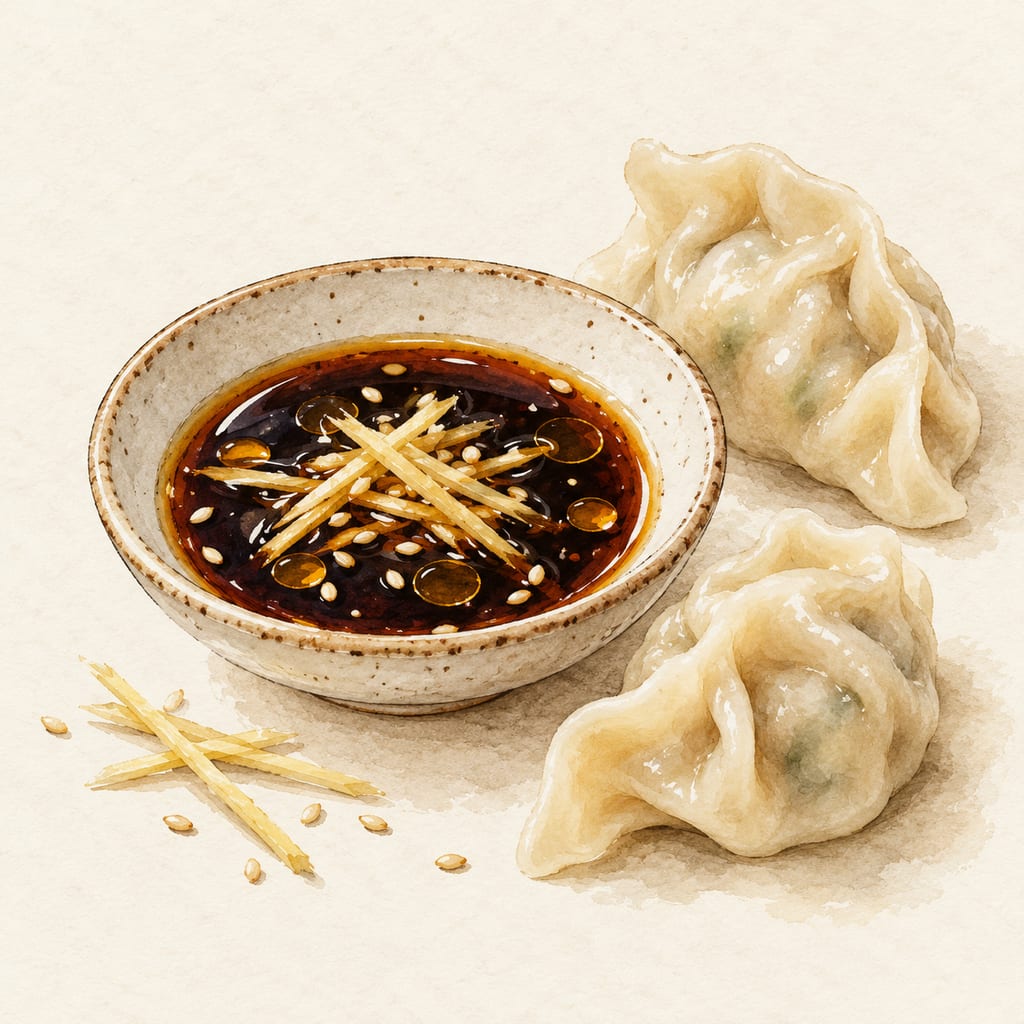
An untested small-batch soy and Zhenjiang black-vinegar dip with ginger and sesame oil, adapted as a modern accompaniment for dumplings or cooked vegetables.
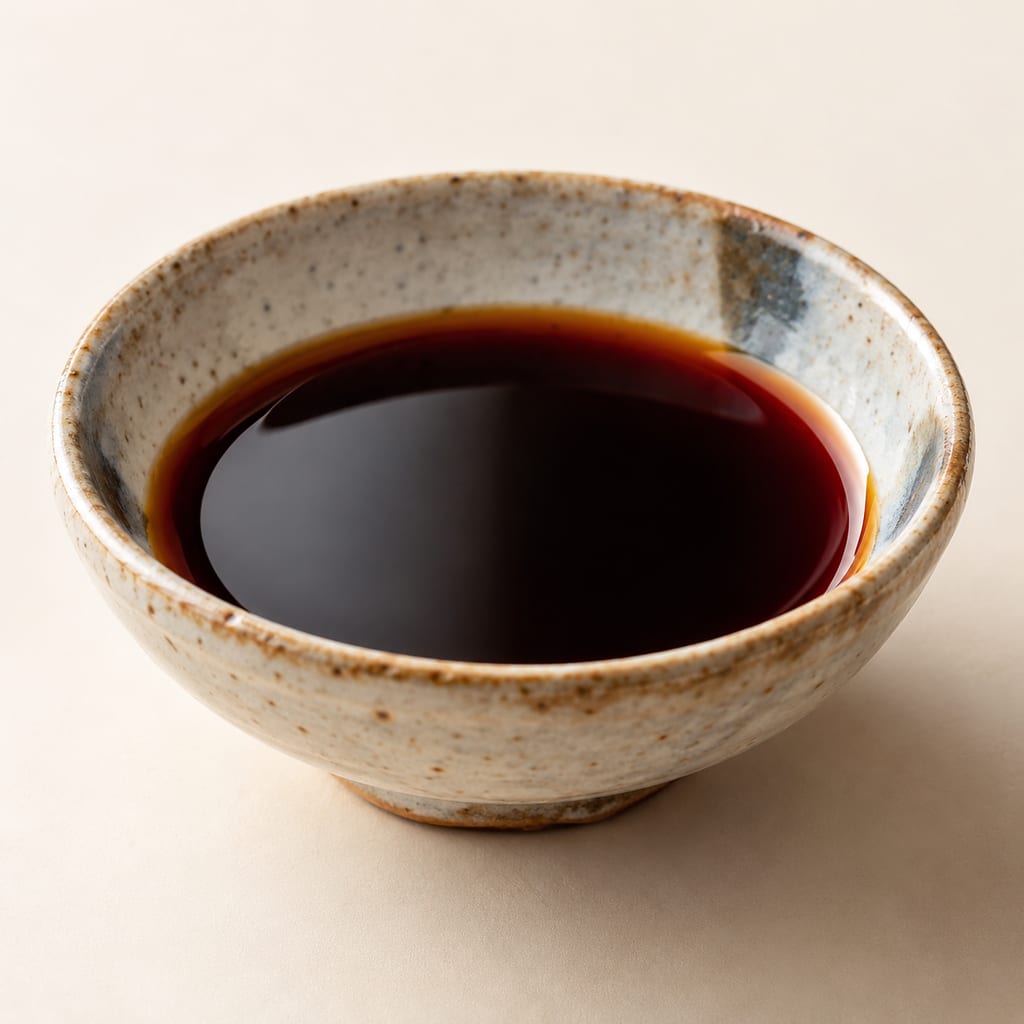
Tamari is the soybean-dominant Japanese soy sauce of the Tokai region, made with little wheat and little brine, and aged longer than koikuchi.

A gelling polysaccharide extracted from red seaweeds, sold as kanten strips or powder; it sets firm at a low concentration and stays solid until about 85 °C.

A Dominican table and seasoning condiment of sour orange juice, mixed with lime and salt and bottled raw; garlic, oregano or a hot pepper may be added for meat or a spicier bottle.

Cicerbita alpina is an alpine perennial whose tender shoots and leaves have been eaten raw or cooked. Sámi milk preparations and modern Carnian dishes are distinct uses, with serious identification and preservation limits.

Japanese skipjack tuna cooked, then repeatedly smoked and dried over a wood fire by the hand-fired tebiyama method into a hard block for shaving into dashi: the first stage of katsuobushi.

A Swedish-style spirit vinegar made by fermenting neutral alcohol with live vinegar bacteria, with a separate guide to commercial ättika strengths.

A yeast-raised wheat ring shaped from a firm dough, briefly boiled and baked. This source-batch formula gives a gently malted crust and a chewy crumb.

A warm dip of garlic, anchovy and olive oil, often enriched with butter, that Piedmont serves over a flame with raw and cooked vegetables and bread.

Bechamel is a white sauce of milk thickened with a butter and flour roux, one of the French mother sauces, and the base from which Mornay and other cheese and cream sauces are made.
No community contributions have been published for this entry yet.
Sign in to contribute. Published comments and photos are free to read.
Kikkoman CorporationMethod · Science
Making MirinIngredients and mash preparation
Koji enzymes and one-to-two-month maturation
Pressing, heating and filtering
Cited in: A sweet rice mash, not sweetened sake; How makers produce hon-mirin; Choosing a bottle and understanding the lees; A drink with many routes into the kitchen; The materials and their separate jobs; Reading the label and using the right style; Storage, alcohol and careful interpretation
Highlighting Japan, Cabinet Office of JapanMethod · History · Uses
The History and Characteristics of Traditional MirinTraditional ingredients
Enzyme-driven starch and protein conversion
Edo-period seasoning use
Cited in: A sweet rice mash, not sweetened sake; How makers produce hon-mirin; What mirin does in the kitchen; A drink with many routes into the kitchen; The materials and their separate jobs; Reading the label and using the right style; Storage, alcohol and careful interpretation
Kikkoman Corporation, Mirin MuseumHistory
History of MirinCompeting origin theories
Mirin as drink before seasoning
Nagareyama style and Edo cuisine
Cited in: A disputed beginning, then an Edo transformation; Choosing a bottle and understanding the lees
Chiba Prefectural GovernmentGeography · History
Chiba's FermentationNagareyama association with shiro-mirin
Pale style and Edo cuisine
Cited in: A disputed beginning, then an Edo transformation; Choosing a bottle and understanding the lees
Ministry of Agriculture, Forestry and Fisheries of JapanScience · Uses · History
An Introduction to Japanese Fermented FoodsAlcohol and sugars' culinary functions
Hon-mirin differs from mirin-style seasoning
Origin remains uncertain
Cited in: A sweet rice mash, not sweetened sake; What mirin does in the kitchen; A drink with many routes into the kitchen; The materials and their separate jobs; Reading the label and using the right style; Storage, alcohol and careful interpretation
Kikkoman Institute for International Food CultureHistory
Searching for the Origin of MirinCompeting origin theories
1593 diary reference
Cited in: A disputed beginning, then an Edo transformation