
Koji intake
Koji: the mould, the grain and the work they do
Koji is grain or beans grown with a mould whose enzymes break food down. This guide separates the mould, the starter and the finished koji, and follows them into sake, amazake, miso, soy sauce and shio-koji.
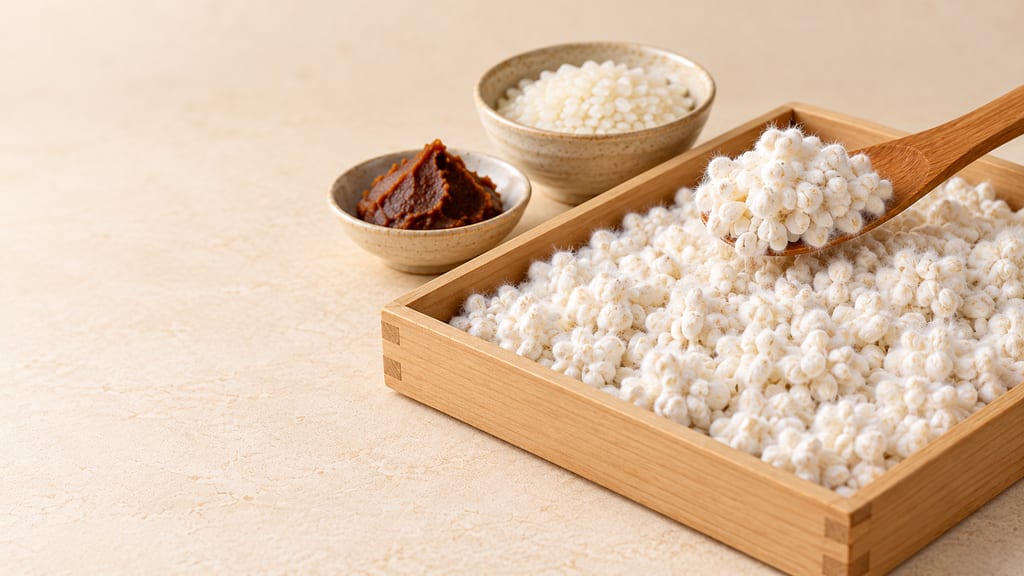
Steamed rice covered in the white, velvety growth of koji mould, the starter behind miso, soy sauce and sake.
Introduction
Rice koji looks modest: cooked grains covered and sometimes joined by a fine white growth. Yet it can help make a sweet drink, a savoury bean paste or the sugars that become sake. Those results depend on what happens after cultivation. The mould grows on the grain and produces enzymes. The enzymes break food components into smaller molecules. In some preparations, yeasts and bacteria then carry out further fermentations. Keeping these jobs separate makes koji much easier to understand—and to choose and use.
The word covers several things that a shop label may leave implicit. Kome-koji is rice colonised by a koji mould; mugi-koji uses barley, and mame-koji soybeans. Tane-koji, also called seed koji, is a spore preparation for inoculating a new batch. Koji-kin can mean the mould itself or, in commerce, its starter. A packet of spores, a slab of fresh rice koji and a bottle of liquid shio-koji therefore perform different jobs. Grinding the slab does not turn it into a tested spore starter.
A cultivated craft with an uneven historical record
Koji belongs to a wider Asian history of growing microorganisms on grains and beans. That history should not be collapsed into one organism travelling unchanged between countries. Korean nuruk, for example, can contain a varied community. A study of commercial and household samples recovered yeasts and several groups of filamentous fungi, with different enzyme activities. The presence of Aspergillus oryzae in such a community does not make the whole starter equivalent to a commercial Japanese koji culture. Chinese qu, Indonesian ragi and Vietnamese bánh men likewise need their own process and community descriptions, rather than translations that turn them all into “koji.”
Within Japan, the skill includes preparing grain, managing the growing bed and matching a starter to a finished drink or food. UNESCO inscribed traditional sake-making knowledge and skills using koji mould in 2024. That recognises a living practice; it does not date the first cultivation of the organism. Its earliest cultivation and the routes by which it spread remain uncertain.
The seed-koji trade provides a more tangible part of the story. In a 2025 interview, Hishiroku’s proprietor described the Kyoto company’s appearance in a publication from 1769, while acknowledging that its founding date is unknown.
Modern starter making combines that craft with strain isolation, controlled production and quality checks. Historical use of wood ash had several proposed functions, including changing the substrate’s chemistry and helping separate grains. It was part of a particular production practice. Ash is not an identity test, and scattering it over exposed grain is not a controlled way to obtain an edible starter. The important inheritance is sustained selection and management, not the assumption that a familiar-looking wild mould is the desired culture.
Species, strains and the trouble with colours
Aspergillus oryzae is central to rice koji used for sake, amazake and many misos. A. sojae is another important soy-sauce organism. Black koji associated with awamori and shochu belongs principally to A. luchuensis. The pale brewing lineage historically called A. kawachii belongs within A. luchuensis; names such as A. luchuensis mut. kawachii remain useful when tracing a particular commercial or research stock.
Older black-koji names need care. Taxonomic work comparing preserved strains showed that historical labels did not always denote one consistent species. An old reference to A. awamori, A. usamii or A. saitoi therefore needs its accession and identification history. Replacing every occurrence with a modern name can create a false certainty.
“White koji” is especially ambiguous. In a shochu context it may mean the pale A. luchuensis lineage. Akita Konno’s Pure White Koji range, however, is explicitly A. oryzae. The appearance serves the maker’s aim of limiting colour in the food; it does not establish membership of the acid-producing shochu lineage. Ask for the organism as well as the colour.
“Red” can be equally misleading. Fermentationculture.eu’s Red Rice starter is A. oryzae intended for red miso. The seller explicitly distinguishes it from Monascus. Red yeast rice or hongqu belongs to the latter tradition, with its own strains, pigments and food uses. Some Monascus preparations can also contain citrinin or pharmacologically active monacolins. Their presence and amount depend on the culture and process. A red name is neither a shared identity nor evidence of a health benefit.
A strain is a particular stock within this wider classification. The reference stock RIB40 illustrates why accession numbers matter. RIKEN’s collection lists JCM 13832, ATCC 42149, BCRC 30434, NBRC 100959 and NRRL 5590 as aliases of RIB40. These are collection references to the same stock, not six independently discovered culinary strains. A laboratory recovery temperature on that record is also not a rice-cultivation instruction.
Food-culture history does not justify identifying mould by eye. Research on industrial A. oryzae found differing remnants and defects in the aflatoxin biosynthesis gene cluster. The explanation is more complicated than “the species has none of the genes.” Its close relatives include toxin-producing fungi, and a white or green growth on an uncontrolled batch cannot establish its identity, purity or suitability for food. Named food-use starters with traceable handling instructions provide evidence that appearance cannot.
Choosing what the enzymes will do
The useful question when buying a starter is what the finished food requires. Amylases act on starch; glucoamylase helps release glucose. Proteases and peptidases break proteins into peptides and amino acids. Glutaminase converts glutamine to glutamate, which matters to savoury taste. A maker may also select growth speed, the length and density of fungal threads, penetration into the grain, browning and the way the cultured grains hold together.
These traits make a strain catalogue more informative than a promise of “strong koji.” Higuchi lists sake starters with different balances of glucoamylase and alpha-amylase, alongside differences in growth and browning. Its soy-sauce catalogue describes Diamond C as an A. oryzae option with strong glutaminase activity and Sojae No.9 as an A. sojae option selected for protease activity. These are the manufacturer’s comparisons within its range, not a ranking of all available cultures.
Read the notes as closely as the product name. Higuchi’s Hi Sojae appears under a “Hybrid” heading, but the description identifies a blend of A. oryzae and A. sojae. That is not evidence of a genetically hybrid organism. White-soy-sauce starters are selected for a wheat-rich substrate; a pale colour alone does not make another strain equivalent.
Akita Konno’s white A. oryzae products also differ substantially. Its No.2 is described as binding the grains tightly, while Suzuran is selected for strong protease activity in miso. The maker warns that laboratory enzyme figures vary with the substrate and cultivation method. Numbers from separate catalogues cannot be compared responsibly without knowing the assay, units and whether they refer to dry or wet material.
For a first purchase, match four things: the food you intend to make, the substrate, the maker’s cultivation method and the form being sold. Starter powder may be diluted with a carrier to aid distribution. A dose stated per kilogram of wet prepared grain cannot silently become a dose per kilogram of dry rice. Fresh or dried food koji is usually the appropriate starting ingredient when the next task is amazake or a seasoning; spores are for the preceding cultivation stage.
Growing a bed of koji
Cultivation requires more than holding rice at a warm room temperature. The grain must contain usable moisture while retaining enough structure for air to move through the bed. Steaming and draining are part of that preparation. A wet, compact mass behaves differently from separate grains, even if an air thermometer shows the same reading. Relative humidity in a box, moisture within the rice and water activity are related but different measurements. A humidistat does not establish the latter two.
The changing heat load is the central practical difficulty. At first, the chamber supplies warmth. As the mould grows, its metabolism heats the grain. Later, the cook may need to release heat while the room remains cool. A heater thermostat can stop adding energy but cannot remove the heat generated inside a deep bed. Loosening, spreading and adjusting the enclosure are therefore parts of cultivation, not merely cosmetic handling.
In Kojiya Sanzaemon’s home method, the rice and chamber follow different temperature schedules. For a batch begun with 500 g of dry rice, inoculation with its specified starter follows steaming and cooling to about 36 °C, with harvest at roughly 45–48 hours. Its later-stage chamber range is 30–35 °C, while the rice itself is managed at 37–42 °C, with intervention before it exceeds the upper value. These are instructions within one complete method, not universal limits for all moulds or grains. The full method also specifies preparation and timed maintenance; the figures alone do not constitute a recipe.
A probe in the grain and a separate air reading answer different questions. Position matters: a reading near an edge can miss a hotter centre. An enclosure needs a way to admit oxygen and let excess heat escape. A proofer, modified cabinet or insulated box is useful only if its actual behaviour suits the batch. A yogurt maker designed to heat a closed pot may be suitable for a later enzyme stage yet poorly suited to an aerated, self-heating grain bed.
Batch size changes that behaviour. Doubling the rice in the same tray increases depth and can change heat retention, airflow and the ease of mixing. More starter cannot correct a bed that cannot shed heat. Keep a record of dry substrate weight, prepared weight, starter and lot, bed arrangement, grain and air temperatures, interventions and harvest time. Those observations make a repeated batch interpretable. They do not certify an unfamiliar batch as safe.
Rice handling deserves its own attention. Bacillus cereus spores may survive cooking, and unsuitable warm storage can allow growth and toxin formation. Reheating does not reliably undo toxin already formed. Controlled koji cultivation deliberately differs from storing ordinary cooked leftovers, so it needs a complete method with preparation, inoculation and monitoring instructions. An unexpectedly stalled, contaminated or overheated batch should not be “rescued” by adding salt or cooking it later. Smell, sweetness and a white surface cannot settle the question.
Food koji is a different harvest from seed koji
Food koji is harvested for its enzymes and culinary properties. Seed production aims for spores of known identity and quality. Keeping a food batch longer until it becomes dusty does not establish a reliable starter: contamination, mixed cultures, spore yield and storage behaviour remain unknown.
At Hishiroku, seed production takes about 120 hours of cultivation, followed by drying. The longer cultivation serves a different harvest from food koji. Individual cultures are selected with microscopy and controlled equipment; the timing alone is not a household propagation method. A commercial blend may be intentional; an unnoticed mixture is a different matter.
A master stock and a working stock serve different purposes. The master preserves an authenticated reference with a documented history. Working material supplies routine production without repeatedly exposing that reference to handling and selection. Repeatedly starting from the most convenient tray loses that separation. Good-looking growth in the next batch does not show that the stock retained the same identity, enzyme profile or contamination status.
This is why buying fresh starter is a practical choice even for someone who cultivates food koji regularly. It separates growing a useful ingredient from maintaining a culture collection. Handle a spore preparation as directed, avoiding unnecessary airborne dust; a billowing cloud distributes spores through the workspace as well as onto the grain.
Three jobs after cultivation
Once koji enters a wet mash, several different processes may follow. Enzymatic hydrolysis can continue even when the mould is no longer growing. Yeast can ferment released sugars into alcohol. Lactic acid bacteria can alter acidity and flavour. The contribution of each depends on the food and its conditions.
In a 2013 comparison of salted koji, the tested commercial samples retained measurable enzyme activity without showing germination; the homemade comparison behaved differently. That small study does not establish that every bottled seasoning is sterile or that every homemade jar contains a viable starter. It does show why “active” needs a stated meaning. An enzyme-active seasoning is not necessarily a source of living mould suitable for another cultivation.
The distinction also prevents an easy error in language: a sweet result need not mean that yeast fermented anything, and a product made through fermentation need not contain living organisms when eaten. The next use of the koji determines which activity matters.
Sake, amazake and mirin take different paths
In sake, koji supplies enzymes while yeast converts sugars to alcohol. At Fukumitsuya, koji preparation and a yeast starter precede the main mash of rice, koji and water. Starch conversion and alcoholic fermentation then proceed together. Pressing separates the drink from sake lees, or sake-kasu. The lees are a distinct ingredient containing material from the brewing mash; they are not unused rice koji.
Rice-koji amazake takes another route. Warm holding encourages starch breakdown and sweetness without requiring an alcoholic fermentation. Akita Konno gives 58–62 °C for 6–8 hours in its specified amazake method. Those are enzyme-processing conditions, not temperatures at which to grow the original grain mould. The maker calls for cooling and refrigeration after completion. A sweet taste indicates sugar formation, not preservation. Amazake made with sake lees is a different preparation and should be labelled accordingly, particularly where alcohol matters.
Hon-mirin takes another path. Kokonoe’s hon-mirin, made in Hekinan in the Mikawa area of Aichi, uses glutinous rice, rice koji and shochu. The alcohol is introduced with the distilled drink while the koji’s enzymes help develop sweetness and flavour during maturation. Calling it “sweet sake” obscures that process.
Shochu and awamori bring acid-producing koji into view before yeast fermentation and distillation. A barley-koji experiment with the lineage then named A. kawachii examined a temperature change from 40 °C to 30 °C. The cooler phase favoured citric-acid accumulation as metabolism shifted away from the heat-stress response. This explains why a brewery might deliberately change the temperature through cultivation. It does not mean every koji should receive that schedule, nor that one home acidity reading validates a mash.
Miso and soy sauce: grain, beans and time
Miso is not one substrate with a range of colours. Rice miso combines rice koji with soybeans; barley miso uses barley koji; soybean miso uses koji made on soybeans. Barley miso has strong regional traditions in Kyushu and parts of Shikoku and Chugoku, while soybean miso is associated with Aichi, Gifu and Mie. These are documented traditions rather than borders beyond which a food cannot be made. Kyoto’s Saikyo, Kagawa’s Sanuki and Hiroshima’s Fuchu provide named regional examples of pale rice miso.
The relative amounts of koji and beans, the starter’s enzymes, salt, water and maturation conditions all affect the result. Colour cannot substitute for that formulation. Nor does a sweet, young paste inherit the storage behaviour of a different long-matured miso. Blended misos sit alongside the three substrate families, another reason to read the ingredients rather than infer the process from the front label.
In Kikkoman’s usual brewed soy sauce, koji grows on prepared soybeans and wheat before brine is added to form moromi. The mould-growth stage gives way to enzyme action and a community including lactic acid bacteria and yeasts. The bed’s earlier need for oxygen and cooling is different from the conditions of the later mash. Pressing, clarification and finishing produce another change of state. Some products undergo heat treatment, while some unheated products rely on other processing; “raw” is not a complete storage instruction.
The word shoyu-koji can refer to that cultured soy-and-wheat material before brining. In a kitchen recipe it often means something else: food koji mixed with already-made soy sauce to produce a seasoning. Marukome’s household version uses rice koji, soy sauce and additional salt. It is not the opening step of brewing soy sauce from beans and wheat.
Seasoning food without cultivating mould on it
Shio-koji combines food koji, salt and water. It can season a food while its enzymes change texture and flavour. Liquid shio-koji is a commercial form with a different texture and a product-specific composition. It seasons meat marinades, sauces and dressings, where its sweetness and salt need balancing against the rest of the dish.
Treat a marinade as a preparation of the food being marinated. Adding koji to poultry does not remove the poultry’s refrigeration and cooking requirements. A warm laboratory assay showing stronger protease action is not a recommendation to hold raw meat at that temperature. Likewise, replacing a portion of salt with a seasoning requires its actual salt content, not a presumed standard shared by every jar.
Vegetables, fish, tofu and meat can all appear in koji-related pickling or seasoning traditions, but the medium matters. A miso marinade, a sake-lees bed and a rice-koji seasoning bring different ingredients and conditions. Their names should lead to their respective methods rather than to a generic instruction to leave food with koji until it smells pleasant.
Allergens remain attached to the ingredients and processing. Soy sauce may contain wheat; barley koji contains a gluten-bearing grain. Fermentation and hydrolysis are not processes that can simply be assumed to remove gluten, and conventional tests have limitations with the fragments produced. A rice-based culture name alone cannot establish the suitability of a blended seasoning for someone avoiding gluten, soy or another allergen.
New substrates, garums and the limits of analogy
Koji’s enzymes make it attractive wherever starch or protein might become useful flavour. Modern garums at Noma Projects use koji to break down ingredients extending beyond fish into savoury liquids. These are contemporary culinary adaptations. The shared word does not establish that a warm meat-and-koji preparation follows the same process as an ancient fish sauce, or that one salt level works for both. A complete method and evidence for the particular substrate remain necessary.
The same kitchen’s peaso uses yellow peas and barley koji as a miso-inspired preparation. Its work on the resulting liquids and reductions shows another decision after fermentation: a cook can separate and concentrate a fraction rather than treat the entire paste as the final ingredient. Concentration changes seasoning strength, so the finished liquid needs to be judged and described on its own terms.
Seaweed offers a particularly instructive research example. Uchida, Hideshima and Araki studied koji production using nori identified in the paper as Pyropia yezoensis, then used it in nori sauce. Their prepared material and aerated arrangement mattered. They reported improved liquid recovery and nitrogen recovery relative to their comparison process.
A yield result for one nori process does not establish that any beach-collected seaweed is a suitable substrate, that other seaweed polysaccharides behave like rice starch, or that the process solves contaminants and species identification. Even commercial nori differs in salt, preparation and structure from other sea vegetables. A promising yield result cannot supply household handling or storage limits.
Brewing and baking ask still different questions. A 2023 beer study replaced 30% of malt with koji made from specified sorghums and compared mash methods. It demonstrates a tested use of that material, not a general one-for-one replacement for malt. Bread work has long investigated separating koji’s starch-degrading and protein-degrading enzyme fractions. The baker needs to know which activity an ingredient supplies; a starch conversion result is not a measurement of dough strength or proof that the culture will leaven bread. A yeast-containing bread starter and powdered food koji should not be treated as interchangeable.
Store the form you actually have
Storage aims differ. A spore packet needs to retain its intended inoculating performance. Fresh food koji needs suitable handling as a moist food. Dried koji may be sold for its enzymes. A bottled seasoning has its own processing, packaging and instructions. “Keeps the koji alive” cannot serve as one rule for all four.
Higuchi recommends cool, dry, dark storage for its seed products and warns against refrigeration or freezing where condensation can occur. That advice cannot be transferred to fresh rice koji: Kojiya Sanzaemon’s method calls for freezing unused finished koji and using it within its stated period. Follow the instructions for the actual product and packaging, including what changes after opening, rather than combining the most convenient parts of unrelated recommendations.
In one rice-koji drying experiment, much of the measured enzyme activity survived while thermotolerant bacterial counts remained unchanged. That is evidence about enzyme retention and the tested microorganisms, not sterilisation. A freezing study measured protease activity; that does not establish that frozen food koji is a validated spore starter. A viable fungus, a measurable enzyme and a safe stored food are different outcomes.
Heat affects enzymes and microorganisms differently. In a study of fresh sake, 65 °C for two minutes inactivated the four enzymes being measured. Alcohol and glucose affected the response. The result belongs to that sake system. It is not a universal temperature that simultaneously destroys every koji enzyme, makes every paste safe and gives every jar the same shelf life. A bath or chamber reading also does not show what temperature the centre of a thick food reached.
Choose the purpose before choosing a heat treatment: encouraging a particular enzyme reaction, stopping further texture change, or carrying out a validated microbial control. Those purposes can require different evidence. Cooling, packaging and subsequent storage still matter after heating. Neither boiling a spoiled batch nor measuring one apparently satisfactory pH supplies the missing history.
What current research can—and cannot—settle
Domestication remains an active question. A 2025 genomic study examined hundreds of isolates across food, environmental and clinical collections and found a more complicated history than one simple split between a wild ancestor and a single domestic lineage. Multiple domestication events and genetic exchange were among its interpretations. That work helps explain why a species name alone does not describe every industrial trait. It does not replace testing of a particular production stock.
Researchers are also treating A. oryzae as edible fungal biomass. A 2024 study led by Vayu Maini Rekdal used genetic engineering to alter heme and ergothioneine production, including a demonstration of more meat-like coloured biomass. This is laboratory development with defined engineered strains. It is not a property established for ordinary kitchen koji, a home procedure or a demonstrated health benefit from eating more fermented food.
For cooks, some of the most useful unanswered questions are less spectacular: how a named strain behaves on a specific new substrate; which enzyme activities survive a proposed drying method; how flavour changes under controlled conditions; and what storage evidence exists for the finished food. Good answers retain the strain, preparation, measurements and comparison. That detail lets a result travel responsibly from one batch to the next without turning a research observation into an unsupported recipe.
Related
Discussed in this article
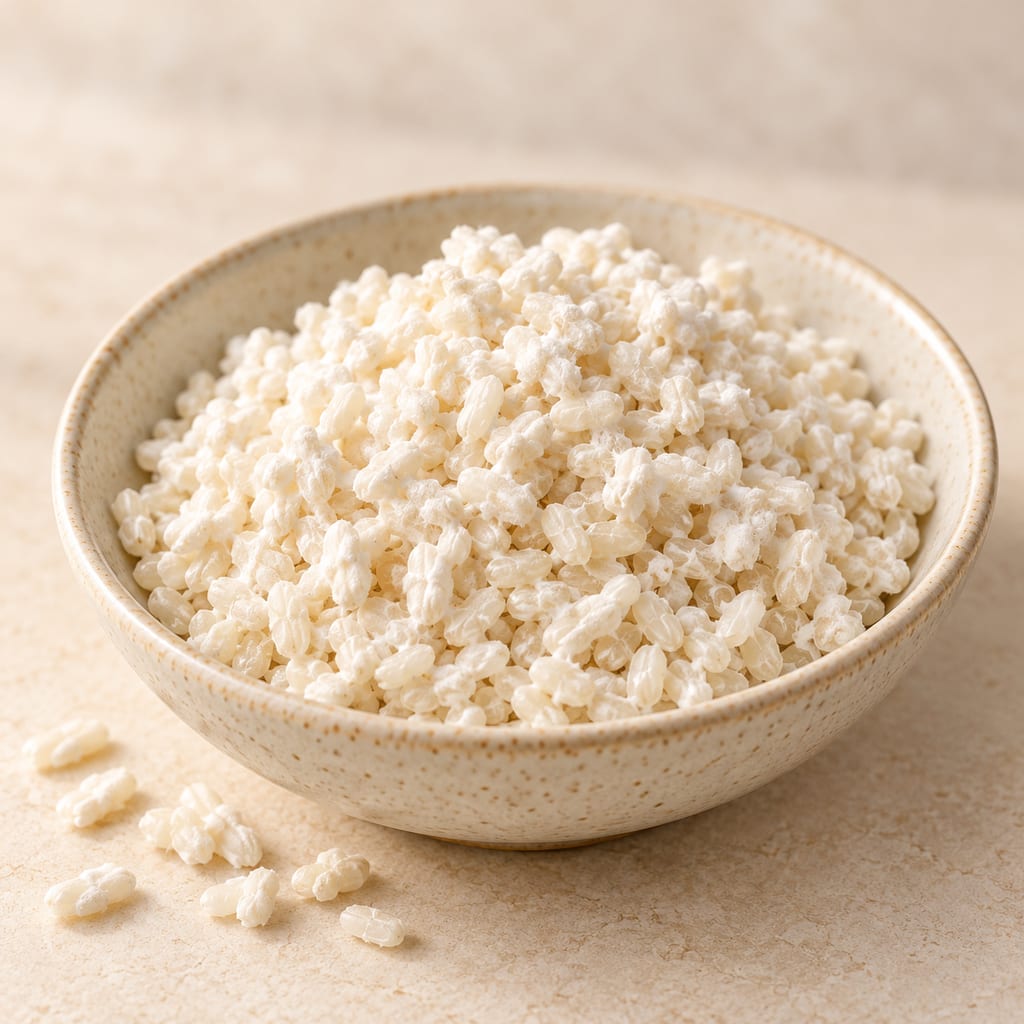
Koji culture: named mold, substrate and enzyme system
Koji is steamed grain — rice, barley, soybean or wheat — grown out with a food-grade Aspergillus mold until the kernels carry working enzymes. It is bought or cultivated, and it converts starch and protein for the foods that follow.
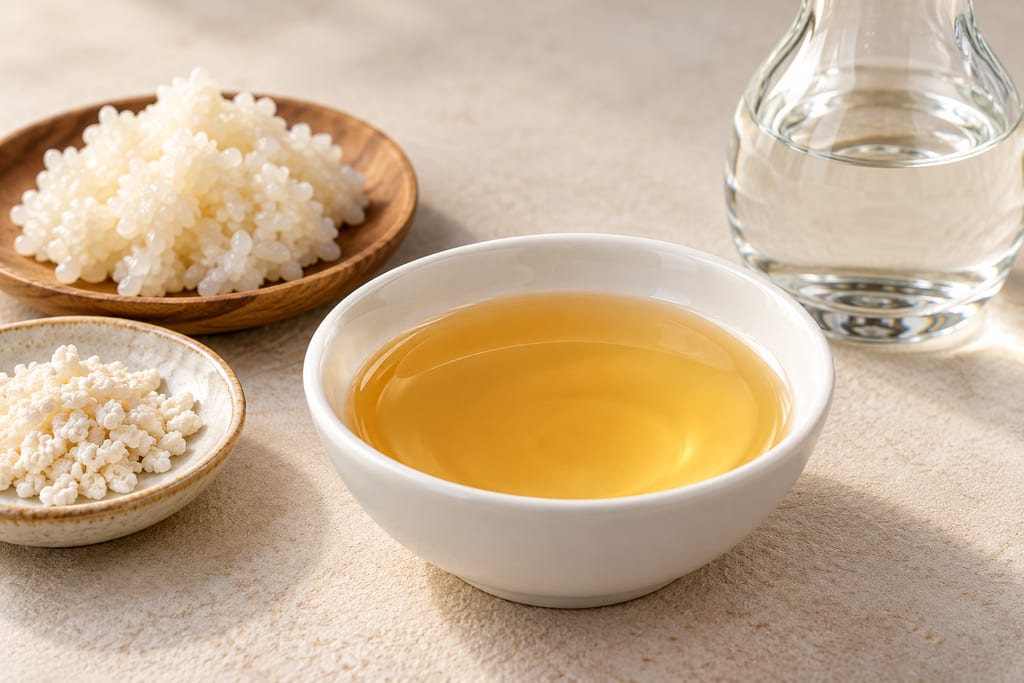
Mirin
Hon-mirin is a Japanese rice seasoning made by saccharifying glutinous rice with rice koji in shochu, then pressing and usually heating the mash.
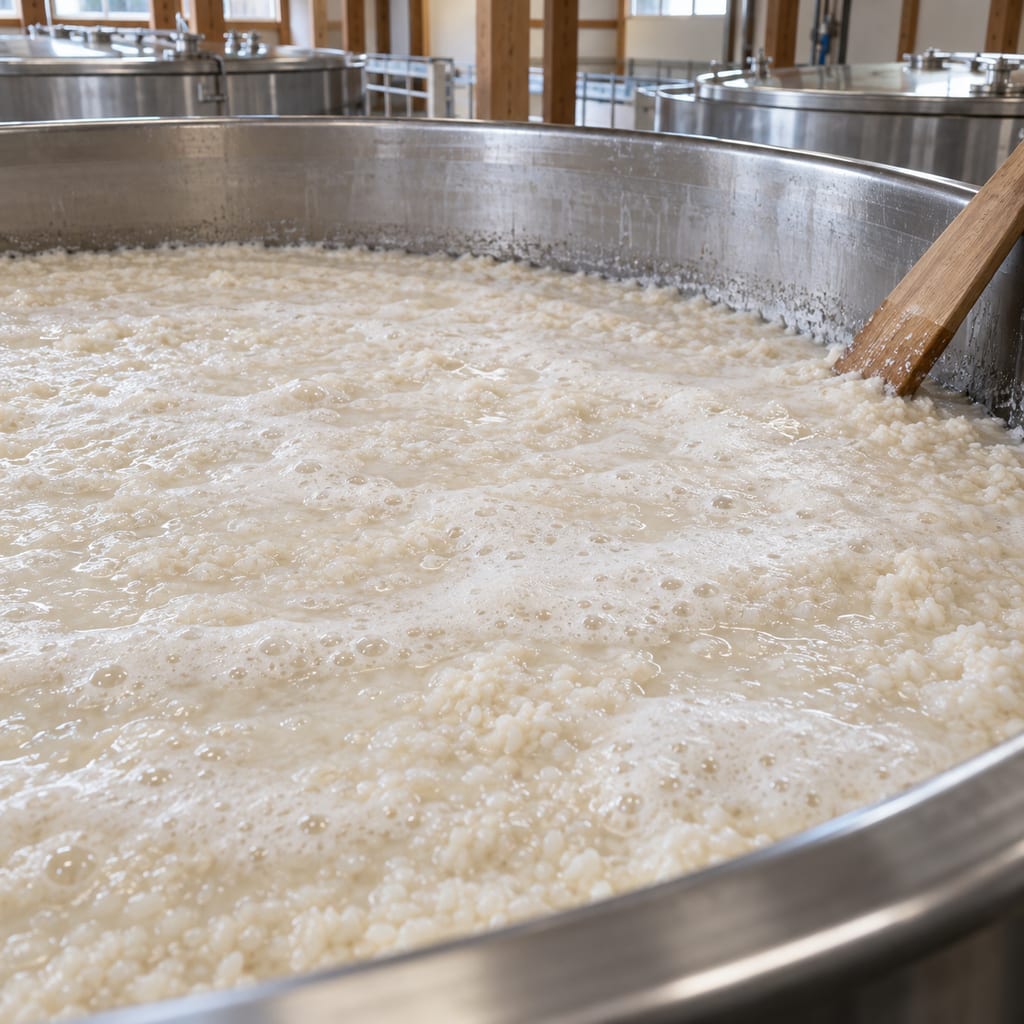
Nihonshu / seishu (Japanese rice sake)
Nihonshu (日本酒), or seishu, is Japanese rice sake: steamed rice, rice koji, water and a yeast starter ferment together in one mash, which is then pressed and finished.

Rice koji
Rice koji is steamed white rice through which koji mold has grown. It carries the enzymes that turn rice starch into sugar, and it is the starting point of sake, sweet miso, amazake and shio koji.
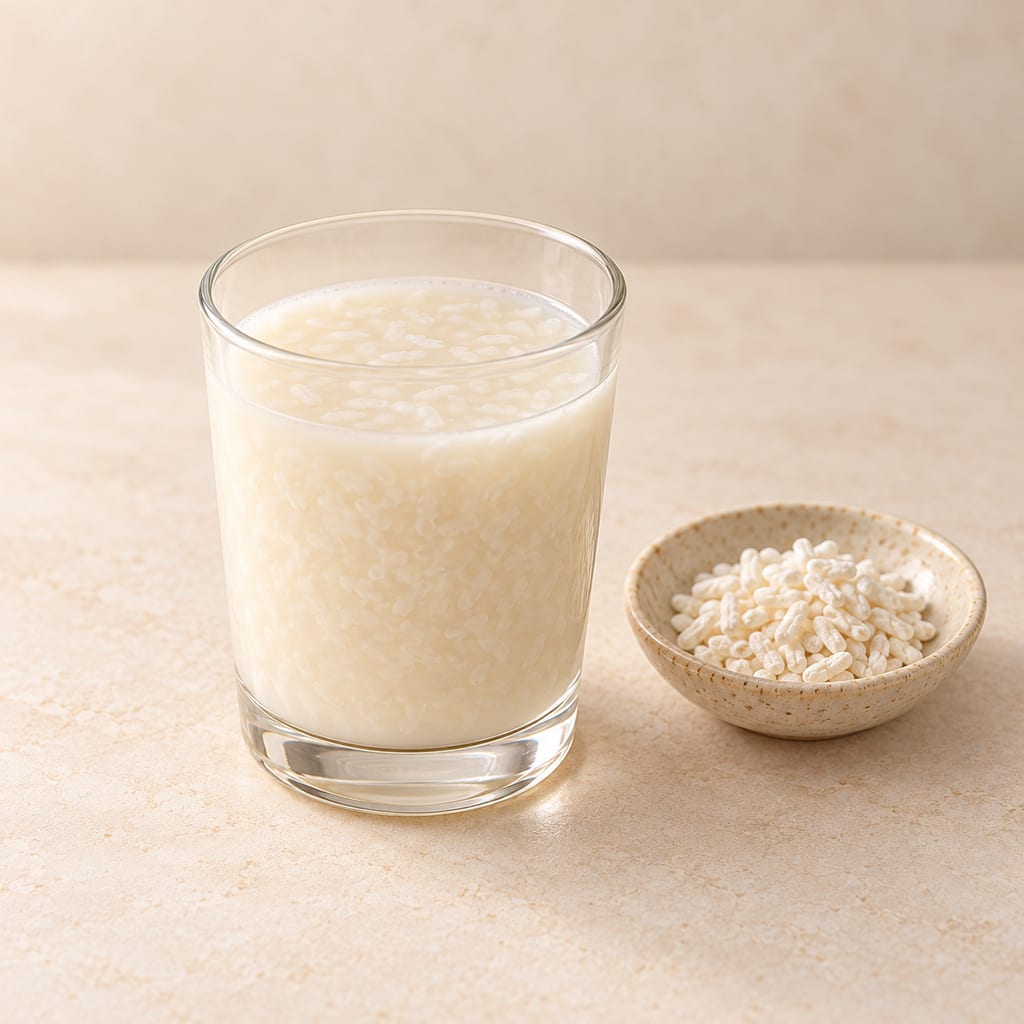
Rice-koji amazake
Cooked rice, rice koji and water are held warm for hours so koji enzymes turn the rice starch to sugars, giving a naturally sweet Japanese drink with no added sugar and no second fermentation.
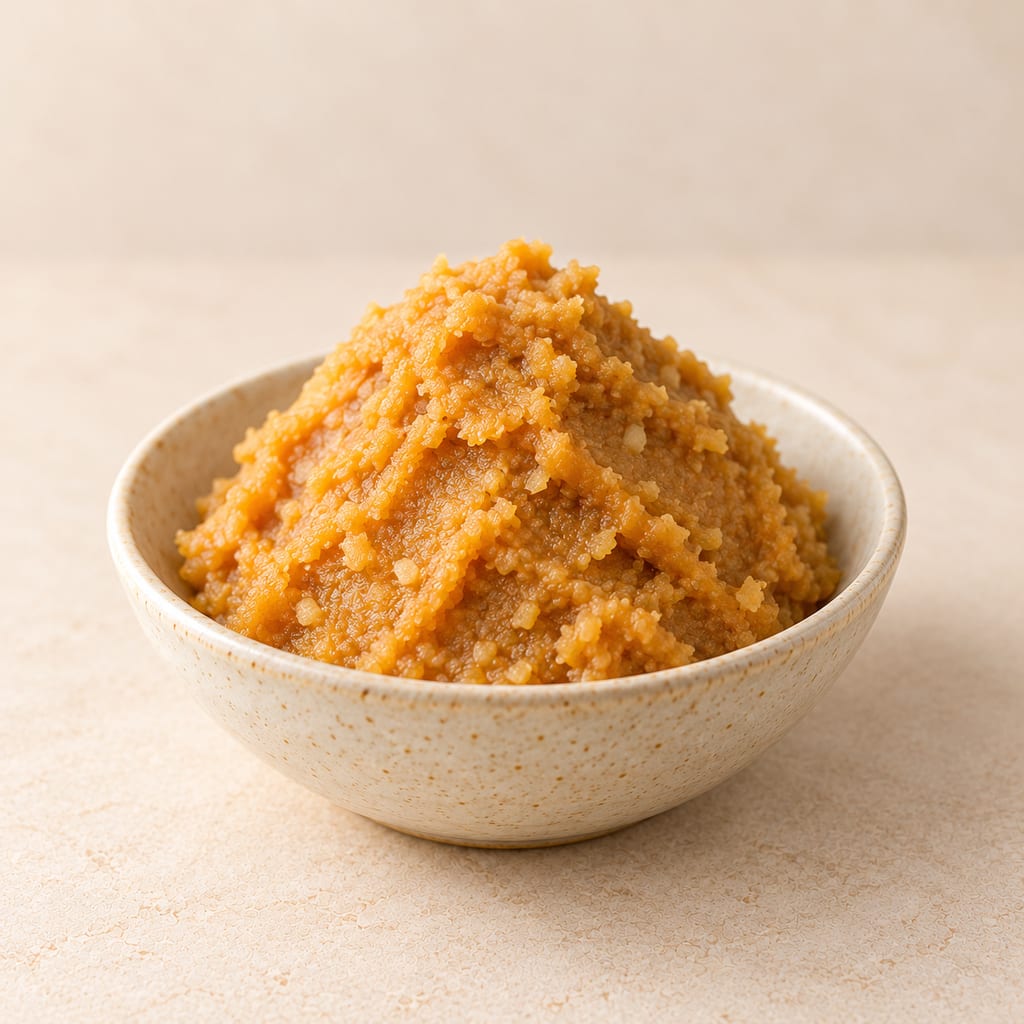
Rice-koji soybean miso
A traditional Japanese fermented paste made by mixing cooked soybeans with rice koji and salt. This guide details the ratio, the long enzymatic breakdown, and the months-long maturation required for depth.
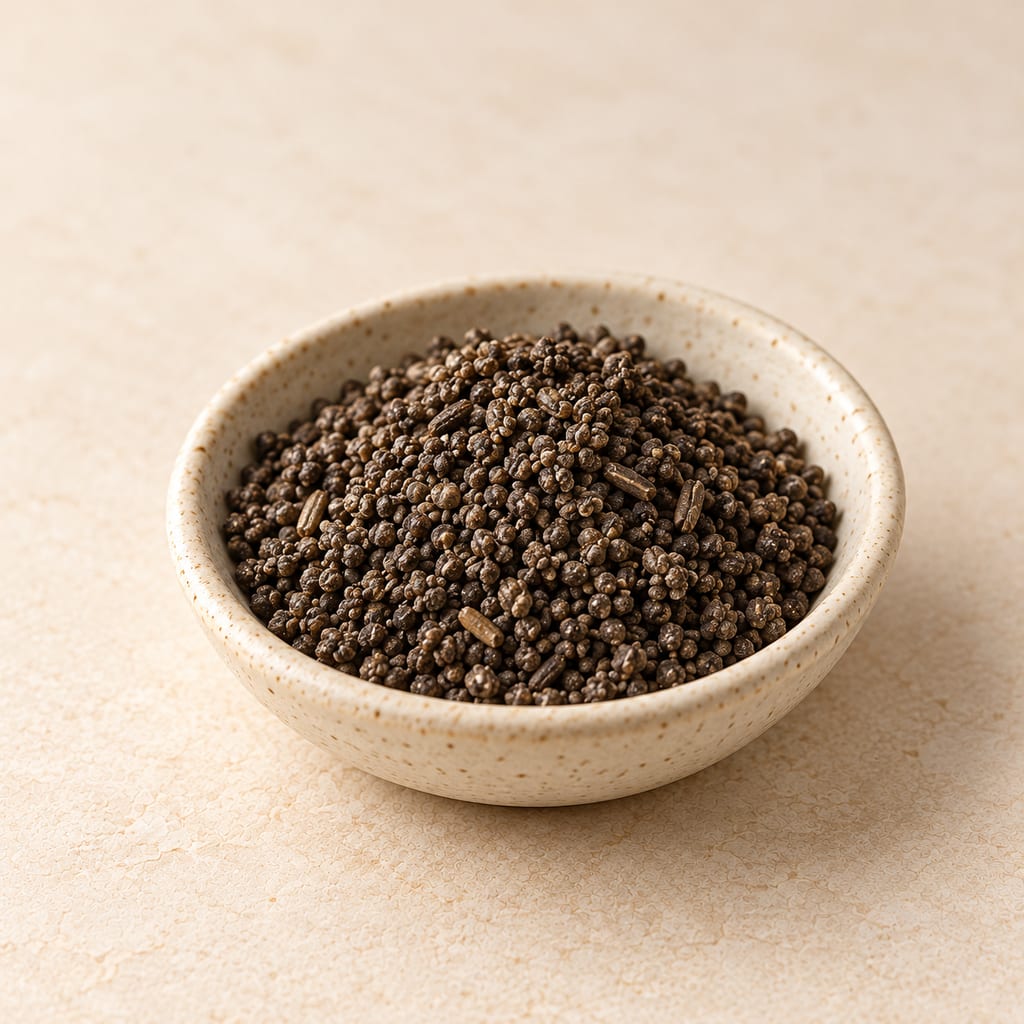
Seed koji
Tane-koji is the mold inoculum Sakimoto plants on steamed rice to make rice koji for Yonaguni awamori; its exact strain and supplier are unpublished.
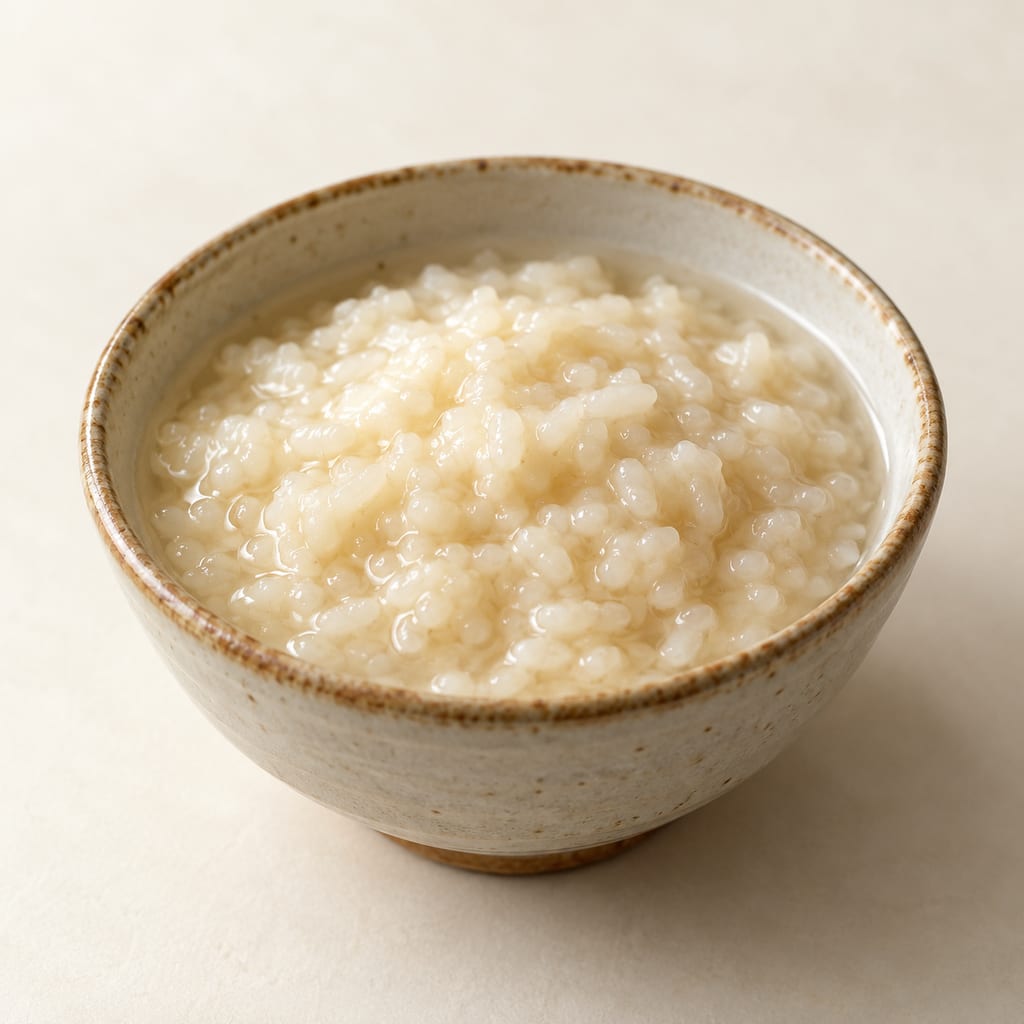
Shio-koji
Shio-koji is a Japanese seasoning of rice koji, salt and water, left at room temperature until the grains soften and turn sweet and the mixture thickens.
Community
No community contributions have been published for this entry yet.
Share what you made
Sign in to contribute. Published comments and photos are free to read.
Sources
Hideyuki Yamashita; Journal of Fungi / MDPI
Koji Starter and Koji World in JapanCited in: Introduction; A cultivated craft with an uneven historical record; Food koji is a different harvest from seed koji
Journal of Microbiology
Comprehensive analysis of fungal diversity and enzyme activity in nuruk, a Korean fermenting starter, for acquiring useful fungiCited in: A cultivated craft with an uneven historical record
Food Microbiology / Elsevier
Unexpected convergence of fungal and bacterial communities during fermentation of traditional Korean alcoholic beverages inoculated with various natural startersCited in: A cultivated craft with an uneven historical record
UNESCO Intangible Cultural Heritage
Traditional knowledge and skills of making sake with koji mold in JapanCited in: A cultivated craft with an uneven historical record
Marukome, Hakkou Bishoku
Seed Koji Traditions Kept Alive by Kyoto’s ArtisansCited in: A cultivated craft with an uneven historical record; Food koji is a different harvest from seed koji
Hong and colleagues; PLOS ONE
Aspergillus luchuensis, an Industrially Important Black Aspergillus in East AsiaCited in: Species, strains and the trouble with colours
Akita Konno
Pure-white koji moldCited in: Species, strains and the trouble with colours; Choosing what the enzymes will do
Fermentationculture.eu
Red Rice Koji SporesCited in: Species, strains and the trouble with colours; Choosing what the enzymes will do
EFSA ANS Panel; EFSA Journal
Scientific opinion on the safety of monacolins in red yeast riceCited in: Species, strains and the trouble with colours
RIKEN Japan Collection of Microorganisms
JCM 13832 - JCM CatalogueCited in: Species, strains and the trouble with colours; Food koji is a different harvest from seed koji
Tominaga and colleagues; Applied and Environmental Microbiology / ASM
Molecular analysis of an inactive aflatoxin biosynthesis gene cluster in Aspergillus oryzae RIB strainsCited in: Species, strains and the trouble with colours
Higuchi Matsunosuke Shoten
How to Select the Koji StarterCited in: Choosing what the enzymes will do; Store the form you actually have
Higuchi Matsunosuke Shoten
Koji Starter for Sake and MirinCited in: Choosing what the enzymes will do
Higuchi Matsunosuke Shoten
Koji Starter for Soy SauceCited in: Species, strains and the trouble with colours; Choosing what the enzymes will do
Kojiya Sanzaemon
How to make rice kojiCited in: Growing a bed of koji; Store the form you actually have
Fermentationculture.eu
What Koji needs to grow and how to provide for its needsCited in: Growing a bed of koji
British Columbia Centre for Disease Control
Salt koji (shio-koji) fermentationCited in: Growing a bed of koji; Food koji is a different harvest from seed koji; Store the form you actually have
New Zealand Ministry for Primary Industries
Bacillus cereus bacteria in rice and other starchy foodCited in: Growing a bed of koji
Abe, Kobari and Akita; Jissen Women's University bulletin; abstract indexed by CiNii
Comparison of Enzyme Activities of Commercial Salted-koji and Homemade Salted-koji.Cited in: Three jobs after cultivation; Store the form you actually have
Fukumitsuya
FUKUMITSUYA SAKE BREWERYCited in: Introduction; Three jobs after cultivation; Sake, amazake and mirin take different paths
Kokonoe Mirin
Continuously creating authentic mirin for nearly 250 yearsCited in: Sake, amazake and mirin take different paths
Futagami and colleagues; Applied and Environmental Microbiology / ASM
Transcriptomic analysis of temperature responses of Aspergillus kawachii during barley koji productionCited in: Sake, amazake and mirin take different paths
Japan Ministry of Agriculture, Forestry and Fisheries
Soy sauce, miso, other seasonings | Traditional Foods in JapanCited in: Introduction; Miso and soy sauce: grain, beans and time
Kikkoman
キッコーマンしょうゆのできるまで(醤油の作り方)Cited in: Introduction; Growing a bed of koji; Three jobs after cultivation; Miso and soy sauce: grain, beans and time
Kikkoman Institute for International Food Culture
Soy Sauce Brewing TechnologyCited in: Three jobs after cultivation; Miso and soy sauce: grain, beans and time
Marukome
麹の調味料を手作りしてみよう!Cited in: Introduction; Miso and soy sauce: grain, beans and time; Seasoning food without cultivating mould on it
US Food and Drug Administration
Questions and Answers on the Gluten-Free Food Labeling Final RuleCited in: Seasoning food without cultivating mould on it
Uchida, Hideshima and Araki; Journal of Bioscience and Bioengineering / Elsevier
Development of koji by culturing Aspergillus oryzae on nori (Pyropia yezoensis)Cited in: New substrates, garums and the limits of analogy
Lee and colleagues; International Journal of Food Properties / Taylor & Francis
Optimizing brewing beer production using Aspergillus oryzae solid-state fermentation of sorghum koji as an adjunctCited in: New substrates, garums and the limits of analogy
Taichi Harada; Bulletin of the Chemical Society of Japan
Fungus and Enzyme. Preparation of Aspergillus Oryzae Amylase and its Use in Bread MakingCited in: New substrates, garums and the limits of analogy
Oyashiki and colleagues; Journal of Fermentation Technology / Elsevier
Mirin-making using long-life koji with low water contentCited in: Store the form you actually have
Momoko Tatsumi, Yuka Sameshima and Tokumitsu Matsui; Journal of Cookery Science of Japan
Effects of rice-koji preservation condition and amazake salt concentration on protease activityCited in: Seasoning food without cultivating mould on it; Store the form you actually have
Tanimoto and colleagues; Journal of the Brewing Society of Japan
Thermal inactivation behavior of enzymes in fresh sake during pasturizationCited in: Store the form you actually have
Pfliegler and colleagues; IMA Fungus
Global population genomics redefines domestication and clinical diversity in the Aspergillus flavus–oryzae complexCited in: What current research can—and cannot—settle
Vayu Maini Rekdal and colleagues; Nature Communications
Edible mycelium bioengineered for enhanced nutritional value and sensory appeal using a modular synthetic biology toolkitCited in: What current research can—and cannot—settle
Gaps
- Historical transmission is uncertain: no precise birthplace or first date is established.
- Storage and nonstandard substrates: No universal safe salt, pH, water activity, heat process, viable-starter window or shelf life established, especially for meat, fish and seaweed experiments.
Updated 2026-10-27