Cooked rice, rice koji and water are held warm for hours so koji enzymes turn the rice starch to sugars, giving a naturally sweet Japanese drink with no added sugar and no second fermentation.
Amazake is a pale, cloudy Japanese drink of cooked rice, and its defining quality is a sweetness that arrives without any sugar being added. Japan's Ministry of Agriculture, Forestry and Fisheries counts it among the country's traditional beverages and describes it as a fermented drink that is strongly sweet and rich in nutrients. The Japanese name, 甘酒 (amazake), carries the character for alcohol, which misleads readers in English; the ministry states plainly that because the drink holds no alcohol, or only trace amounts, it is not classified among alcoholic beverages at all. The name records what the drink descends from, not what is in the cup.
The rice version has its own name, because there are two ways to make something called amazake. The ministry names them to keep them apart: 麹甘酒 (kōji-amazake), built on rice inoculated with koji mold, and 酒粕甘酒 (sakekasu-amazake), built on the pressed cake left behind when sake is drawn off. They share a word and a place in the kitchen, and they reach that place by entirely different routes. Knowing which one a recipe means is the first thing a maker needs to settle.
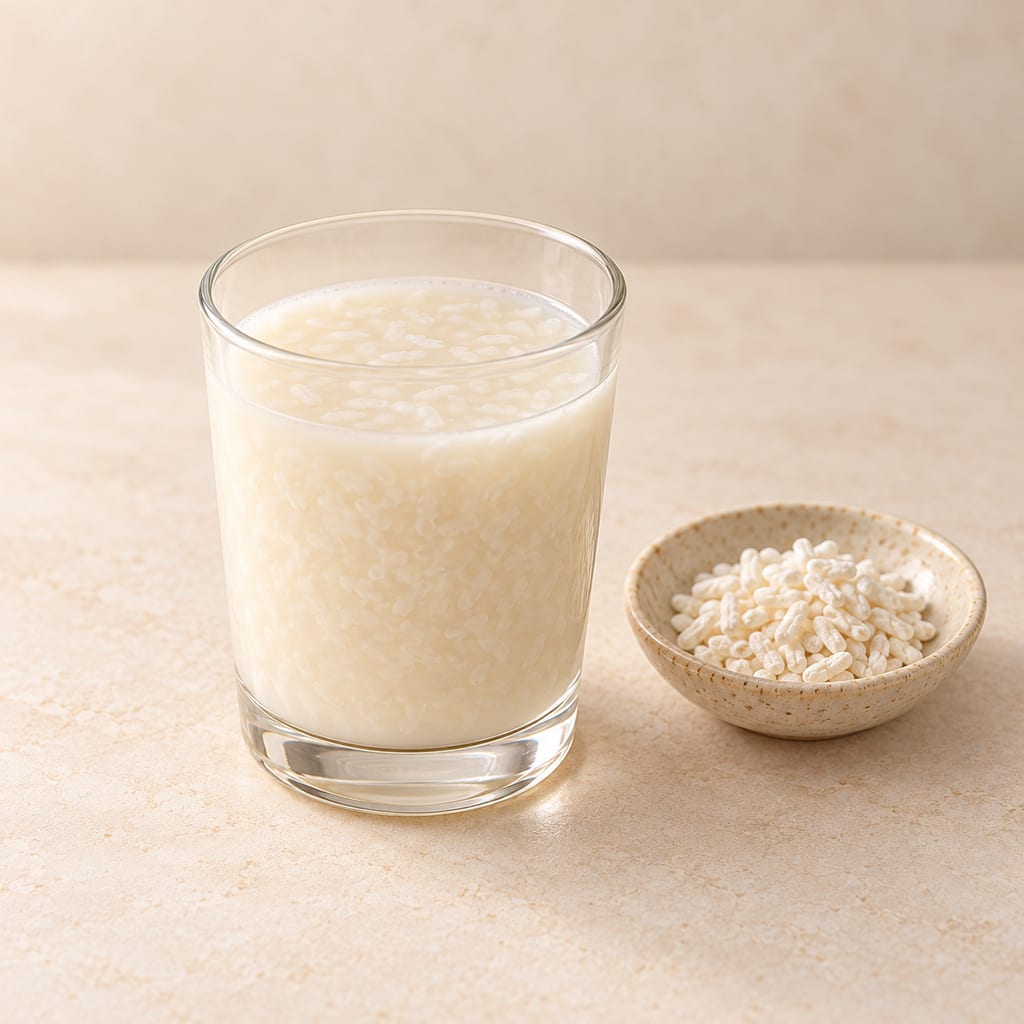
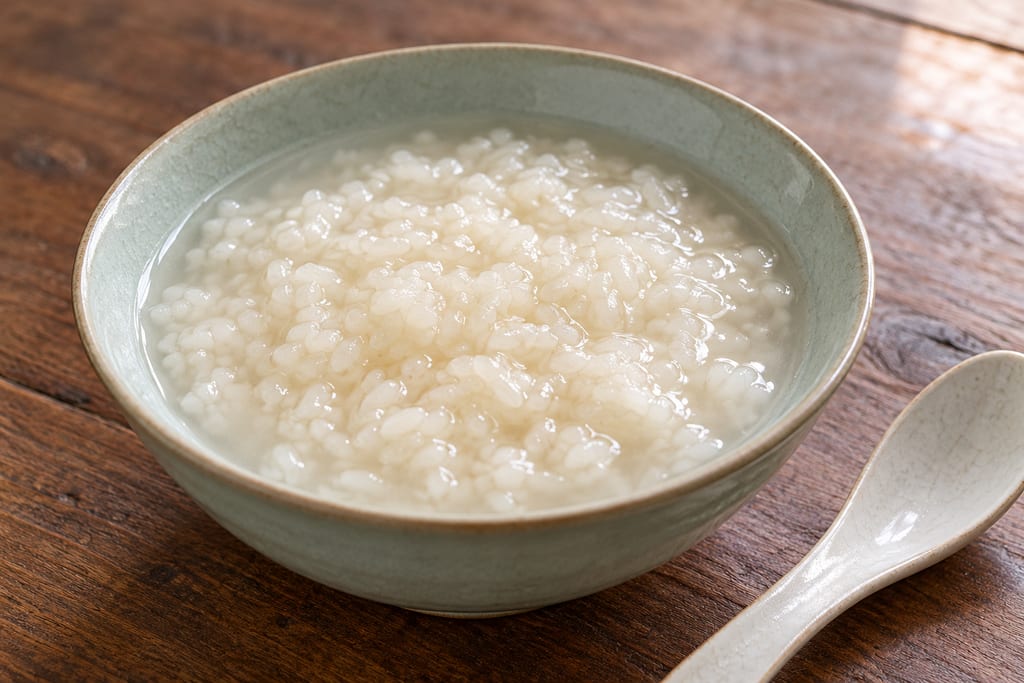
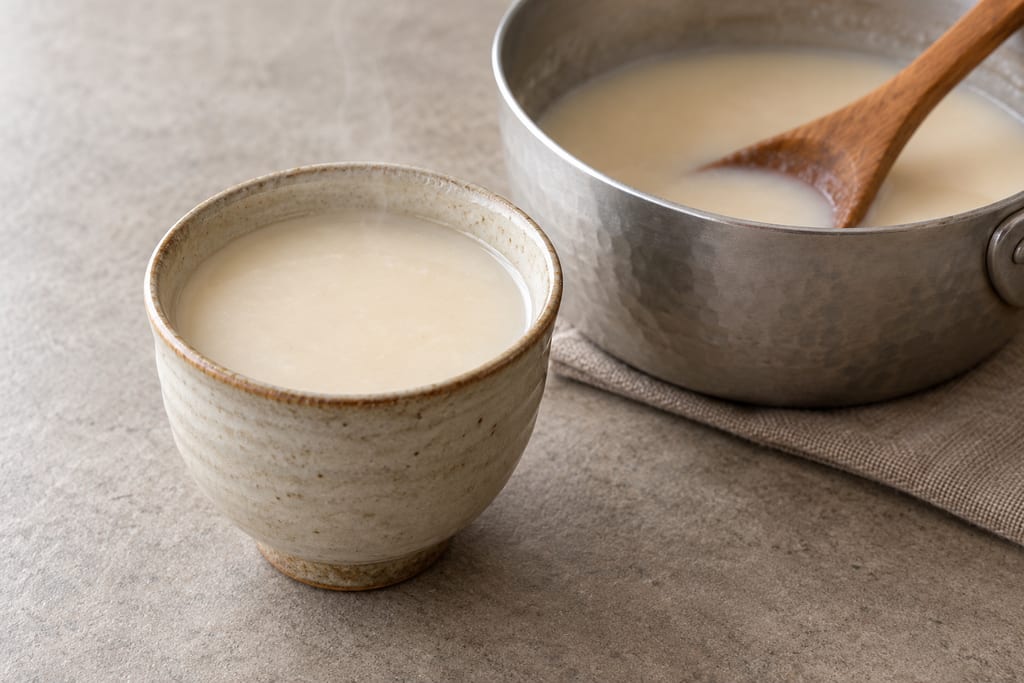
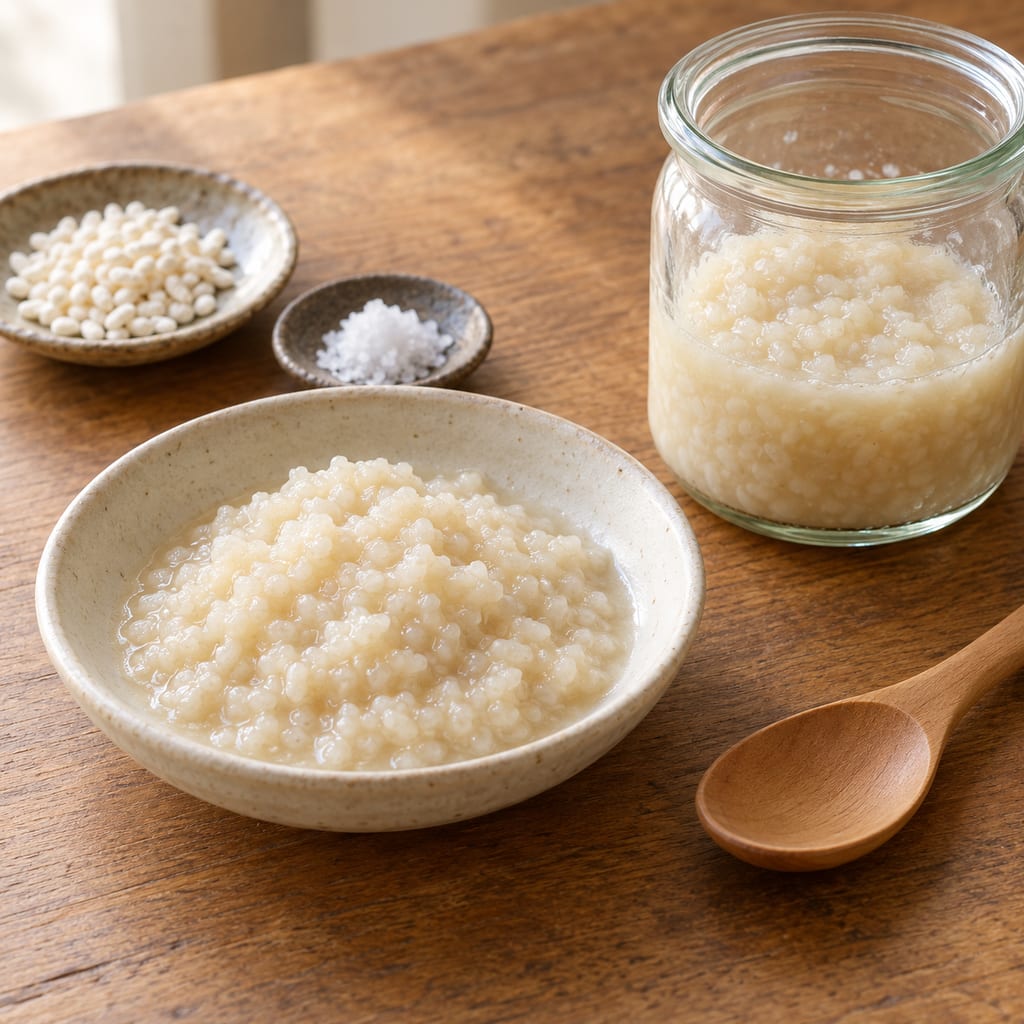
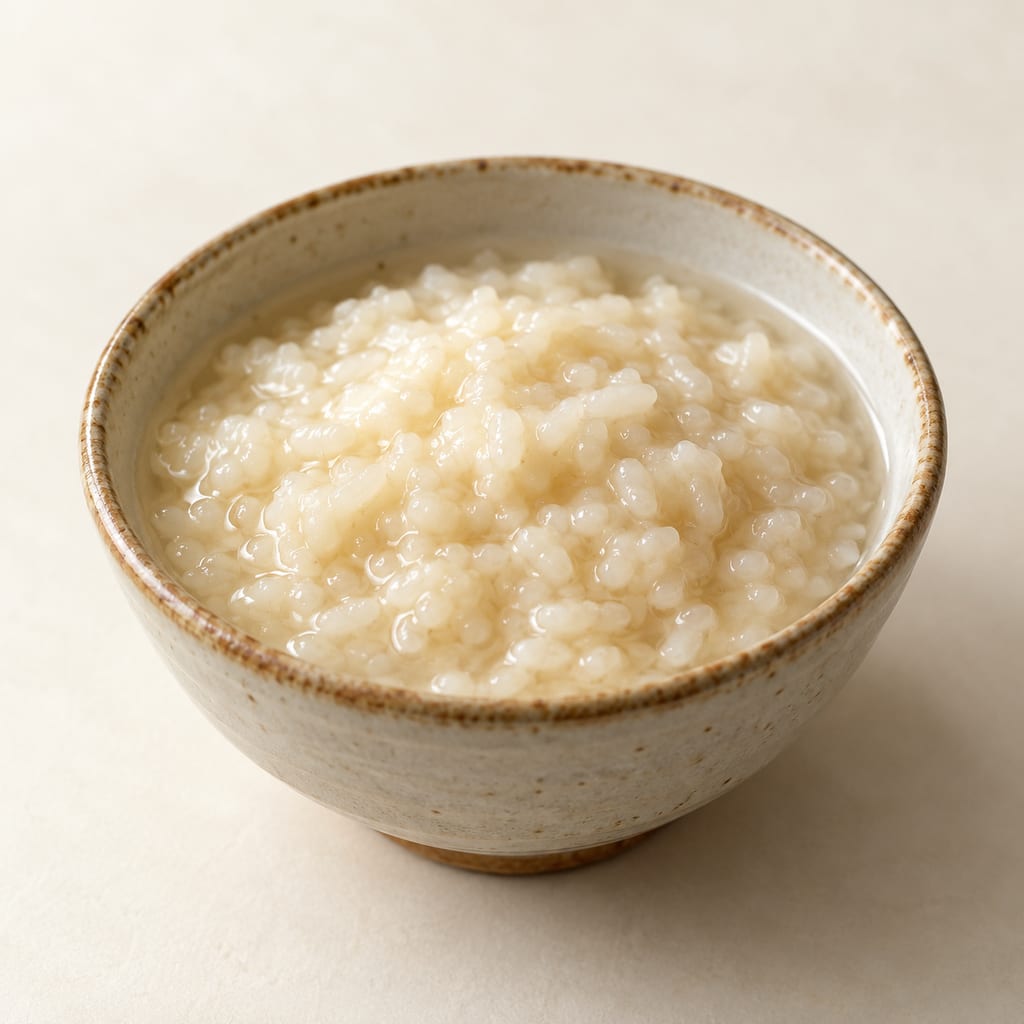
The formula on this page is koji amazake, and it is deliberately minimal: cooked white rice, rice koji and water, held warm for most of a day. No sugar, no salt, no flavouring, no second culture. The sweetness is coaxed out of the rice itself by enzymes the koji carries. The home method followed here finishes with a mixture so loose it is described as a runny, rice-flecked porridge — thin enough to drink from a mug, thick enough that softened grains stay visible in it. It is a drink you can also eat with a spoon, and it is served hot.
Two clarifications belong at the start, because this drink is often described carelessly. The change that sweetens it is enzymatic rather than microbial: the British Columbia Centre for Disease Control's guideline on koji foods treats the warm stage as saccharification, the conversion of starch to glucose by amylase, and declines to call that stage fermentation at all. The ministry, meanwhile, calls the drink a fermented beverage. Both statements stand if the terms are kept apart — a mold grown on rice supplies the enzymes, and the enzymes do the sweetening. Whether living organisms are still active in the finished cup is a separate question, and the sources read here answer the first question but not that one.
The method recorded below is a modern domestic one, with cup-and-ounce quantities and a kitchen appliance holding the temperature. It is worth reading against the ministry's plainer account of the same drink, because the two agree on every essential and differ only in how precisely the numbers are written down.
Nobody has settled where amazake began, and the careful sources say so directly. The ministry's account opens by noting that several origin theories exist, then offers the best-known candidate without endorsing it. The chronicle *Nihon Shoki*, compiled in the Nara period, describes a drink written 天舐酒 and read *ama no tamuzake*. The ministry's reading of that passage is that it was a sweet rice-koji drink of low alcohol, closer in kind to today's amazake than to modern sake. If that identification holds, the ancestor of this sweet drink sits on the koji-and-rice side of the family rather than the brewing side, and the line between those two was still soft when the chronicle was written.
That is the full extent of what the evidence supports, and it should be reported that way. The chronicle passage is presented by the source as one theory among several, not as a dated first appearance of amazake under its own name, and no source consulted for this page fixes a century at which the drink can be pinned down. The period field of this record is therefore left unestablished rather than filled with a guess. What the sources do settle is the drink's home ground: it is treated as indigenous to Japan, resting on rice as the staple crop and on koji as a foundational element of traditional Japanese cooking. Its identity is tied to two materials that define that kitchen.
The geography inside Japan is more legible than the deep history, and it traces the shape of the fermentation trades. Koji amazake, the ministry observes, is associated with regions where koji-based crafts such as miso and soy sauce are deeply rooted. Those were households and workshops that already grew mold on rice as routine work, so a sweet rice drink was a short step away. Sake-lees amazake clusters where breweries are numerous, because the lees are what remains after sake is pressed out of the mash. The two drinks distribute themselves along two economic lines: one follows the koji maker, the other follows the brewer and the residue the brewer is left with.
That division explains how each drink was historically obtained. The sake-lees version is essentially a way of using what the brewery has left over, and its recipe shows it — lees, water and sugar, with no conversion step needed because brewing has already done the work on the grain. Koji amazake is the more self-sufficient of the pair. It needs cooked rice and a supply of koji, and koji is the same culture a household kept for its miso paste. A family that made its own paste already owned everything the sweet drink required.
The ministry's Japanese-language account places widespread everyday drinking in the Edo period. Until roughly then, when sugar was not yet a common household staple, the drink mattered as a rare source of sweetness rather than as a treat. What it was drunk *for* has shifted more than how it is made.
The modern home recipe on this page cannot be traced back through any of that. It is a contemporary formulation, and nothing in the sources dates its particular ratio. The ministry's description of the same drink gives no quantities at all, only a process and an overnight hold. The recipe is presented here as a present-day adaptation of a long-standing practice, not as a recovered period formula.
Rice is mostly starch, and starch is not sweet. A grain of plain cooked rice tastes bland because its carbohydrate is locked in long chains the tongue cannot read as sugar. Amazake begins when those chains are cut short. The ministry attributes the drink's sweetness to enzymes produced by *Aspergillus oryzae* acting on starch, which is the bulk of the rice. That mold is koji, the culture called 麹 (kōji) in Japanese. It does not sweeten the drink by living in it; it sweetens it by having grown on rice beforehand and leaving a load of enzymes behind in the grain.
The BC CDC guideline explains where those enzymes come from in more detail. Rice koji is made by polishing brown rice, steaming it, cooling it, and only then introducing *A. oryzae* spores, which grow into the kernels. The temperature at which that growth is held shapes what the mold produces. For amazake, the guideline records incubation at 35 to 40°C, warmer than the 27 to 30°C used for miso koji, because the higher range favours amylase. The same mold on the same grain, kept a few degrees warmer, is steered toward the enzyme family this drink needs. Koji grown for a savoury paste and koji grown for a sweet drink are not the same tool; they are different outcomes of a temperature decision made days before the drink is mixed.
Once koji is stirred into cooked rice and water, what follows is chemistry carried out by those enzymes. The guideline describes the koji being diluted with water and held at 50 to 60°C, with amylase converting rice starch into glucose, and it names that stage saccharification rather than fermentation. The distinction matters. Saccharification is the cleaving of starch into sugars; it requires no living cell at the moment it happens, only the enzyme the mold supplied. This is also why the drink can be intensely sweet while holding little or no alcohol. No yeast has been asked to convert sugar into ethanol, and the recipe never introduces one.
The sugar that appears is not a single compound. The guideline reports at least twelve oligosaccharides among the products, grouped loosely under "glucose," and says their proportions shift across a range from 45 to 70°C. So the sweetness of amazake is a mixture — glucose alongside shorter and longer chain fragments — and the balance within that mixture is sensitive to how warm the mash was kept. Two makers working with the same rice and the same koji can end up with different sugar profiles purely because one held the pot a few degrees cooler. The sources establish that the variation exists and that temperature drives it; they offer no target profile and no way to measure one at home.
A mild acidity does develop on its own. The guideline notes citric and succinic acids among the products of the process, which accounts for the faint tang underneath the sweetness in a well-made cup. That tang is not strong enough to preserve the drink, a point taken up below. It is also worth separating the drink's chemistry from its texture: the grains in finished amazake are soft because they were cooked and then held warm for hours, not because enzymes dissolved them. The conversion acts on the starch inside the grain rather than on the grain's structure, which is why the finished drink still shows recognizable rice.
The recipe source describes adding the koji as the point where fermentation starts. Read against the ministry and the safety guideline, that is loose language for a precise event: the moment enzymes meet the starch they will act on. *Aspergillus oryzae* is a mold, and the recipe page's description of koji as a bacterial culture misstates what koji is; the ministry and the guideline both identify the organism by name. The enzymes do the work. The mold that made them stays upstream of the pot.
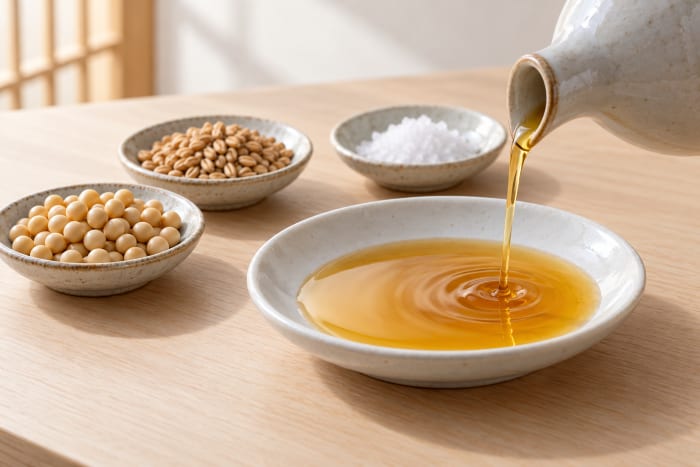
The recipe asks for half a cup of cooked white rice, four ounces of rice koji and one and a half cups of water. That is the entire list. No rice variety is named beyond "white," nothing salty appears, and no final volume is stated, so the batch stands as published rather than as a ratio a reader can safely double.
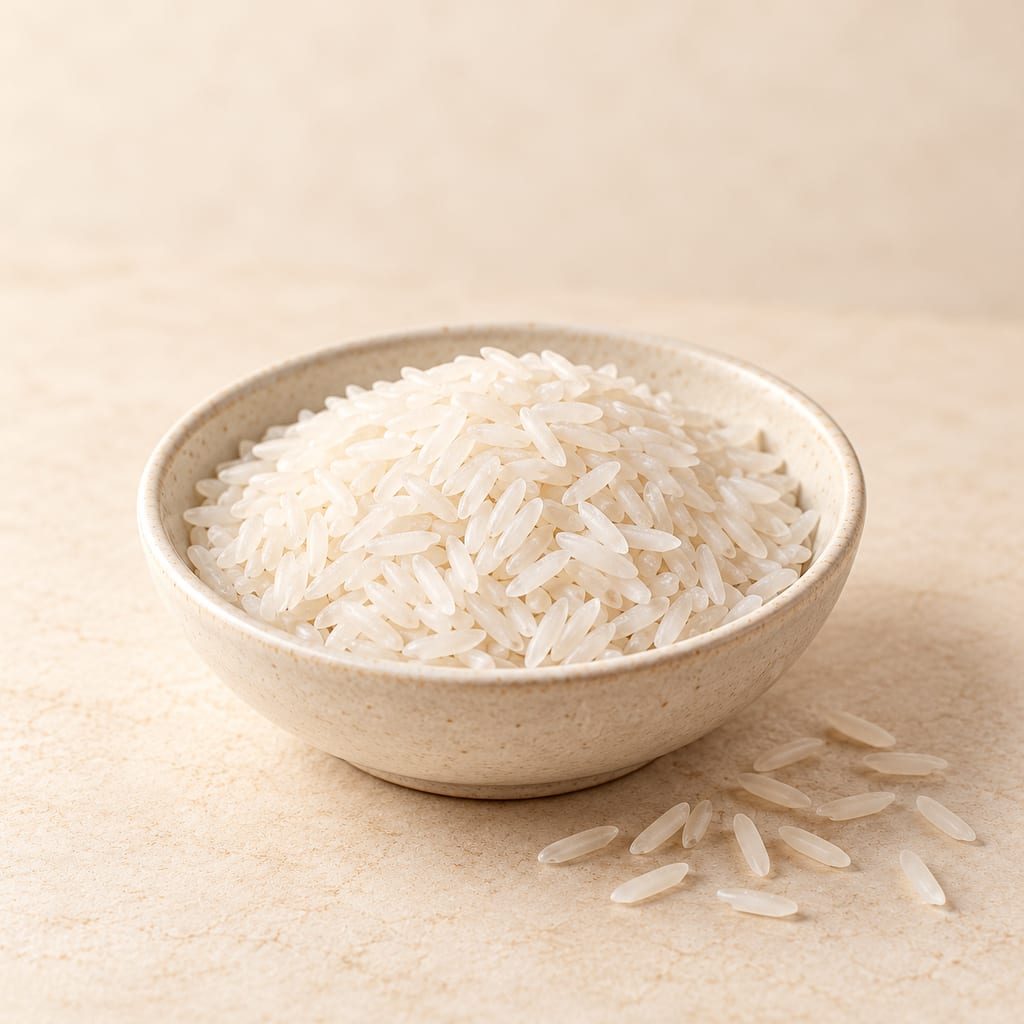
The rice is both substrate and flavour base. It supplies the starch the enzymes attack, and after hours of warm holding it supplies the soft grains suspended in the finished drink. The ministry frames the ingredient in the widest possible terms, as the Japanese staple food, and the sources consulted here say nothing more specific about grain type, soaking, or whether the rice is boiled or steamed before use. That silence is worth stating rather than filling: a reader who prefers a particular rice should know the evidence does not rank one against another for this drink.
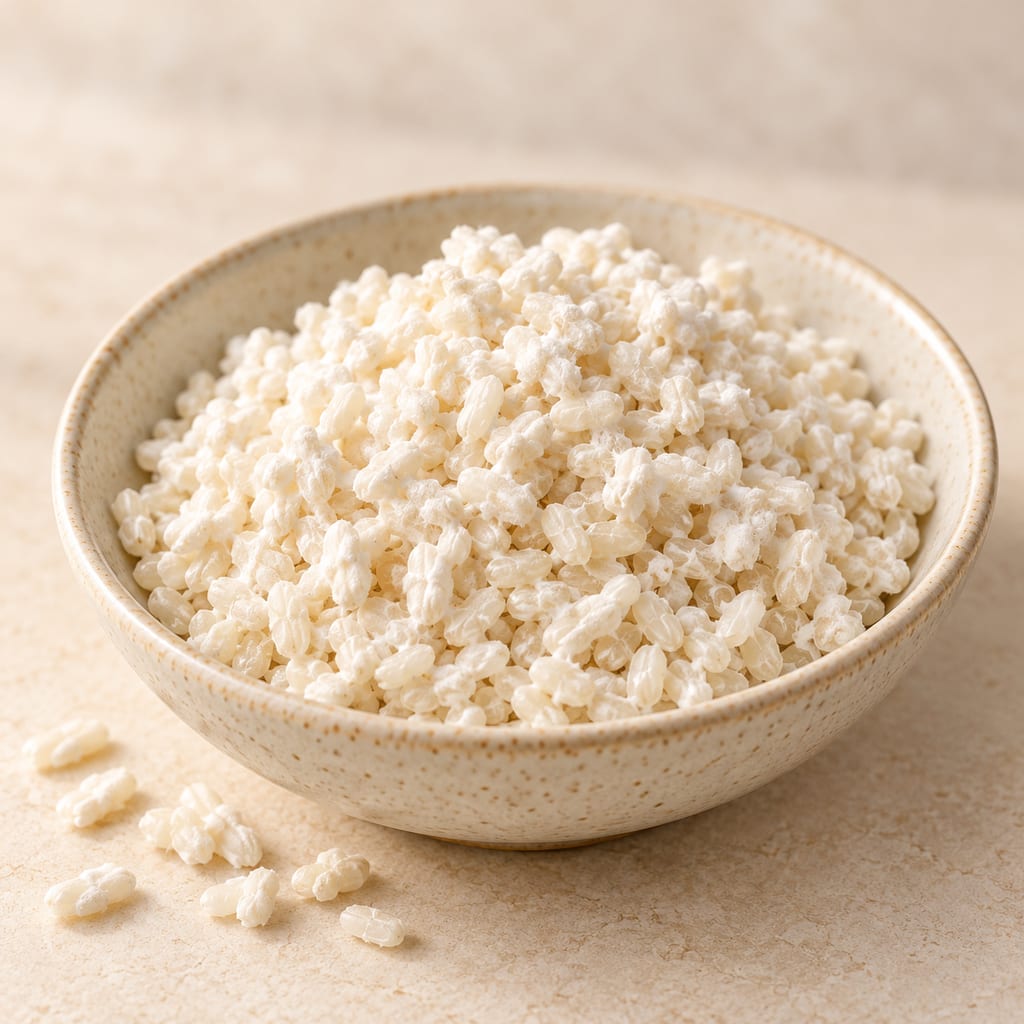
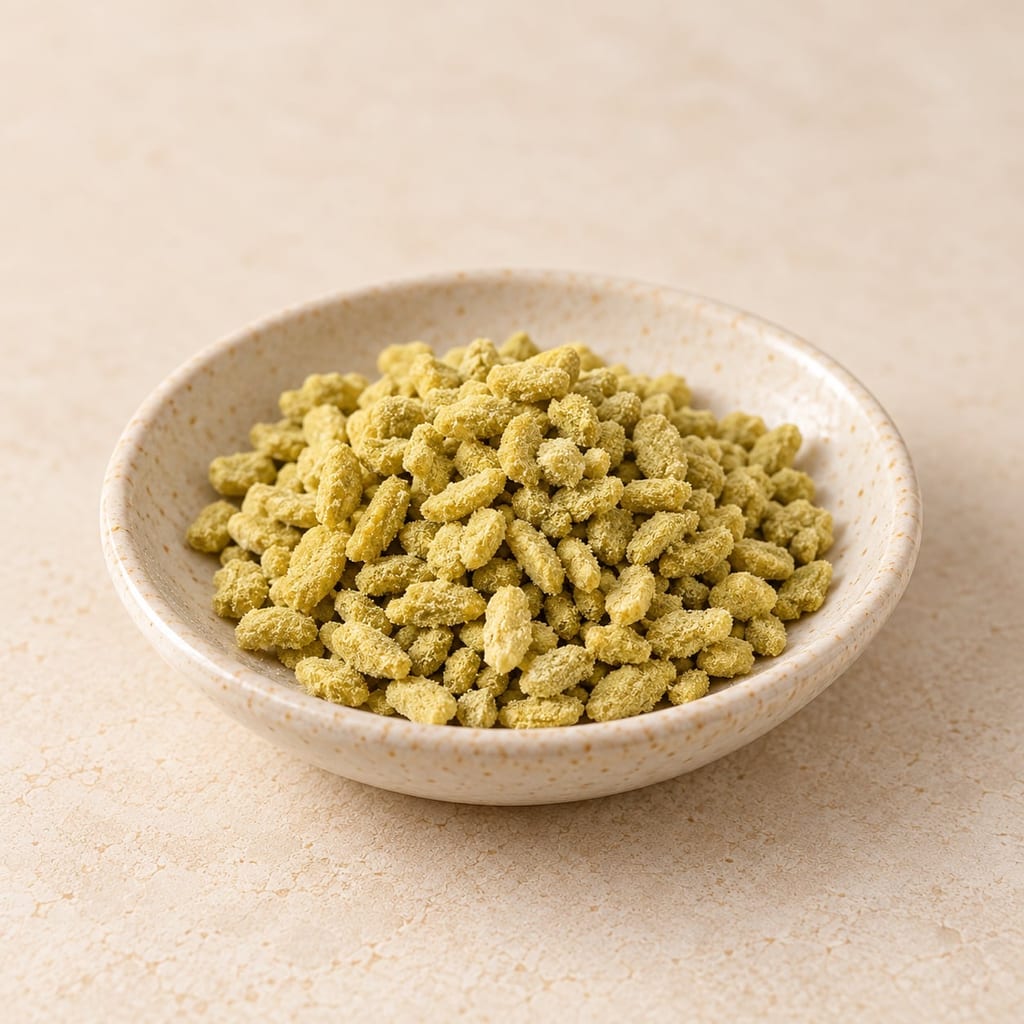
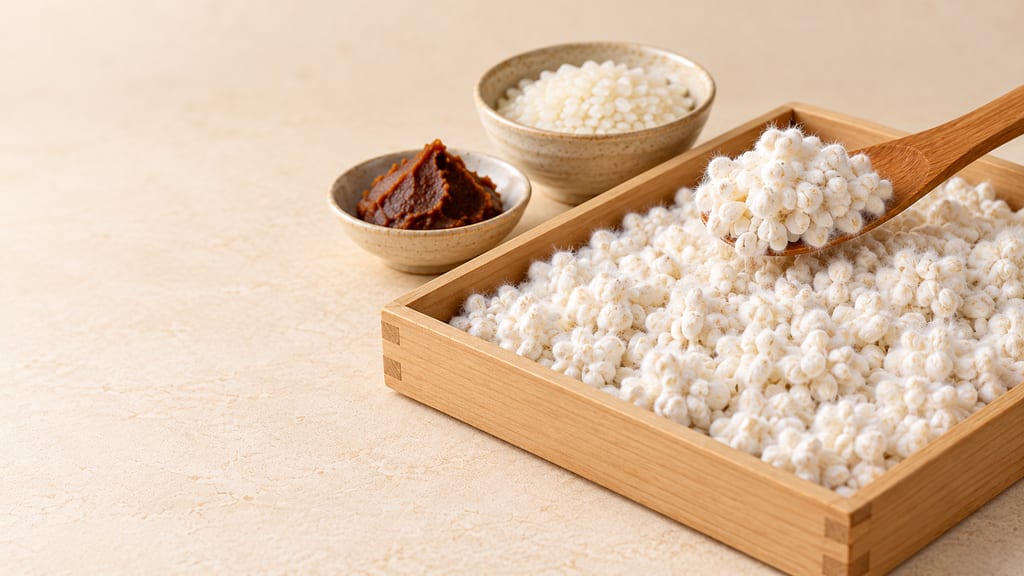
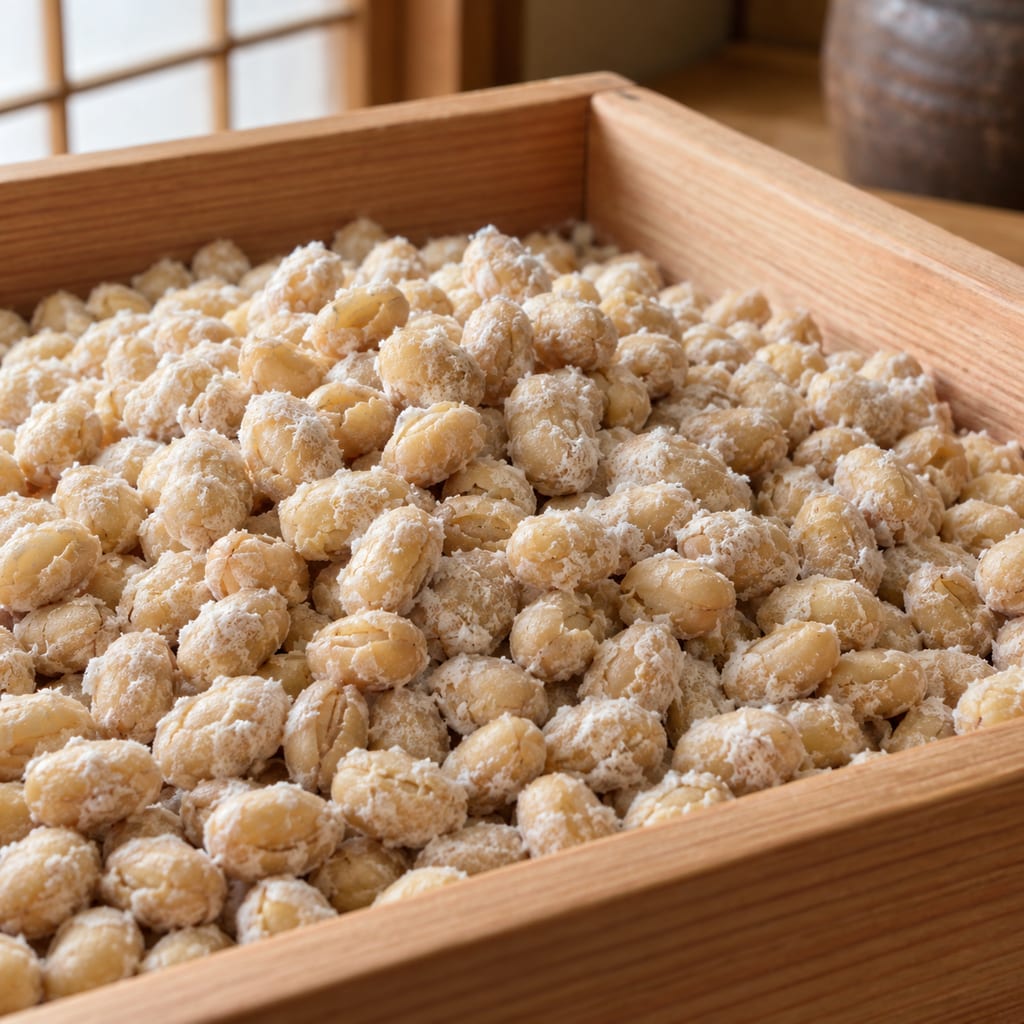
The koji does the real work, and it does most of it before it ever reaches the pot. It is rice on which *Aspergillus oryzae* has been grown until the grains are loaded with amylase. The quantity here is strikingly generous — four ounces of koji against half a cup of cooked rice. No source gives a dosage rule or a koji-to-rice percentage for amazake, so this proportion is the recipe's own rather than a documented standard. What the guideline does establish is that koji meant for amazake is a specific thing, incubated warm enough to favour amylase, so a culture raised for a savoury paste is not the same tool in different packaging.
Koji is bought rather than kept. The recipe source notes that it turns up online and in Japanese grocery stores, and that it is usually sold dried. Drying suits a home maker, and it is why the method asks for the koji to be crumbled before going in: dried grains clump, and the enzymes act on contact, so breaking the clumps apart spreads the activity through the mash. The safety guideline treats koji as a supply-chain ingredient with real limits. It requires the *Aspergillus* to come from an approved commercial source, and it allows a kept starter to be refrigerated for roughly a month, or frozen, with some loss of activity acceptable as long as contamination is kept out. A packet that has sat in a cupboard far longer than that, or one carried forward from an earlier batch, is a different proposition.
Water is the medium. It loosens a dense mass of rice and koji into something that can be stirred and held evenly, and the guideline's own description of the stage treats dilution as part of the process rather than as an afterthought. Enzymes travel through liquid; a dry or pasty mash gives them less contact with the starch. The one and a half cups here is the only water figure in the sources, and no target consistency accompanies it, so the amount is the recipe's choice, not a specification.
Nothing sweetens this drink, and that is the whole point of the formula. The only version in the sources that takes added sugar is the sake-lees kind, which is built from lees, water and sugar — sugar goes in because there is no conversion step to generate it. In koji amazake the sugar is manufactured inside the pot, and every degree of holding temperature and every extra hour changes how much of it appears.
Everything in this method happens during one long, warm hold, and the two published accounts of it agree more than they differ. The ministry's version is the spare one: cooked rice with water and koji stirred together, covered, and left overnight at 55 to 60°C, with a note that stirring partway through speeds the process. The home recipe gives the same shape with numbers attached — cover and hold at 130 to 150°F (54 to 66°C) for eight to twelve hours, stirring now and then and keeping the temperature inside that band the whole time. The guideline's band for the stage, 50 to 60°C, sits beneath both. Three sources, three slightly different ranges, and the overlap is obvious: a warm mash, kept warm for most of a day, never allowed to cool off and never allowed to get hot.
That band is the recipe's genuine difficulty, and it exists because enzymes have preferences. The conversion runs while the mash stays warm. Let it drift toward room temperature and the work slows to a crawl, which is why the ministry specifies a maintained overnight temperature rather than a pot left on the counter. Let it climb well past the band and the enzymes lose their grip on the starch. The guideline's observation that the sugar mixture varies across 45 to 70°C is the practical consequence: the holding temperature quietly decides what kinds of sugar end up in the cup, not only how fast they appear.
Stirring appears in both descriptions, and the ministry states its purpose outright — it promotes the process. In a mass of rice and koji, contact between enzyme and starch is everything. Turning the mash over redistributes grains that have settled, evens out cooler pockets near the wall of the vessel, and gives the enzymes fresh surface to work on. This is a physical operation rather than a biological one. Nothing is being aerated for the benefit of a living culture, because the stage is a chemical conversion.
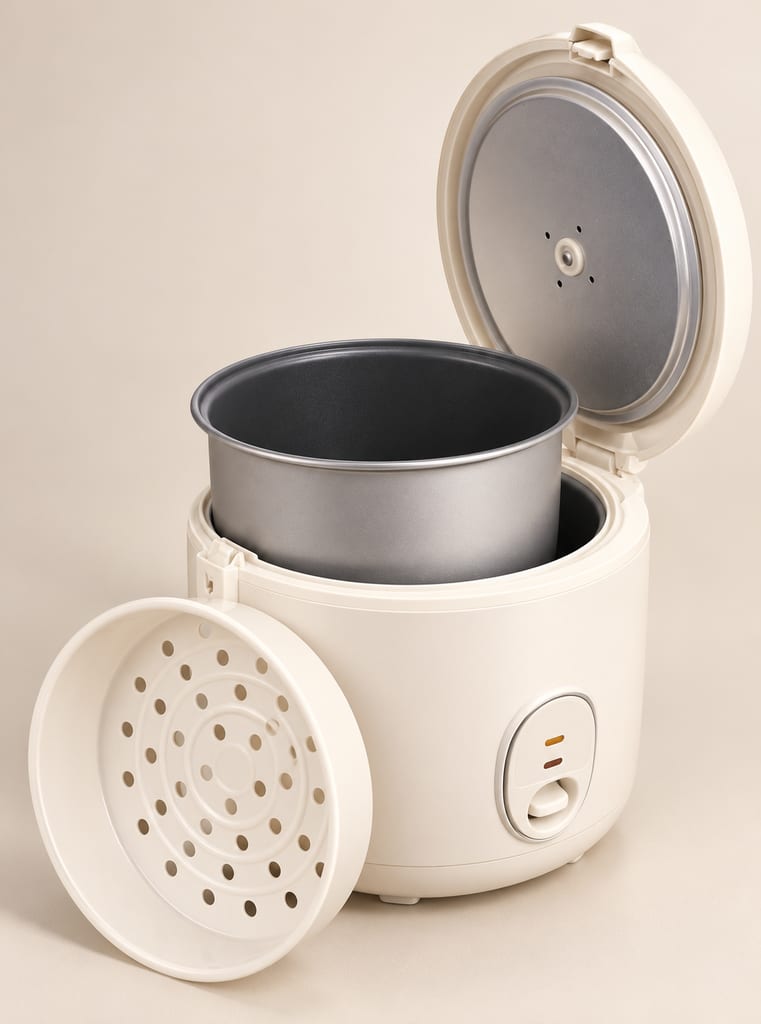
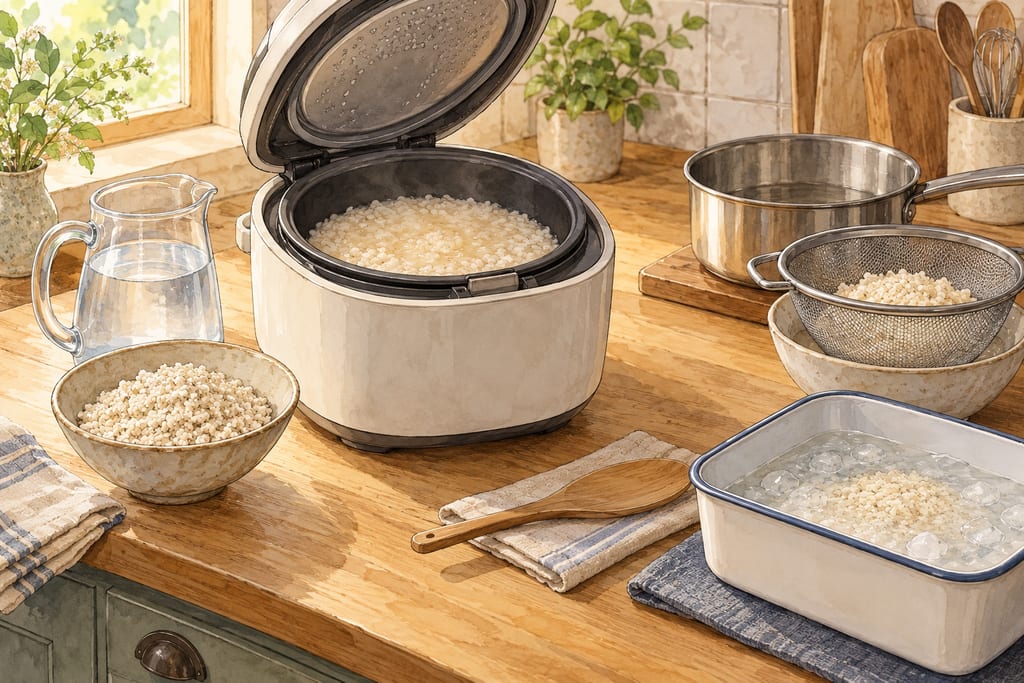
Holding a pot between 54 and 66°C for eight to twelve hours is not something a stove manages unaided, which is why the recipe names its equipment: a thermal pot or a rice cooker, worked with a wooden spoon. A rice cooker on a warm setting, or a thermal pot that keeps its heat, performs the job the ministry's account leaves unnamed. The recipe asks that the temperature be maintained continuously, which in practice means checking it, yet the sources give no instrument specification and no endpoint test — no iodine test, no sweetness reading, no way to confirm the starch has gone. Time and temperature are the only guidance offered.
The end of the hold is marked by a deliberate rise in heat. The recipe instructs raising the mixture to 167°F (75°C) or higher, and gives the reason: stopping the conversion keeps the drink from turning sour. The ministry's account of koji amazake does not mention this step at all, so it belongs to the home method, but it is consistent with the chemistry the guideline lays out. Driving an enzyme-driven process to a finish means heating hard, and the source names its threshold.
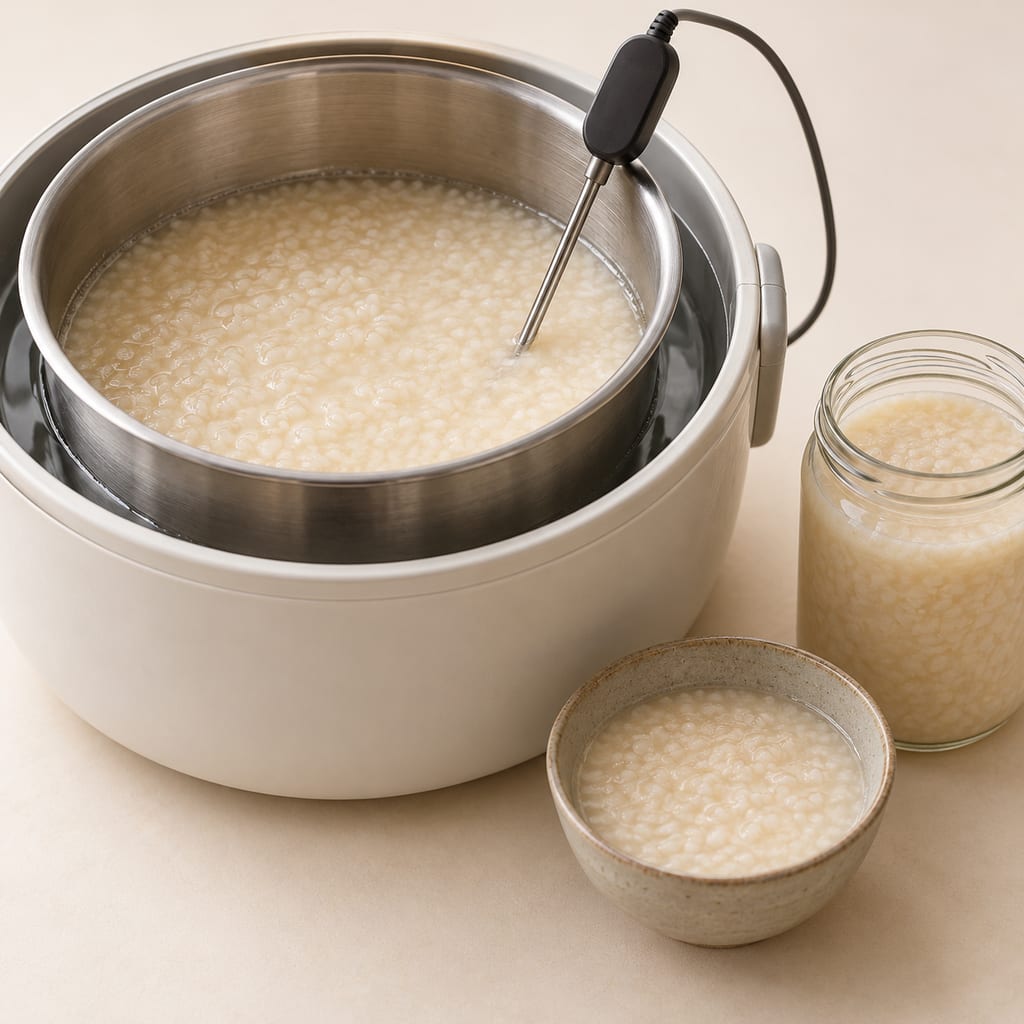
What the pot should look like when it is done is described once, in the recipe source, as a very runny porridge flecked with rice. That is a useful picture, and it is also the only doneness signal in any of the sources. There is no target sweetness, no thickness standard, no clarification and no straining step. The drink passes from pot to mug or bowl exactly as it came out, grains and all. The ministry's description of the process stops at the same place, with no finishing operation of any kind.
One practical difference between the two accounts is worth naming for anyone who follows the home version. The ministry's hold is described as overnight, which is an open-ended span, while the home recipe bounds it at eight to twelve hours and then applies a stopping heat. The bounded version is the more repeatable of the two, and it is also the one that acknowledges that leaving the mash warm indefinitely invites something else to take over the sugar.
Koji amazake is only one member of the family, and the differences between its relatives are sharper than the shared name suggests.
The most common alternative is *sakekasu amazake*, built on the pressed cake left behind after sake is drawn off. Its method could hardly be further from the one described above. Sake lees are dropped into boiling water, the heat is turned down and the mixture stirred until the lees dissolve, then the heat is raised and sugar added. No koji goes in, nothing is held warm for hours, and no conversion happens in the pot. The sweetness is bought with sugar, because the brewing that made the sake broke the grain down long ago. The lees carry a little alcohol, and the ministry notes that heating drives it off. The safety guideline treats that alcohol as a genuine variable rather than a culinary footnote: yeasts surviving from the sake-making can leave residual alcohol in this style of amazake, and the guideline says alcohol should be handled as a chemical hazard when the drink is planned commercially. Anyone serving this version to children, or to someone avoiding alcohol, has a real question to answer — and that question does not arise in the koji version at all.
A third type sits between the two in method and looks nothing like them in flavour. The guideline describes a sour amazake made with a koji starter built on lactic acid bacteria: it is prepared much as the sweet version is, then held at room temperature for anywhere between a day and a week, finishing below pH 4.6. Here a live microorganism is deliberately given the run of the pot, for far longer than the eight to twelve hours of the sweet version. The result is a drink soured by lactic acid rather than sweetened to the same pitch, and it reaches an acidity the sweet drink never manages. The difference comes from which starter was used and how long the culture was left alone, not from leaving the same pot resting a little longer.
That contrast is the most instructive one on the page. Sweet amazake and sour amazake can start from a similar mash and end on opposite sides of pH 4.6, and what separates them is the organism invited in and the length of the hold. It also means a maker cannot read safety off the finished glass. A mild, sweet-looking amazake is not the same kind of product as an acidified one, however alike they appear in the cup.
The ministry's regional note explains where each tradition took hold. Koji amazake belongs to the districts where miso and soy sauce culture runs deep; sake-lees amazake belongs to the sake-brewing country, following the byproduct. The ministry's Japanese-language account sharpens this: because lees differ from one brewery to the next, the character of the sake-lees drink varies with its source, and that variation is what gives the drink its regional identity. The ministry also lists separate regional beverages around Japan, including Kochi's *Hiyashi Ame*, which has its own entry rather than being a name for this one. Those pages are worth reading as neighbours of amazake, not as versions of it.
The catalogue holds no sake-lees recipe at present, so the variants above are described rather than linked. Nothing in the sources supports treating them as interchangeable: different ingredients, different processes, different alcohol and acidity profiles, and different reasons for being made.
The serving instruction is short and literal: drink it hot, straight from the pot, in a mug or a bowl. Nothing is added at the end. There is no cold serving, no garnish, no flavouring and no straining. What comes out is thick and spoonable as well as drinkable, and its sweetness is the kind that wants something alongside it — the ministry's own description calls the drink strongly sweet, and the recipe source calls the finished mixture a very runny, rice-flecked porridge. A cup of it behaves less like a glass of juice than like a small, rich interlude. The sources consulted here name no specific dishes it accompanies, so no pairing is claimed; what they do establish is that the koji version has historically belonged to households already working with miso and soy sauce, and that is where it has been drunk. The ministry's Japanese-language account adds one habit worth knowing, because it runs against the modern expectation: today amazake is often thought of as a winter and New Year drink, but widespread everyday drinking is placed in the Edo period, when it was popular as a summer refreshment sold by street vendors.
Storage is where this record has to be blunt, because the drink's own chemistry works against it. Sweet amazake is full of free sugar, and the safety guideline's position is that the mild acids which form during the warm hold do not make it self-preserving: the pH can remain above 4.6, and for that reason the product has to be refrigerated. A pH above 4.6 means this is not a pickle, not a yoghurt, not a product whose acidity protects it on a shelf. The recipe's own advice — keep it sealed and cold for up to a week — is a home cook's figure rather than a validated shelf life, and the guideline that insists on refrigeration offers no storage duration for amazake at all. The honest position is that the drink must be refrigerated and that the length of time it keeps has not been established by any source read here.
The warm hold deserves the same clear-eyed look. The working band in this recipe, 54 to 66°C, is the range every source gives for the conversion; the ministry's is 55 to 60°C and the guideline's is 50 to 60°C. It is also a temperature at which a sugar-rich, near-neutral food sits for eight to twelve hours, and no source consulted here turns that into a validated control. The guideline's reasoning about rice points the same way: it warns that heat-stable toxins of the kind associated with rice, such as the cereulide produced by *Bacillus cereus*, survive boiling, which is why it insists that any soak running past four hours happen cold or acidified. A pot of rice that has stood in water overnight on the counter can carry a toxin that no amount of later reheating removes. That is a real consideration rather than a reason to call the method wrong, and it is worth carrying into the kitchen alongside the temperature band.
Two upstream points from the guideline bear directly on what a home maker buys and keeps. First, koji should come from an approved commercial source rather than being carried forward from an earlier batch. The guideline advises against using one batch of koji to raise the next, because doing so amplifies the risk of cultivating wild *Aspergillus* strains capable of producing aflatoxins; it also allows a kept starter to be refrigerated for roughly a month, or frozen, accepting some loss of activity provided contamination is kept out. Second, the soaking rule just mentioned applies to the rice before it becomes koji as well as to rice cooked at home. Both points are about ingredients, and both are cheaper to respect than to undo.
None of this can be judged by taste. A sour note in finished amazake tells the maker that the conversion was left running too long, which is exactly what the recipe's final heating step exists to prevent; it says nothing about whether the drink is safe. Sweetness, aroma, bubbles and appearance are qualities of the food, not measurements of it. The narrow summary the sources support is usable: make it hot, hold it warm, stop it hot, refrigerate it promptly, and do not assume a longer keeping time than the recipe claims without evidence behind it.
A final note on what this page does not claim. The ministry's description of the process is a summary drawn from an encyclopedia entry, so the 55 to 60°C figure it gives is a secondary report rather than a laboratory measurement. The home recipe supplies quantities but no yield. The guideline supplies safety reasoning but no amazake quantities, and its hazard table and critical control points are written for miso rather than for this drink. Between them the three accounts agree on the shape of the method and leave its exact numbers open, and that is how the record above is written.
Japanese ministry material treats amazake as a traditional beverage indigenous to Japan, made from rice and koji or from sake lees, and reports several theories of its origin, one of them the Nara-era Nihonshoki account of amanotamuzake. That attestation is hedged in the source and does not date the rice-koji home method recorded here.
Ingredients
Scaling: source batch only
Cooked riceCooked white rice, as the source specifies; no variety is given.
118 mL½ cup as recorded
Rice kojiRice koji, usually sold dried; crumble it before stirring in.
The BC CDC guidance records that citric and succinic acids form during saccharification but that the pH can still sit above 4.6, which requires refrigeration of the product; it should not be presumed shelf-stable.
Hazard source
Heat-stable toxin carried in rice
The BC CDC guideline warns that heat-stable toxins such as Bacillus cereus cereulide survive boiling, and requires soaking of koji rice to happen under refrigerated or acidified conditions once it runs past four hours. Rice left standing at room temperature before cooking can therefore carry a toxin that reheating will not remove.
Hazard source
Unapproved Aspergillus strains in home-saved koji
The BC CDC guideline advises against back-slopping koji starter because the risk of growing wild Aspergillus strains that produce aflatoxins is amplified, and requires the Aspergillus to come from an approved commercial source.
Hazard source
Refrigerate the finished drink: the guideline states that the pH can be above 4.6, requiring refrigeration of this product. It gives no storage duration for amazake, so the recipe's one-week figure is a home claim and not a validated shelf life.
Control source
Keep any soaking of rice short or cold: the guideline says soaking over four hours should occur under refrigerated or acidified conditions, because heat-stable toxins such as Bacillus cereus cereulide survive boiling.
Control source
Use rice koji from an approved commercial source rather than carrying koji over from a previous batch; the guideline states that back-slopping is not recommended because aflatoxin-producing wild Aspergillus risk is amplified.
Control source
The 54 to 66°C working band is the temperature every source gives for the conversion, and it is not a validated preservation control. The guideline's hazard table and critical control points cover miso, not amazake, so no validated amazake limit exists in the sources read here.
Control source
The 54 to 66°C hold is the conversion range the sources give, not a validated safety control, and the one-week refrigeration figure comes only from the recipe source. Neither has been validated for this drink.
A sour taste is not a sign that this drink is safe or unsafe. The BC CDC guideline records that sweet amazake can sit above pH 4.6 and needs refrigeration, while a separate lactic-acid version reaches pH below 4.6 through a different starter and a much longer ambient hold.
Cook the rice. The source's ingredient is cooked white rice; no variety or cooking method is specified.
Combine the cooked rice and 1 1/2 cups water in a thermal pot or rice cooker and mix well with a wooden spoon.
Add the crumbled rice koji and stir until it is thoroughly distributed; the source treats this addition as the point where the change begins.
Cover and hold the mixture at 130 to 150°F (54 to 66°C) for 8 to 12 hours, stirring occasionally and keeping the temperature within that range throughout. Koji enzymes convert the rice starch to sugars during this hold.
Raise the heat until the mixture reaches at least 167°F (75°C), which the source gives as the point where the conversion stops and the drink does not turn sour.
Pour into a mug or bowl and serve hot. The finished mixture is described as a rice-flecked, very runny porridge.
Cool and store in an airtight container in the refrigerator; the source gives up to one week, a duration not independently validated here.
Conditions
Fermentation8–12 h
Temperature54–66°C
Temperature controlIncubated
Places
Japan
Traditional preparation · Country evidence
The ministry documents amazake as part of Japan's beverage traditions; this home recipe is a modern adaptation.
Koji is steamed grain — rice, barley, soybean or wheat — grown out with a food-grade Aspergillus mold until the kernels carry working enzymes. It is bought or cultivated, and it converts starch and protein for the foods that follow.
Rice contributes starch to flatbreads, steamed breads, batters and many distinct fermentations. Its species, milling and starch character shape how it cooks, binds, expands and feeds enzymes.
Rice koji is steamed white rice through which koji mold has grown. It carries the enzymes that turn rice starch into sugar, and it is the starting point of sake, sweet miso, amazake and shio koji.
Yellow-koji starter is the spore inoculum of the yellow koji mold — Aspergillus oryzae and the related A. sojae — sold by specialist tane-kōji houses to grow koji for sake, miso and soy sauce.
Usukuchi is Japan's light-coloured soy sauce, a Kansai style identified by its pale colour rather than by lower salt, with the colour set by production choices made during brewing.
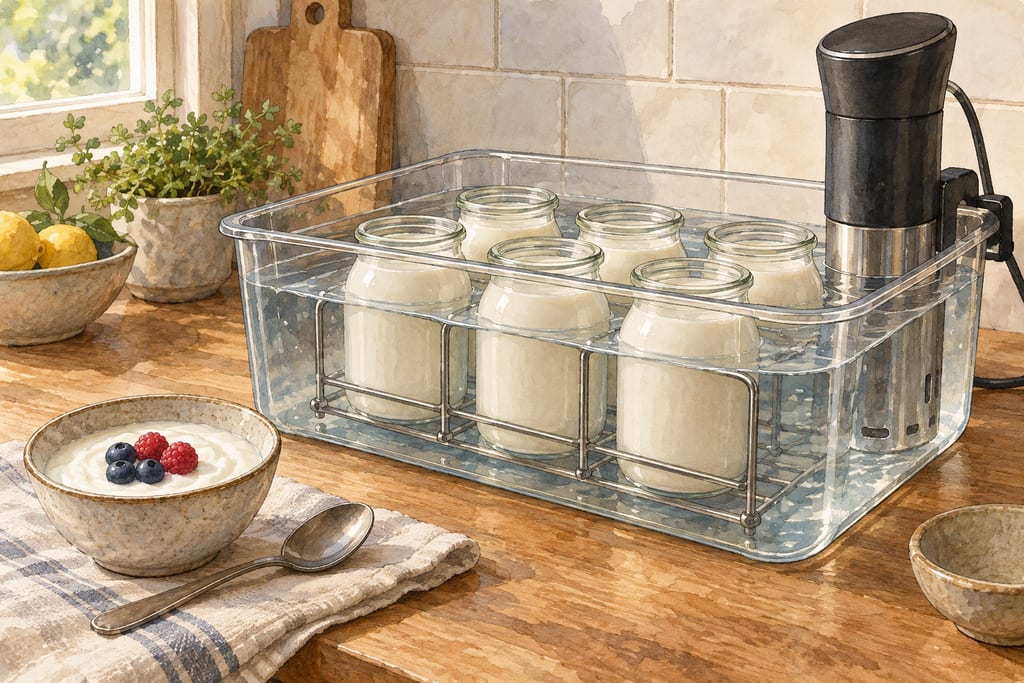
A small electric incubator holds jars at a selected temperature for yogurt and other documented warm food preparations. Controls, capacity and vessel arrangement vary by model.
A purpose-rated warm water bath or heated vessel with a food probe, holding rice or sake-lees amazake at the 50 to 60 C range where koji enzymes turn starch into sugar.
A source-bounded account of Edo’s subterranean kōji chambers: shafts led through narrow passages to low rooms cut into Kantō loam for cultivating kōji. Excavated examples vary by site.
A modern electric pot that cooks rice and may provide a model-specific keep-warm stage. Documented Japanese and Korean recipes use it for koji amazake, sikhye and ssal-jocheong; measure warm settings rather than assume.
One rice cooker run as two stages: cook the rice, then add koji or malt water and hold it warm with the lid managed, before boiling, straining or chilling elsewhere.
A circulator tank holding a rack of identical jars, so several small batches share one temperature for side-by-side trials of cultures, milks, ratios or flavourings.
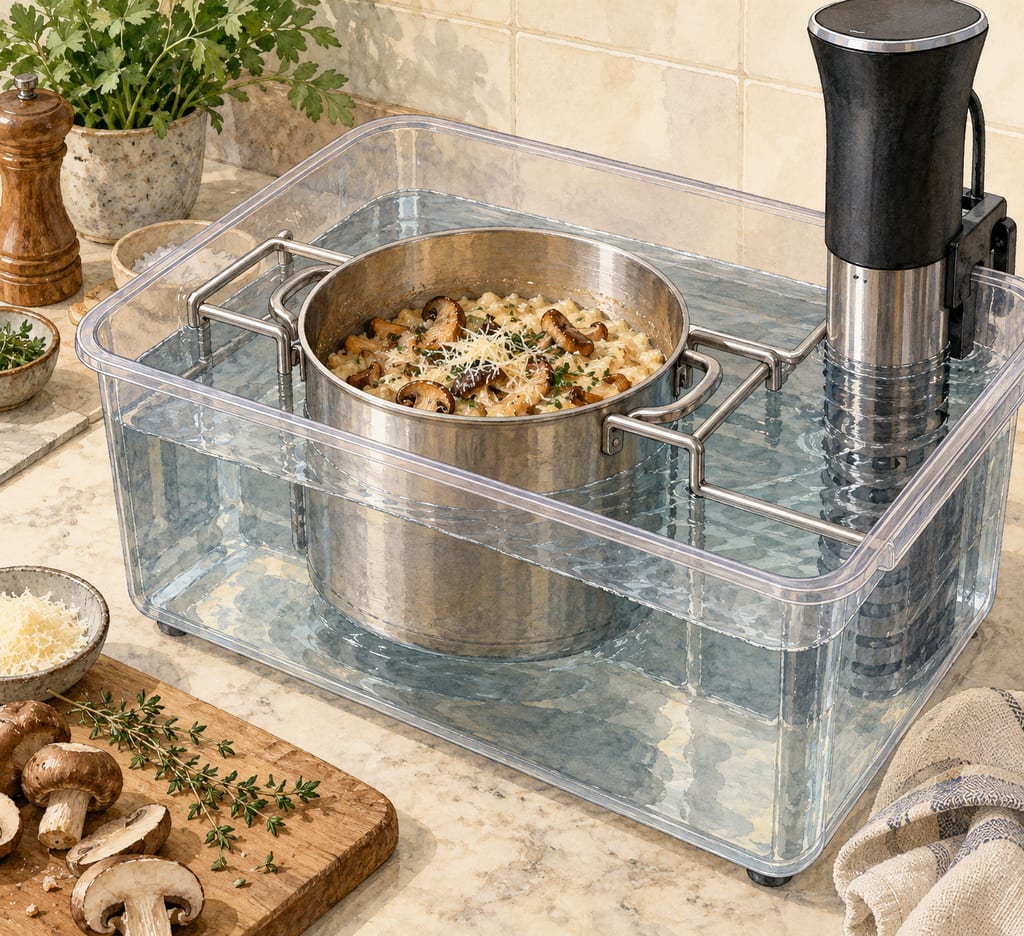
A small open metal pot held on a rack or bridge inside a circulator bath, so food can be stirred, added to or cut while bath water heats it from outside.
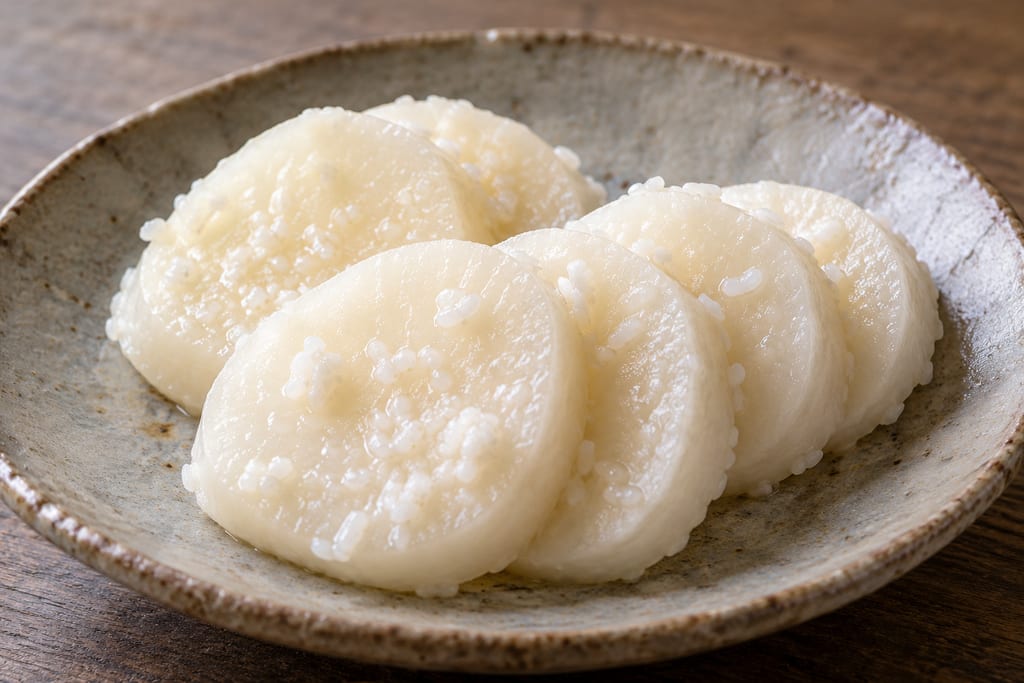
A sweet, crisp Japanese daikon pickle from Tokyo's Nihonbashi district, made by salting fresh radish and dressing it in rice koji, sugar or koji amazake without the heavy drying used for takuan.
Chinese sweet fermented glutinous rice: steamed rice and a mixed jiuqu starter, where mould enzymes release sugar and yeast makes a little alcohol, eaten with its sweet liquid.
A Japanese sweet drink made by dissolving sake lees in hot water and adding sugar, often with ginger or salt; it carries flavours and alcohol from sake brewing but normally undergoes no new fermentation.
Koji is grain or beans grown with a mould whose enzymes break food down. This guide separates the mould, the starter and the finished koji, and follows them into sake, amazake, miso, soy sauce and shio-koji.
Every preserved food is a stack of barriers against microbes, enzymes, air and time. This is how they work, what a recipe's numbers measure, and how cooks worldwide build them.
Amazake, sikhye and rice syrup turn cooked rice sweet with enzymes from koji or barley malt, held at the right warmth. Jiu niang and idli batter look similar but depend on living microbes, at very different temperatures.
A thick, naturally sweet rice-and-koji preparation used to add body and sweetness to marinades, dressings and sauces. This method follows a published Marukome home recipe and is an enzyme-conversion hold, not a way to grow koji mould.
Japanese soybean koji: steamed soybeans, loose or formed into balls, grown over with Aspergillus mould to make the enzymes for mame-miso, tamari and regional soybean condiments.
A Japanese seasoning of rice koji, salt and water, left at room temperature until the koji's enzymes and its microbes turn it into a savoury, salty paste for marinades and dressings.
Shio-koji is a Japanese seasoning of rice koji, salt and water, left at room temperature until the grains soften and turn sweet and the mixture thickens.
An Okinawan fermented tofu: dried tofu cubes matured in rice koji, awamori and salt, traditionally with red Monascus koji, until the curd turns smooth and intensely savoury.
Japanese reddish-brown vinegar from sake lees matured about three years, turned to vinegar by acetic bacteria; the vinegar of Handa and Edomae sushi rice.
Amabito no Moshio is a modern, pale beige Japanese seaweed salt made from Seto Inland Sea water and hondawara seaweed. Its documented factory method concentrates filtered brine in kettles, then separates and dries the salt.
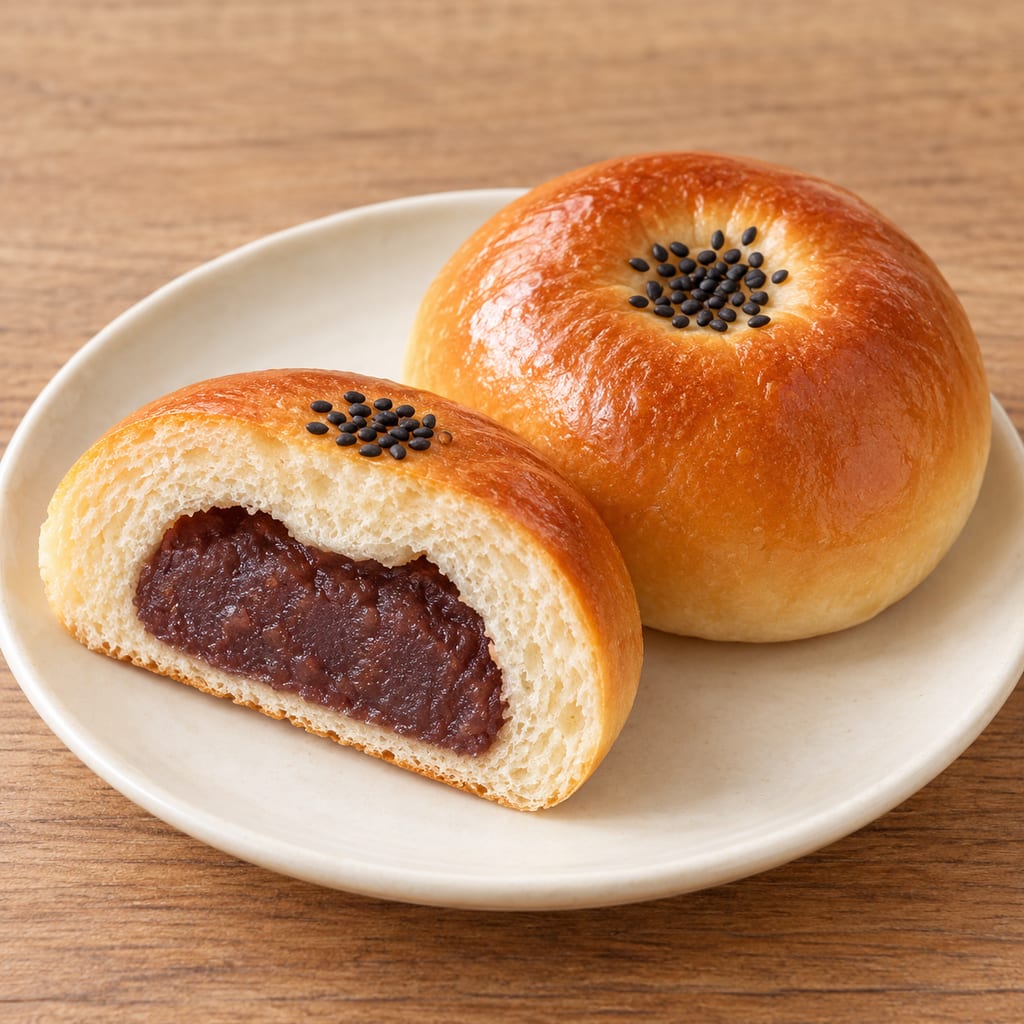
Anpan is a soft wheat bun filled with sweet red-bean paste and finished with egg wash and black sesame. This dough rises with commercial instant yeast.
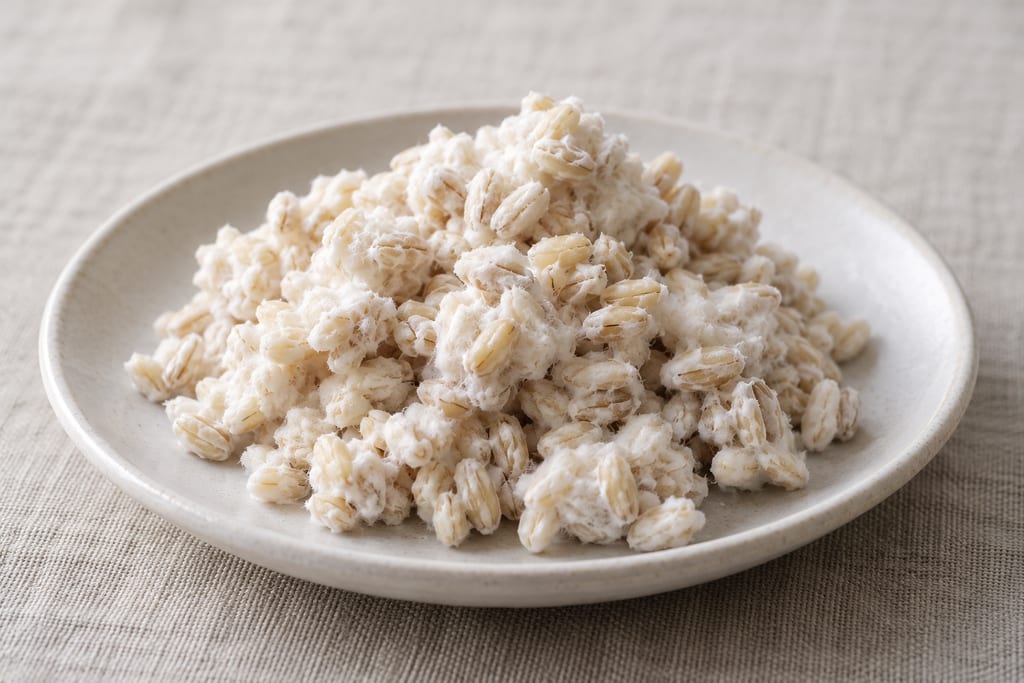
Steamed pearled barley grown into a white koji cake with Aspergillus oryzae over about 36 hours in a 30 °C chamber, turned three times under a damp cloth.
An ethnographic record of marcha (murcha), a dry starter cake used in Eastern Himalayan cereal fermentations. This page documents source-specific community knowledge and is not a recipe for making or storing starter.
Community
No community contributions have been published for this entry yet.
Share what you made
Sign in to contribute. Published comments and photos are free to read.
1/2 cup cooked white rice, 4 ounces rice koji, 1 1/2 cups water
combine in a thermal pot or rice cooker with a wooden spoon, then add koji crumbles
hold 8 to 12 hours at 130 to 150°F, stirring occasionally and maintaining temperature
raise to 167°F or higher to stop the process and prevent souring; finished texture a rice-flecked, super-runny porridge
serve hot in a mug or bowl; refrigerate airtight up to one week
koji usually sold dried, found online or in Japanese grocery stores; the page calls koji a bacterial culture, which conflicts with the mold identity given by MAFF and BC CDC
Cited in: A sweet drink without the sugar; Enzymes, not yeast: how rice turns sweet; Three ingredients and what each one does; Why the hold is the whole recipe; Drinking it, and reading it safely
Accessed 2026-10-25
Ministry of Agriculture, Forestry and Fisheries, JapanHistory · Process · Context
amazake as a very sweet, nutritious fermented drink containing no or very little alcohol, not classed as an alcoholic beverage
two methods: rice koji (koji amazake) and sake lees (sakekasu amazake)
sweetness from Aspergillus oryzae-derived enzymes acting on rice starch
cooked rice plus water and koji, stirred, covered and left overnight at 55 to 60°C, with stirring promoting the process
sakekasu amazake made only from sake lees, water and sugar, heated so alcohol evaporates
several origin theories, including the Nara-era Nihonshoki account of amanotamuzake
koji amazake associated with regions of deep koji culture such as miso and soy sauce; sakekasu amazake with sake-brewing regions
page content excerpted from Horii, Nakamura and Kato, Nihon no Dento Shokuhin Jiten (Asakura), p.153-186, so the 55 to 60°C figure is secondary
Cited in: A sweet drink without the sugar; Origins in the shadows of several theories; Enzymes, not yeast: how rice turns sweet; Three ingredients and what each one does; Why the hold is the whole recipe; The other amazakes; Drinking it, and reading it safely
Accessed 2026-10-26
British Columbia Centre for Disease ControlSafety · Science
amazake as a sweet drink of rice and rice koji whose sweetness comes from glucose released by amylase
rice koji incubated at 35 to 40°C, higher than miso rice koji at 27 to 30°C, favouring amylase production
rice koji diluted with water and held at 50 to 60°C; amylase converts rice starch to glucose, a stage the guideline calls saccharification rather than fermentation
at least 12 oligosaccharides produced, their proportions varying with temperatures from 45 to 70°C
citric and succinic acids form but pH can be above 4.6, requiring refrigeration
sour amazake from a lactic-acid-bacteria starter, held 24 hours to a week at ambient temperature to pH below 4.6
sake-based amazake from sake lees with water and sugar; resident yeasts may leave residual alcohol, treated as a chemical hazard
upstream koji controls: cooking above 74°C, rice cooled to 40°C within two hours, koji ferment below 40°C at 98% initial humidity, Aspergillus from an approved commercial source
koji starter kept refrigerated about one month or frozen; back-slopping not recommended because aflatoxin-producing wild Aspergillus risk is amplified
soaking over four hours to occur refrigerated or acidified because heat-stable toxins such as B. cereus cereulide survive boiling
the guideline's flow chart and critical limits cover miso, not amazake
Cited in: A sweet drink without the sugar; Enzymes, not yeast: how rice turns sweet; Three ingredients and what each one does; Why the hold is the whole recipe; The other amazakes; Drinking it, and reading it safely
Accessed 2026-10-26
Ministry of Agriculture, Forestry and Fisheries, JapanHistory · Process · Context
甘酒 defined as a strongly sweet, nutrient-rich fermented drink that is not classed as an alcoholic beverage because it holds no or only trace alcohol; ingredients are rice and koji, or sake lees
two named methods: 麹甘酒 (koji amazake) and 酒粕甘酒 (sake-lees amazake)
koji amazake sweetness comes from enzymes the koji makes acting on rice starch; sake-lees amazake is lees dissolved in hot water with sugar added, with no fermentation step of its own
process: cooked rice with water and koji stirred well, covered and held at 55 to 60°C overnight; stirring partway promotes the process
origin theories disputed (発祥説は諸説ある); 天舐酒 (ama no tamuzake) in the Nara-period Nihon Shoki described as a sweet low-alcohol rice-koji drink closer to amazake than to modern sake
until around the Edo period, when sugar was uncommon, it was a precious source of sweetness; widespread popular drinking dates to the Edo period
despite a modern winter and New Year image, it was popular as a summer drink sold by street vendors; called 飲む点滴 (drinkable IV drip) for its nutrition
koji amazake drunk where miso and soy sauce koji culture is rooted; sake-lees amazake made where breweries cluster, with lees character varying by brewery
page cites Horii, Nakamura and Kato, 『日本の伝統食品事典』, Asakura Shoten, p.153-186; no ratios, pH, salt, storage or numeric alcohol limit given
Cited in: A sweet drink without the sugar; Origins in the shadows of several theories; Enzymes, not yeast: how rice turns sweet; Three ingredients and what each one does; Why the hold is the whole recipe; The other amazakes; Drinking it, and reading it safely