
Home equipment crafts
Rice, koji and malt in a warm hold
Amazake, sikhye and rice syrup turn cooked rice sweet with enzymes from koji or barley malt, held at the right warmth. Jiu niang and idli batter look similar but depend on living microbes, at very different temperatures.
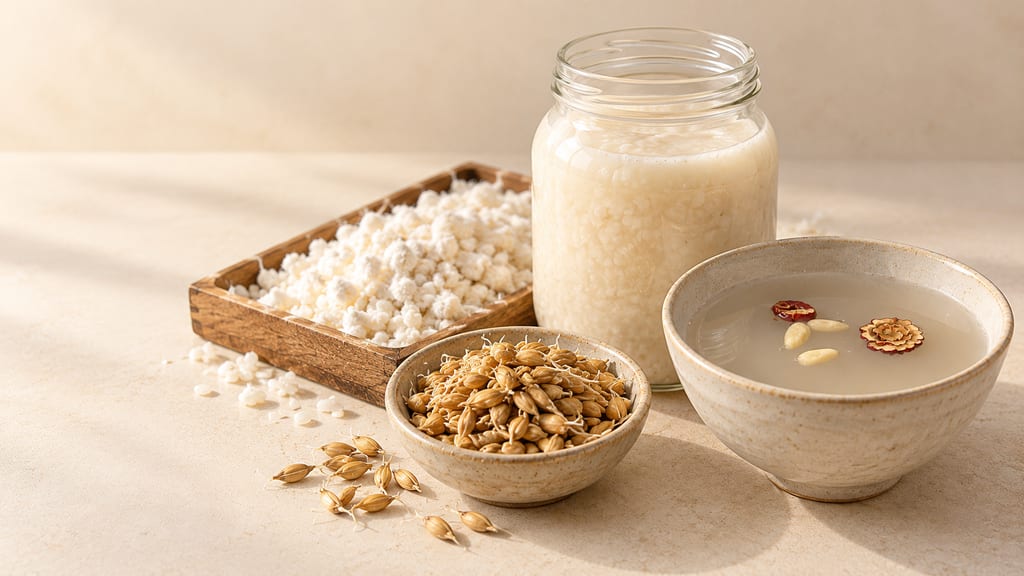
Koji rice, malted barley, amazake and sikhye: grain turned sweet by enzymes held at the right warmth.
Two old ways to make rice taste sweet
Cooked rice is mostly starch, and starch barely tastes sweet. Japan and Korea each kept a way to sweeten it with enzymes borrowed from another ingredient. In Japan the ingredient is koji: grain, usually rice, on which the mould Aspergillus oryzae has been grown. In Korea it is yeotgireum (엿기름), malted barley, sold dried and ground as yeotgireum-garu. Mixed with cooked rice and kept warm for some hours, either one breaks the rice starch down into sugars.
Japan's Ministry of Agriculture, Forestry and Fisheries describes amazake as a very sweet drink with no or very little alcohol, made in two ways. Koji amazake is rice and koji held warm. Sakekasu amazake is sake lees, the solids left after pressing sake, dissolved in hot water with added sugar. Koji amazake, the ministry says, tends to be drunk where miso and soy sauce traditions run deep. This article is about koji amazake.
The ministry notes that the Nihon shoki, the chronicle of Japan compiled in the Nara period, describes a drink called amanotamuzake that it considers close to amazake, and that amazake was a valued sweet until sugar became common in the Edo era, popular in summer and nicknamed a "drinkable intravenous drip". Atsushi Kurahashi, managing director for production and research at Hakkaisan Brewery, which makes koji amazake, dates the chronicle to 720 in his 2021 review, and writes that by the middle of the Edo period, around 1700 to 1750, amazake was made as it is today and sold by street peddlers.
Maangchi, the Korean cooking writer, publishes sikhye as a rice punch and ssal-jocheong as a rice syrup from the same pairing of rice and malt. The Korean Traditional Knowledge Portal, drawing on a 2008 collection of regional foods of South Chungcheong Province, records a chili sikhye made the same basic way. These are drinks and syrups, not beers; Maangchi says her punch is never left long enough to become alcoholic.
Starch, and the enzymes that cut it
Starch is long chains of glucose packed into tight granules, and enzymes work slowly on raw granules. Water and heat make the granules swell and loosen, a change called gelatinisation. Michael Rittenauer and colleagues, studying barley malt for brewing, describe the logic: milling increases the surface, and warm water swells and partly disrupts the granules so enzymes can reach the starch. That is why every method for these foods starts with cooked rice, or with koji, which is rice that was steamed before the mould was grown on it.
Koji brings its own enzymes. Marukome, the miso and koji producer, says koji contains more than thirty kinds, among them amylases that break starch into glucose and proteases that break proteins into amino acids. Kurahashi's review is specific about amazake: its sugar is mainly glucose, released from rice starch by α-amylase and glucoamylase from the mould, and a third enzyme, α-glucosidase, rejoins some of it into small sugars, chiefly isomaltose. In his table, 100 g of koji amazake carries 23.2 g of glucose and no sucrose.
Barley malt brings a different set. Rittenauer's team describes malted barley as a combined source of starch and starch-cutting enzymes, and notes that two of the most important for making sugar, β-amylase and limit dextrinase, are unstable when heated. Grainfather's manual for its G30 brewing system gives home brewers working ranges of about 55–65 °C for β-amylase and 65–72 °C for α-amylase, and ends the mash at 75 °C for ten minutes to denature the enzymes.
Each of these enzymes is a protein with a working window. Too cold and it works slowly; too hot and it is destroyed for good. Tanica's 2014 amazake trial warns that adding koji to porridge hotter than 70 °C destroys its enzymes, and Marukome says that a mixture held too hot stops turning sweet. The lower edge has a second reason. Marukome warns that below 50 °C bacteria may multiply, and Kurahashi, citing reports of food poisoning from koji amazake, mainly staphylococcal, writes that food-poisoning bacteria can grow at around 40 °C and that saccharification should be kept at 50–60 °C. These holds sit far warmer than a yogurt incubation.
So what is not happening matters. The mould is not growing: koji is made earlier, by inoculating steamed rice with spores and letting the mould spread, and the warm hold only puts its enzymes to work. The barley is not sprouting, and no yeast is making alcohol. The ministry, Maangchi and Kurahashi all still call the hold fermentation, and as everyday usage that is fair. The sweetening itself is enzyme work, saccharification, and this article keeps the word fermentation for processes in which living microbes grow.
Amazake: four documented methods, kept apart
Kurahashi divides koji amazake into two kinds, one made only from rice koji and water, the other with extra cooked rice; industrially, he writes, the mixture goes into a tank set at 50–60 °C. The home methods below cover both, share that temperature range and differ in nearly everything else.
Tanica Electric, a Japanese maker of yogurt makers sold as Yogurtia, publishes reports of its fermentation trials. Its 2017 amazake uses only koji and water: 400 ml of water and 200 g of Shirayuki-brand rice koji, mixed in a sterilised inner container closed with an inner lid and a screw lid, held at 60 °C for six hours. It is finished, the report says, if sweetness has developed; the result had a light sweetness and a texture that melted in the mouth, with the grains still noticeable.
Tanica's 2014 trial adds rice. Porridge is cooked from one gō of rice, the traditional rice-cooker cup, with 400 ml of water, using the cooker's porridge marks, then mixed with another 200 ml of water and 200 g of Miyako-brand koji loosened grain by grain. This is the report that warns against adding koji to porridge above 70 °C. The setting is again 60 °C for six hours, and the writer liked the result best chilled, diluted with water if too strong.
Marukome's rice-cooker method is the most detailed. For 100 g of dried koji it mixes 200 g of cooked rice with 300 ml of water at about 70 °C in a cooker on keep-warm. The mixture quickly falls to about 50 °C, so the lid is closed until it climbs back to about 60 °C; only then does the koji go in. From there the lid stays open under a cloth, to keep contamination out, and the mixture is held at about 50–60 °C, stirred now and then, for 5 to 10 hours; if it runs too hot, the cook switches off the keep-warm and stirs. It makes about 580 g and is ready when it tastes sweet enough; a longer hold makes it sweeter. Marukome also gives a porridge version and, for Marukome's own amazake maker, a koji-only version of 100 g of koji with 180 ml of water at about 60 °C.
The ministry's description is the briefest: water and koji added to cooked rice, stirred, covered and left overnight at 55–60 °C, with stirring during the hold. It gives no quantities.
Ama-koji is the thicker relative: sweet koji rice made with less water and in smaller portions, used as an ingredient in sauces and marinades rather than drunk, and sometimes blended smooth after the conversion. Marukome's ama-koji is held at 55–60 °C for eight hours, a narrower and steadier hold than its amazake method's 50–60 °C for 5 to 10 hours. Like amazake, it uses enzymes already in prepared koji; it is not live koji incubation. A cook should follow one complete method rather than take the ratio from one source, the time from another and the temperature from a third.
Holding 50 to 60 °C: yogurt maker, rice cooker or jar bath
An adjustable yogurt maker is the documented appliance: Tanica's trials set theirs to 60 °C with the container closed, and Marukome's own amazake maker asks for about three stirs during the hold.
A rice cooker is the improvised choice. Its keep-warm setting exists to keep rice hot, not to hold an enzyme window, so Marukome has the cook manage it with the lid and the switch, and notes that cookers differ and their manuals should be checked. One manufacturer's figures show why: the 2016 manual for the Instant Pot Duo specifies its Keep Warm function at 63–78 °C, above the top of Marukome's range and close to the 70 °C at which Tanica warns the enzymes are destroyed.
A jar in a sous-vide bath has not been tried for amazake. It holds 60 °C steadily and lets several jars test different ratios at once, with the limits described in the article on one bath and many small jars: the mixture lags the water, so time the hold from when a probe in a representative jar reads the target; cool the porridge below 70 °C before the koji goes in; and expect to open the jar to stir. Log the mixture temperature, the time, the sweetness by taste and, for a comparable number, the soluble solids on a refractometer.
Homemade amazake is perishable. Marukome says to eat refrigerated or frozen amazake soon and to bring it to a boil if you are concerned about bacteria; Kurahashi writes that cold storage after production is needed to suppress food-poisoning bacteria. Boiling also ends the enzyme work, as a brewer's mash-out does, so boiled amazake stops getting sweeter.
Shio koji: salt, koji, and either weeks or hours
Shio koji is koji with salt and water, used as a seasoning. Marukome's method takes one to two weeks at room temperature. For 100 g of rice koji it uses 35 g of salt and 120 ml of water. The koji and salt are rubbed together by hand for at least three minutes before the water goes in; the mixture is packed into a clean lidded container of about 800 ml, kept out of direct sun and stirred once a day. It is ready when it smells sweet, tastes pleasantly salty, has grains that crush between the fingers, and has thickened.
Tanica's 2014 trial takes six hours. Koji loosened grain by grain is mixed with salt and 200 ml of water in a sterilised container, held at 60 °C for six hours, then stirred and refrigerated. The tasters found it salty but softer than salt, with savoury depth, and suggested it for seasoning meat and fish, for dressings and sauces, and for quick pickles. The report does not print the amounts of koji and salt.
That gap matters: a shio koji recipe is defined by its salt ratio and koji as much as by its temperature. Pairing Marukome's ratio with Tanica's six hours at 60 °C would be a combination neither company tested, and should be treated as an experiment.
Its use on meat has a measured basis. Yuji Miyaguchi and colleagues separated protein-cutting enzymes from commercial shio koji, including aspergillopepsin I, and showed that they break down beef muscle proteins and release peptides, an effect that rose with temperature and was limited at 4 °C compared with 37 °C.
Sikhye: malt water poured over rice
Maangchi's sikhye starts with the malt. Eight ounces of yeotgireum-garu, barley malt powder, is whisked into 14 cups of cold water and left two to three hours, until the powder settles. A cup of rice, 210 g, is cooked in a 10-cup rice cooker, the clear malt water is poured gently over it and stirred, and the cooker is set to warm; four more cups of water go onto the malt sediment to settle again. After four hours the cook looks for dozens of floating grains, giving it another hour if they are not there. The hot liquid then goes into a pot with about three cups of the second clear malt water and boils, covered, for ten minutes, with a cup of sugar if wanted. Without a rice cooker, she says to keep the mixture between 50 °C and 66 °C (50–65 °C) for four hours, until some rice floats. The drink is cooled and refrigerated in a glass jar; the rice is strained, rinsed and kept in cold water to float in each glass.
Only the clear liquid, carrying the malt's enzymes, goes onto the rice; the sediment stays behind. The grains float once their starch has broken down. The boil ends the conversion, since malt enzymes are destroyed well below boiling, as the brewer's mash-out at 75 °C shows.
The boil is not sterilisation. A 2012 study of sikhye by Kim, Ryu and colleagues treated spores of Bacillus cereus as the hazard to control. At 95 °C it took 2.8 to 4.9 minutes, depending on the medium, to cut their number tenfold, and ordinary heat treatment was the least effective of the methods tested. Home sikhye belongs in the refrigerator, as the recipe says.
South Chungcheong has a variant, chili sikhye, recorded in a 2008 collection of the province's regional foods. 200 g of malt powder soaks in 3 L of water for about three hours until the top clears, and 400 g of glutinous rice is steamed firm. The clear malt water goes onto the hot rice with 60 g, about four, Cheongyang chillies, and the mixture is held at 50–60 °C overnight. When the grains float they are strained and rinsed; the liquid is boiled with 300 g of sugar and cooled, and served with the rice and three or four pine nuts. It holds overnight, not for four hours: a separate recipe, not a source of settings for Maangchi's. Its malt is 엿기름가루, barley malt powder. A brewing kettle with a programmable mash step could hold a large batch in this window, but nobody has published that method.
Ssal-jocheong: convert, strain, then boil down
Maangchi's stovetop ssal-jocheong cooks 5 cups (2¼ pounds) of short-grain white rice with 5 cups of water, then adds 8 cups of water at about 60 °C and 2 cups of barley malt powder. After an hour with the lid on the mixture has cooled to 49–54 °C; it is warmed on medium for two or three minutes to 57–63 °C and switched off, and the reheating is repeated each hour. In all it spends six hours between 43 °C and 63 °C (43–63 °C), turning thin and sweet, until the rice is, in her words, like wet paper.
Then comes concentration. The mash is strained through hemp cloth or doubled cheesecloth and squeezed, giving about 3½ quarts of liquid. That boils for 80 to 90 minutes, to a little over a quart, then 10 to 20 minutes more, until the small foamy bubbles give way to bubbles about half an inch across and a thermometer reads 93–104 °C. The syrup should fall in a thick, steady stream; boiled too far it sets like candy and needs a little water and a second boil. It keeps refrigerated in glass or ceramic for up to three months. Her rice-cooker version holds 1 pound of rice, a cup of malt powder or flakes and 4 cups of cold water on the warm setting for six hours, strains out 5 to 6 cups and boils them down in the open cooker for about 30 minutes, to roughly 1½ cups.
The two stages have different physics. Conversion is enzyme chemistry at a held temperature; concentration is evaporation, governed by heat input and open surface, with an endpoint read from bubbles, temperature and pour. The articles on the brewing kettle and on fruit extraction and concentration deal with evaporation at larger scale.
Malt in a brewing kettle: sweet wort
Brewers carry out the same malt conversion on barley every brew day. Grainfather's G30 manual sets out step mashing: rests around 45–50 °C for beta-glucans, 50–55 °C for protein and 65–72 °C for saccharification, then a mash-out around 75 °C. The most used saccharification temperature, it says, is 67 °C, and higher temperatures leave more unfermentable sugar. Malt crushed too coarsely leaves starch the enzymes cannot reach; crushed too finely, it blocks the flow through the grain bed.
The sweet liquid from the mash, the wort, is an ingredient before any yeast reaches it. A brewer's native mashing hardware performs that conversion well, and the strained wort can be used as it is or concentrated. Cooking with it, fresh or boiled down, has no documented home method, and no recipe or keeping time exists for homemade wort or concentrate; it should be used fresh or processed and stored properly, and a home reduction should not be assumed to keep like commercial malt extract. The brewing kettle article covers these machines as food workshops.
Sujeonggwa: a Korean punch that is only an infusion
Not every Korean sweet drink works by enzymes. Maangchi's sujeonggwa boils half a cup of sliced ginger and five cinnamon sticks in 7½ to 8 cups of water, 20 minutes on high and 25 on medium, stirs in a cup of sugar, strains out the spices and pours the cooled liquid over dried persimmons. It rests in the refrigerator at least 12 hours, is served cold with a persimmon and pine nuts in each bowl, and keeps, she says, more than a week in the fridge. Nothing converts and nothing ferments. A kettle with a removable spice basket could make the infusion repeatable, but nobody has published that method.
Jiu niang: when the starter is alive
Jiu niang, sweet fermented glutinous rice, looks like a cousin of amazake and works differently. The 2016 manual for the Instant Pot Duo, models IP-DUO60 and IP-DUO80, gives it a programme. It describes jiu niang as a sweet, mildly alcoholic food used in desserts, whose rice starch turns to sugar during fermentation. Two cups of glutinous rice soak in cold water for at least five hours, until the grains break easily between the fingers, then are wrapped in cheesecloth and steamed for 30 minutes. Once the rice is below 35 °C, a cup of cold boiled water and starter yeast powder are mixed in, every grain separated, and the rice is pressed lightly into a lidded glass or ceramic container with a hole in the middle. The containers stand on the rack in water filled to the pot's 3-cup mark, about 1 cm up their sides, and the Yogurt function runs in Less mode, specified at 30–34 °C, for a default 24 hours, adjusted for the starter used.
The endpoint is a description: clear liquid, small gas bubbles, a smell of liquor and a very sweet taste. Running too long turns it sour. The manual adds that white growth on the surface is normal and black growth means contamination and the rice must not be eaten. That is a rule for rejecting a batch, not proof that a batch without black growth is safe.
The difference from amazake is the starter. Chinese rice-wine starters of this kind, called qu, are living mixed cultures. A 2025 review by Dandan Song and colleagues describes rice-based xiaoqu as a network of Rhizopus moulds, Saccharomyces and related yeasts, and lactic acid bacteria: the mould saccharifies the starch, the yeast makes alcohol from part of the sugar, and the bacteria add mild acidity. In sweet rice wine made with traditional sweet starters, alcohol stayed below 2.0% by volume over short fermentations of 24 to 48 hours, and the enzyme activity of starters from different regions varied by orders of magnitude. The manual's word yeast undersells them. Kurahashi draws the same line for Indonesian tape ketan and Thai loog-pang, sweet-sour foods with some alcohol made by mixed moulds and yeasts, unlike koji amazake.
The temperatures make the point. Jiu niang's programme runs at 30–34 °C, where microbes grow; amazake holds at 50–60 °C, where the enzymes work and, Kurahashi writes, food-poisoning bacteria do not grow. They cannot share a bath.
Batters that rise: idli, dosa and surnoli
Katherine Paphitis of Public Health Ontario, writing the dosa and idli section of the BC Centre for Disease Control's fermented foods guidance, describes them as fermented mixtures of rice and black gram, the urad bean, eaten mainly in southern and western India. Rice and black gram soak separately for four to six hours, in the refrigerator, or for no more than four hours at room temperature. The black gram is ground fine; the rice coarse for idli, fine for dosa. They are combined at about four parts rice to one of black gram for idli, three to one for dosa, with water and 2% salt, and left overnight, typically at least 12 hours, at around 30 °C. One study found a pH of about 4.3 to 4.6 after 12 hours. Good batter has roughly doubled, is light with visible bubbles, and floats when a spoonful is dropped into water. Idli is steamed for five to eight minutes; dosa is cooked as thin crepes.
The rise is biological, though researchers weigh the organisms differently. The guidance names yeasts and lactic acid bacteria as the main agents, crediting the yeasts with leavening and flavour and the bacteria with acidity, and says the salt lets the salt-tolerant bacteria start work. A 2019 study by Madhvi Mandhania and colleagues found lactic acid bacteria made up 86% of the bacteria in fermenting idli batter, with Weissella the most important genus, showed with labelled glucose that heterofermentative metabolism contributes to leavening, and found that surface-sterilised grains did not ferment at all. The starter is the rice and beans themselves.
For cold weather the guidance suggests an oven preheated and switched off, with the light on, to keep the batter near 30 °C. A multicooker's low setting is a reasoned alternative: the Instant Pot Duo's Less mode runs at 30–34 °C. Idli batter has not been tested that way, and in a spontaneous fermentation a different temperature may change which organisms lead, so a trial should log batter temperature, rise, time and sourness against a batter made the usual way.
On safety the guidance asks that idli and dosa reach 74 °C inside for at least 15 seconds, and gives batter about a day at room temperature and five to seven days refrigerated. The few outbreaks it found were suspected to come from contamination during handling.
Surnoli shows how much a published appliance recipe can differ from a spontaneous ferment. Chandra Ram's Coconut Chile Surnoli, published by Instant Pot, introduces surnoli as pancakes from Goa, on India's west coast, often sweet and eaten at breakfast or afternoon tea. She soaks idli or dosa rice with fenugreek seeds for 8 hours, blends them with plain yogurt, poha (flattened rice), coconut, salt, turmeric and water, stirs in ¼ teaspoon each of citric acid and baking soda, and ferments the batter on the Yogurt function's Normal setting for 8 to 12 hours, until bubbly and almost doubled. The pancakes are cooked in a little ghee, topped with chilli and onion, covered and not turned. The recipe names no model; on the Duo, Normal yogurt mode is specified at 36–43 °C. Two ingredients change the biology: the yogurt brings a live culture, and the citric acid and baking soda give lift by chemistry. It documents surnoli in a multicooker; it says nothing about idli in the same programme.
Comparing appliances without confusing the processes
The most useful home trial keeps one formula and changes only the appliance, with a probe in each mixture. Expect the appliances to differ in supervision and steadiness rather than speed; past the top of the window, more heat stops the enzymes instead of hurrying them. And do not mix families in one appliance. Amazake, sikhye and jocheong want 50–65 °C enzyme holds. Jiu niang and idli batter want about 30 °C and living organisms. Shio koji can sit at room temperature for weeks. A shared rice ingredient does not make these one process.
Related
Discussed in this article
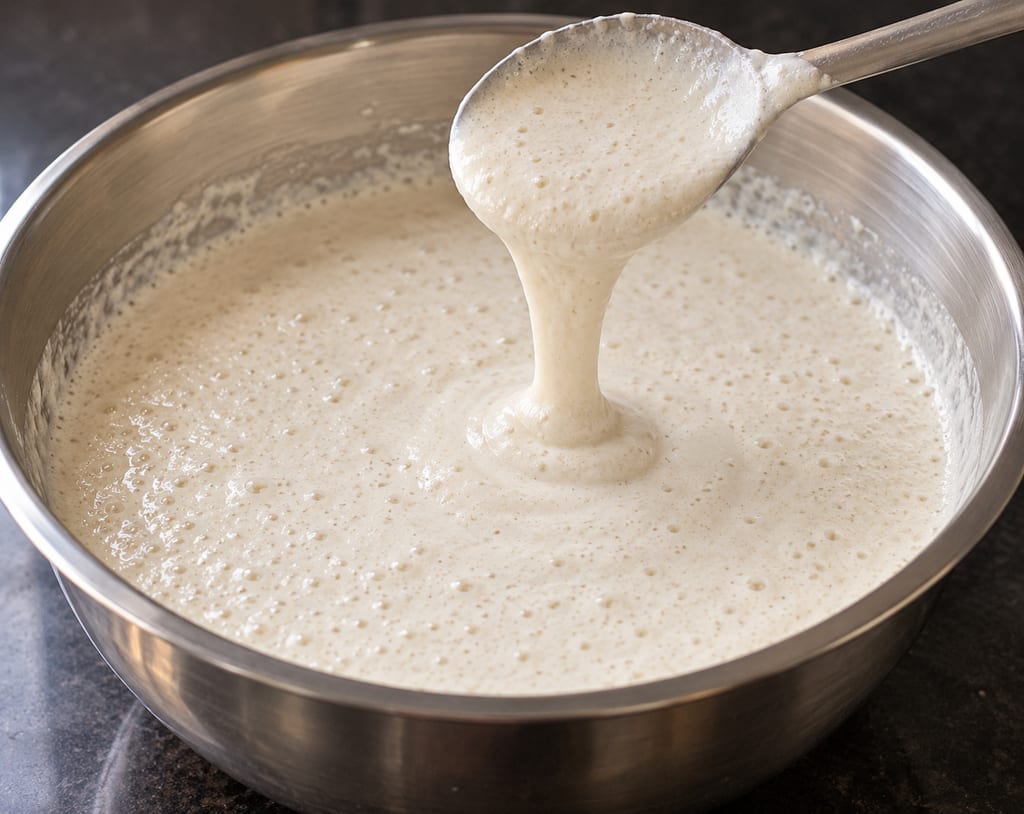
Dosa batter
A naturally fermented South Indian rice-and-urad batter, ground fine and spread thin on a hot griddle. Fermentation lightens the batter and develops its gentle tang.
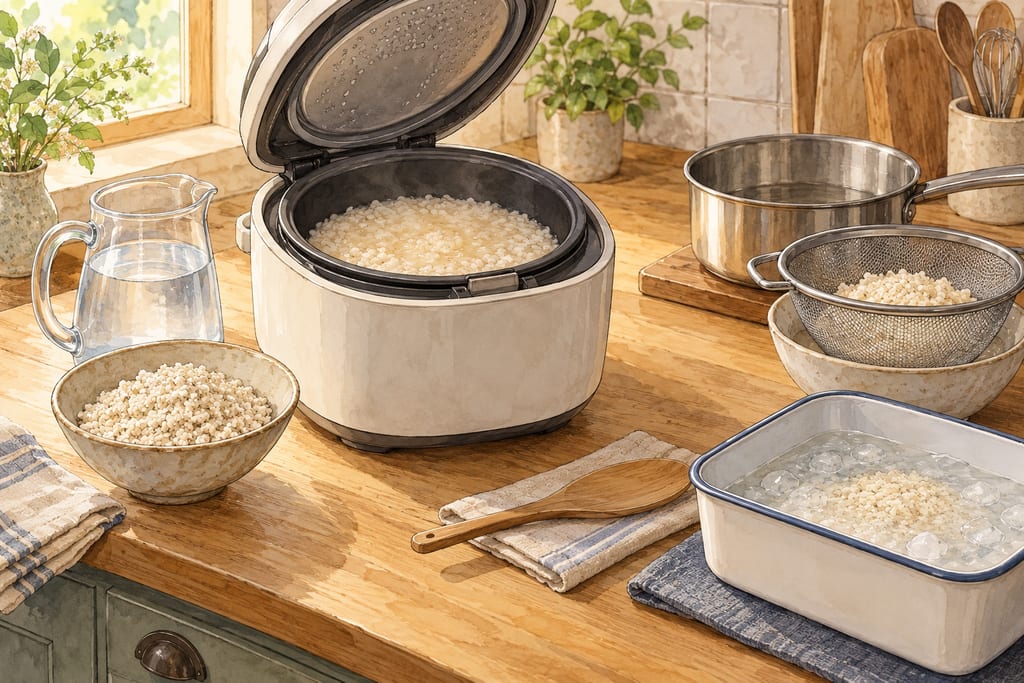
Rice cooker used in stages
One rice cooker run as two stages: cook the rice, then add koji or malt water and hold it warm with the lid managed, before boiling, straining or chilling elsewhere.
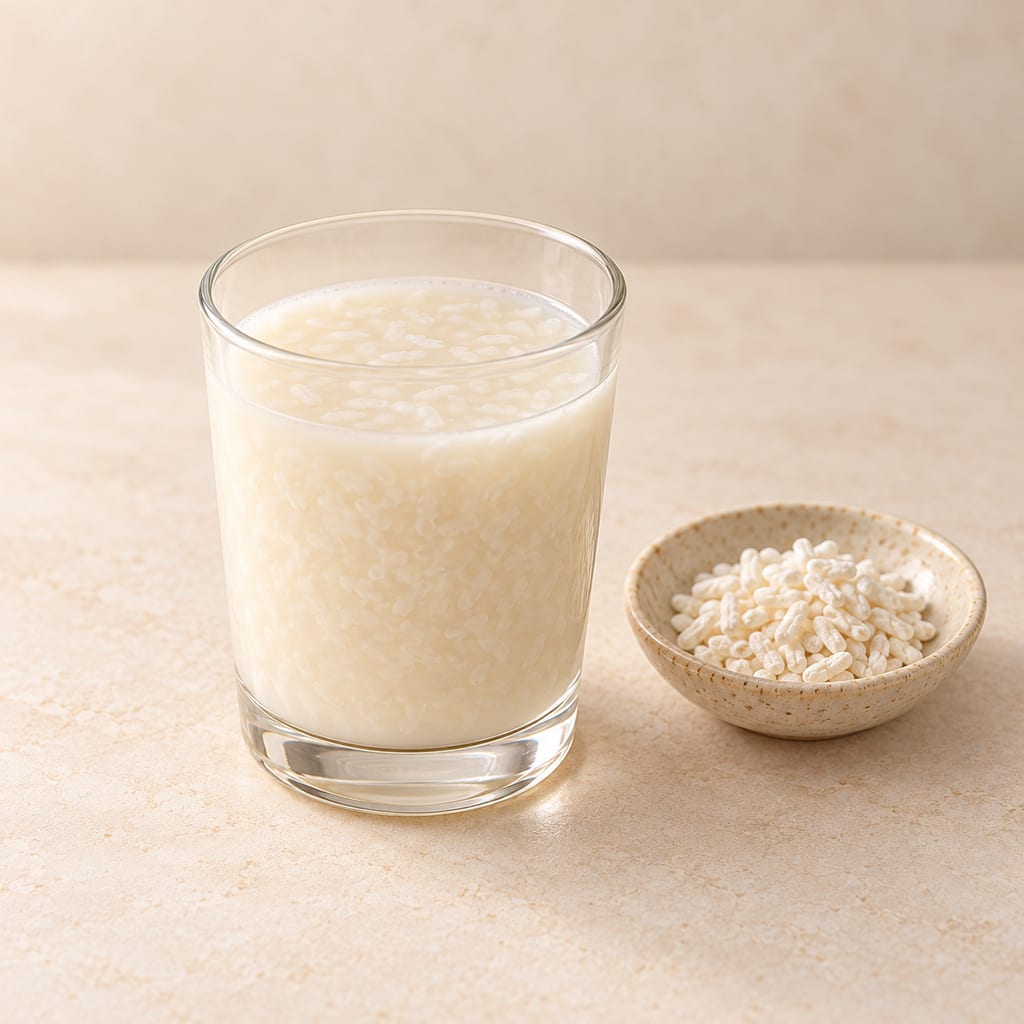
Rice-koji amazake
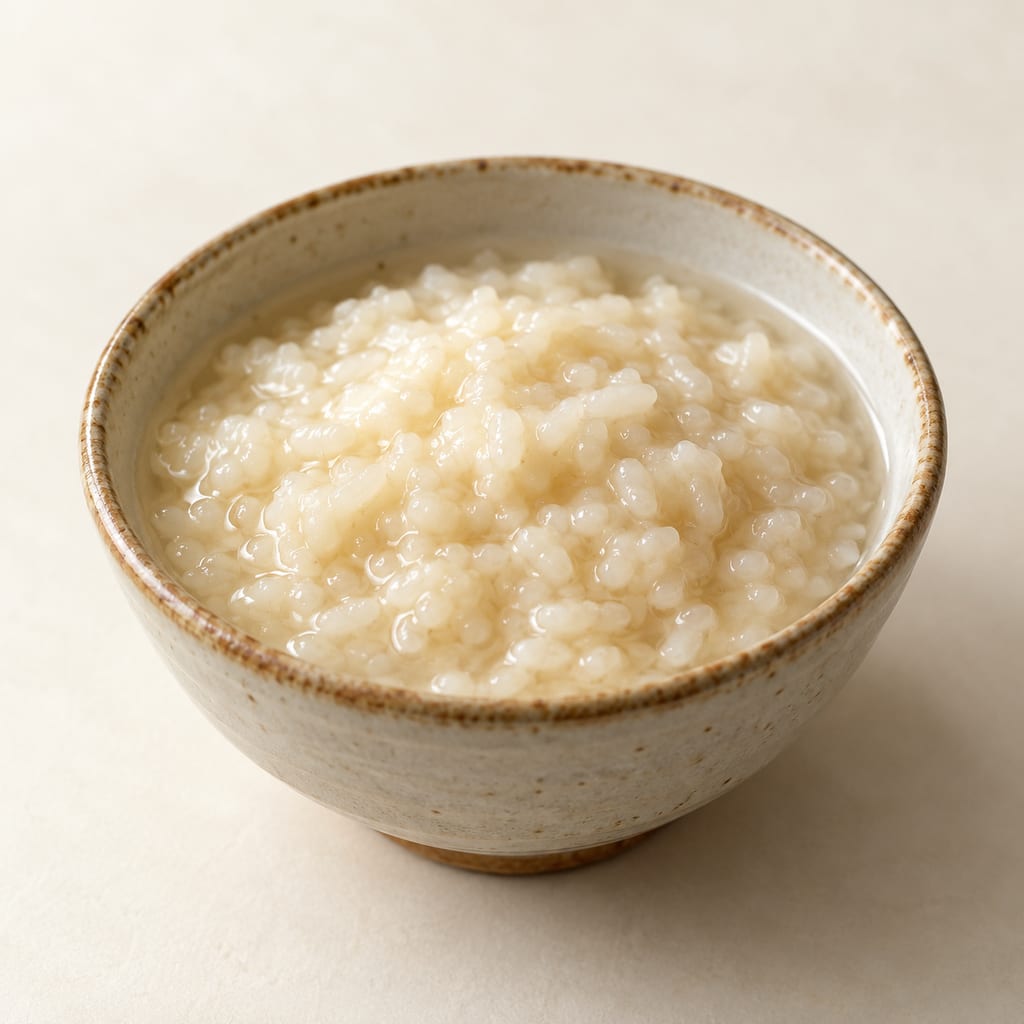
Cooked rice, rice koji and water are held warm for hours so koji enzymes turn the rice starch to sugars, giving a naturally sweet Japanese drink with no added sugar and no second fermentation.
Shio-koji
Shio-koji is a Japanese seasoning of rice koji, salt and water, left at room temperature until the grains soften and turn sweet and the mixture thickens.
Sikhye
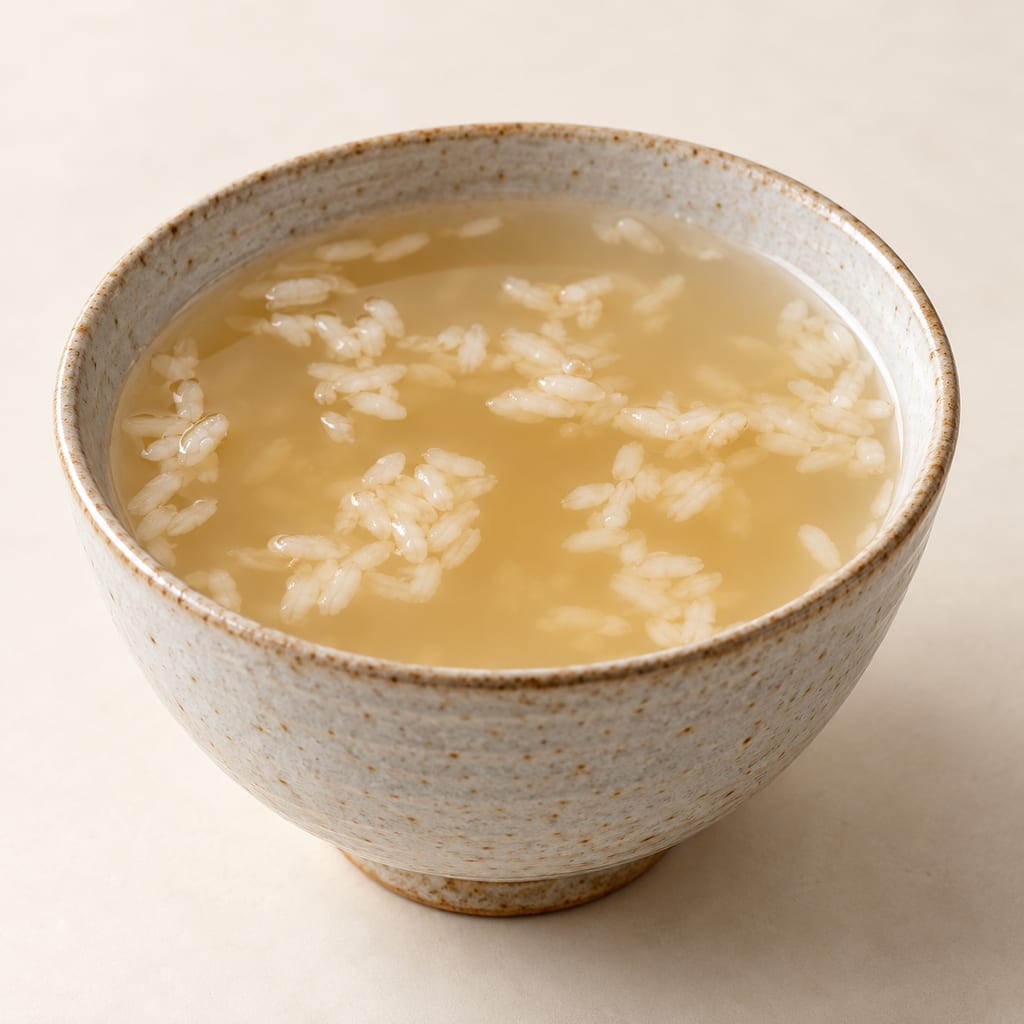
A Korean sweet rice drink made by holding cooked rice in water drawn off barley malt until the grains float, then boiling and chilling it.
Ssal-jocheong (rice syrup)
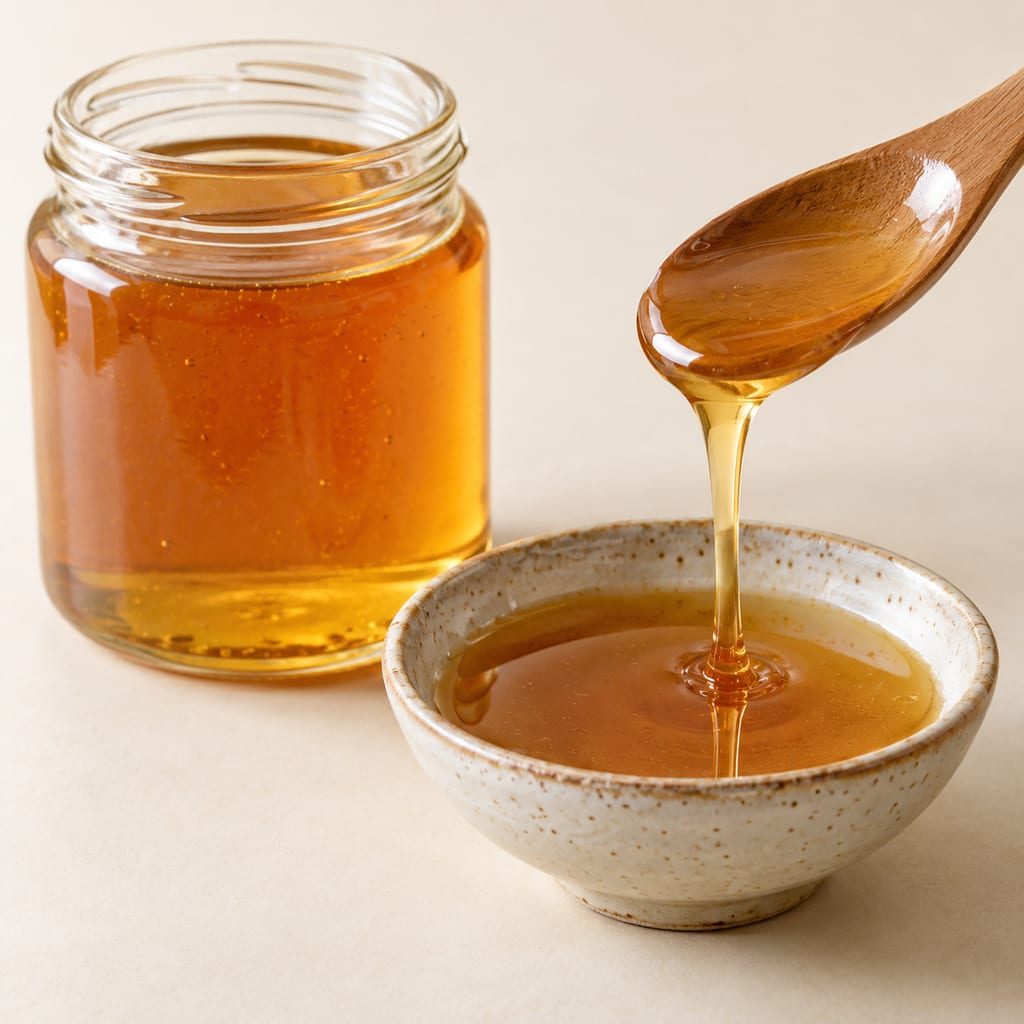
A Korean rice syrup: cooked rice is converted by barley malt in a long warm hold, strained, and the sweet liquid is boiled down until it pours like maple syrup.
Community
No community contributions have been published for this entry yet.
Share what you made
Sign in to contribute. Published comments and photos are free to read.
Sources
Ministry of Agriculture, Forestry and Fisheries of Japan
Beverages | Traditional Foods in Japan : MAFFCited in: Two old ways to make rice taste sweet; Starch, and the enzymes that cut it; Amazake: four documented methods, kept apart
Journal of Fungi 7(6):469 (MDPI), 2021; DOI 10.3390/jof7060469; PMCID PMC8227387
Ingredients, Functionality, and Safety of the Japanese Traditional Sweet Drink AmazakeCited in: Two old ways to make rice taste sweet; Starch, and the enzymes that cut it; Amazake: four documented methods, kept apart; Holding 50 to 60 °C: yogurt maker, rice cooker or jar bath; Jiu niang: when the starter is alive
Korean Traditional Knowledge Portal (한국전통지식포탈); data from 『한국의 전통향토음식 5-충청남도』, 교문사, 2008
고추식혜 [한국전통지식포탈-향토음식]Cited in: Two old ways to make rice taste sweet; Sikhye: malt water poured over rice
Maangchi (maangchi.com)
Rice punch (Sikhye: 식혜) recipe by MaangchiCited in: Two old ways to make rice taste sweet; Starch, and the enzymes that cut it; Sikhye: malt water poured over rice
Maangchi (maangchi.com)
Homemade rice syrup (Ssal-jocheong) recipe by MaangchiCited in: Two old ways to make rice taste sweet; Ssal-jocheong: convert, strain, then boil down
Maangchi (maangchi.com)
Dessert punch with persimmon, cinnamon, and ginger (Sujeonggwa) recipe by MaangchiCited in: Sujeonggwa: a Korean punch that is only an infusion
Foods 10(8):1733 (MDPI), 2021; DOI 10.3390/foods10081733; PMCID PMC8391644
Gelatinization or Pasting? The Impact of Different Temperature Levels on the Saccharification Efficiency of Barley Malt StarchCited in: Starch, and the enzymes that cut it
Marukome Co., Ltd.
麹の酵素とそのはたらき|麹(糀・こうじ)のこと|マルコメCited in: Starch, and the enzymes that cut it; Shio koji: salt, koji, and either weeks or hours
Grainfather
Instructions - G30 (English PDF; first page 'INSTRUCTIONS DESIGNED BY BEER LOVERS BREWERS GRAINFATHER CONNECT')Cited in: Starch, and the enzymes that cut it; Sikhye: malt water poured over rice; Malt in a brewing kettle: sweet wort
Tanica Electric (Tanica Press trial-report database); trial date 29 May 2014
甘酒「米麹」(かなの実験室)|発酵食品試作報告書|Tanica PressCited in: Starch, and the enzymes that cut it; Amazake: four documented methods, kept apart
Marukome Co., Ltd.
糀甘酒の作り方|マルコメの糀甘酒|マルコメCited in: Starch, and the enzymes that cut it; Amazake: four documented methods, kept apart; Holding 50 to 60 °C: yogurt maker, rice cooker or jar bath; Comparing appliances without confusing the processes
Tanica Electric (Tanica Press trial-report database); trial date 21 April 2017
甘酒(白雪印)|発酵食品試作報告書|Tanica PressCited in: Amazake: four documented methods, kept apart; Holding 50 to 60 °C: yogurt maker, rice cooker or jar bath; Comparing appliances without confusing the processes
Tanica Electric (タニカ電器)
Tanica|毎日、発酵食を。ヨーグルトメーカーのタニカ。Cited in: Amazake: four documented methods, kept apart; Holding 50 to 60 °C: yogurt maker, rice cooker or jar bath
Instant Pot (manual hosted by Williams-Sonoma)
Programmable Electric Pressure Cooker User Manual, Models IP-DUO60/80 (September 2016)Cited in: Holding 50 to 60 °C: yogurt maker, rice cooker or jar bath; Jiu niang: when the starter is alive; Batters that rise: idli, dosa and surnoli; Comparing appliances without confusing the processes
Marukome Co., Ltd.
麹の調味料を手作りしてみよう!|麹(糀・こうじ)のこと|マルコメCited in: Shio koji: salt, koji, and either weeks or hours
Tanica Electric (Tanica Press trial-report database); trial date 19 May 2014
塩麹:作り方(かなの実験室)|発酵食品試作報告書|Tanica PressCited in: Shio koji: salt, koji, and either weeks or hours
Animal Science Journal 97(1):e70188, 2026; DOI 10.1111/asj.70188
Effect of Proteases in Fraction in Commercial Shio-Koji on the Proteolysis of Bovine MyofibrilsCited in: Shio koji: salt, koji, and either weeks or hours
Letters in Applied Microbiology 55(3):218–223, 2012; DOI 10.1111/j.1472-765x.2012.03278.x
Reduction of Bacillus cereus spores in sikhye, a traditional Korean rice beverage, by modified tyndallization processes with and without carbon dioxide injectionCited in: Sikhye: malt water poured over rice
Foods 14(22):3814 (MDPI), 2025; DOI 10.3390/foods14223814; PMCID PMC12651284
From Artisan Experience to Scientific Elucidation: Preparation Processes, Microbial Diversity, and Food Applications of Chinese Traditional Fermentation Starters (Qu)Cited in: Jiu niang: when the starter is alive
BC Centre for Disease Control, Environmental Health Services (June 2023, updated December 2024)
Fermented Food Guidance Section 3.4 Dosa & Idli (Safety of Fermented Foods: Assessing risks in fermented food processing practices and advice on how to mitigate them)Cited in: Batters that rise: idli, dosa and surnoli; Comparing appliances without confusing the processes
Applied and Environmental Microbiology 85(13):e00368-19, 2019; DOI 10.1128/AEM.00368-19
Diversity and Succession of Microbiota during Fermentation of the Traditional Indian Food IdliCited in: Batters that rise: idli, dosa and surnoli
Instant Pot (instantpot.com recipes)
Coconut Chile SurnoliCited in: Batters that rise: idli, dosa and surnoli
Gaps
- The koji and salt amounts for a warm 60 °C, six-hour shio koji are unknown, so that fast method cannot be written as a recipe.
- Ama-koji quantities (koji, water, rice) are unknown.
- Amazake, sikhye and idli batter have not been tested in a jar bath or brewing kettle.
- No recipe or keeping time exists for sweet wort or a homemade malt concentrate as a cooking ingredient.
- Multicooker programme temperatures differ by model; the 30–34 °C jiu niang mode is one model's specification.
Updated 2026-10-27