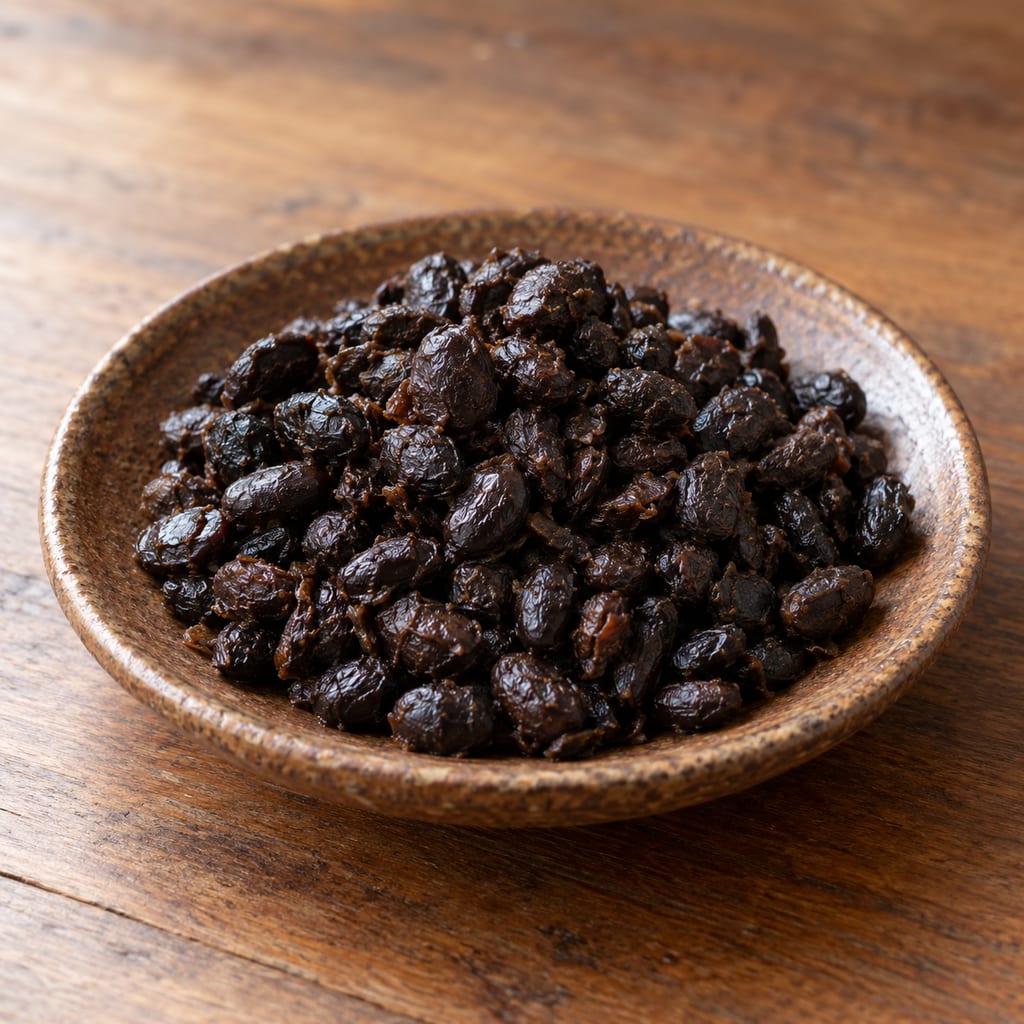
Mucor-type douchi
A Chinese fermented soybean condiment from Chongqing and Sichuan, made by growing Mucor-type mould on cooked beans, then salting and maturing them into dark, savoury, soft beans with a concentrated aroma.
 FermenteaWhere food goes to change
Traditional method
酒酿 · Jiuniang · Jiu niang · 酒釀 · Laozao · Lao zao · 醪糟 · Tianjiu · Tian jiu · 甜酒 · Tianjiuniang · 甜酒酿 · 甜酒釀 · Tianmijiu · 甜米酒 · Nuomijiu · 糯米酒 · Jiangmijiu · 江米酒 · Sweet fermented rice · Sweet fermented glutinous rice · Chinese fermented sweet rice · Chinese sweet rice wine · Fermented sticky rice
Chinese sweet fermented glutinous rice: steamed rice and a mixed jiuqu starter, where mould enzymes release sugar and yeast makes a little alcohol, eaten with its sweet liquid.
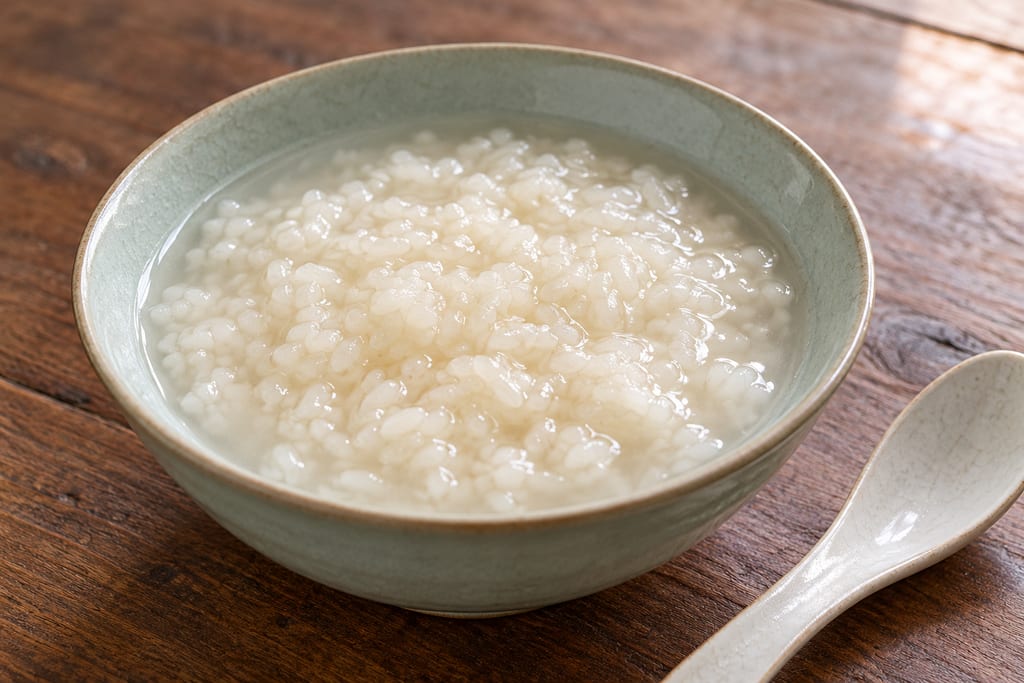
Jiuniang (酒酿) is sweet fermented rice. Glutinous rice is steamed, mixed with a dry starter called jiuqu and left warm for a day or two, and by then the grains have gone soft and the bowl holds a pale, sugary, faintly boozy liquid. It is neither plain cooked rice nor a clear rice wine. The grains and the liquid are eaten together, usually with a spoon, and the texture runs from separate tender grains in syrup to a looser, porridge-like mass. The taste is sweet first, then a little tart, with the winey aroma of fermented rice.
What sets it apart is the stage at which it is stopped. Starch in the rice has been broken into sugar, some of that sugar has become alcohol, and the cook takes the bowl while most of the sugar is still there. Left longer, the same rice turns drier, more acid and stronger, and moves toward the cloudy rice wines that are strained and drunk. Jiuniang is a food that happens to be alcoholic, not a drink that happens to be sweet.
The starter makes this possible. Jiuqu is a dried cake or powder of microbes grown on rice or flour, and the useful members of the mixture do different jobs. Moulds, above all Rhizopus, produce the enzymes that cut starch down to glucose. Yeasts turn part of that glucose into alcohol and carbon dioxide. Lactic acid bacteria add a little acid. Ordinary baker's yeast supplies only the yeast part, so it cannot turn cooked rice into jiuniang on its own.
The same food goes by many names. Jiuniang is the common term in eastern China, and laozao (醪糟) is the one heard in Sichuan, Chongqing and much of the north. Tianjiu (甜酒) means sweet wine, and tianjiuniang, nuomijiu and jiangmijiu are other labels, some of which also cover thinner or stronger rice wines. Jiuzao (酒糟) can mean the leftover grain from brewing rather than the finished dessert. The words overlap without being perfect synonyms, so a recipe should be read for what it does with the rice, not only for its name.
Chinese writers have recorded sweet grain brews for two thousand years, but the food now called jiuniang cannot be traced back along a clean line. The strongest early candidate is the tujiu of the Shu people, set down in the Qimin yaoshu, the sixth-century farming handbook of Jia Sixie. Its recipe steeps a barley ferment in water in the twelfth month and seals the urn with mud. In the first or second month, when the thaw comes, the liquid is filtered, and part of it is mixed with cooked saccharified rice, resealed and left for ten days. It is eaten together with the dregs and is described as sweet, pungent and smooth, with little power to intoxicate. That is close to jiuniang in outline, though the starter, timing and sealing differ from the modern food.
Older still are the laoli and laoyao of the Huangdi neijing, the Han-period medical classic. Lao was defined in the ancient dictionary Shuowen Jiezi as a brew that keeps its dregs, and li as a sweet brew without them, so a compound of the two can be read as a sweet rice brew with its grains. Scholars such as Nicholas Tursi treat these passages as likely forerunners. They stop short of calling them jiuniang, because the texts do not describe starter, rice or method closely enough to say.
The name jiuniang itself turns up in the Qing period. Zhao Xuemin wrote his Bencao gangmu shiyi in the middle of the eighteenth century as a supplement to the Ming materia medica, and gave jiuniang a place in Book 8 among the grains. One recipe there boils five jin of jiuniang with sealwort, wolfberries and millet wine in a jar for the time it takes an incense stick to burn. That is a medicinal use, and it shows that by then jiuniang was a named, familiar material. It is also a ceiling for what the texts can prove, not a date of invention.
Part of the silence is social. Jiuniang is rustic home food made with a few cheap things, and the literati who wrote the books seldom recorded it. A small jar needs only rice, starter, water and time, so households could keep making it without leaving a trace. Later regional histories add local colour, such as the Xiaogan shop Luyuanxing, founded in 1924 by a former rice wine peddler, and the Fuling dish youlaozao dated to 1799. They record how the food was used in particular places, not how old jiuniang is.
Raw rice starch is packed in hard granules that enzymes cannot easily reach. Steaming with water swells and bursts the granules, which is called gelatinisation, and that is why the rice is cooked before the starter goes in. Glutinous rice is almost all amylopectin, the branched form of starch. It cooks soft and sticky, and its many branch ends give enzymes plenty of places to work.
The starter's moulds do the first job. Rhizopus species release alpha-amylase, which chops long starch chains into shorter pieces, and glucoamylase, which strips glucose from those pieces one at a time. The grains soften as the starch leaves them, and the liquid around them fills with sugar. This saccharification is why jiuniang can taste so sweet while it ferments: sugar is released faster than the yeasts use it. A 2025 sequencing study of one batch found Rhizopus and the yeast Wickerhamomyces anomalus in command from start to finish, and measured 33 degrees Brix of soluble solids alongside 3.5 per cent alcohol and a pH of 3.75 after 43 hours.
Yeast then turns glucose into pyruvate and, through acetaldehyde, into ethanol and carbon dioxide. Saccharomyces cerevisiae is the best-known worker, but starters also carry other yeasts. Studies of jiuqu have isolated Saccharomycopsis fibuligera, Wickerhamomyces anomalus and Torulaspora delbrueckii, and a co-fermentation with Saccharomycopsis and Rhizopus produced more volatile compounds, among them more esters and higher alcohols, than the mould alone. Those compounds are the fruity, winey notes of the finished rice.
Bacteria join in too. A 2023 survey of laozao from Liquan County in Shaanxi found Lactobacillus making up 85.25 per cent of the bacterial sequences, with Pediococcus, Leuconostoc, Streptococcus and Lactococcus beneath it, and among the fungi Rhizopus at 56.66 per cent, Saccharomyces at 23.28 and Saccharomycopsis at 12.24. Samples from the same county split into two significantly different groups, so even one named local product is not a fixed recipe, and gene sequences count DNA, not living or working cells. In a controlled test, adding Lactobacillus rhamnosus raised acidity and made lactic acid the main organic acid, while extra Saccharomyces cerevisiae raised ethanol. Starter enzymes can also free amino acids from the rice proteins, which feed the microbes and add flavour. Sweetness, alcohol, acid, softened grain and aroma all come from several organisms working at once.
There are only three ingredients: glutinous rice, starter and water. The rice is the whole source of sugar, so no sugar is added. Glutinous rice is chosen because it stays soft and cohesive when cooked and still keeps its grains. The starter brings the organisms and enzymes. Water lets the starch swell during cooking and then lets enzymes and microbes move through the bowl.
The Hunan government's recipe for the sweet rice in tianjiu chongdan is a good plain model. Soak 350 g of glutinous rice for two hours, steam it for 30 minutes, sprinkle on a little hot water and steam 15 minutes more. Rinse with cold water until the rice is no longer too hot to handle, drain it well, mix in 2.5 g of jiuqu powder, press the rice into an earthenware bowl and cover it. The bowl is held at 30 C for 34 hours.
Each stage has a purpose. Soaking lets water enter the grain so the middle cooks as well as the outside. The second, moistened steaming finishes cooking without turning the rice into porridge. Rinsing with cold water stops the cooking and cools the rice to a point the starter can survive, because hot rice would kill the moulds and yeasts; it also loosens clumps so the starter reaches every grain, and draining keeps a puddle of water from diluting the sugar. A steady 30 C suits the Rhizopus and yeasts of the starter, and in the hours that follow saccharification runs ahead of fermentation.
Other published methods show how much latitude the food has. A Chongqing account cools the rice to about 35 C, adds the starter in batches and presses a small hollow into the centre, so the syrup gathers there and the cook can see it. The bowl is wrapped to stay warm and the laozao is ready in about three days. A 2025 research batch soaked 1,000 g of rice for 12 hours, steamed it for 60 minutes, cooled it to about 30 C, used 4 per cent starter by dry rice weight and fermented at 28 C, and the panel judged 43 hours best. A 2024 experiment soaked overnight at 25 C, steamed 30 minutes, added water at 1:0.8 and a Rhizopus-bearing leaven at 500:1, and ran 72 hours at 30 C. Their times and ratios belong to their own set-ups and should not be pooled into one recipe.
The Hunan recipe prints 34 hours at 30 °C as its production setting. A separate 2025 experiment at 28 °C used a flavour panel that preferred its own 43-hour sample to a 48-hour sample. Neither result is a validated safety endpoint or a timing rule for another starter and batch. Sweetness, soft grains, syrup and a pleasant smell describe quality changes; they do not rule out pathogens or toxins. Refrigeration can slow further fermentation but does not supply a tested household shelf life.
Jiuniang is better thought of as a family than as one fixed product. Regions differ in the rice, the starter, the amount of water, the length of the ferment and the way the grains are finally eaten. Hubei's Xiaogan is the best-documented local form. Its rice wine is made from Zhuhu pearl glutinous rice and a honeycomb-shaped starter, soaked, washed, drained, steamed, cooled to lukewarm, mixed with the starter and left in vats or jars. Local tradition ties it to the Song emperor Zhao Kuangyin, who in the story was rescued by a bowl of it, and a Qing county gazetteer line says the wine was perfected in Xiaogan and began in the Song. The rice wine is a fixture at weddings and festivals, and a thick-soup version is a street breakfast. Hubei lists the craft among its provincial traditional crafts.
Chongqing and neighbouring Sichuan favour the name laozao. Fuling, a town on the Yangtze, is known for youlaozao, in which fermented rice is stir-fried in lard with peanuts, black sesame, walnuts and candied fruit into something richer and sweeter than the plain rice. The local gazetteer dates the dish to 1799, with a story about a cook who had no time to make dumplings for an important household and served sweet fermented rice with eggs instead. It is a cooked speciality built on jiuniang, not the same food.
In Hunan the rice goes into tianjiu chongdan, a hot sweet soup poured over beaten egg. In Shanghai, shops such as Guxingsing sold osmanthus sweet jiuniang and jiuniang yuanzi, with eight-treasure rice, before merging into the Songyunlou shop on Yuyuan Road. Colour changes the food too: a 2023 experiment on black glutinous rice followed sugar, alcohol, acidity and colour through the ferment and saw alcohol peak at 6.24 per cent on day five, higher than the figures usually quoted for white-rice jiuniang. Selected yeasts and lactic bacteria added in laboratory trials are research variants, not inherited household methods.
The simplest way to eat jiuniang is straight from the jar, cool or gently warmed, grains and liquid together. Cooks also stir a few spoonfuls into hot water for a quick sweet rice soup. The best-known dessert is jiuniang yuanzi, a bowl of the fermented rice with small glutinous rice dumplings, often scented with osmanthus. The fermented rice goes in at the end of cooking, once the heat has dropped, so the aroma survives.
Eggs are the usual partner. In Hunan's tianjiu chongdan, the cook boils a thin paste of glutinous rice, stirs in half of the sweet rice, cracks eggs into the bowls and pours the boiling liquid over them so the egg sets in silky strands. The remaining cold sweet rice is spooned in with osmanthus sugar, sugar and crushed dried longan, and the recipe makes ten bowls. In Chongqing laozao is simmered with poached eggs or dumplings, and in Fuling the fat-rich youlaozao follows the same logic.
Jiuniang has savoury uses too. Chinese cooks put it into marinades and braises, where it adds sweetness, a little acid and a ferment aroma, and it can stand in for cooking wine in some dishes. Because it already carries sugar, a cook has to cut the sugar elsewhere. Food scientists have even studied it as a source of natural enzymes in bread: a 2017 paper tested fermented glutinous rice as a natural enzyme mixture to improve dough and slow staling.
It is also eaten as a tonic. Chongqing writing records laozao with eggs or brown sugar for new mothers and older people, and the Shenzhen regulator notes that postpartum dishes of sweet rice wine with egg are common. Health agencies in Hami and Beijing's Haidian district say plainly that small amounts of rice wine or laozao do not increase milk, and that alcohol reaches a breastfed baby. The custom is part of the food's social history, not a reason to eat it for recovery.
Several signs show that the ferment is working: the rice softens, liquid collects around it or in the central hollow, the smell turns sweet and winey. They show that starch is breaking down. They do not show that the batch is safe, and a sweet smell cannot rule out a pathogen. Sugar, acidity and alcohol, when measured, say more than taste does. The measured values in the literature are examples. A laboratory batch at 43 hours gave 33 degrees Brix, pH 3.75 and 3.5 per cent alcohol; the black-rice batch reached 6.24 per cent; a classic description puts jiuniang near 1.5 to 2 per cent, while rice wines on the market are said to run roughly 3 to 14 per cent and one experiment reached about 14 per cent after 96 hours. These are not targets.
Too sour a bowl usually means too long, too warm or too much lactic acid from the starter. The 2024 experiment showed that extra Lactobacillus raises acidity, and extra yeast raises alcohol, so a batch that tastes sharp or hot has moved past the sweet stage. A bowl that stays hard and dry may have been undercooked, cooled so far that the starter hardly worked, or inoculated with a dead starter. Plain baker's yeast does not rescue it because it does not break down the starch.
The main safety question is the rice itself. Bacillus cereus spores survive cooking, and rice that is cooked, cooled slowly and held warm is the textbook setting for their growth and toxin. Laboratory work with cooked rice found the emetic toxin forming at 15 to 45 C and surviving two hours at 100 C, so boiling a doubtful batch does not help. Jiuniang adds a warm incubation on purpose, which is why a working starter, clean equipment and prompt handling matter, and why ordinary advice about cooking and chilling rice cannot simply be reused for it. Unexpected coloured mould, a putrid smell or growth that does not look like the white mycelium of the starter calls for throwing the batch away.
Jiuniang is also alcoholic. Alcohol content has no national standard, rises with time and warmth, and the sweetness hides it. It is not an alcohol-free dessert for children, nor for pregnancy or breastfeeding. Storage is not settled either: cold slows fermentation without stopping it, and sealed jars can build pressure. No safe shelf life, pH limit or minimum alcohol is established for home batches.
Sweet rice brews eaten with their dregs appear early in Chinese writing. The Qimin yaoshu of the sixth century gives a recipe for the Shu people's tujiu that is sweet, low in intoxicating power and eaten with the solids, and the Han-period Huangdi neijing speaks of laoli and laoyao, which scholars read as forerunners. The name jiuniang itself is found in Zhao Xuemin's Bencao gangmu shiyi, written in the mid-eighteenth century, which lists it in a medicinal recipe. The long gap between the early brews and the named food is unresolved.
Bacillus cereus spores can survive cooking, and cooked rice held warm can allow growth and toxin formation. The Hunan recipe's 34-hour hold and an assumed working starter are not validated controls for this hazard.
Hazard sourceThe emetic toxin of some B. cereus strains formed in cooked rice kept warm and persisted after two hours at 100 C in laboratory tests, so reheating or cooking a doubtful batch does not make it safe.
Hazard sourceStarter cakes and powders carry different mixes of Rhizopus, yeasts and bacteria, and two samples of one local laozao split into two distinct microbial groups. A starter without a known source may not start the intended fermentation.
Hazard sourceSweet fermented rice contains alcohol that grows with time and warmth. Rice wines on sale are described as roughly 3 to 14 per cent by volume, and the Shenzhen market regulator advises breastfeeding women to avoid alcohol-containing dishes such as sweet rice wine with eggs.
Hazard sourceThe rice keeps sugar and living microbes after the sweet stage, so acidity, alcohol and carbon dioxide continue to rise unless the batch is cooled or heated to stop it. A research batch tasted too acidic and old at 48 hours.
Hazard sourceUse a food-grade starter made for sweet rice, never an unidentified mouldy rice culture.
Control sourceUse clean basins, bowls and drinking water, and handle the cooled rice as little as possible.
Control sourceCool the steamed rice only as far as the starter needs and add the starter at once, so the rice does not stand warm without it.
Control sourceThrow away a batch with coloured colonies, a putrid smell or any growth other than the white mycelium of the starter, rather than scraping it or cooking it.
Control sourceCover the bowl loosely rather than sealing it tight, since yeast keeps releasing carbon dioxide.
Control sourceCooked rice held at 30 °C can support Bacillus cereus. The Hunan recipe's 34-hour hold is a production time, not a safety limit. Putrid odour or coloured growth warrants discarding a batch; their absence does not prove it is safe.
The emetic toxin of Bacillus cereus survives boiling, so do not try to rescue a suspect batch by cooking it into a soup.
Baker's yeast does not split starch and cannot replace jiuqu; mouldy rice that is not a food-grade starter must not be used in its place.
Jiuniang is alcoholic even though it tastes sweet; do not serve it as an alcohol-free food to children, and avoid it in pregnancy and while breastfeeding.
Sweet, pleasant smell or a pool of syrup around the rice shows that starch has broken down; it does not show that the batch is free of Bacillus cereus.
Country-level: made in households and shops across China under several names; the entry does not claim a single birthplace.
Local laozao sampled for a sequencing study; no claim about the age of the local recipe.
Xiaogan rice wine is a named local form of the tradition and is listed as a provincial craft.
Home laozao making, and the Fuling speciality youlaozao.
Osmanthus sweet jiuniang and jiuniang yuanzi sold by long-established snack shops.
The method on this page is the Hunan provincial government's published recipe for the sweet rice used in tianjiu chongdan.
A Chinese fermented soybean condiment from Chongqing and Sichuan, made by growing Mucor-type mould on cooked beans, then salting and maturing them into dark, savoury, soft beans with a concentrated aroma.
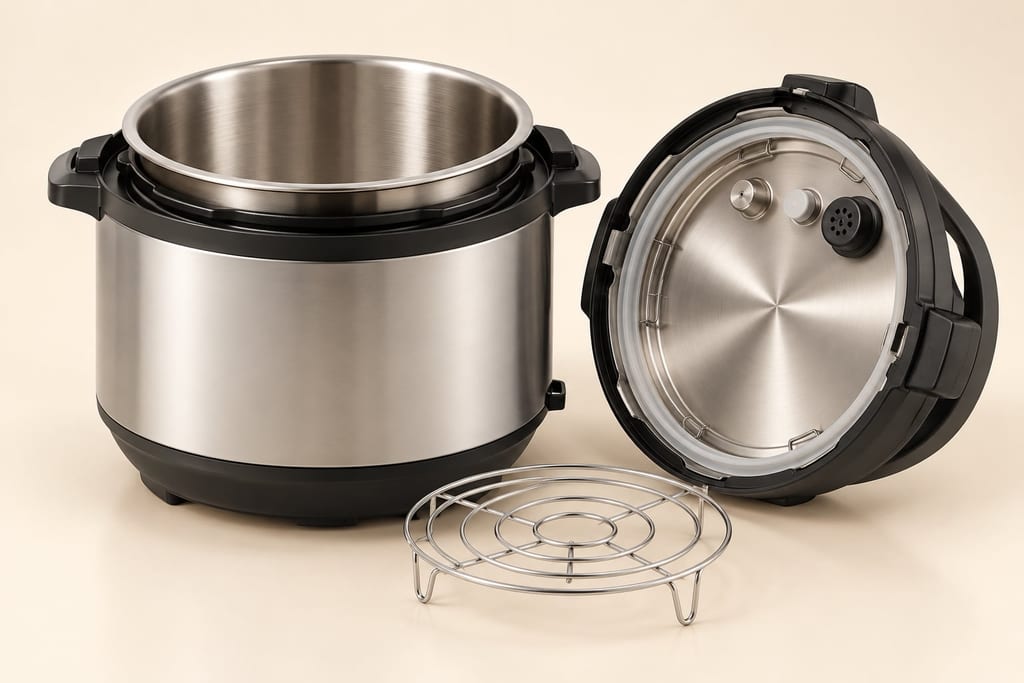
A countertop electric cooker combines pressure cooking with model-specific functions such as sautéing, slow cooking, rice cooking and low-temperature programs. Settings do not transfer to pressure canning.
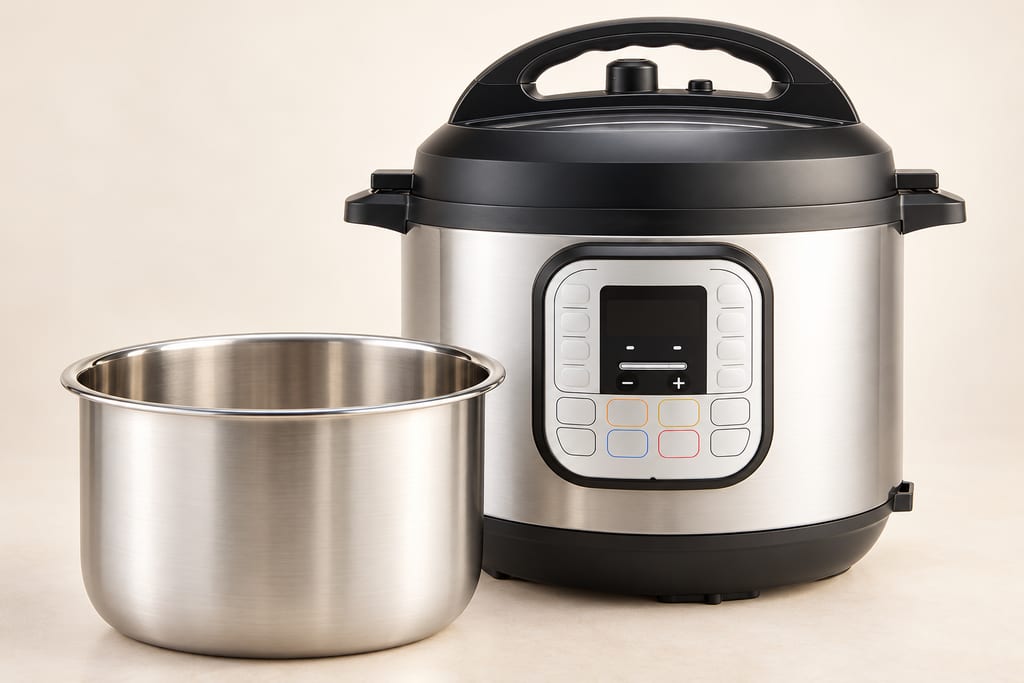
The Instant Pot Duo is a manufactured electric multicooker with a removable inner pot, locking lid and electronic programs. A 2016 IP-DUO60/80 manual documents yogurt and jiu niang settings; later revisions may differ.
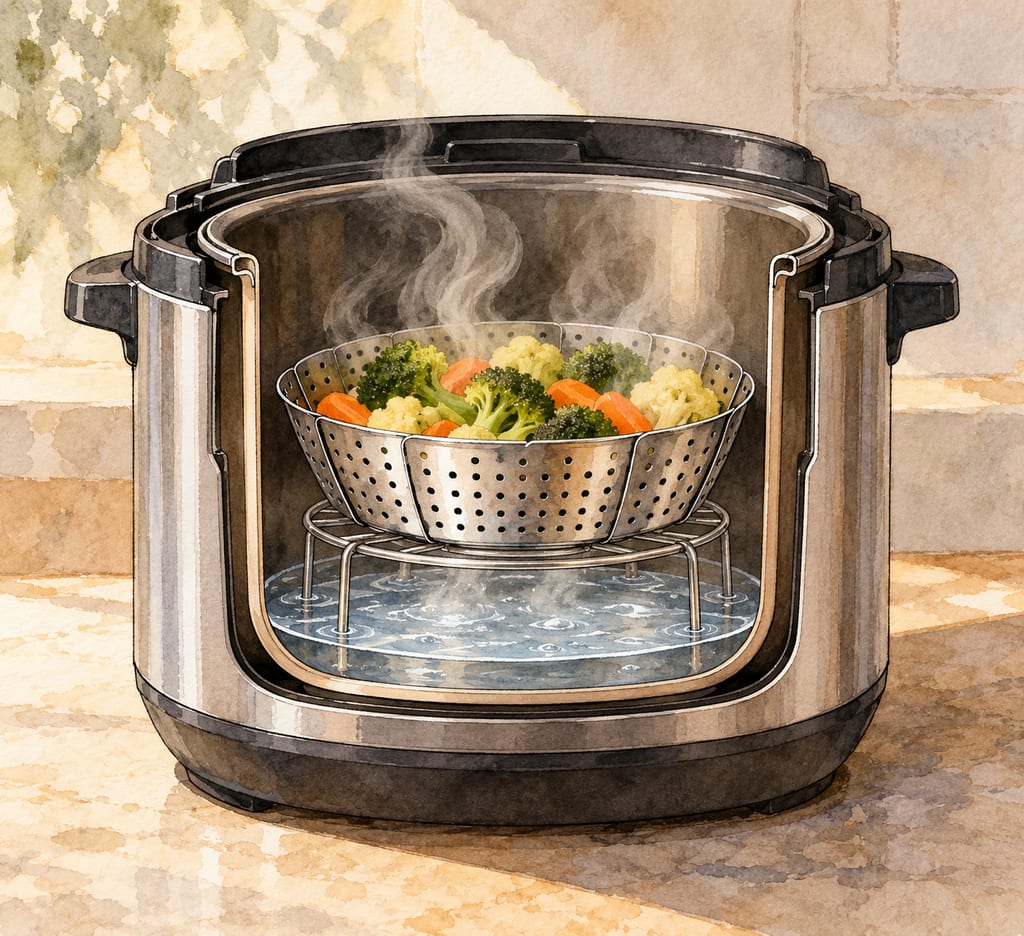
Containers or a steaming basket standing on the multicooker's rack over a measured depth of water, so the water carries heat evenly to food kept out of it.
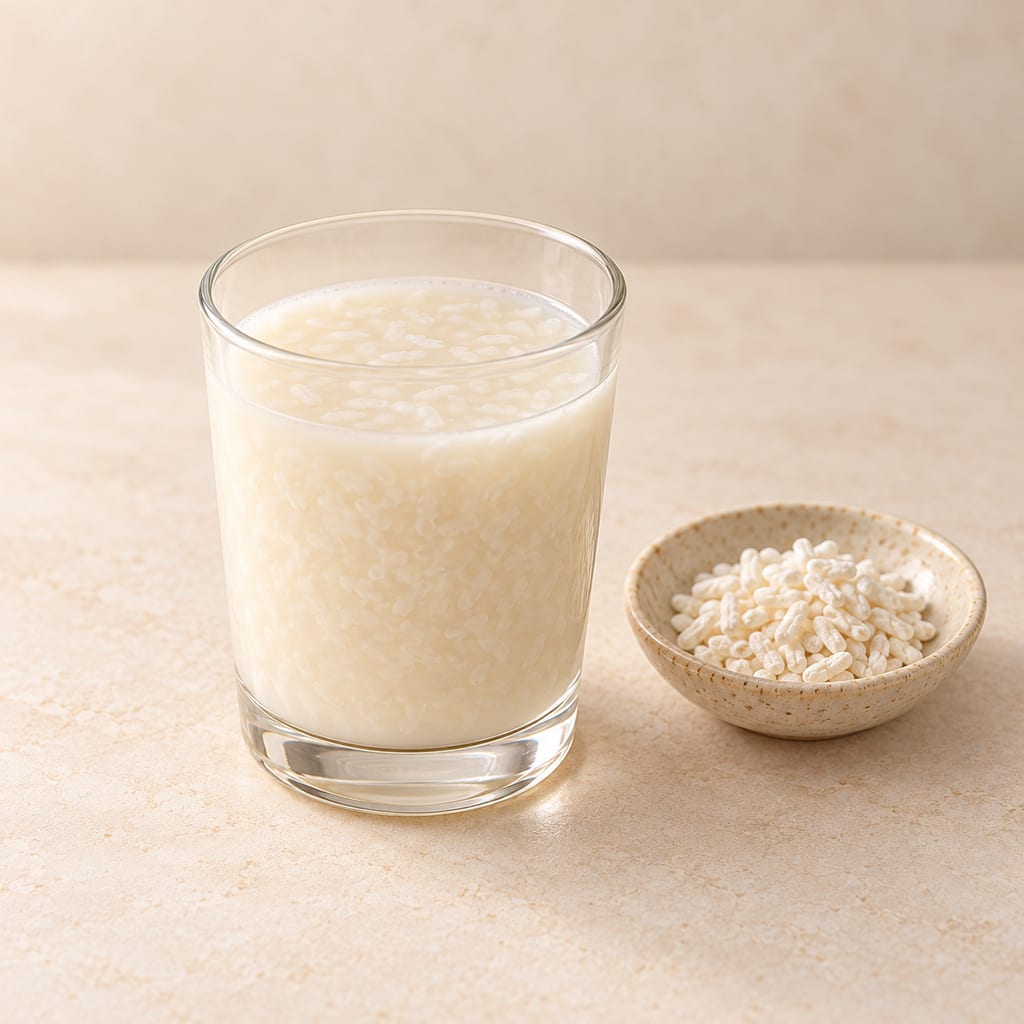
Cooked rice, rice koji and water are held warm for hours so koji enzymes turn the rice starch to sugars, giving a naturally sweet Japanese drink with no added sugar and no second fermentation.
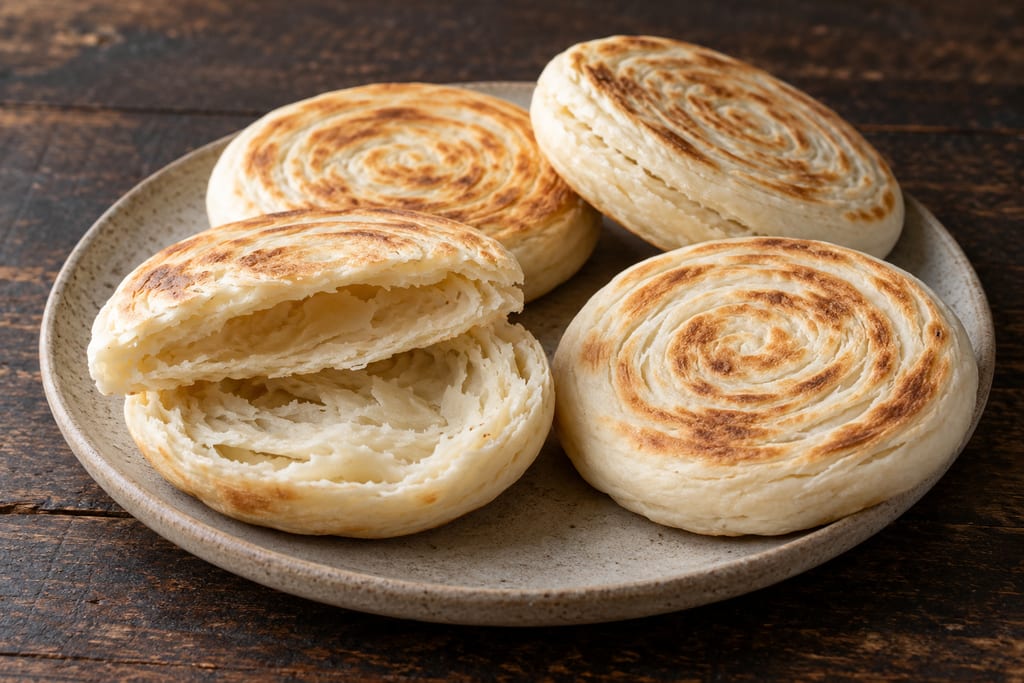
This Shaanxi-associated yeast flatbread uses a simple water dough, coiled shaping and a skillet bake. It is the bread used in roujiamo, not the filled meat dish.

A thick, naturally sweet rice-and-koji preparation used to add body and sweetness to marinades, dressings and sauces. This method follows a published Marukome home recipe and is an enzyme-conversion hold, not a way to grow koji mould.
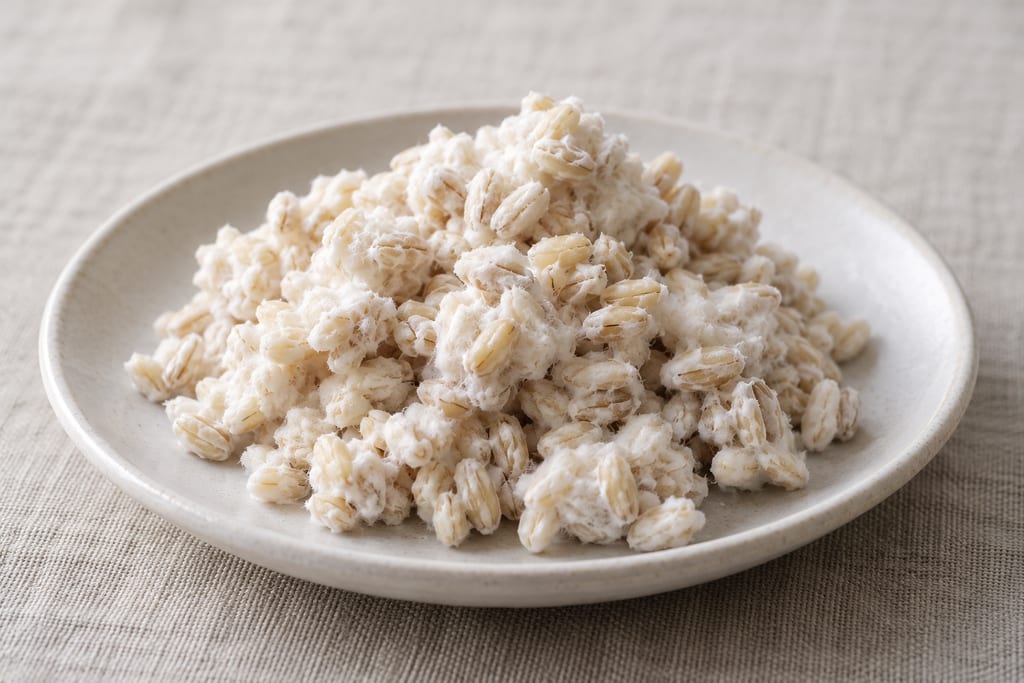
Steamed pearled barley grown into a white koji cake with Aspergillus oryzae over about 36 hours in a 30 °C chamber, turned three times under a damp cloth.

An ethnographic record of marcha (murcha), a dry starter cake used in Eastern Himalayan cereal fermentations. This page documents source-specific community knowledge and is not a recipe for making or storing starter.

Rice koji is steamed white rice through which koji mold has grown. It carries the enzymes that turn rice starch into sugar, and it is the starting point of sake, sweet miso, amazake and shio koji.
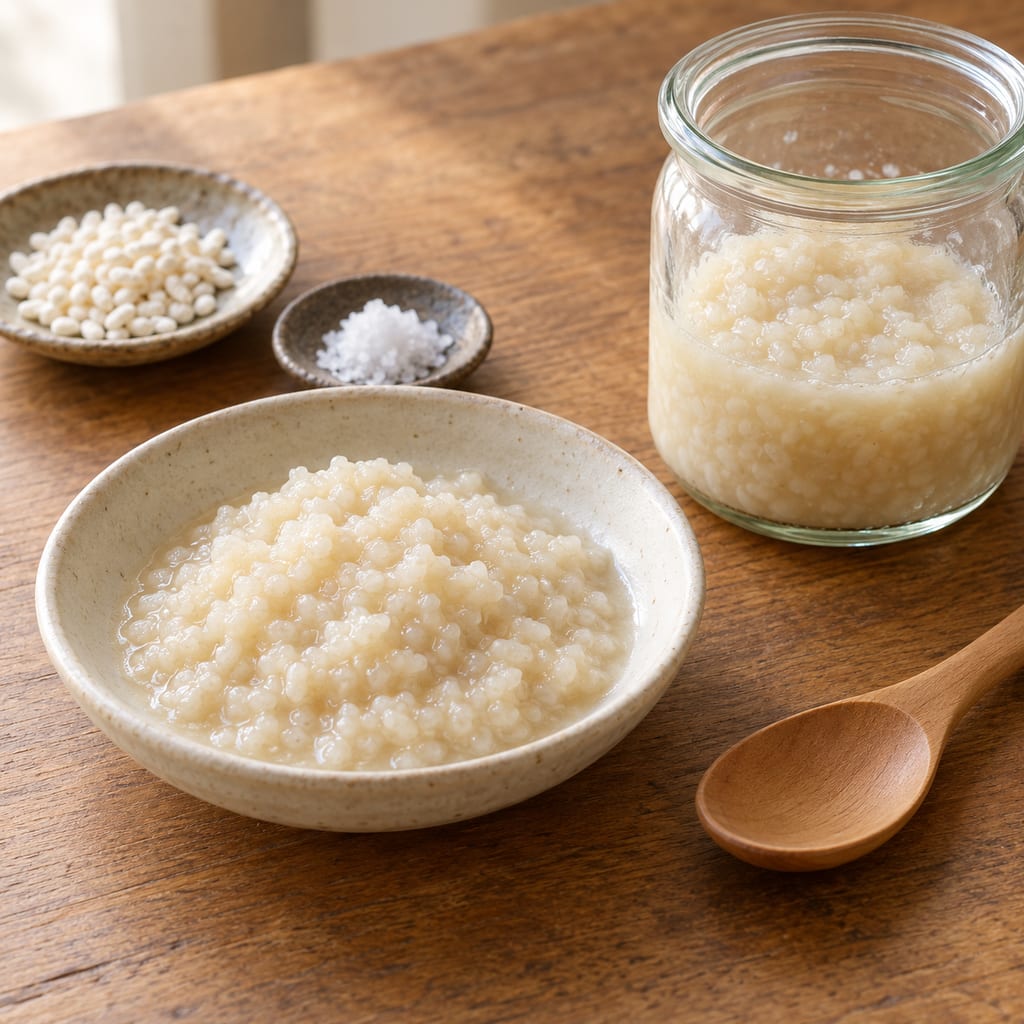
A Japanese seasoning of rice koji, salt and water, left at room temperature until the koji's enzymes and its microbes turn it into a savoury, salty paste for marinades and dressings.
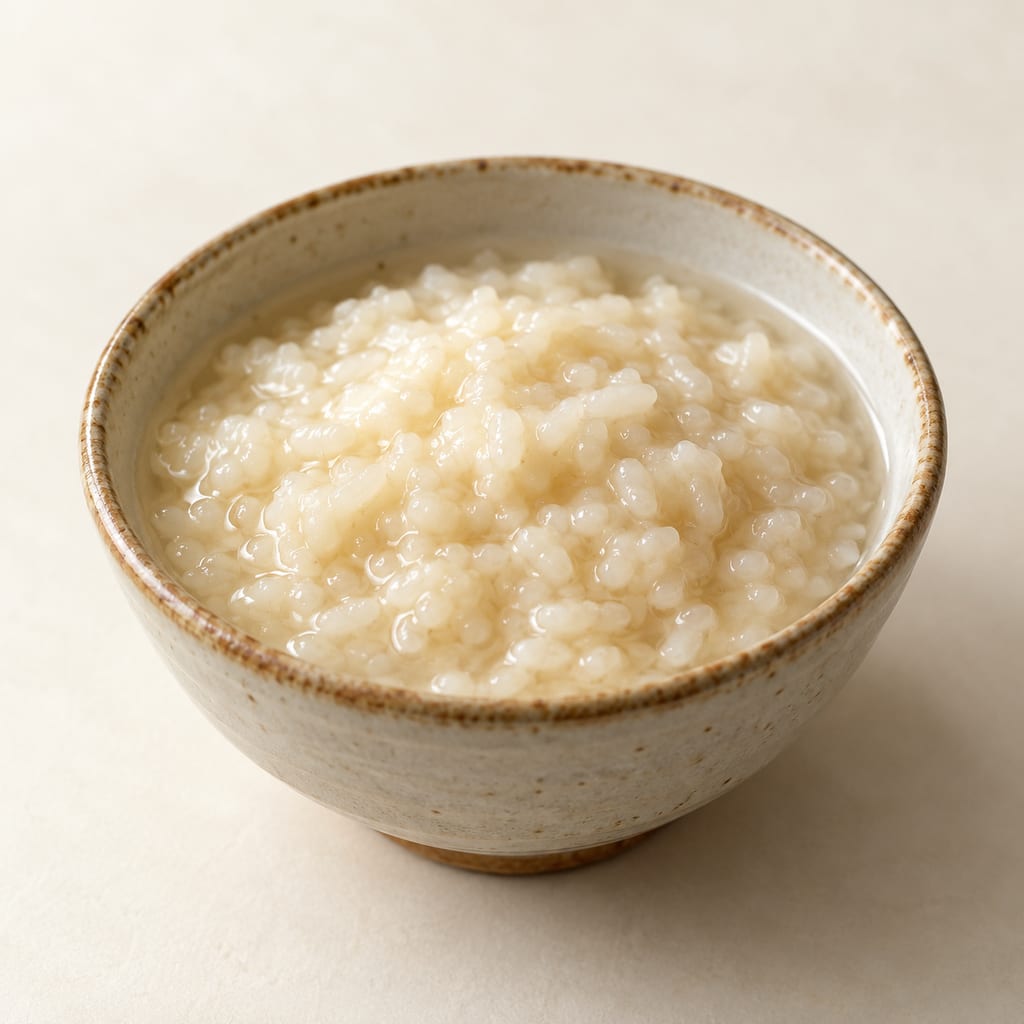
Shio-koji is a Japanese seasoning of rice koji, salt and water, left at room temperature until the grains soften and turn sweet and the mixture thickens.

A gelling polysaccharide extracted from red seaweeds, sold as kanten strips or powder; it sets firm at a low concentration and stays solid until about 85 °C.

A Dominican table and seasoning condiment of sour orange juice, mixed with lime and salt and bottled raw; garlic, oregano or a hot pepper may be added for meat or a spicier bottle.

Cicerbita alpina is an alpine perennial whose tender shoots and leaves have been eaten raw or cooked. Sámi milk preparations and modern Carnian dishes are distinct uses, with serious identification and preservation limits.

Japanese skipjack tuna cooked, then repeatedly smoked and dried over a wood fire by the hand-fired tebiyama method into a hard block for shaving into dashi: the first stage of katsuobushi.

A Swedish-style spirit vinegar made by fermenting neutral alcohol with live vinegar bacteria, with a separate guide to commercial ättika strengths.

A yeast-raised wheat ring shaped from a firm dough, briefly boiled and baked. This source-batch formula gives a gently malted crust and a chewy crumb.

A warm dip of garlic, anchovy and olive oil, often enriched with butter, that Piedmont serves over a flame with raw and cooked vegetables and bread.

Bechamel is a white sauce of milk thickened with a butter and flour roux, one of the French mother sauces, and the base from which Mornay and other cheese and cream sauces are made.
No community contributions have been published for this entry yet.
Sign in to contribute. Published comments and photos are free to read.
Hunan Provincial People's Government portalMethod · Use
地方名小吃:甜酒冲蛋 (Local snack: sweet fermented rice with beaten egg)350 g glutinous rice soaked 2 hours; steamed 30 minutes, a little hot water sprinkled on, steamed 15 minutes more.
Rice rinsed with cold water until not too hot to handle, drained, mixed with 2.5 g jiuqu powder in a basin.
Pressed into an earthenware bowl, covered, held at 30 C for 34 hours as printed.
Finishing the dish tianjiu chongdan: thin rice paste, half the sweet rice stirred in, beaten egg poured over with the boiling liquid, the rest of the cold sweet rice added with osmanthus sugar, sugar and crushed dried longan; 10 bowls.
Cited in: Making it, and why each stage matters; Regional forms and uses; How it is eaten and cooked with
International Journal of Food Science and Technology, 59(4), 2024Method · Science · Safety
Effect of Lactobacillus rhamnosus and Saccharomyces cerevisiae on the Flavour Profile of Sweet Fermented Glutinous Rice (Jiu Niang)Rice soaked overnight at 25 C, steamed at 100 C for 30 minutes, mixed with water 1:0.8 and a Rhizopus-containing rice leaven 500:1, fermented at 30 C for 72 hours.
Added Saccharomyces cerevisiae raised ethanol and 3-methylbutan-1-ol; added Lactobacillus rhamnosus raised acidity and made lactic acid dominant.
Added cultures were a flavour experiment, separate from the traditional starter.
Cited in: What jiuniang is; How the rice becomes sweet and a little alcoholic; Making it, and why each stage matters; Reading results and problems
Foods (MDPI), 2025Method · Science · Safety
Analysis of the Changes in Physicochemical Properties and Microbial Communities During Fermentation of Sweet Fermented Rice1000 g glutinous rice soaked 12 hours, steamed 60 minutes, cooled to about 30 C, 4 per cent starter by dry rice mass, hollow pressed in the centre, fermented at 28 C.
Best flavour at 43 hours; too acidic and old by 48 hours.
At 43 hours: pH 3.75, 33 Brix, 3.5 per cent alcohol by volume; start pH 6.19.
Rhizopus delemar, Rhizopus microsporus and Wickerhamomyces anomalus among the key organisms in this one system.
Cited in: How the rice becomes sweet and a little alcoholic; Making it, and why each stage matters; Reading results and problems
Food Science, 44(14), 2023Science · Variation · Safety
Microbial Diversity of Liquan's Laozao, Sweet Fermented Glutinous RiceLactobacillus 85.25 per cent of bacterial sequences; Pediococcus, Leuconostoc, Streptococcus, Lactococcus also found.
Rhizopus 56.66, Saccharomyces 23.28, Saccharomycopsis 12.24, Candida 5.35 per cent of fungal sequences.
Samples fell into two groups that differed significantly in bacterial diversity and fungal richness.
Cited in: What jiuniang is; How the rice becomes sweet and a little alcoholic
Food Science, 45(15), 2024Science
Selection of Non-Saccharomyces Yeasts and Effect of Co-fermentation with Them and Rhizopus on the Volatile Flavor Components of Fermented Glutinous Rice WineTraditional jiuqu dominated by Rhizopus and Saccharomycopsis; isolates Saccharomycopsis fibuligera, Torulaspora delbrueckii and Wickerhamomyces anomalus.
Co-fermenting a Saccharomycopsis isolate with Rhizopus raised the number of volatile compounds and the esters and alcohols.
Cited in: How the rice becomes sweet and a little alcoholic
China Brewing, 2023Variation · Science
Changes of Flavor, Taste and Quality of Black Glutinous Rice Sweet Wine During Fermentation ProcessBlack glutinous rice sweet wine followed through fermentation for sugar, alcohol, acidity and colour.
Alcohol peaked at 6.24 per cent by volume on day five in that experiment.
Cited in: Regional forms and uses; Reading results and problems
Sino-Platonic Papers, 323, University of Pennsylvania, 2022History · Variation
Alcoholic Beverages in China: Terminology, History, and Cultural SignificanceQimin yaoshu recipe for the Shu people's tujiu: barley ferment steeped in water and sealed with mud, filtered, mixed with cooked saccharified rice, ten days, eaten with the dregs, sweet and not intoxicating.
Huangdi neijing laoli and laoyao read as forerunners of jiuniang; lao means a brew with dregs, li a sweet brew without.
Bencao gangmu shiyi by Zhao Xuemin, mid-eighteenth century, names jiuniang in a medicinal recipe with sealwort, wolfberries and millet wine.
Jiuniang described as a rustic, low-alcohol food of about 1.5 to 2 per cent; its exact origin cannot be dated.
Cited in: A sweet brew with a long, hazy past; Reading results and problems
Information Office of Shanghai Municipality, Touch Shanghai, 2018History · Use
历史中的中国酒酿 (Start with the essence of Chinese winemaking)Jiuniang described as sweet fermented glutinous rice, often eaten as a dessert soup, made with jiuqu like grain wines.
Cited in: What jiuniang is
The Paper, republished by Hubei Provincial Department of Culture and Tourism, 2025Variation · History · Use
读懂城市丨湖北孝感:一座千年文化滋养的甜蜜之城Xiaogan rice wine from Zhuhu pearl glutinous rice and honeycomb-shaped starter; soaked, washed, drained, steamed, cooled to lukewarm, mixed with starter, fermented in vats or jars.
Local legend of Zhao Kuangyin and the Guangxu-period county gazetteer line that the wine was perfected in Xiaogan and began in the Song.
Rice wine a must at weddings and festivals; thick-soup rice wine eaten at street stalls.
Cited in: Regional forms and uses
Hubei Daily, hosted by Hubei Provincial Department of Agriculture and Rural Affairs, 2023History · Variation
[孝感]守匠心 立标准Lu Yubai, a former rice wine peddler, opened the Luyuanxing shop in Xiaogan in 1924 and developed a six-step process.
Zhao Kuangyin legend of being saved by rice wine in Xiaogan.
Cited in: A sweet brew with a long, hazy past
Hubei Provincial Department of Culture and TourismVariation
湖北省非物质文化遗产名录Xiaogan rice wine making craft (孝感米酒制作技艺) listed as a traditional craft, No. 288, with other Hubei rice wine crafts.
Cited in: Regional forms and uses
Chongqing Municipal Local Chronicles Office, 2024Method · Variation
巴乡清,先秦名酒Home laozao needs glutinous rice, starter and clean water: wash, soak, steam, loosen with cool water to about 35 C, mix in starter in batches, press a hollow in the middle, seal, keep warm, ready after about three days.
Cited in: Making it, and why each stage matters
Chongqing Municipal Local Chronicles Office, 2024Variation · Use · History
市级非遗:涪陵油醪糟Youlaozao: laozao stir-fried in lard with peanuts, black sesame, walnuts and candied fruit; dated to 1799 in the Fuling gazetteer.
Traditionally given to new mothers and eaten with eggs or brown sugar.
Cited in: A sweet brew with a long, hazy past; Regional forms and uses; How it is eaten and cooked with
Shanghai Municipal Civil Affairs Bureau, 2023Use · Variation
松月楼与松运楼The shop Guxingsing specialised in osmanthus sweet jiuniang, jiuniang yuanzi and eight-treasure rice before merging into Songyunlou on Yuyuan Road.
Cited in: Regional forms and uses
The Woks of Life, 2022Use
Jiu Niang (Fermented Sweet Rice)Current household terms and uses: with tangyuan, as a sweet soup, in braised dishes and in bread.
Cited in: What jiuniang is; How it is eaten and cooked with
RSC Advances, 2017Use
Use of fermented glutinous rice as a natural enzyme cocktail for improving dough quality and bread stalingJiu-niang tested as a natural enzyme cocktail for improving bread quality.
Cited in: How it is eaten and cooked with
Shenzhen Municipal Market Supervision Administration, 2021Safety
米酒消费提示 (Rice wine consumption tips)Rice wine put at roughly 3 to 14 per cent alcohol by volume.
Breastfeeding women advised to avoid alcohol-containing drinks and dishes such as sweet rice wine with eggs.
Cited in: How it is eaten and cooked with; Reading results and problems
Hami Municipal People's Government, from Science Popularisation China, 2023Safety
警惕!4种藏在食物里的“隐形酒精”No national standard for the alcohol content of fermented rice; one experiment reached about 14 per cent after 96 hours.
Advises pregnant and breastfeeding women and children to avoid it, and rejects the belief that it raises milk supply.
Cited in: How it is eaten and cooked with; Reading results and problems
Haidian District Health Commission, Beijing, 2023Safety
有没有特殊的食物或饮品能催乳?Small amounts of rice wine or laozao do not raise milk supply; alcohol reaches the infant.
Cited in: How it is eaten and cooked with
UK Health Security Agency, GOV.UKSafety
Bacillus Species (Food Poisoning)Bacillus spores survive cooking; cooked rice is a recognised vehicle when it is cooled and stored badly.
Cited in: Reading results and problems
FoodSafety.gov, US governmentSafety
Bacteria and Viruses: Bacillus cereusCooked rice and leftovers kept at the wrong temperature are a main source of Bacillus cereus illness; clean, cook and chill.
Cited in: Reading results and problems
Foodborne Pathogens and Disease, 2014Safety
Effect of temperatures on the growth, toxin production, and heat resistance of Bacillus cereus in cooked riceEmetic toxin formed in cooked rice at 15 to 45 C within 72 hours and persisted at 100 C for 2 hours; spores survived warm storage.
Cited in: Reading results and problems