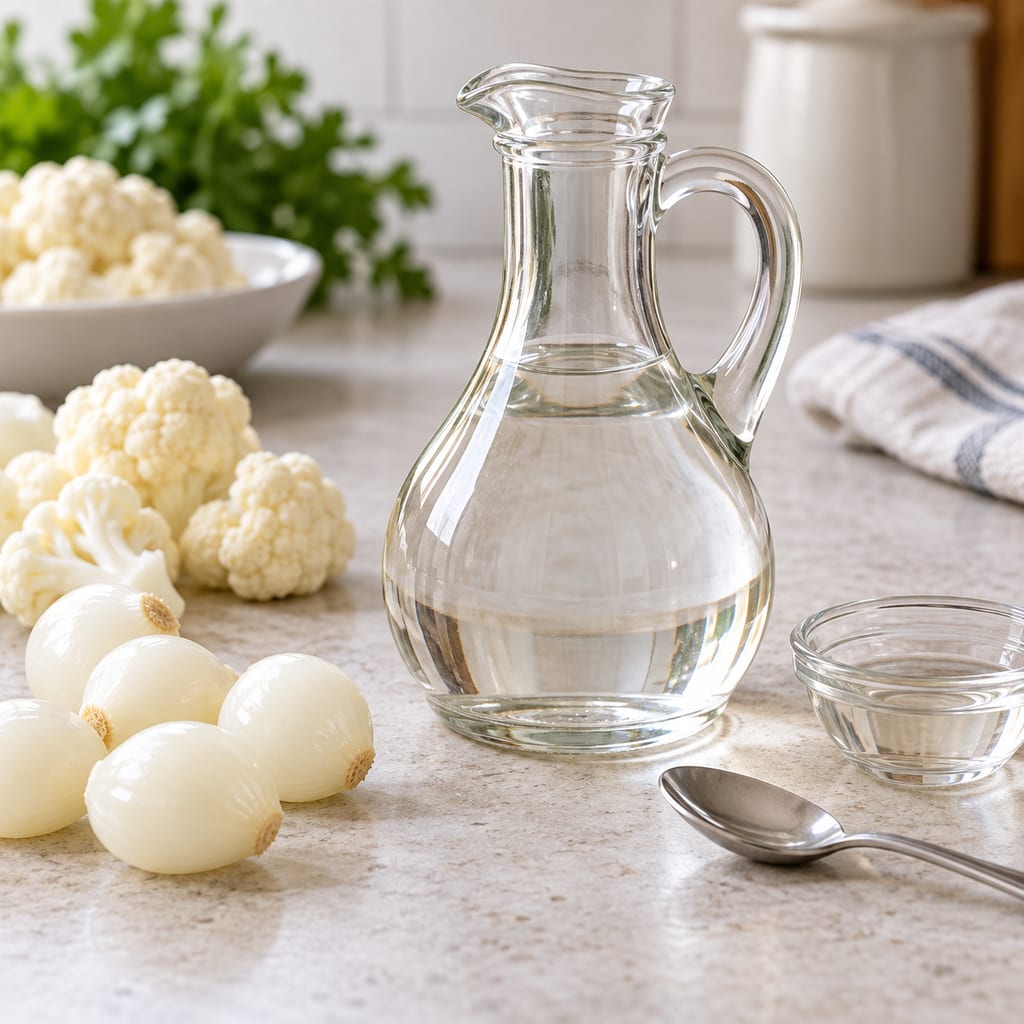
Spirit / distilled white vinegar
A clear, sharp vinegar made by acetifying alcohol. Its restrained color and aroma suit pickles, sauces and dressings where darker or more aromatic vinegars would change the result.
 FermenteaWhere food goes to change
Traditional method
Ättiksprit · Spritättika · Hushållsättika · Ättika 24% · Ättiksprit 12% · Inläggningsättika · Matättika · Swedish vinegar essence · Swedish spirit vinegar
A Swedish-style spirit vinegar made by fermenting neutral alcohol with live vinegar bacteria, with a separate guide to commercial ättika strengths.

Ättika is the Swedish word for vinegar and, in modern kitchens, often refers to a clear, strong acetic acid solution. This recipe makes a Swedish-style fermented spirit vinegar at home, not a 12% or 24% commercial concentrate.
Spirit vinegar begins with alcohol which acetic acid bacteria oxidise in the presence of air. The result is clean and neutral compared with fruit vinegar, though the starter can contribute flavour.
Manufacturing varies: Kavli says the acetic acid in Perstorp Ättika is made by chemical synthesis and purified; its 24% product contains acetic acid and water. Some 12% ättiksprit products are biologically produced from agricultural alcohol.
Vinegar was known in Sweden long before bottled ättika. The Swedish Academy's historical dictionary records sixteenth-century spellings, among them ätik- and ättik-, and cites the 1526 Swedish New Testament. The word came through Germanic languages from Latin acetum. These records show the word in use; they do not describe a standard strength, and early references to wine vinegar show that ättika did not originally mean a purified acid solution.
By the seventeenth century Swedish texts discuss making and storing vinegar. A work attributed to Johann Colerus from about 1645 describes vinegar vessels and ättikmoder, the vinegar mother, and the dictionary notes vinegar containers in seventeenth-century inventories. In the eighteenth century vinegar brewers, ättiksbryggare, were a recognised trade, and a December 1771 advertisement names a brewer called Schultz. Names and containers show use, while brewers and mother show knowledge of production.
Industry changed the picture in the nineteenth century. A contemporary account of Th. Winborg & Co. in Sveriges industri links the firm's predecessor to the chemist Jöns Jacob Berzelius and the Kummelnäs vinegar works, without giving a founding year. Theodor Winborg obtained permission to run the Stockholm factory in 1861. Earlier attempts reportedly ended in failed fermentations, and after the engineer Alarik Liedbeck studied rapid vinegar making abroad, the works adopted a process that worked.
The Winborg works used tall generators running through two storeys, in which alcohol was oxidised biologically as liquid trickled over bacterial growth surfaces in contact with air. The account describes 10 to 12 percent ättiksprit for dilution into table vinegar. An analytical certificate dated 28 March 1889 describes a sample made by alcohol fermentation and tested after dilution with an equal volume of water. The account also records lower costs after a change in the alcohol tax from the beginning of 1888.
A rival route grew up in Skåne. Wilhelm Wendt founded Stensmölla Kemiska Tekniska Industri in Perstorp in 1881. It heated beech wood without air and recovered acetic acid from the products of dry distillation, and in 1886 became Skånska Ättiksfabriken. The Nationalmuseum and the Skåne county board describe this history separately. A regional industrial study counts fourteen Swedish vinegar factories towards the end of the century, with Winborg leading spirit vinegar and Wendt wood-derived acid, and records a vinegar brewery in Helsingborg in 1879.
The modern retail strengths of 12 and 24 percent are well documented, but nobody has dated when they became standard. The history of vinegar in Sweden, of concentrated ättiksprit and of individual brands should be kept apart.
The vodka supplies ethanol already produced by alcoholic fermentation and distillation. Dilution brings it into a range suitable for the live vinegar culture; bacteria need oxygen to convert ethanol into acetic acid. Keep a breathable cover secured against insects and allow several weeks, checking the actual acidity rather than assuming a result.
A titration kit measures total acidity expressed as acetic acid; pH alone does not give percent acidity. Acidity and residual alcohol vary with the culture, conditions and time. Smell and taste cannot confirm either measurement or preservation safety.
For an alcohol-from-sugar alternative, dissolve about 120 g white sugar per litre of water, add wine yeast and appropriate yeast nutrient, and ferment under an airlock at about 18–24°C until complete, typically 1–3 weeks. Measure original and final gravity to estimate alcohol. Rack off sediment, adjust to approximately 5–7% ABV, and inoculate with 10–20% live vinegar before the aerobic stage. This is an adaptation, not a guarantee of neutral flavour or final acidity.
Use a tested preserving recipe and the commercially labelled vinegar it specifies. Penn State advises against using homemade vinegar for home pickling, even though titration can be useful for monitoring a ferment.
The active compound is acetic acid, CH3COOH, called ättiksyra in Swedish. In water it partly dissociates into hydrogen ions and acetate ions, with a pKa of about 4.76. That makes it a weak acid in the chemical sense, one that does not dissociate completely, although strong solutions still cause chemical burns. The sharp smell comes from the undissociated molecules, which are volatile.
A biologically made ättiksprit starts from alcohol. If the alcohol is made from grain, enzymes first turn the starch into fermentable sugars, yeasts ferment those sugars into ethanol and carbon dioxide, and distillation may separate the ethanol before vinegar making begins. Saccharomyces cerevisiae is the usual industrial yeast, but makers do not publish the strains behind particular Swedish brands.
The acetic stage depends on acetic acid bacteria, genera such as Acetobacter and Komagataeibacter. Acetobacter pasteurianus and Komagataeibacter europaeus are well documented in vinegar research, but none of the checked Swedish makers names the cultures it uses. The bacteria are strictly aerobic. Alcohol dehydrogenase on their membrane turns ethanol into acetaldehyde and aldehyde dehydrogenase turns that into acetic acid, passing electrons to oxygen. In outline C2H5OH + O2 gives CH3COOH + H2O.
Some Komagataeibacter species tolerate more acid than many Acetobacter strains, which matters in making strong vinegar. It does not follow that a bottle of 24 percent ättika was fermented directly to 24 percent. Purification, concentration or a different manufacturing process may be involved, and where acetic acid is made chemically no yeast or bacterium takes part. The molecule is the same.
Acetic acid preserves by lowering pH and through the action of the undissociated acid, which can enter microbial cells and upset their internal pH and metabolism. The effect depends on acid concentration, the food and the organism. Salt and sugar add further barriers by tying up water. The strength on the bottle is not the acidity of the finished pickle, because water, sugar and moisture from the vegetables change the composition.
Swedish ättika has varied more by manufacturing method, strength and use than by regional recipe. The word could mean wine vinegar, grain vinegar, fermented spirit vinegar or purified acetic acid in water, which were not necessarily alike in flavour or strength. A modern clear 24 percent solution should not be assumed to be the vinegar of every historical recipe.
One old distinction is between spritättika and träättika. Spirit vinegar was made by oxidising ethanol biologically, in equipment that gave the liquid much contact with air. Wood vinegar came from the acids formed when wood is dry distilled, recovered and purified. The acetic acid is chemically identical, but the two could differ in impurities and accompanying aromas, and nineteenth-century accounts say they tasted different.
Stockholm was a centre of industrial fermented vinegar. Winborg's factory was associated with the rapid generator method, known historically as snällättikfabrikation, and records concentrated spirit vinegar of roughly 10 to 12 percent that was diluted before table use. Perstorp in Skåne took the wood route using local beech, and Eslöv was also associated with spirit vinegar. These are production centres. They do not show that households in different provinces preferred different strengths.
Modern products differ in production as well as strength. Kavli says Perstorp's 24% product uses purified, chemically synthesised acetic acid, while Kavli and Druvan list biological 12% products from agricultural alcohol. Ordinary home fermentation is not a reliable way to reach either 12% or 24%.
Cooking varies more than the product. Swedes pickle herring, Baltic herring, cucumbers and beetroot, and newer cooking adds quick pickles of red onion, radish and mixed vegetables. No reliable source assigns the 1-2-3 ratio to a province or dates its invention.
Ättika is a standard sour in Swedish cooking, used in pickling liquids, fish, vegetables, sauces and dressings. Commercial strengths differ from this homemade vinegar; do not exchange them volume for volume.
Inlagd sill, pickled herring, is the key dish. A prepared herring is covered with ättiksprit, water and sugar, often with allspice, bay leaves, onion and carrot. ICA's basic version uses 1 decilitre of 12 percent ättiksprit, 2 decilitres of sugar and 3 decilitres of water: the liquid is heated to dissolve the sugar, cooled and used with the prepared fish. The kind of herring used, whether salted, pretreated or otherwise preserved, matters for safety and cannot simply be swapped for raw fish.
Baltic herring, strömming, is also cooked this way. In stekt inlagd strömming the fish is seasoned, floured and fried before going into a sweet-sour liquid with onions and spices. ICA's recipe uses the same 1-2-3 quantities, the fish is cooked separately, and the dish is chilled. Other strömming recipes treat the fish differently and carry their own proportions.
Pressgurka is thin cucumber slices salted and pressed to lose some water, then dressed. ICA's version uses 2 tablespoons of 12 percent ättiksprit, 1 decilitre of water, 2 tablespoons of sugar, white pepper and parsley, and it is eaten quickly with meatballs and potatoes. The salting is not a lactic or alcoholic fermentation.
Inlagda rödbetor, pickled beetroot, go with everyday dishes such as pyttipanna. The beetroot is cooked first and covered with a liquid that may hold sugar, peppercorns, cloves, bay and horseradish. ICA's recipe uses 2 decilitres of 12 percent ättika, 9 decilitres of water and 3 decilitres of sugar for 1 kilogram of beetroot plus spices, which shows that 1-2-3 is not used for everything. Modern kitchens also quick-pickle red onion, radish, cauliflower and fennel. A refrigerated quick pickle is not a shelf-stable preserve just because it contains ättika.
Kavli's volume ratios for its food-grade 24% Perstorp Ättika are: one part concentrate plus one part water for nominal 12%; one plus three for 6%; and one plus seven for 3%. This is a separate dilution method, not vinegar fermentation. Check the starting label; do not use cleaning or industrial acid.
A homemade ferment can develop a smooth mother, but not every successful batch does. Discard the batch if fuzzy or coloured mould appears. An acid smell is not proof of safety, finished fermentation or a particular concentration.
A suitable titration test reports total acidity, whereas a pH meter measures hydrogen ion activity and cannot establish percentage acidity. Neither titration nor smell establishes residual alcohol. Avoid casual boiling to concentrate vinegar.
The Swedish Poisons Information Centre classifies 24% ättika as corrosive. Keep it labelled and away from children; avoid splashes and never mix acid with chlorine cleaners. Follow tested preservation methods and use their specified commercially labelled vinegar: the acidity throughout the finished food matters, not just the liquid.
The Swedish Academy's dictionary records ättika in sixteenth-century Swedish, including the 1526 New Testament. About 1645 a text describes vinegar vessels and ättikmoder, and eighteenth-century Sweden had vinegar brewers.
Theodor Winborg got permission to run a Stockholm vinegar factory in 1861, making 10 to 12 percent spirit vinegar in generators. Wilhelm Wendt founded Stensmölla in Perstorp in 1881, recovering acetic acid from heated beech wood, and the firm became Skånska Ättiksfabriken in 1886.
Yield 1 litre
Insufficient or uneven acid can allow dangerous microbial growth.
Hazard sourceFuzzy or coloured surface growth warrants discarding the batch.
Hazard source24% ättika is corrosive and must be handled carefully.
Hazard sourceUse tested preserving recipes with the specified commercially labelled vinegar; do not use homemade vinegar in home canning or pickling.
Control sourceUse clean glass and protect the ferment from insects while allowing oxygen.
Control sourceKeep 24% concentrate in its original labelled container away from children and avoid splashes.
Control sourceDo not use homemade vinegar for home canning or pickling: its acidity varies. Use the labelled vinegar specified by a tested recipe.
A pH reading, smell or taste does not establish vinegar strength or preservation safety.
Do not attempt to concentrate vinegar by casually boiling it down.
Commercial 24% ättika is corrosive; never consume it undiluted.
A country-level association; no regional recipe is claimed.
Industrial spirit vinegar, not the origin of household ättika.
Wood-derived acetic acid industry.
A clear, sharp vinegar made by acetifying alcohol. Its restrained color and aroma suit pickles, sauces and dressings where darker or more aromatic vinegars would change the result.
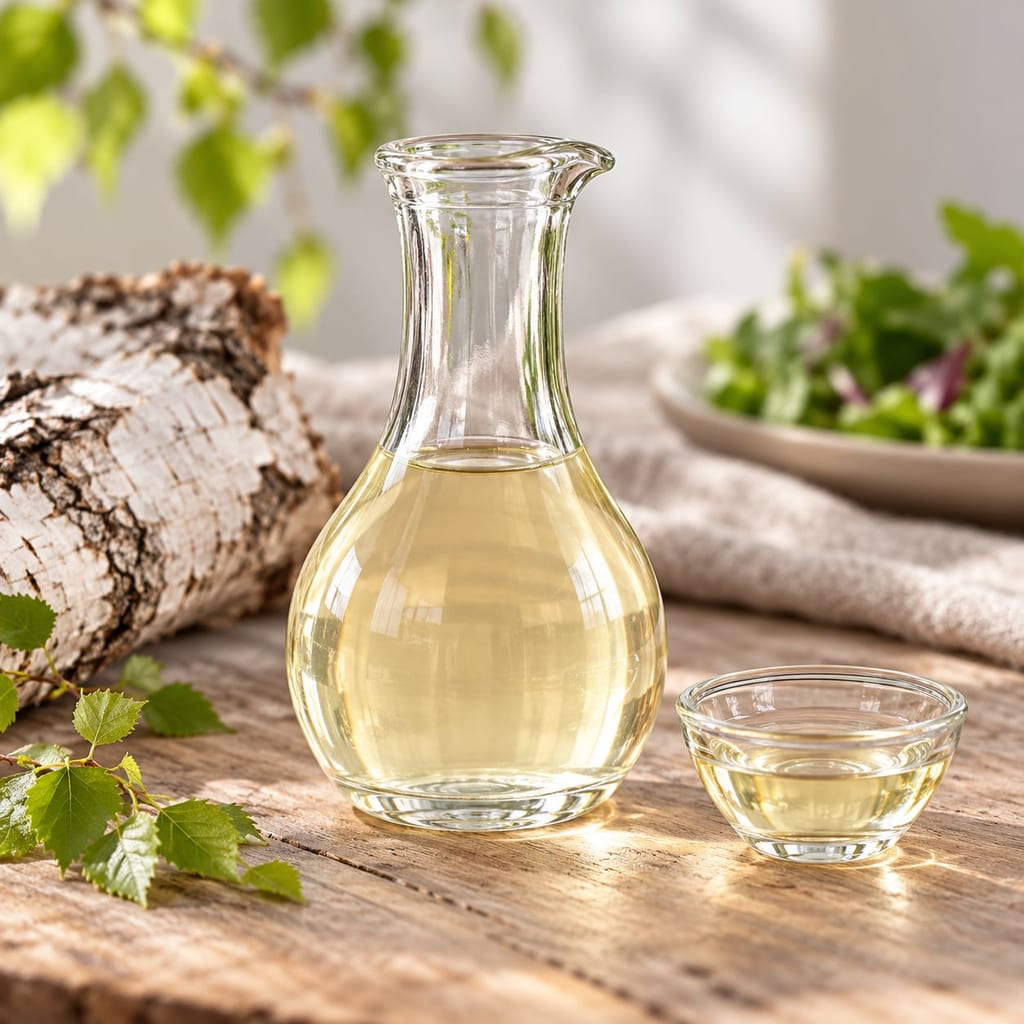
Vinegar from spring birch sap fermented to alcohol and then acetic acid, usually with added sugar or honey because the sap is so dilute; made in Sweden and described in older eastern European accounts.

Protected Italian vinegar made only from cooked grape must, fermented and aged in a battery of wooden barrels for at least 12 years: sweet, sharp and syrupy.

A Dominican table and seasoning condiment of sour orange juice, mixed with lime and salt and bottled raw; garlic, oregano or a hot pepper may be added for meat or a spicier bottle.

Japanese reddish-brown vinegar from sake lees matured about three years, turned to vinegar by acetic bacteria; the vinegar of Handa and Edomae sushi rice.
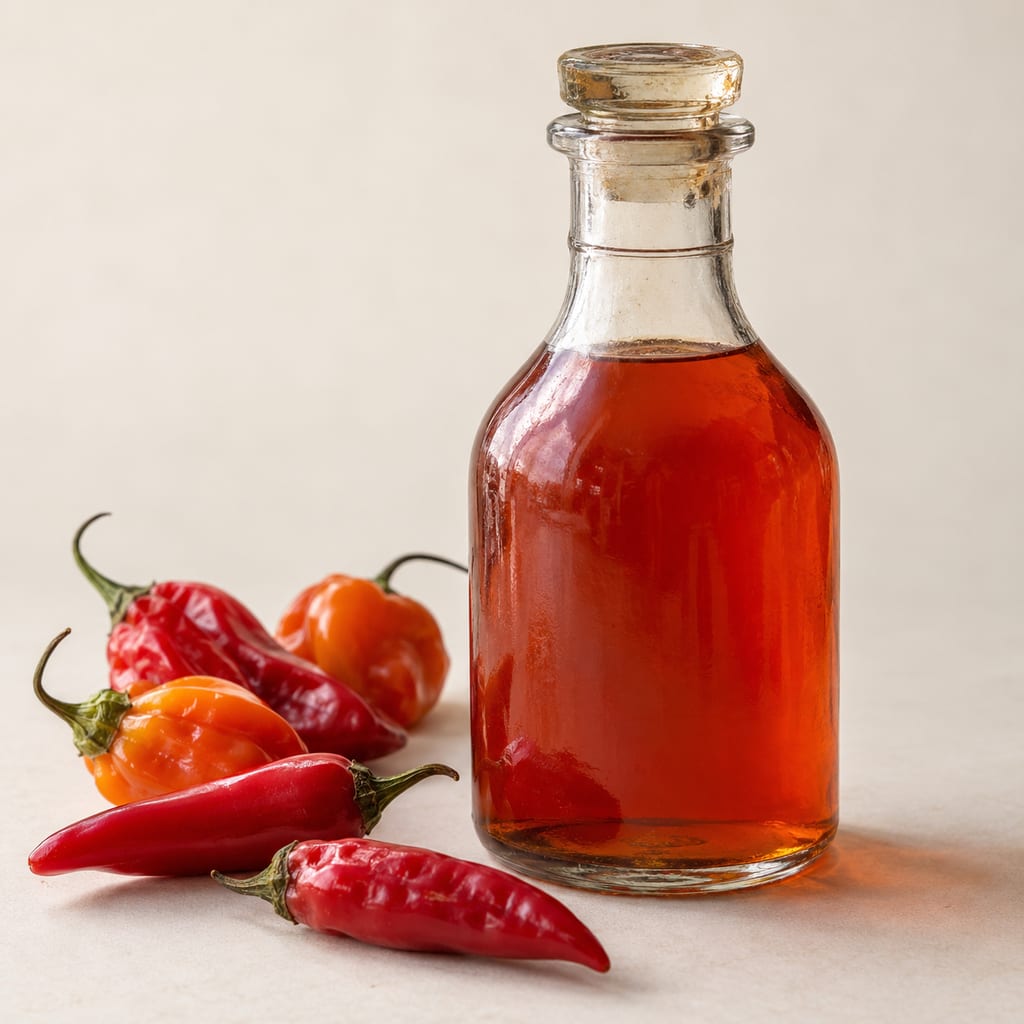
Mary Randolph's pepper vinegar: ripe pepper pods simmered in vinegar until the liquid is reduced to one quart, then strained for use in gravies and catsups. From The Virginia Housewife.
A Japanese mixed seasoning of vinegar, sugar and salt for sushi rice. Ratios vary with the rice batch and style; this version follows Marukan Vinegar's formula for two go of rice.
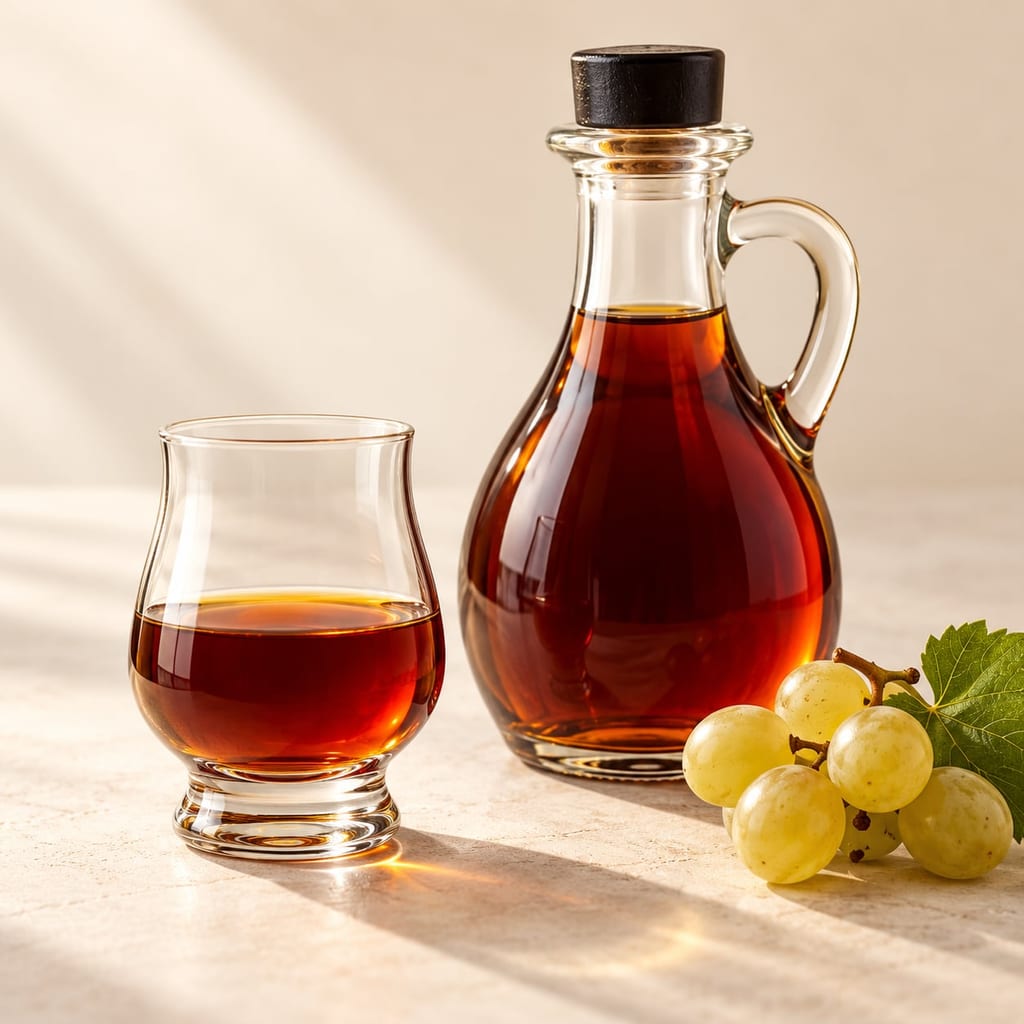
Vinagre de Jerez is made by acetifying eligible Jerez wines and ageing the vinegar in wood. Its protected name belongs to a defined Andalusian zone and a cellar tradition joining wine, oxygen, acetic bacteria and long ageing.
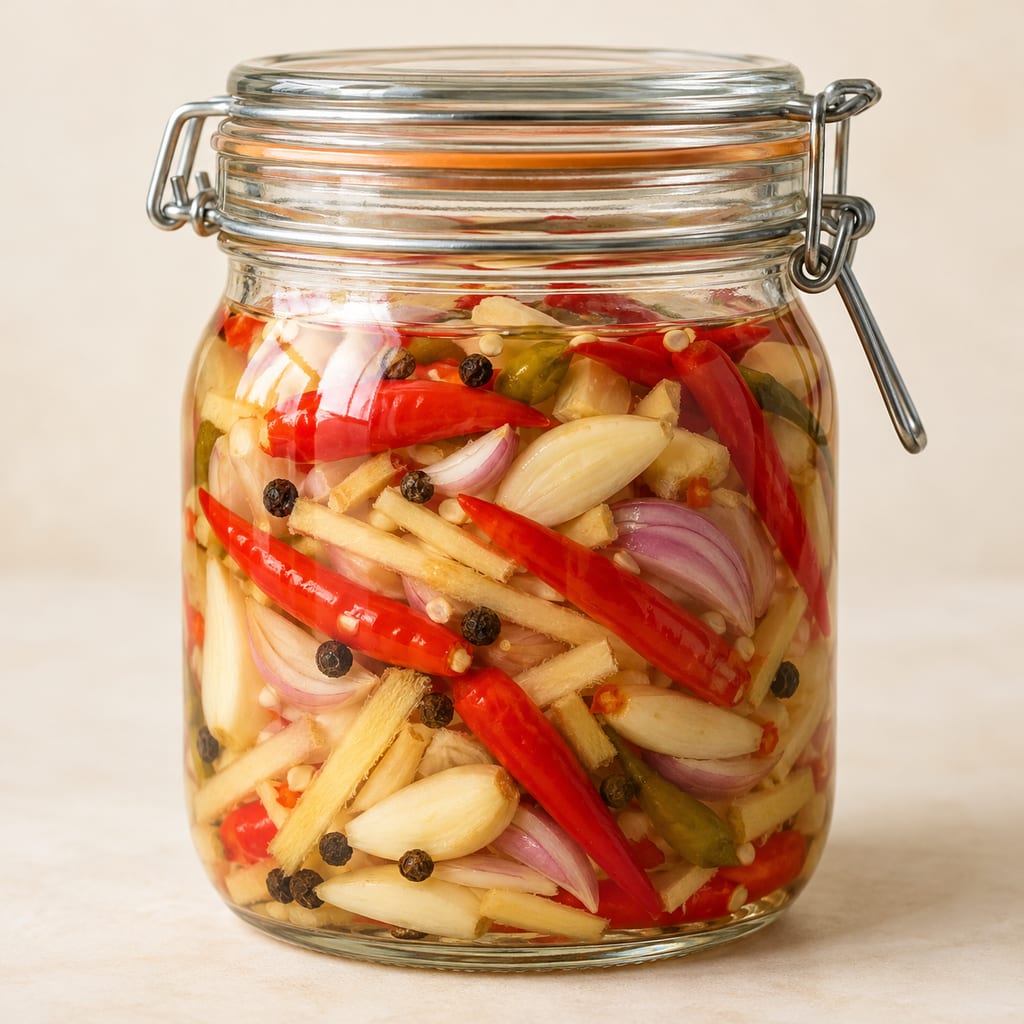
Sinamak is a Philippine spiced vinegar: white, cane or coconut vinegar steeped with chilies, ginger, garlic, onion and peppercorns for days or weeks until it is ready to use as a condiment.
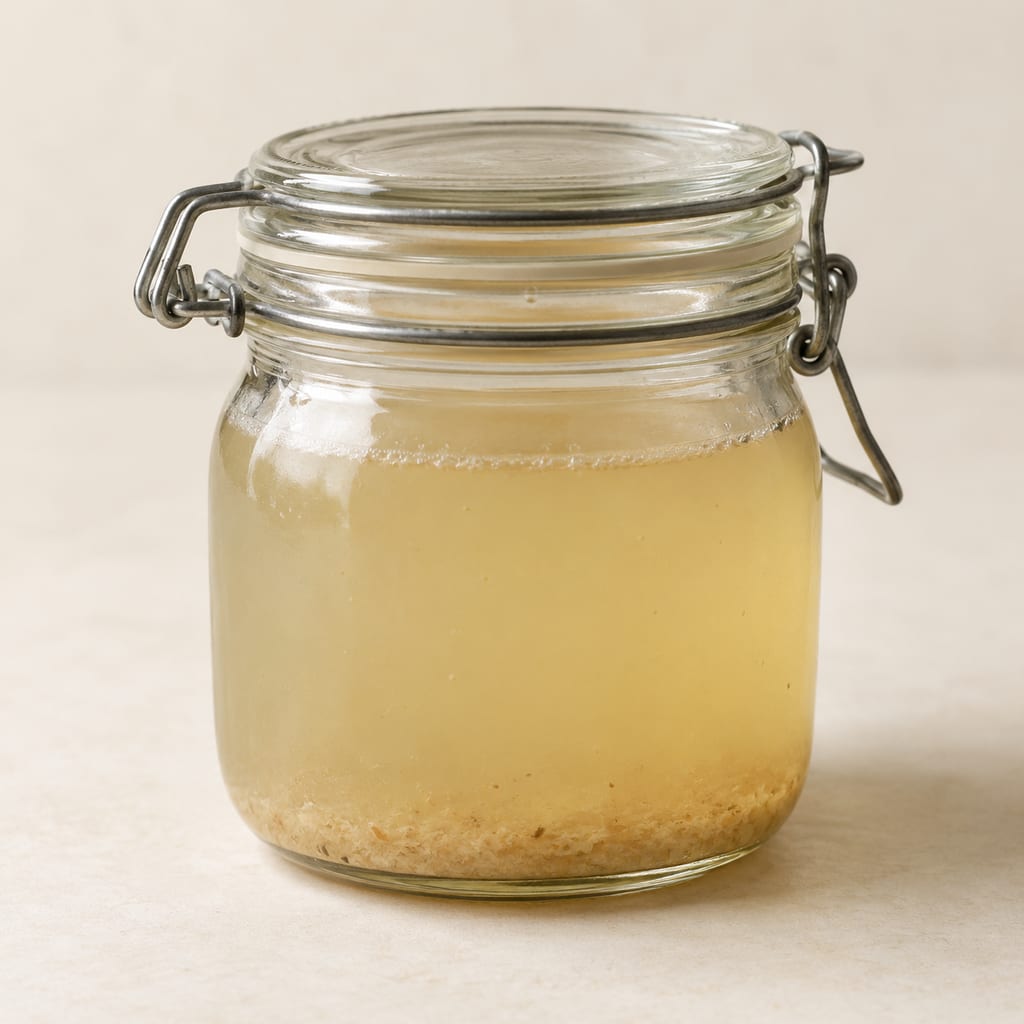
The sour liquid that forms during Manipuri Soidon fermentation, kept to start the next batch and used to sour curries.

A gelling polysaccharide extracted from red seaweeds, sold as kanten strips or powder; it sets firm at a low concentration and stays solid until about 85 °C.

Cicerbita alpina is an alpine perennial whose tender shoots and leaves have been eaten raw or cooked. Sámi milk preparations and modern Carnian dishes are distinct uses, with serious identification and preservation limits.

Japanese skipjack tuna cooked, then repeatedly smoked and dried over a wood fire by the hand-fired tebiyama method into a hard block for shaving into dashi: the first stage of katsuobushi.

A yeast-raised wheat ring shaped from a firm dough, briefly boiled and baked. This source-batch formula gives a gently malted crust and a chewy crumb.

A warm dip of garlic, anchovy and olive oil, often enriched with butter, that Piedmont serves over a flame with raw and cooked vegetables and bread.

Bechamel is a white sauce of milk thickened with a butter and flour roux, one of the French mother sauces, and the base from which Mornay and other cheese and cream sauces are made.
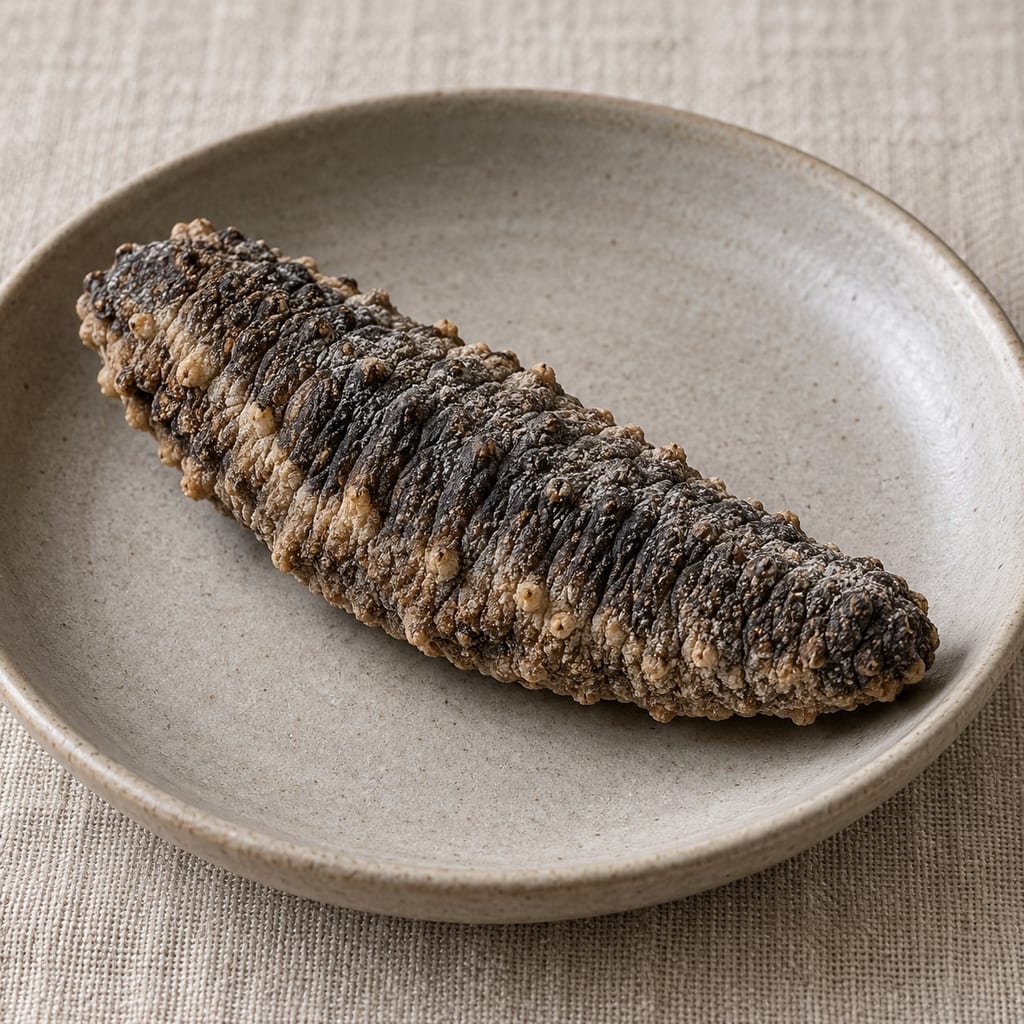
Sea cucumber cleaned, boiled and dried, sometimes with smoke, into a long-keeping trade product; Makassan processing in Arnhem Land is documented from at least the eighteenth century.
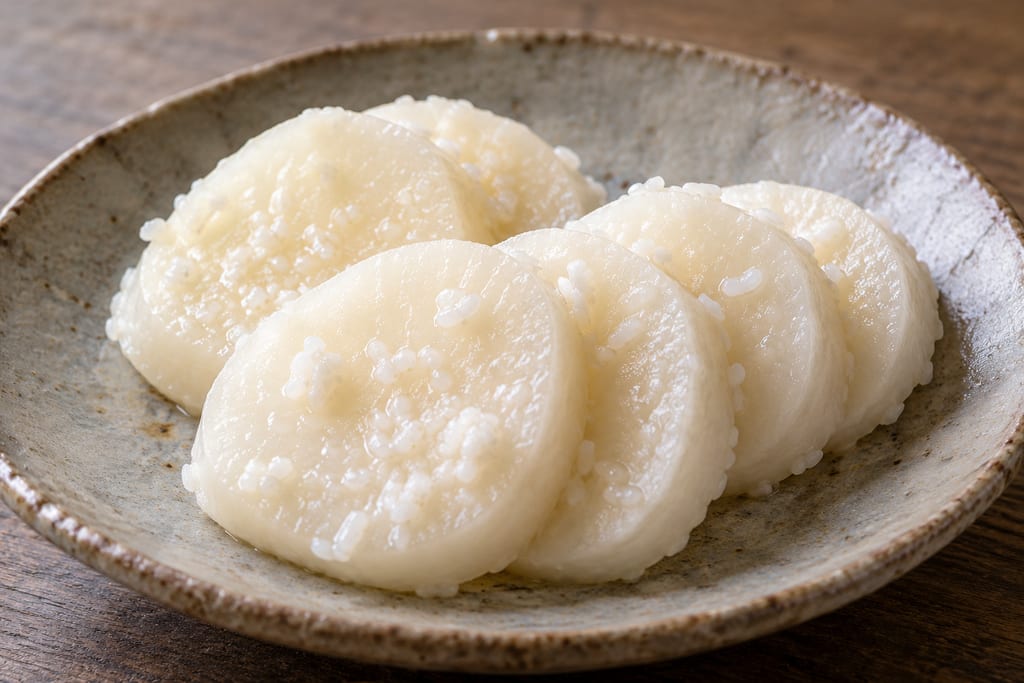
A sweet, crisp Japanese daikon pickle from Tokyo's Nihonbashi district, made by salting fresh radish and dressing it in rice koji, sugar or koji amazake without the heavy drying used for takuan.
No community contributions have been published for this entry yet.
Sign in to contribute. Published comments and photos are free to read.
Svenska Akademiens Ordbok, Svenska AkademienHistory
ÄttikaSixteenth-century forms and the 1526 New Testament
Seventeenth and eighteenth century vinegar vessels and brewers
Cited in: What it is; History; Regional and historical variations
O. Kavli ABMethod · Safety
Perstorp Ättika 24%Dilution ratios for 12, 6 and 3 percent
Cited in: What it is; Regional and historical variations; Commercial strengths and troubleshooting
DabasMethod
Perstorp Ättika 24%, product specification24 percent acetic acid and 76 percent water
Storage temperature of the unopened product
Cited in: What it is; How it works: acetic acid and bacteria
DabasMethod
Ättiksprit 12%, Druvan, product specificationBiological production from agricultural alcohol
Cited in: What it is; History; How it works: acetic acid and bacteria; How it is eaten and used
DabasMethod
Ekologisk ättiksprit 12%, Kavli, product specificationBiological production from agricultural alcohol
Cited in: What it is
Project RunebergHistory
Sveriges industri, part 2: Th. Winborg & Co.1861 permission, generators, 10 to 12 percent spirit vinegar, 1889 certificate
Cited in: History; Regional and historical variations
Nationalmuseum, SwedenHistory
Skånska ÄttiksfabrikenWendt, Perstorp 1881 and the 1886 renaming
Cited in: History; Regional and historical variations
Länsstyrelsen SkåneHistory
Kemisk-teknisk industriWood distillation at Perstorp
Cited in: History; Regional and historical variations
Länsstyrelsen SkåneHistory
Den skånska livsmedelsindustrinFourteen vinegar factories and the 1879 Helsingborg brewery
Cited in: History; Regional and historical variations
ICAUse · Method
Picklade rädisorPickled radishes with a 1-2-3 brine
Cited in: How it is eaten and used
GiftinformationscentralenSafety
Ättika24 percent classed as corrosive
Cited in: Commercial strengths and troubleshooting
LivsmedelsverketSafety
Heminläggning av grönsaker: en riskvärdering, L 2021 nr 16Barriers against C. botulinum and the pH 4.6 point
Cited in: How it works: acetic acid and bacteria
LivsmedelsverketSafety
Heminläggning och hemkonservering av grönsaker, L 2023 nr 16Following reliable preserving methods
LivsmedelsverketSafety
Inläggning, gravning, syrning och konservering: riskvärdering, rapport 8/2017 del 2Pickled fish safety depends on treatment and storage
University of Minnesota ExtensionSafety
Preserving Food at Home: Pickling ProduceAvoid reactive metals for acidic liquids
ATSDR, CDCSafety
Chlorine: public health statementChlorine gas from mixing cleaners
Cited in: Commercial strengths and troubleshooting
PMCMicrobiology
Acetic acid bacteria and vinegar fermentationAcetic acid bacteria and oxidation of ethanol
Cited in: Making fermented spirit vinegar; How it works: acetic acid and bacteria
Kavli consumer contactMethod
ÄttikaChemical synthesis and purification of Perstorp acetic acid
Cited in: What it is
Penn State ExtensionMethod
Making Cider Vinegar at HomeOxygen and temperature for vinegar fermentation
Cited in: Making fermented spirit vinegar
Penn State ExtensionSafety
Ingredients Used in Home Food PreservationUse labelled vinegar rather than homemade vinegar for pickling
Cited in: Making fermented spirit vinegar; Commercial strengths and troubleshooting
National Center for Home Food PreservationSafety
General Information on PicklingTested recipes and known acidity
Cited in: Commercial strengths and troubleshooting