
Ättika
A Swedish-style spirit vinegar made by fermenting neutral alcohol with live vinegar bacteria, with a separate guide to commercial ättika strengths.
 FermenteaWhere food goes to change
Modern adaptation
Björksavsvinäger · Birch vinegar · Björksavsvinäger · Берёзовый уксус · Уксус из берёзового сока · Betula sap vinegar
Vinegar from spring birch sap fermented to alcohol and then acetic acid, usually with added sugar or honey because the sap is so dilute; made in Sweden and described in older eastern European accounts.
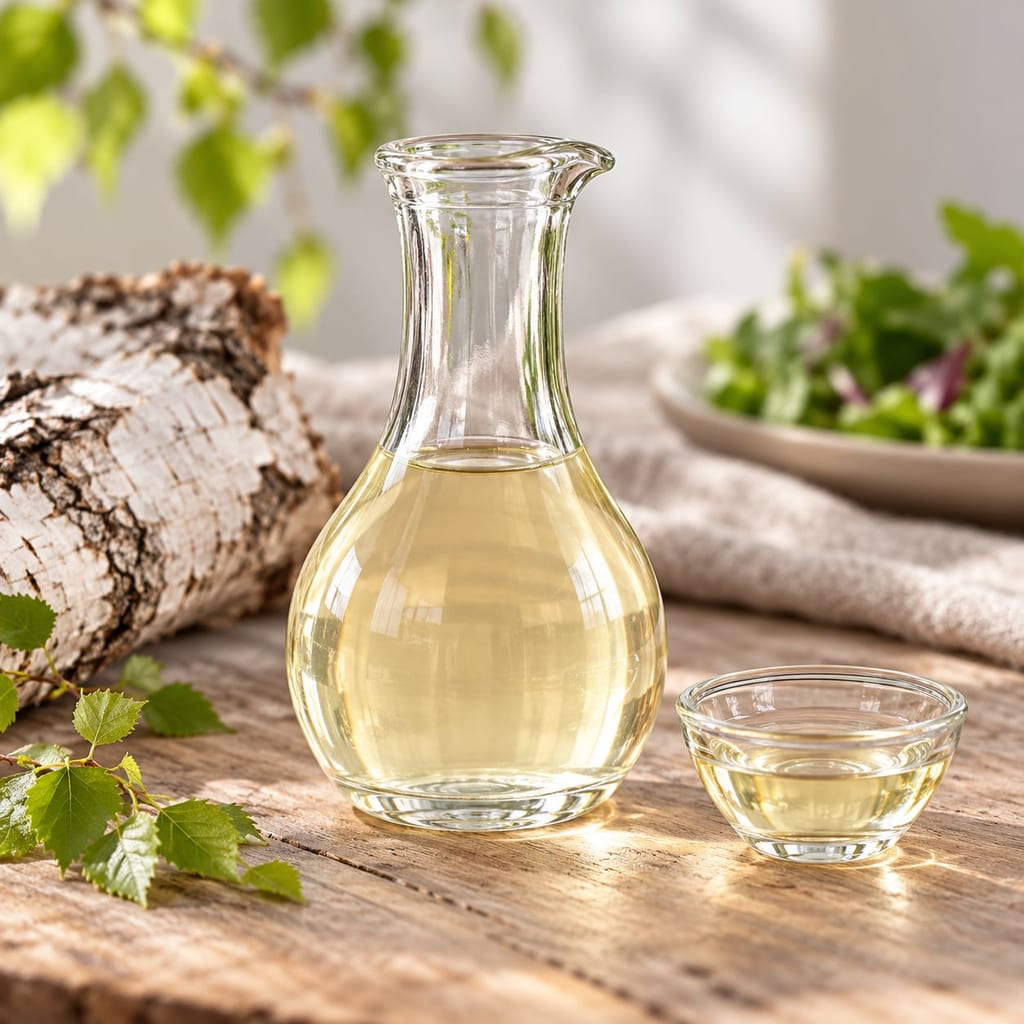
Birch sap vinegar is a vinegar made from the watery sap that runs from birch trees in early spring. In the ordinary two-stage process, yeast turns the sugars into alcohol and acetic acid bacteria then oxidise the alcohol to acetic acid. It is known from northern and eastern European food traditions and is made today by a few specialist vinegar makers. It is not the same as fresh birch sap, spontaneously soured sap or birch wine, although all of them can start from the same liquid.
The birches most often described are silver birch, Betula pendula, and downy birch, Betula pubescens, both of which yield sap before the leaves open. Swedish has björksav for the sap and björksavsvinäger for the vinegar. Russian recipes say берёзовый уксус or уксус из берёзового сока. The Hungarian names nyírvíz and virics and the Estonian kasemahl mean the sap itself and are not names for the finished vinegar.
The raw material is very dilute. Birch sap is mostly water with small amounts of glucose and fructose and much less sucrose, and the concentration varies with the species, the tree, the weather and the tapping date. A scientific review gives sugar concentrations of 0.25 to 2.25 percent in silver birch sap, and a Swedish heritage description gives about 1.5 percent as typical. That is far too little to make a strong vinegar unless the sap is concentrated or sugar is added.
Malmö Vinägerfabrik in Sweden makes an organic birch sap vinegar from birch sap, sugar, honey, yeast and vinegar culture. The maker describes an alcoholic fermentation followed by vinegar making, and labels the vinegar 5 percent acidity. It is unfiltered, unpasteurised and not aged in barrels, with honey and almond notes, and is recommended for pickling vegetables, salads and dressings. How much of its acid comes from the sap and how much from the added honey and sugar cannot be told apart.
A separate Russian recipe uses birch sap, honey and vodka left loosely covered in a warm place. It adds alcohol directly and does not rely on sap-derived ethanol, and it gives quantities without a final acidity or a culture. The name therefore covers a family of preparations and not one standardised formula, and it carries no geographical protection.
The history of collecting birch sap is far older and better recorded than the history of birch sap vinegar. People across northern and eastern Europe drank the sap fresh, boiled it into concentrates and fermented it into mildly alcoholic or sour drinks. None of that proves vinegar, because a sour birch sap may owe its taste to lactic acid with too little ethanol or acetic acid to count as vinegar.
Swedish records of the sap run into the early modern period. The national inventory of intangible heritage records the word björklag from 1578 and describes fermented birch-sap preparations in eighteenth-century households, a tapping record from Svinhult dated 17 April 1926, and a 1950 account from Knivsta of sap left to ferment into a drink. They date the sap tradition and not any Swedish vinegar recipe.
Hungarian research gives more specific evidence. A 2013 review by Andrea Dénes and colleagues of wild food plants of the Carpathian Basin says birch sap was used to make vinegar and beer as well as wine, citing Ecsedi's research of 1934. The practice was mainly in forested areas, where shepherds, forestry workers and later children drank the sap.
A 2014 study by Nóra Papp and colleagues interviewed 123 Hungarian-speaking Csángó and Székely people in six Transylvanian villages between 2007 and 2012. They recorded sap collection and compared it with older accounts that mention vinegar, wine, beer and syrup, and they found no current birch sap vinegar making. The vinegar evidence there comes from older literature. The same study cites vinegar use in Sweden, Estonia, Poland, Slovakia, Ukraine, Russia, Britain and Ireland, without a continuous dated record or a shared recipe.
In Estonia a heritage record compiled in 2012 documents sour birch-sap drinks in Vana-Võromaa, and in Russia accounts describe sap fermented with malt, rye bread and other additions. They show fermentation and not necessarily acetification.
A measured Russian formula appeared in a culinary magazine in April 2009: two litres of sap, forty grams of honey and one hundred grams of vodka, in a warm loosely covered vessel for about two months. Later books and websites repeat it, which does not make it medieval or show that it reaches a particular acidity. Contemporary Swedish manufacture is better documented, with yeast, honey, sugar and vinegar culture and a product labelled 5 percent acidity. A Chinese patent of 2018 (CN109055170A) also describes a staged industrial process for white birch sap vinegar.
Birch sap vinegar needs enough fermentable carbohydrate, an alcoholic stage and an oxygen-dependent acetic stage. Fresh sap contains glucose and fructose with a little sucrose, so no starch has to be saccharified first, as in a grain vinegar. Yeast ferments glucose and fructose directly, and invertase splits sucrose into those two. The difficulty is the small amount of sugar in the sap.
Yeast takes the sugars through glycolysis to pyruvate, pyruvate decarboxylase releases carbon dioxide and forms acetaldehyde, and alcohol dehydrogenase reduces the acetaldehyde to ethanol while regenerating NAD+. In outline one glucose gives two ethanol and two carbon dioxide. Saccharomyces cerevisiae is the established wine yeast, though Malmö lists only yeast with no species and the patent calls for dry wine yeast.
The second stage uses acetic acid bacteria, genera such as Acetobacter and Komagataeibacter. Membrane alcohol dehydrogenase oxidises ethanol to acetaldehyde, aldehyde dehydrogenase takes it to acetic acid, and oxygen is the final electron acceptor: C2H5OH + O2 giving CH3COOH + H2O. Oxygen transfer is needed, and the work gets harder as acidity rises.
The sap's own chemistry sets limits. In a Finnish study of Betula pendula and B. pubescens the sap held glucose, fructose, a little sucrose and several organic acids, above all malic acid, with succinic, citric and phosphoric acids, and sap pH and acid levels changed markedly over the tapping season. These natural fruit acids can make sap taste slightly sour before any fermentation, and they do not show that ethanol has been oxidised.
Added sugar and honey change the potential. Malmö adds both because sap alone does not supply enough fermentable carbohydrate. Sugar raises the ethanol that yeast can make, honey adds fermentable sugar and aroma, and with enough ethanol the acetic culture can reach vinegar-strength acid. Honey does not make acetic acid by itself, and yeast does not replace the separate aerobic stage.
Uncontrolled sap fermentation can take another route. Work on stored sap finds diverse bacteria and yeasts, including Pseudomonas, with rapid changes in pH and counts. Lactic acid bacteria may make lactic acid and other organisms spoil the sap. A falling pH or a sour smell does not identify acetic vinegar, so ethanol formation and then acetic acid formation have to be measured separately.
Production starts with sap collected during the spring flow, before the leaves are fully open, through clean food-safe equipment into covered containers. Composition shifts through the season, so the sugar of one collection differs from another. The Swedish heritage inventory describes traditional tapping and notes that the landowner's permission is needed, and the University of Alaska Fairbanks advises processing sap promptly because it spoils quickly.
Next the sugar is judged. Birch sap carries far less fermentable sugar than grape or apple juice, which Malmö addresses with sugar and honey. The limit is not starch, which sap does not contain, but the low concentration of fermentable sugar. Added sugar and honey give the yeast enough to make the alcohol the acetic stage needs.
The prepared liquid is fermented with yeast to ethanol, carbon dioxide and a little of other metabolites. Malmö's stated aim is an alcoholic strength of 6 percent, without published sugar, yeast, dose or temperature. After that a vinegar culture supplies the acetic acid bacteria, and air must reach it without letting contaminants in. A Business Sweden profile describes a double fermentation of at least eight weeks with birch shoots and honey added near the end, whereas the maker's own page lists honey and sugar as fermentation ingredients and gives no such timing. They are two descriptions and not one recipe.
The finished vinegar is labelled 5 percent acidity and sold unfiltered and unpasteurised, not barrel aged. Unfiltered vinegar can hold suspended matter or living cells, and that does not show a particular culture in each bottle.
The Chinese patent CN109055170A, published 21 December 2018, gives the one staged quantitative example. Sap is filtered and the medium brought to 170 g/L total sugar. Dry wine yeast is activated at 37 degrees C in a 4 percent sugar solution and added at 0.8 g per litre. Alcoholic fermentation runs at 20 to 30 degrees C until residual sugar is below 4 g/L, at about 10 percent alcohol by volume. The acetic starter, culture Zhongke 1.41, is propagated in two laboratory seed stages at 30 to 32 degrees C, two days and then three days. The alcoholic liquid is diluted with more sap to 5 percent alcohol by volume, inoculated with 8 percent starter and acetified at 30 degrees C until the acetic acid stops rising. It is then sterilised and filtered, salted at 2 percent, sealed and matured for two months, and blended to 5 percent total acidity, giving a clear, pale-yellow, mildly sour vinegar. Details of the final sterilisation are not given.
The Russian magazine recipe of 2009 is a different method: two litres of sap, forty grams of honey and one hundred grams of vodka in a small barrel or large vessel, loosely covered in warmth for about two months. The vodka supplies alcohol directly and the honey fermentable sugar. It names no yeast or acetic starter, oxygen management, temperature or final acidity, and it is a cooking practice and not a preservation method.
Birch sap vinegar is a family of related preparations and not a single standard recipe. Older accounts mention vinegar from birch sap, while modern makers may add sugar, honey, alcohol or chosen cultures, so acidity, flavour and the route of fermentation differ. The name alone does not say whether all the acetic acid came from the sap's own sugar.
In Sweden birch sap is a long-recorded seasonal drink and an ingredient in fermented drinks. The heritage inventory lists regional names including björklag, björklake and björkdricka and preparations with yeast, malt, spices or wine. Malmö Vinägerfabrik makes a commercial vinegar with honey and sugar at 5 percent. Its own page describes sap from selected local organic suppliers, while a Business Sweden profile mentions sap from Jutland in Denmark, which may reflect different sourcing or different periods.
Estonia has a well-recorded tradition of collecting and fermenting sap. In Vana-Võromaa the sap was gathered in spring and often left to sour slowly in cool storage, sometimes with raisins, bread, orange peel or blackcurrant stems, and drunk in summer. Older literature mentions Estonian vinegar from birch sap, but the household method and its link to the surviving sour-sap tradition are unclear, and spontaneously soured kasemahl is not kasemahlaäädikas.
Russian traditions include fresh sap, birch kvass and alcoholic birch preparations. Zelenin's 1927 ethnographic account records sap fermented with malt, wax, beans or rye bread, which belongs to drink making and does not necessarily give vinegar. More recent Russian publications give the sap, honey and vodka formula, whose added spirit sets it apart from a process that makes its own alcohol.
In Hungary and Transylvania birch sap goes by nyírvíz and virics, and older accounts mention vinegar, beer and wine from it. The 2014 field study found no current vinegar making, and sap tapping itself was declining. Poland, Slovakia, Ukraine, Britain and Ireland appear in comparative studies without equally detailed preparation records. Birch wine and beer are documented in some of these countries and are separate preparations unless a source describes converting them into vinegar.
Birch sap vinegar is a condiment. Its documented modern uses are salad dressings, vegetable pickling, marinades, soups and sauces. Malmö describes its vinegar as fairly mild with honey and almond notes, giving acidity without the strong fruit character of cider vinegar or the wine aroma of grape vinegar. The flavour depends on how much of the fermentable material came from sap, sugar, honey or other ingredients.
Malmö recommends it for pickling vegetables and for salads and dressings, at a labelled 5 percent acidity. The product page gives no tested pickling formula or canning procedure, and a vinegar's acidity has to be weighed with the amounts of vegetable, water and other ingredients in the finished preparation.
Business Sweden's profile adds acidifying soups, sauces and marinades, dressings, and a small amount in sparkling water or a cocktail. These are contemporary uses and not traditions. In cooked dishes the vinegar goes in towards the end if its aroma should stay noticeable, since heat alters volatile compounds.
Older use is thinly documented. Russian recipes describe making the vinegar and say little of its acidity or dishes, and some later books suggest it as a diluted drink or an external remedy. Those are popular uses and not evidence of benefit or a safe dose, and concentrated vinegar can irritate the mouth and throat.
Estonian and neighbouring fermented birch sap is a summer drink, with sourness that may come mainly from lactic acid and alcohol and acetic acid that may be low or unknown. A genuine vinegar is used in small amounts as a seasoning. Birch sap vinegar is also distinct from birch syrup, which is sap boiled down and used for sweetness and needs no alcoholic or acetic fermentation.
The first difficulty is the sugar. A sweet taste does not mean there is enough fermentable sugar for vinegar-strength acid, and sap composition varies between trees, places and dates in the spring flow. Soluble solids and, where possible, the individual sugars should be measured before alcoholic fermentation, and the amount of honey or sugar to add cannot be standardised without knowing the starting composition and the intended alcohol.
The second is contamination. Sap comes straight from a living tree and spoils fast. A 2022 Danish study found microbial populations rising through the tapping season, with Pseudomonas the commonest genus, and freezing for two weeks lowered counts without improving shelf life as assessed. A Latvian storage study found strong microbial growth and a fall in pH in stored sap. Spontaneous souring is therefore not controlled fermentation.
The University of Alaska Fairbanks advises using fresh sap at once or refrigerating it below 41 degrees F (about 5 degrees C) for no more than a few days. That is handling advice for sap and not a fermentation temperature. Clean equipment and quick processing reduce contamination, and the Swedish heritage authority asks that tapping be done responsibly so the trees are not damaged.
Alcoholic fermentation has to be judged separately from souring. With poor yeast activity too little ethanol forms for acetification, and if lactic acid bacteria dominate the sap becomes sour with much of its sugar left. A low pH alone cannot show acetic acid. Ethanol, residual sugar and organic acids are the stronger evidence.
In acetification the bacteria need oxygen and ethanol. A surface film fits acetic bacteria at work, but does not identify the organisms. Visible mould or odd spoilage is not a normal stage. The final acidity has to be measured: titratable acidity and pH are different, and neither colour nor smell shows vinegar strength.
The Russian sap, honey and vodka formula has important gaps: no vodka strength, sap sugar concentration, inoculum, temperature or final acidity. Its two months do not guarantee acetification, and even an exact historical recipe may be unsuitable as a validated modern preserving method.
Malmö's 5 percent label is a useful reference, but it is not what copying the ingredient list produces. Penn State Extension advises against homemade vinegar or vinegar of unknown acidity in tested pickling recipes and recommends commercial vinegar labelled 5 percent, with the whole recipe followed. A birch sap vinegar cannot be assumed shelf-stable or fit for canning because it smells sour.
For an experiment, record the tree species and place, collection date, starting sugar, additions, yeast and bacterial cultures, fermentation conditions, ethanol, titratable acidity, pH and finishing. Distinguish residual sweetness, lactic sourness, real acetic acid and spoilage.
Swedish records show birch sap used for fermented drinks from the early modern period, including the word björklag from 1578. A 2013 review cites Ecsedi's 1934 research as evidence that Hungarians made vinegar, beer and wine from birch sap, and a 2014 study reports older mentions of birch sap vinegar in Sweden, Estonia, Poland, Slovakia, Ukraine, Russia, Britain and Ireland.
A Russian magazine printed a measured sap, honey and vodka formula in April 2009. Malmö Vinägerfabrik sells a birch sap vinegar at 5 percent acidity.
Sap comes from a living tree and spoils fast; microbial counts rise through the tapping season and Pseudomonas is the commonest genus.
Hazard sourceLactic bacteria can sour sap with little alcohol or acetic acid, so a falling pH or sour smell does not show acetic vinegar.
Hazard sourceSap sugar ranges from 0.25 to 2.25 percent, too low for a strong vinegar without additions.
Hazard sourceHomemade vinegar of unknown strength can leave pickles under-acidified.
Hazard sourceKeep sap cold before processing.
Control sourceSet the starting sugar of the medium (patent example).
Control sourceDose the wine yeast (patent example).
Control sourceFerment alcoholically (patent example).
Control sourceAdjust the alcoholic liquid before acetification (patent example).
Control sourceInoculate and acetify (patent example).
Control sourceMeasure the acidity of the finished vinegar.
Control sourceFor canning or pickling use commercial vinegar of the stated acidity.
Control sourceSour sap is not vinegar. A falling pH or sour smell can come from lactic bacteria or spoilage; measure ethanol, then titratable acidity.
Do not use homemade birch vinegar of unknown acidity in canning or pickling; use commercial vinegar labelled 5% acidity as the tested recipe specifies.
Use sap quickly or keep it below 41 degrees F (about 5 degrees C) for no more than a few days.
The sap, honey and vodka recipe has no stated alcohol strength, starter or final acidity; its two months do not guarantee vinegar.
A country-level association.
Home of Malmö Vinägerfabrik.
Sour birch sap drinks are documented; vinegar is not.
Reported use of birch sap for vinegar.
No current vinegar making was found in the 2007 to 2012 fieldwork.
A Swedish-style spirit vinegar made by fermenting neutral alcohol with live vinegar bacteria, with a separate guide to commercial ättika strengths.

Protected Italian vinegar made only from cooked grape must, fermented and aged in a battery of wooden barrels for at least 12 years: sweet, sharp and syrupy.

A Dominican table and seasoning condiment of sour orange juice, mixed with lime and salt and bottled raw; garlic, oregano or a hot pepper may be added for meat or a spicier bottle.

Japanese reddish-brown vinegar from sake lees matured about three years, turned to vinegar by acetic bacteria; the vinegar of Handa and Edomae sushi rice.
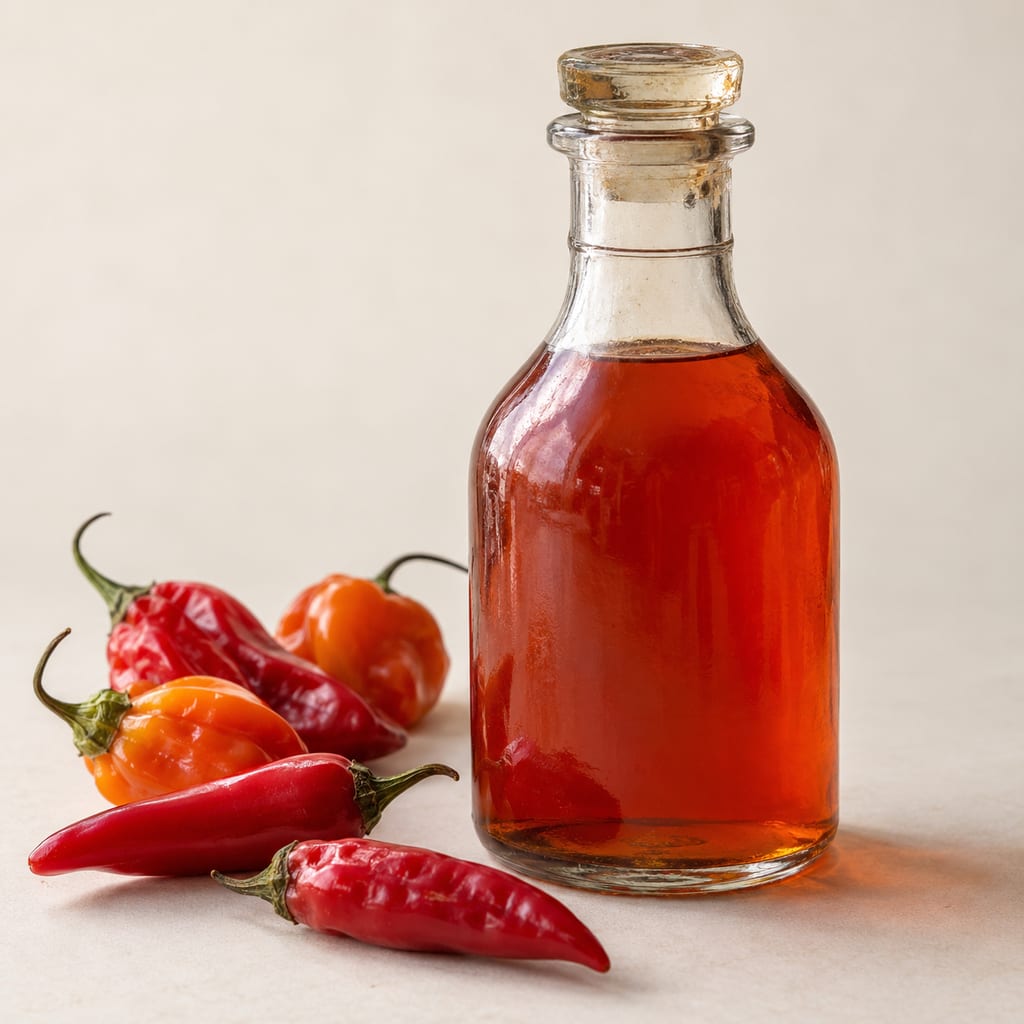
Mary Randolph's pepper vinegar: ripe pepper pods simmered in vinegar until the liquid is reduced to one quart, then strained for use in gravies and catsups. From The Virginia Housewife.
A Japanese mixed seasoning of vinegar, sugar and salt for sushi rice. Ratios vary with the rice batch and style; this version follows Marukan Vinegar's formula for two go of rice.
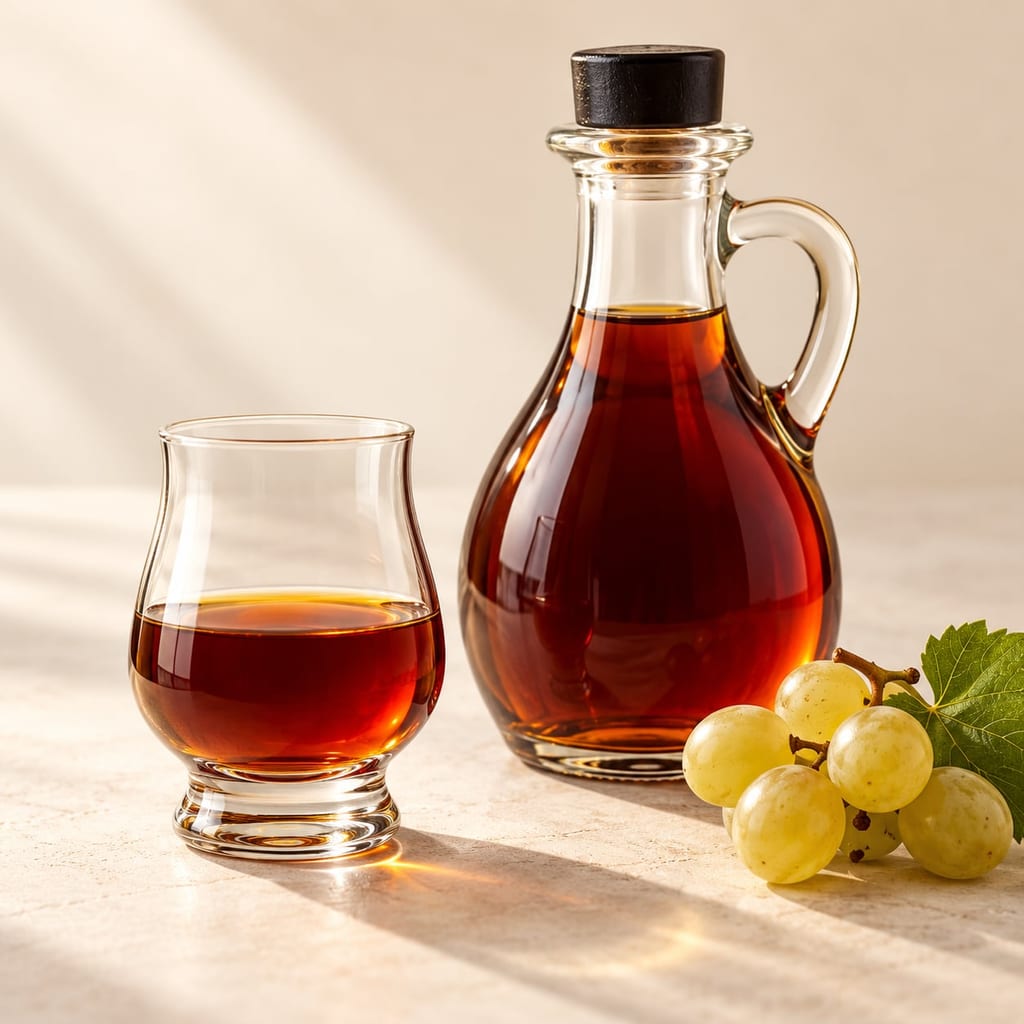
Vinagre de Jerez is made by acetifying eligible Jerez wines and ageing the vinegar in wood. Its protected name belongs to a defined Andalusian zone and a cellar tradition joining wine, oxygen, acetic bacteria and long ageing.
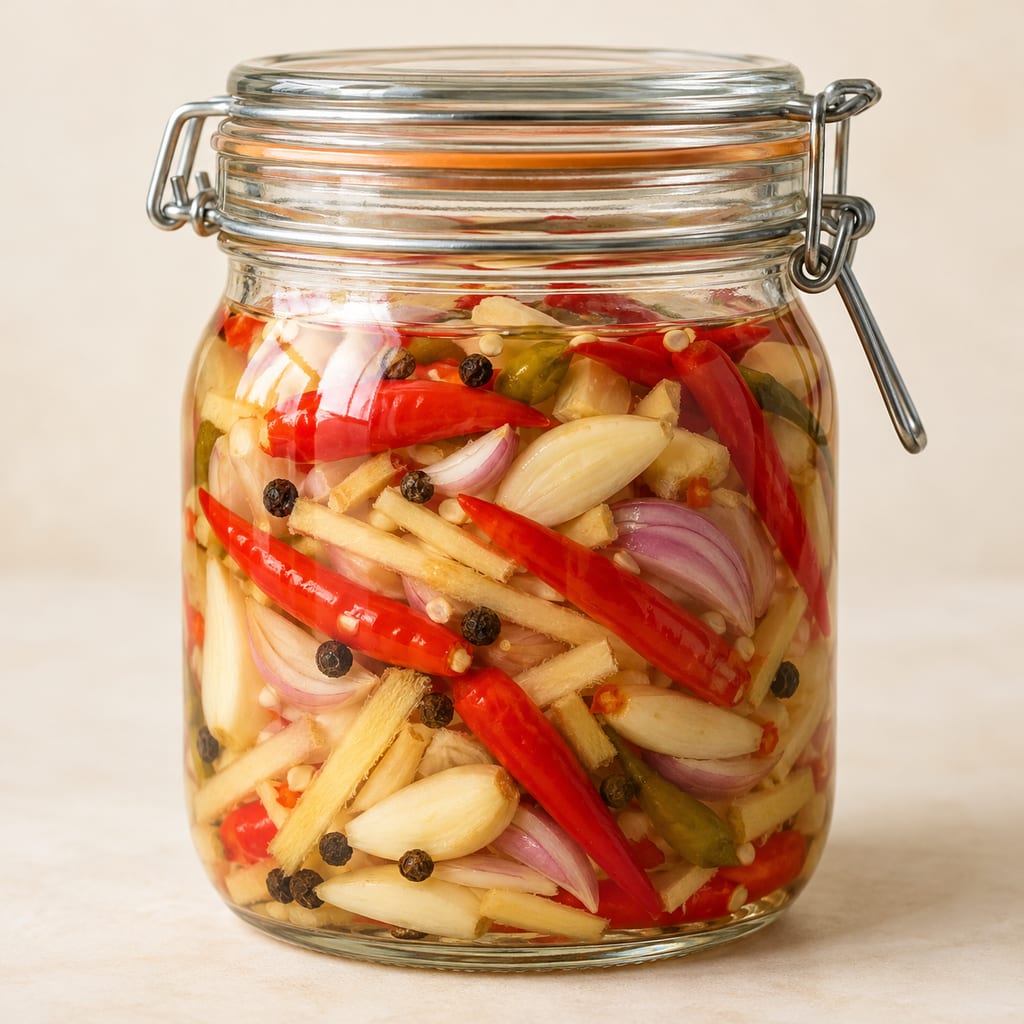
Sinamak is a Philippine spiced vinegar: white, cane or coconut vinegar steeped with chilies, ginger, garlic, onion and peppercorns for days or weeks until it is ready to use as a condiment.
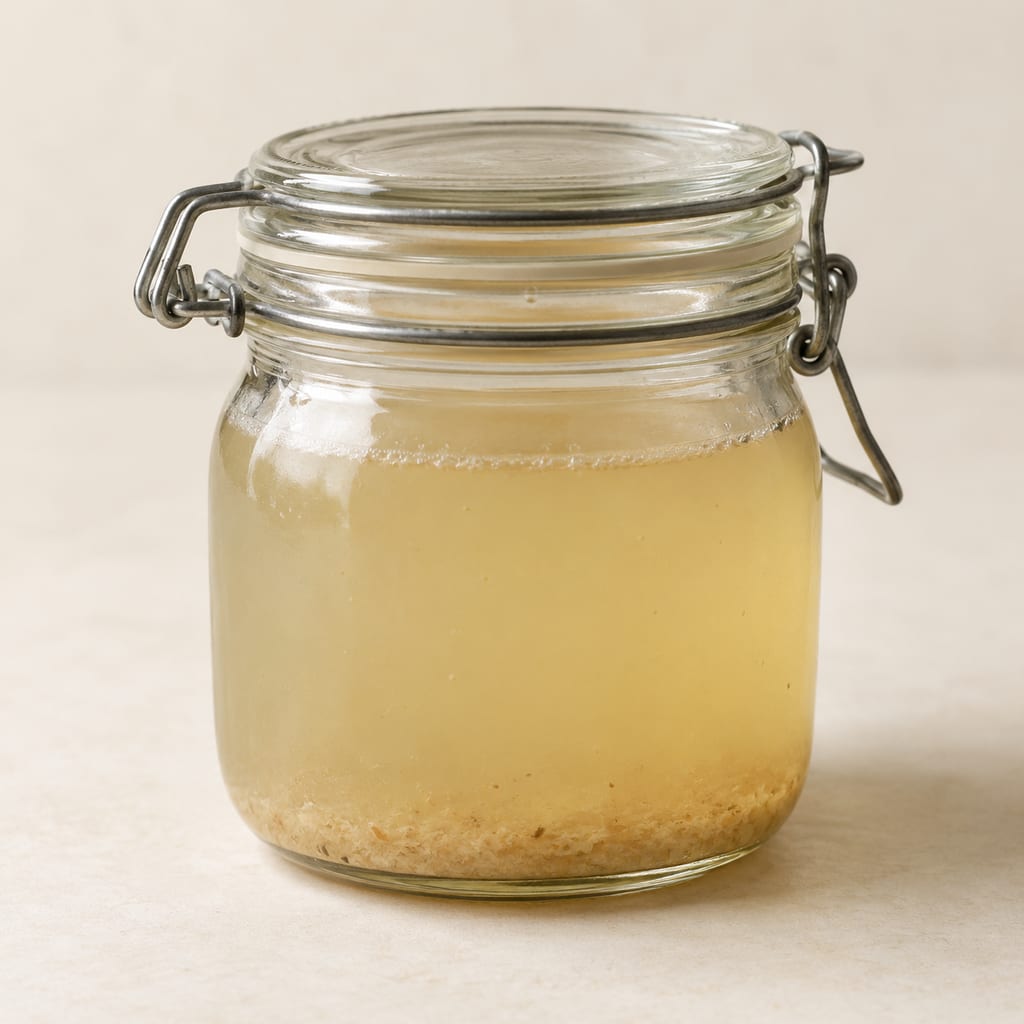
The sour liquid that forms during Manipuri Soidon fermentation, kept to start the next batch and used to sour curries.

Soft, spreadable Calabrian pork sausage made with a great deal of red chilli and fatty pork, stuffed into natural casings, sometimes smoked and matured while staying soft.

A way to add independent temperature logging to an existing food dehydrator without changing its built-in controls or protections. It is a monitoring method, not a rewiring plan.

Pleurotus cystidiosus is the abalone mushroom, a cultivated oyster-type fungus with dark brown caps that grows more slowly and is more demanding than other Pleurotus species.

A dark, balanced vinegar from Emilia-Romagna made by combining cooked or concentrated grape must with wine vinegar, then acetifying and refining it in wood under a protected specification.

A living dairy inoculum that starts controlled cream fermentation, developing acidity and aroma before sour cream or cultured butter is finished.

A small electric incubator holds jars at a selected temperature for yogurt and other documented warm food preparations. Controls, capacity and vessel arrangement vary by model.

Adygean salt is a seasoned table salt associated with Adygea and the wider North Caucasian culinary tradition. Salt is blended with garlic and a variable selection of herbs and spices; the exact mix depends on the named style and maker.

The African Caesar-group mushroom, Amanita masasiensis, is a wild ectomycorrhizal species of central and southern African woodlands, eaten locally. The genus contains deadly poisonous species, so identification needs care.
No community contributions have been published for this entry yet.
Sign in to contribute. Published comments and photos are free to read.
China National Intellectual Property AdministrationMethod
A birch sap vinegar and its preparation method (CN109055170A)Example 3: 170 g/L sugar, 0.8 g/L yeast, 20 to 30 C, 5% ABV, 8% starter, 30 C, 2% salt, 2 months, 5% acidity
Cited in: History; How it works: sugar, yeast and acetic bacteria; How it is made, and why each step matters
Malmö VinägerfabrikMethod · Use
Ekologisk björksavsvinägerIngredients, 5% acidity, unfiltered and unpasteurised, uses
Cited in: What it is; History; How it works: sugar, yeast and acetic bacteria; How it is made, and why each step matters; Regional and historical variations; How it is eaten and used; Reading results and problems
Business Sweden, Try SwedishMethod · Use
Malmö VinägerfabrikDouble fermentation of at least eight weeks; suggested uses
Cited in: What it is; How it works: sugar, yeast and acetic bacteria; How it is made, and why each step matters; Regional and historical variations; How it is eaten and used
Swedish Institute for Language and Folklore, Living HeritageHistory · Method
Birch sap: tapping and preparationTapping, permission, early records
Cited in: How it is made, and why each step matters; Reading results and problems
Levande kulturarv, SwedenHistory
Björksav: tappning och tillredningBjörklag from 1578; fermented sap preparations
Cited in: What it is; History; Regional and historical variations
University of Alaska Fairbanks Cooperative ExtensionSafety · Method
Backyard birch tapping and syrup basicsProcess sap promptly; refrigerate below 41 F
Cited in: How it is made, and why each step matters; Reading results and problems
Journal of Food Composition and AnalysisSafety · Microbiology
Microbial safety and protein composition of birch sap2022 study: Pseudomonas and microbial counts through the season
Cited in: How it works: sugar, yeast and acetic bacteria; Reading results and problems
International Food Research Journal, 2018Microbiology
Changes of physicochemical properties and predominant microbiota during storage of birch sapMicrobial growth and pH fall in stored sap
Cited in: How it works: sugar, yeast and acetic bacteria; Reading results and problems
Food Chemistry, 1987Chemistry
Seasonal variations of the acids in birch sapMalic, succinic, citric and phosphoric acids; seasonal change
Cited in: How it works: sugar, yeast and acetic bacteria
Food and Agriculture Organization of the United NationsIdentity
Non-wood forest products from temperate broad-leaved trees, chapter 5Birch sap sugar concentrations and uses
Cited in: What it is; How it is eaten and used
Papp and colleagues, 2014History
Birch use among Hungarian-speaking communities in Transylvania123 interviews 2007 to 2012; older vinegar references; no current vinegar making
Cited in: History; Regional and historical variations
Denes and colleagues, 2013History
Wild food plants used by Hungarians in the Carpathian BasinBirch sap used for vinegar, beer and wine, citing Ecsedi 1934
Cited in: History; Regional and historical variations
Estonian Folk Culture CentreHistory · Variation
Kasemahla kogumine ja tarvitamine Vana-VoromaalSoured birch sap drinks in Vana-Voromaa
Cited in: History; Regional and historical variations; How it is eaten and used
Sladkaya zhizn culinary magazineHistory · Method
Sladkaya zhizn no. 4, 2009: Uksus iz berezovogo sokaTwo litres of sap, 40 g honey, 100 g vodka for about two months
Cited in: What it is; History; How it is made, and why each step matters; Regional and historical variations
thelib.ruHistory · Use
Anastasiya, Lesnaya kulinariya: Uksus iz berezovogo sokaThe same birch vinegar formula and uses
Cited in: What it is; How it is made, and why each step matters; How it is eaten and used
Penn State ExtensionSafety
Let's Preserve: Ingredients Used in Home Food PreservationCommercial vinegar of 5% acidity for tested recipes
Cited in: Reading results and problems
Penn State ExtensionSafety
Acidifying canned products for safetyAcidity in canned products
Cited in: Reading results and problems
National Center for Home Food Preservation, University of GeorgiaSafety
General Information on PicklingUnknown-acidity vinegar in preserving
Cited in: Reading results and problems