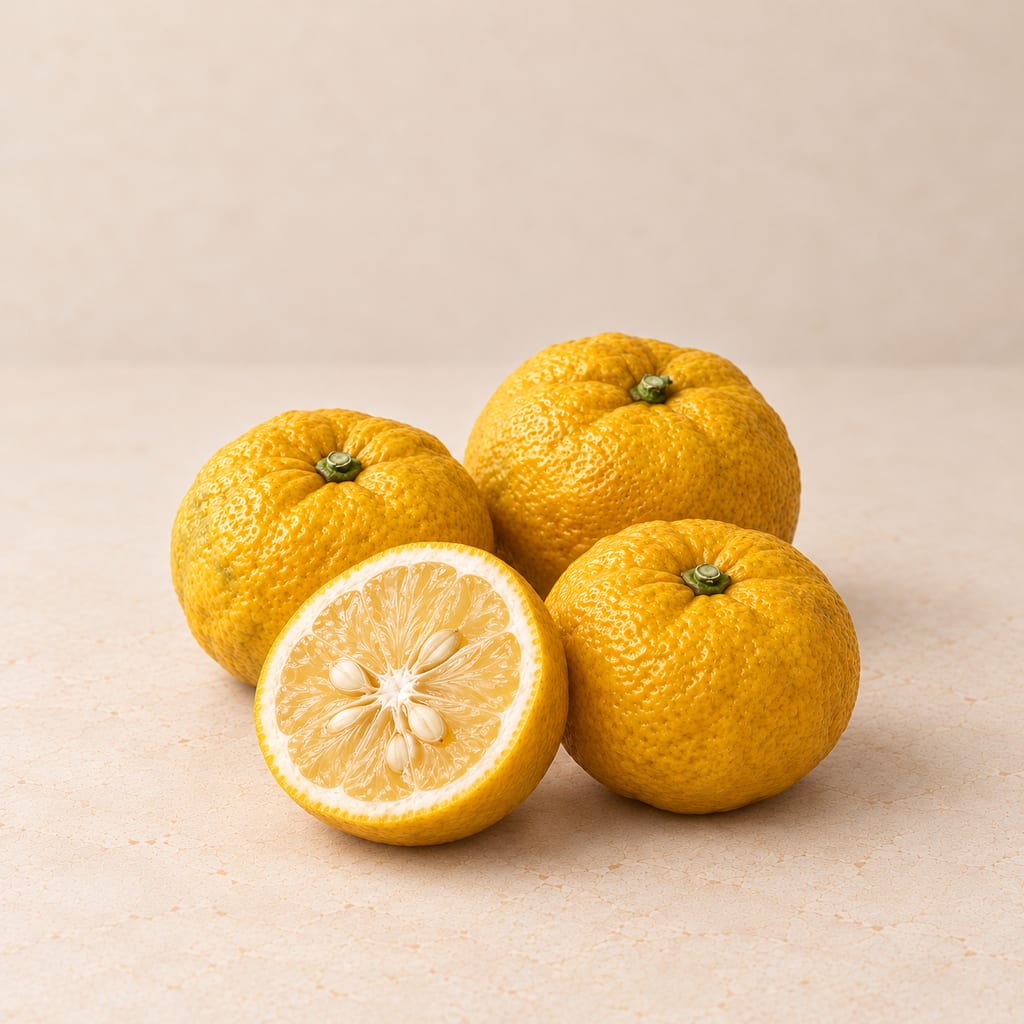
Yuzu (fruit and zest)
Yuzu (Citrus junos) is a hardy, thorny East Asian citrus whose sour juice and intensely scented peel flavour ponzu, yuzu kosho and preserves.
 FermenteaWhere food goes to change
Modern method
Quick Homemade Ponzu · Yuzu ponzu
This quick ponzu combines soy sauce, vinegar, hon mirin, kombu, dried bonito and yuzu juice after a brief boil and a warm extraction; the recipe serves five.
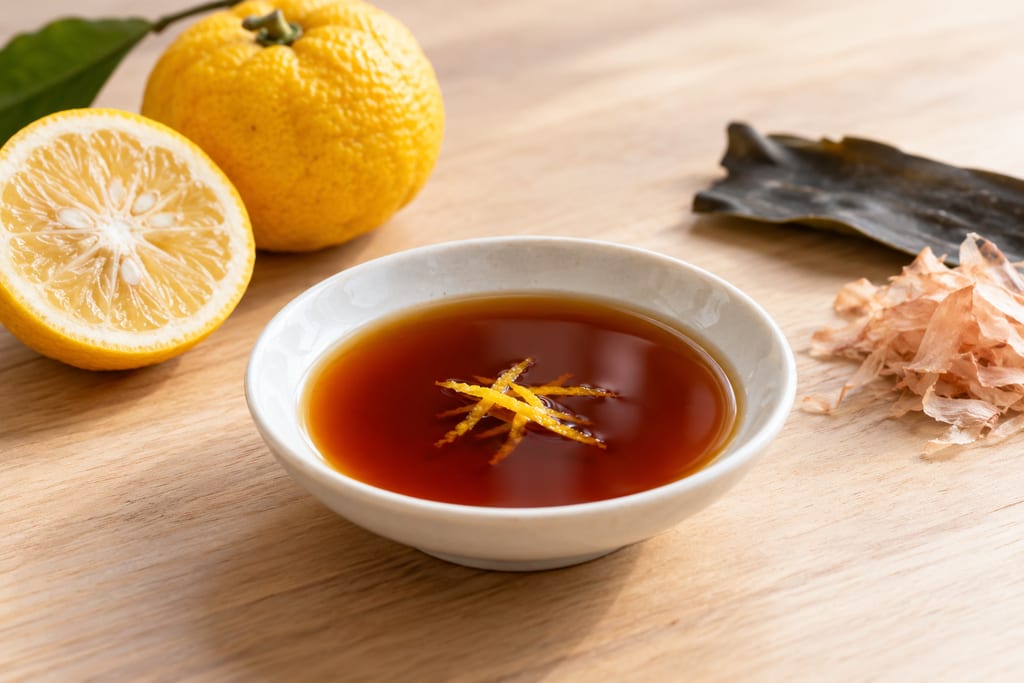
Ponzu is a Japanese citrus-based condiment whose flavour combines acidity, freshness and savouriness. The common modern form, often called ponzu shōyu, contains soy sauce and citrus juice, sometimes supported by mirin, vinegar, kombu and dried bonito.
Yuzu ponzu uses the aromatic citrus fruit yuzu, usually classified as Citrus junos.
In Japanese, ponzu is written ポン酢 or ぽん酢. Yuzu is 柚子 or ゆず, giving the name 柚子ポン酢.
The specific recipe in this record is a quick homemade version that heats the soy-vinegar-mirin mixture, extracts flavour from kombu and bonito, then adds fresh yuzu juice after cooling.
The result is a sauce intended for dipping, finishing and dressing food.
It is not deliberately fermented after assembly, although it contains fermented ingredients such as soy sauce and hon mirin.
Ponzu has an unusual name whose history reflects contact between Japan and European traders.
One widely discussed etymology connects the first part of the word with the Dutch pons, a word related to punch, followed by the Japanese su (酢), meaning vinegar.
Other etymological explanations have also been proposed, including Portuguese influence.
The exact linguistic history is not entirely settled.
Historically, ponzu could refer more directly to an acidic citrus condiment without soy sauce.
The modern brown soy-seasoned preparation is more precisely called ponzu shōyu (ポン酢醤油).
This distinction is useful because contemporary English recipes frequently use the shorter word ponzu for both.
The modern sauce combines Japanese traditions of citrus seasoning, soy sauce and dashi-rich ingredients.
However, the exact quick formula preserved here was published in 2016 by KitchenNippon, a Japanese home-cooking educational source.
That date documents the recipe, not the invention of ponzu.
Yuzu is highly aromatic.
Its peel contains essential oils with a distinctive citrus fragrance.
The juice is acidic and may have an aromatic character unlike ordinary lemon or lime.
Yuzu is especially associated with Japanese winter cooking, seasonal condiments and preserved preparations.
Its juice can provide acidity, while the zest contributes powerful aroma.
The distinction matters because the recipe uses both parts separately.
The juice is incorporated into the finished ponzu after cooling.
The zest is julienned for garnish.
Heating fresh citrus juice and peel can change volatile compounds and reduce some delicate aroma.
The source's sequence therefore protects the fresh citrus character while extracting savoury flavour from the kombu and bonito.
Yield: five servings. Final finished volume and cooling duration are not specified.
The mirin is given in grams, not millilitres.
The source's weight should be preserved rather than silently converted into a liquid measure.
The kombu is measured by length rather than mass. Its actual weight can vary with thickness and dryness.
This limits reproducibility but accurately reflects the original recipe.
Soy sauce is produced through a complex fermentation and maturation process.
Traditional Japanese soy sauce is called shōyu (醤油).
It commonly uses soybeans, wheat, salt and water, with koji microorganisms and subsequent microbial maturation.
During production, proteins are broken into peptides and amino acids.
The resulting sauce contains salt, glutamate and numerous aroma compounds.
Its fermentation history contributes to the depth of flavour in ponzu.
However, pouring finished soy sauce into a saucepan with vinegar does not itself constitute a new fermentation.
The finished ponzu is assembled from already prepared ingredients.
The distinction is important for accurate culinary classification.
Hon mirin is a traditional sweet Japanese rice seasoning containing alcohol.
It is produced through a process involving rice-derived starch conversion and maturation.
Its flavour differs from an equal quantity of plain sugar dissolved in water.
Hon mirin contributes sweetness, body and characteristic aromatic compounds.
In the documented ponzu recipe, it is brought to the boil before the other liquid ingredients are added.
Heating changes the mixture and may reduce some volatile alcohol, although bringing mirin briefly to the boil does not establish that all alcohol has been eliminated.
The recipe does not provide a measured residual alcohol concentration.
Therefore, it should not be described as guaranteed alcohol-free.
Kombu is edible kelp, most commonly associated with species such as Saccharina japonica and related kelps used in Japanese cooking.
It is valued for its glutamate content.
Glutamate contributes umami taste.
During extraction, water-soluble compounds move from the dried kelp into the surrounding liquid.
The temperature and duration influence extraction.
The recipe adds kombu after turning off the heat, allowing the warm sauce to extract flavour as it cools.
This is a short warm infusion rather than a long stock-making procedure.
The source does not give a precise steeping time or temperature curve.
Dried bonito is commonly known as katsuobushi (鰹節).
It is usually made from skipjack tuna, Katsuwonus pelamis, through processes involving cooking, drying and, in some forms, mould-assisted maturation.
The finished flakes are rich in characteristic savoury compounds.
Inosinate is particularly important because it can enhance the perception of umami when combined with glutamate.
The combination of kombu and bonito is fundamental to many forms of Japanese dashi.
This flavour synergy is one reason the sauce can taste intensely savoury despite using only a small quantity of dried bonito.
The recipe uses 3 g, enough to contribute aroma without turning the sauce into a thick fish preparation.
The sauce combines vinegar and yuzu juice.
Vinegar contributes acetic acid.
Yuzu contributes citric acid and other fruit components.
The two are chemically and sensorially different.
Acetic acid produces a recognisable vinegar aroma.
Citric acid contributes bright citrus sourness.
Together with soy sauce and mirin, they create a sauce that balances sour, salty, sweet and savoury tastes.
The relative amounts are central.
The source uses 100 mL soy sauce, 50 mL vinegar and approximately 50 mL yuzu juice, together with 50 g mirin.
Those quantities describe the documented formulation. They do not establish one universal ponzu recipe.
1. Prepare the ingredients. Measure soy sauce, vinegar and hon mirin. Set aside the kombu and dried bonito.
2. Heat the mirin. Place 50 g hon mirin in a saucepan and bring it to the boil.
3. Add the other liquids. Pour in 100 mL soy sauce and 50 mL vinegar.
4. Bring to a full boil. The source specifies reaching a boil, then immediately turning off the heat. It provides no timed boiling interval.
5. Add the umami ingredients. Place one approximately 3 cm piece of kombu and 3 g dried bonito into the warm liquid.
6. Allow the mixture to cool. The kombu and bonito steep while the sauce reaches room temperature.
7. Prepare the yuzu. Zest and juice two fruits, yielding approximately 50 mL juice in the source recipe.
8. Strain. Remove the kombu and bonito after the warm extraction stage.
9. Add the juice. Stir in the fresh yuzu juice only after the sauce has cooled.
10. Prepare the garnish. Julienne the zest and use it with the finished condiment as appropriate.
No fermentation period is specified.
The author includes a separate general note that some ponzu may be rested for extended periods, but the quick recipe does not provide the conditions for such maturation.
That note should not be converted into a shelf-life claim for this batch.
The preparation is organised around extraction and aroma retention.
Mirin is heated first.
Soy sauce and vinegar are then brought to the boil.
Kombu and bonito are introduced after heating stops.
The warm liquid extracts savoury compounds during cooling.
Fresh citrus is added last.
This avoids subjecting the yuzu juice to the same heat treatment as the other ingredients.
The sequence is a practical compromise between extracting savouriness and preserving volatile citrus character.
A sauce made by boiling everything together would not necessarily taste identical.
Yuzu is only one possible citrus fruit used in ponzu.
Sudachi (Citrus sudachi) is associated with Tokushima and has a distinctive tart aroma.
Kabosu (Citrus sphaerocarpa) is associated particularly with Ōita.
Daidai and other bitter or sour citrus fruits may also be used.
The resulting sauces differ in aroma and acidity.
A sudachi ponzu is not identical to yuzu ponzu, even if the soy sauce and dashi ingredients remain unchanged.
However, these are meaningful ingredient variations within the same ponzu family rather than entirely separate culinary technologies.
A recipe database can record the citrus species as a variant dimension.
Ponzu is closely associated with Japanese hot-pot cooking.
In shabu-shabu, thin slices of meat and vegetables are briefly cooked in hot broth and dipped into sauces.
Ponzu provides a sharp contrast to the richness of the meat.
It is also served with yudōfu, a simple hot tofu dish.
The mild flavour of tofu allows the citrus-soy character to become prominent.
Ponzu can accompany grilled or seared fish.
In Kōchi Prefecture, it is strongly associated with katsuo no tataki, seared bonito served with aromatic accompaniments.
It can be used with dumplings, grilled vegetables and salads.
As a dressing, its acidity can replace part of the role otherwise played by vinegar.
The sauce is usually most effective as a finishing condiment rather than being cooked for a long period.
Prolonged heating can alter the delicate citrus aroma.
If the ponzu tastes excessively salty, the soy sauce may dominate the intended balance.
If it tastes too sharp, the particular yuzu or vinegar may be more acidic than expected.
If the sauce lacks savouriness, extraction from kombu and bonito may be limited.
A cloudy appearance may result from suspended particles.
However, unwanted deterioration or visible growth during storage should not be treated as normal maturation.
The source gives no measured pH, salt concentration or validated shelf life.
Ponzu contains soy sauce, vinegar and citrus juice, but that does not automatically make a homemade formulation shelf-stable.
The exact finished acidity is not measured.
The source's brief boiling stage is not a validated canning process.
Fresh yuzu juice is added after cooling, meaning the finished product is not subsequently subjected to a defined heat treatment.
Refrigeration is appropriate for a fresh homemade condiment, but no precise validated storage period is established for this batch.
The recipe is credited to Machiko Tateno and published by KitchenNippon in 2016. The page describes ponzu generally but does not establish the history or origin of this quick formula.
Yield 5 servings · Scaling: source batch only
The publisher identifies itself as Japanese homestyle cooking instruction; the page does not claim this exact quick batch originated in Japan.
Yuzu (Citrus junos) is a hardy, thorny East Asian citrus whose sour juice and intensely scented peel flavour ponzu, yuzu kosho and preserves.

Japanese reddish-brown vinegar from sake lees matured about three years, turned to vinegar by acetic bacteria; the vinegar of Handa and Edomae sushi rice.
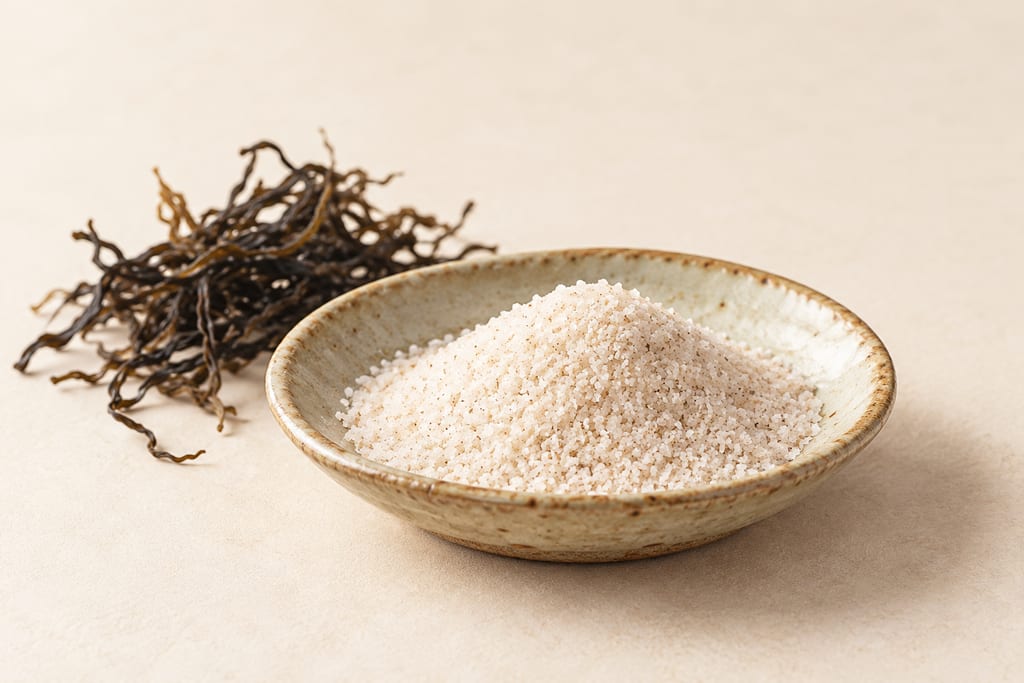
Amabito no Moshio is a modern, pale beige Japanese seaweed salt made from Seto Inland Sea water and hondawara seaweed. Its documented factory method concentrates filtered brine in kettles, then separates and dries the salt.
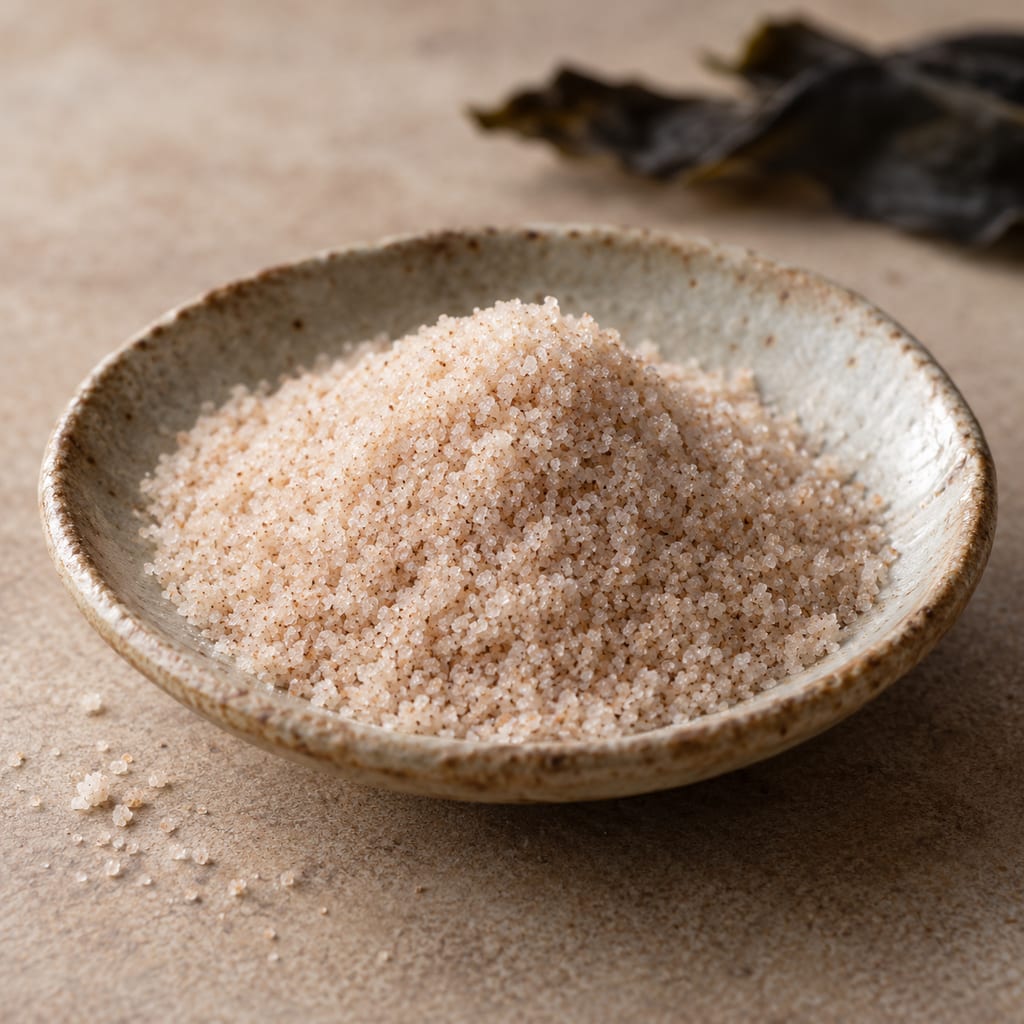
Awaji moshio is a modern Japanese seaweed salt made by TaDa PHILOSOPHY from Awaji Island seawater and seaweed. Its premium process concentrates brine, extracts seaweed flavor, then crystallizes, separates, dries and grades the salt.
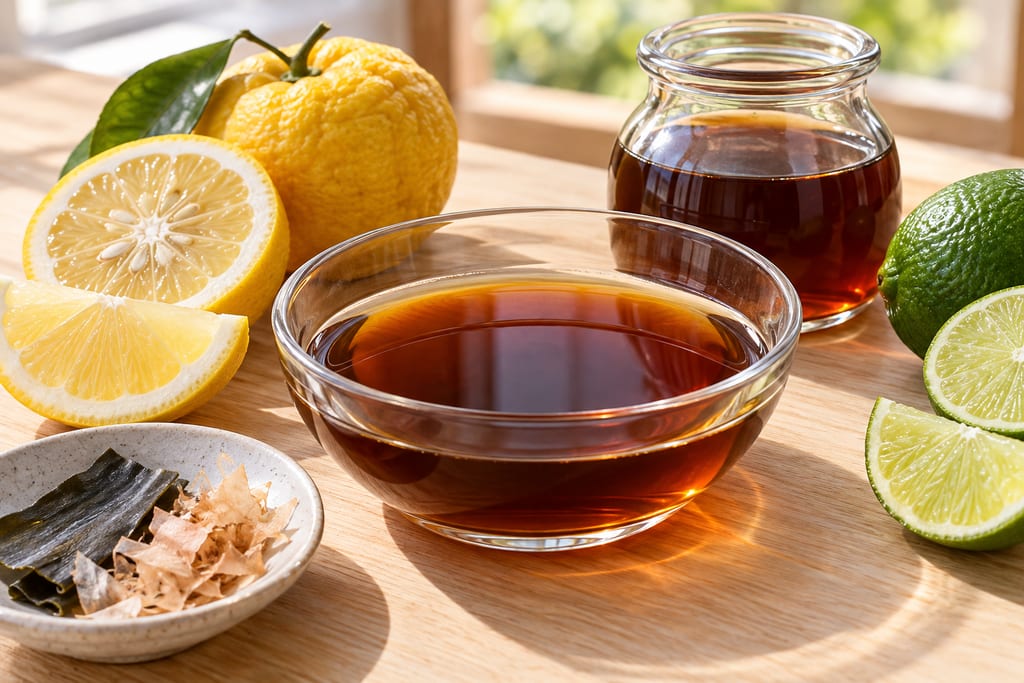
This fresh ponzu-shoyu mixes Japanese koikuchi soy sauce with yuzu or a lemon-lime blend, rice vinegar, water and sugar; optional kombu and bonito give a short chilled infusion.
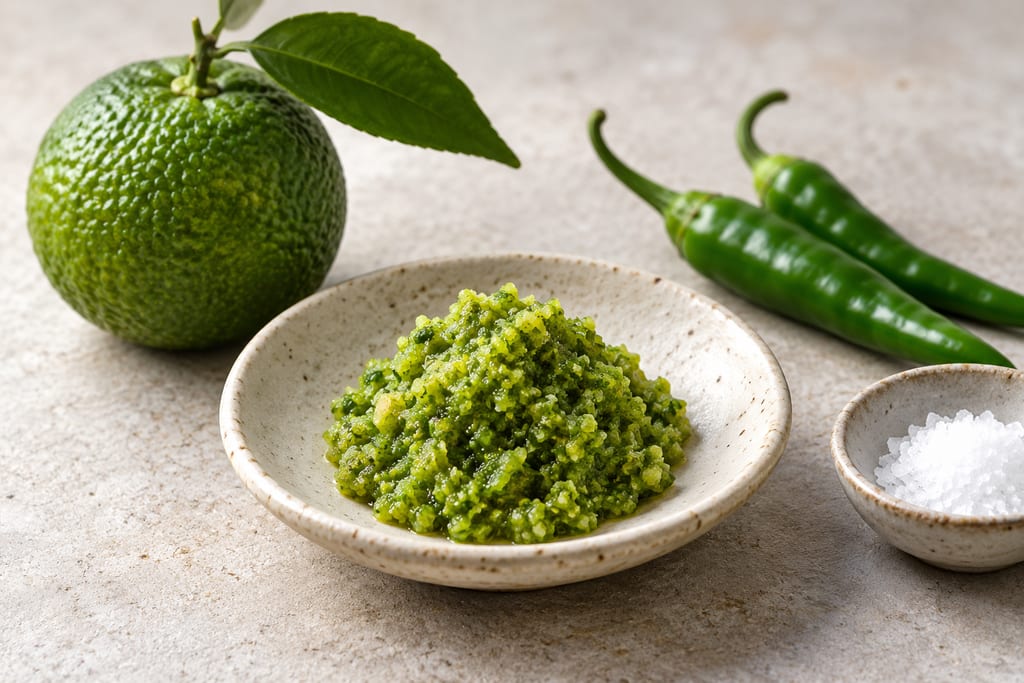
A fresh, uncooked yuzu and green chilli paste inspired by Kyushu’s yuzu kosho, made here as an untested small-batch seasoning rather than a preservation formula.
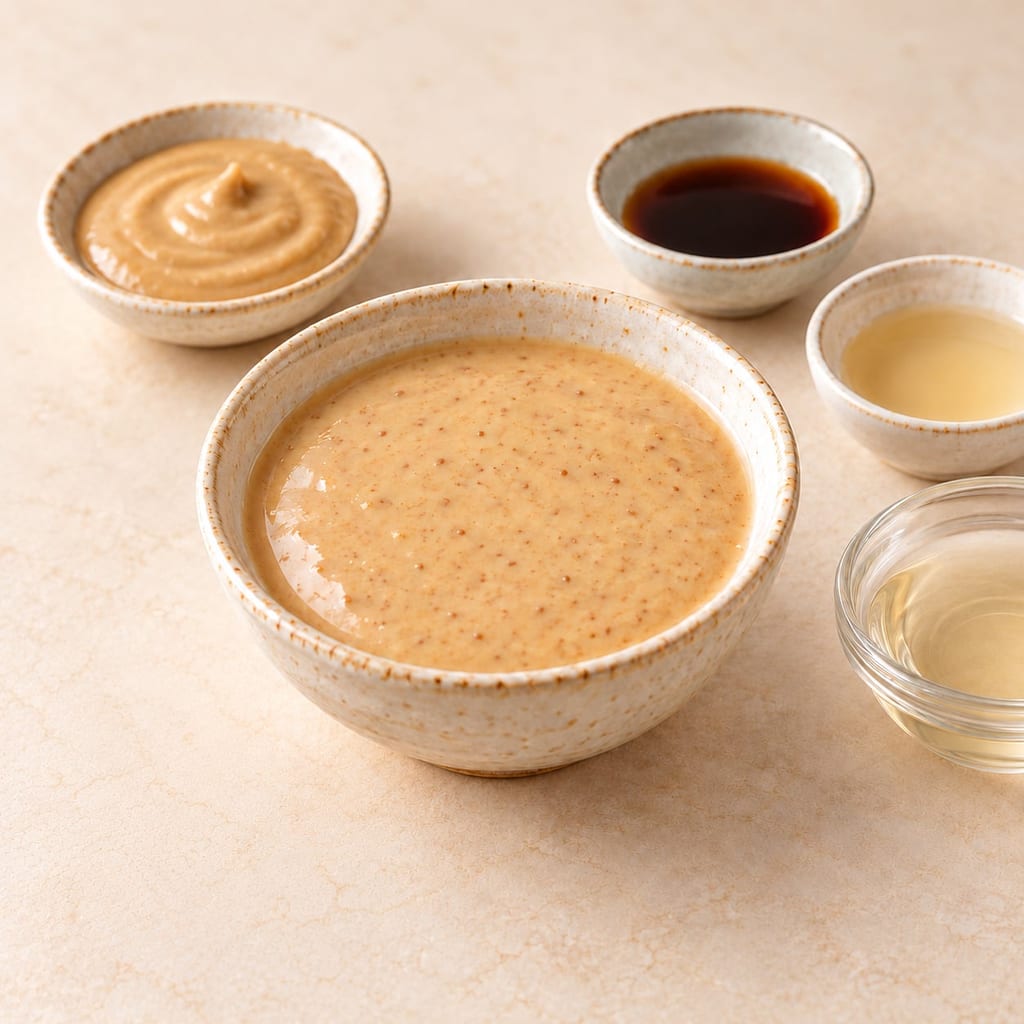
A creamy Japanese sesame dipping sauce with soy, rice vinegar and dashi. Gradual mixing turns the thick sesame paste into a smooth sauce.
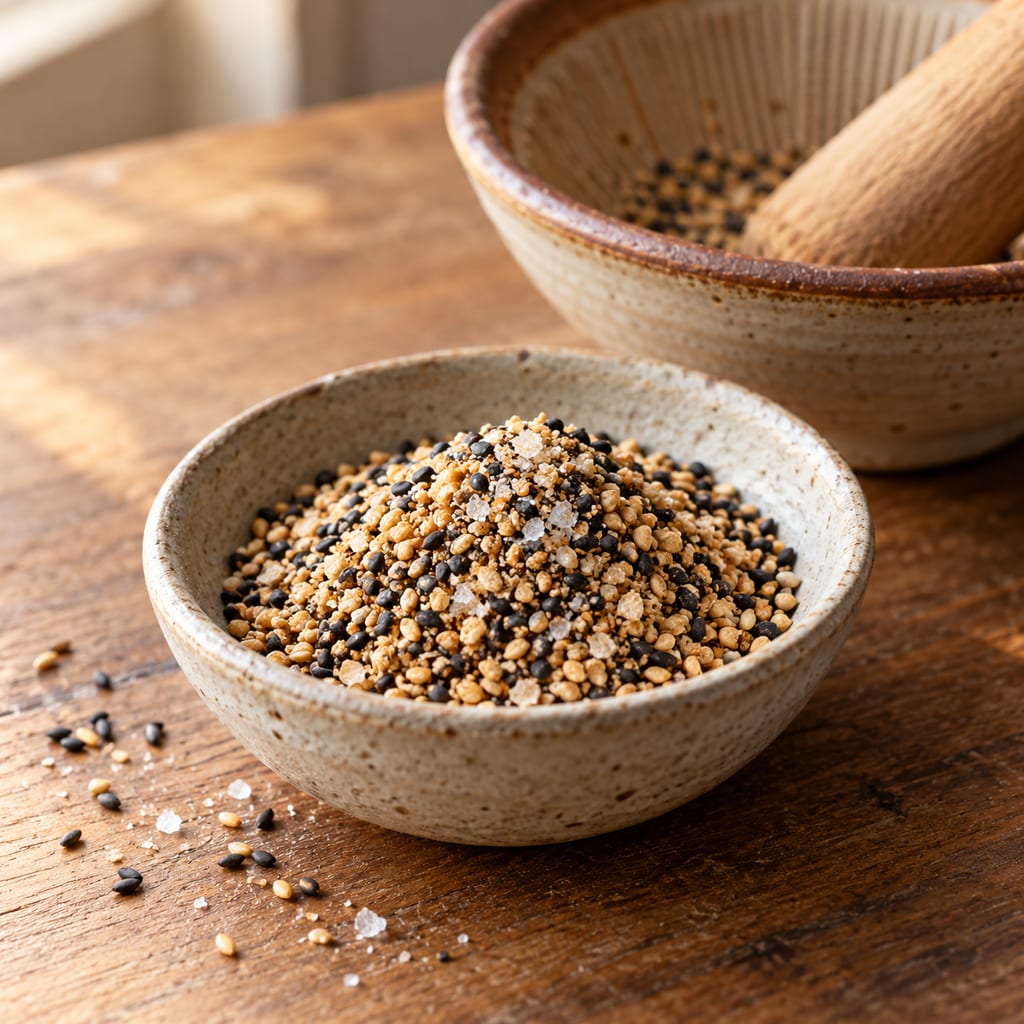
Toasted sesame seeds and sea salt are ground together into a coarse seasoning for rice. This small pan-roasted batch keeps most of the seed texture.
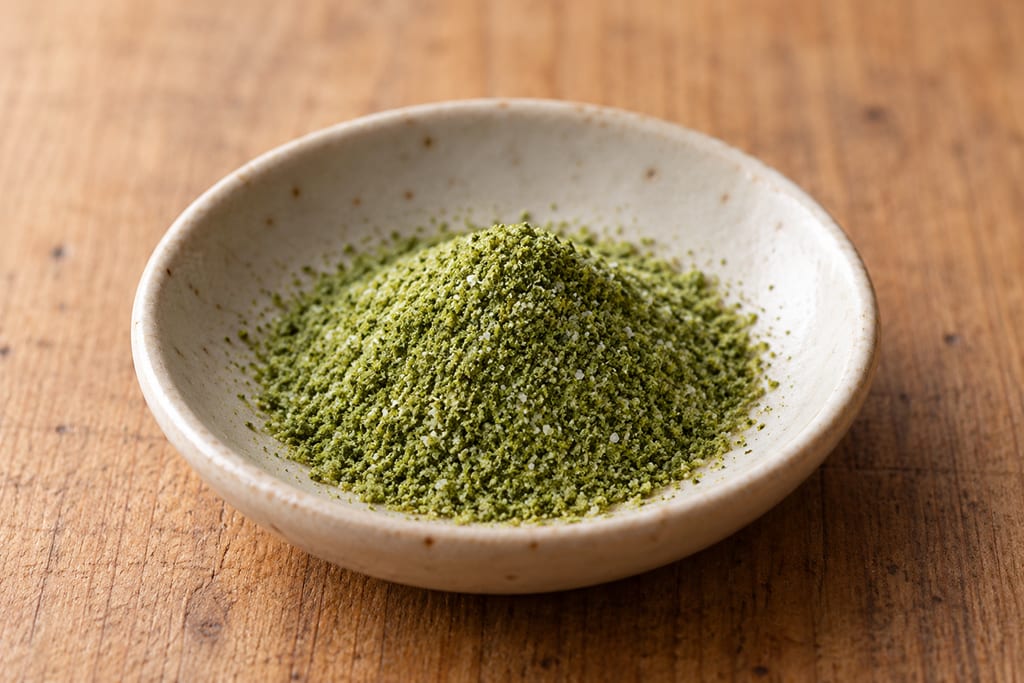
Green tea leaf salt is a dry seasoning made by grinding tea leaves, sieving them and mixing the powder with fine salt. This Japanese-style version follows a documented equal-parts method.
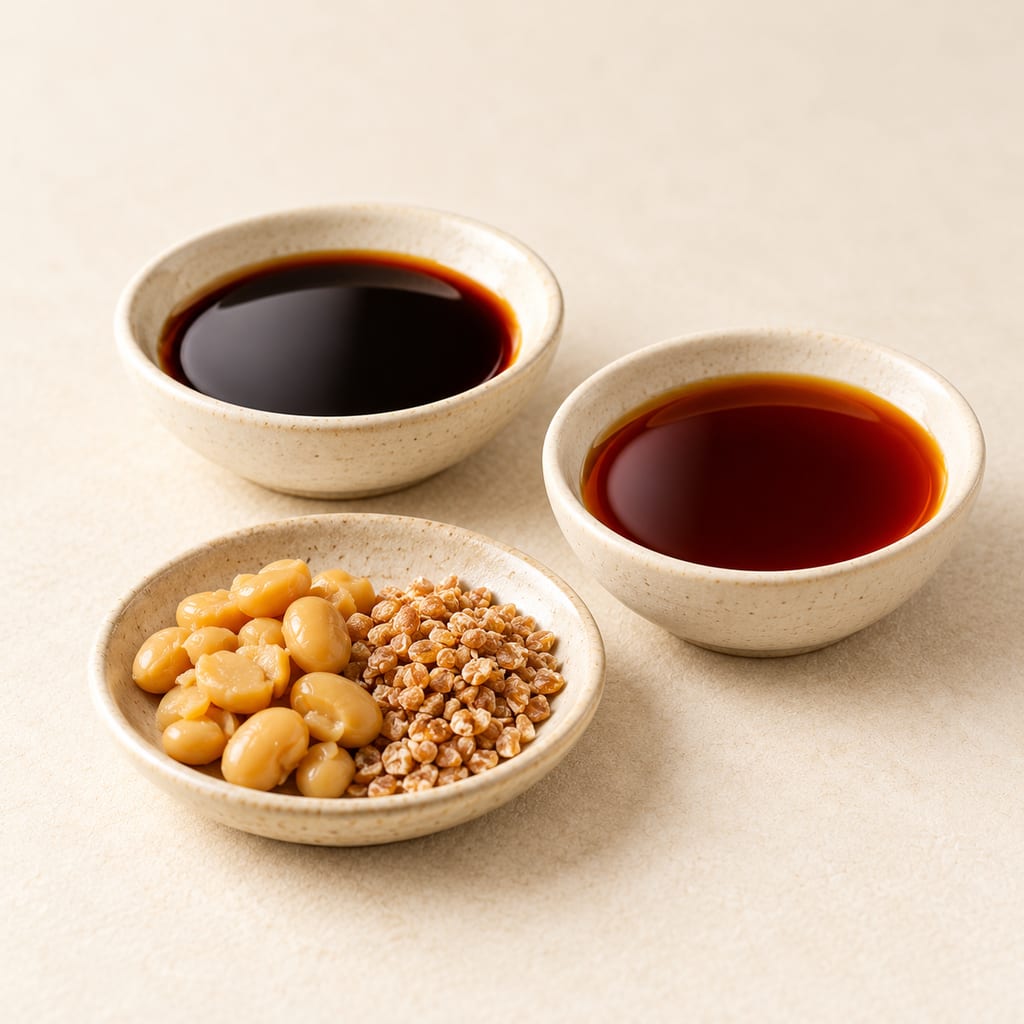
Jiangyou is the Chinese soy sauce family, an umbrella term for light, dark and seasoned sauces made by two main process families: high-salt liquid-state and low-salt solid-state brewing.
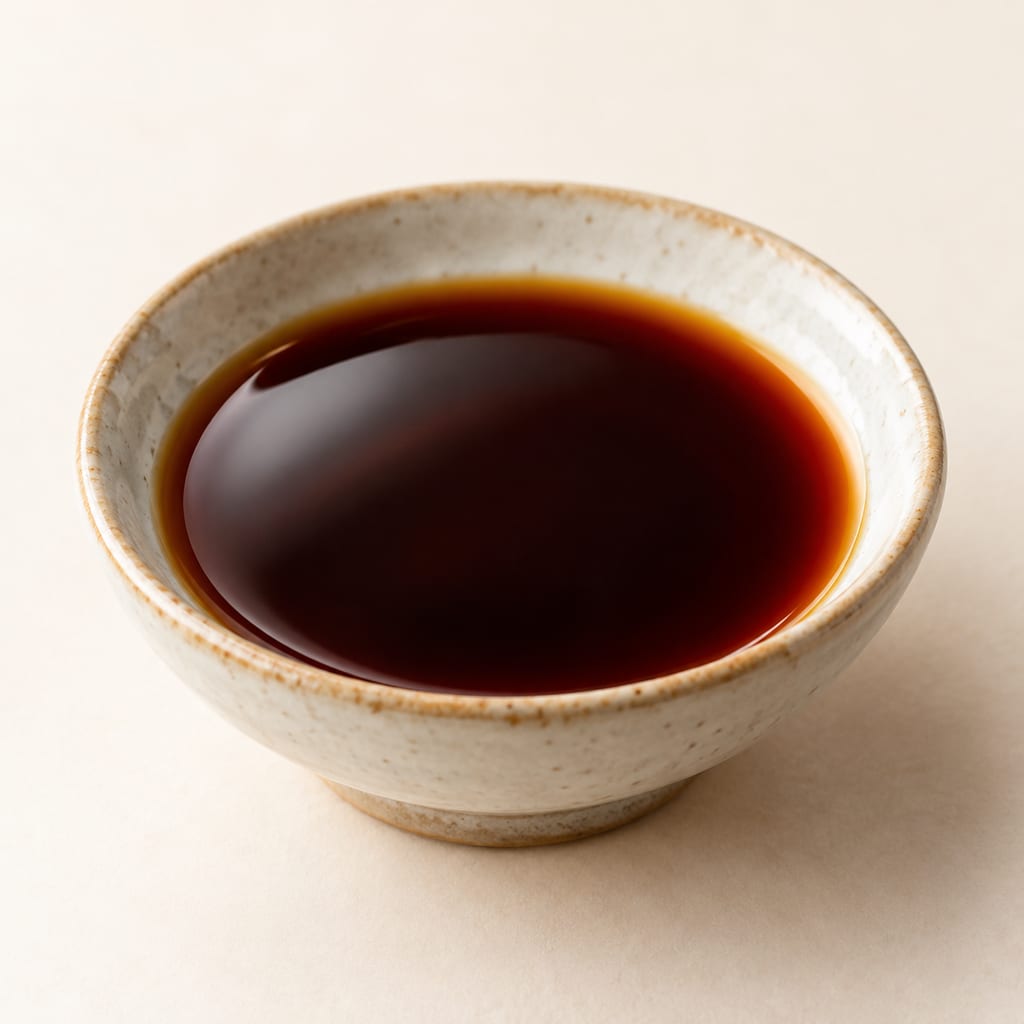
Japan's standard all-purpose soy sauce: soybeans and wheat grown over with koji mould, brined, fermented for months, pressed and usually heated into a reddish-brown, savoury liquid.
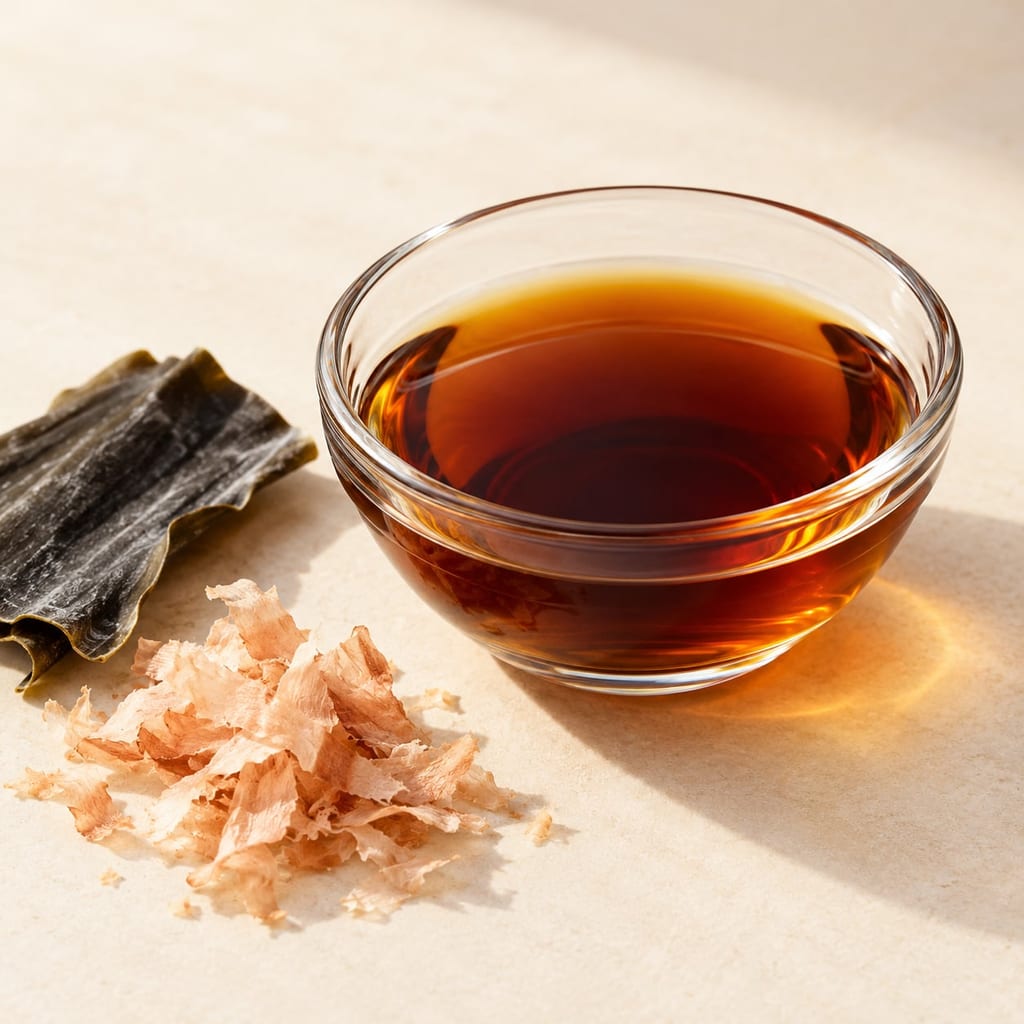
Mentsuyu seasons Japanese noodles with dashi, soy sauce and mirin. Two home formulas are recorded here: a 2012 light-soy and bonito sauce, and a concentrate diluted 1:2 for dipping or 1:4 for hot soup.
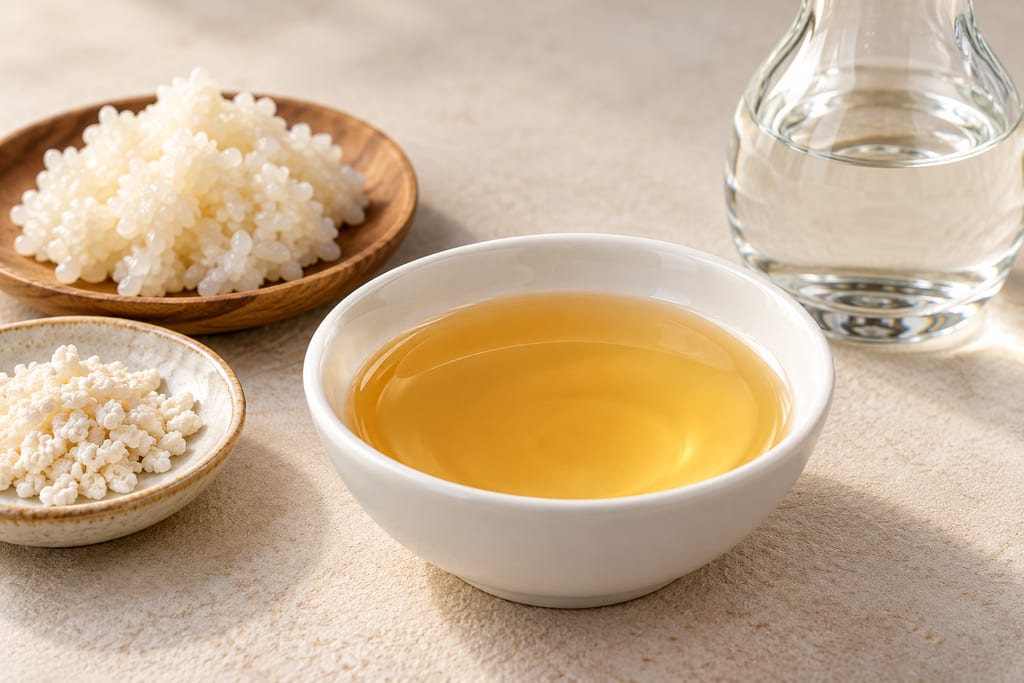
Hon-mirin is a Japanese rice seasoning made by saccharifying glutinous rice with rice koji in shochu, then pressing and usually heating the mash.
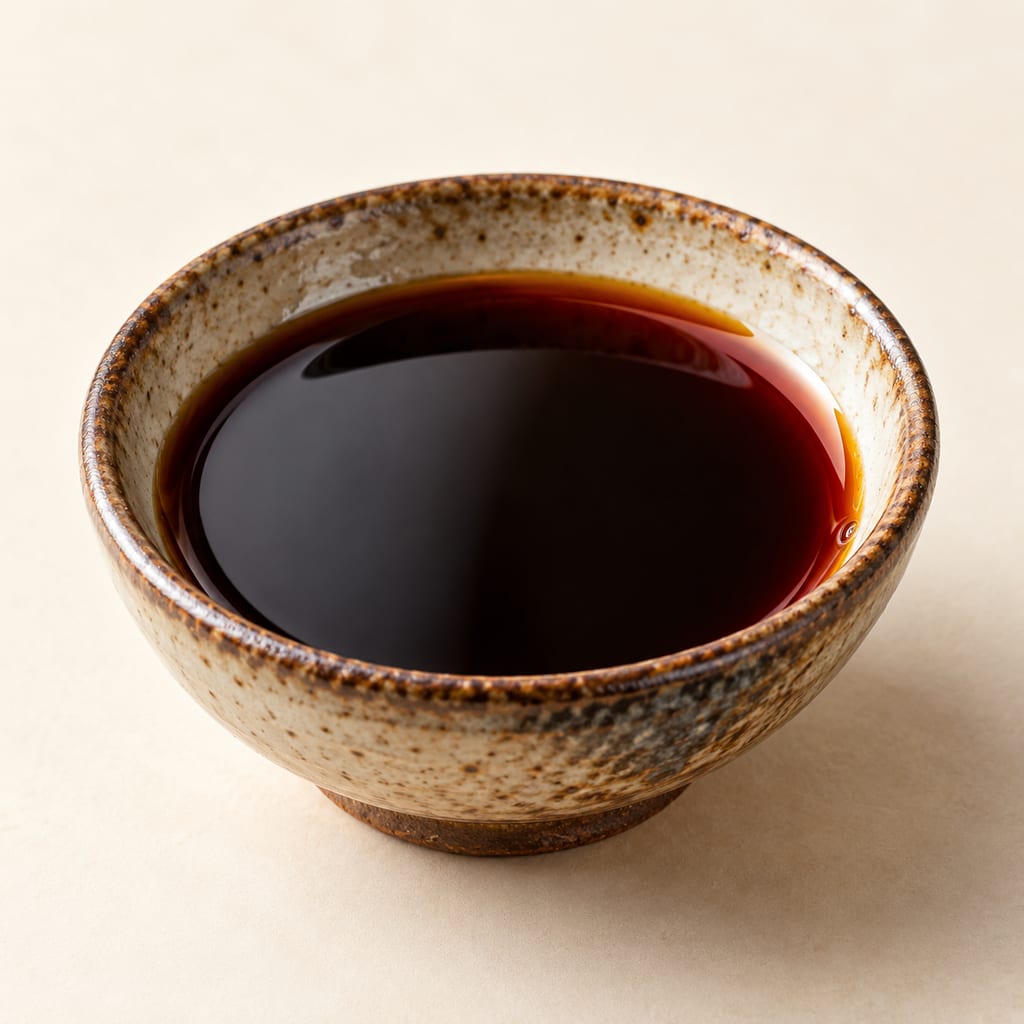
Saishikomi shoyu is a double-brewed soy sauce: a second moromi is made with a finished soy sauce in place of salt water, which makes a dark, concentrated sauce with softer salt.
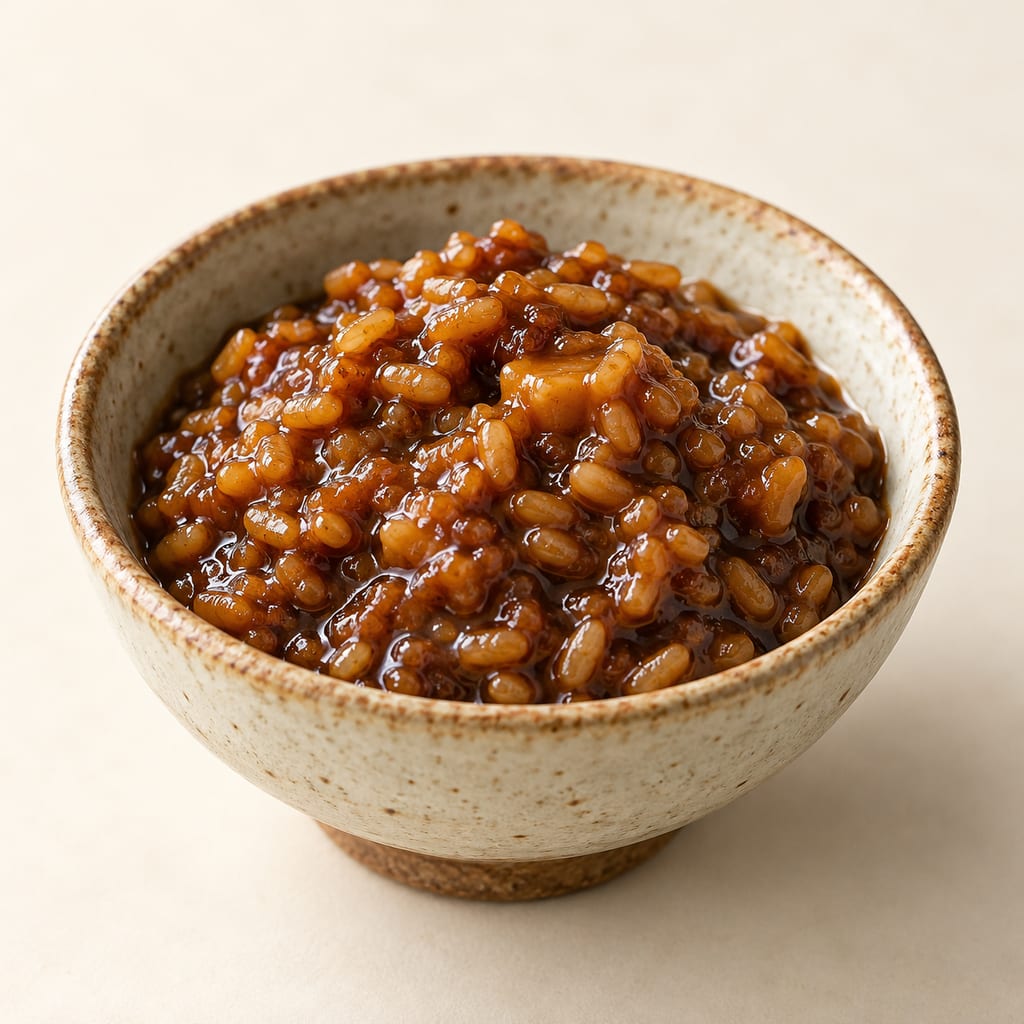
A Japanese kitchen condiment of rice koji matured in soy sauce until the grains turn soft and sweet. The same name also means the mould-grown soybean and wheat used to brew soy sauce.
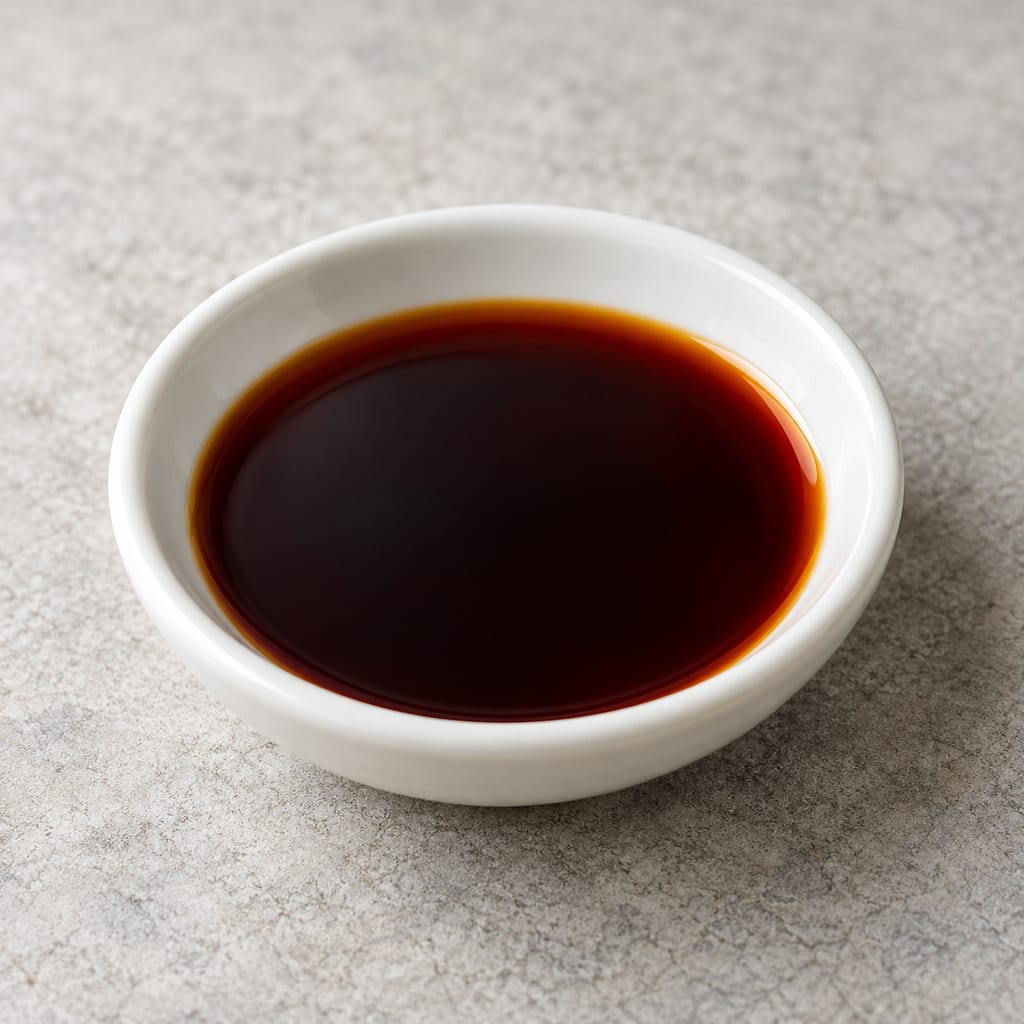
Soy sauce is a salted liquid seasoning made by growing koji mould on soybeans and grain, maturing the mash in brine and pressing out the liquid. Japan's shoyu is the best-documented form.
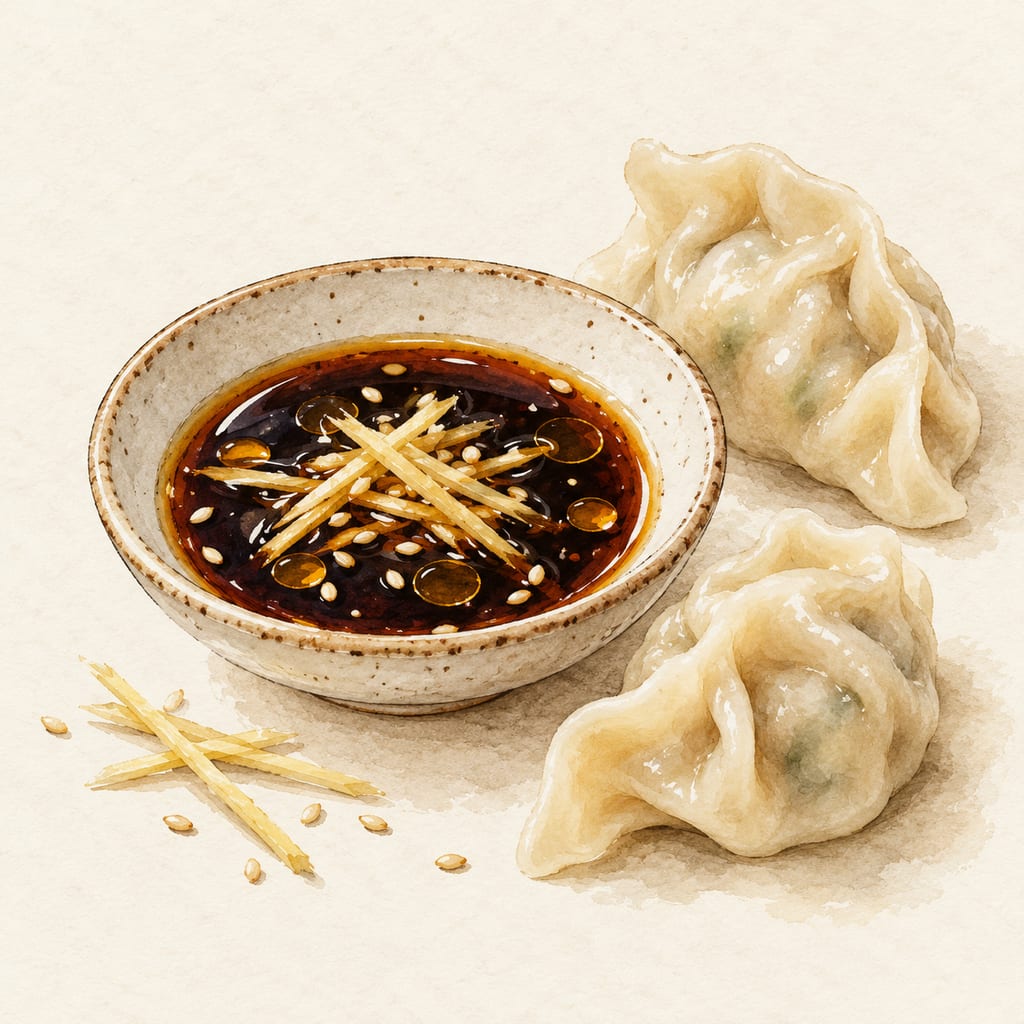
An untested small-batch soy and Zhenjiang black-vinegar dip with ginger and sesame oil, adapted as a modern accompaniment for dumplings or cooked vegetables.
No community contributions have been published for this entry yet.
Sign in to contribute. Published comments and photos are free to read.
KitchenNippon Japanese Homestyle Cooking ClassesInspiration · Recipe · Geography
Quick Homemade PonzuFull page lines 18–37: ingredients, five-serving yield, four ordered preparation stages, developer credit and separate general rest note. The quick recipe itself does not rest for a month to six months.
Cited in: Overview; What is the historical meaning of ponzu?; Yuzu and its place in Japanese cooking; Ingredients — original five-serving recipe; Soy sauce as a fermented ingredient; The role of mirin; Kombu and glutamate; Bonito and umami synergy; Acidity and flavour balance; The quick preparation method; Why the sauce is heated in stages; Ponzu and related Japanese citrus; How ponzu is eaten; Troubleshooting; Safety and storage
KikkomanHistory
Kikkoman — Ponzu Sauce GlossaryCited by the written account for this record.
Cited in: What is the historical meaning of ponzu?; Ponzu and related Japanese citrus
Just One CookbookMethod
Just One Cookbook — Ponzu SauceCited by the written account for this record.
Cited in: Yuzu and its place in Japanese cooking; Ponzu and related Japanese citrus; How ponzu is eaten; Troubleshooting
James Beard FoundationHistory
James Beard Foundation — Eat This Word: PonzuCited by the written account for this record.
Cited in: What is the historical meaning of ponzu?