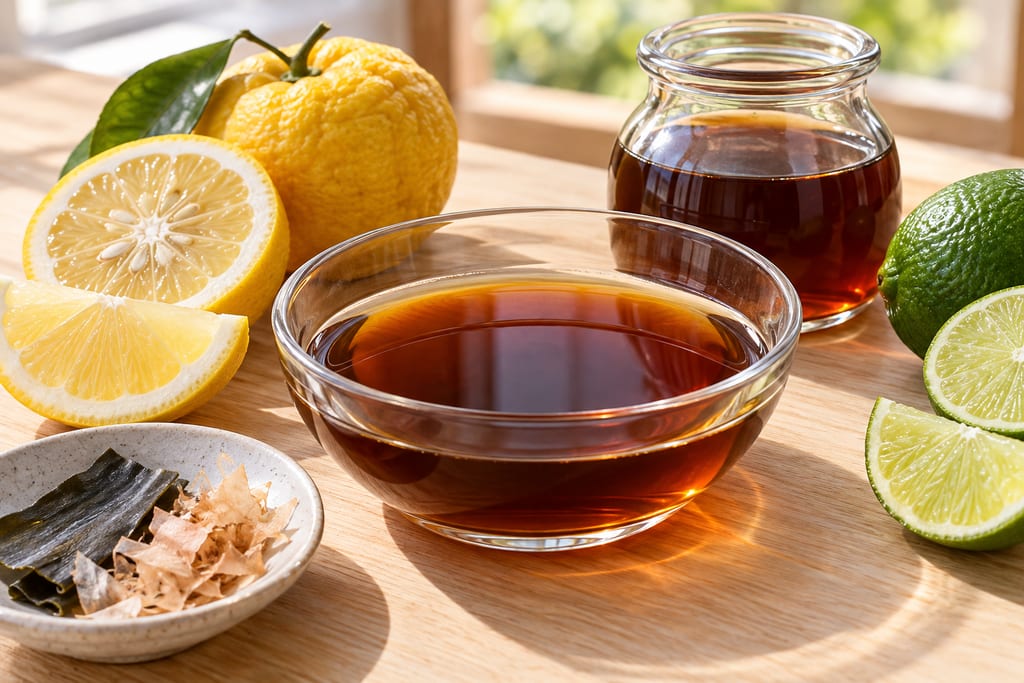
Fresh ponzu-shoyu
This fresh ponzu-shoyu mixes Japanese koikuchi soy sauce with yuzu or a lemon-lime blend, rice vinegar, water and sugar; optional kombu and bonito give a short chilled infusion.
 FermenteaWhere food goes to change
Spices and aromatics
Yuzu (Citrus junos) is a hardy, thorny East Asian citrus whose sour juice and intensely scented peel flavour ponzu, yuzu kosho and preserves.
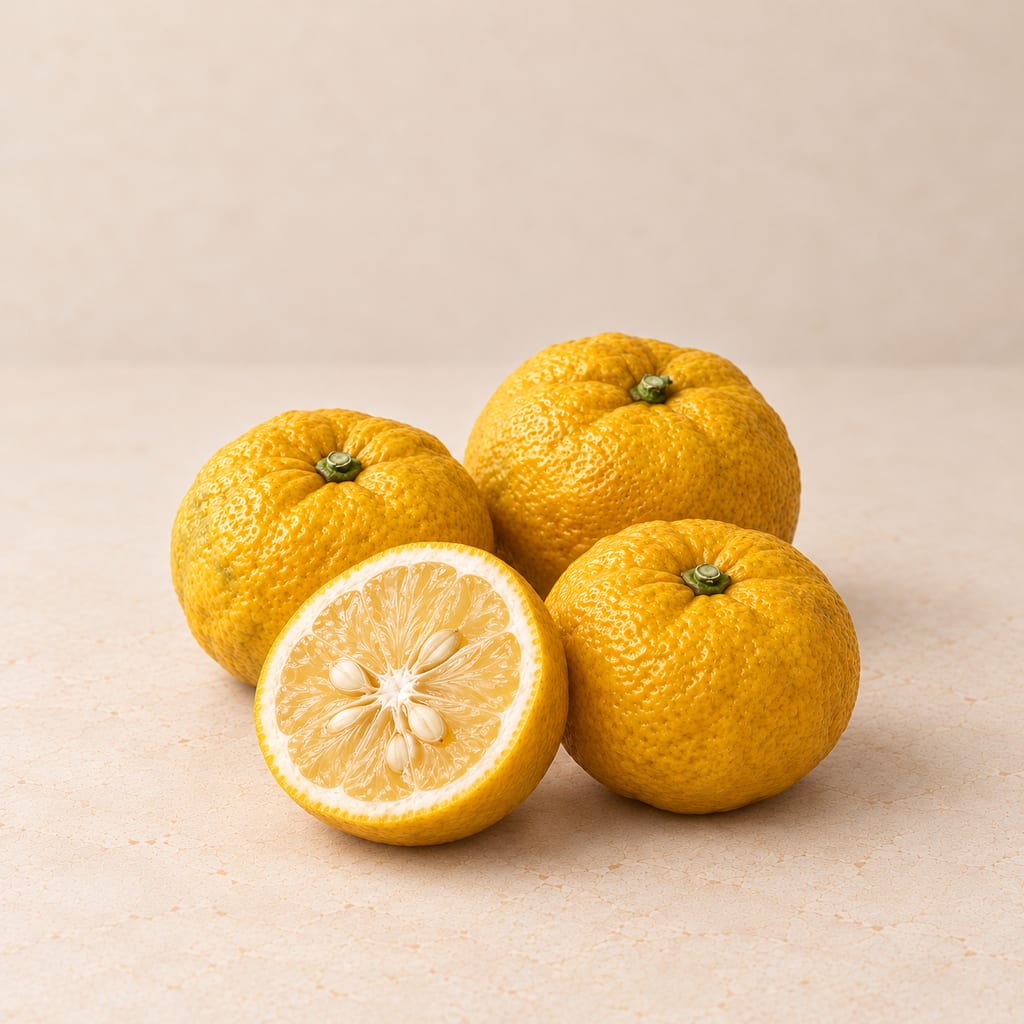
Yuzu, Citrus junos, looks like a bumpy yellow clementine. The fruit is usually 5.5 to 7.5 centimetres across, can reach about 10, and is yellow when fully ripe and green earlier in the season. The skin is uneven and very aromatic, and the tree is an upright shrub or small tree armed with many large thorns and leaf-like petioles. It is a fruit eaten for its smell more than its pulp: the juice is sour and the fruit holds seeds, while the peel carries a potent, distinctive perfume, and it is called a peel-eatable fruit because the peel goes into food as readily as the juice.
In Japanese the fruit is yuzu (柚子) and in Korean yuja (유자). A recipe that asks for lemon or lime in its place gets a sour fruit with a different aroma, because the scent of yuzu is its own. That aroma is carried by the peel oil, which is why zest and juice are separate ingredients, with different uses and different rules for the cook.
In the fermented kitchen yuzu supplies sourness to ponzu and an aromatic top note to seasonings such as yuzu kosho, a paste of citrus peel, chilli and salt.
Yuzu is believed to have originated in central China, where it grew wild in Tibet and in the provinces of Sichuan, Hubei and Yunnan. It is thought to be a first-generation hybrid of a mandarin, the mangshanyeju type, and the ichang papeda, a hardy wild citrus. A DNA study of Japanese citrus collections supports the papeda link: yuzu clusters close to Citrus ichangensis, in agreement with Swingle’s earlier proposal that it is a chance seedling of that species. The same analysis groups yuzu with ichanchii, hanayu, Kourai Tachibana, rokugatsumikan, lemon and limonia as varieties with more than 80 percent of their markers from the population that represents citron, Citrus medica; the markers of citron and ichanchii lie close together, so the result fits a papeda parent without separating it cleanly from the citron lineage.
From China the fruit went to Korea and Japan, introduced to both during the Tang dynasty, in a period that one account puts at the fourth to eighth centuries. Japan’s citrus is a mosaic of arrivals: the country lies at the eastern edge of the natural range of citrus, has two endemic species, tachibana and shiikuwasha, and received many others, yuzu among them, through prehistoric and historical introductions and natural hybridisation. These have been grown mainly along the coast of south-western Japan. Yuzu has also been grown in California since 1888, although the US Department of Agriculture bans the import of fresh yuzu.
The fruit became part of the calendar. In Japan a bath with yuzu floating in it is traditional at the winter solstice, and in Korea yuja turns up in sugar preserves, tea and a fruit punch. Yuja has been used for food and medicine in China and Korea, and it is mostly prepared as sugar pickles, tea, dressing and vinegar.
Kochi Prefecture on Shikoku produces more yuzu than any other part of Japan. The eastern Chugei district gets heavy rain, which suits a tree that needs moisture, and Kochi fruit is known for its size and rich aroma. The harvest falls around November. In traditional Tosa cooking the fruit was paired with foods by season, with autumn yuzu going to moray eel. National production was about 27,000 tonnes in 2016.
Kochi’s modern yuzu story is told through ponzu. Around 1965, as the forestry industry declined, most households already had a yuzu tree in the yard, and people tried to build a business on it. Fresh fruit of good quality was hard to sell from a thinly spread, ageing population with other jobs, so they sold the juice as ponzu instead, and about 1986 yuzu ponzu for home use began to be sold in earnest and became known across Japan. Ponzu in its older sense is yuzu juice mixed with vinegar; ponzu soy sauce adds a kombu and bonito broth, soy sauce and mirin. A rarer ponzu is made from seed-grown trees, which are hard to manage. In 2020 Monobe yuzu from Kami City was registered under Japan’s geographical indication system as a regional ponzu, and ponzu made from other citrus is also sold in Kochi.
In the five towns and villages of eastern Kochi’s Chugei area, Nahari, Tano, Yasuda, Kitagawa and Maji, yuzu is a whole food culture, recognised in Japan’s Traditional 100-Year Food list and as part of the Japan Heritage story titled “From a forest railway to Japan’s top yuzu road”. Some of the trees are said to be over 300 years old, and a tradition holds that Nakaoka Shintaro, a samurai activist who served as a village headman in the late Edo period, encouraged farmers to plant yuzu as a sideline.
The local word for the juice is yunosu, and it was used in place of vinegar because it is so acid. It is said to have preserving and appetite-stimulating effects and is sold in large bottles. Yuzu sushi is made with rice seasoned with yunosu, and the local dishes that use the fruit include vinegared dishes, sashimi, nuta with garlic leaves, yuzu miso, yuzu kosho, tsukudani, pickles and yuzu sake. The acid does the job of the vinegar, and the peel and juice add the fragrance.
The two parts of the fruit that reach the kitchen are different materials. The peel is the aromatic one. Cold-pressed yuzu oil, squeezed from the oil sacs in the coloured outer peel, and steam-distilled oil differ in composition. Reconstructions of the two oils, built from their analysis, put limonene at about 53 percent of both, γ-terpinene at 27 percent in the cold-pressed oil and 14.5 percent in the steam-distilled one, and p-cymene at 2.5 percent against 11.5 percent, with myrcene, α-pinene, linalool and β-pinene in smaller amounts and terpinen-4-ol appearing only in the steam-distilled oil. Fresh zest brings the cold-pressed profile to a dish.
The peel is also richer in vitamin C and phenolics than the flesh, and the fruit is called peel-eatable because the rind goes into food as readily as the juice. The peel and seed contain citric acid, and the juice is the acid of ponzu and of the local vinegar substitute yunosu. Green peel holds more of the flavonoids naringin and hesperidin than yellow peel, which is one more reason the colour of the fruit matters when it is bought for a seasoning.
Ponzu is served as a dressing or dipping sauce for salads, boiled vegetables, cold tofu, grilled meat or fish, sashimi, potstickers and hot-pot dishes such as shabu shabu. It also works in heated dishes, as a marinade for roasts and as a stir-fry seasoning, and it pairs especially well with grated daikon.
Korea takes the fruit in a sweeter direction. Yuja is prepared as sugar pickles, tea, dressing and vinegar. Yuja-cheong is a marmalade-like preserve of fruit and sugar, yuja tea is made from it, and yuja-hwachae is a fruit punch. Japan has its own yuzu tea and liquors, and the juice and peel go into yuzu miso, tsukudani and pickles in Kochi. The sweet preserves are the older cousins of the sour seasonings: both put the peel to work, one with sugar and the other with salt and chilli.
Yuzu kosho is the clearest case of yuzu working in a preserved seasoning. In Kyushu, where the name comes from, kosho means chilli pepper, not black or white pepper. The Fukuoka recipe published by the Ministry of Agriculture, Forestry and Fisheries uses green chilli and the peel of green yuzu with salt. It calls for the peel to be pared with a knife, chopped and blended with the chilli and salt. The fruit used is the green yuzu of around September, because the fruit turns yellow as it ripens in autumn and winter, and green chilli is in season from July to September, so the two overlap. Batches are often frozen in portions for the rest of the year.
Salt sets the balance. The recipe notes that more salt extends shelf life and keeps the green colour stable but dulls the yuzu aroma, while less salt lets the chilli fade faster; stored refrigerated, the paste keeps its green colour until the next season. Red chilli is sometimes used instead and is more aromatic. Recipes vary by region and household, and several places claim the origin, one candidate being the Hikosan area of Fukuoka, where mountain ascetics reportedly used local yuzu as medicine.
The acid in yuzu juice does not cure or preserve a seasoning on its own. In ponzu, citrus juice, soy sauce and vinegar are the basic ingredients: the citrus and vinegar give sourness, the soy sauce saltiness, and soy sauce and dashi ingredients such as kombu, bonito and shiitake add umami. Yuzu is the best known citrus for it, but sudachi, kabosu, shikuwasa and lemon are also used, alone or in blends such as yuzu with lemon. Strictly, a lighter citrus seasoning is ponzu and the soy-blended version ponzu soy sauce, although everyday speech calls both ponzu. It is the soy sauce and mirin in ponzu soy sauce that have fermentation histories of their own. Because it contains fruit juice, commercial ponzu spoils more easily than other sauces, and the advice is to refrigerate it after opening and use it within two to four months, following the label.
Yuzu is relatively frost-hardy and can be grown where winter temperatures fall to about minus 7 degrees Celsius. The plant is an upright shrub or small tree with many large thorns. The Kochi producers say their fruit is grown without pesticides, a producer claim and not a standard.
The season has two halves. Green fruit comes first, with the best yuzu for kosho picked from around September, and the fruit turns yellow as it ripens through autumn and winter, with the main harvest in Kochi around November. A cook who wants the green aroma and colour for kosho buys early; one who wants yellow fruit buys later.
Fruit sold in autumn can be green or yellow, and the colour tells which job it suits: green for kosho and for sharp aroma, yellow for juice and for the bath. The Fukuoka recipe asks for the peel to be carefully pared with a knife before it is chopped. Batches of kosho are often frozen in portions so they can be used through the year.
In Japan the zest and juice go into ponzu, yuzu kosho, yuzu tea and liquors. Ponzu is served with hot pots, vinegared dishes, grilled fish, sashimi, chilled tofu and salad dressings, and a simple dressing mixes three tablespoons of yuzu ponzu with a tablespoon of ground sesame, a teaspoon of sugar, half a teaspoon of soy sauce and a tablespoon of sesame oil. Yuzu kosho goes with hot pot, udon and somen noodles and sashimi, and sits in many dishes as an accent. Because the juice is so sour and the zest so fragrant, a little goes a long way, and recipes use yuzu as a seasoning, in drops and gratings, far more than as a fruit to be eaten whole. In Korea the common uses are yuja-cheong, a marmalade-like preserve, yuja tea and the fruit punch yuja-hwachae. The wood of the tree is used for the body of the taepyeongso, a Korean oboe.
Recipes for yuzu kosho vary with the region and the household, and the salt level is a matter of taste and keeping quality.
Area where the fruit is found and believed to have originated; no single birthplace is established.
Leading yuzu-producing prefecture; harvest around November.
Regional recipe for yuzu kosho; several places claim its origin and no single origin is established.
Yuja is made into preserves, tea and punch; a country-level association.
This fresh ponzu-shoyu mixes Japanese koikuchi soy sauce with yuzu or a lemon-lime blend, rice vinegar, water and sugar; optional kombu and bonito give a short chilled infusion.
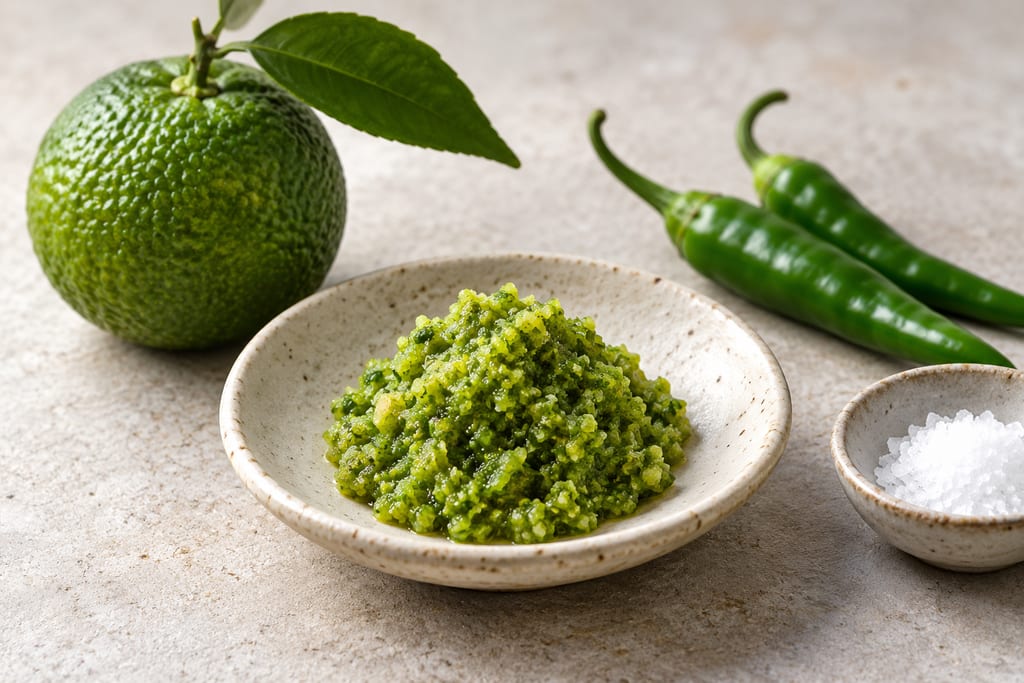
A fresh, uncooked yuzu and green chilli paste inspired by Kyushu’s yuzu kosho, made here as an untested small-batch seasoning rather than a preservation formula.
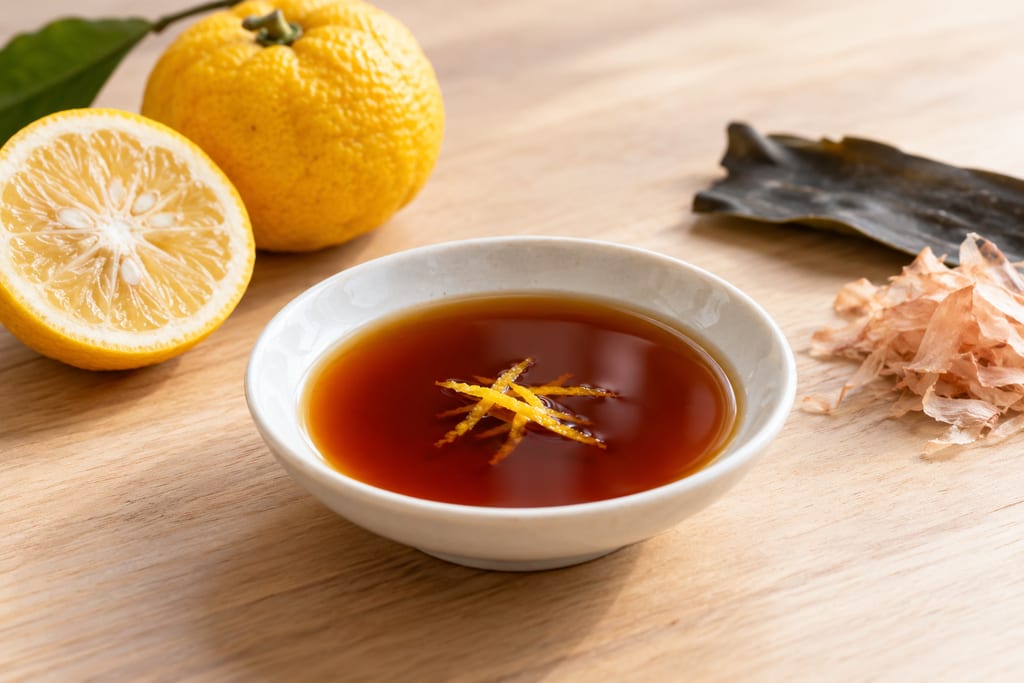
This quick ponzu combines soy sauce, vinegar, hon mirin, kombu, dried bonito and yuzu juice after a brief boil and a warm extraction; the recipe serves five.
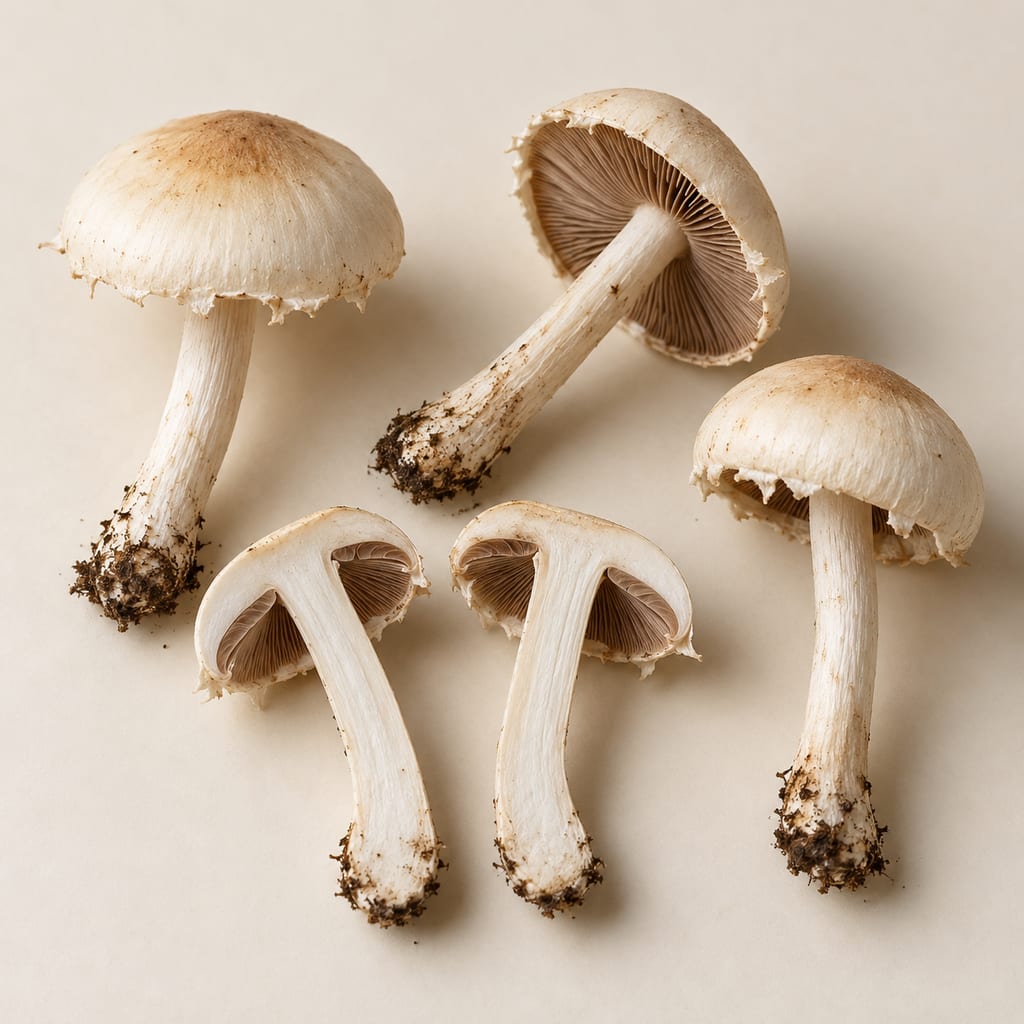
A grassland agaric listed as edible in historical and scientific catalogues for Hong Kong and China. Taxonomic concepts and practical food value vary; the listings do not establish safe identification or culinary practice.
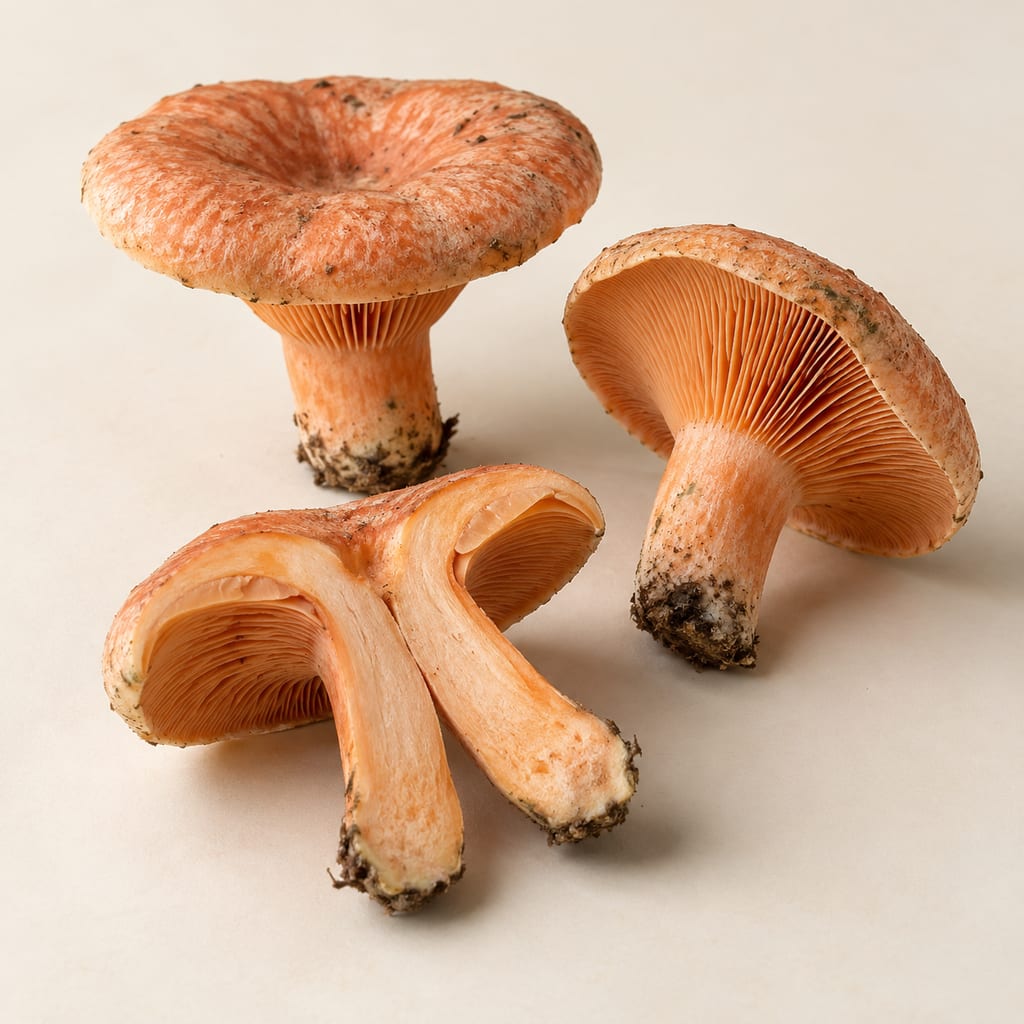
Akahatsu, Lactarius akahatsu, is a wild milkcap of East Asian pine and mixed forests that is sold in Yunnan markets, with its edibility and identity still needing species-level review.
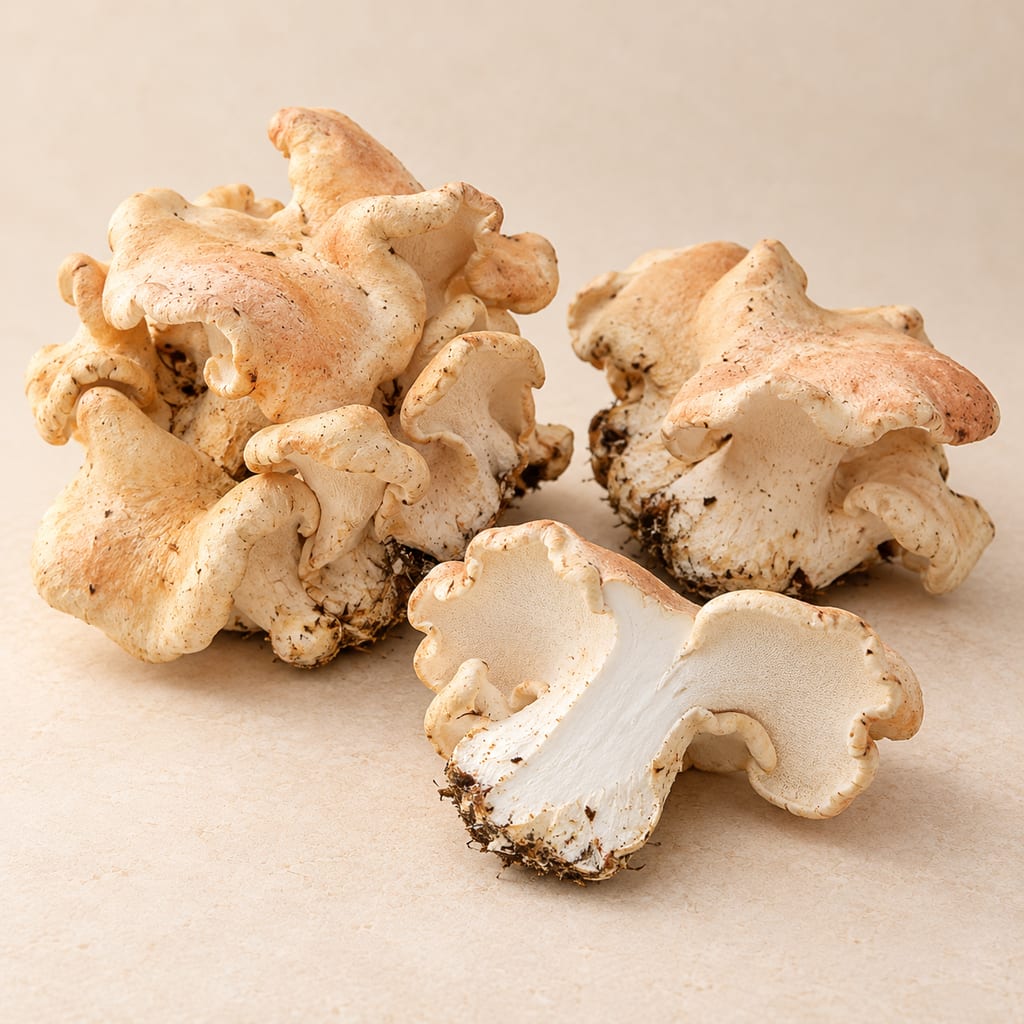
Albatrellus confluens is a ground-growing polypore with fused buff-orange caps. Sources document Chinese market use and regional edibility, but others reject it as too bitter; taxonomy also varies between Albatrellus and Albatrellopsis.
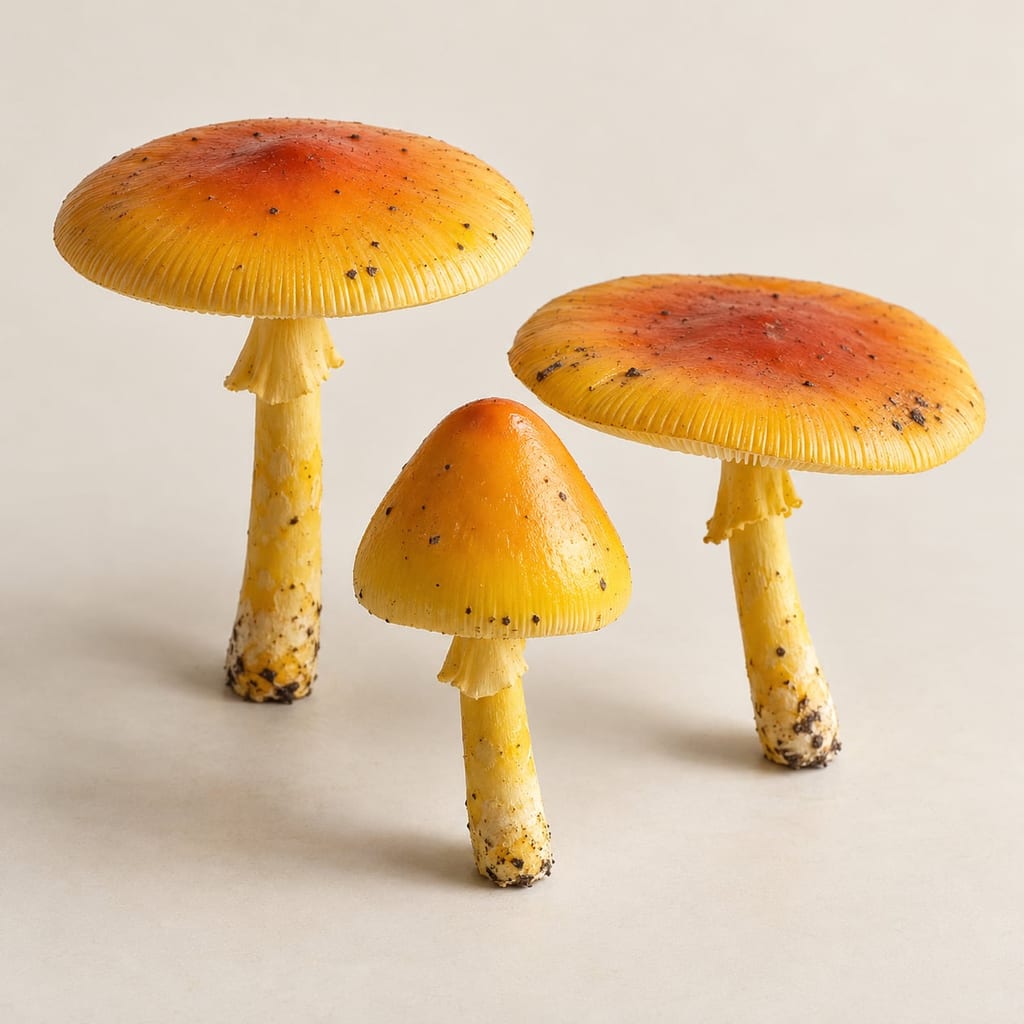
A wild Amanita recorded from China in a 2026 checklist of edible and medicinal fungi. The genus holds deadly species, so this page gives no identification or edibility verdict.

A wild Amanita of China, first reported there and listed as edible in a Yunnan ethnomycology study. The genus contains deadly species, so this page does not support identifying or eating it.
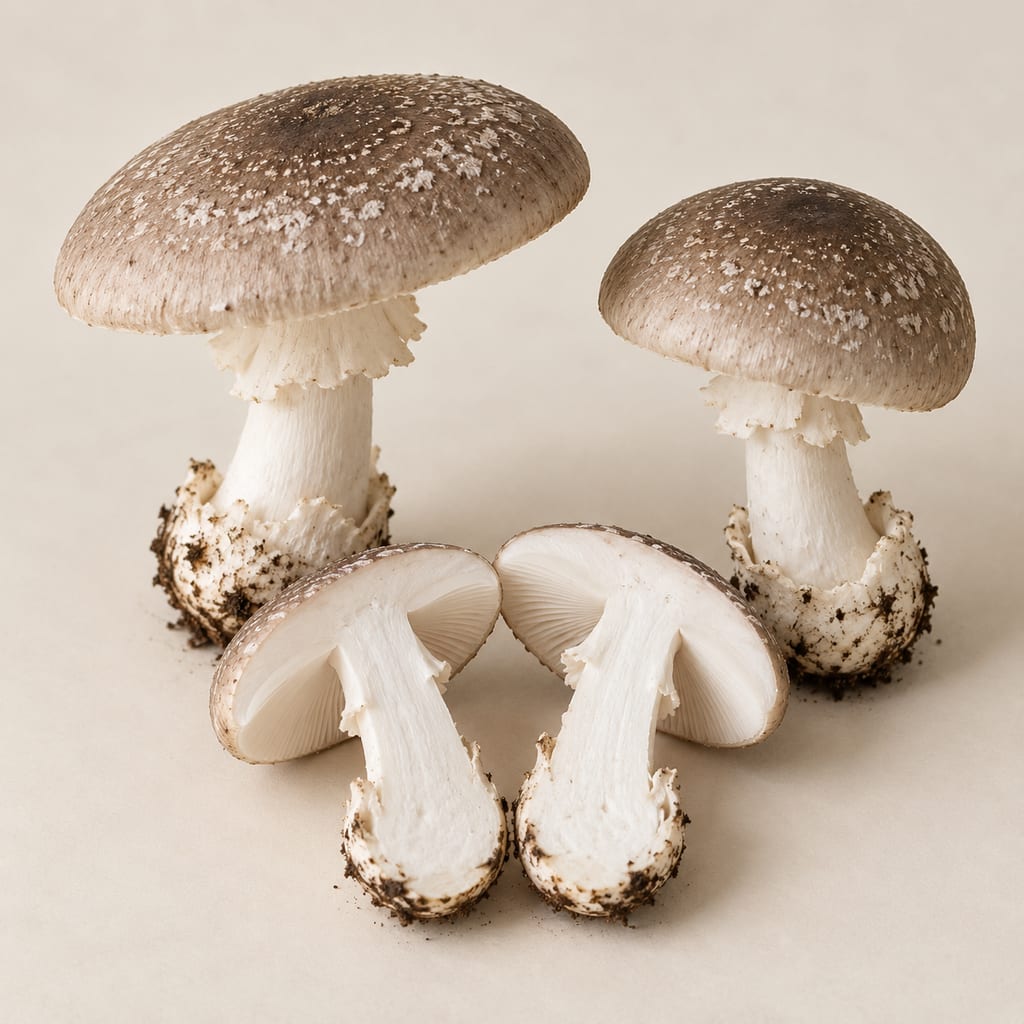
Amanita yuaniana is a Chinese Amanita that a 2023 Yanshan survey and a Yunnan ethnomycology survey list among edible species. No source tests it for safety, and the genus holds the most lethal mushrooms.
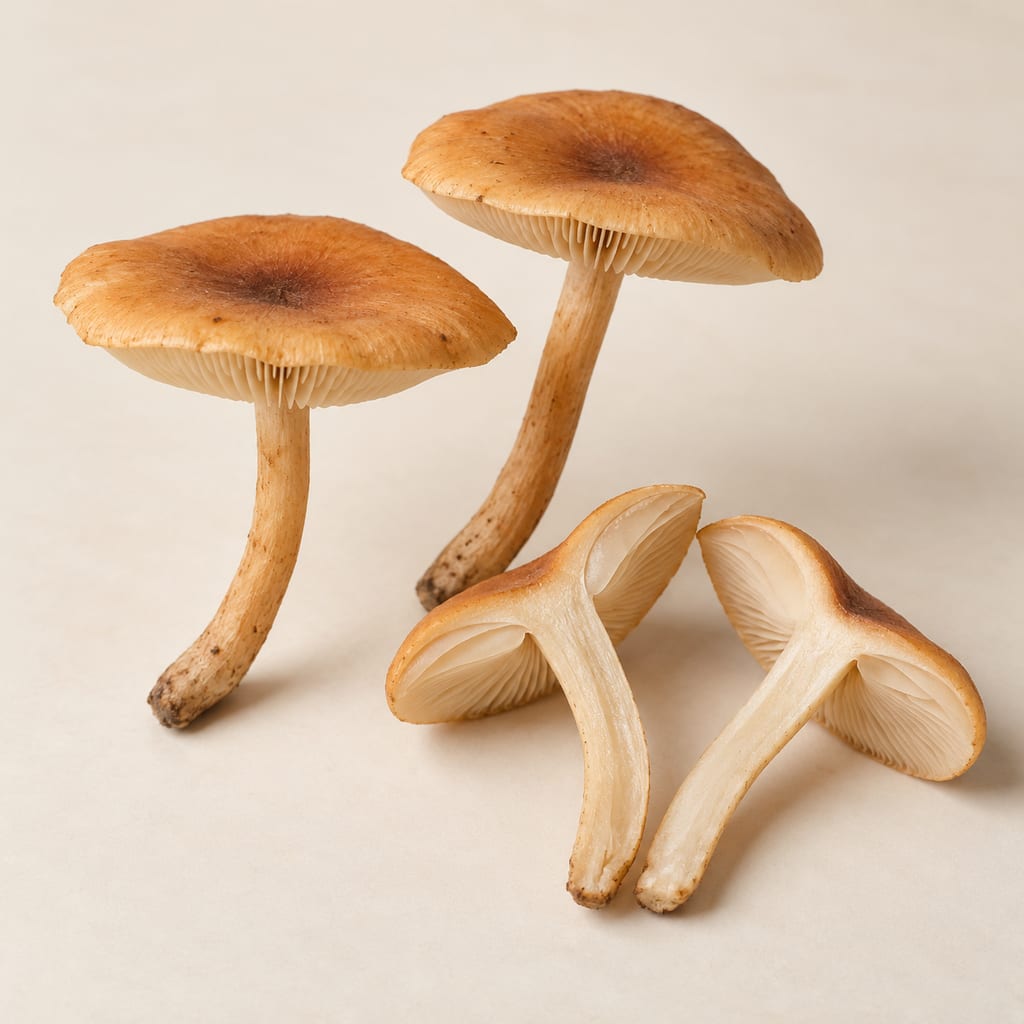
A wood-associated Armillaria recorded in Yunnan and Sichuan, China, and listed as edible in a 2026 Chinese catalogue.
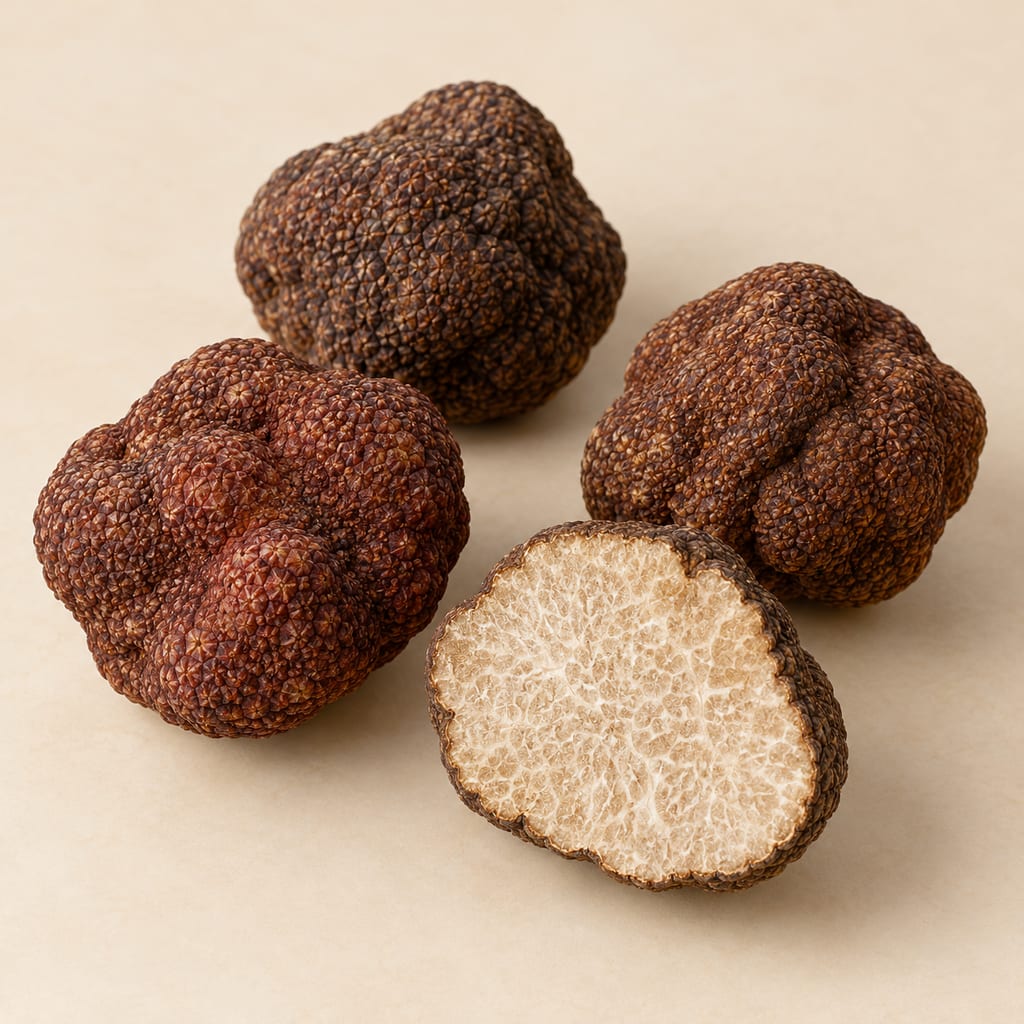
Tuber pseudohimalayense is a wild black truffle from Yunnan, China, listed as edible in a Chinese species catalogue. No independent assessment of its culinary use or safety is available.

Protected Italian vinegar made only from cooked grape must, fermented and aged in a battery of wooden barrels for at least 12 years: sweet, sharp and syrupy.
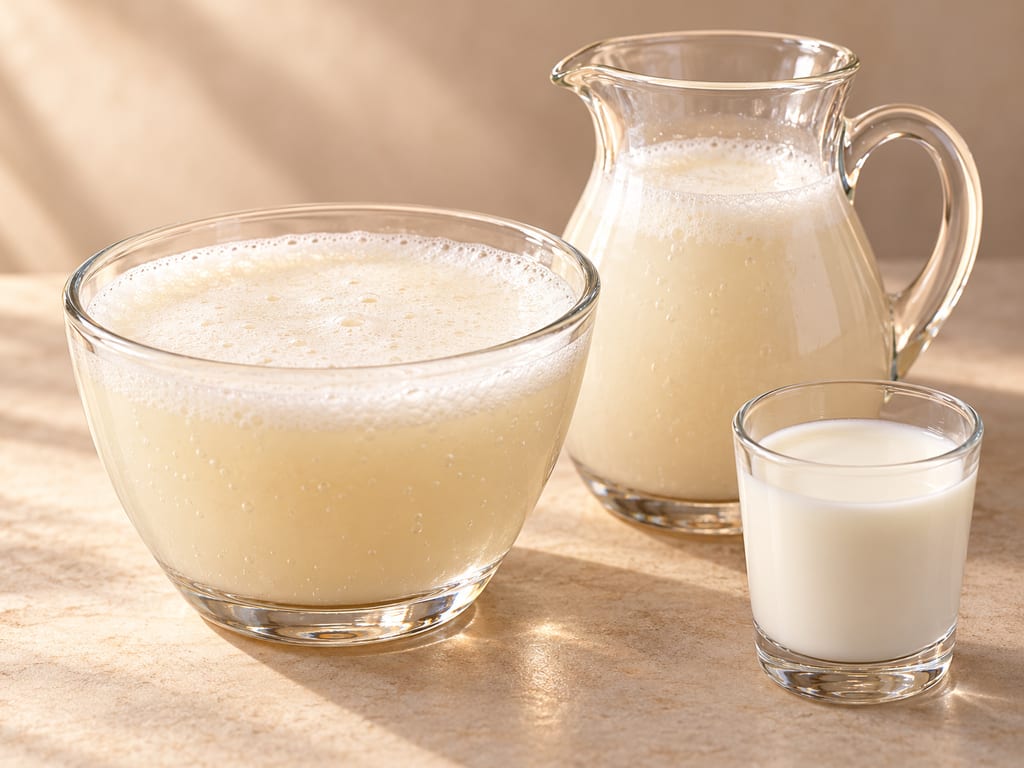
Airag is Mongolia’s fermented mare’s-milk drink, traditionally churned with saved starter in a reusable cowhide khokhuur.

Appam, or hoppers, are South Indian and Sri Lankan rice pancakes made from a fermented coconut-and-rice batter and cooked in a curved pan to a crisp lacy rim and a soft, spongy centre.
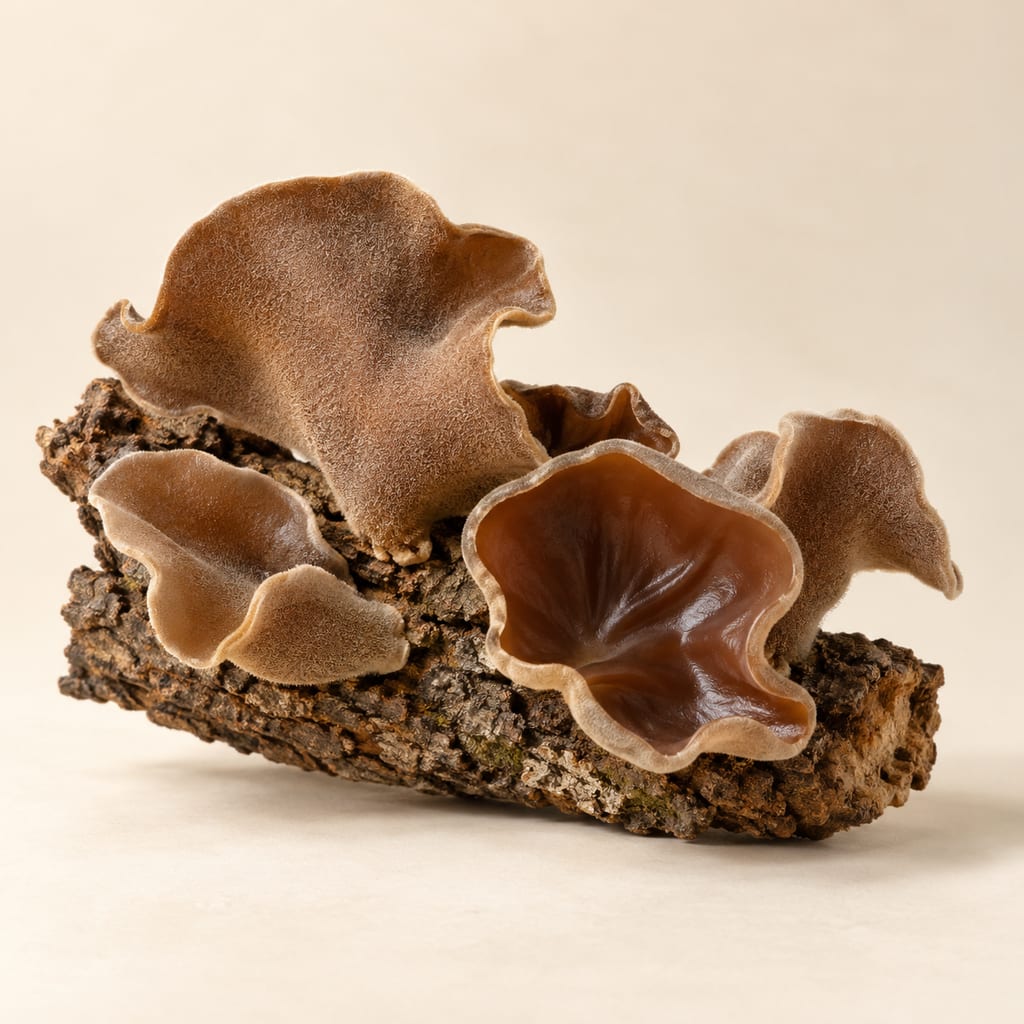
Auricularia tremellosa is a wood ear fungus of the genus that supplies most dried wood ear sold in China; its own food record is thin, and the culinary practice described here comes from the closely related wood ear species.

Ayran is Turkey’s cold, savoury yogurt drink: plain yogurt is loosened with water and lightly salted, then whisked smooth or aerated into a soft cap of foam.
A thin stone griddle used over an open hearth. Norwegian archaeology documents the established tradition from the early Middle Ages; a Viking-period origin is only a cautious suggestion linked to Shetland.

Crushed or milled barley cooked in water until the starch softens and the mixture thickens, the plainest way a northern household turned stored grain into a meal, here with apple and hazelnut.

Black carrot is the anthocyanin-pigmented Eastern carrot (Daucus carota var. atrorubens), the purple root that preceded orange types and still colours kanji and şalgam.
No community contributions have been published for this entry yet.
Sign in to contribute. Published comments and photos are free to read.
WikipediaLead · Botany · Uses
YuzuFruit size and colour; thorns; frost tolerance to minus 7 degrees Celsius.
Believed hybrid of mangshanyeju mandarin and ichang papeda; wild in Tibet and central China; introduced to Japan and Korea in the Tang dynasty.
Japanese production about 27,000 tonnes in 2016; uses in ponzu, yuzu kosho, tea and liquors; winter-solstice bath; yuja-cheong and yuja tea in Korea; grown in California since 1888; USDA ban on fresh imports.
Cited in: A citrus eaten for its fragrance; From the mountains of China to Japan and Korea; Kochi, ponzu and a regional fruit; Ponzu at the table, preserves in the jar; The tree and the season; How yuzu is used
Ministry of Agriculture, Forestry and Fisheries of JapanHistory · Region · Uses
Yuzu Ponzu (Traditional Foods in Japan)Kochi as the leading yuzu prefecture; Chugei district; November harvest; large, aromatic fruit.
Ponzu sales from about 1965 and nationwide from about 1986; ponzu as yuzu juice and vinegar; ponzu soy sauce with kombu, bonito, soy sauce and mirin; Monobe yuzu GI in 2020; uses and a dressing recipe.
Cited in: Kochi, ponzu and a regional fruit; The tree and the season; How yuzu is used
Ministry of Agriculture, Forestry and Fisheries of JapanMethod · Preservation
Yuzu kosho, Fukuoka (Our Local Cuisine)Green chilli and green yuzu peel with salt; kosho means chilli in Kyushu; salt level trades shelf life and green colour against aroma; keeps green colour refrigerated until the next season; frozen portions; Hikosan origin claim; uses.
Cited in: Zest, salt and time: yuzu in preserved seasonings; The tree and the season; Choosing and handling; Notes
Kikkoman CorporationUses · Storage
Ponzu Sauce (Kikkoman cookbook glossary)Ponzu as citrus-based seasoning; citrus used (yuzu, sudachi, kabosu, shikuwasa, lemon); basic ingredients citrus juice, soy sauce and vinegar; optional kombu, bonito and shiitake.
Opened commercial ponzu is refrigerated and used within two to four months, following the label.
Cited in: Ponzu at the table, preserves in the jar; Zest, salt and time: yuzu in preserved seasonings
Agency for Cultural Affairs, JapanHistory · Uses
Traditional 100-Year Food: Yuzu cuisine (Kochi)Chugei area of eastern Kochi, trees said to be over 300 years old, the Nakaoka Shintaro tradition; yuzu juice called yunosu used in place of vinegar; yuzu sushi and the local dishes that use yuzu.
Cited in: Yuzu juice as a vinegar
PLoS OneTaxonomy · Origin
Hybrid Origins of Citrus Varieties Inferred from DNA Marker Analysis of Nuclear and Organelle GenomesYuzu close to Citrus ichangensis, agreeing with Swingle’s proposal that it is a chance seedling of that species.
Cited in: From the mountains of China to Japan and Korea
Breeding ScienceHistory · Cultivation
Citrus breeding, genetics and genomics in JapanCitrus in Japan arrived through prehistoric and historical introductions and natural hybrids; endemic tachibana and shiikuwasha; yuzu among the cultivated types of south-western coastal Japan.
Cited in: From the mountains of China to Japan and Korea
Foods (MDPI)Aroma · Composition
Antistress Effects of Terpinen-4-ol and Compounds of Mimicked Yuzu Synthetic Fragrance in Humans and MiceComposition of cold-pressed versus steam-distilled yuzu oil as reproduced in synthetic fragrances: limonene, gamma-terpinene, p-cymene, myrcene, pinene, linalool, terpinen-4-ol.
Cold pressing squeezes the oil from the vacuoles of the flavedo.
Cited in: Peel oil and juice
Nutrition Research and PracticeComposition
Anti-obesity effects of ethanol extract of green Citrus junos peel enriched in naringin and hesperidin in vitro and in vivoGreen yuja peel holds more naringin and hesperidin and has higher antioxidant activity than yellow peel; flavonoids naringin, hesperidin, neohesperidin, narirutin; peel richer in vitamin C and phenolics than flesh.
Cited in: Peel oil and juice
Antioxidants (MDPI)Composition · By products
Nomilin from Yuzu Seed Has In Vitro Antioxidant Activity and Downregulates Melanogenesis in B16F10 Melanoma Cells through the PKA/CREB Signaling PathwayYuzu peel and seed contain vitamin C, citric acid and polyphenols.
Cited in: Peel oil and juice
Antioxidants (MDPI)Range · Uses
Skin Improvement with Antioxidant Effect of Yuja (Citrus junos) Peel Fractions: Wrinkles, Moisturizing, and WhiteningYuja found in Sichuan, Hubei, Yunnan and Tibet and in Korea; prepared as sugar pickles, tea, dressing and vinegar.
Cited in: A citrus eaten for its fragrance; From the mountains of China to Japan and Korea; Ponzu at the table, preserves in the jar; How yuzu is used
Food Chemistry: XOrigin · Composition
A combination of commercial and traditional food-source-derived enzymatic treatment acts as a potential tool to produce functional yuzu (Citrus junos) powderOriginated in China and introduced to Japan and other countries around the 4th to 8th centuries; peel-eatable fruit with a potent aroma; enzyme treatment reduced bitterness at the human receptor TAS2R16 by about half.
Cited in: A citrus eaten for its fragrance; From the mountains of China to Japan and Korea; Peel oil and juice