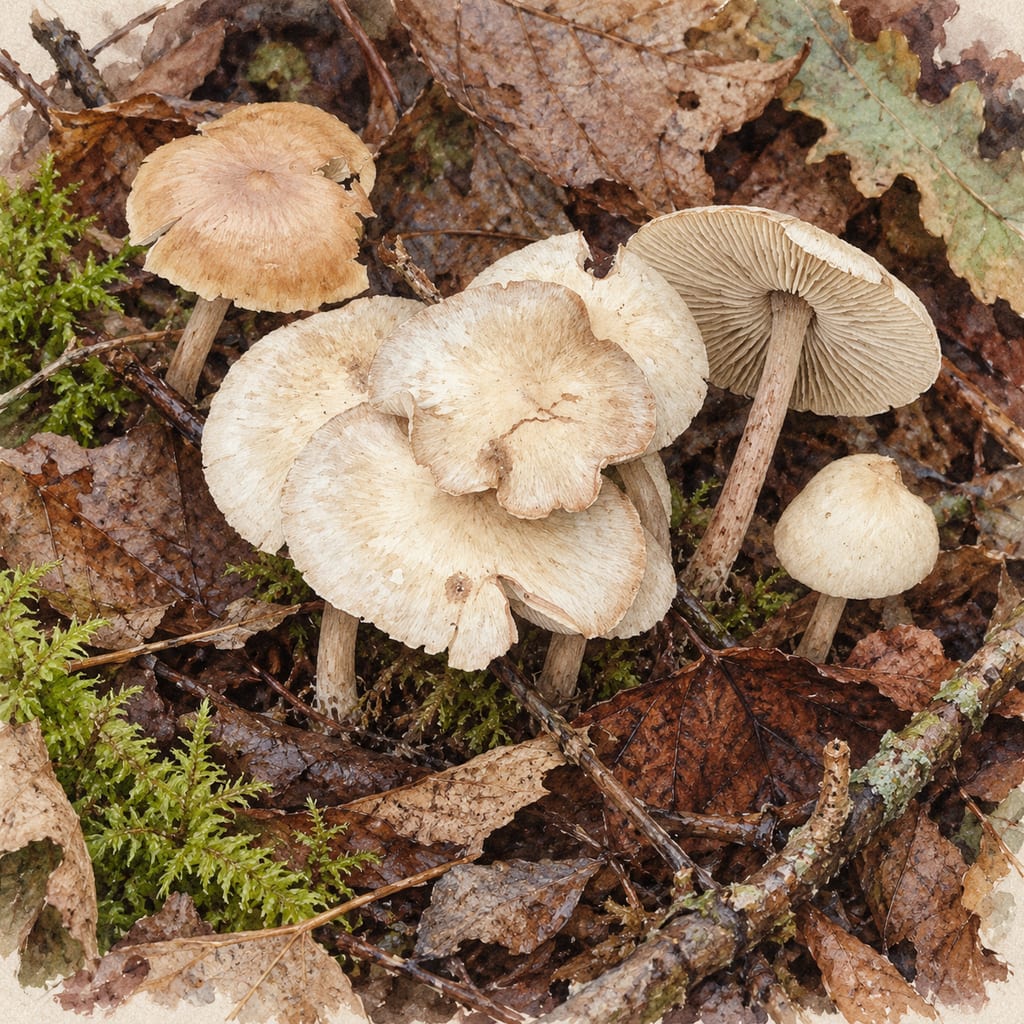
Collybia confluens
A clustering woodland agaric, now named Collybiopsis confluens, documented as eaten in one Mexican lake basin and listed as edible in older Hong Kong and Malawi checklists. Its food status varies by region.
 FermenteaWhere food goes to change
Substrates
A grassland agaric listed as edible in historical and scientific catalogues for Hong Kong and China. Taxonomic concepts and practical food value vary; the listings do not establish safe identification or culinary practice.
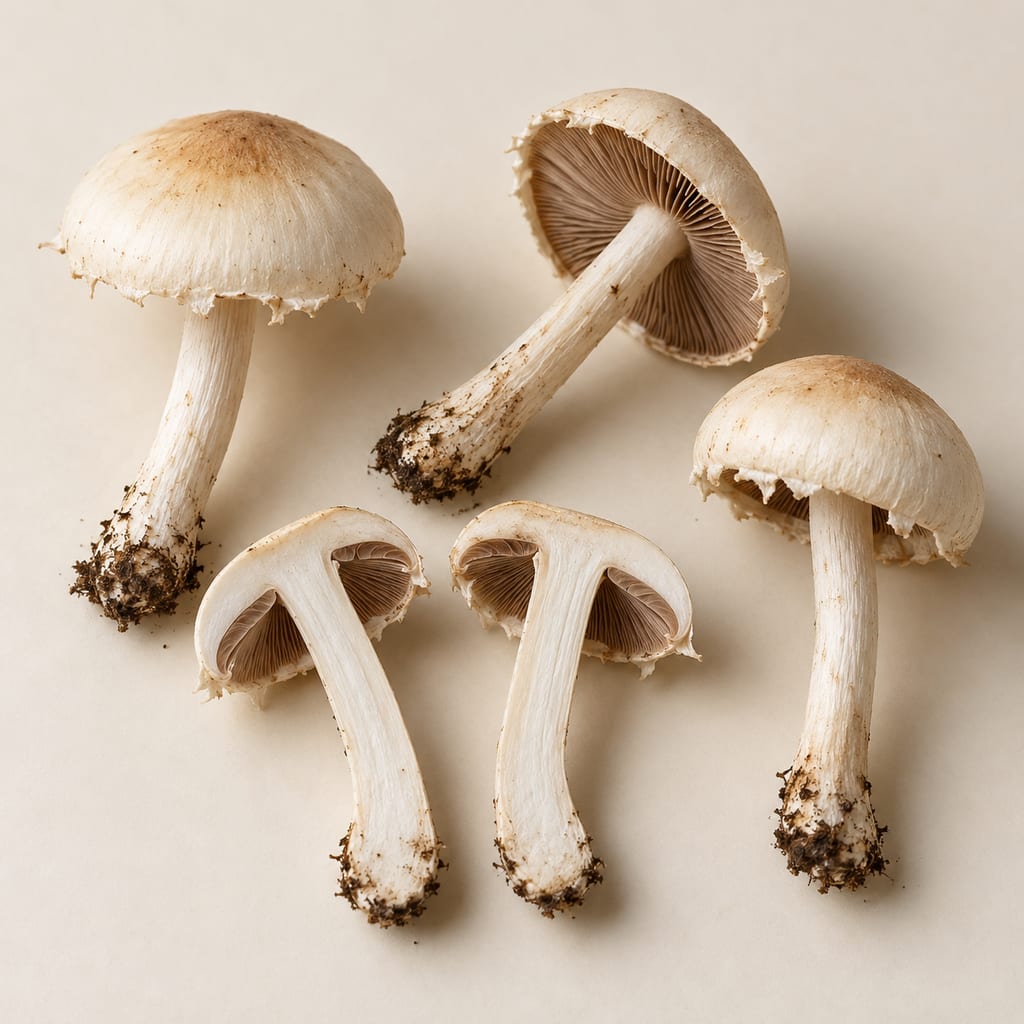
The name followed here is Agrocybe dura (Bolton) Singer, based on Agaricus durus Bolton (1788). Index Fungorum accepts the name and Species Fungorum treats Agrocybe molesta as a synonym, although some regional accounts retain that name or apply A. dura to a narrower or broader concept. North American sources note overlap with the A. praecox group and that microscopy may be needed. These records should not be collapsed into one certain field concept. [Index Fungorum](https://www.indexfungorum.org/names/namesrecord.asp?RecordID=356857); [Species Fungorum](https://www.speciesfungorum.org/names/names.asp?strGenus=Agrocybe); [MushroomExpert](https://www.mushroomexpert.com/agrocybe_dura.html); [E-Flora BC](https://linnet.geog.ubc.ca/Atlas/Atlas.aspx?sciname=Agrocybe+dura).
Field descriptions place this saprotrophic, brown-spored agaric in lawns, grass, meadows, pastures and nutrient-rich disturbed soils. They describe a pale cap that can crack as it dries or ages, darkening gills and a fragile veil or ring zone. These features explain common names such as cracked-cap agrocybe; they are not a safe field key. It is not the poplar-associated pioppino Cyclocybe cylindracea, often called Agrocybe aegerita in older literature. [Iowa State Herbarium](https://www.herbarium.iastate.edu/files/fungi/Agrocybe%20dura%20%28Bolton%29%20Singer.pdf); [Naturalis](https://mushrooms.linnaeus.naturalis.nl/linnaeus_ng/app/views/species/nsr_taxon.php?id=100119).
Boa's FAO overview lists A. dura as edible and medicinal in its Hong Kong country record, citing Chang and Mao (1995); a 2026 Chinese species catalogue also lists it among edible and medicinal fungi. These sources establish country-level classifications, not a specific recipe, preparation method, household survey or assurance that an unidentified wild specimen is safe. Other food guides differ about practical quality, so the record should preserve the source claims without turning them into foraging advice. No specific regional dish or preservation practice was substantiated. A medicinal catalogue label is not a health claim. [FAO Annex 2](https://www.fao.org/4/y5489e/y5489e13.htm); [Wu et al. 2026](https://castjournals.cast.org.cn/joweb/jwxb/CN/1256540739983519893).
Seasonal summaries vary: a Naturalis guide gives spring to summer, an Iowa State sheet says summer, a Norfolk reserve list gives spring to late summer, and a North American account allows spring through fall with May most likely in temperate areas. Norfolk records include June and July observations and an older October record. A Polish inventory documents a voucher collected on 11 June 1971 near Szaflary Dolne and Nowy Targ. These are local observations, not a universal calendar. [Naturalis](https://mushrooms.linnaeus.naturalis.nl/linnaeus_ng/app/views/species/nsr_taxon.php?id=100119); [Iowa State Herbarium](https://www.herbarium.iastate.edu/files/fungi/Agrocybe%20dura%20%28Bolton%29%20Singer.pdf); [Norfolk Fungus Study Group](https://thenfsg.co.uk/Taxon_page.php?Taxon=Agrocybe+dura); [Komorowska 2023](https://www.botany.pl/images/Books/Komorowska_2023_Agaricomycotina.pdf).
Photographic records include Croatia, Kansas and Trzciana in Poland, with dates and confidence limits described in the image dossier. The index's Hong Kong and China entries relate to food-status sources, not collection sites for these field observations. The two evidence types should remain separate. [Wikimedia Commons image records](https://commons.wikimedia.org/wiki/Category:Agrocybe_dura).
Pale Agrocybe species overlap in appearance and the limits of the A. dura concept vary among regional sources. A photo, cap colour, cracking, habitat or season cannot establish edible identity. The available food records justify reporting catalogue claims, not recommending wild collection or consumption. The history period remains unknown: a 1995 citation is a dated attestation, not the beginning of use. [MushroomExpert](https://www.mushroomexpert.com/agrocybe_dura.html); [E-Flora BC](https://linnet.geog.ubc.ca/Atlas/Atlas.aspx?sciname=Agrocybe+dura).
Country-level FAO edible-and-medicinal list; it does not identify a collection locality.
Country-level scientific edible-and-medicinal catalogue; no particular collection locality or dish is given.
A clustering woodland agaric, now named Collybiopsis confluens, documented as eaten in one Mexican lake basin and listed as edible in older Hong Kong and Malawi checklists. Its food status varies by region.
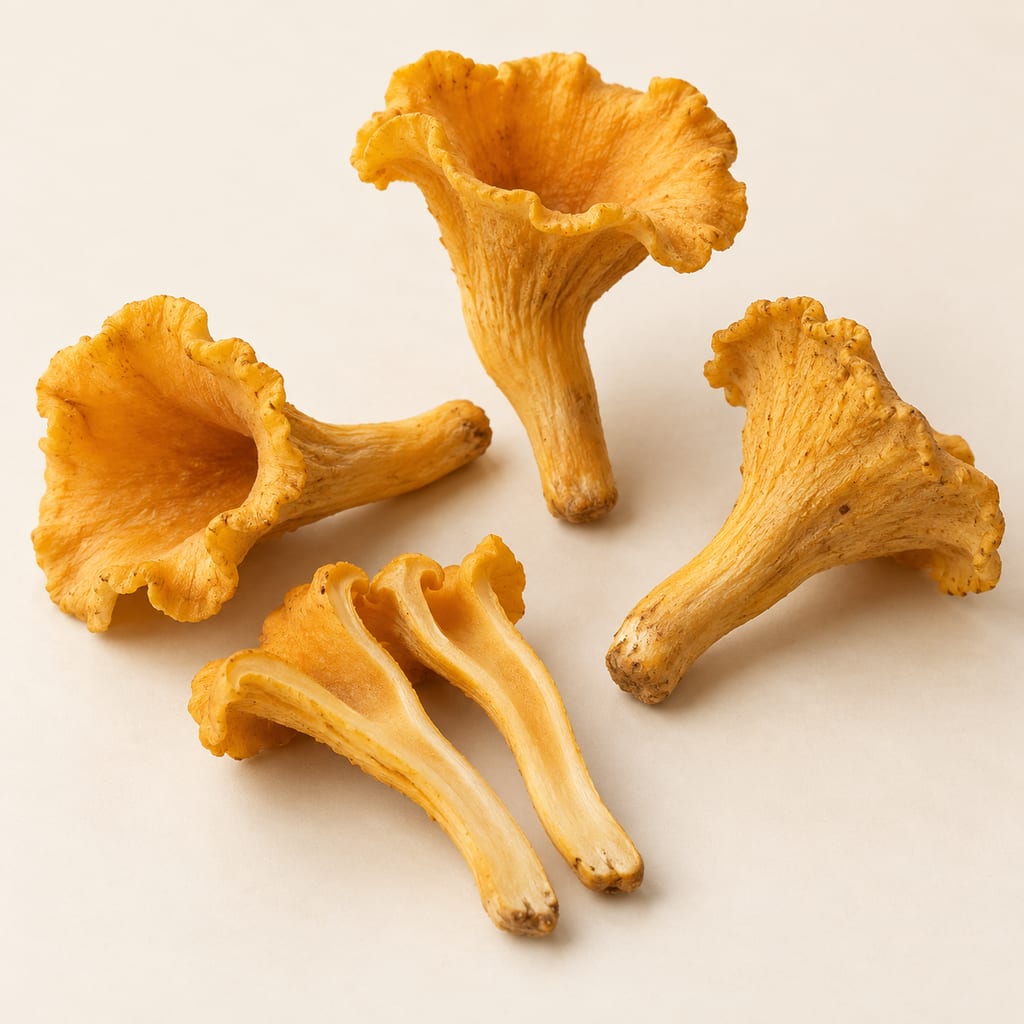
A golden funnel mushroom described from Hong Kong and documented from China; reported as food in several regions, with African taxonomy unresolved.
No community contributions have been published for this entry yet.
Sign in to contribute. Published comments and photos are free to read.
Index FungorumTaxonomy
Agrocybe dura (Bolton) SingerAccepted name and basionym.
Cited in: Name and taxonomic scope
Species FungorumTaxonomy
Agrocybe genus searchSynonym treatment of Agrocybe molesta.
Cited in: Name and taxonomic scope
MushroomExpertIdentity · Season
Agrocybe duraField concept, habitat, season and similarity cautions.
Cited in: Name and taxonomic scope; Safety and limits
E-Flora BCTaxonomy
Agrocybe duraRegional concept and similarity cautions.
Cited in: Name and taxonomic scope; Safety and limits
Iowa State University HerbariumIdentity · Season
Agrocybe duraDescription, habitat and summer timing.
Cited in: Name and taxonomic scope; Habitat, seasons and recorded places
Naturalis Interactive GuideHabitat · Season
Agrocybe duraGrass and disturbed habitats; spring-to-summer occurrence.
Cited in: Name and taxonomic scope; Habitat, seasons and recorded places
FAOFood history
Wild edible fungi: a global overview — Annex 2Historical Hong Kong edible-and-medicinal list, attributed to a 1995 source.
Cited in: Food-status records and uncertainty
MycosystemaFood history
Species cataloging of edible and medicinal fungi in China2026 Chinese catalogue includes Agrocybe dura.
Cited in: Food-status records and uncertainty
Norfolk Fungus Study GroupLocations · Season
Agrocybe dura recordsDated Norfolk observations.
Cited in: Habitat, seasons and recorded places
KomorowskaLocations · Season
The AgaricomycotinaPolish inventory voucher and collection date/locality.
Cited in: Habitat, seasons and recorded places
Wikimedia CommonsImage provenance
Agrocybe dura photographsPhoto leads and associated observation metadata.
Cited in: Habitat, seasons and recorded places