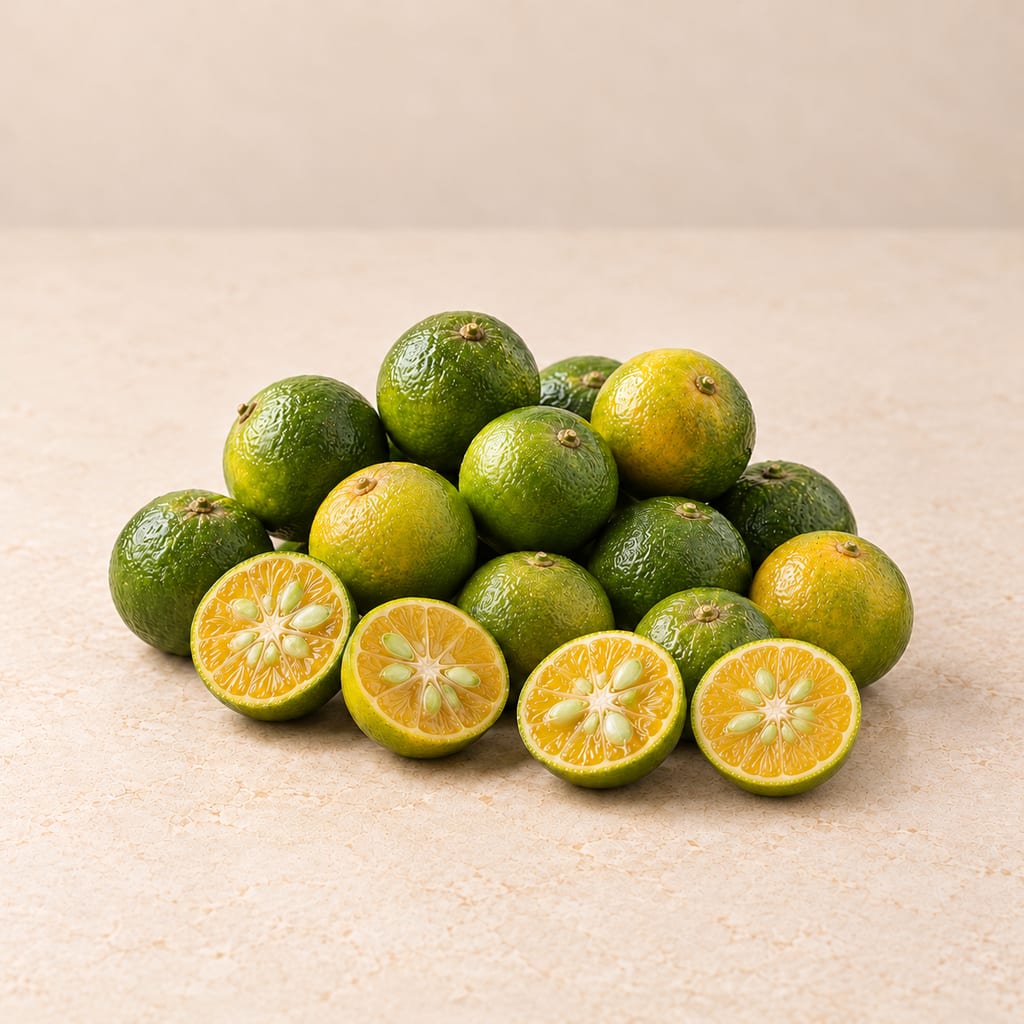
Calamansi
Calamansi is a small, very sour kumquat-mandarin hybrid, Philippine cooking’s all-purpose citrus, squeezed into soy sauce, fish sauce, broths and dips.
 FermenteaWhere food goes to change
Mushrooms
A golden funnel mushroom described from Hong Kong and documented from China; reported as food in several regions, with African taxonomy unresolved.
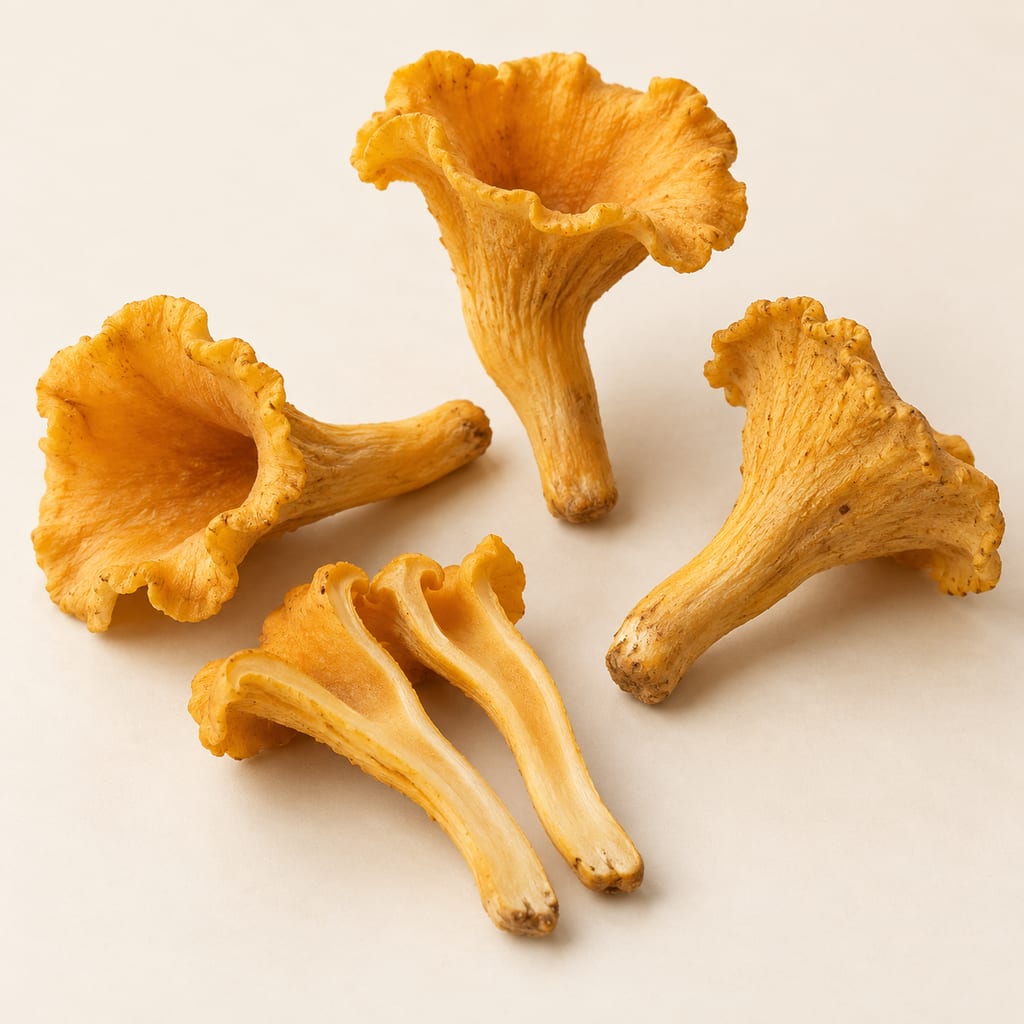
Craterellus aureus is a funnel-shaped mushroom among the chanterelle allies. Fresh fruitbodies in the Chinese taxonomic account are golden yellow to orange, with wavy or lobed caps and a hollow stem that often curves. The underside is nearly smooth or bears low folds rather than the thin, blade-like gills of many cap mushrooms. The cap and stem meet without a sharp boundary. These visible traits explain its golden-chanterelle description, but do not identify a specimen by themselves: related Craterellus species overlap in colour and form.
Berk. and M.A. Curtis named the species in 1860 from Hong Kong. Modern taxonomy revisited the name using collections and DNA sequence comparisons. A 2022 study analysed ribosomal markers from Chinese specimens and compared them with material assigned to Craterellus luteus; its authors proposed C. luteus as a synonym of C. aureus. They also cautioned that southern Chinese diversity may include a larger species complex. Taxonomic databases do not agree on family placement: the Chinese paper uses Hydnaceae, while other resources use Cantharellaceae. This account follows the study's usage for the focal taxon without implying that placement is universally settled.
The reported range is disjunct rather than continuous. Voucher-backed Chinese collections support the name in several southern and eastern localities. Historical literature also reports it from Hong Kong and central Africa. A 2025 assessment calls for taxonomic work to test whether African material is a separate species. Those country-level reports establish that the name was used there, not that every population belongs to one confirmed taxon.
The Chinese research provides the strongest locality-level evidence in the sources reviewed. Collections from Hainan and Jiangxi were preserved as vouchers and examined in the taxonomic analysis. Hainan material includes Limushan and Jianfengling; Jiangxi material includes named villages in Ganzhou and Nanchang. Listed collection dates run from 9 June to 27 July, at elevations of 180 to 850 metres. These are collection records, not a complete fruiting calendar.
The Chinese collections grew on soil in forests dominated by Castanea and Quercus. The published figure shows five collections in panels A through E, each linked in the caption to a voucher. Panel F depicts Craterellus fulviceps and is not a reference for C. aureus. Voucher-linked images illustrate studied forms, but they are not an identification key for an unexamined mushroom.
FAO's country annex lists C. aureus as edible for Hong Kong and the Democratic Republic of the Congo, citing earlier regional literature. The annex is a compilation and gives no recipe, exact collection locality, or preparation method. Its separate global edible list is a classification rather than a cooking guide.
The Chinese taxonomic paper reports that mushrooms identified as C. aureus are sold as food in Yunnan markets, drawing on earlier market literature. This supports a report of regional trade and use, not a detailed account of preparation or a toxicological study. The Red List assessment also records edible use from cited sources while flagging African taxonomy for review.
These sources support saying that the mushroom has been reported as food or sold as food in particular regions. They do not justify a universal recommendation, a cooking time, or a claim that colour and funnel shape establish edibility. The sources reviewed establish no species-specific fermentation method.
Voucher dates in Hainan and Jiangxi show collections during June and July at those Chinese localities. They do not show when fruiting begins or ends throughout China, Hong Kong or Africa. FAO's historic food-use entries have no season attached, and the Red List account supplies no species-specific calendar; a general rainy-season claim would exceed the evidence.
Hong Kong is the historical type locality and appears in the FAO food-use compilation, but those records provide no specimen coordinates. Yunnan appears as a province-level market context, not an exact wild collection site in the 2022 paper. In the Democratic Republic of the Congo, FAO records country-level food use; the Red List says African identifications need reassessment. These are different evidence types and should not appear as equivalent verified map pins.
The Hainan and Jiangxi collection localities can be mapped at locality precision with their voucher and source attached. The paper supplies elevations but not specimen coordinates. No coordinates are assigned here: town-centre markers or photo metadata would imply precision the source does not give.
Published food reports document local knowledge and trade; they do not identify a mushroom in someone's basket. Golden colour and funnel shape are not unique to C. aureus, and African reports carry an unresolved taxonomic question. Voucher-backed photographs illustrate the Chinese taxonomic concept, not a field test for edibility.
The sources reviewed provide no species-specific preparation method, storage life, nutrient profile or safe dose. This account does not invent one. Any local use belongs in the context of regional expertise and correctly identified material, not generalized across the disjunct range. The absence of a poisoning report in sources checked is not evidence that the mushroom is harmless.
Historical type locality and country-level food-use report; no exact collection site or coordinates.
Voucher-backed occurrence locality; no coordinates are provided and the record does not establish local food use.
Voucher-backed occurrence locality; no coordinates or local food use are established by this collection record.
Voucher-backed occurrence locality; no coordinates or local food use are established by this collection record.
Voucher-backed occurrence locality; no coordinates or local food use are established by this collection record.
Regional market report says mushrooms identified as C. aureus are sold as food; this is not a voucher-localized collection.
Country-level food-use listing only. The Red List assessment says the African identifications need taxonomic reassessment.
Calamansi is a small, very sour kumquat-mandarin hybrid, Philippine cooking’s all-purpose citrus, squeezed into soy sauce, fish sauce, broths and dips.
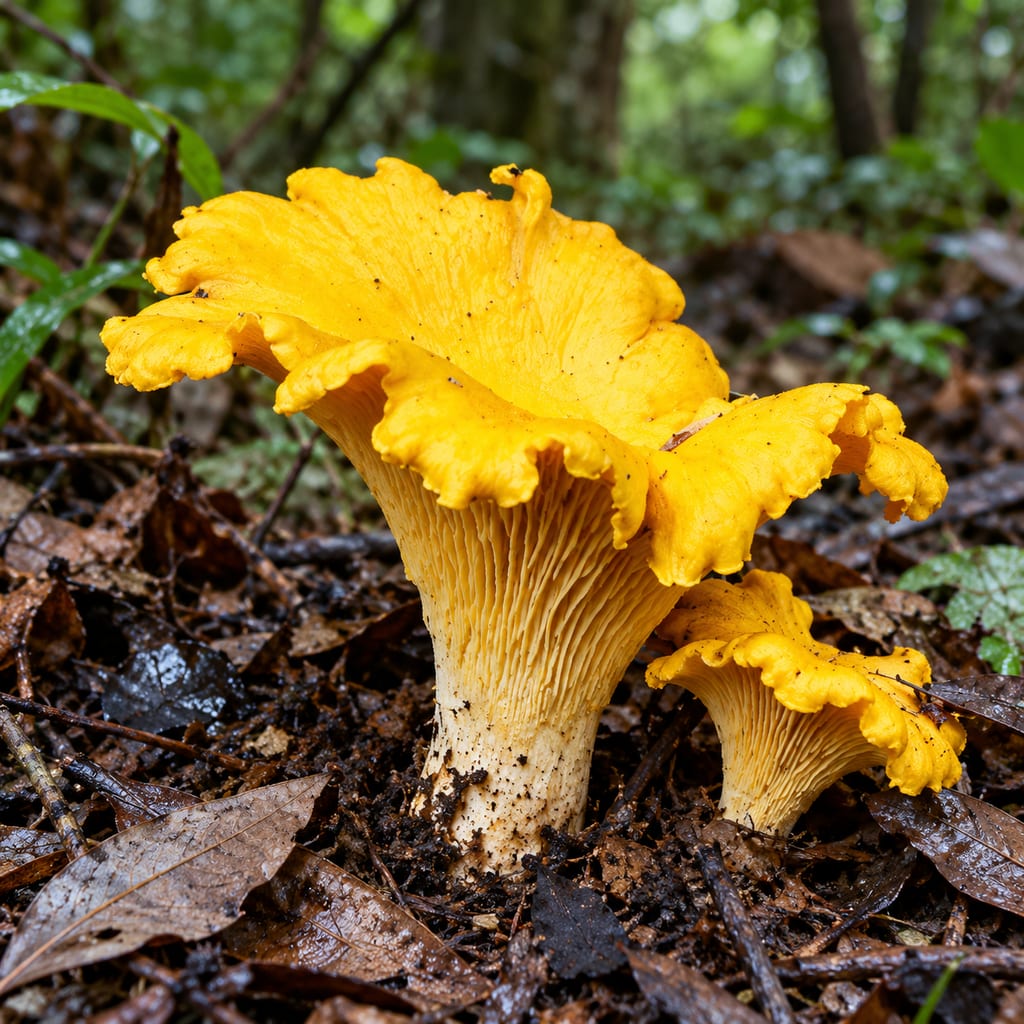
Cantharellus macrocarpus is a large yellow-orange chanterelle described from southern China in 2021. It is listed as edible in a national catalogue; no species-specific food study was found.
No community contributions have been published for this entry yet.
Sign in to contribute. Published comments and photos are free to read.
Food and Agriculture Organization of the United NationsHistorical food use · Food classification
Wild edible fungi: a global overview of their use and importance to people, Annexes 2–3Annex 2 lists C. aureus as edible for Hong Kong and the Democratic Republic of the Congo, citing earlier regional sources; gives no local preparation or fruiting season. It is a literature compilation.
Cited in: Regional food reports and their limits; Season and geography are local observations; Reading the name with care
Journal of Fungi 8(7):684Taxonomy · Morphology · Voucher localities · Season · Food trade · Image reference
A Contribution to Knowledge of Craterellus (Hydnaceae, Cantharellales) in China: Three New Taxa and Amended Descriptions of Two Previous SpeciesTwo-locus analysis and proposed C. luteus synonymy; southern China species-complex caveat; morphology, habitat, five Hainan/Jiangxi voucher collections with dates/elevations; Yunnan market report; Figure 3 A-E are C. aureus vouchers and F is C. fulviceps. Article CC BY 4.0.
Cited in: A golden funnel with a complicated range; What the voucher collections establish; Regional food reports and their limits; Season and geography are local observations; Reading the name with care
IUCN Red List of Threatened SpeciesDistribution · Ecology · Food use · Taxonomic caution
Craterellus aureus — Red List assessmentDisjunct Asian and Central African reports; soil fruiting in forest and plantations; edible use cited from earlier sources; African records need taxonomic research.
Cited in: A golden funnel with a complicated range; Regional food reports and their limits; Season and geography are local observations; Reading the name with care
Species Fungorum / Index FungorumTaxonomy · Nomenclature · Type locality
Craterellus aureus, nomenclatural recordName authority and 1860 publication, Hong Kong type locality, listed synonym C. luteus.
Cited in: A golden funnel with a complicated range