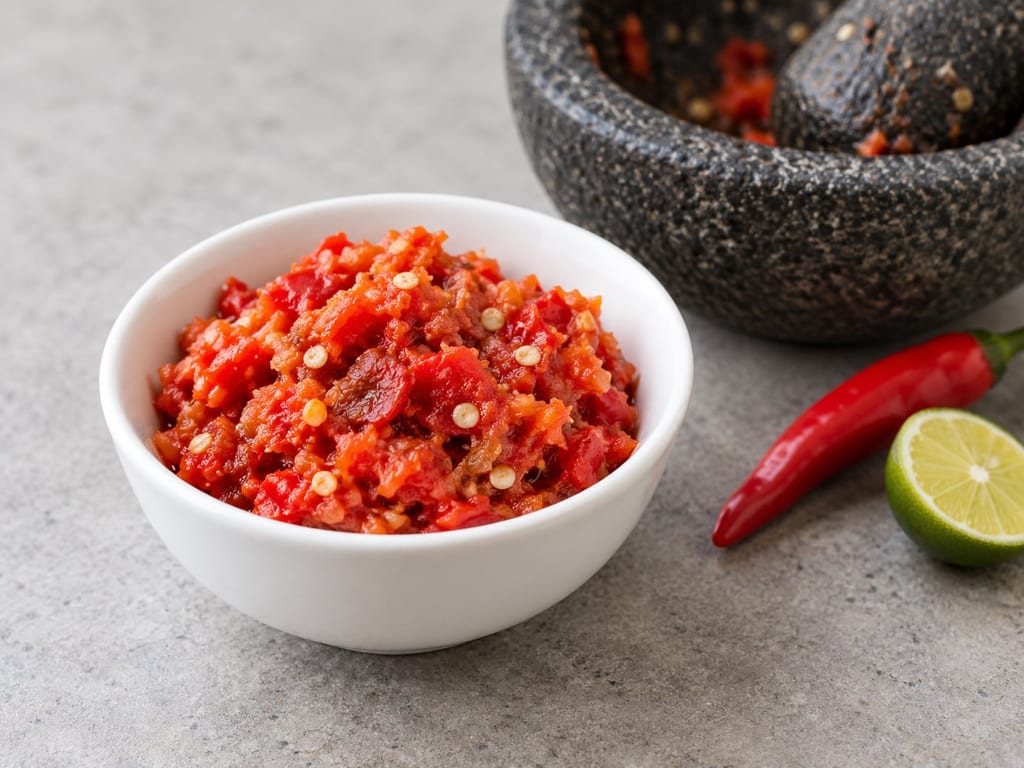
Sambal belacan-style fresh relish
Red chillies pounded with belacan shrimp paste, then mixed with lime or calamansi and sugar for a fresh relish. Contains crustacean shellfish.
 FermenteaWhere food goes to change
Acids
Calamansi is a small, very sour kumquat-mandarin hybrid, Philippine cooking’s all-purpose citrus, squeezed into soy sauce, fish sauce, broths and dips.
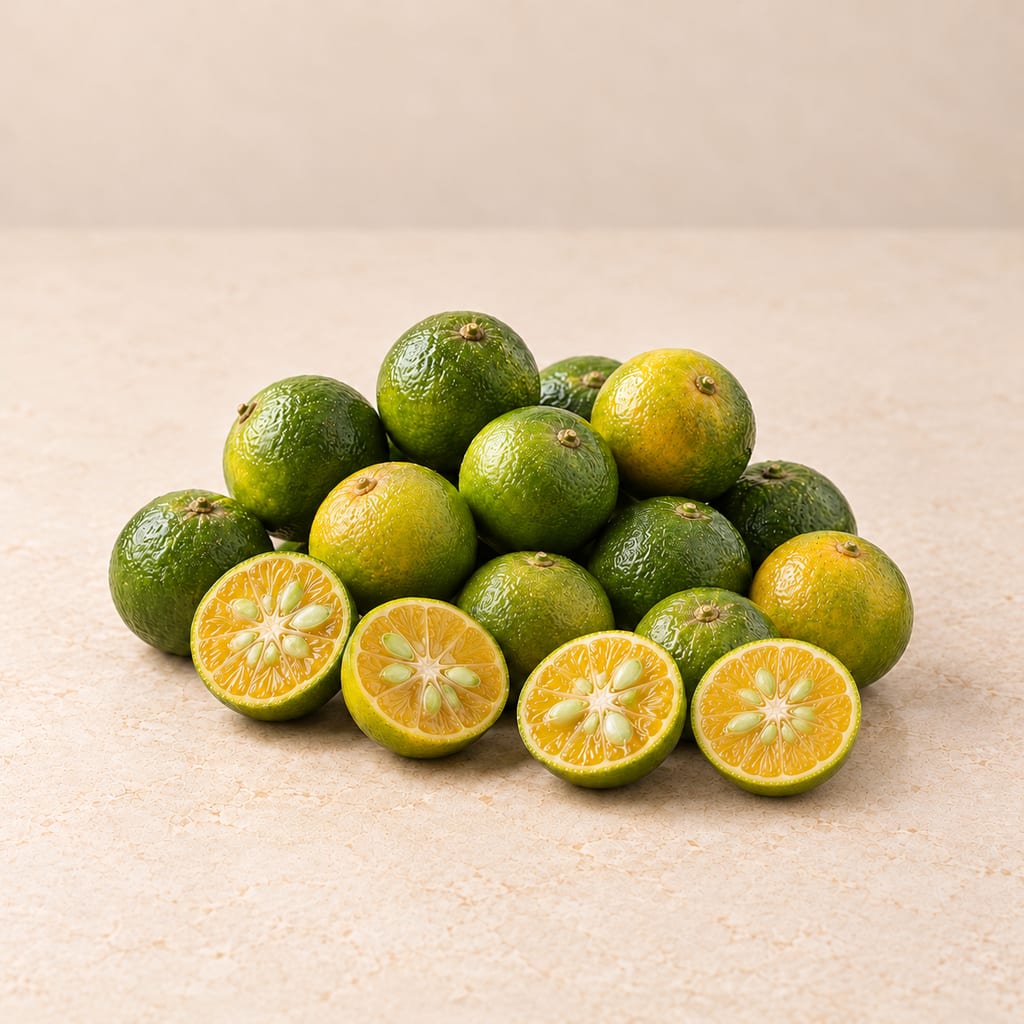
Calamansi is a small round citrus, usually 25 to 35 millimetres across and sometimes up to 45, with thin, smooth skin that is green when young and turns orange as it ripens. Each fruit holds 8 to 12 seeds, and the ripe pulp and juice are the orange of a tangerine. The juice is very sour while the thin peel is sweet, and the aroma is distinctive: tasters in Florida have described fully ripe fruit as carrying notes of apricot, tangerine, lemon, pineapple and guava. It is a hybrid of a kumquat and another citrus, probably a mandarin, and is classed by botanists as Citrus × microcarpa or, in older usage, Citrofortunella microcarpa.
The names vary with the place. In English it is also called calamondin, Philippine lime or Philippine lemon; calamansi is the Philippine English spelling of the Tagalog kalamansi, and in Malay it is limau kasturi. Calamondin is the usual horticultural name for the same plant, often grown as an ornamental or bonsai, while calamansi names the fruit as a food crop in the Philippines. Lime or lemon is the common stand-in, but it gives an acid without the sweet peel and tangerine-like perfume of a ripe calamansi.
In the fermented kitchen calamansi is the fresh sour note added at the table. It is squeezed into soy sauce to make the dip toyomansi, into fish sauce, and over cencalok, the fermented shrimp of Melaka, where its quick, clean sour sets off the depth of a ferment.
Calamansi is believed to have originated in China, from where it was introduced to Southeast Asia, India, Hawaii, the West Indies, Central America and North America. It is also described as native to the Philippines and found in Borneo, Sumatra, Sulawesi, Malaysia, Brunei, Taiwan and tropical southern China, mainly Hainan, where it has been cultivated for a long time. No dated record fixes its first use.
The fruit is often planted in the Philippines as an alternative to lime, because it tolerates pests and diseases better, and calamansi ranks fourth among Philippine fruit crops, after banana, mango and pineapple. The main production centres are the Southwestern Tagalog region, Central Luzon and the Zamboanga Peninsula, and the Philippines is the only major producer. Elsewhere the plant was long kept as an ornamental or used as a rootstock for grafted citrus; it has become a commercial crop in recent years for its aroma, flavour and nutritional value, and the global export value of calamondin rose from about 111.6 million US dollars in 2014 to about 114.4 million in 2021.
In Florida the fruit was used in calamondin cake, popular from the 1920s to the 1950s, and in coulis, marmalade and jam. In Taiwan a tea of sliced fruit steeped in boiling water is a winter favourite, and in Sri Lanka the tree grows in home gardens and is used in Ayurveda.
Calamansi grows as a shrub or small tree, 1.5 to 3 metres tall in one account and 3 to 6 metres in another, with dense branches, glossy oval leaves and strongly fragrant white flowers. It can be propagated from seed or by cutting, layering, budding or grafting. It flowers throughout the year, so fruit and blossom can be on the tree together, and unlike most citrus, which sets fruit only on the spring flush, calamansi fruits year round. Outdoors it is limited to warm climates, the equivalent of USDA zones 8b to 11; elsewhere it is grown in pots and brought indoors for winter. In Europe and America it is sold as a potted plant to decorate gardens and homes, a trade of real commercial value.
Flowers take 17 to 23 days from bud creation to opening, and the fruit then needs 78 to 84 days to reach commercial maturity, or 94 to 101 days counted from bud creation, at which point its skin is glossy and smooth. The fruit matures slowly, which is why a calamansi tree stays decorative for longer than most citrus. Fruit can be picked all year, with peak supply from November to June and sweetness rising toward the end of the season.
Calamansi juice has about 9.0 degrees Brix, a pH between 2.40 and 3.00 and 4.50 to 5.80 percent citric acid; another analysis puts total acid at 6.74 percent with only 0.37 percent reducing sugar. That is a juice with far more acid than sugar. Of the whole fruit, about 47.5 grams in 100 are juice and 52.5 grams are peel, seeds and pulp. A single fruit gives about 12 calories, 1.2 grams of fibre, 7.3 milligrams of vitamin C and 37 milligrams of potassium. The main acids are ascorbic, dehydroascorbic and citric.
The peel is the aromatic and fibrous part. It holds about 7.14 percent pectin, 1.00 percent flavonoids, 0.51 percent limonin and 4.25 percent volatile oils. Limonene is the main volatile, at roughly 10.5 to 27.9 percent of the peel’s volatile intensity and about 14.5 percent in the juice, followed in the peel by (Z)-3-hexenol, linalool, α-terpineol and geraniol. Peel and dregs together are 84.25 percent dietary fibre, of which 35.76 percent is soluble and 48.49 percent insoluble.
The great Philippine pairing is made at the table. Soy sauce is a fermented condiment, and a squeeze of calamansi turns it into toyomansi, a dipping sauce. One home version juices two calamansi onto a small plate, cut crosswise near the stalk without cutting through the seeds, and stirs in two tablespoons of soy sauce, with a bird’s-eye chilli, siling labuyo, if more heat is wanted. It is eaten with fried, broiled or charcoal-roasted tilapia, with grouper and pompano, and with chicken inasal; soy sauce with calamansi suits most fish. The mixture is assembled fresh, and nothing ferments after mixing.
Fish sauce takes the same treatment. Patis at calamansi is a quarter cup of fish sauce with four calamansi squeezed into it and two Thai chillies sliced in, enough for six, and it is set on the table as a condiment for the whole meal so that each diner spoons it over a portion. It goes with pork adobo, vinegar-and-soy water spinach and annatto rice. Fish sauce and calamansi also meet in bistek Tagalog, a dish of beef in soy, calamansi and onions, in grilled eggplant salad, in grilled pork belly and in kinilaw, the cured raw fish.
A chef-adapted version served in Charleston, South Carolina, mixes equal quarter-cup measures of toyo and kalamansi juice with a tablespoon each of diced red onion and tomato, a minced clove of garlic and, if wanted, a little diced jalapeño, enough for six to eight people; it shows how far the basic soy-and-calamansi pairing travels once the fruit can be had.
Calamansi juice is also pressed into marinades and into the broth of sinigang, the sour Philippine stew, and it goes with lugaw rice porridge, with pancit noodles and with kesong puti cheese.
In Melaka the same small lime appears under its Malay name, limau kasturi. Cencalok is made from fresh geragau shrimp, salt and water: the shrimp are washed to remove sand, drained and mixed with salt water, and kept in covered clay pots or jars for days or weeks while natural fermentation takes place. The salt ratio decides how salty the result is. The cultural record links it to Melaka’s role as a maritime trading port since the fifteenth century, and it was originally made by coastal fishing communities, including Peranakan Malay and Serani families, to preserve surplus shrimp. Garlic, onion, chilli and lime are added only at serving.
The classic way to eat it is raw, as sambal cencalok mentah: a few spoonfuls mixed with sliced onion, chopped bird’s-eye chilli and a generous amount of lime juice, served as a dip for fresh vegetables or with plain rice. Small amounts also flavour sambal tumis and some rich coconut-milk dishes.
In North Sulawesi in Indonesia, calamansi is used in kuah asam, a sour fish broth, and in Malaysia and Singapore it is served with dishes at hawker centres.
Across Southeast Asia calamondin is used as a substitute for lime in shrimp paste sauce, in salt mixtures, in chilli paste and as pickled whole fruit, as well as in juice that is an inexpensive source of vitamin C. In many countries the fruit is grown mainly for household use and sold when there is a surplus; in Malaysia, Singapore, Vietnam, China and Indonesia it is used in cooking and medicine. The United States, Japan, South Korea, Canada and Hong Kong import the most from Southeast Asia.
Calamondin tea is made by steeping slices or peels in boiling water, and the juice suits teas and desserts because of its low sugar, pungent aroma and high ascorbic and citric acid. The whole fruit carries monoterpene alcohols such as linalool, terpinen-4-ol and a good deal of α-terpineol, which shape the flavour of the tea. Non-alcoholic syrups are made from the juice with water and sugar. A squash at 43 or 60 degrees Brix kept at room temperature lost titratable acidity and ascorbic acid between two and six weeks of storage, with microbial counts reaching standard levels after ten weeks. A mocktail has been made from 175 millilitres of juice extract, 1,200 millilitres of sweet-potato-leaf extract and 200 grams of sugar. Hard candy is made by simmering glucose syrup and sucrose with the juice and taking the mixture to 120 to 130 degrees Celsius.
Juice at a pH of 2.4 to 3.0 is a strong acid, but the acid in a squeezed fruit is variable, because it changes with ripeness, season and cultivar, and a squeeze of calamansi does not replace a tested acidification process. Squeezing calamansi over raw seafood is a serving custom and not a validated treatment against microbes or parasites. A fresh blend of calamansi with soy sauce or fish sauce is made for the meal and is not a preserved condiment.
Commercial juice is pasteurised to remove harmful and spoilage microorganisms. Dried fruit powder, made by halving the fruit, removing the seeds, drying at low temperature and grinding, has been stored cool and dry for up to six months, and is used in marinades and added to meat and fish products to slow fat oxidation.
Juice quality follows fruit quality. The fruit used for juice should be fully mature, with suitable sugar, acid, colour, flavour and firmness, and handled carefully through harvest, transport and storage, with temperature, humidity and cleanliness controlled so that pests, bacteria, moulds and yeasts do not spoil it. Sweetness rises toward the end of the season, and a squeezed juice is strained of its seeds, of which a fruit holds 8 to 12. Whole fruit can be frozen as ice cubes. Juice is extracted by hand or with small pressing or reaming extractors at home, in shops and in small plants, and with machine extractors at industrial scale.
Composition figures come from analyses of calamondin fruit from different countries and differ with ripeness and cultivar.
Principal producer and the home of toyomansi and patis at calamansi; a country-level association, not an established origin of the plant.
Widely grown in tropical southern China, mainly Hainan; cultivated there for a long time.
Cencalok, a fermented shrimp condiment, is eaten with limau kasturi juice, onion and chilli.
Used in kuah asam, a sour fish broth.
Red chillies pounded with belacan shrimp paste, then mixed with lime or calamansi and sugar for a fresh relish. Contains crustacean shellfish.
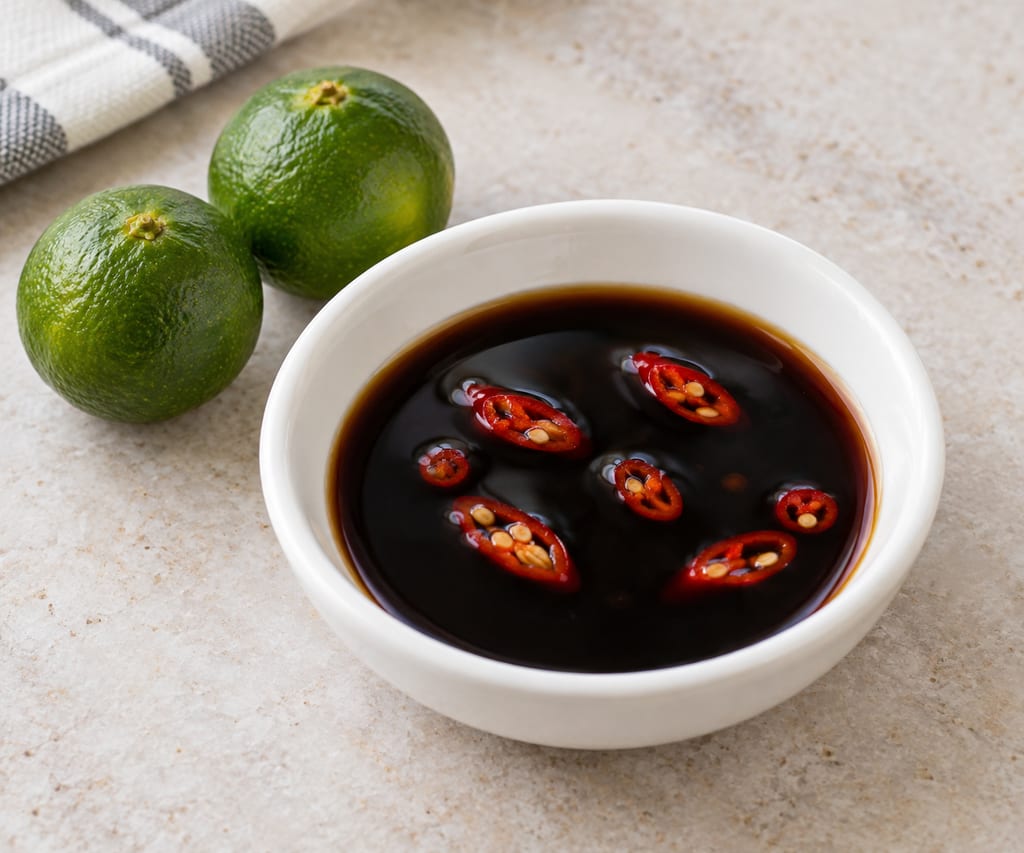
Toyomansi is a Filipino table dip of soy sauce and calamansi juice, served with grilled or fried foods; this version adds sliced chilli and optional sugar.
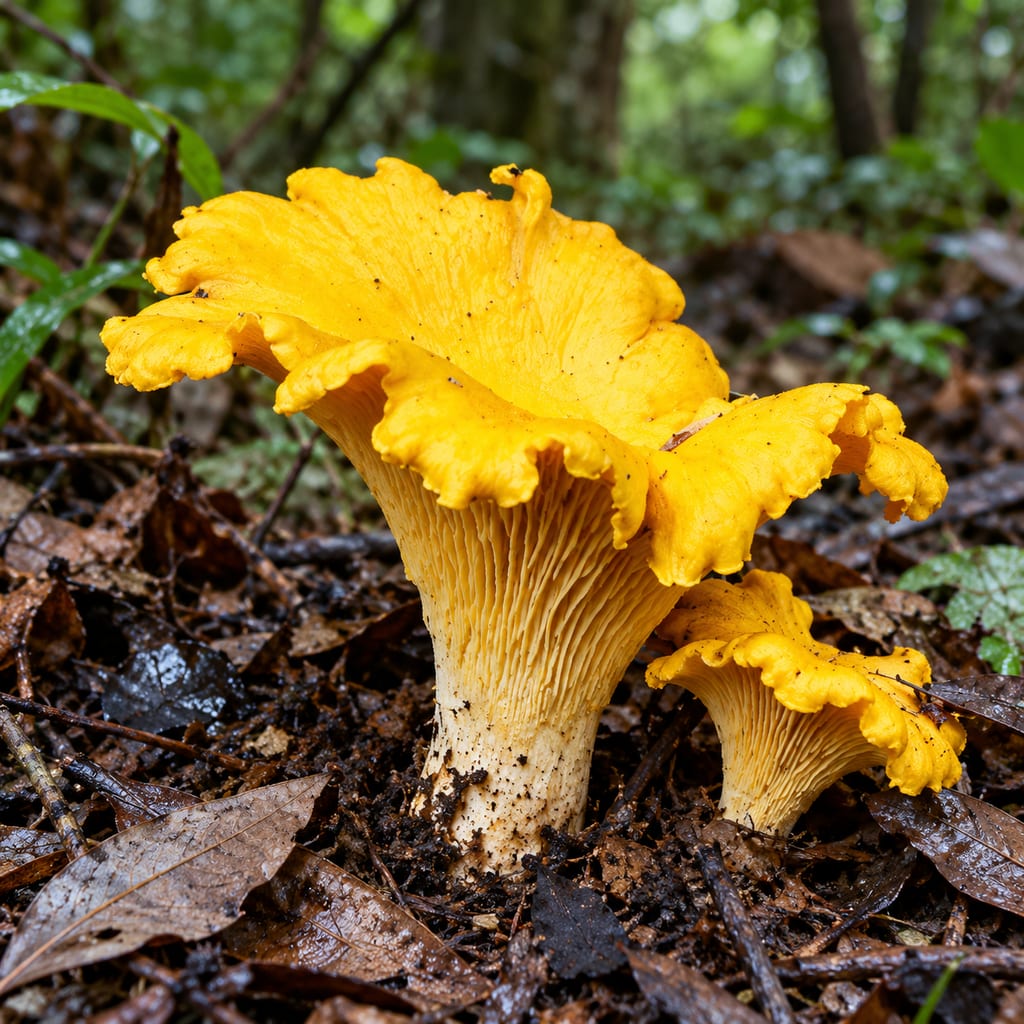
Cantharellus macrocarpus is a large yellow-orange chanterelle described from southern China in 2021. It is listed as edible in a national catalogue; no species-specific food study was found.
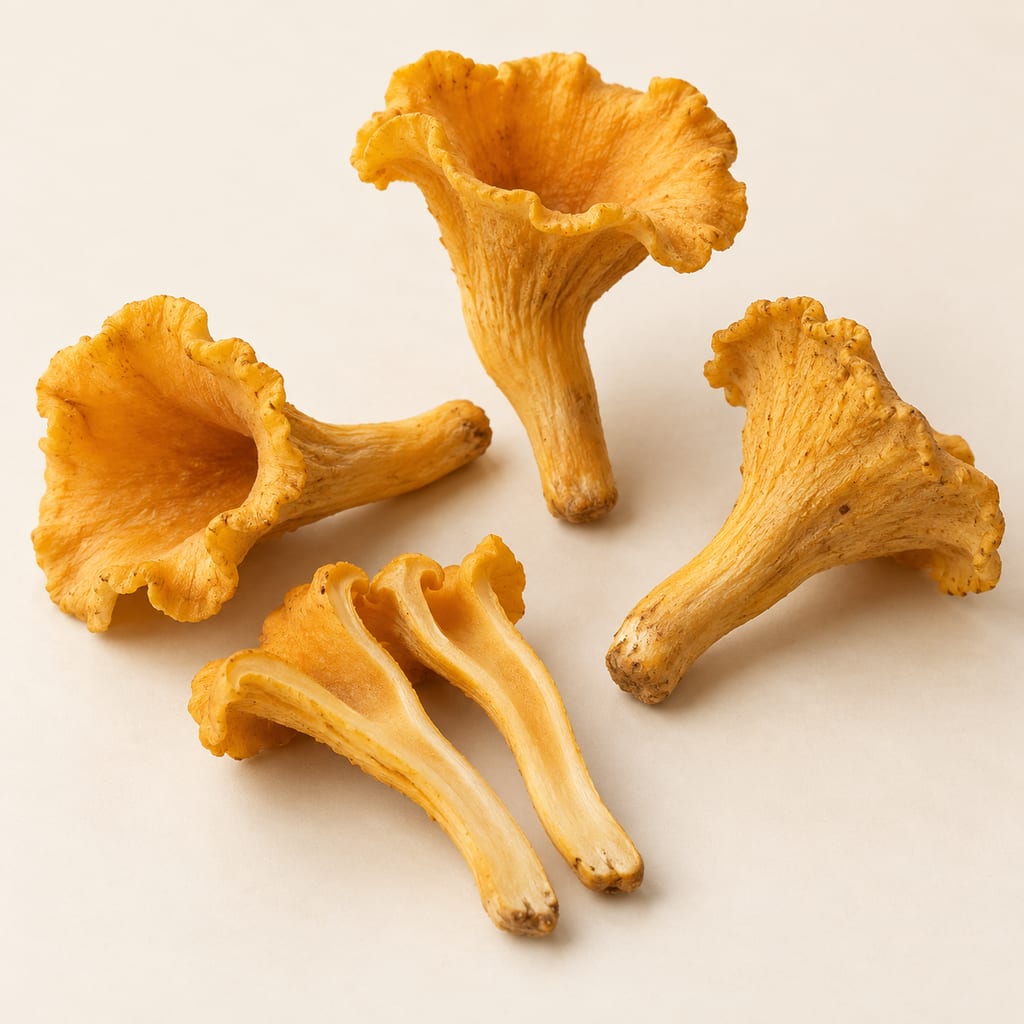
A golden funnel mushroom described from Hong Kong and documented from China; reported as food in several regions, with African taxonomy unresolved.
No community contributions have been published for this entry yet.
Sign in to contribute. Published comments and photos are free to read.
Molecules (MDPI)Composition · Cultivation · Uses
Phytochemicals, Bioactive Properties and Commercial Potential of Calamondin (Citrofortunella microcarpa) Fruits: A ReviewHybrid of mandarin and kumquat; believed to have originated in China and spread; planted in the Philippines as a lime alternative; export value 2014 and 2021.
Plant size, year-round flowering, harvest all year with peak November to June, development periods.
Juice 9.0 degrees Brix, pH 2.40 to 3.00, citric acid 4.50 to 5.80 percent, total acid 6.74 percent; peel composition and volatile profile; processed products, tea, squash, juice pasteurisation, fruit powder; lime substitute in shrimp paste sauce, chilli paste and pickles.
Cited in: The small, very sour citrus of the Philippine table; Where calamansi came from and how it became a Philippine crop; The tree and the harvest; What is in the juice; Pickles, pastes, teas and sweets; How acid from a squeezed fruit behaves; Choosing and handling; Notes
Ultrasonics SonochemistryRange · By products
Simultaneous ultrasound-microwave assisted deep eutectic solvent extraction of essential oil from calamansi (Citrus × microcarpa) peelCultivated in tropical Southeast Asia and China, notably Hainan, with a long history.
Cited in: Where calamansi came from and how it became a Philippine crop
WikipediaLead · Names · Uses
CalamansiNames; fruit size, colour and seed count; aroma notes; Philippine production centres and rank among fruit crops.
Uses in the Philippines, North Sulawesi, Malaysia, Singapore and Florida; freezing whole fruit; USDA zones 8b to 11.
Cited in: The small, very sour citrus of the Philippine table; Where calamansi came from and how it became a Philippine crop; The tree and the harvest; Toyomansi, patis and the Philippine table; Beyond the Philippines: cencalok, kuah asam and hawker stalls; How acid from a squeezed fruit behaves; Choosing and handling
Slice of Filipino LifeUses
Toyomansi SauceToyomansi as calamansi juice with soy sauce, two calamansi to two tablespoons, optional siling labuyo; served with tilapia, grouper, pompano and chicken inasal.
Cited in: Toyomansi, patis and the Philippine table
DinejotUses
Patis at Calamansi (Fish Sauce with Calamansi and Chili)A quarter cup of fish sauce, four calamansi and two Thai chillies for six, as a table condiment; other dishes using fish sauce and calamansi.
Cited in: Toyomansi, patis and the Philippine table
The Local PalateUses
Toyo-Mansi Dipping SauceChef-adapted toyo-mansi with equal quarter cups of toyo and kalamansi juice, red onion, tomato, garlic and optional jalapeño, serving six to eight.
Cited in: Toyomansi, patis and the Philippine table
Jabatan Kebudayaan dan Kesenian Negara (Malaysian cultural mapping portal)Uses · Fermentation
CencalokCencalok from geragau shrimp, salt and water fermented in covered pots for days or weeks; Melaka as trading port since the 15th century; eaten raw as sambal cencalok mentah with onion, chilli and generous limau kasturi juice; small amounts in sambal tumis.
Cited in: Beyond the Philippines: cencalok, kuah asam and hawker stalls
