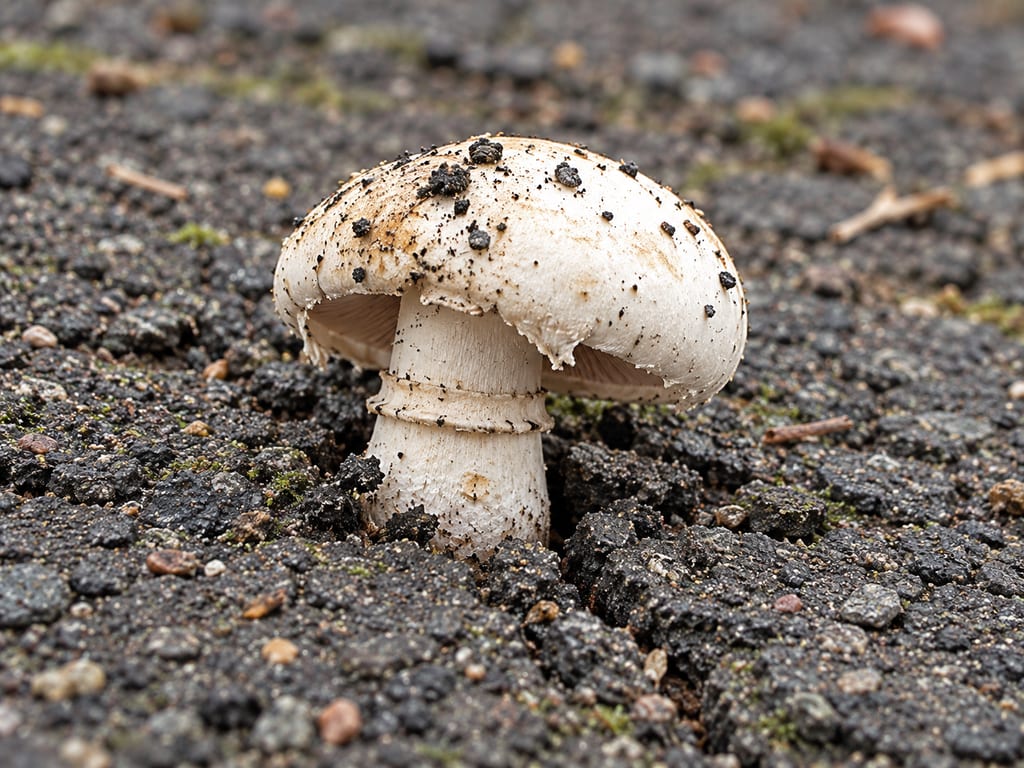
Pavement mushroom
Agaricus bitorquis is a firm edible mushroom known for fruiting in hard, disturbed ground and for its persistent double ring. It is also cultivated in warmer conditions than the common button mushroom.
 FermenteaWhere food goes to change
Mushrooms
Albatrellus confluens is a ground-growing polypore with fused buff-orange caps. Sources document Chinese market use and regional edibility, but others reject it as too bitter; taxonomy also varies between Albatrellus and Albatrellopsis.
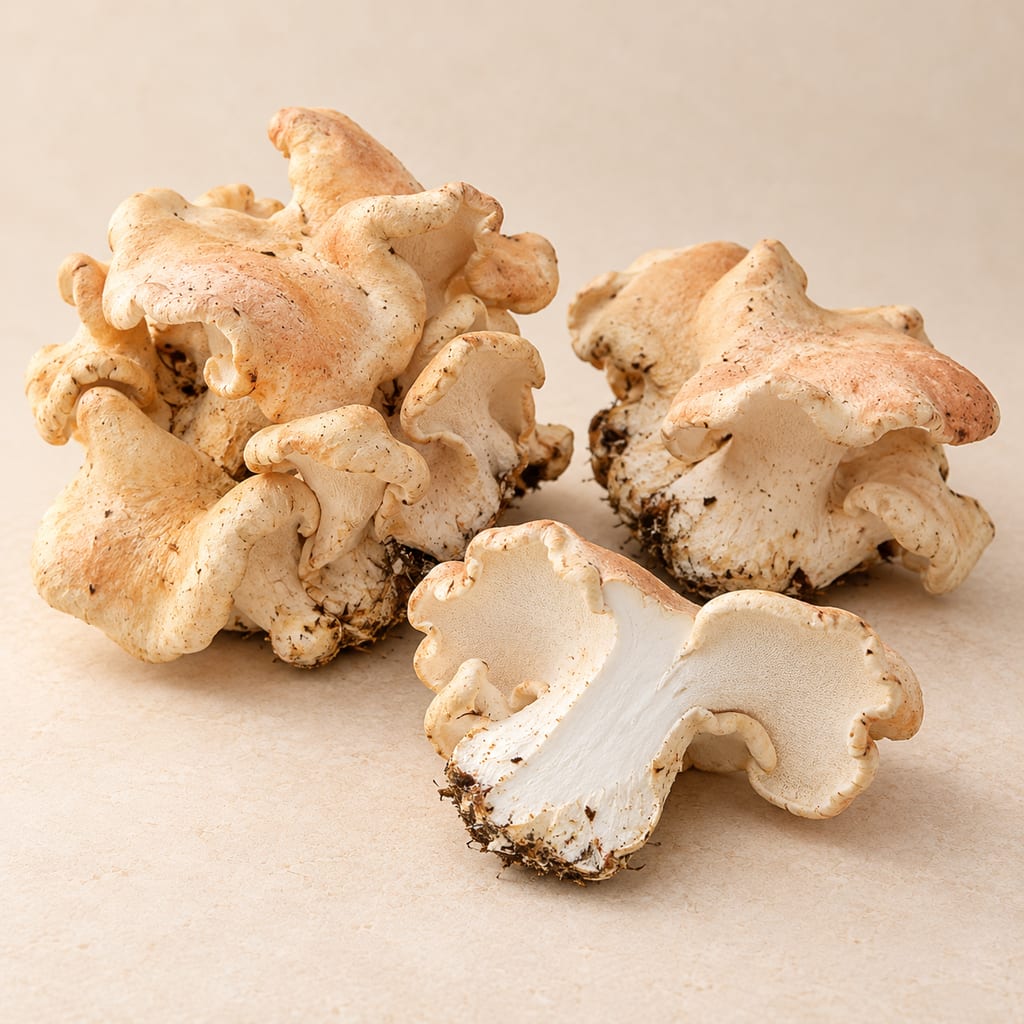
Albatrellus confluens is a fleshy fungus that grows from the forest floor and makes pore-bearing fruiting bodies rather than gills. Its common name, fused polypore, describes the way neighbouring caps and stems often merge into one irregular mass. The familiar names bread polypore, Semmelporling, franskbrødsopp, brödticka and typäskääpä are vernacular names attached to the same taxon in different languages; the bread comparison is mainly about the cap's warm buff-orange colour and does not imply a particular bread recipe.
The fruit body is usually a cluster of thick, lobed caps with wavy margins. Colours reported across regional accounts include pale buff, cream, yellow-orange, pinkish brown and salmon. The undersides carry many small pores, usually white or cream when fresh, and the pore layer runs a short distance down stout, often fused stems. The flesh is pale and firm to soft-fleshed depending on age and water condition. These features explain the mushroom's visual character, but a short prose description is not enough to establish an identification in the field.
The species is a terrestrial member of Russulales, family Albatrellaceae. This placement can surprise readers because a polypore often evokes a hard shelf fungus on a tree trunk; Albatrellus fruit bodies instead arise on soil and are associated with forest trees. Studies treat the group as ectomycorrhizal, forming an underground association with host roots. Visible mushrooms are only the seasonal fruiting structures of a much larger organism in the soil, so the brief appearance of a cap does not tell us the age or extent of the fungal network.
The species name has moved among genera. Albertini and Schweinitz published the basionym Boletus confluens in 1805. The fungus later appeared as Polyporus confluens; Kotlaba and Pouzar used the combination Albatrellus confluens in 1957. Index Fungorum and the related Species Fungorum treatment currently give Albatrellopsis confluens as the name accepted in their database, and NCBI Taxonomy also uses Albatrellopsis confluens. The New Zealand Organisms Register and several regional taxonomic or food sources instead retain Albatrellus confluens as the preferred name, while listing Albatrellopsis as a synonym.
This disagreement is a nomenclatural choice, not evidence that two different mushrooms are involved: the names refer to the same type, or homotypic synonym. For readers, retaining both names is useful because current field guides, food authorities, museum records and market-use papers do not all update at the same pace. This page keeps Albatrellus confluens in its title to match the supplied research index and most food-use sources, and records Albatrellopsis confluens as a searchable alternate name.
Regional field descriptions distinguish it from the sheep polypore, Albatrellus ovinus, by warmer orange-brown colours and by not developing the sheep polypore's lemon-yellow marks when pressed. Fused, irregular caps are common in A. confluens, but other terrestrial polypores can also grow in clusters. A specialist's identification may use microscopic characters, host associations, pore features and spore traits alongside the whole fruit body. The photographs in this record support visual context and editorial illustration only; their captions are not independent specimen determinations.
The Chinese taxonomic paper explains why those visual features are not the whole story: it distinguishes A. confluens by its fused orange fruit bodies together with clamped hyphae and small amyloid spores. Such microscopic evidence matters when a name is attached to a market record, because commercially gathered fungi may be grouped under familiar names while taxonomic treatments change. The reported market use is stronger when read alongside a systematic study of Chinese specimens, but the article still does not record the vendor's handling, buyer practice or preparation method.
Accounts place the fruit bodies on the ground in coniferous and mixed forest, commonly among moss, needles and low vegetation. Spruce and pine associations recur in the Nordic, Italian and Chinese sources. A Norwegian biodiversity profile says the fungus occurs north to Nordland and is associated mainly with spruce and pine. A Swedish field guide describes it in mossy conifer forest across Sweden, with fewer records in the extreme south and north. These are source-specific regional patterns, not a full global distribution map.
The Chinese taxonomic treatment reports specimens from the country and characterizes the fruit bodies as terrestrial; the 2012 Chinese checklist records it on the ground in Picea forest, boreal habitat, as rare. A contemporary Swiss or European taxon occurrence should not automatically be used to infer a traditional culinary practice in China or Finland. Occurrence evidence and food-use evidence answer different questions and remain linked to their own sources in this entry.
Season varies with climate, elevation and year. Vienna's municipal advisory gives summer through autumn. A Polish checklist describes fruiting in autumn, especially September and October; documented specimen photographs include Šumava in August, Bellamonte in Italy in August and a Norwegian blueberry-spruce forest in August. Those dated examples support summer and early autumn fruiting in parts of central and northern Europe, with later autumn reports farther east or in other years. They do not define a universal season or promise that a mushroom will be present each year.
A fruit body can persist or age after it emerges, and the stage matters to local food descriptions. The same regional authorities that describe young fruit bodies as edible also mention increasing bitterness with age. Age-related taste is not a safe way to identify the species and should not be converted into a promise that a young-looking wild mushroom is safe.
Published records give a more useful sense of timing than a single calendar label. Czech and Italian photographs and field records document fruit bodies in August; the Vienna advisory uses the broader phrase summer to autumn; a Polish checklist places its records in September and October. The Swedish guide's country-wide occurrence statement does not specify an equal abundance in every county or year. Temperature, rainfall, altitude, forest composition and observer effort all affect when a visible fruit body is recorded, so these dates should be treated as examples from named regions.
The supplied expanded index combines three kinds of record: a historical edible claim from FAO country sources, a historical use record whose meaning is uncertain, and an entry in the 2026 Chinese edible-fungi catalogue. None has been independently assessed for this Fermentea research record. The index appropriately identifies the evidence as a lead rather than a finished safety judgment.
For Bulgaria, the FAO global overview reproduces a 1978 country list that marks Albatrellus confluens as edible. It does not identify a recipe, portion, preservation method or frequency of use. That is a historical edible classification, not proof that it was commonly eaten. For China, a 2026 catalogue of edible and medicinal fungi places the species in the broader national list. The stronger evidence of actual food use is Zheng and Liu's 2008 taxonomic account, which describes A. confluens as a common and popular edible species sold in southwestern Chinese markets. The authors' taxonomic study is valuable because they examined specimens, but their market sentence still does not specify how households cook it.
Finnish Food Authority consumer guidance treats typäskääpä (A. confluens) as edible at least when young and notes a slightly bitter taste when fresh. The City of Vienna mushroom advisory also calls it edible, gives a summer-to-autumn season and warns that older specimens become bitter; it says raw mushrooms are not suitable to eat. These are geographically scoped consumer sources, not a universal guarantee or substitute for competent identification.
Other sources are more cautious about flavour. Store norske leksikon describes the Norwegian franskbrødsopp as bitter and says it is not recommended as a food mushroom. A Swedish field guide says it is edible when young but less palatable as it ages. An Italian mycological association describes young specimens as moderately edible and mentions preserving them in oil. These differences show that a species may be eaten in one region while rejected in another because of its taste or local culinary preferences. They should not be collapsed into a single consensus statement.
The most concrete modern food-use record is sale in southwestern Chinese markets, and the best-supported regional consumer guidance comes from Finland and Vienna. The Bulgarian source records edible status but no culinary technique. The Italian source suggests using young fruit bodies in an oil preserve, but this is only a brief recommendation, not a validated recipe. No amounts, cooking temperature, acidification, storage duration or shelf-stability data were found. For that reason this page does not turn a short regional note into a preservation method.
The word polypore can also mislead: edible claims do not mean the mushroom is cultivated or traded internationally at scale. A CITES information document notes that information about international trade in Albatrellus is limited even though some species are used as food and certain species are sold in China. This dossier has no evidence of cultivation of A. confluens. It should not be described as a farmed mushroom, a standardized market commodity outside its documented locations, or a medicinal food.
Laboratory research on compounds isolated from A. confluens, including grifolin, is sometimes repeated on consumer pages as a health claim. Laboratory activity of an extracted compound does not show that eating the mushroom prevents or treats disease. That topic is outside the ingredient's supported food story and is deliberately not presented as a benefit.
No source in this research provides a complete, safety-validated recipe. This page records the cultural and market evidence without recommending a dish or a harvesting practice. Where local authorities say the mushroom is edible, that classification presupposes correct identification under local guidance; it does not transfer automatically to lookalikes, uncertain specimens, or every locality.
Albatrellus confluens is supported as a food ingredient by more than a single old list: the Chinese literature documents market sale, the Chinese catalogue includes it among edible fungi, and national or municipal Nordic and Austrian guidance describes local edibility, especially for young specimens. At the same time, the taste advice is not uniform and taxonomic resources differ on whether the species belongs in Albatrellus or Albatrellopsis. A careful page should make both facts easy to see.
The record also needs to distinguish a place where the fungus has been photographed or collected from a place where a source describes food use. The Norwegian, Czech, Italian and Swedish locality records document species or habitat; only some of their sources also discuss edibility. Bulgaria is a historical edible-list record. China carries a specific market-use report. Finland and Vienna carry consumer guidance. Keeping these claims separate lets readers trace the evidence rather than infer a culinary tradition from a range map.
This is a source-backed ingredient profile, not an identification key or a recommendation to forage. Individual mushrooms can be misidentified, local rules and advice vary, and a food classification cannot verify a specimen found by a reader. No taste test, colour change or visual match in these photographs is a substitute for qualified identification. The intended use here is to explain what the named ingredient is and what the published sources say, with uncertainty visible.
The study reports market sale but gives no household recipe or measured preparation.
Historical edible classification; source gives no preparation or consumption frequency.
The national authority says the species is edible at least when young; local guidance, not a universal safety certification.
The city's advice calls it edible and notes mature specimens become bitter.
This is a source-reported preservation suggestion, not a validated shelf-stable recipe.
Sources document occurrence and conflicting culinary opinion; no region-specific customary preparation is established.
The field guide classifies young specimens as edible but notes older specimens become bitter.
Photographic occurrence documentation only; not a culinary-use claim.
Agaricus bitorquis is a firm edible mushroom known for fruiting in hard, disturbed ground and for its persistent double ring. It is also cultivated in warmer conditions than the common button mushroom.

Soft, spreadable Calabrian pork sausage made with a great deal of red chilli and fatty pork, stuffed into natural casings, sometimes smoked and matured while staying soft.

A way to add independent temperature logging to an existing food dehydrator without changing its built-in controls or protections. It is a monitoring method, not a rewiring plan.

Pleurotus cystidiosus is the abalone mushroom, a cultivated oyster-type fungus with dark brown caps that grows more slowly and is more demanding than other Pleurotus species.

A dark, balanced vinegar from Emilia-Romagna made by combining cooked or concentrated grape must with wine vinegar, then acetifying and refining it in wood under a protected specification.

A living dairy inoculum that starts controlled cream fermentation, developing acidity and aroma before sour cream or cultured butter is finished.

A small electric incubator holds jars at a selected temperature for yogurt and other documented warm food preparations. Controls, capacity and vessel arrangement vary by model.

Adygean salt is a seasoned table salt associated with Adygea and the wider North Caucasian culinary tradition. Salt is blended with garlic and a variable selection of herbs and spices; the exact mix depends on the named style and maker.

The African Caesar-group mushroom, Amanita masasiensis, is a wild ectomycorrhizal species of central and southern African woodlands, eaten locally. The genus contains deadly poisonous species, so identification needs care.
No community contributions have been published for this entry yet.
Sign in to contribute. Published comments and photos are free to read.
Food and Agriculture Organization of the United NationsReference
Wild edible fungi: a global overview of their use and importance to people, Annex 3The FAO country section for Bulgaria lists Albatrellus confluens as edible; the cited source is a 1978 Bulgarian species list and provides no preparation details.
Cited in: Food records across regions
MycosystemaReference
Species cataloging of edible and medicinal fungi in ChinaThe 2026 catalogue covers edible and medicinal fungal species in China and the supplied expanded index classifies Albatrellus confluens as a scientific edible-checklist entry.
Cited in: Food records across regions
Fungal Diversity 32Reference
Additions to our knowledge of the genus Albatrellus (Basidiomycota) in ChinaTaxonomic examination of Chinese Albatrellus specimens; the authors call A. confluens common and popular and report it for sale in southwestern Chinese markets.
Cited in: Food records across regions; Reading the record responsibly
Index Fungorum, Royal Botanic Gardens, KewReference
Index Fungorum name record 292349: Albatrellus confluensBasionym Boletus confluens (1805); Albatrellus confluens combination (1957); Index Fungorum gives Albatrellopsis confluens as current name.
Cited in: Names and identification limits; Reading the record responsibly
National Center for Biotechnology InformationReference
NCBI Taxonomy Browser: Albatrellopsis confluensNCBI's current taxon name is Albatrellopsis confluens; it lists Albatrellus confluens as a homotypic synonym and cautions that NCBI taxonomy is not a nomenclatural authority.
Cited in: Names and identification limits
Biota of New Zealand, Manaaki Whenua — Landcare ResearchReference
Names and classification: Albatrellus confluensNZOR consensus prefers Albatrellus confluens while listing Albatrellopsis confluens as a synonym, illustrating differing nomenclatural treatments.
Cited in: Names and identification limits
Finnish Food Authority (Ruokavirasto)Reference
Lampaankääpä: safe use of mushroomsThe authority describes typäskääpä (Albatrellus confluens) as edible at least when young, with a somewhat bitter fresh taste, and explains it differs from Albatrellus ovinus.
Cited in: Food records across regions; Uses and what the sources do not establish; Reading the record responsibly
City of ViennaReference
Semmelporling: mushroom advisoryMunicipal advisory calls Albatrellus confluens edible; fruiting summer to autumn; older specimens become bitter and fresh mushroom is not suitable raw.
Cited in: Forest habitat, range and season; Food records across regions; Reading the record responsibly
Store norske leksikonReference
FranskbrødsoppNorwegian encyclopedia describes pine association and bitter taste, and does not recommend eating it.
Cited in: Food records across regions
Gruppo Micologico AnconaReference
Albatrellus confluens: field record and descriptionRegional source describes young specimens as moderately edible and suggests preservation in oil; states a specimen was studied in spruce forest at Stava, Trentino, on 29 August 2012.
Cited in: Food records across regions; Uses and what the sources do not establish
Artsdatabanken, Norwegian Biodiversity Information CentreReference
Franskbrødsopp: species profileNorwegian occurrence extends to Nordland; habitat on ground in forest, mainly spruce and pine; species profile gives traits and a conservation category.
Cited in: A ground-growing polypore; Forest habitat, range and season
Polish Academy of Sciences, Institute of BotanyReference
Agaricomycotina: checklist and distribution recordsPolish checklist records Albatrellus confluens in coniferous forest, terrestrial and mycorrhizal, in autumn (September and October).
Cited in: Forest habitat, range and season
Fungal DiversityReference
Additions to our knowledge of the genus Albatrellus (Basidiomycota) in ChinaThe taxonomic paper's Chinese vouchers and market-use note identify the species by fused orange fruit bodies, clamped hyphae and small amyloid spores.
Cited in: A ground-growing polypore; Names and identification limits
Wikimedia CommonsReference
Albatrellus confluens (6685151553).jpgSpecies-captioned photo lead under CC BY 2.0, visually inspected; shows wild cluster with pores and joined caps.
Wikimedia CommonsReference
Albatrellus confluens I Sumava.jpgPhoto of wild specimen near Volary, Sumava, Czech Republic, 20 August 2011; CC BY-SA 3.0; visually inspected.
Cited in: Forest habitat, range and season
Wikimedia CommonsReference
Albatrellus-confluens.jpgPhoto of wild specimen in Bellamonte, Trentino, Italy, 20 August 2008; CC BY-SA 3.0; visually inspected.
Cited in: Forest habitat, range and season
Wikimedia CommonsReference
Albatrellus confluens-o.jpgPhoto of wild cluster in blueberry spruce forest in Norway, 11 August 2016; CC BY-SA 4.0; visually inspected.
Cited in: Forest habitat, range and season
Wikimedia CommonsReference
Albatrellus confluens 1.jpgPublic-domain photo of harvested fruit bodies shown at a Prague mushroom exhibition in 2008; visually inspected for underside and fused-cap form.
SvampguidenReference
BrödtickaSwedish species guide describes mossy conifer forest habitat, countrywide occurrence, seasonal fruiting and young specimens as edible with bitterness in older fruit bodies.
Cited in: A ground-growing polypore; Forest habitat, range and season; Food records across regions
MycoscienceReference
Polypore diversity in China with an annotated checklist of Chinese polyporesChecklist reports Albatrellus confluens on the ground in Picea forest, boreal habitat, as rare in China.
Cited in: Forest habitat, range and season
CITESReference
Convention on International Trade in Endangered Species, Scientific Committee information document 27Report says information on international trade in Albatrellus species is limited and cites edible use in Chinese markets for Albatrellus confluens.
Cited in: Uses and what the sources do not establish
Gruppo Micologico AnconaReference
Albatrellus confluens: field record and descriptionRegional source describes young specimens as moderately edible and suggests oil preservation; studied spruce-forest specimen from Stava, Trentino, 29 August 2012.
Cited in: Food records across regions; Uses and what the sources do not establish