Names and identity
The pavement mushroom is the current name used here for *Agaricus bitorquis* (Quél.) Sacc., an agaric in Agaricaceae. EPPO lists *Psalliota bitorquis* Quél. as another scientific name and records the familiar English name “pavement mushroom.” New Zealand’s Biota of NZ record gives the nomenclatural sequence more exactly: the basionym is *Psalliota bitorquis* Quél. (1884), and Saccardo published the present combination in 1887. The same account treats it as a species, not a form of the common button mushroom, *A. bisporus*. The supplied Fermentea catalogue likewise explicitly distinguishes the two. One British Columbia government record lists *Agaricus rodmani* as a synonym; synonym lists vary among databases and should not be presented as a settled universal list.
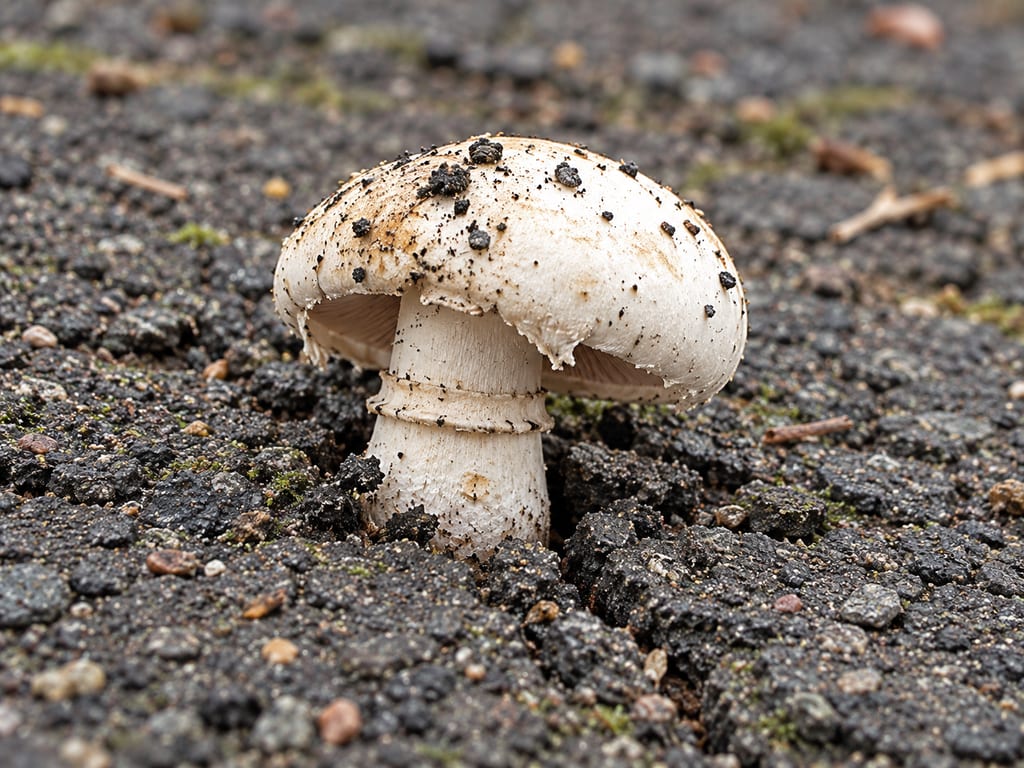
The double, persistent ring on the stem is a notable feature and is reflected in several names: French “agaric à deux anneaux” (“two-ring agaric”), Italian “prataiolo dai due anelli,” and the species epithet *bitorquis*. The English “pavement mushroom” and French “agaric des trottoirs” point to its association with hard, disturbed urban ground. Other names in regional reference sources include sidewalk mushroom, spring agaric, urban agaric, banded agaric, Danish “Vej-Champignon,” Norwegian “Bysjampinjong,” Swedish “Vägchampinjon,” and German “Stadtchampignon.” Common names are helpful for searching, not proof that a found mushroom has been identified correctly.
The fruit body is generally stout and firm, with a smooth white to cream cap and a solid, thick stem. The gills are free from the stem and become dark brown as the spores mature; young gills are paler. The spore deposit is brown. Descriptions from Kerala report a globose to convex cap, crowded free gills, a solid central stem, a double white ring, mild smell and taste, and ellipsoid brown spores. Biota of NZ describes a double annulus, dark brown spore mass, and flesh that slowly reddens when cut or bruised. Field descriptions differ in detail and colour terminology, so these traits form a research description rather than a stand-alone field key.
Sources for this section
Habitat, growth and season
*A. bitorquis* is saprotrophic: it obtains nutrients from dead organic material rather than forming a tree-root partnership. Institutional and regional accounts place it in dry, hard-packed or otherwise disturbed soils, including lawns, gardens, parks, pasture, roadside margins, gravel, debris heaps and urban ground. It sometimes fruits through cracks in paving or asphalt. That striking behaviour gives the species its common name, but it does not mean the mushroom consumes asphalt or that pavement is a food-safe growing medium. Norwegian species assessors describe it as primarily urban and possibly associated with calcareous conditions; they also note that in Norway it is known from a limited set of urban localities around the Oslofjord and one record at Trondheim. That local account is not a global distribution map.
Season depends on place and conditions. The Nordic food-risk assessment describes fruiting from late spring into autumn. Vienna’s city mushroom advisory gives May through September for its regional account. A Kerala biodiversity report documents a specific locality at the JNTBGRI campus in Palode, Thiruvananthapuram, with an October-to-December season. Those reports should remain attached to their own geography; “spring agaric” does not make spring the season everywhere. Water availability, temperature and local substrate influence fruiting, and a species-level source does not provide a reliable calendar for every site.
The species has a broad, human-associated range. Records and research considered here span Europe, North America, China, India, South Korea and New Zealand. That broad distribution should not be confused with a long-established culinary tradition everywhere it occurs. A photograph, herbarium record or molecular study confirms occurrence in its described context, not local consumption. The Norwegian biodiversity assessment, for example, considers whether the urban species is established and spreading there; that is ecological evidence, not a food-use report.
Sources for this section
Cultivation and its history
The documented cultivation story is comparatively recent and is tied to production in warmer rooms. G. Fritsche’s 1976 breeding paper says *A. bitorquis* was first brought into cultivation in 1968. It contrasts the species with the previously cultivated *A. bisporus*: the pavement mushroom can fruit at temperatures roughly five degrees Celsius higher, and its large, white, smooth fruit bodies were considered robust. Breeding research has examined four-spored basidia, resistance traits, pressure tolerance, ease of picking, shelf life, and strain-to-strain variation. Those observations belong to the strains and trials reported in that paper, not every commercial crop today.
Later agricultural accounts use the label “summer white button” for cultivated *A. bitorquis*. A cultivation chapter from India reports fruiting around 23–25 °C, in contrast with the cooler fruiting temperatures conventionally used for *A. bisporus*. Its cultivation sequence resembles button-mushroom production: prepare and condition compost, introduce spawn, allow the mycelium to colonise the prepared substrate, apply a casing layer, manage the cropping environment, and handle the harvest after picking. The exact set points vary among strains and production systems; the cited chapter presents an agricultural method rather than a home-growing recipe. It also reports slower growth and the need for clean, carefully prepared compost, which helps explain why a warm-fruiting trait alone does not make the crop universally simple or economical.
The cultivation literature considered here includes experimental work in India, a 1996 production study at the Zamorano valley in Honduras, and Korean work on high-temperature strains. Zamorano’s abstract highlights the challenge of matching temperature and humidity to local conditions. Korean research describes cultivation at elevated temperatures compared with *A. bisporus*. These examples show that cultivation has been investigated in several places, but they do not prove current production volumes, availability in ordinary shops, or that one schedule transfers safely to every facility.
Sources for this section
Food use and texture
Institutional food sources describe the species as edible, and the supplied Fermentea catalogue records it as a firm mushroom used both wild and cultivated. Vienna’s city advisory calls it edible and describes a nut-like flavour; the Nordic assessment says it is generally regarded as edible and good. The Kerala survey records the whole fruit body as food and notes cultivation as well as wild occurrence. These are documented food-use statements, not a guarantee for any specimen or location.
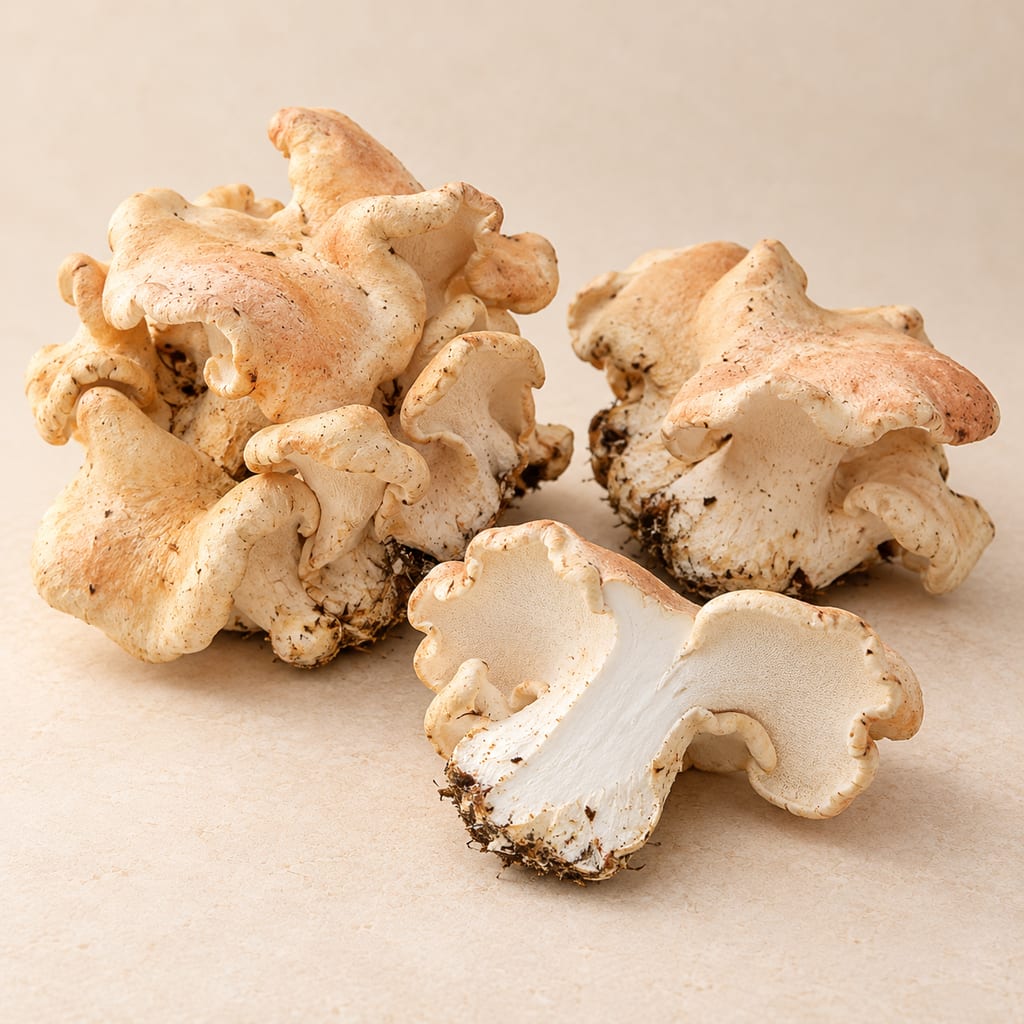
Its thick, firm flesh and sturdy stem distinguish its culinary appeal from a softer, more delicate mushroom. Agricultural writing has discussed the fruit bodies’ solid build and suitability for canning. Fresh fruit bodies can be cooked as mushrooms in ordinary dishes; the sources consulted do not establish a single signature regional recipe or a uniform preservation method. “Can be canned” in a cultivation text describes a possible product outlet, not a validated canning process. Readers should use a tested food-preservation procedure appropriate to the product and equipment rather than infer processing conditions from this ingredient account.
The firmness can make it useful where a mushroom should keep some structure through cooking, but no source here establishes a particular substitution ratio for *A. bisporus*. It is a distinct species, and commercial cultivars, age at harvest, water content and growing conditions affect texture. Treat culinary comparisons as a starting point, not as a promise that one species behaves identically to another in every recipe.
Sources for this section
Role in fermentation
The mushroom is an ingredient, not a fermented preparation. The sources reviewed describe it as a food mushroom and a compost-grown crop; they do not document a species-specific traditional fermentation, a defined starter culture, or a standard ferment made from *A. bitorquis*. Composting is part of mushroom cultivation, but the compost’s microbial conditioning is not a fermentation recipe for the harvested mushroom, and it does not turn the fruit body into a culture.
Mushrooms can be ingredients in wider preservation and fermentation practices, but that general observation cannot be assigned to this species without a source for the particular method. No claim should be made here about a special enzyme, strain, fermentation organism, acidification behaviour or preservative effect. In any future Fermentea recipe that names the mushroom, the line should link to this raw ingredient page; a preparation that ferments or preserves it would need its own recipe record and its own process evidence.
Sources for this section
Buying, cleaning and storage
For food use, prefer a traceable cultivated product or a specimen assessed by a qualified local mushroom expert. Check that it is sold as *Agaricus bitorquis* rather than relying on the vague label “white mushroom.” The available sources do not establish a universal grade, pack label, harvest-age test, household storage duration or species-specific cleaning protocol. Follow the producer’s storage instructions and local food guidance; do not invent a shelf life from the species name or from an unrelated button-mushroom source.
The urban habitat is a food-safety concern. A mushroom growing beside traffic, on industrial fill, in a polluted landscape or through road surfacing is not made safe by being a species regarded as edible. Vienna’s municipal advisory explicitly warns that a descriptive page is not a substitute for trained assessment. The University of Lyon’s mushroom database is more cautious still: it advises avoiding this otherwise edible species because its hard-ground and roadside habitats can bring pollution exposure and long-term toxicity concerns. These sources support a practical distinction between cultivated food and opportunistically collected urban fruit bodies.
A Nordic-countries assessment reports that measured agaritine levels in Czech samples varied widely, and it notes no reported poisonings in the literature it reviewed. A detected compound and a reported lack of poisoning are not, by themselves, a consumer risk threshold or proof of safety. No safe dose, preparation technique or cooking temperature is established from those measurements.
There is also a broader identification problem: *Agaricus* includes species with differing edibility, and pale mushrooms can be confused by inexperienced collectors. A photograph or one character such as a double ring cannot establish identity. This account is not a field-identification guide. Do not eat an unknown wild mushroom based on a common name, web photograph, app match or this page; seek a competent local identification service, and avoid specimens from contaminated sites.
Sources for this section
Geographic records and limits
Food and cultivation associations supported by the sources include Denmark and neighbouring Nordic countries (wild seasonal use, with regional frequency varying), Vienna in Austria (a city advisory listing an edible species and local season), Kerala in India (a local wild food record and cultivation entry), and South Korea (high-temperature cultivation research). The Zamorano valley in Honduras has a documented cultivation experiment. France has a long-running popular association with the “agaric des trottoirs,” but the University of Lyon source cautions against eating urban examples because of contamination concerns. These associations describe evidence of use or research, not origin, continuous tradition or current retail supply.
New Zealand’s taxonomic record marks the species as exotic there and gives a first recorded collection in 1970. This is an occurrence milestone, not an introduction date or a first-food-use date. Likewise, the 1884 and 1887 nomenclatural dates describe the publication of scientific names. The sources reviewed do not establish when people first ate the mushroom, who first cultivated it before the reported 1968 start, or a continuous historical food tradition. Its period as a food attestation should therefore remain unknown until a historical food-use source is found.
Sources for this section
Places
Nordic countries
Documented use · Region evidenceNordic Council assessment reports A. bitorquis as edible and describes seasonal occurrence; this does not establish uniform use in every Nordic country.
Vienna
Documented use · Locality evidenceCity mushroom advisory describes regional food use and May–September season; not evidence of historical tradition or current market supply.
Palode, Thiruvananthapuram
Documented use · Locality evidenceKerala State Biodiversity Board report documents food use and a locality-specific season; do not generalize this association to all Kerala.