Salt: the mineral, the work and the foods it makes
Salt seasons a meal, shapes fermentation and preserves food. Its history follows the people who mine, harvest, trade and transform it, and the choices hidden inside an ordinary packet.
 FermenteaWhere food goes to change
淡路島の藻塩 · MOSHIO of Awaji Island · Awajishima no Moshio · Awaji Island seaweed salt · 淡路島の藻塩 PREMIUM · 藻塩
Awaji moshio is a modern Japanese seaweed salt made by TaDa PHILOSOPHY from Awaji Island seawater and seaweed. Its premium process concentrates brine, extracts seaweed flavor, then crystallizes, separates, dries and grades the salt.
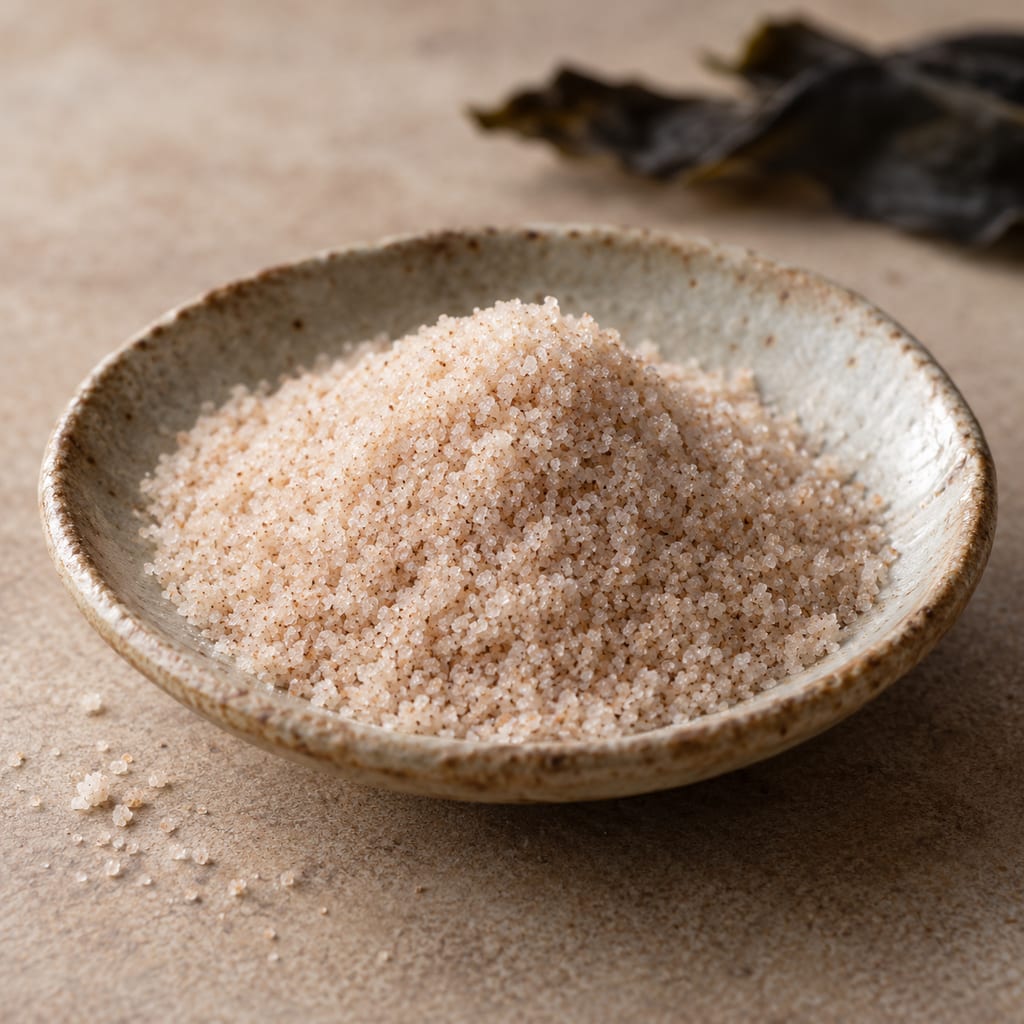
Awaji moshio is a pale beige Japanese seasoning salt associated with TaDa PHILOSOPHY in Hyogo Prefecture. Its Japanese product name is 淡路島の藻塩; the manufacturer’s English site calls it MOSHIO of Awaji Island. The Premium line is made from seawater and seaweed, with a light marine aroma and savory character. The salt is sold ready to season food, but this page treats it as a preparation because its manufacture involves several distinct operations: filtration, concentration, extraction, crystallization, separation and finishing. The account describes the maker’s product family, not a universal recipe for all salts called moshio.
The color and flavor distinguish this style from a plain, refined white salt, but they do not reveal a precise seaweed species, mineral profile or process endpoint. The manufacturer describes a mild saltiness and seaweed-associated savoriness. Those are sensory descriptions, not a health claim or evidence that the salt can replace a recipe’s salt amount one-for-one. Grain size also matters: a large crystal melts differently on a finished dish than finer grains mixed into a broth or dough. The finished product remains a mineral seasoning, not a ferment.
The name is also a useful reminder to keep maker identity separate from food category. “Moshio” describes a seaweed-associated salt tradition and a class of products, while “Awaji moshio” points to this manufacturer’s island-sourced line. A reader buying a retail pack is choosing the current product and its maker’s specification; a historian studying a poem or excavated pot is asking how salt may have been produced in an earlier period. The same word connects those subjects, but it does not erase the difference in evidence.
TaDa PHILOSOPHY traces its company history to a cotton-trading business founded on Awaji Island in 1673. That is the beginning of the company’s lineage, not the age of the salt. The company says it began moshio production in 1999 and moved toward larger-scale production with strengthened hygiene measures in 2002. The product’s modern history therefore sits alongside a much older regional salt-making story without claiming an unbroken recipe.
Awaji has archaeological salt-making vessels associated with the Tumulus period, and the producer connects moshio-yaki to poetry in the Man’yoshu. Those finds and literary references place salt making in the island’s history, but neither supplies the full proportions, equipment or sequence used by today’s manufacturer. A poem records an image of seaweed salt-making, not a factory manual. The modern product makes that past visible to consumers through its name and place, while its current process is a contemporary commercial preparation.
The Tobacco and Salt Museum describes several possible ancient methods: using seaweed ash, rinsing salt from dried seaweed, concentrating brine and boiling it in pottery. It notes that the evidence is fragmentary and exact procedures remain difficult to establish. The Salt Association of Japan likewise documents regional changes from seaweed-related brine to sand-based concentration, boiling and, much later, factory membrane technology. These histories help explain the techniques behind moshio without turning one uncertain reconstruction into a definitive ancient formula.
The poem most often used in modern retellings evokes gathering seaweed and burning it into salt. Its cultural force is clear, but the museum cautions that the surviving archaeological and literary material does not settle the exact operation. Researchers have proposed different ways to obtain concentrated brine from plant material, ash and seawater. Those interpretations are valuable because they show how people adapted to a coast without large rock-salt deposits. They remain reconstructions, not direct instructions for making the present commercial product.
The producer locates its seawater intake near Fukura Bay on the southwest end of Awaji Island, facing the Naruto Strait. It draws water from a bore near the shore, then filters it and raises its salinity with membrane equipment. This gives the named salt a documented relationship to Awaji and a specific intake area. It does not show that Awaji is the source of all Japanese seaweed salt traditions, which vary across coasts and periods.
Seawater supplies dissolved salts and provides the liquid for seaweed extraction. Concentration removes water relative to the dissolved material. When the brine reaches conditions where salt crystals form, the solid crystals can be separated from the remaining liquid. The maker does not publish a complete mineral analysis or a batch-specific salinity schedule, so this account describes the physical operation without claiming a special nutritional value.
Seaweed is the second named material. The manufacturer’s general Japanese process description lists hondawara, akamoku and other seaweeds; its English product page describes the premium ingredients more broadly. The exact blend and weight for a particular pack are not disclosed. Hondawara and akamoku should be read as examples in the maker’s wider account, not a guaranteed fixed formula for every product. Steeping makes some seaweed-derived material soluble in the brine, contributing to the product’s color and savory aroma.
The process starts with underground seawater near the factory. The maker filters it and concentrates it with a membrane system before the longer cauldron work. This first concentration reduces the water that must later be evaporated. The company describes Premium Moshio as a small, hand-finished product made over about four days, but publishes no reproducible batch weights. It is not possible to scale the process from a retail packet or a photograph of the finished salt.
Seaweed is steeped into the concentrated brine, and the liquid is heated again. The producer’s English and Japanese pages describe the intermediate soaking and reboiling in a different order, but both include an overnight seaweed steep followed by further heating. The accounts establish extraction and boiling as parts of the method, not a complete day-by-day production specification. That distinction matters because a reader cannot infer an exact steep time, species dose or brine strength from the broad process narrative.
As water leaves the brine, dissolved salts concentrate and crystals appear. The maker then separates the crystals from the remaining liquor, which it calls bittern, and cools the intermediate salt before further reduction. The amount of liquid retained affects moisture and flavor, but the manufacturer does not provide a measurement or target. Its process relies on specialized equipment and salt-makers’ inspection; visual resemblance to the finished product cannot reproduce those controls.
The salt receives a slow finishing stage in a flat pan, then it is sieved, visually inspected and heat-sealed. This final work helps determine how dry and free-flowing the packaged grains are. The company’s process description does not state a target moisture level, temperature, sieve size or quality test that a home producer could apply. Those missing specifications are why the page remains a record of a commercial preparation instead of a household recipe.
The major stages work on different materials. Filtering removes particles from the raw water before concentration; membrane equipment reduces water volume without relying solely on an open boil; steeping transfers soluble seaweed material to the brine; later heating promotes crystal formation. The remaining liquid is chemically distinct from the crystals because dissolved components do not all leave solution at the same point. A final separation and drying stage changes how damp or free-flowing the salt feels. The maker does not publish a composition table that would let these sensory changes be assigned to individual ions or compounds.
Historical moshio-making was not one uniform process. Archaeological evidence and later salt histories point to different ways of gathering and concentrating seawater, while the modern market includes products made with different seaweeds, vessels and equipment. A shared name or tan color does not prove that two brands use the same ingredient mix or method. Awaji moshio should also remain distinct from other named products such as Amabito no Moshio.
TaDa PHILOSOPHY sells Premium Moshio, larger-grained Tsubu Moshio, small table formats, food-service and industrial packs, and a Setouchi no Moshio line described as a more economical product made with Seto Inland Sea water. The Premium process is described as a labor-intensive, roughly four-day manufacture; larger crystals are suited to topping or dipping because their size changes how they dissolve and deliver salt. These product variations belong to the same maker’s range but should not be collapsed into one exact recipe.
Other makers can choose different seaweeds and processing stages. Ancient reconstructions may involve dried seaweed or ash; Awaji Premium instead begins with membrane-concentrated seawater and uses modern cauldrons and finishing equipment. These methods can be compared as related ways of making a seaweed-associated salt, but combining them into a synthetic step list would invent a recipe no source documents.
This maker’s format range also reflects how salt is purchased and handled. Small bottles suit table use; larger bags serve kitchens, restaurants and food manufacturers. Tsubu Moshio is explicitly sold as a large-crystal version, which is more noticeable as a topping than a fine-grained ingredient mixed into a dressing. The products share the moshio identity, but packaging size, grain size and product line are not evidence of a different origin story. The producer’s pages are the authority for its own range; they do not define every seaweed salt sold elsewhere in Japan.
The producer suggests using moshio where its own flavor can be noticed: sprinkled over grilled fish, yakitori, grilled meat, vegetables or hot edamame, or offered as a dip with tempura, tofu and steak. These are current serving suggestions rather than claims about ancient custom. A final pinch on warm rice or a cooked vegetable leaves some crystals intact long enough for their texture and taste to be felt before they dissolve.
The maker also lists uses where salt is distributed through a larger dish: sushi rice, pickles, pickled plums, ramen broth, soba, somen and udon, salads, bread and baguettes. Its product page gives examples such as salt-crusted sea bream, seafood sushi, tofu with olive oil, vegetables, and vanilla ice cream with matcha. The amount depends on the dish and the grade; the manufacturer does not provide universal quantities for these servings.
Fine grains can disperse through dough or broth, while larger crystals are useful on the surface of grilled food or as a dipping salt. That is a practical difference in texture, not a different fermentation or preservation method. Although salt is used in many pickles and cured foods, sprinkling moshio on a dish does not itself make that dish preserved. For a brined or salted preparation, follow that preparation’s own tested formula.
The serving ideas show how a seasoning can cross culinary settings without losing its local identity. A pinch over edamame or grilled fish lets the seaweed note remain distinct; dissolved into sushi rice or ramen broth, it becomes one part of a larger flavor balance. The manufacturer also names bread and desserts, where a measured trace of salt can sharpen sweetness or contrast with richer ingredients. These are product suggestions, not fixed formulas. A recipe that lists salt by mass should keep its own quantity because crystal size and moisture can affect how a spoonful packs.
The producer says humidity and storage conditions can cause the salt to solidify and recommends gently loosening it before use. Keep it sealed in a dry place and away from strong odors. The cited Q&A does not state a specific after-opening shelf life, so no duration is assigned here. A change in texture alone does not establish spoilage; neither appearance nor taste proves that a product is safe.
The manufacturer markets its product for household and food-service seasoning, but its public pages do not provide a complete production specification, batch testing record or home-scale safety validation. The recipe therefore retains what is known—the materials, documented equipment and broad stages—and leaves unreported quantities and endpoints unknown. Anyone seeking the named salt should use the producer’s marketed product rather than treating a description of industrial equipment as directions for a domestic stove.
TaDa PHILOSOPHY dates its moshio production to 1999. The product draws on a broader seaweed-salt tradition, but its current membrane and factory process is a modern branded preparation, not a demonstrated unchanged ancient formula.
Scaling: source batch only
The factory method heats concentrated brine and handles hot salt, creating burn and scald hazards during production.
Hazard sourceThis account describes a commercial process, not a validated household method.
Do not infer food-grade production controls, contaminant tests or safe process endpoints from color, taste or crystal formation.
The named maker product is sourced and made on Awaji Island; this association does not establish the origin of all moshio traditions.
The producer identifies Fukura Bay as the underground seawater intake area for its Premium Moshio.
Salt seasons a meal, shapes fermentation and preserves food. Its history follows the people who mine, harvest, trade and transform it, and the choices hidden inside an ordinary packet.
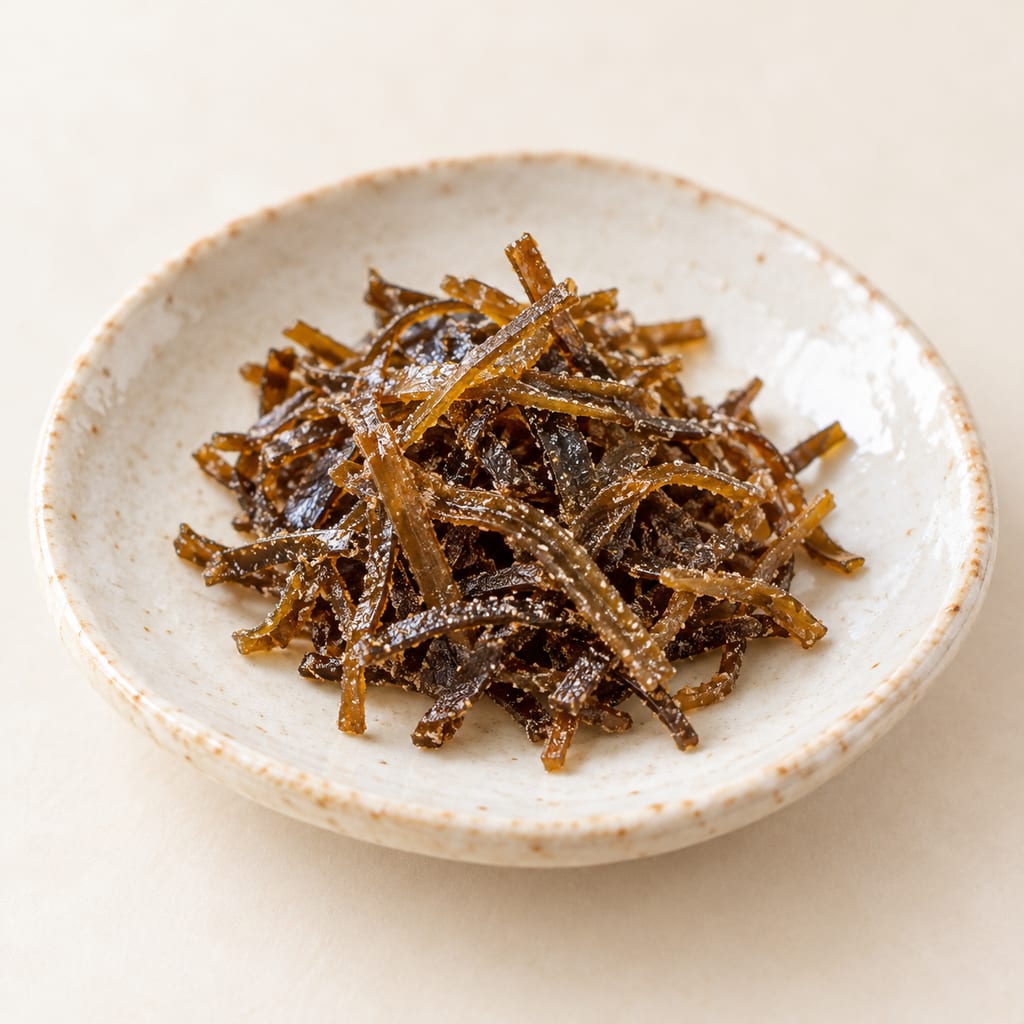
Japanese kelp simmered in soy sauce and seasonings, sometimes dried and salted, eaten with rice or used as an umami seasoning.

Adygean salt is a seasoned table salt associated with Adygea and the wider North Caucasian culinary tradition. Salt is blended with garlic and a variable selection of herbs and spices; the exact mix depends on the named style and maker.
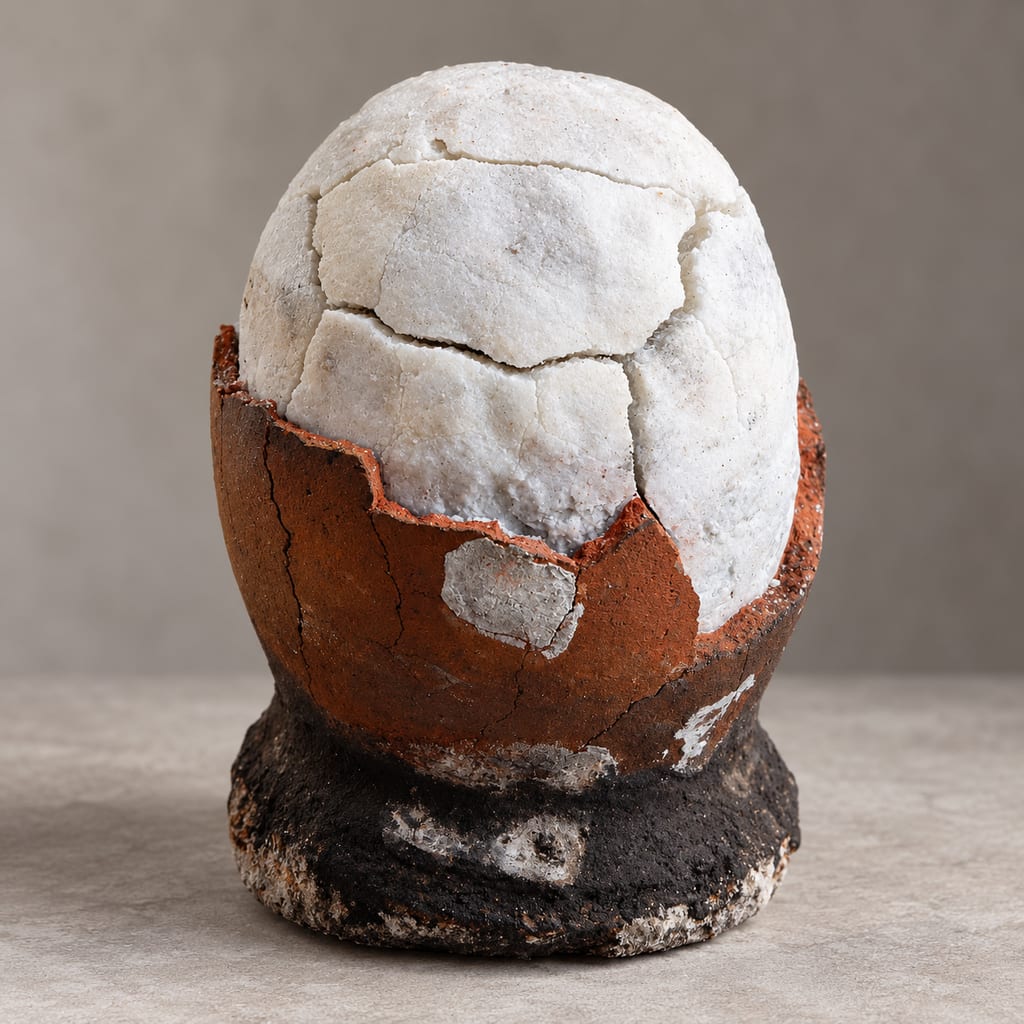
Asin tibuok is a Boholano salt-making craft that turns seawater-soaked coconut husks into a salt-rich ash, brine and formed sea salt in specialized clay pots. This record follows one published account of the community process; it is not a validated household formula.
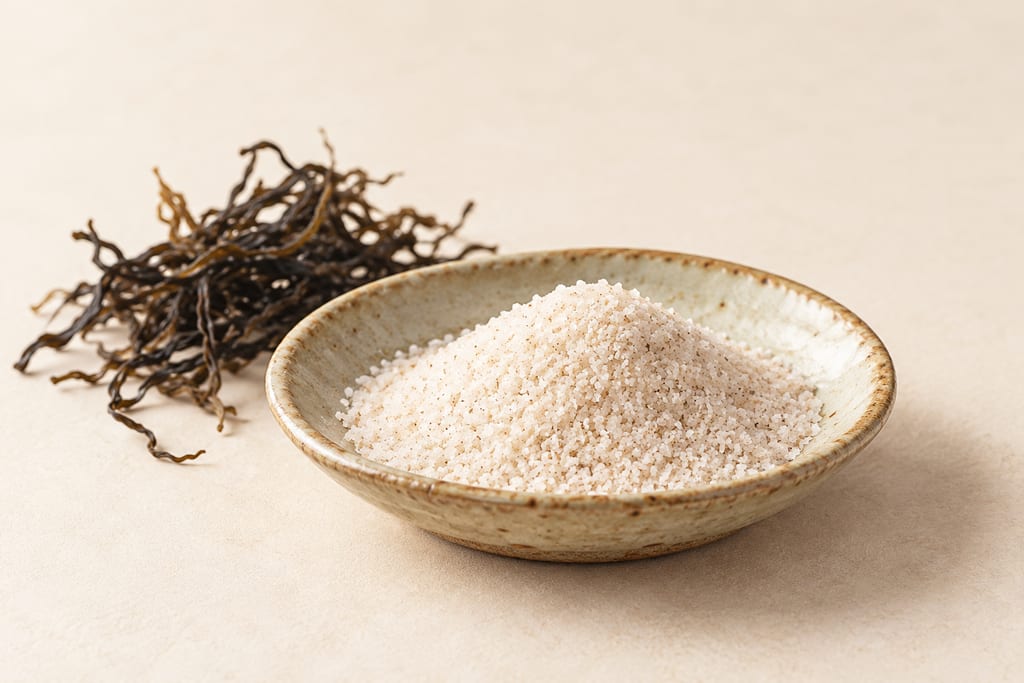
Amabito no Moshio is a modern, pale beige Japanese seaweed salt made from Seto Inland Sea water and hondawara seaweed. Its documented factory method concentrates filtered brine in kettles, then separates and dries the salt.
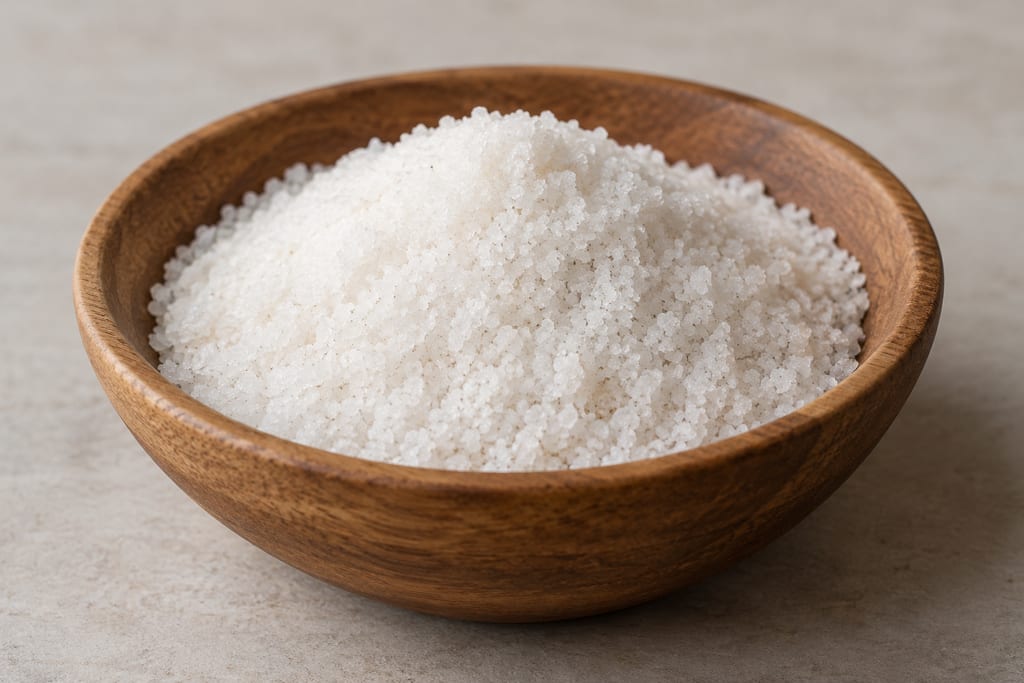
Asin sa buy-o is a fine sea salt made in Panayunan, Botolan, and packed in a woven nipa pouch called a buy-o. Salt-bearing coastal earth is leached with seawater, and the brine is boiled to crystals.
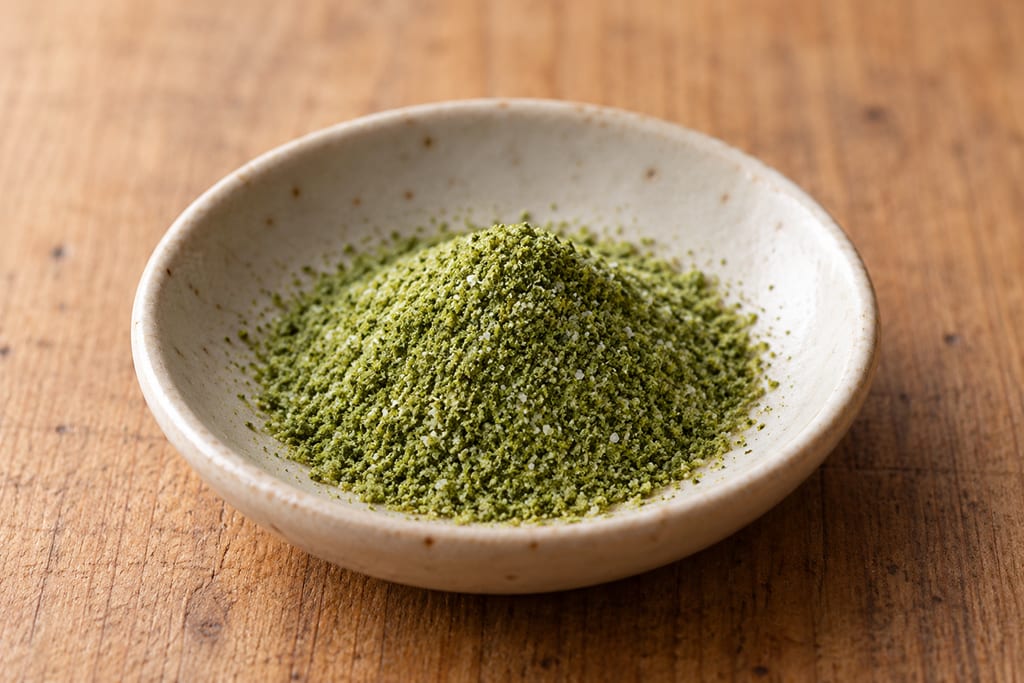
Green tea leaf salt is a dry seasoning made by grinding tea leaves, sieving them and mixing the powder with fine salt. This Japanese-style version follows a documented equal-parts method.
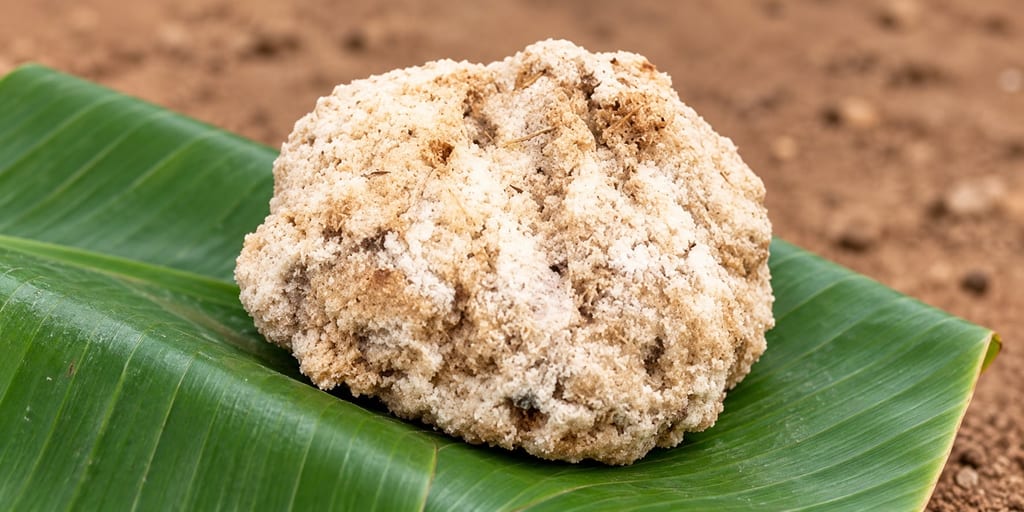
Nzoia River reed salt is a Bukusu seasoning made by leaching and evaporating the ash of mature muchua reeds. Its sources document a local method, but provide neither a measured formula nor verified mineral composition.
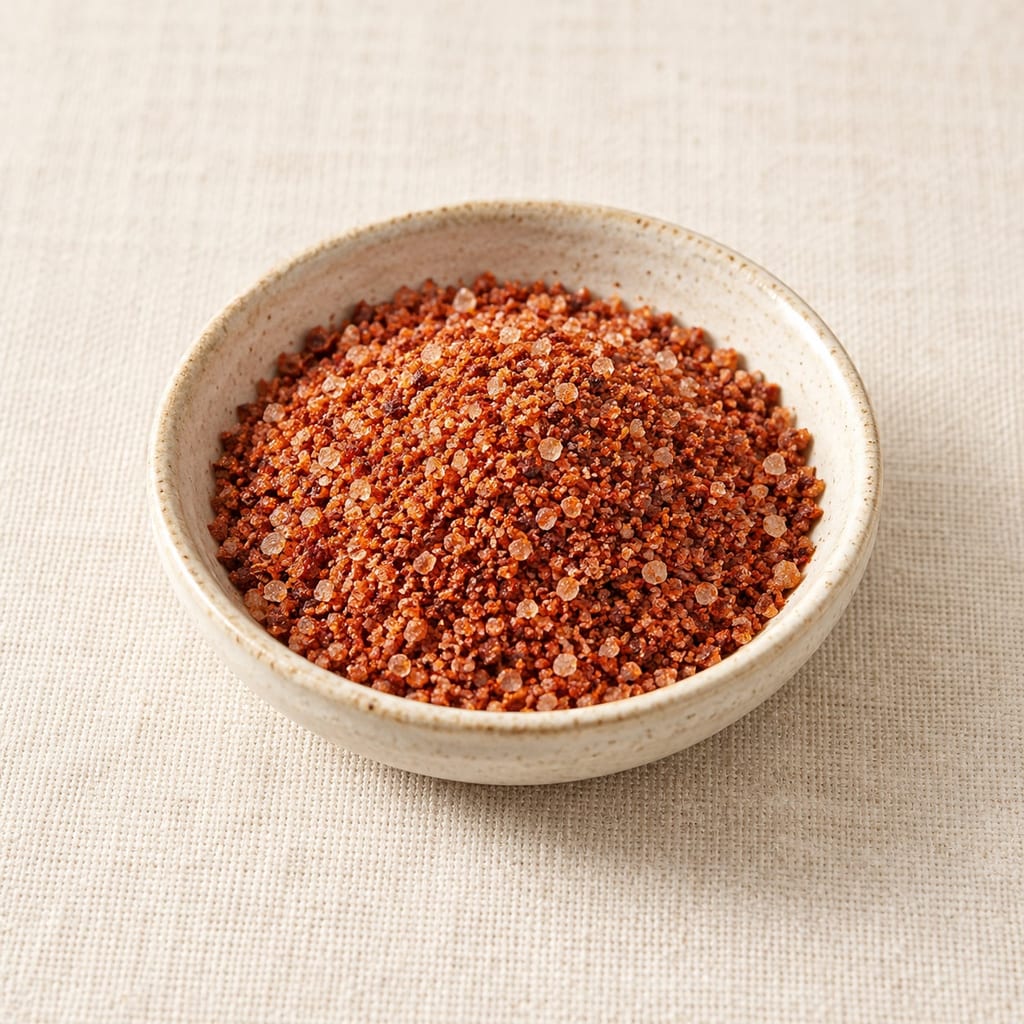
A dry Mexican seasoning of maguey worm, salt and chile, most closely associated in published accounts with Oaxaca and commonly served with mezcal, citrus and fruit.
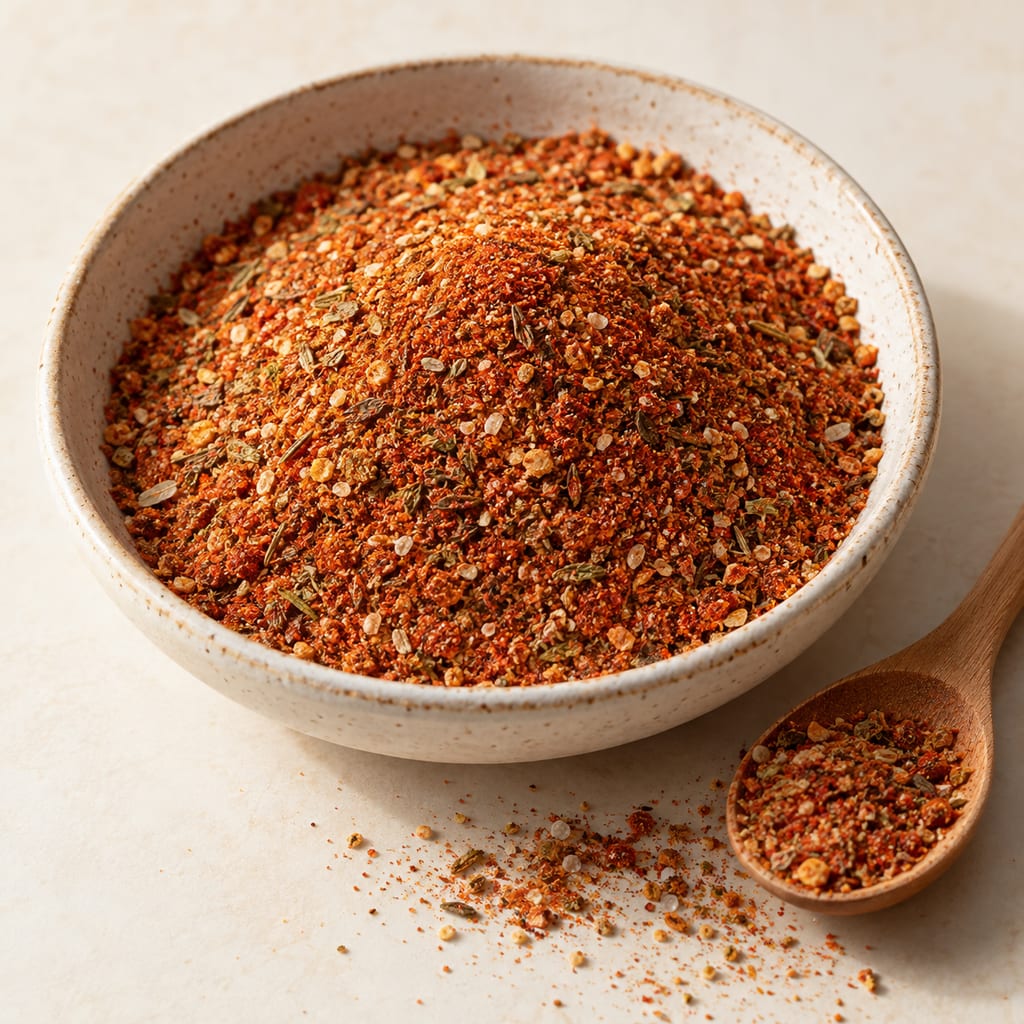
Bulgarian dry seasoning of salt, paprika, dried herbs and spices, with household and regional variations.

Soft, spreadable Calabrian pork sausage made with a great deal of red chilli and fatty pork, stuffed into natural casings, sometimes smoked and matured while staying soft.

A way to add independent temperature logging to an existing food dehydrator without changing its built-in controls or protections. It is a monitoring method, not a rewiring plan.

Pleurotus cystidiosus is the abalone mushroom, a cultivated oyster-type fungus with dark brown caps that grows more slowly and is more demanding than other Pleurotus species.

A dark, balanced vinegar from Emilia-Romagna made by combining cooked or concentrated grape must with wine vinegar, then acetifying and refining it in wood under a protected specification.

A living dairy inoculum that starts controlled cream fermentation, developing acidity and aroma before sour cream or cultured butter is finished.

A small electric incubator holds jars at a selected temperature for yogurt and other documented warm food preparations. Controls, capacity and vessel arrangement vary by model.

The African Caesar-group mushroom, Amanita masasiensis, is a wild ectomycorrhizal species of central and southern African woodlands, eaten locally. The genus contains deadly poisonous species, so identification needs care.
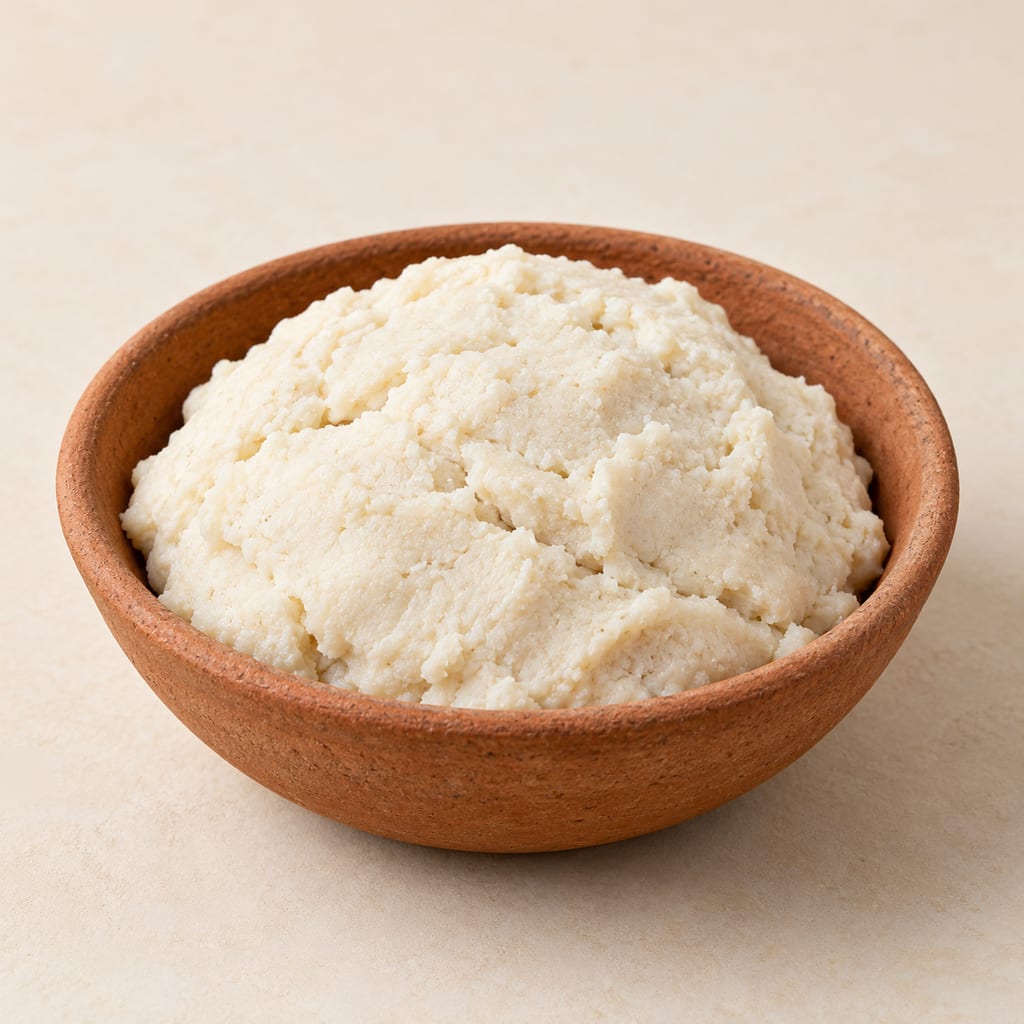
Ghanaian sour cassava dough fermented with traditional inoculum and drained during fermentation. It is used as a base for cooked foods such as banku and akple; process variants and safety outcomes differ.
No community contributions have been published for this entry yet.
Sign in to contribute. Published comments and photos are free to read.
TaDa PHILOSOPHY, Inc.Method · Ingredients · Geography
Manufacture | MOSHIO of Awaji IslandThe producer draws underground seawater near Fukura Bay on Awaji Island, filters and membrane-concentrates it.
The premium process uses seaweed extraction, extended cauldron boiling, crystallization, separation from bittern, cooling and further reduction.
The maker describes Premium Moshio as a small, hand-produced salt taking about four days; it publishes no home-scale formula.
Cited in: A named salt from Awaji Island; Place, water and seaweed; How the manufacturer makes it; Keeping the salt and reading its limits
TaDa PHILOSOPHY, Inc.Method · Ingredients
こだわり製法The maker names hondawara, akamoku and other seaweeds in its process description.
The published stages include concentration, heating, seaweed steeping, crystal separation, cooling, flat-pan finishing, sieving, inspection and sealed packing.
The process page gives no ingredient quantities or numerical finishing endpoint.
Cited in: A named salt from Awaji Island; Place, water and seaweed; How the manufacturer makes it; Moshio is a family, not a single formula; Keeping the salt and reading its limits
TaDa PHILOSOPHY, Inc.History
沿革The company traces its founding to a cotton business on Awaji Island in 1673; that is company history, not salt-product age.
The company dates its moshio production to 1999 and a production expansion with strengthened hygiene measures to 2002.
Cited in: A modern product with a much older cultural backdrop
TaDa PHILOSOPHY, Inc.Identity · Ingredients · Use · Variations
Products | MOSHIO of Awaji IslandThe Premium product is marketed as made with ingredients sourced from Awaji Island and offered in household, table, food-service and industrial formats.
The maker lists Tsubu Moshio as a separate large-crystal product.
Current serving suggestions include fish, rice, tofu, vegetables, edamame, bread, ice cream and other dishes.
Cited in: A named salt from Awaji Island; Place, water and seaweed; Moshio is a family, not a single formula; Serving Awaji moshio; Keeping the salt and reading its limits
TaDa PHILOSOPHY, Inc.Character · Use · Variations · Storage
Q&A | MOSHIO of Awaji IslandThe maker describes moshio as seawater and seaweed salt with mild salinity, seaweed sweetness and umami.
Suggested uses include grilled fish, yakitori, tempura, tofu, steak, sushi rice, pickles, ramen, noodles, salads, bread and desserts.
The producer says humidity and storage conditions can cause solidification; its product range includes approximately four-day Premium and Setouchi lines.
Cited in: A named salt from Awaji Island; Place, water and seaweed; Moshio is a family, not a single formula; Serving Awaji moshio; Keeping the salt and reading its limits
TaDa PHILOSOPHY, Inc.History · Character
MOSHIO | MOSHIO of Awaji IslandThe company connects Awaji salt vessels from the Tumulus period and Man’yoshu poetry with the broader history of moshio-yaki.
The producer describes the modern salt as pale beige with a mild taste and seaweed-associated savoriness.
Cited in: A modern product with a much older cultural backdrop
Tobacco and Salt MuseumHistory · Archaeology
採かんの発達/藻塩焼き(古代)The museum describes multiple interpretations of ancient seaweed-related brine concentration and boiling in pottery.
Coastal salt-making vessels appear across Japan; fragmentary records make exact ancient procedures difficult to reconstruct.
Cited in: A modern product with a much older cultural backdrop; Moshio is a family, not a single formula
Salt Association of JapanHistory · Technology
日本の塩づくりの歴史The association documents changing Japanese salt technologies, including seaweed brine, salt-bearing sand, and modern membrane concentration.
It notes the transition to factory production and discusses multiple historical interpretations of moshio-yaki.
Cited in: A modern product with a much older cultural backdrop; Moshio is a family, not a single formula