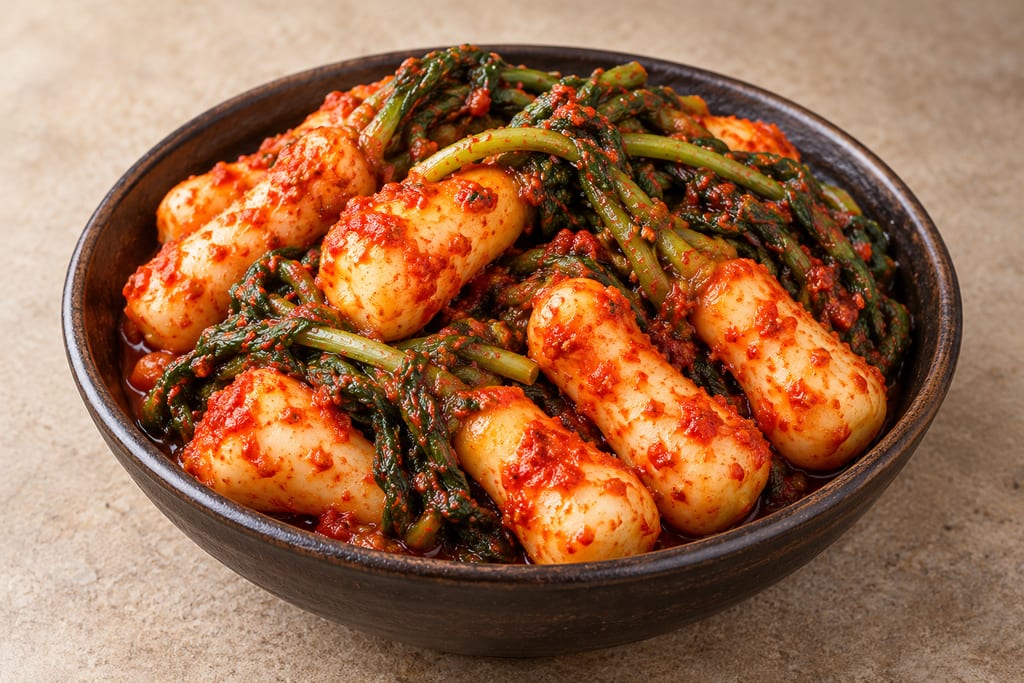
Chonggak-kimchi (ponytail radish kimchi)
Small ponytail radishes keep their greens attached and ferment in a flour-and-chile seasoning paste.
 FermenteaWhere food goes to change
Substrates
Radish and daikon are the crisp, peppery roots, leaves and seed pods of Raphanus sativus, fermented as kimchi, takuan and sinki and eaten raw across Asia and Europe.
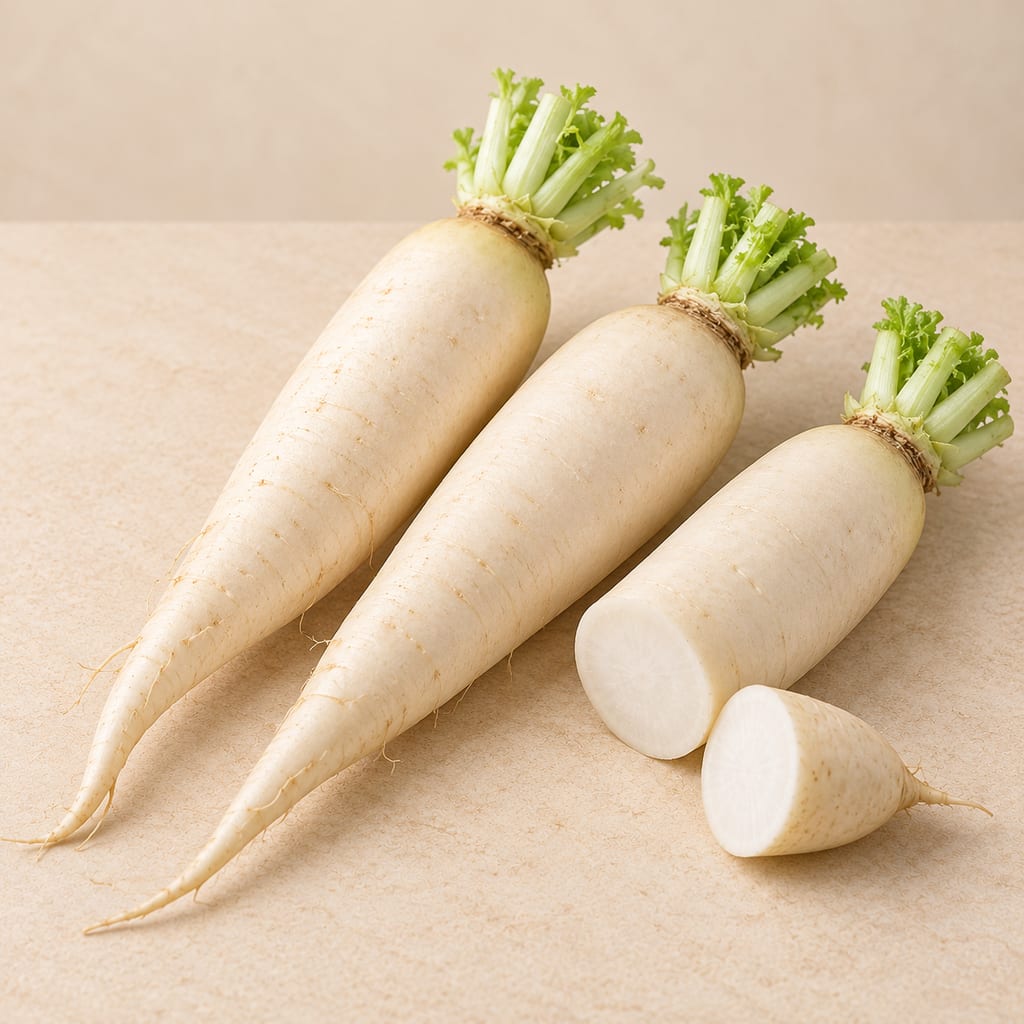
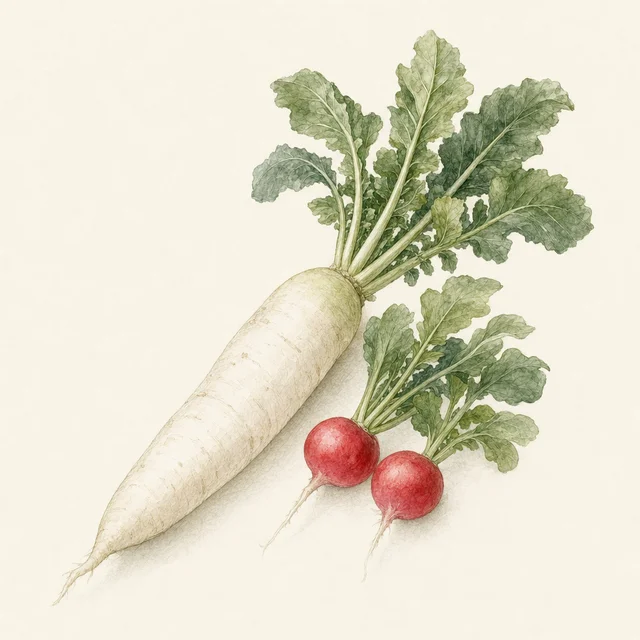
Radish, Raphanus sativus, is a fast-growing annual of the mustard family, Brassicaceae, with 18 chromosomes, sometimes treated as a subspecies of the wild radish, Raphanus raphanistrum. The word covers a startling range of crops. Spring and summer radishes such as Cherry Belle, French Breakfast and White Icicle, the last of which dates to the sixteenth century, are small and ready in about a month. Winter radishes include the Black Spanish, which dates to Europe in 1548, the daikon or mooli, the Korean radish mu, and the Sakurajima, which can reach about 30 kilograms if left in the ground. A third group is grown for the seed pod: the rat-tailed radish has pods over 20 centimetres long that were pickled and served with meat in the seventeenth century. Wild radish seeds contain up to 48 percent oil.
Skin colours run from white, pink, red and purple to yellow, green and black, while the flesh is usually white. The red varieties owe their colour to pelargonidin and the purple cultivars to cyanidin. Harvested at the proper time the root is crisp and mild; left too long it becomes bitter and tough.
The domestication of the radish is poorly documented because there are almost no archaeological records. Scientists tentatively place its origin in Southeast Asia, the only region where truly wild forms have been found, with South Asia, central China and Central Asia as secondary centres of diversification. Radishes enter the historical record in the third century BC, and Greek and Roman agriculturalists of the first century AD described small, large, round, long, mild and sharp varieties. The radish appears to have been one of the first European crops introduced to the Americas, and in 1544 a German botanist reported radishes of about 45 kilograms and 90 centimetres.
Daikon, Raphanus sativus var. longipinnatus, is a mild winter radish with a long white root, native to continental East Asia, probably north China. The Japanese name means big root; in South Asia it is mooli, in Cantonese lobak and in Min-speaking areas chai tow. The Korean radish mu is shorter, stouter and denser than the long white radishes, with softer leaves, and is often spicier. A Cantonese lobak form has a light green top, and the watermelon radish has a dull green exterior with a bright rose or fuchsia centre. In North America the daikon is mainly grown as a forage or fallow crop and the United States Department of Agriculture calls it oilseed radish.
The pungency of a radish comes from glucosinolates and the enzyme myrosinase. When the root is chewed or cut they meet and form allyl isothiocyanates, the same family of compounds found in mustard, horseradish and wasabi, so the bite appears only once the cells are damaged. Pungency also varies with the crop: the Korean radish is often spicier than the long white radishes, and daikon that grows slowly in dry conditions turns tough and sharp.
Raw radish is a mild, watery root, about 95 percent water, with 16 kilocalories per 100 grams and 14.8 milligrams of vitamin C; daikon is about 94.6 percent water with 22 milligrams of vitamin C. That high water content is what salt works on in a ferment: salting draws the water out, firms the root and makes the brine in which the seasoning dissolves.
Radish is a cool-season crop that germinates in three to four days in moist soil at 18 to 29 degrees Celsius. Common small varieties are ready within about a month, three to four weeks in average conditions and six to seven weeks in colder weather, and daikon takes several weeks. The best roots form under moderate day lengths with air temperatures of 10 to 18 degrees Celsius, in full sun and light sandy loam at pH 6.5 to 7.0. Flea beetles, swede midge and the cabbage root fly are the main pests. Roots keep two to three days at room temperature and about two months at 0 degrees Celsius and 90 to 95 percent relative humidity.
Radish is grown mainly in China, Japan and South Korea. Winter types such as daikon and the Korean mu take several weeks to mature, and moisture matters: daikon grown with abundant moisture grows quickly, while a dry season leaves the flesh tough and pungent. Chinese and Indian daikon varieties tolerate more heat than Japanese ones, so they extend the season into warmer regions, and the Korean mu is the dense, often spicier radish that kimchi makers favour. Small spring radishes serve for raw eating and quick pickles, while the long, firm winter roots are the ones that are salted, dried or fermented.
Napa cabbage and Korean radish are the most common kimchi vegetables, and radish is a kimchi in its own right. Kkakdugi is cubed radish kimchi, dongchimi is a non-spicy water kimchi of whole radish in brine, yeolmu-kimchi is a summer kimchi of young radish, and chonggak-kimchi uses small ponytail radishes; nabak-kimchi is a water kimchi of vegetables and fruit that includes radish. Radish also goes into cabbage kimchi: a measured kimchi uses a quarter pound of daikon with two pounds of napa cabbage, garlic, green onions, sugar and two and a half tablespoons of salt, and the final salt concentration should be 2 to 5 percent.
The vegetables are salted first to draw out water and inhibit harmful microbes. Radish gives up water readily, and the juice it releases becomes the brine in which the seasoning dissolves. The lactic acid bacteria that ferment kimchi follow a succession: Leuconostoc dominates early, since it tolerates low salt and low acidity, and Lactobacillus and Weissella take over as acidity rises; the optimum pH of a measured kimchi is 4.2. Danmuji, the sweet yellow pickled radish served with Korean-Chinese dishes, is the Korean version of the Japanese takuan.
Radish is also the older kimchi vegetable. The Samguk Sagi mentions pickle jars, which suggests fermented vegetables were common in the Three Kingdoms period, and a thirteenth-century poem by Yi Gyubo shows that radish kimchi was common in the Goryeo period; early kimchi had no chilli or garlic, which reached the recipe much later.
Two radish kimchis show the range. Kkakdugi is Korean radish cut into small cubes and flavoured with salt, red chilli powder, spring onions and ginger, mixed and stored in a large earthenware pot, a jangdok or onggi, in a cool, dry place for about two weeks and eaten cold while the radish is still crisp. It is the usual companion of seolleongtang, galbitang and samgyetang, where its taste cuts through the richness and smell of the meat soup. Dongchimi is the opposite in character: its name combines dong, winter, with an old word for kimchi, and radish is its most important ingredient, in a watery brine with napa cabbage, scallions, pickled green chilli, ginger and Korean pear. It matures in only two to three days, is served cold, and its clear broth goes into dongchimi guksu, a cold noodle soup, and naengmyeon. The north of Korea, especially Hamgyong and Pyongan provinces, is known for it, and variants include baechu dongchimi stuffed with julienned radish and chives, daenamu dongchimi, which ferments longer because of its lower sodium, and the royal gungjung dongchimi of small radishes with yuja, pomegranate and pears.
Takuan is Japan's pickled daikon. In the traditional method the daikon is hung by its leaves in the sun for a few weeks until it is dehydrated and flexible. It is then placed in a crock and covered with a mixture of salt and rice bran, optionally with sugar, daikon greens, kombu, chilli or dried persimmon peel, weighted, and left to pickle for several months. The finished pickle is usually yellow and quite pungent, and mass-produced versions use salt or syrup to shorten the dehydration and artificial colour to improve the look. The yellow pickle is popularly credited to the Buddhist monk Takuan Soho, who lived from 1573 to 1645. Takuan is served cold alongside other tsukemono, as a side dish, as a snack at teatime and at the end of meals; it is washed, sliced thinly and cut into strips for bento and sushi rolls, and old sour takuan may be stir-fried or braised.
A smoked relative, iburi-gakko, is a specialty of Akita Prefecture, smoked rather than sun-dried, originally above the house hearth; it received Japanese geographical indication status in 2019. Takuan reached Korea during the Japanese occupation as dakkwang and was later renamed danmuji, meaning sweet radish pickle, usually sweeter and crunchier than the Japanese original. Japan has other bran pickles: in nukamiso-zuke vegetables, radish among them, ferment in a mixture of rice bran, salt and water.
Takuan is one of a family of bran pickles. Nukazuke developed in the seventeenth century as a traditional Japanese preserved food, traditionally fermented in tubs of Japanese cedar, and its vitamin B1 is said to have helped prevent beri-beri in Edo, the present Tokyo. The bed, called nukadoko or nukamiso, is rice bran mixed with salt, kombu and water to the consistency of wet sand or cooked grits, sometimes with ginger, chilli, garlic, persimmon or apple peel or mustard powder. The water mostly comes from the vegetables buried in the bed, and salt, acidity and oxygen from daily stirring keep harmful microbes from growing.
A live bed holds mostly lactobacilli and yeast, which come from vegetable skins, from hands or from a seed taken from an established bed; a new bed is started by burying vegetable scraps or apple or persimmon peels daily until a culture forms. Almost any vegetable can be pickled in it, and daikon is among the most common, with cucumber, carrot, cabbage, celery, eggplant and turnip. Pickling can last a few hours for a quick pickle or several months for strong flavour, cold weather slows the fermentation, and the bed has to be turned every day, traditionally with bare hands, to keep it from turning putrid or mouldy. Flavour ranges from pleasantly tangy to very sour, salty and pungent, and an old bed that is kept alive for generations is valued for its depth. A sour or stinky smell can signal a problem with the bed.
Sinki is a sour radish pickle eaten in India, Nepal and parts of Bhutan, used as a base for soup or eaten as a pickle, and one of the most popular pickles in Nepal. Fresh radish taproots are harvested and washed, wilted by sun-drying for one to two days, shredded, washed again and packed tightly into an earthenware or glass jar, which is sealed and left to ferment; the optimum is twelve days at about 30 degrees Celsius, and a second method ferments the radish in a clay-lined pit for two to three months. No salt is used. Fermentation is initiated by Lactobacillus fermentum and L. brevis and followed by L. plantarum, and the pH falls from 6.7 to 3.3. After fermentation the radish is sun-dried to a moisture level of about 21 percent. To eat it, the sinki is rinsed and squeezed, fried with salt, tomato, onion and green chilli, boiled in rice water and served hot as a soup with the main meal.
The leaf is a food in its own right. Gundruk, a fermented leafy green of Nepal also popular in Sikkim, other parts of India, Bhutan and Myanmar, is made from the leaves of the first broad harvest of mustard, radish and cauliflower in October and November, and radish roots can be added. The leaves wilt for a day or two, are shredded, packed tightly into an earthenware container and covered with warm water at about 30 degrees Celsius, and kept in a warm place. After about a week a mild acid taste signals the end of fermentation and the contents are removed and sun-dried. Unlike sauerkraut or kimchi, no salt is added before fermentation. Pediococcus and Lactobacillus species predominate, pH falls slowly to about 4.0 and acid rises to about 1 percent by the sixth day. Annual production in Nepal is estimated at 2,000 tons, mostly made at household level, and it is an important source of minerals in the off-season, when diets are mostly starchy tubers and maize. The traditional process loses about 90 percent of the carotenoids, probably during sun-drying.
Radish is eaten mostly raw in salads, and also served with butter, salt and bread as an appetiser or sliced as a garnish on Mexican tostadas, sopes, enchiladas and pozole. Its greens are edible and nutritious and are used in potato soup, sauteed or blended into juices, and in Pakistan young daikon leaves are cooked and stuffed into paratha. The seed pods are eaten in India as moongra or mogri, and the seeds can be sprouted and eaten raw.
Daikon is grated in Japan as daikon-oroshi, with chilli as momiji-oroshi, dried as kiriboshi-daikon, and used as a sashimi garnish, in oden and in the nanakusa herbs of spring. In South India mullangi sambar uses it, in North India it fills sabzi and paratha, in Bangladesh it is grated with chilli, coriander, fish and lime into mulo bhorta, in China it makes turnip cake, chai tow kway, and daikon zhacai, in the Philippines it goes into sinigang, and in Vietnam it appears in the sweet-sour pickles of banh mi.
For fermenting, choose firm, unblemished roots harvested at the right time. Wash them and cut them as the preparation asks: cubes for kkakdugi, matchsticks for a cabbage kimchi, whole roots for dongchimi. For a saltless ferment follow the sinki method of wilting before shredding, and for a bran pickle bury the roots in the bed. Keep the vegetable submerged or buried, and discard anything slimy, mouldy or foul-smelling.
Tentative place of origin, the only region where wild forms are found; not a precise birthplace.
Daikon is native to continental East Asia, probably north China.
Radish kimchi such as kkakdugi and dongchimi; the row does not date them.
Takuan pickled daikon; the attribution to Takuan Soho is popular, not documented.
Sinki from radish roots and gundruk from radish and mustard leaves; the sources place them in Nepal and neighbouring areas without finer location.
Small ponytail radishes keep their greens attached and ferment in a flour-and-chile seasoning paste.
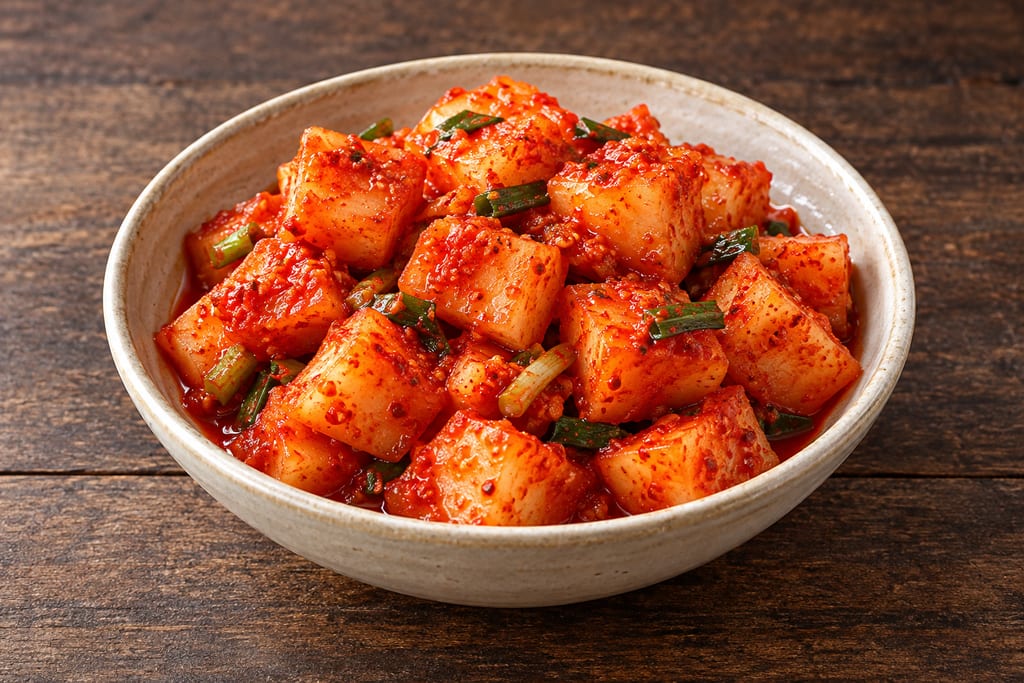
A radish kimchi cut into cubes and seasoned with gochugaru, fish sauce, garlic and ginger, eaten fresh or fermented a few days at room temperature.
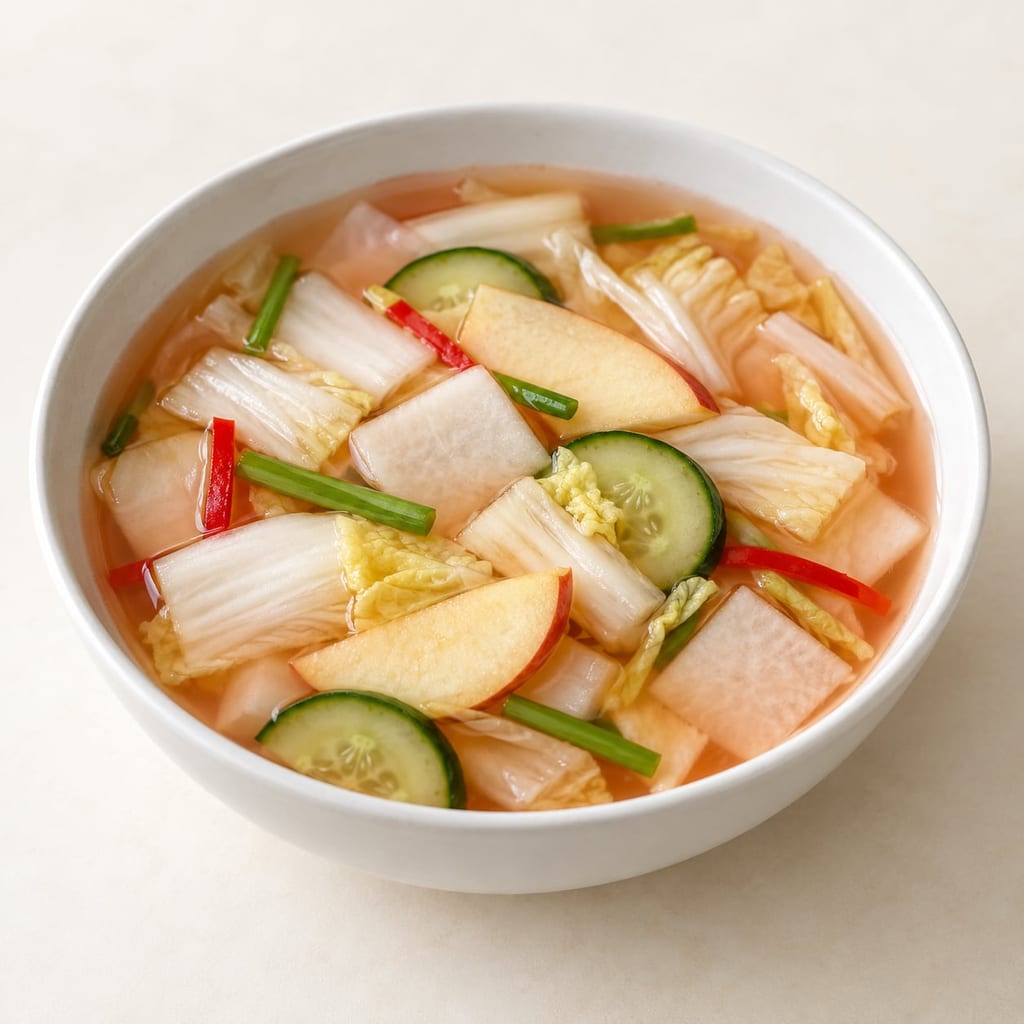
Napa cabbage and radish ferment in a rose-coloured broth with cucumber, apple, pear, alliums and chile.
Kimchi of salted napa cabbage and daikon with garlic, green onion and red pepper, kept at room temperature one to four days, then refrigerated.
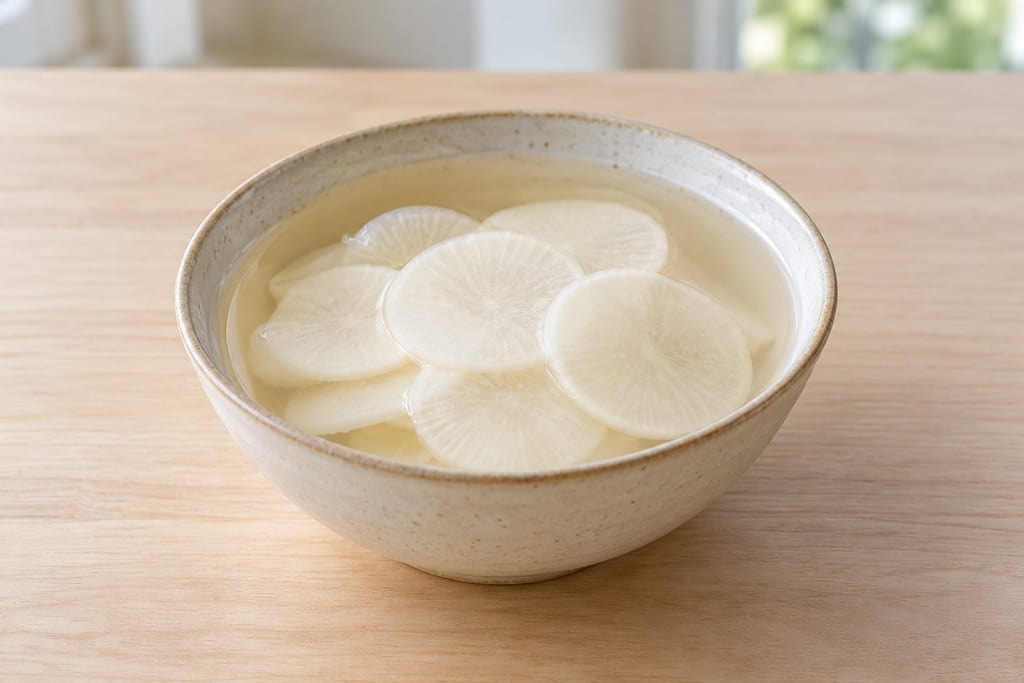
A modern broth-forward radish-water kimchi cooks apples and onion into the fermentation liquid.
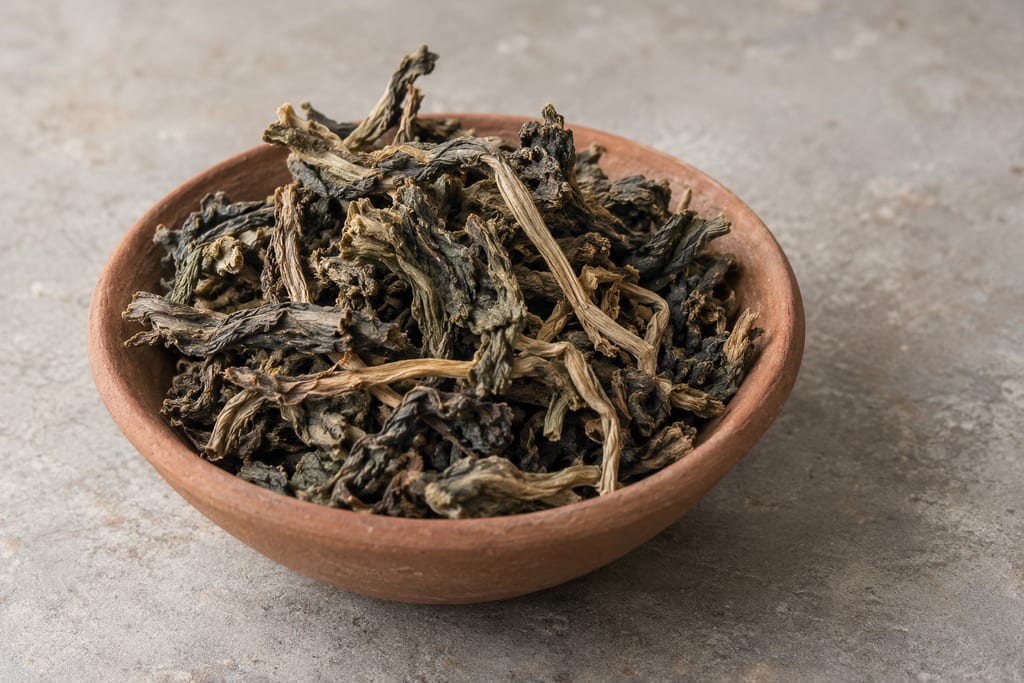
Radish greens wilted, packed into an earthen pot with warm water and fermented without salt, then sun-dried into Nepal's dark, sour gundruk.
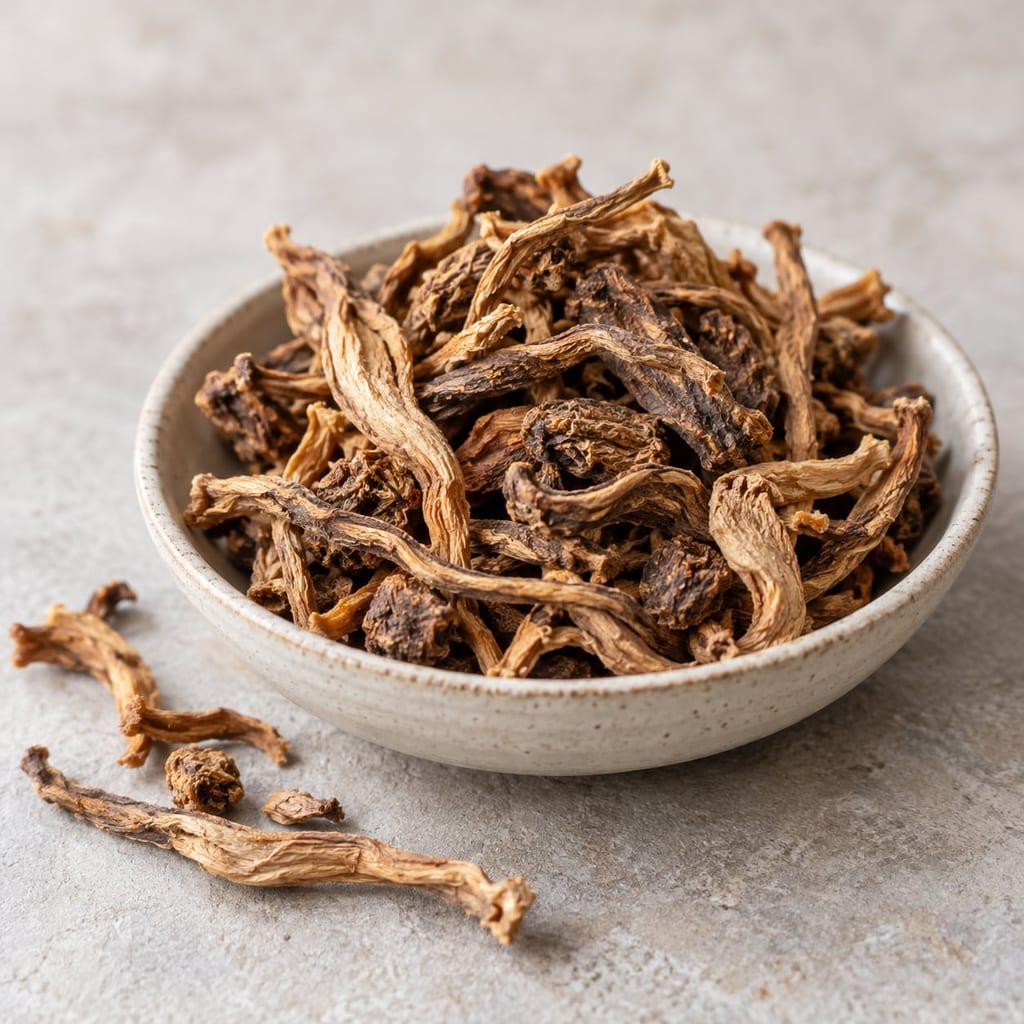
Sinki is a salt-free, fermented radish-taproot product dried after fermentation. Published jar and pit accounts use different conditions; neither supplies a validated home-preservation endpoint.
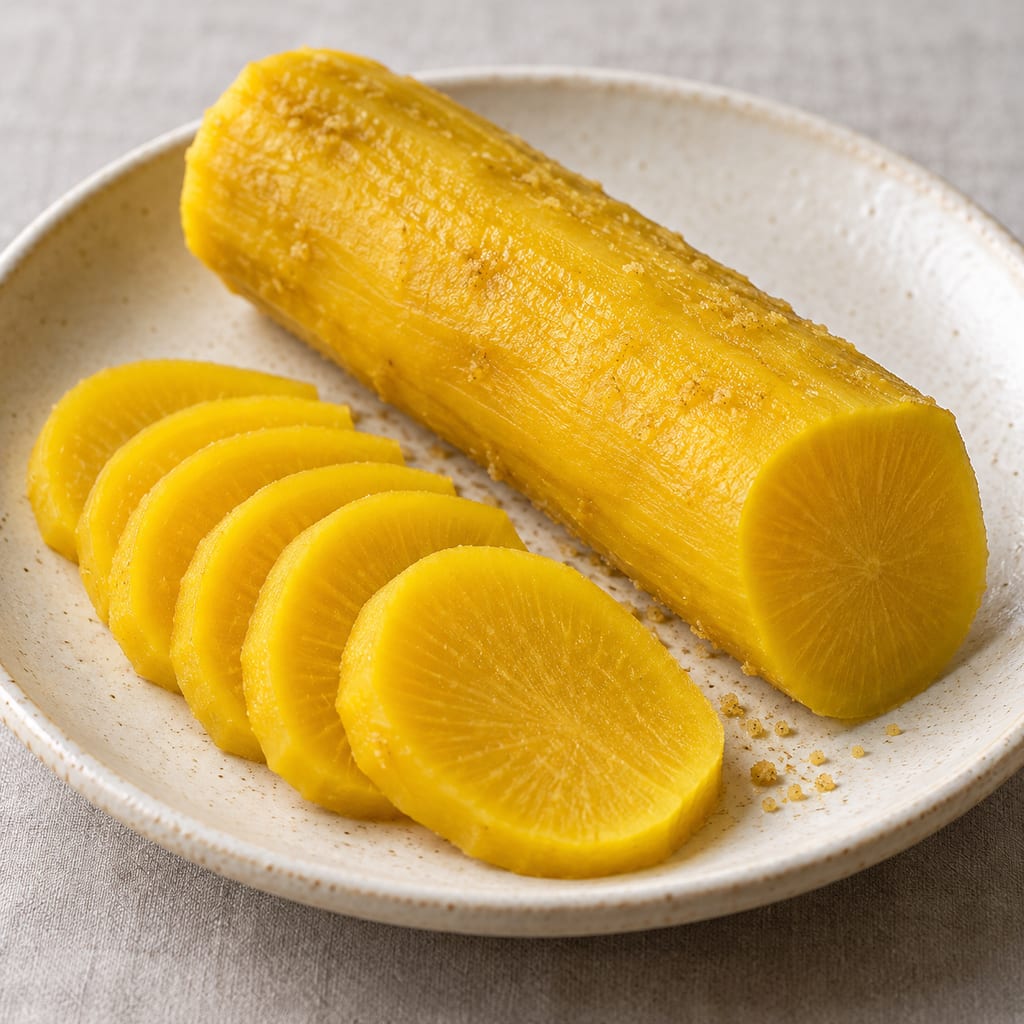
Daikon is dried until pliable, then layered in seasoned rice bran and pressed for a long fermentation.
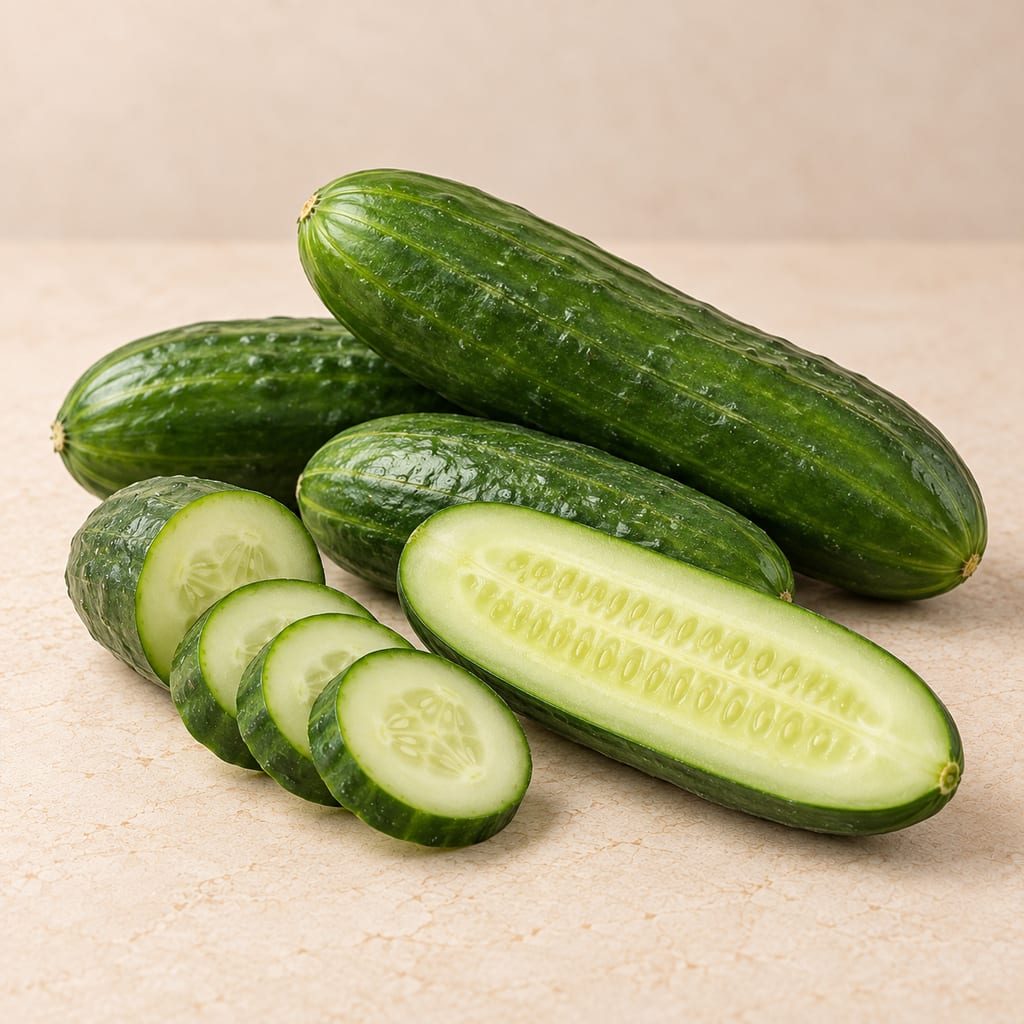
Cucumber is the watery fruit of Cucumis sativus, domesticated in India, and the classic raw material of brine pickles from New York dills to Nepali khalpi and Korean oi-sobagi.
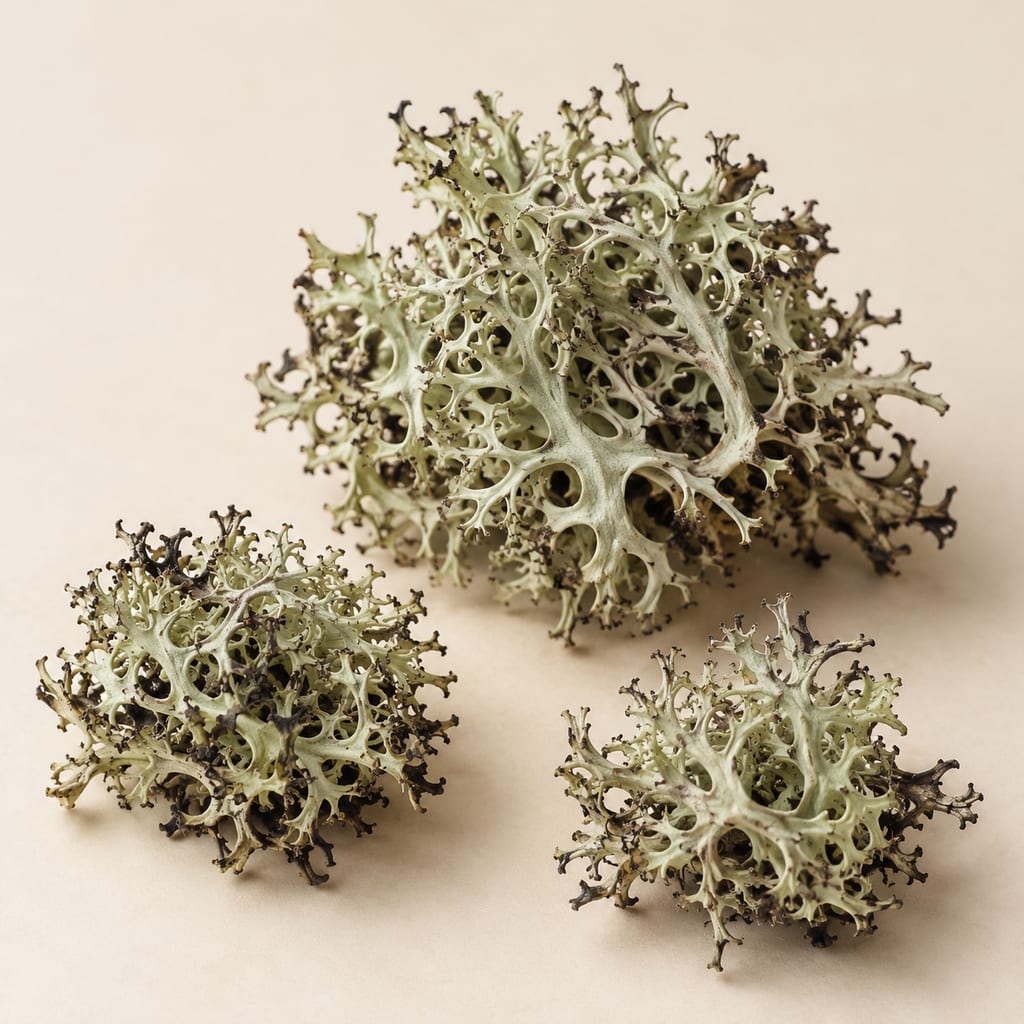
Everniastrum cirrhatum, a tree-dwelling lichen of the Nepal Himalaya, gathered wild and used in soups, pickles and sausages by the Limbu and Rai communities of the north-east hills.
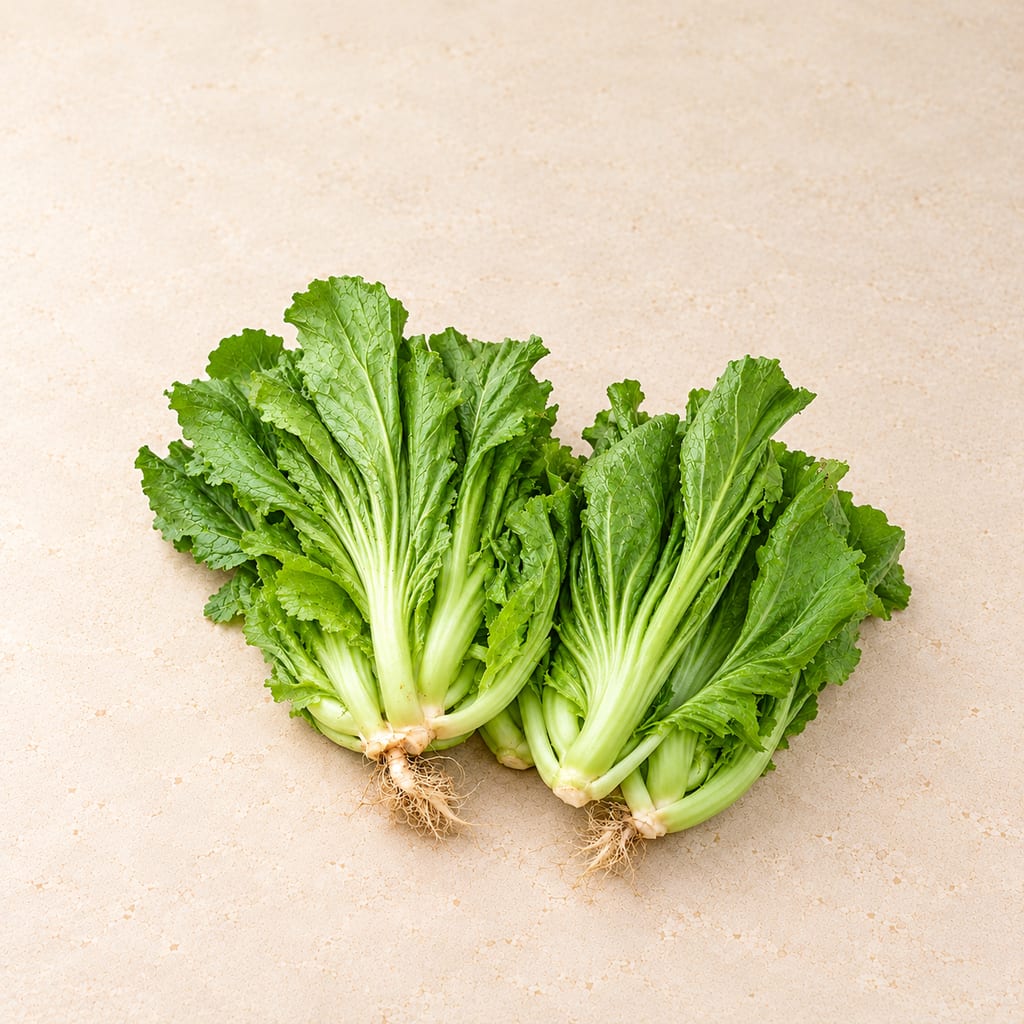
The leaves of Brassica juncea, a hardy cool-season crop with a sharp, sulfurous bite, eaten fresh and cooked and fermented across Asia as pickled greens, kimchi and gundruk.

At North Abydos in Egypt, a fixed early Dynastic brewery comprised parallel semi-subterranean installations with rows of ceramic mash vats; excavation reports revise their number, scale and estimated batch capacity.

Ají amarillo is the orange-yellow Peruvian chilli cultivar group of Capsicum baccatum, used to colour and season huancaína sauce and ají de gallina. Published heat estimates do not establish one range for the named cultivar.

Toasted almonds are whole sweet almond kernels dry-roasted until golden to brown. Heat replaces their marzipan note with a roasted, nutty one; they thicken and flavour romesco.

Kodiak salmon, halibut and cod cut as seg'aq and hung on an initaq rack to become tamuuq, with kac'amaasaq and kupcuunaq named as different results.

Aniseed is the dried ripe fruit of Pimpinella anisum, an aromatic Apiaceae spice commonly called a seed. It adds a sweet, warm aroma to breads such as Moroccan krachel and South African mosbolletjies, and is distinct from star anise.

A fixed Late Chalcolithic installation in Areni-1 cave combined a shallow clay pressing basin with a large jar set into the cave floor and storage vessels nearby.

Ripe avocado flesh is the soft, buttery, fat-rich pulp of Persea americana, eaten raw. It is low in acid, so it is a fresh ingredient that needs care in chilled dishes.

A portable dome and pan used over a hearth, with embers on the lid and heat from below. Regional peka and saç forms share this principle while differing in materials, pan shape and how the food is cooked.
No community contributions have been published for this entry yet.
Sign in to contribute. Published comments and photos are free to read.
WikipediaIdentity · History · Production · Nutrition
RadishTaxonomy, origin, cultivars, pungency chemistry
Cultivation, storage, production and nutrition, uses
Cited in: One species, many roots; Where radishes came from; Why radish bites; Growing the crop; Raw and cooked uses; Choosing and handling
WikipediaIdentity · Use
DaikonDaikon origin, names, Korean radish, cultivation
Uses across Asia, nutrition
Cited in: Where radishes came from; Why radish bites; Growing the crop; Raw and cooked uses; Choosing and handling
WikipediaMethod · History
TakuanTraditional takuan method of sun-drying then pickling in salt and rice bran
Takuan Soho, iburi-gakko, danmuji
Cited in: Radish in Korean kimchi; Takuan: daikon dried and pickled in bran
WikipediaFermentation · Method
GundrukGundruk from radish, mustard and cauliflower leaves, salt-free fermentation, microbes, pH and carotenoid loss
Cited in: Gundruk and the radish leaf
Food and Agriculture Organization of the United NationsFermentation · Method
Fermented fruits and vegetables: a global perspective, Chapter 6: Typical products of bacterial fermentationsSinki method, microorganisms, pH change and drying
Korean radish product names and nukamiso-zuke
Cited in: Takuan: daikon dried and pickled in bran; Sinki: radish without salt
WikipediaFermentation
KimchiNapa cabbage and Korean radish as the common kimchi vegetables, microbial succession, kkakdugi, dongchimi, yeolmu-kimchi
Cited in: Radish in Korean kimchi
Oregon State University ExtensionMethod
Kimchi basicsDaikon in a measured kimchi, salt 2 to 5 percent, pH 4.2
Cited in: Radish in Korean kimchi
Penn State ExtensionSafety
Let's Preserve: Sauerkraut and PicklesKeep vegetables submerged, discard slimy or mouldy product
Cited in: Choosing and handling
WikipediaMethod
KkakdugiCubed radish kimchi: flavouring, two-week cool fermentation, serving
Cited in: Radish in Korean kimchi
WikipediaMethod
DongchimiRadish water kimchi: ingredients, two to three day maturing, regions, variants
Cited in: Radish in Korean kimchi
WikipediaMethod
NukazukeRice-bran pickling bed: composition, microbes, vegetables, daily stirring
Cited in: Nukazuke: the rice-bran bed; Choosing and handling