Chilli
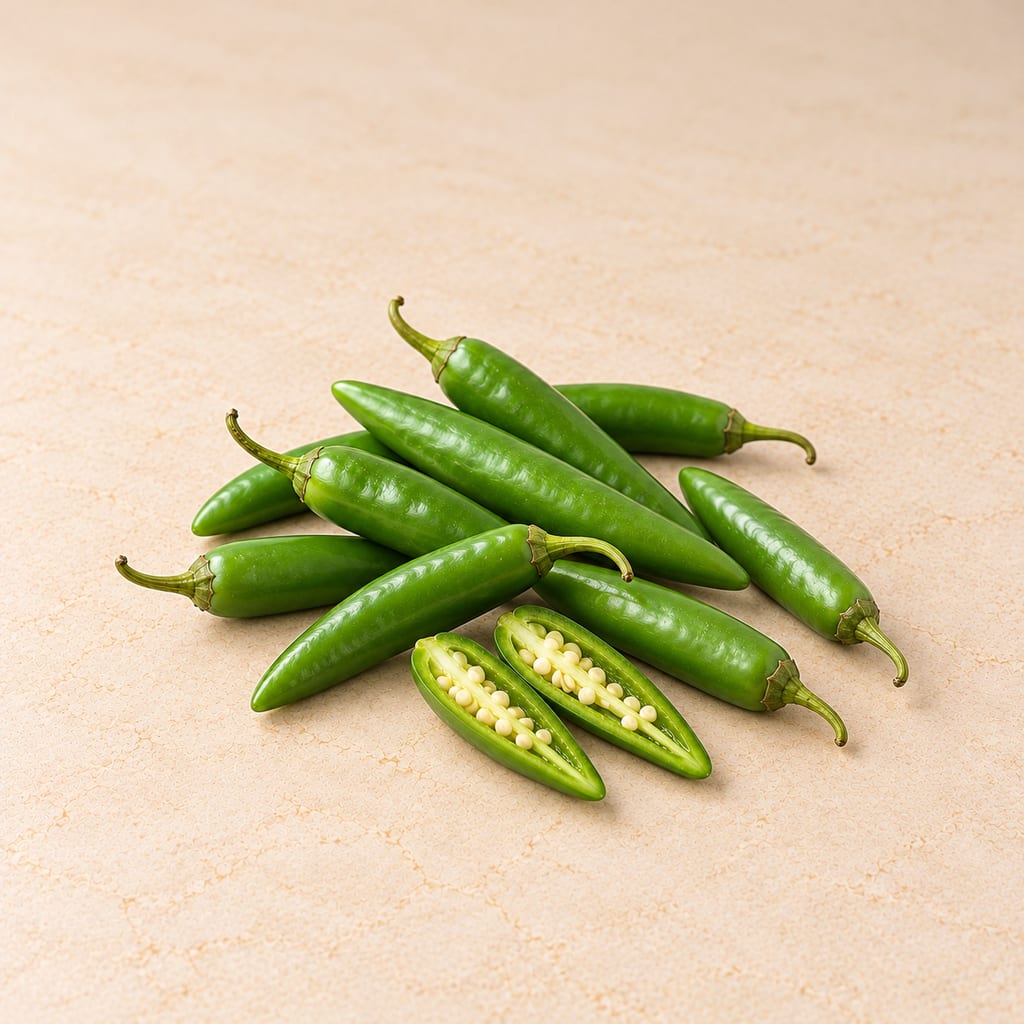
Chilli is the pungent fruit of Capsicum plants, native to the Americas and eaten fresh, dried, ground or fermented in cuisines around the world.
 FermenteaWhere food goes to change
Traditional method
Kimchi
A radish kimchi cut into cubes and seasoned with gochugaru, fish sauce, garlic and ginger, eaten fresh or fermented a few days at room temperature.
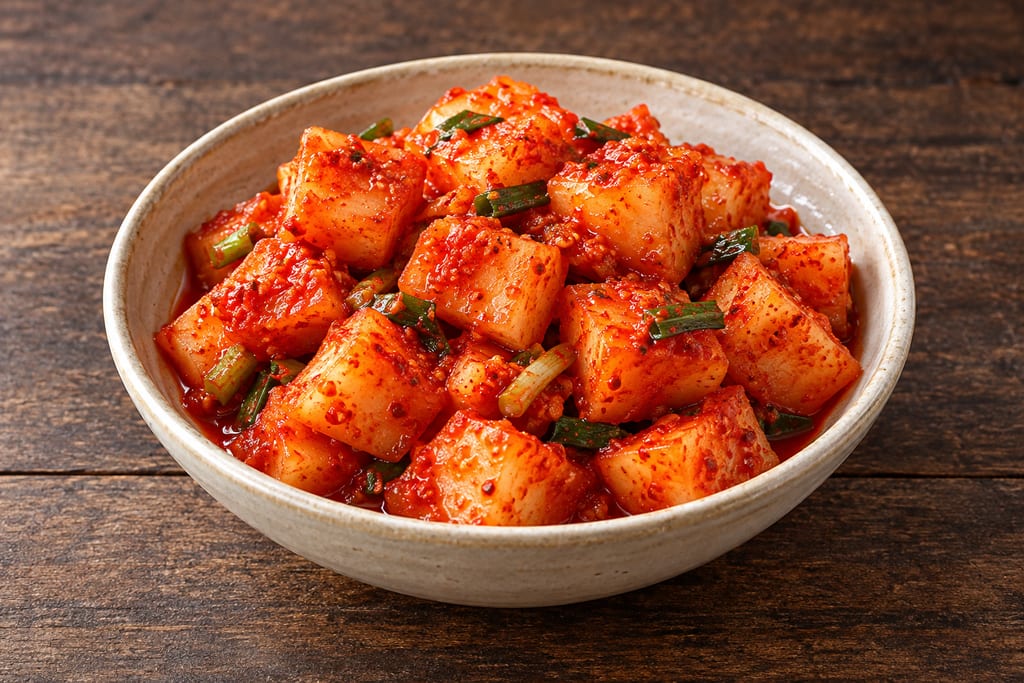
Kkakdugi is a Korean kimchi made from cubes of white radish coated with chilli flakes, garlic, ginger, spring onions and salty seasonings.
It is one of the most familiar forms of radish kimchi and a common accompaniment to Korean meals.
Its characteristic texture is a substantial part of its identity.
Where some kimchi varieties use long leaves or thinly sliced vegetables, kkakdugi retains recognisable cubes of radish.
These pieces provide a crisp, juicy bite even after fermentation begins.
The seasoning clings to the outside of each cube, while liquid is released from the interior of the radish.
As fermentation progresses, lactic acid bacteria convert available sugars into acids, creating the sour flavour associated with mature kimchi.
However, kkakdugi is also eaten freshly prepared, before substantial fermentation takes place.
This creates two legitimate serving styles within the same recipe: a fresh, crunchy seasoned radish and a more developed fermented preparation.
The Fermentea record is based on a fully measured recipe by Korean cook Maangchi, originally published in 2011 and subsequently updated.
That formulation is retained below, with additional historical and scientific context.
Revised Romanisation — Kkakdugi
Alternative romanisation — Kkaktugi, kkaktugi
English — Cubed radish kimchi
The radish belongs to Raphanus sativus.
Korean radish, often called mu, is associated with thick, relatively firm white roots.
The recorded method permits daikon as an alternative.
Although both are cultivated radishes, their shapes, water content and culinary characteristics can differ.
Korean radish is usually preferred when available.
Radish has a long history of cultivation and use in East Asia.
Its use in Korea extends beyond modern red-coloured kimchi.
Historical radish preparations include salted, pickled and fermented vegetables made with different seasonings and liquids.
A scholarly review published in 2010 examined Korean radish kimchi traditions through historical literature and later cookbooks.
It identifies several major families of radish preserves, including kkakdugi, dongchimi, seokbakji, jjanji, jangachi and jangkwa.
These are not interchangeable names.
They refer to foods with differences in cutting, seasoning, brining, fermentation and serving.
The history of preserved radish is older than the exact modern red-pepper-seasoned cube recipe.
Early Korean pickling traditions did not necessarily contain the chilli peppers familiar in present-day kimchi.
Chilli peppers reached East Asia after their movement from the Americas.
The gradual incorporation of chilli into Korean food therefore belongs to a later historical development than radish preservation itself.
There is no justification for assigning today's measured proportions of gochugaru, fish sauce and garlic to an ancient Korean manuscript.
Kimchi is not simply a preservation technique.
It is also an important element of Korean meal structure.
A typical Korean table may include rice, soup, a principal dish and several smaller accompaniments known as banchan.
Kkakdugi works especially well in this setting because its sourness and texture provide contrast to softer foods.
It is particularly associated with hearty soups and broths.
A bowl of rich ox-bone soup and a side of crisp radish kimchi offer very different textures and flavours.
The soup provides warmth and richness, while the radish delivers crunch, acidity and chilli.
Kkakdugi also has a practical advantage: it can be prepared without the leaf-by-leaf seasoning required by some napa-cabbage kimchi methods.
The cubed structure simplifies cutting, salting and mixing.
Korean radish contains substantial water and relatively crisp tissues.
Its firmness allows the vegetable to withstand salting and mixing without immediately becoming soft.
The root also contains carbohydrates that can support microbial fermentation.
When cut into cubes, the vegetable retains much of its interior structure.
At the same time, the cut surfaces allow salt and seasoning to interact with the tissues.
Radish has a characteristic sharpness associated partly with compounds formed from glucosinolates.
These compounds contribute to the distinct flavour of cruciferous vegetables.
As the radish is cut, salted and fermented, its flavour changes.
The initial raw sharpness can become more balanced by salt, chilli, garlic and increasing acidity.
The resulting food is not simply a red-coloured pickle.
It is a particular combination of root-vegetable texture, aromatic seasoning and developing fermentation.
The size of the pieces is important for both texture and microbiology.
A small cube has more exposed surface area relative to its volume than a large cube.
This changes how readily salt and dissolved compounds move through the tissue.
It also affects the environment encountered by microorganisms.
A scientific study published in 2023 investigated how radish-cube size influences kimchi fermentation.
The researchers observed differences in microbial communities, acidity and metabolites between different cube sizes.
Smaller radish pieces supported more rapid development of certain lactic acid bacterial communities during the early stages of the experiment.
The published trial identified changes involving Leuconostoc, Weissella and Lactobacillus groups.
It also found differences in substances including glucose, sucrose, lactic acid, malic acid, citric acid and GABA.
These results demonstrate that cutting is not merely a cosmetic decision.
Changing the piece size can alter the fermentation process.
For the present recipe, keep the documented cube size rather than making arbitrary substitutions.
Fresh radish carries a mixed population of microorganisms.
Seasonings and preparation surfaces introduce further microbial inputs.
Salt changes the conditions in which those organisms must grow.
Lactic acid bacteria can metabolise sugars from the radish and the added seasoning mixture.
As fermentation progresses, the concentration of organic acids increases.
The pH decreases.
Different microbial groups may dominate at different stages.
Leuconostoc and Weissella species are particularly relevant to many kimchi fermentations.
Members of the Lactobacillus group, using current revised classifications where appropriate, also participate.
Some organisms produce carbon dioxide and other metabolites alongside lactic acid.
This explains why a fermenting jar may develop gas.
It also explains changes in aroma and acidity.
The exact microbial succession is affected by temperature, salt, radish quality, seasoning ingredients and fermentation time.
A recipe using fresh radish does not need a commercial starter culture to undergo fermentation.
However, spontaneous fermentation still requires appropriate hygiene and process controls.
Complete measured formulation from the existing Fermentea record and the original Korean cooking recipe.
Korean radish, or daikon — 4 lb
Kosher salt — 2 tablespoons
Sugar — 2 tablespoons
Fish sauce — ¼ cup
Korean chilli flakes (gochugaru) — ⅔ cup
Spring onions — 4 stalks
Minced garlic — 2 tablespoons
Minced ginger — 1 teaspoon
The recorded method allows more sugar for a sweeter version.
It also suggests reducing the gochugaru to ⅔ cup for a milder preparation.
These are documented options, not invented alternatives.
The radish provides the structure, water and fermentable carbohydrates.
Its natural flavour is the foundation of the finished dish.
Salt draws moisture from the radish and changes the microbial environment.
The recipe uses a measured amount rather than an arbitrary brine percentage.
Sugar contributes sweetness and can provide additional fermentable substrate.
Its sensory effect changes as microorganisms metabolise sugars over time.
Fish sauce supplies salt and savoury flavour.
It contains amino acids and other flavour compounds produced through fish processing.
The recorded method permits replacing fish sauce with soy sauce for a vegetarian variation.
This changes the flavour and potentially the allergen profile.
Gochugaru is Korean dried red-pepper flake.
Its colour, texture and flavour differ from those of many finely ground Western chilli powders.
The recipe's generous quantity coats the radish pieces and gives the dish its characteristic red appearance.
Garlic provides sulfur-containing aroma compounds.
Ginger contributes pungent and aromatic compounds.
Neither should be treated as a substitute for proper fermentation controls.
Spring onions contribute fresh onion flavour and green colour.
Their texture also contrasts with the larger radish cubes.
Use a knife, cutting board, large mixing bowl, clean spoon and suitable food-safe storage jar or container.
A clean glass jar is used in the original recipe.
Leave sufficient space to accommodate the movement of liquid and any fermentation gas.
A suitable fermentation lid or airlock can help manage gas while limiting contamination.
If using an ordinary lid, do not seal the container in a manner that permits dangerous pressure accumulation.
A refrigerator is needed for the fresh version and for storage after fermentation.
A calibrated pH meter or appropriate food-grade pH testing system is useful when verifying acidity.
Peel the 4 lb Korean radish.
Rinse it in cold water and pat it dry.
Inspect the radish before cutting.
Discard unsuitable or deteriorating material.
Aim for reasonably consistent cubes.
This makes mixing more uniform and helps maintain the intended eating texture.
Place the cubes in a large bowl.
Add 2 tablespoons kosher salt and 2 tablespoons sugar.
Mix thoroughly.
The salt and sugar should contact the exposed surfaces.
Leave the mixture for 30 minutes.
During this period, liquid is drawn from the radish.
The cubes begin changing texture as water moves out of the tissues.
Drain the released liquid into a separate clean bowl.
Do not discard all of it.
The recorded method does not specify what to do if the radish releases less than that amount; an additional liquid substitution should not be invented as a source instruction.
Add 2 tablespoons minced garlic and 1 teaspoon minced ginger to the prepared radish.
Chop the 4 spring onions and add them.
Distribute the ingredients through the cubes.
Pour in ¼ cup fish sauce.
Add ⅔ cup gochugaru for the standard version.
For a milder variation, the recorded method allows ⅔ cup gochugaru.
Mix everything thoroughly.
The liquid helps distribute the seasoning and create a coating around the cubes.
Continue mixing until the surfaces are covered.
The final mixture should be visibly juicy.
Avoid crushing the cubes.
The aim is to preserve their firm shape.
Transfer the seasoned radish into a clean glass jar or suitable food-grade container.
Press down gently to reduce large air spaces between pieces.
Retain the seasoned liquid.
For fresh kkakdugi, the recipe permits eating it immediately and storing the remainder in the refrigerator.
For fermented kkakdugi, the recorded method describes leaving the prepared radish outside the refrigerator for a few days, then transferring it to refrigeration once fermentation develops.
The recorded method does not give a precise numerical room temperature or a universal fermentation duration.
When the desired fermentation has developed and appropriate safety checks are satisfied, refrigerate the product.
The flavour may continue changing gradually under refrigeration.
The recorded method does not specify a fixed refrigerator shelf life for this exact batch.
Fresh kkakdugi is dominated by the ingredients as mixed.
The radish retains much of its raw sharpness and crisp texture.
The salt, sugar, chilli, garlic and fish sauce are immediately noticeable.
In the fermented version, microbial activity introduces additional acidity and aroma compounds.
The flavour becomes more integrated.
The radish may soften slightly, though it should retain substantial crunch.
Some sugars are consumed during fermentation.
The balance between sweetness and sourness therefore changes.
The texture and taste of a fresh batch should not be used to predict the exact properties of the same batch after several days of fermentation.
A less spicy preparation can use the original recipe's ⅔ cup gochugaru variation.
The colour and chilli heat will differ noticeably from the standard version.
The recorded method permits adding 1 or more extra tablespoons sugar according to preference.
This increases sweetness in the freshly prepared product and may influence fermentation.
Soy sauce may replace fish sauce in the source's vegetarian variation.
The precise flavour will differ because fermented fish sauce and soy sauce contain different combinations of amino acids and aromatic compounds.
Check the soy sauce for wheat or other allergens where relevant.
Some Korean radish kimchi preparations use oysters or other seafood ingredients.
These are separate recipe variations and introduce additional food-safety considerations.
They should not be silently added to the present formulation.
Seokbakji uses larger or differently shaped radish pieces.
Dongchimi is a watery radish kimchi with a markedly different eating and fermentation style.
Chonggak-kimchi uses young radishes, often with their greens.
These products belong to the same wider Korean food culture, but they are not minor spelling variations of kkakdugi.
Kkakdugi is commonly served as banchan alongside rice and other dishes.
It is particularly suited to Korean soups.
Rich ox-bone soup is a well-established pairing.
The sharpness and acidity of radish kimchi contrast with the rich broth.
It can also accompany soybean-sprout soup, rice dishes and grilled foods.
The cubes are eaten in small portions, providing periodic bursts of crunch and chilli flavour.
Kkakdugi can also be chopped for use in cooked dishes, although heating will change its texture and microbial activity.
During fermentation, small bubbles may appear.
The aroma becomes stronger and more sour.
Liquid continues to distribute through the radish and seasonings.
The mixture may produce some gas.
The colour remains influenced strongly by gochugaru.
The presence of bubbles indicates microbial or gas-related activity, but does not independently establish safety.
A sour smell is also insufficient as a safety test.
Appropriate acidity must be verified when the product is being treated as a completed fermented preserve.
General fermented-food guidance identifies pH 4.6 or lower as an important food-safety threshold.
This is a general safety criterion, not an endpoint specified in Maangchi's original recipe.
University of Minnesota Extension recommends monitoring pH during vegetable fermentation.
Its guidance notes that gas production can stop before the product has reached the required acidity.
That makes pH measurement more informative than relying solely on bubbles or aroma.
Food-safety guidance from Colorado State University also describes measuring kimchi acidity during fermentation.
A measured pH does not erase every possible handling error or contamination risk, but it provides an important objective control.
The precise temperature and fermentation duration needed for this individual radish recipe have not been experimentally validated in the source record.
The radish releases little liquid: Radish variety, maturity and water content may influence the result. The recorded method does not provide a standard additional-water quantity.
The seasoning coats unevenly: Mix carefully and ensure the reserved radish juice is distributed.
The dish tastes too spicy: Use the documented reduced-gochugaru option in a future batch.
The dish is very salty: Check the ingredient measurements and the saltiness of the selected fish sauce. Arbitrary dilution after fermentation is not a validated preservation correction.
The radish becomes soft: Prolonged fermentation, warm conditions or other texture changes may be involved.
The jar develops pressure: Fermentation gases need a safe route of escape. Use suitable equipment and handle any pressurised container cautiously.
Mould appears: Discard the affected batch.
A putrid or otherwise abnormal smell develops: Do not taste it.
The mixture is sour but has not reached the required measured acidity: Continue only in accordance with appropriate fermentation guidance; taste is not a substitute for pH testing.
Use sound fresh radish and clean equipment.
Wash the vegetables thoroughly.
Keep the fermentation container protected from contamination and manage gas safely.
Use the recorded method's measured salt quantity rather than estimating it.
The recipe contains fish, a recognised allergen, when fish sauce is used.
Vegetarian substitutions may introduce soy or wheat allergens.
The original recipe can be eaten fresh without waiting for fermentation, but freshly seasoned radish is a perishable prepared food and should be refrigerated.
For a fermented preparation, monitor acidity and temperature using applicable food-safety guidance.
Do not assume that several days at an unspecified room temperature guarantees a safely completed fermentation.
Refrigeration slows continued fermentation and helps maintain the product after preparation.
Commercial shelf-stable packaging requires separate process validation and must not be inferred from a domestic jar recipe.
The measured ingredient list and immediate preparation are well documented.
The recipe's longer fermentation stage is less numerically specific.
No exact room-temperature setpoint or mandatory fermentation duration is provided by the original source.
The recipe also does not establish a unique microbial composition or precise final acidity for every batch.
Scientific research shows that differences in cube size alone can influence fermentation behaviour.
The most accurate way to present kkakdugi is therefore as a complete, measured radish-kimchi preparation that can be eaten fresh, while explaining that safe, reproducible fermentation requires additional monitoring.
This preserves the culinary tradition without creating false certainty around the microbial process.
Measured Maangchi recipe.
Scaling: source batch only
Poor brine coverage or inadequate acidity monitoring can allow spoilage; recipe-specific validated limits are not established.
Hazard sourceUse clean food-grade equipment, keep produce submerged and monitor acidity; no universal endpoint is supplied for this recipe.
Control sourceThe source supports this broad area and no precise location.
Chilli is the pungent fruit of Capsicum plants, native to the Americas and eaten fresh, dried, ground or fermented in cuisines around the world.
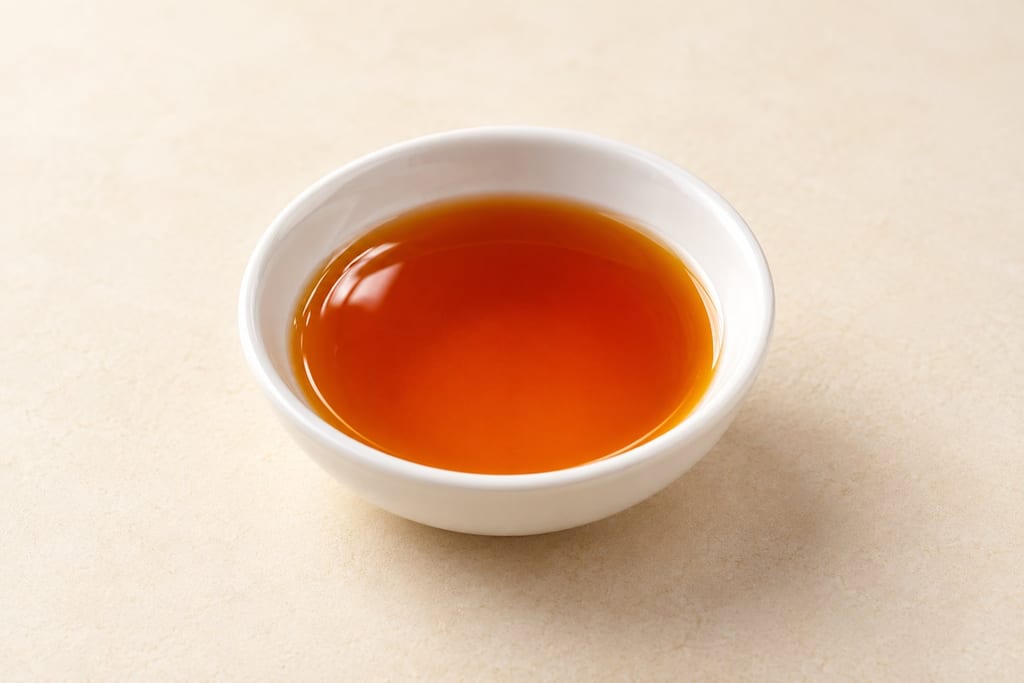
Fish sauce is a clear, salty seasoning made by maturing fish with salt and drawing off the liquid. The broad family includes distinct regional sauces rather than one interchangeable method.
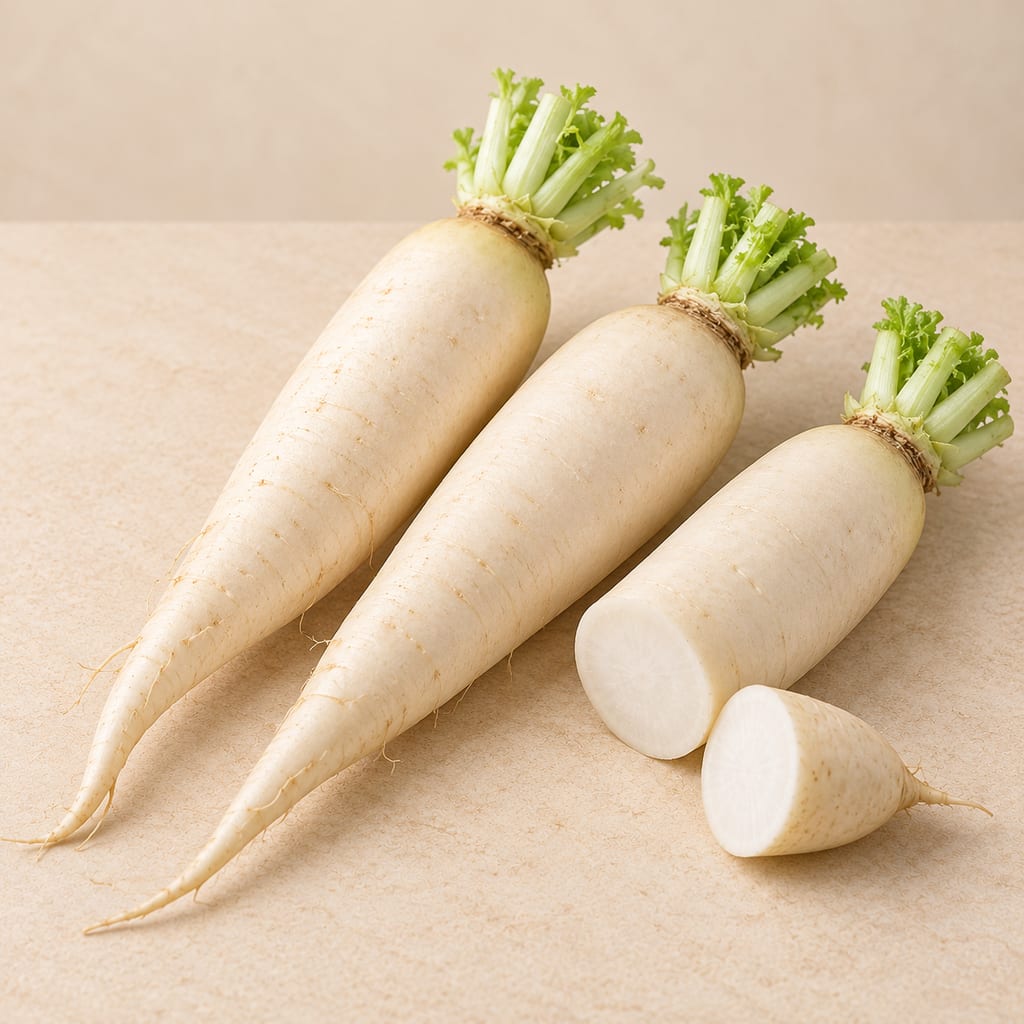
Radish and daikon are the crisp, peppery roots, leaves and seed pods of Raphanus sativus, fermented as kimchi, takuan and sinki and eaten raw across Asia and Europe.
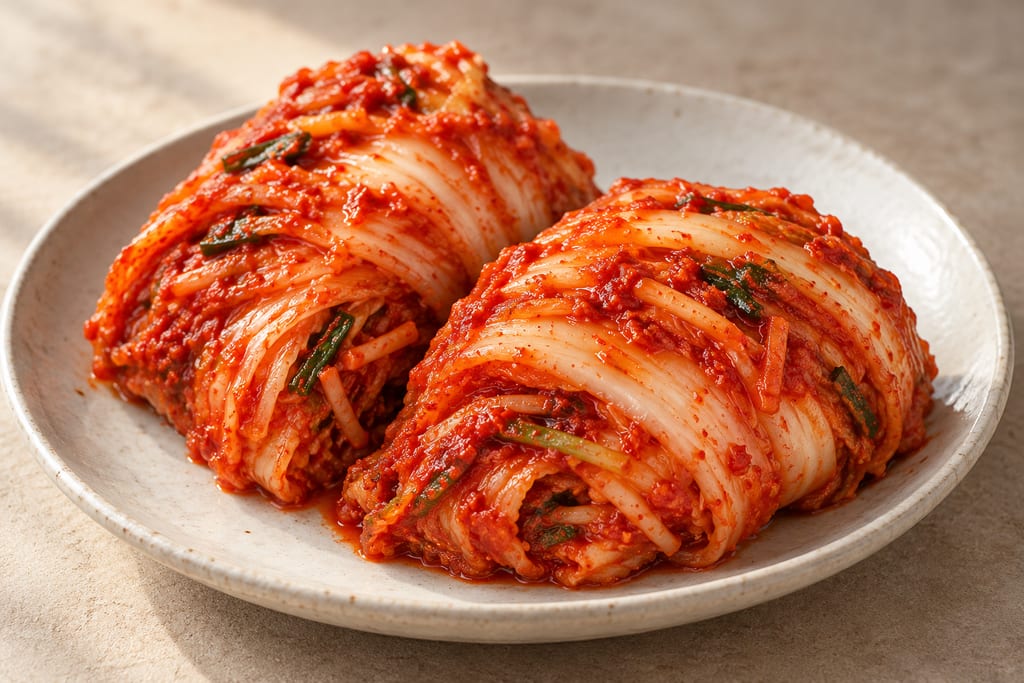
Napa cabbage salted, seasoned with a paste of gochugaru, garlic, ginger and salted seafood, and left to sour through lactic fermentation; Korea's everyday winter preserve.
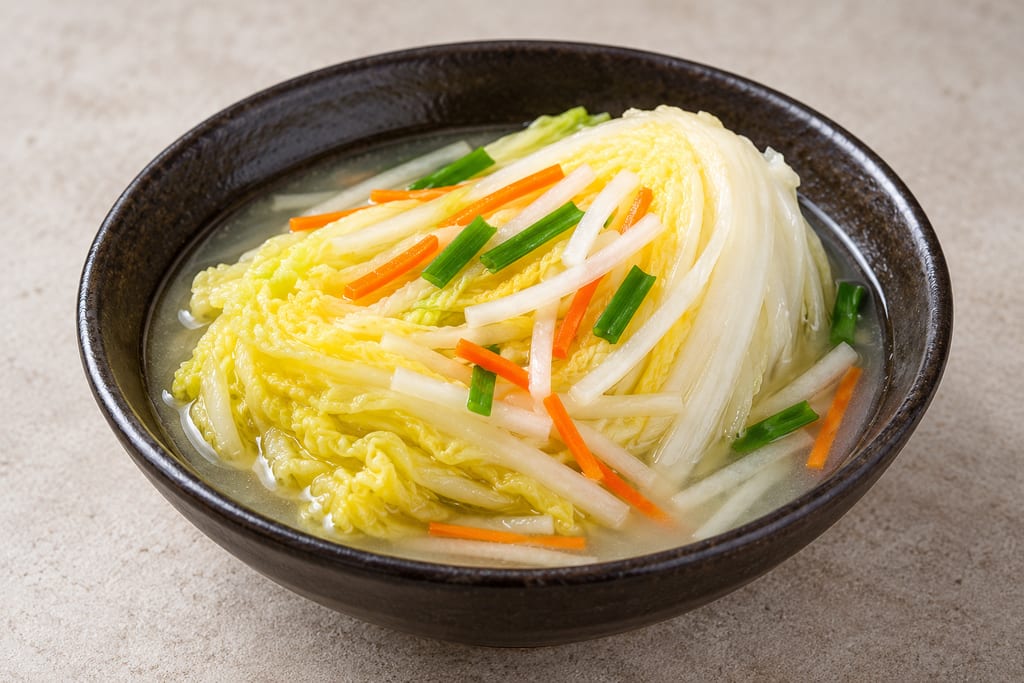
Napa cabbage is brined and filled with pear, radish, alliums, chives and fruit; this Korean kimchi omits red pepper flakes.
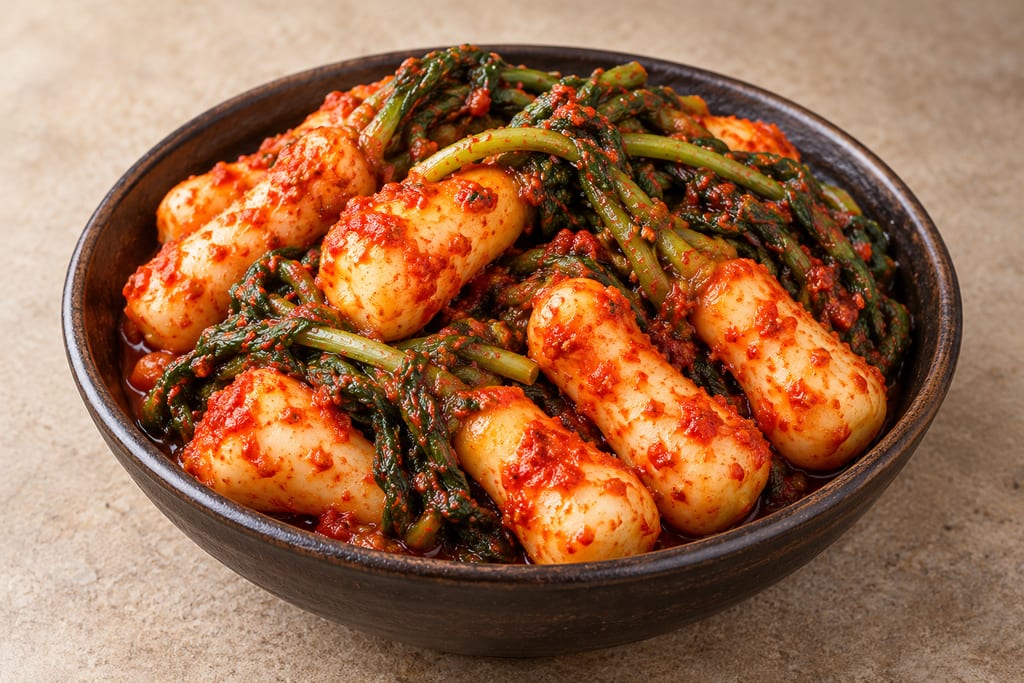
Small ponytail radishes keep their greens attached and ferment in a flour-and-chile seasoning paste.
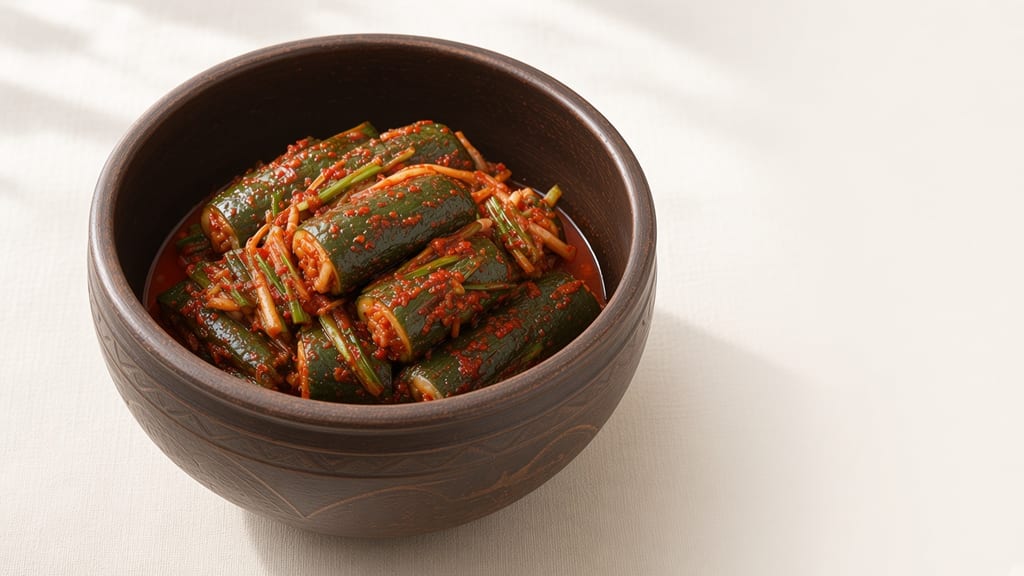
Hwanggwa damjeo is a cucumber kimchi from Yu Jung-rim's Jeungbo sallim gyeongje of 1766. Slit cucumbers are packed with chilli powder and garlic, scalded with hot salted water and sealed overnight.
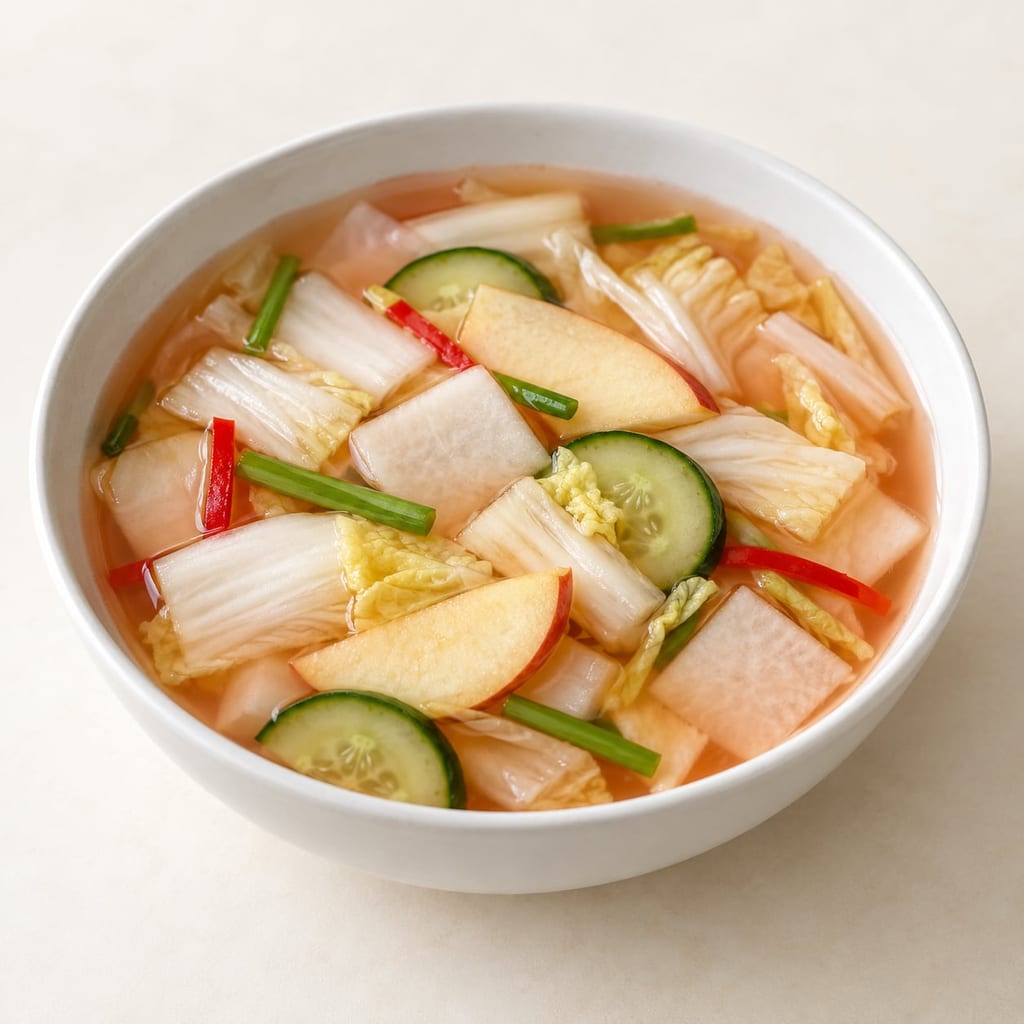
Napa cabbage and radish ferment in a rose-coloured broth with cucumber, apple, pear, alliums and chile.
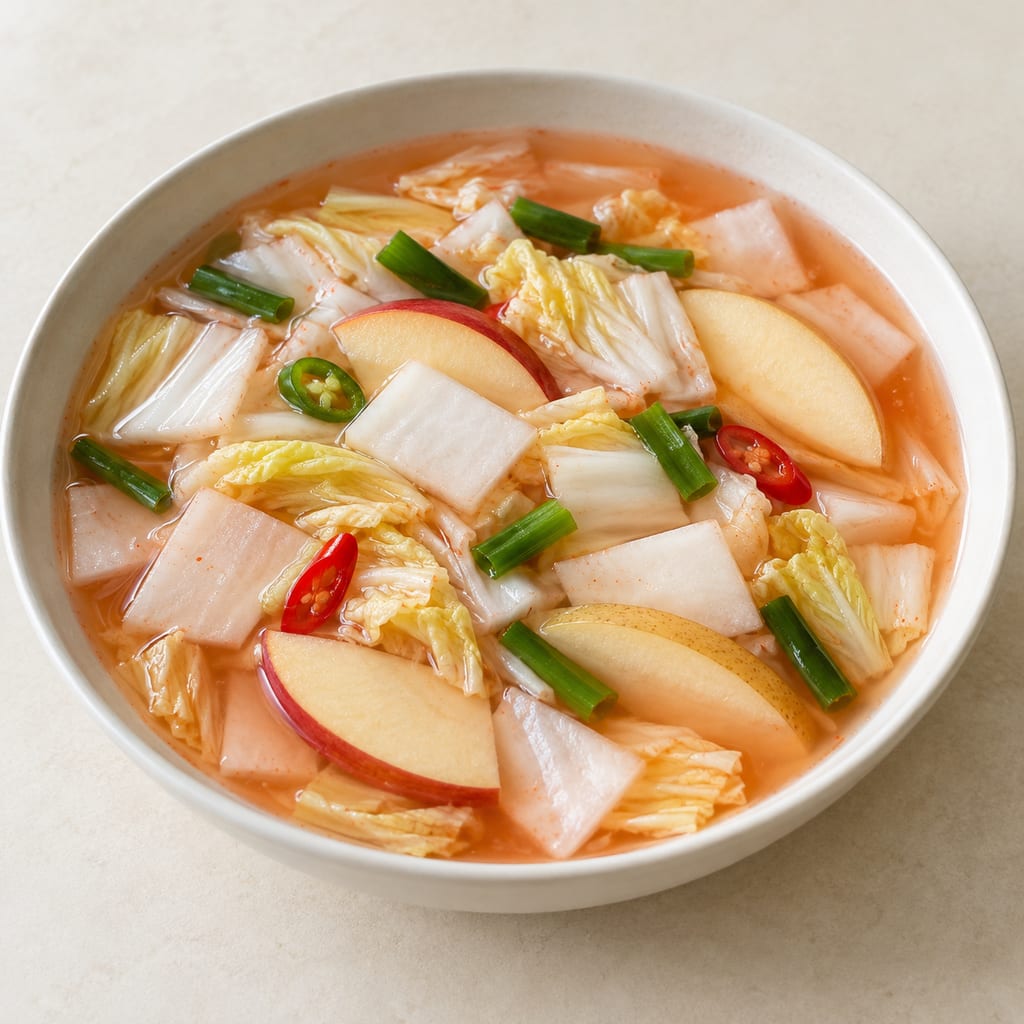
Cabbage-and-radish water kimchi with pear, apple and strained chili broth, following one Korean creator’s batch.
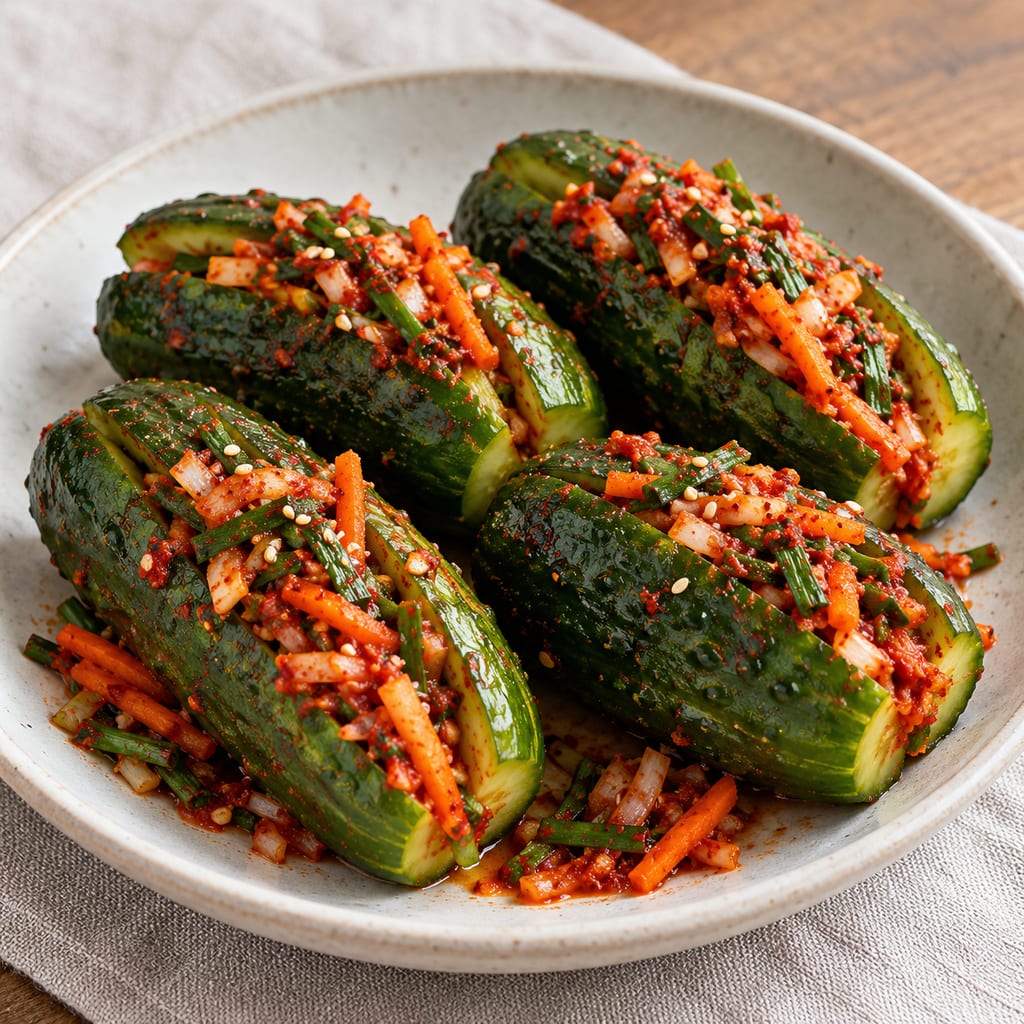
Oi-sobagi is a Korean stuffed cucumber kimchi: salted cucumbers slit and filled with a chive-and-chilli seasoning, eaten fresh or left to ferment.
Kimchi of salted napa cabbage and daikon with garlic, green onion and red pepper, kept at room temperature one to four days, then refrigerated.
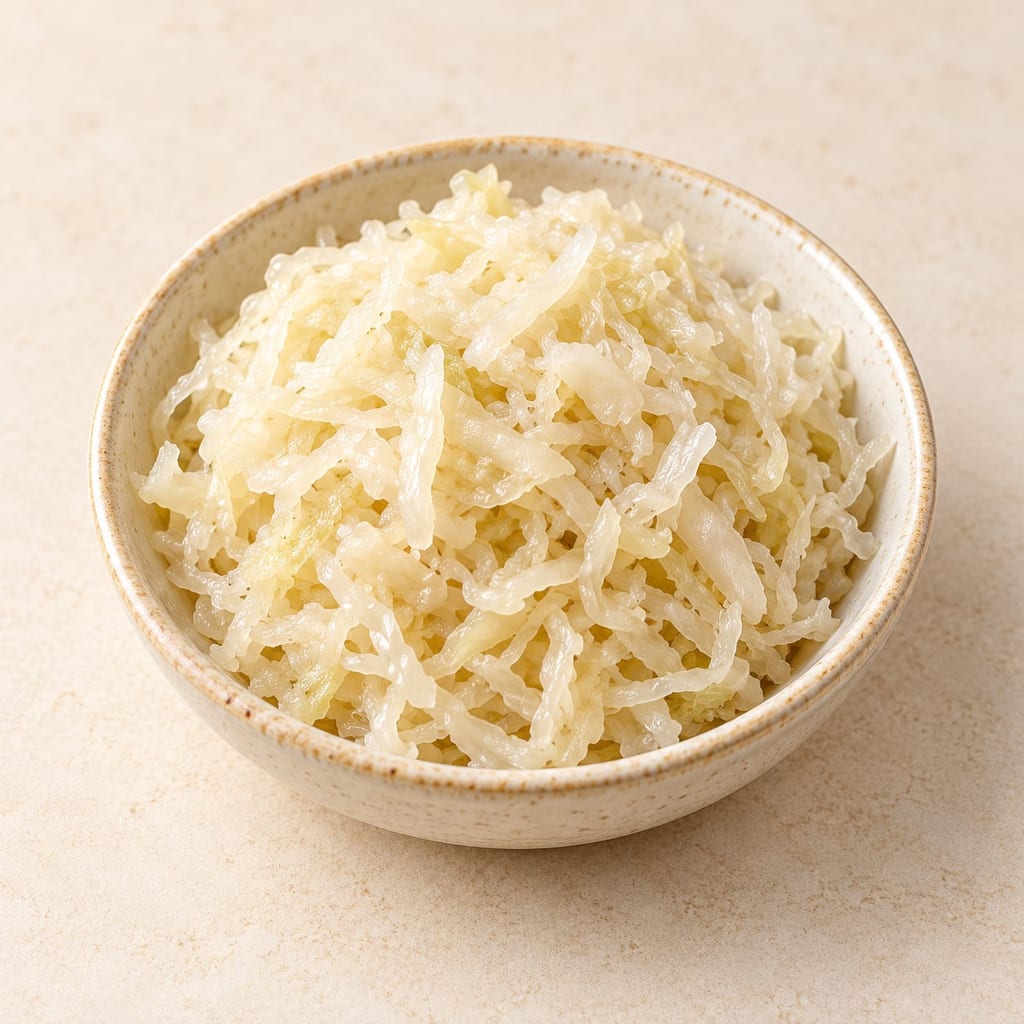
Finely cut cabbage fermented with salt in vats by natural lactic fermentation, a protected Alsatian product sold raw or cooked after fermentation.
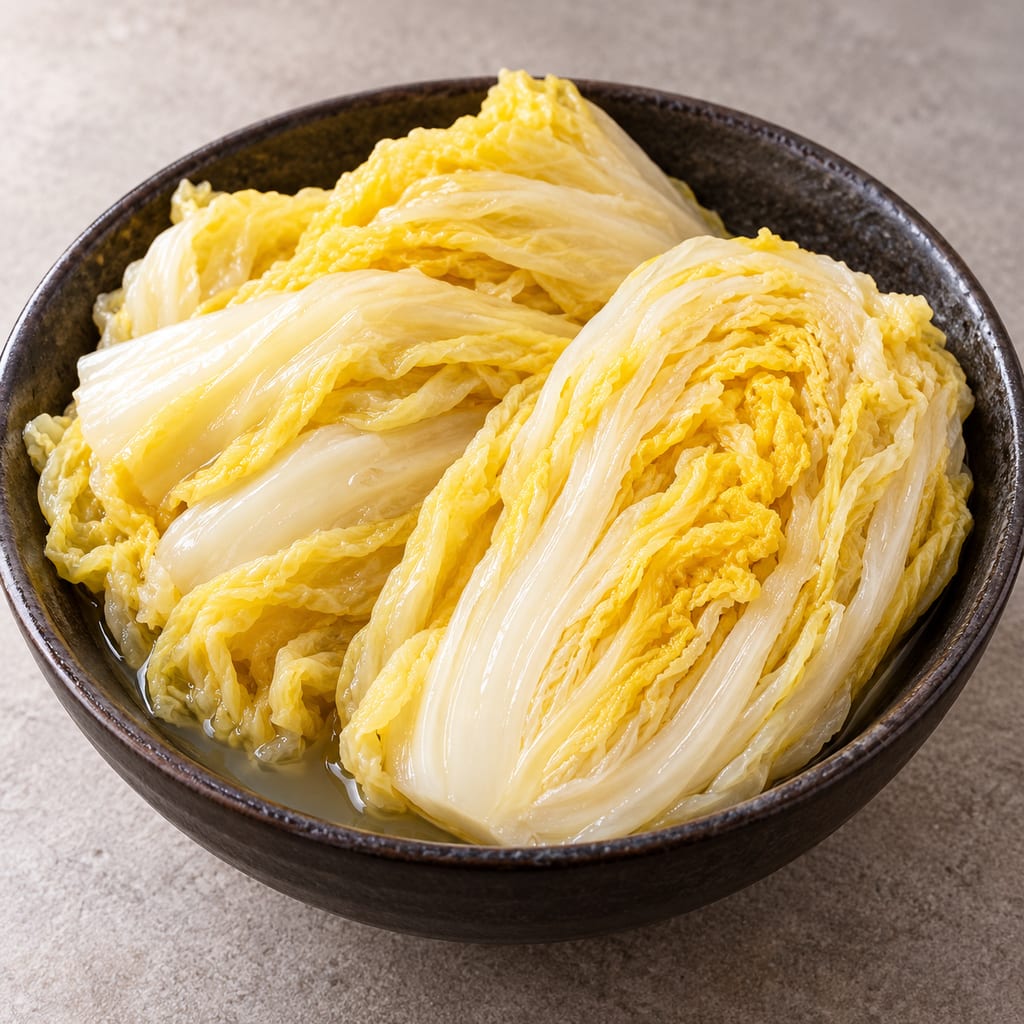
Napa cabbage fermented in a salt brine in Northeast China, traditionally in large ceramic or glass jars, until it turns sour.
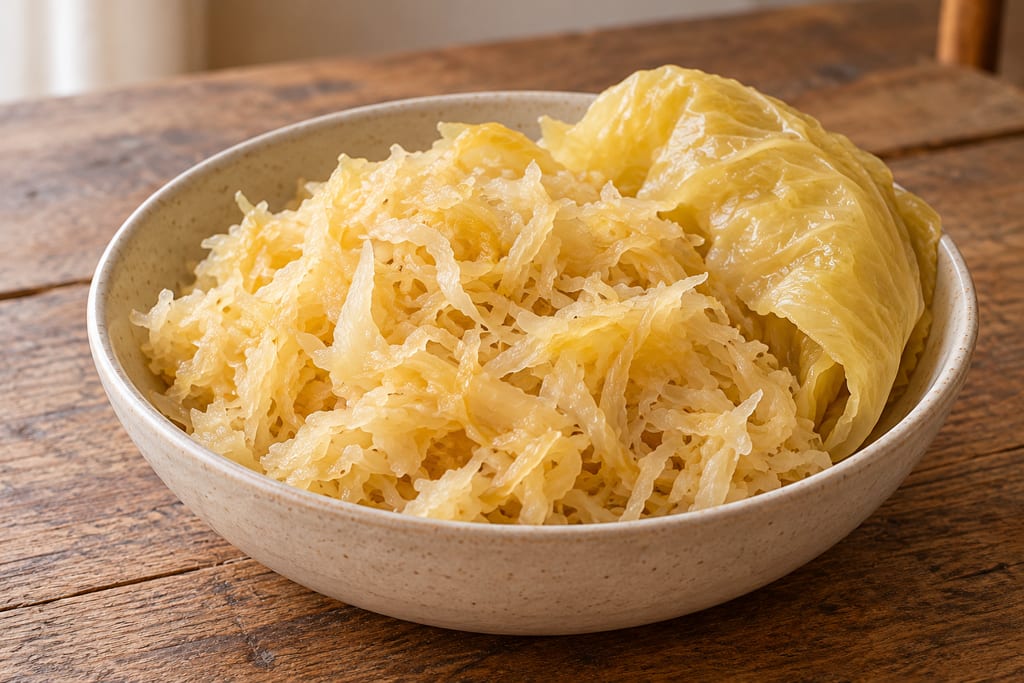
Serbian sour cabbage from the Futog area, made from the autochthonous Futoški cabbage population and registered as a protected product in 2008. It is a subset of general Serbian kiseli kupus.
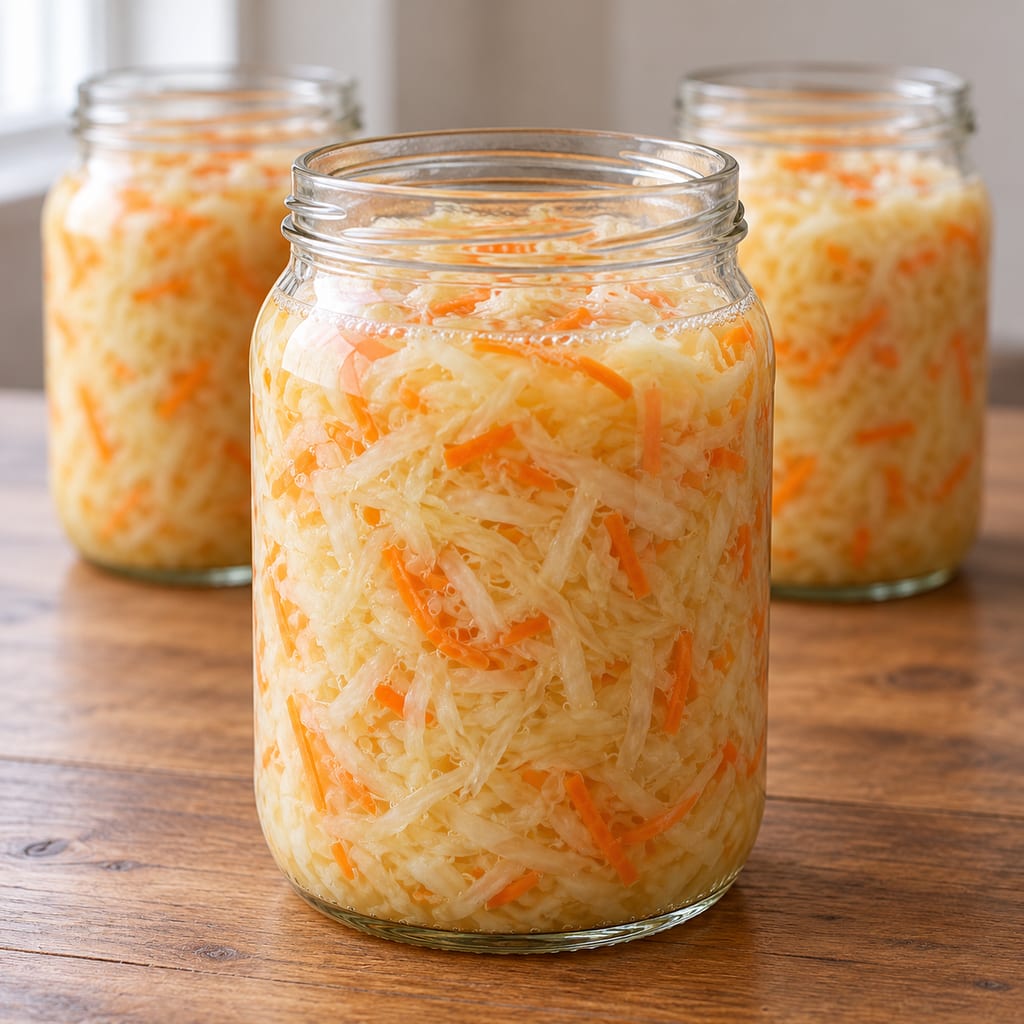
Shredded cabbage and grated carrot are salted to 20 g/kg, rested, packed into three jars and monitored during a creator-reported eight-day fermentation; measured temperature is not given.
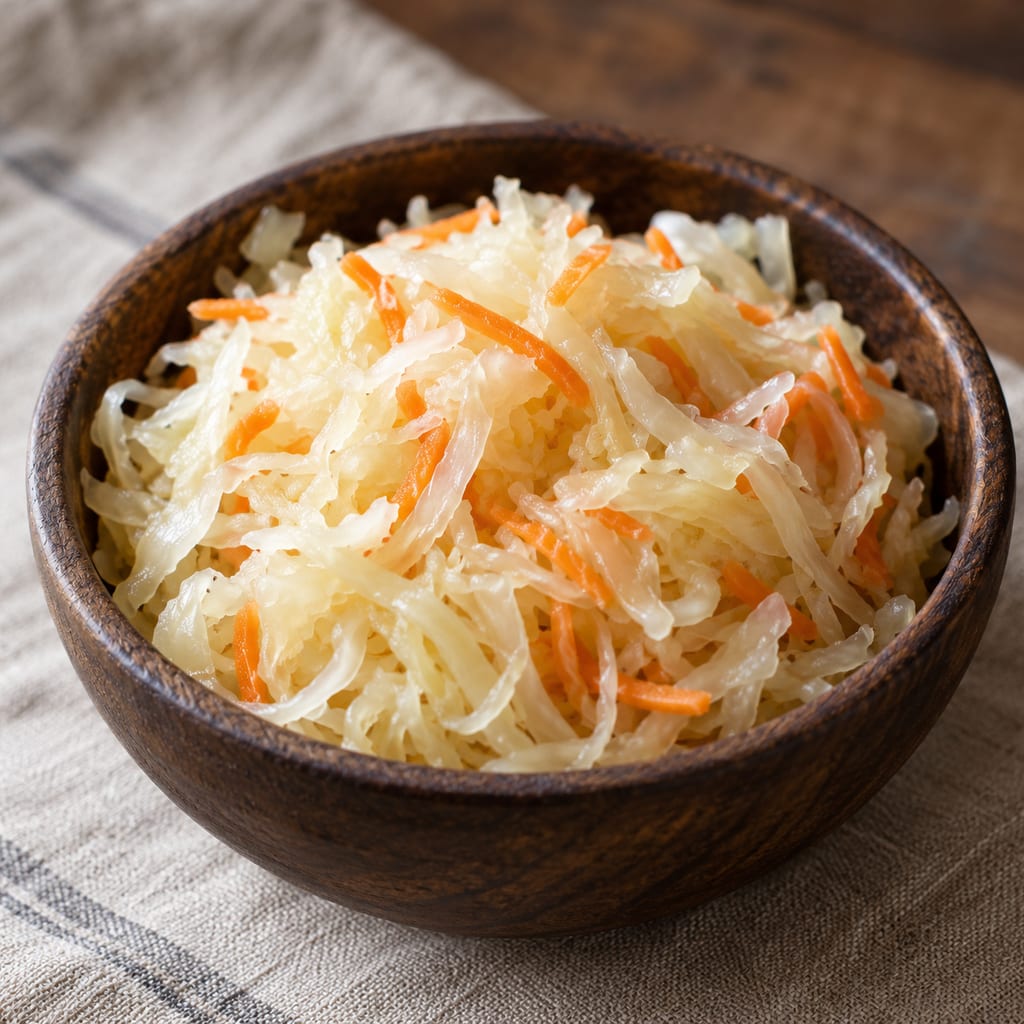
Kapusta kiszona z beczki is barrel-fermented cabbage from the Kołobrzeg area, entered on Poland’s List of Traditional Products in 2008. It is salted and fermented, with raw grated carrot added after souring.
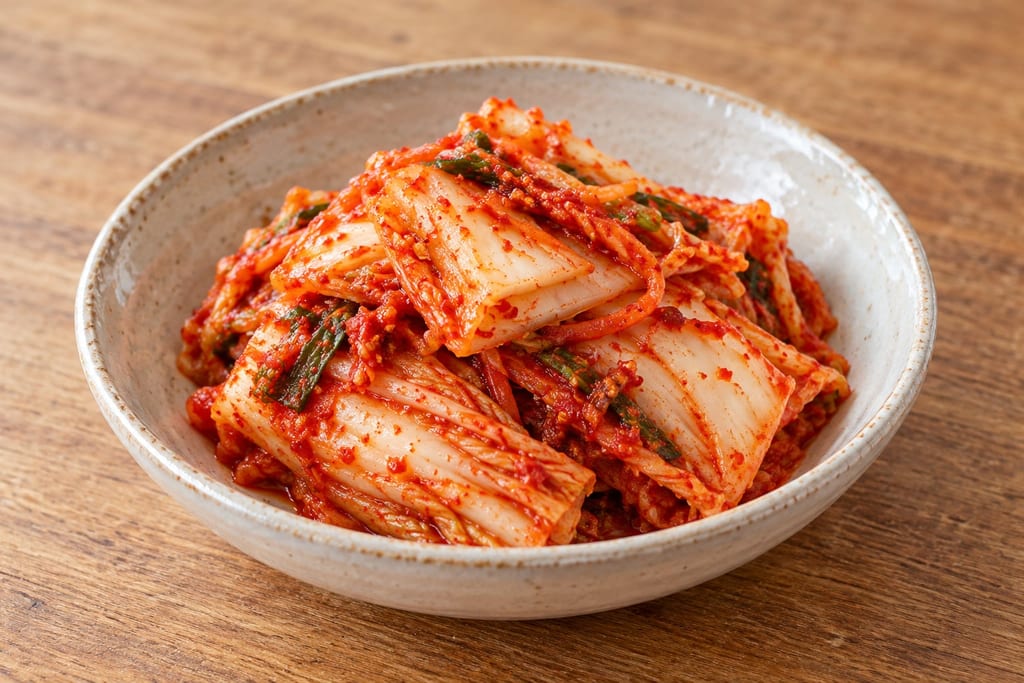
Kimchi is a Korean preserved vegetable food, most often cabbage, salted and seasoned, then fermented by the lactic acid bacteria that arrive with the vegetables. Some studies test added starter cultures, but a home jar is usually spontaneous.
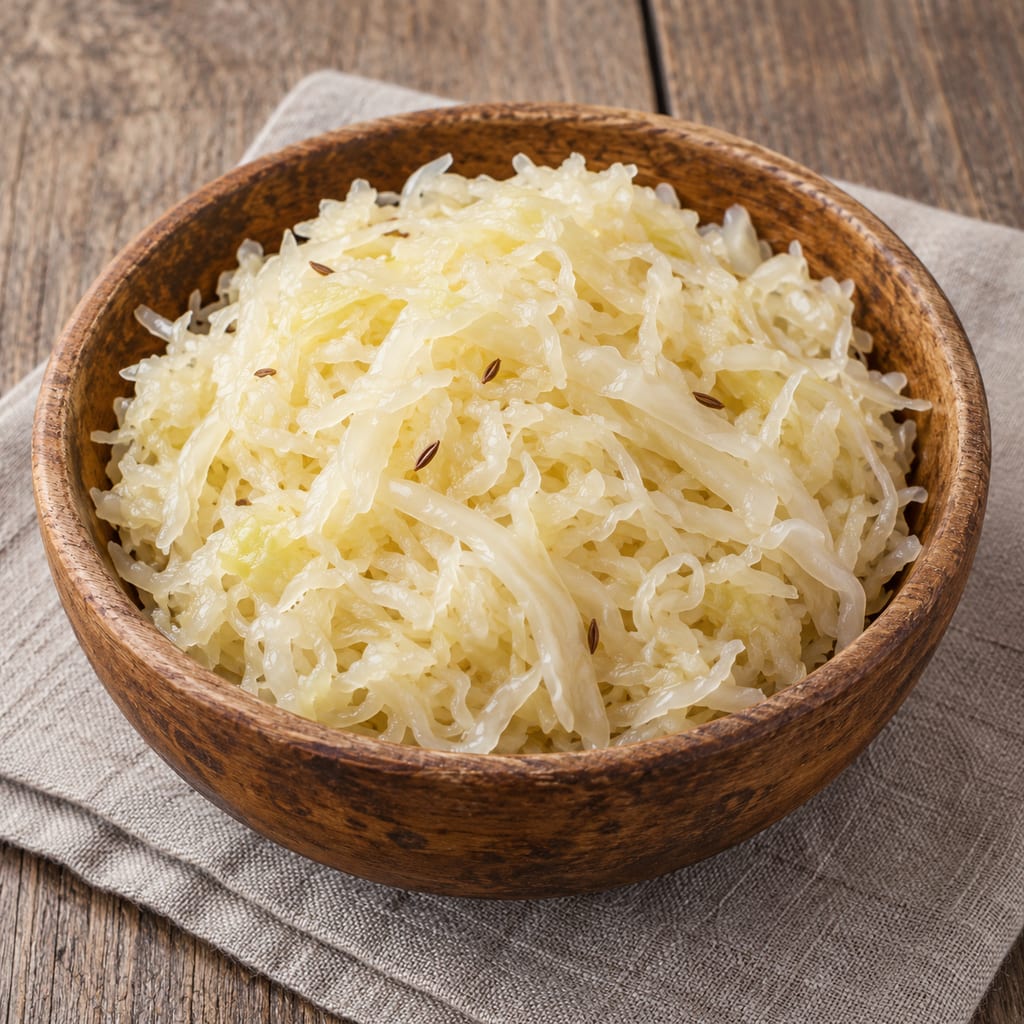
Kysané zeľí is Czech sour cabbage: shredded cabbage layered with salt and caraway and pressed in a wooden barrel. The regional account is descriptive and gives no validated salt ratio or endpoint.
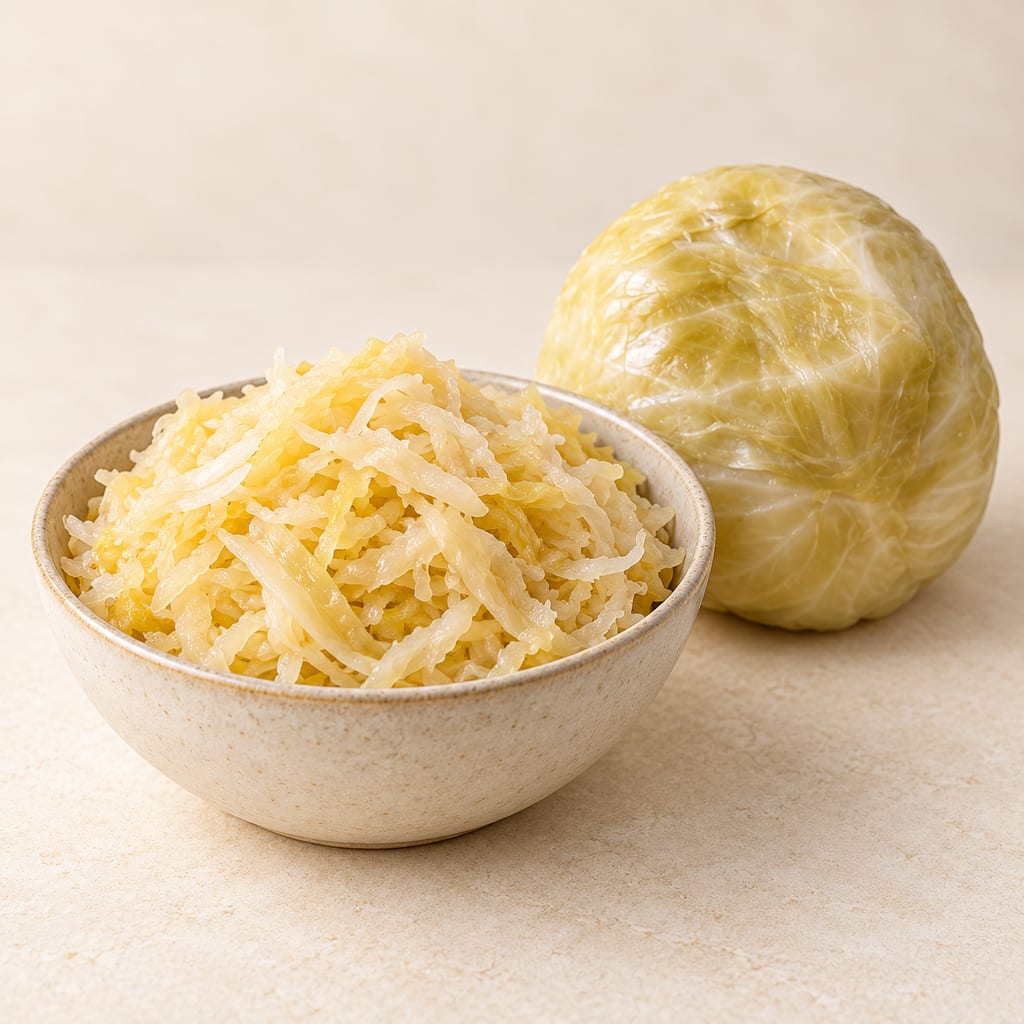
Protected Croatian sauerkraut from the Ogulin area: fresh white cabbage naturally lactic-fermented without preservatives, sold whole or shredded, from registered establishments.
No community contributions have been published for this entry yet.
Sign in to contribute. Published comments and photos are free to read.
MaangchiInspiration
Kkakdugimeasured radish kimchi recipe
Cited in: What is kkakdugi?; Kimchi and the culture of shared meals; The science of lactic fermentation; Ingredients; Radish; Salt; Sugar; Fish sauce; Gochugaru; Garlic and ginger; Spring onions; Equipment; Stage 1 — Prepare the radish; Stage 2 — Cut the cubes; Stage 3 — Salt and sweeten; Stage 4 — Rest; Stage 5 — Collect the juice; Stage 6 — Add the aromatics; Stage 7 — Add fish sauce and chilli; Stage 8 — Return the radish juice; Stage 9 — Coat evenly; Stage 10 — Pack; Stage 11 — Choose fresh or fermented service; Stage 12 — Refrigerate; Mild kkakdugi; Sweeter kkakdugi; Vegetarian kkakdugi; Seafood-enriched traditions; Other radish kimchi families; How kkakdugi is served; Measuring acidity; What remains uncertain
University of Minnesota ExtensionSafety
Preserving food at home: FermentationProduce fermentation equipment, acidity monitoring and submersion controls.
Cited in: Ingredients; Equipment; Stage 1 — Prepare the radish; Stage 2 — Cut the cubes; Stage 3 — Salt and sweeten; Stage 4 — Rest; Stage 5 — Collect the juice; Stage 6 — Add the aromatics; Stage 7 — Add fish sauce and chilli; Stage 8 — Return the radish juice; Stage 9 — Coat evenly; Stage 10 — Pack; Stage 11 — Choose fresh or fermented service; Stage 12 — Refrigerate; Signs of fermentation; Troubleshooting; Food safety
Korean academic reviewReference
Korean academic review — Historical study of Korean radish kimchihistorical classification and recipe families. KCI
Cited in: Names and botanical identity; The place of radish in Korean food history; Why Korean radish is suitable; Why cube size matters; Ingredients; Equipment; Stage 1 — Prepare the radish; Stage 2 — Cut the cubes; Stage 3 — Salt and sweeten; Stage 4 — Rest; Stage 5 — Collect the juice; Stage 6 — Add the aromatics; Stage 7 — Add fish sauce and chilli; Stage 8 — Return the radish juice; Stage 9 — Coat evenly; Stage 10 — Pack; Stage 11 — Choose fresh or fermented service; Stage 12 — Refrigerate; Why the fresh and fermented versions taste different
pubmed.ncbi.nlm.nih.govReference
Effects of ingredient size on microbial communities and metabolites of radish kimchipeer-reviewed fermentation study. PubMed
Cited in: Why Korean radish is suitable; Why cube size matters; Why the fresh and fermented versions taste different
Colorado State University ExtensionReference
Colorado State University Extension — Understanding and Making Kimchimodern kimchi safety and pH monitoring. Food Smart Colorado
Cited in: Why Korean radish is suitable; Why cube size matters; Ingredients; Equipment; Stage 1 — Prepare the radish; Stage 2 — Cut the cubes; Stage 3 — Salt and sweeten; Stage 4 — Rest; Stage 5 — Collect the juice; Stage 6 — Add the aromatics; Stage 7 — Add fish sauce and chilli; Stage 8 — Return the radish juice; Stage 9 — Coat evenly; Stage 10 — Pack; Stage 11 — Choose fresh or fermented service; Stage 12 — Refrigerate; Why the fresh and fermented versions taste different; Signs of fermentation; Troubleshooting; Food safety
Korean Ministry of Food and Drug SafetyReference
Korean Ministry of Food and Drug Safety — Kimchi standardsclassification and production context. foodsafetykorea.go.kr
Cited in: Signs of fermentation; Troubleshooting; Food safety