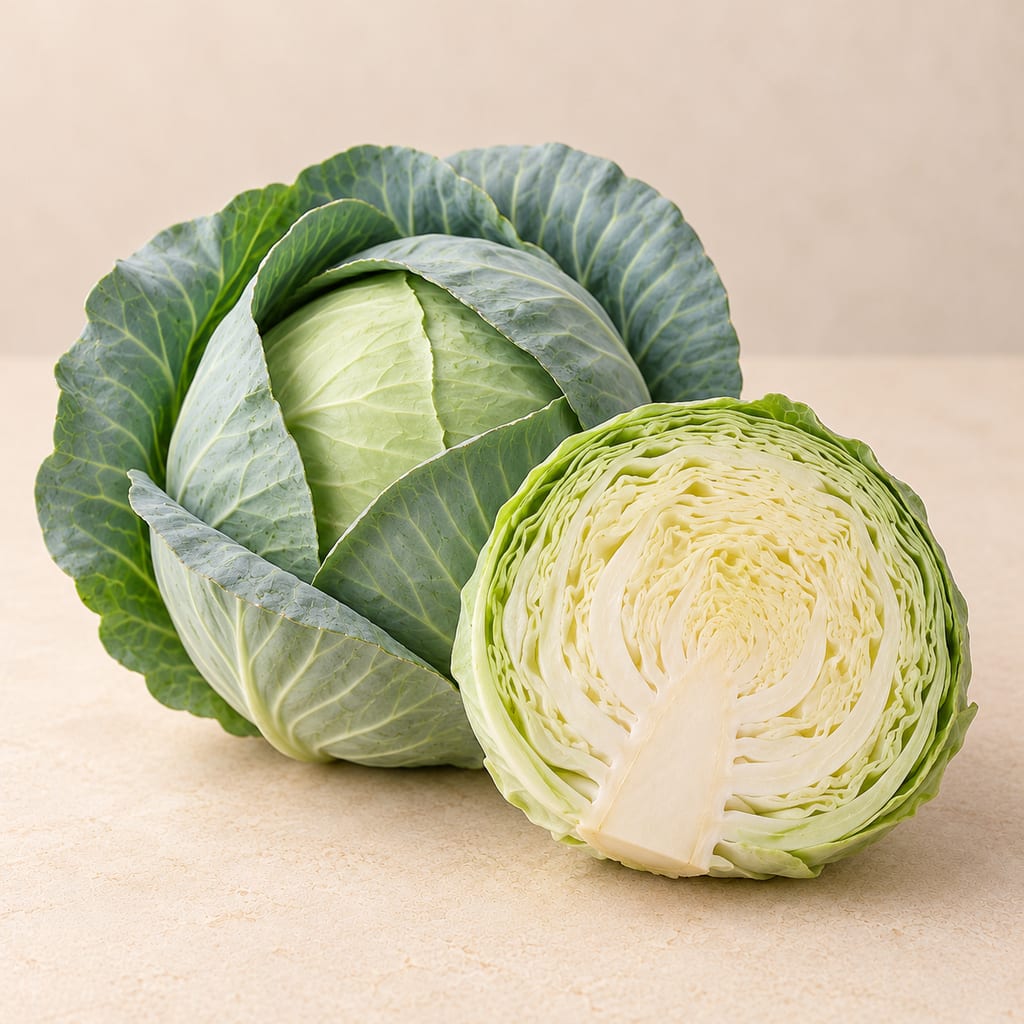
Cabbage
Cabbage is the dense leafy head of Brassica oleracea, a European vegetable that keeps for months and is the classic raw material for sauerkraut, with napa cabbage the base of kimchi.
 FermenteaWhere food goes to change
Traditional method
Kimchi
Kimchi of salted napa cabbage and daikon with garlic, green onion and red pepper, kept at room temperature one to four days, then refrigerated.
This kimchi recipe combines napa cabbage, daikon radish, garlic, green onions, sugar, salt and red pepper in a simple small-batch fermentation.
Its purpose is different from that of an elaborate Korean whole-cabbage kimchi prepared in large seasonal quantities.
It is a measured educational formulation suitable for learning the basic steps of vegetable salting, seasoning, packing and fermentation.
The original recipe appears in Oregon State University Extension's Kimchi Basics, publication SP 50-1007, originally published in March 2020 and subsequently reviewed.
The formula itself is adapted from the book Food Preservation and Safety: Principles and Practice by Shirley J. VanGarde and Margy Woodburn.
The finished yield is 3 cups, using a one-quart jar as its fermentation container.
The site's existing record incorrectly treats one quart as the yield. This should be corrected because container capacity and finished food volume are not the same measurement.
The formulation is relatively simple. It does not include fish sauce, salted shrimp, rice porridge or a complex seasoning paste.
Its vegetable base is napa cabbage, generally Brassica rapa subsp. pekinensis, together with daikon radish, Raphanus sativus.
It belongs to the broad tradition of Korean kimchi, but is best described as a modern measured adaptation rather than a historically specific regional household recipe.
Kimchi is written 김치 in Korean.
The term encompasses many preparations made from salted, seasoned and often fermented vegetables.
The most familiar type internationally is baechu-kimchi (배추김치), based on napa cabbage.
Other varieties use radish, cucumber, green onions, mustard greens and many additional vegetables.
Historical Korean vegetable-preservation traditions are well attested, but their development cannot be reduced to a single invention date.
Preserved vegetables existed before the modern combination of cabbage, red chili and other familiar ingredients became widespread.
Red chili peppers entered Korean food culture during the early modern period, changing the flavor and appearance of many kimchi preparations.
The historical evidence does not establish that the exact Oregon State University formula represents a particular ancient Korean recipe.
The formula is useful precisely because it reduces the process to a relatively short, measured ingredient list.
It demonstrates basic kimchi fermentation without requiring the cook to manage a large whole-cabbage preparation.
The original university publication also describes another, substantially different kimchi recipe using fish sauce, soy sauce, ginger, carrot and more chili.
Those two formulations should not be combined.
This page concerns the first recipe, titled Fermented Kimchi.
Fresh napa cabbage contains a large amount of water.
Its leaves and broad white ribs behave differently during salting.
The thin green portions soften relatively quickly, while the thick white ribs retain more structure.
Salt draws some water from the cabbage through osmotic effects.
As the cabbage loses water, its volume decreases and its leaves become easier to compact.
The original method uses 2 tablespoons of salt during this preliminary stage.
The cabbage is left for several hours until it has reduced to approximately half its original volume.
The source does not specify a fixed number of hours.
This is therefore a condition-based step rather than an exact timed interval.
The cabbage is then rinsed thoroughly.
That rinse removes an unknown portion of the salt.
The final salt concentration cannot be calculated simply by dividing the original 2½-tablespoon addition by the vegetable weight.
Daikon adds crispness and mild radish pungency.
Its relatively firm structure provides textural contrast to the salted cabbage.
Garlic supplies sulfur-containing aromatic compounds.
The onion-family ingredients also contribute their own naturally occurring microorganisms.
Green onions provide freshness, color and a milder allium flavor than garlic.
Red pepper brings heat and color. The source does not require a particular Korean chili-flake product, although using a Korean chili may more closely reflect familiar kimchi flavor.
Sugar contributes a small amount of readily soluble carbohydrate.
Some of it can be metabolized during fermentation.
The quantity is modest relative to the cabbage mass, and it should not be described as the sole substrate for microbial acid production.
The cabbage and radish also contain fermentable carbohydrates.
Use a large bowl, colander, knife, cutting board, mixing spoon and clean one-quart jar.
A clean food-grade fermentation lid or another suitable gas-management arrangement is appropriate.
The original recipe does not specify a fermentation weight, additional brine or headspace measurement.
Its instruction to pack loosely should be distinguished from the tighter compression specified in some sauerkraut methods.
A calibrated food pH meter is useful when assessing fermentation rather than relying entirely on flavor and elapsed time.
Inspect and wash the cabbage. Use 2 lb fresh napa cabbage.
Remove damaged portions and rinse away soil.
Drain before cutting. Cut into pieces.
Slice the cabbage into approximately 1-inch pieces.
Separate thicker rib pieces so salt can reach them.
The source does not require removing the ribs.
Salt the cabbage. Toss with 2 tablespoons salt.
Leave for several hours until the cabbage has reduced to approximately half its original volume.
The source does not specify a numerical temperature or exact number of hours for this stage.
Rinse and drain. Transfer the cabbage to a colander.
Rinse thoroughly and drain without pressing. The instruction not to press helps preserve some of the leaf structure and prevents unnecessarily crushing the vegetable.
Prepare the daikon. Peel ¼ lb daikon.
Cut into matchsticks for the more traditional textural presentation, or shred coarsely in a food processor.
Both methods are explicitly permitted. Prepare the aromatics.
Slice both the green and white portions of 2 green onions into thin slivers.
Mince 3 garlic cloves and 2 teaspoons red pepper.
If using the optional ginger, grate 1 teaspoon finely.
Mix the vegetables and remaining seasoning. Combine the drained cabbage, daikon, onions, garlic and red pepper.
Add the remaining ½ tablespoon salt and 2 teaspoons sugar.
Toss until the ingredients are distributed. Pack the jar.
Transfer the mixture loosely into a clean one-quart jar.
Use a suitable fermentation closure. The original method does not specify an added-brine volume. Do not arbitrarily add water and present it as the documented formulation.
Allow fermentation. Hold at room temperature for 1–4 days.
Fermentation proceeds more quickly in warm conditions.
The original recipe does not give a numerical temperature, a final pH for this particular batch or a tested pressure-management specification.
Refrigerate. After the intended fermentation stage, move the kimchi into refrigeration.
The publication emphasizes refrigerated storage. The finished yield of the original formulation is approximately 3 cups.
Kimchi is principally a lactic-acid vegetable ferment.
The organisms involved are generally present on the raw vegetables and other ingredients.
A pure commercial starter is not required for the traditional spontaneous process.
Important organisms include members of Leuconostoc, Weissella and the wider group historically called Lactobacillus.
Different species can become prominent as the fermentation progresses.
Early microorganisms may grow when the vegetables are still relatively mildly acidic.
As organic acids accumulate, other organisms that tolerate the increasingly acidic environment may become more competitive.
The exact succession depends on temperature, salt, ingredient composition and starting microbial populations.
Lactic acid is a major product.
Other metabolites can include acetic acid and carbon dioxide.
These contribute acidity, aroma and sometimes mild effervescence.
Lactic acid bacteria obtain energy from metabolizing carbohydrates.
The acids generated during this process lower the pH of the vegetable juices.
The university publication describes an optimum kimchi pH of approximately 4.2 in its general technical discussion.
This is not a measurement of the exact batch prepared from the first recipe.
It should be understood as a general fermentation reference rather than a guaranteed endpoint after one to four days.
The document also describes final salt concentrations commonly falling within 2–5% for kimchi as a wider food category.
Again, the precise concentration of the measured recipe cannot be calculated without accounting for rinsing and actual salt weights.
These distinctions matter because a source's general technical background and its particular recipe instructions are not always interchangeable.
Salting causes the cabbage to lose water and become flexible.
Fermentation then changes the chemical environment surrounding the plant tissues.
Acid accumulation, endogenous enzymes and microbial activity can gradually alter texture.
The white cabbage ribs may remain crisp while green portions soften.
Daikon matchsticks provide a contrasting crunch.
If the vegetables become excessively soft or slimy, that is not the intended texture.
The university publication emphasizes that kimchi quality changes during continued fermentation and storage.
The relationship between flavor and texture is one reason some people prefer relatively young kimchi while others use more mature kimchi in cooking.
The first OSU recipe resembles a simple chopped-cabbage kimchi.
Korean cabbage kimchi is frequently prepared with much more elaborate seasonings, including gochugaru, salted seafood, ginger and rice porridge.
Whole-cabbage preparations may use substantial leaf-by-leaf salting and coating.
Radish kimchi can be made as cubes, shreds or whole vegetables.
White kimchi omits the familiar intense red-chili seasoning.
Water kimchi contains a relatively large liquid component.
These are different styles rather than interchangeable ingredient lists.
The educational formula here does not establish a specific province of origin.
It should be indexed geographically as Korea for the food tradition and the United States for the particular published adaptation if the site supports separate origin and publication fields.
Kimchi is commonly served as banchan alongside rice.
The crisp, sour vegetable provides contrast to grilled meats, tofu, eggs and soups.
Younger kimchi can be eaten cold.
More fermented kimchi can be used in kimchi fried rice, pancakes and stews.
Cooking changes its texture and aroma, and heating will reduce or eliminate many viable microorganisms present in the raw fermented product.
The recipe's lack of fish sauce makes it easier to adapt to vegetarian cooking, but ingredient labels should still be checked.
Its relatively simple seasoning profile also makes it a useful base for comparing different fermentation durations.
Sourness should develop as organic acids accumulate.
The vegetables may soften slightly and release liquid.
Some gas production can occur.
These are expected observations, but none independently establishes microbiological safety.
A pH measurement provides more useful information about acidification.
The product should remain free from fuzzy mold, abnormal decay odors and extensive sliminess.
A batch that has failed to acidify adequately cannot be rescued merely by allowing it to stand for a prescribed number of days.
The OSU publication emphasizes clean equipment, appropriate temperature management and refrigerated storage.
Its introductory discussion states that kimchi is best eaten within one week for quality, whereas its separate Newell Kimchi recipe provides different storage guidance.
Those statements refer to different presentations and should not be combined into a single universal shelf life.
For this first formula, follow the actual product's handling conditions and use a measured fermentation process when safety depends on acidification.
A general produce-fermentation threshold of pH 4.60 or below is important, but complete safety still depends on the formulation and process.
The source does not establish a validated shelf-stable canning method.
OSU measured 3-cup formula.
Yield 1 quart · Scaling: source batch only
Poor brine coverage or inadequate acidity monitoring can allow spoilage; recipe-specific validated limits are not established.
Hazard sourceUse clean food-grade equipment, keep produce submerged and monitor acidity; no universal endpoint is supplied for this recipe.
Control sourceThe source supports this broad area and no precise location.
Cabbage is the dense leafy head of Brassica oleracea, a European vegetable that keeps for months and is the classic raw material for sauerkraut, with napa cabbage the base of kimchi.
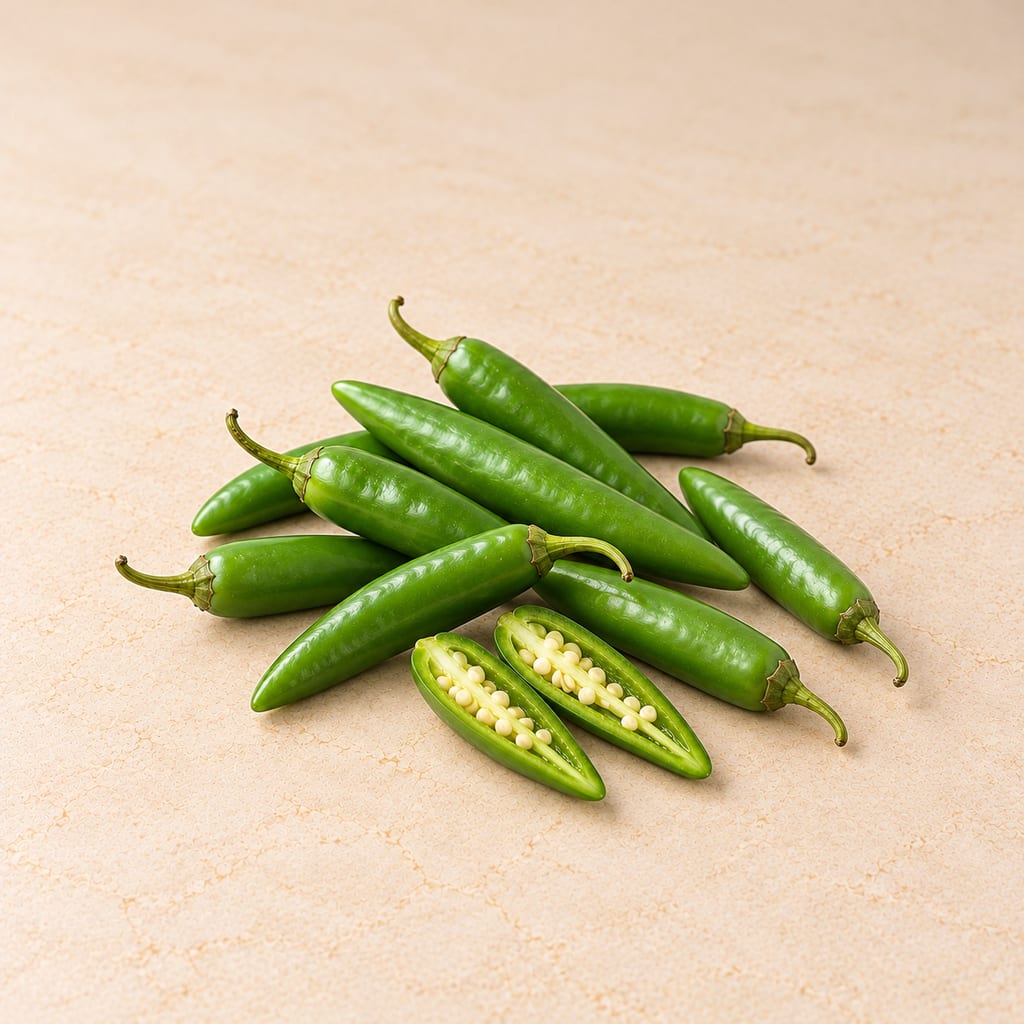
Chilli is the pungent fruit of Capsicum plants, native to the Americas and eaten fresh, dried, ground or fermented in cuisines around the world.
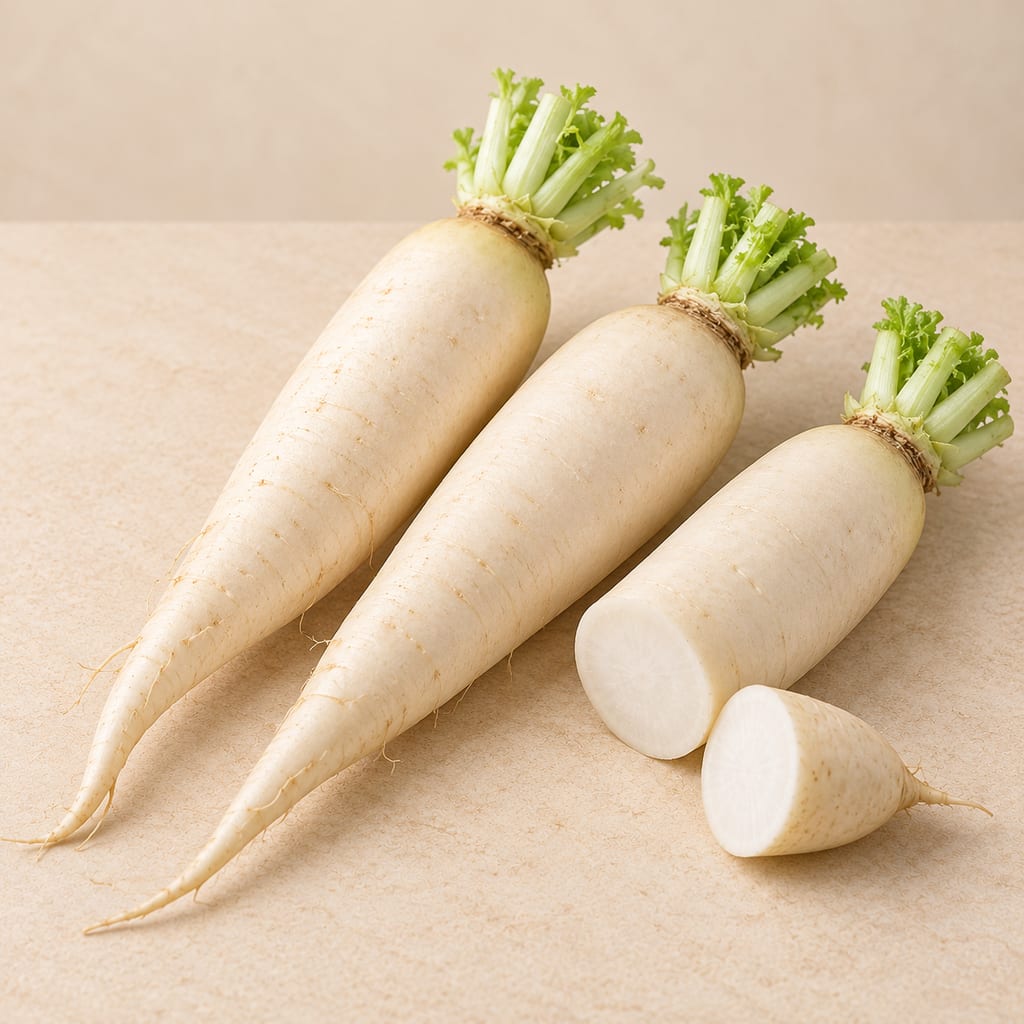
Radish and daikon are the crisp, peppery roots, leaves and seed pods of Raphanus sativus, fermented as kimchi, takuan and sinki and eaten raw across Asia and Europe.
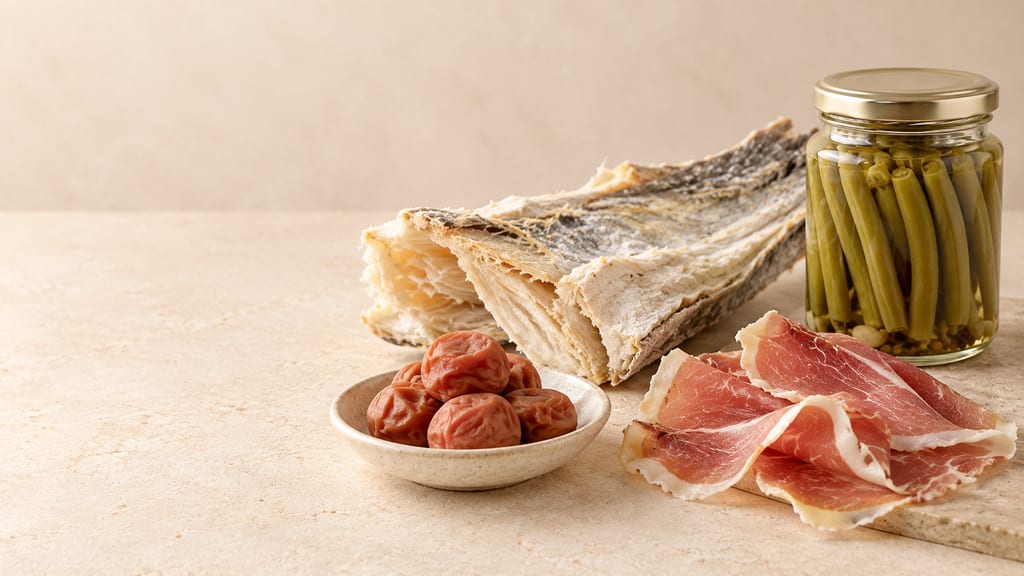
Every preserved food is a stack of barriers against microbes, enzymes, air and time. This is how they work, what a recipe's numbers measure, and how cooks worldwide build them.
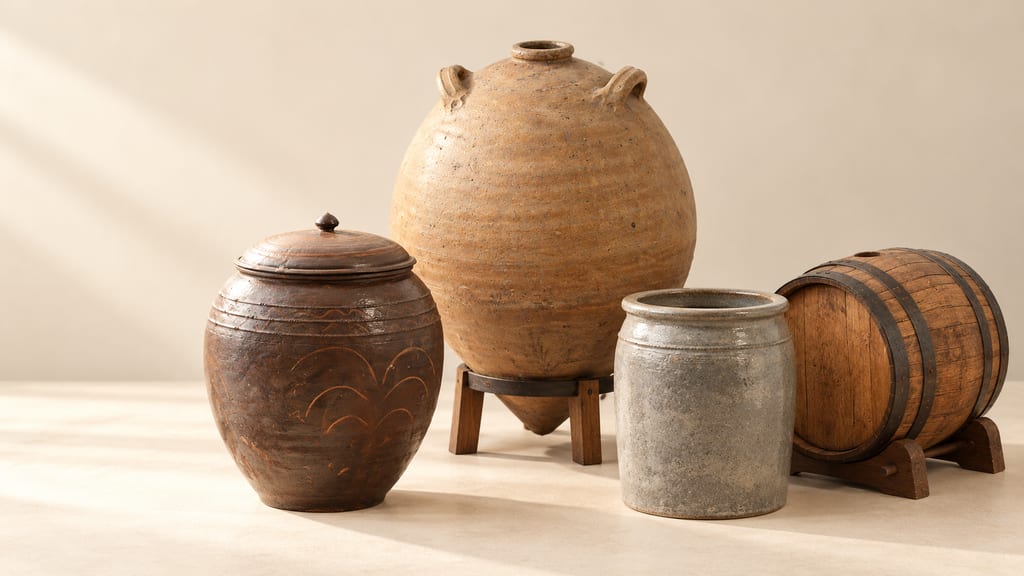
Jars, barrels, skins, leaves, pits and whole rooms decide much of what happens to fermented and cured food. This is how a container works on its contents, and how people in different places chose theirs.
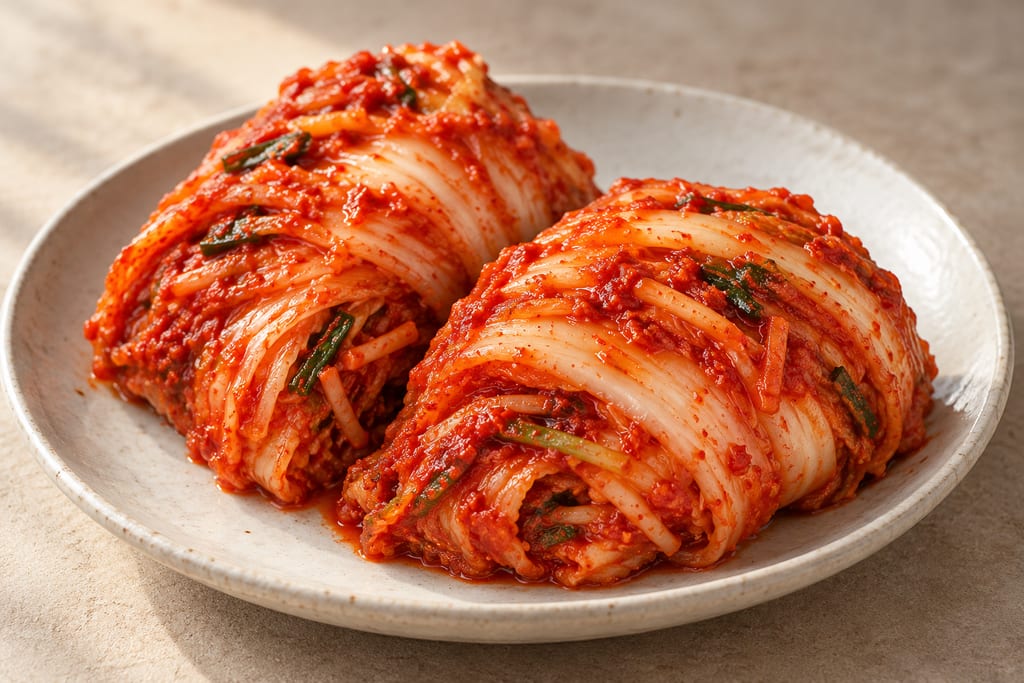
Napa cabbage salted, seasoned with a paste of gochugaru, garlic, ginger and salted seafood, and left to sour through lactic fermentation; Korea's everyday winter preserve.
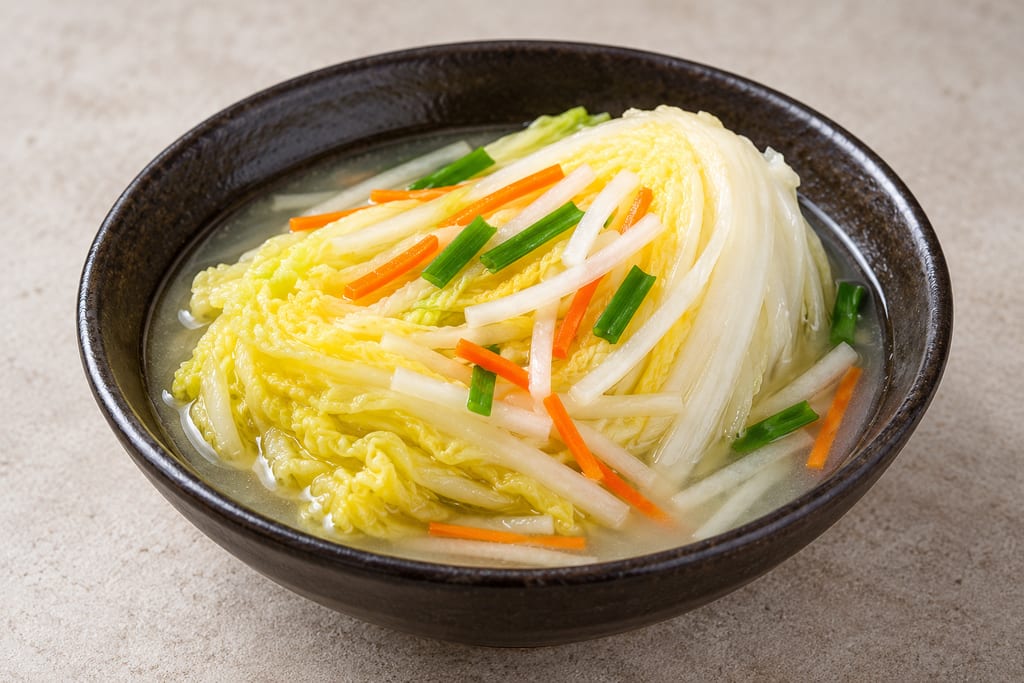
Napa cabbage is brined and filled with pear, radish, alliums, chives and fruit; this Korean kimchi omits red pepper flakes.
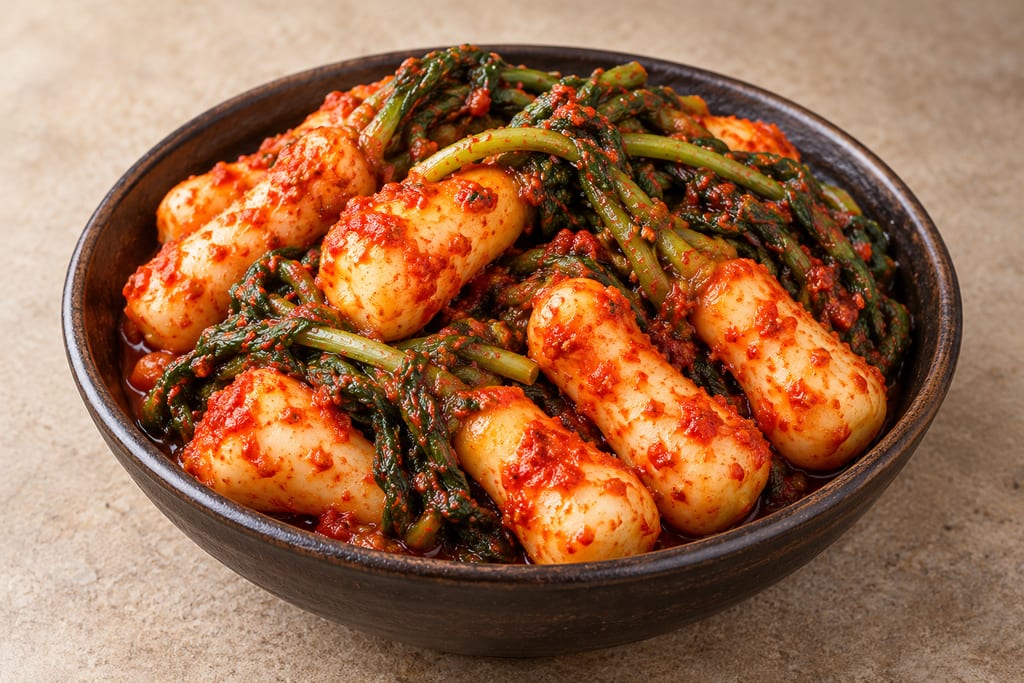
Small ponytail radishes keep their greens attached and ferment in a flour-and-chile seasoning paste.
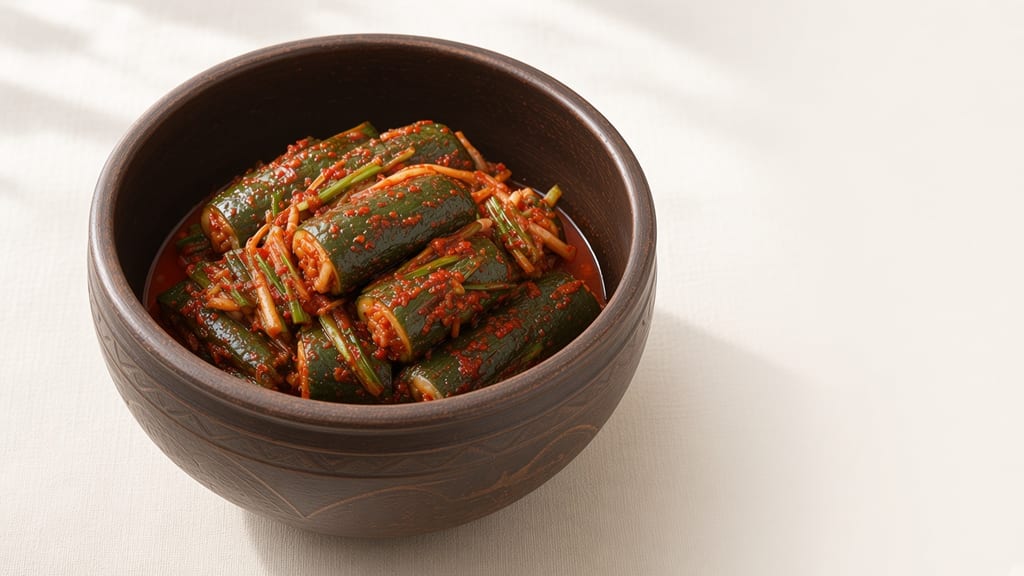
Hwanggwa damjeo is a cucumber kimchi from Yu Jung-rim's Jeungbo sallim gyeongje of 1766. Slit cucumbers are packed with chilli powder and garlic, scalded with hot salted water and sealed overnight.
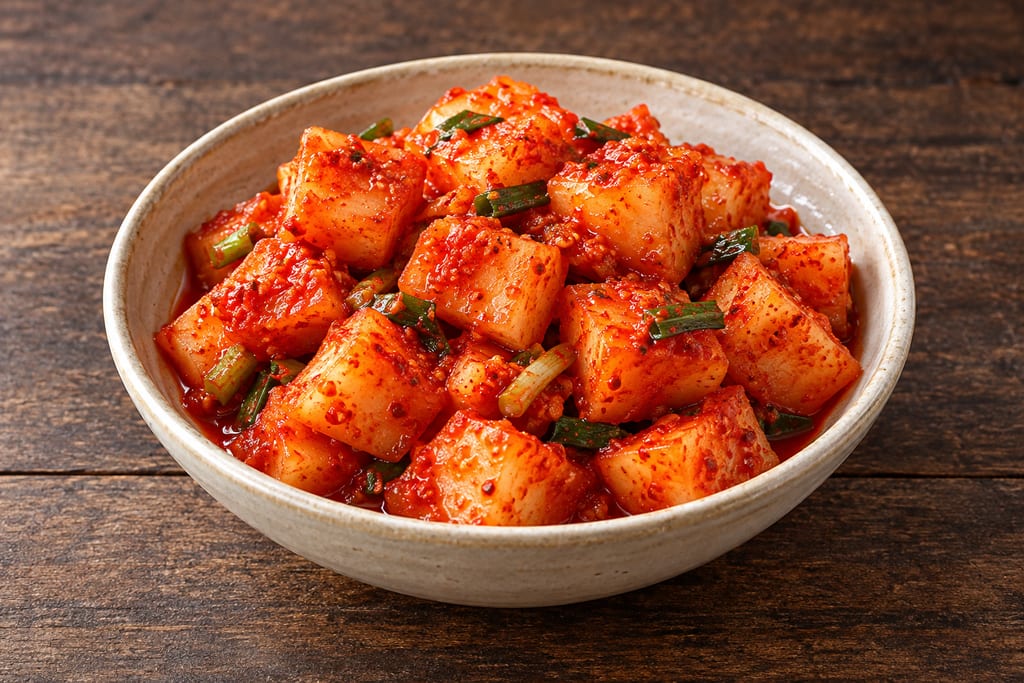
A radish kimchi cut into cubes and seasoned with gochugaru, fish sauce, garlic and ginger, eaten fresh or fermented a few days at room temperature.
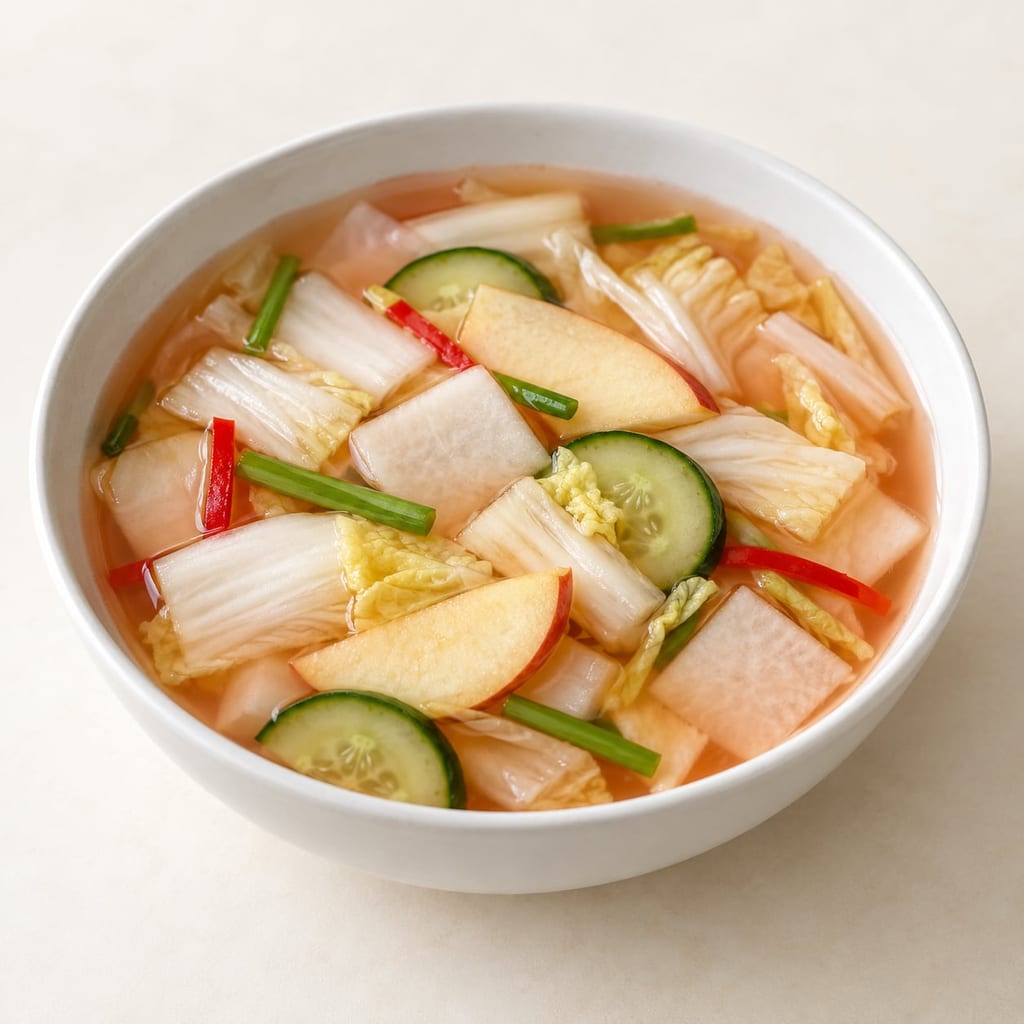
Napa cabbage and radish ferment in a rose-coloured broth with cucumber, apple, pear, alliums and chile.
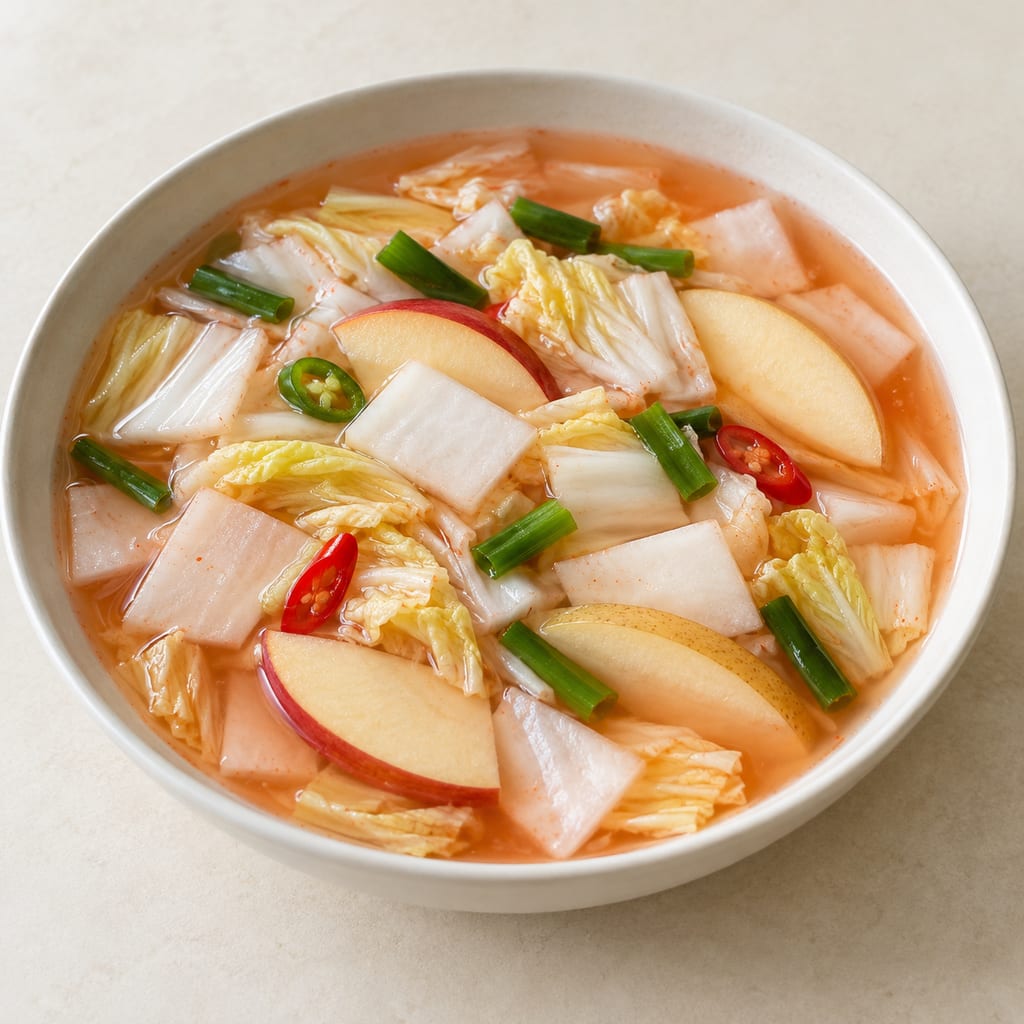
Cabbage-and-radish water kimchi with pear, apple and strained chili broth, following one Korean creator’s batch.
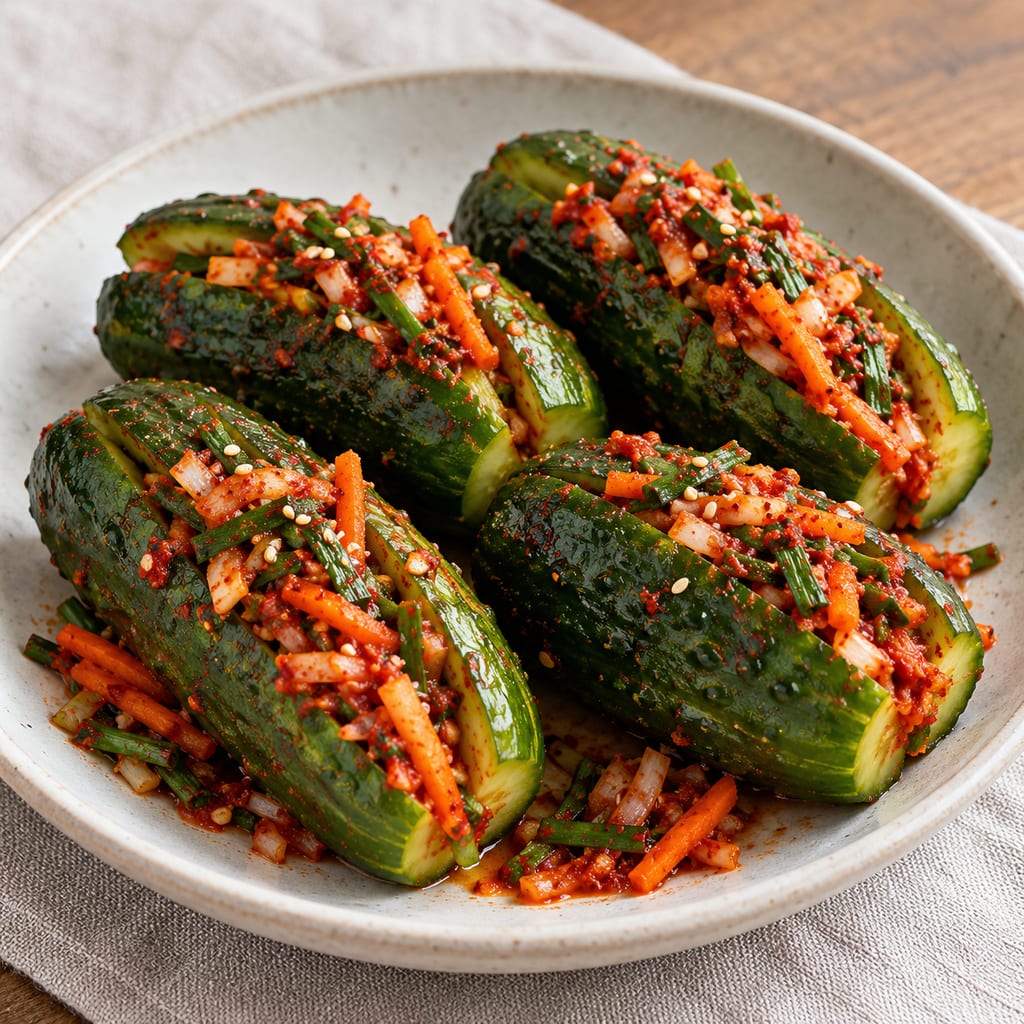
Oi-sobagi is a Korean stuffed cucumber kimchi: salted cucumbers slit and filled with a chive-and-chilli seasoning, eaten fresh or left to ferment.
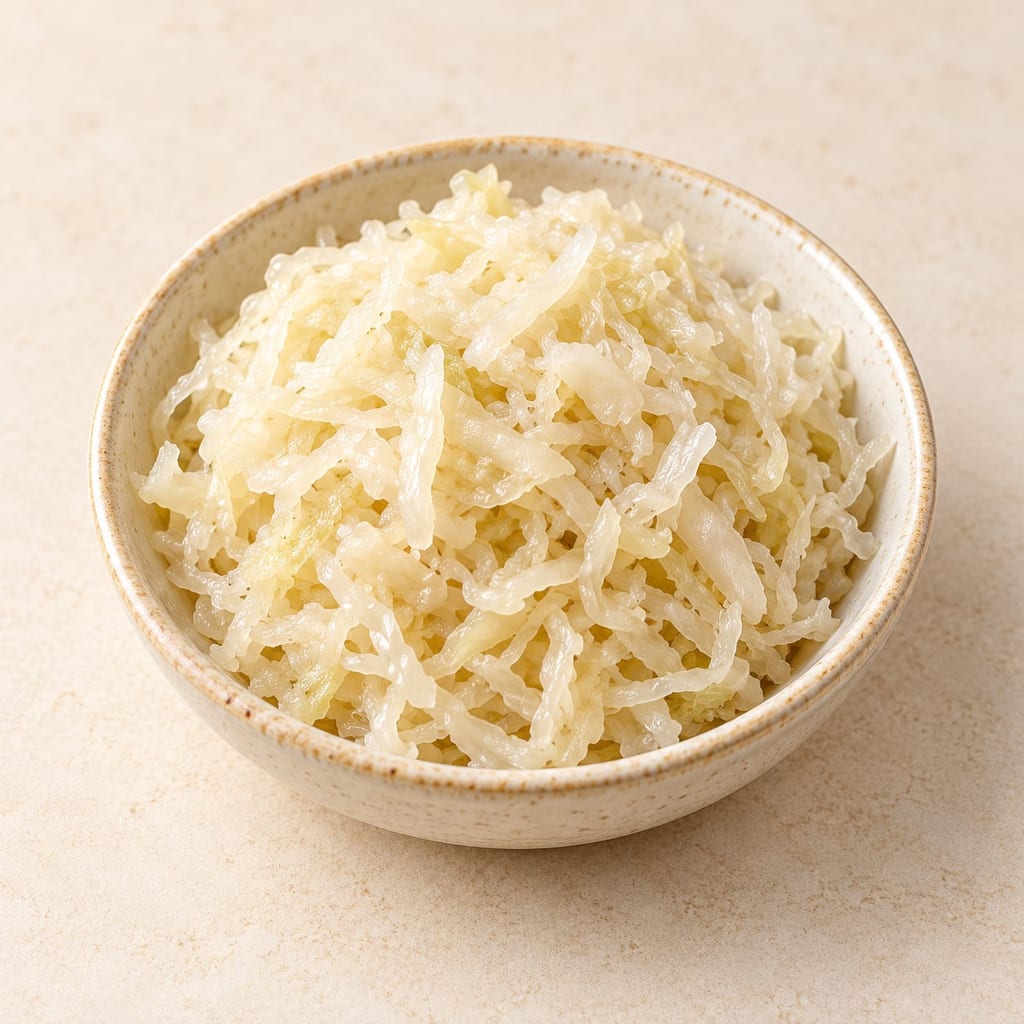
Finely cut cabbage fermented with salt in vats by natural lactic fermentation, a protected Alsatian product sold raw or cooked after fermentation.
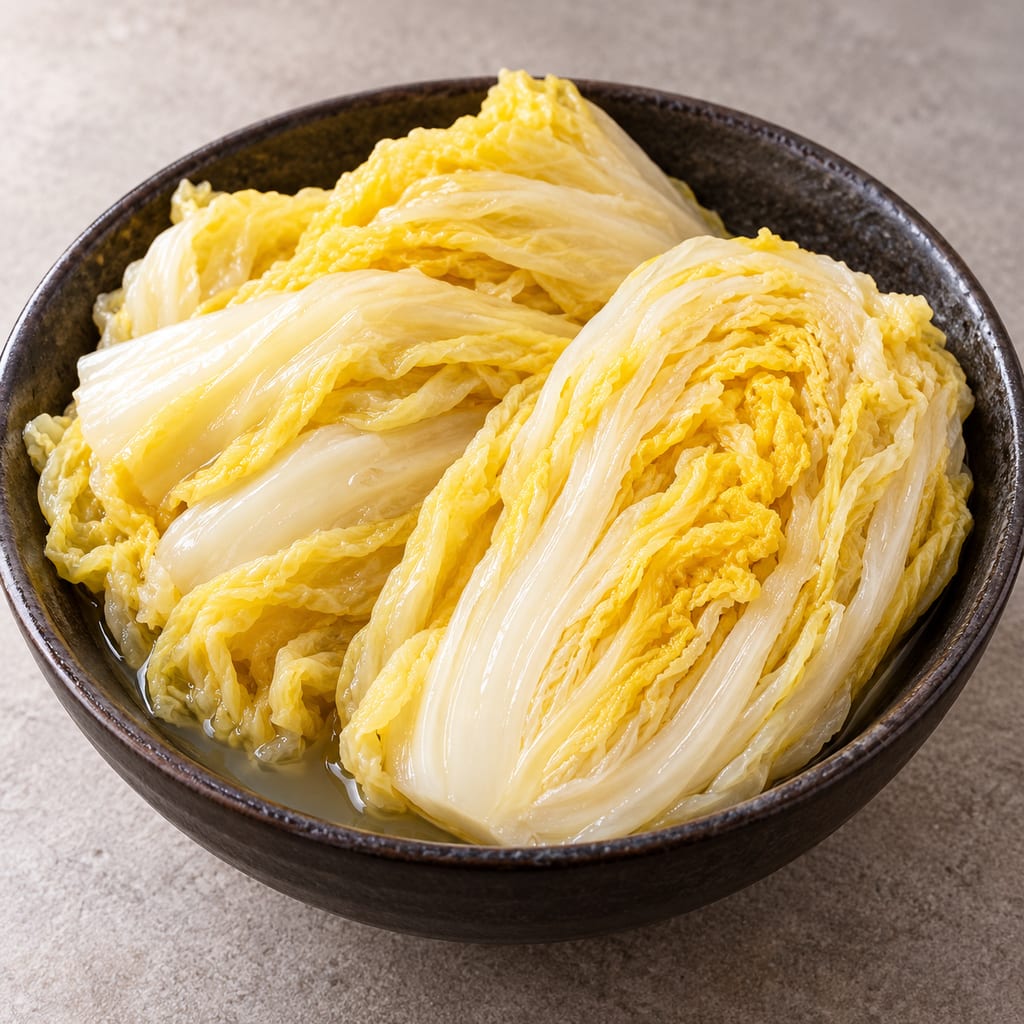
Napa cabbage fermented in a salt brine in Northeast China, traditionally in large ceramic or glass jars, until it turns sour.
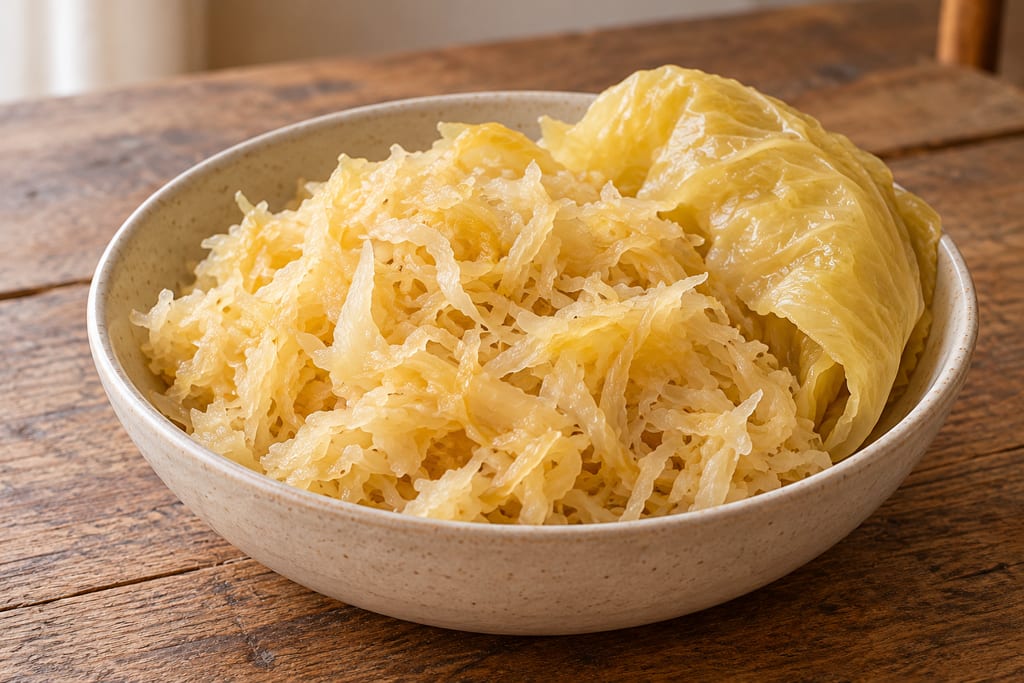
Serbian sour cabbage from the Futog area, made from the autochthonous Futoški cabbage population and registered as a protected product in 2008. It is a subset of general Serbian kiseli kupus.
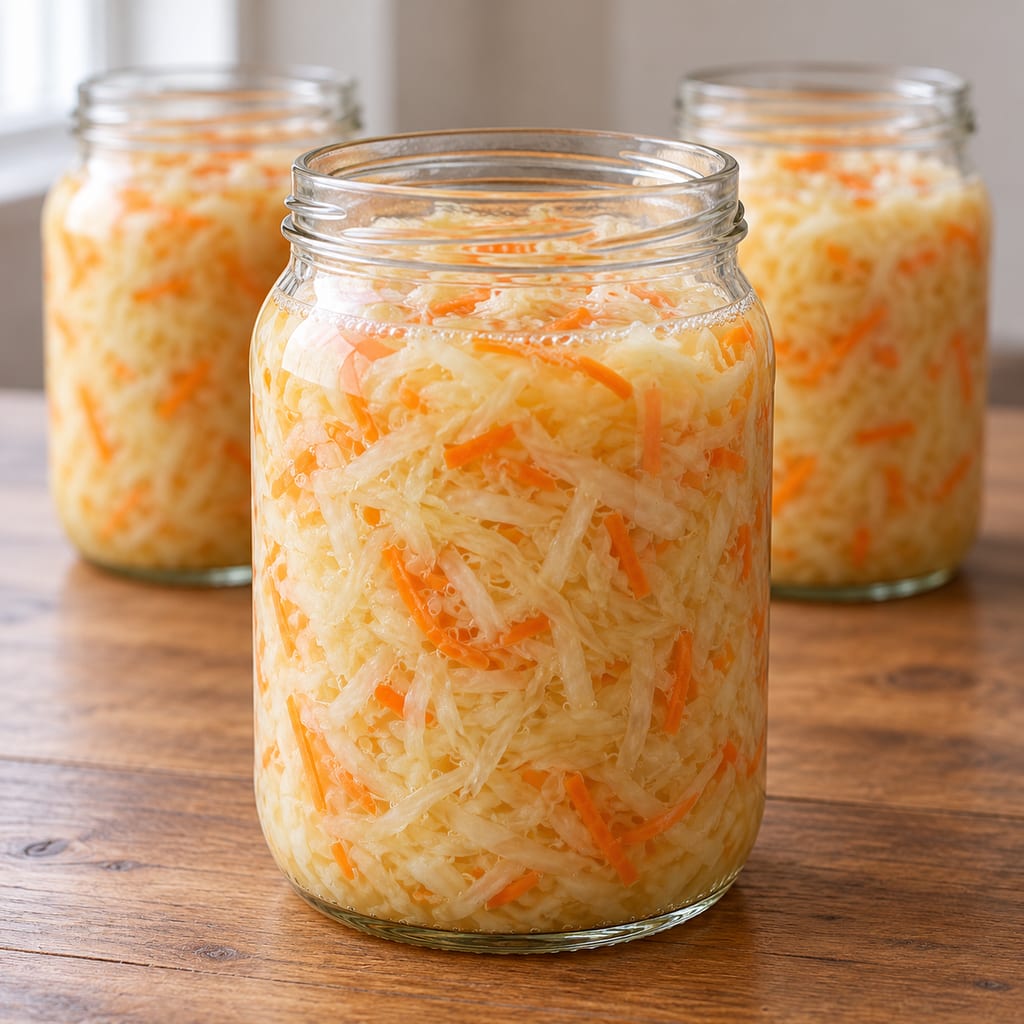
Shredded cabbage and grated carrot are salted to 20 g/kg, rested, packed into three jars and monitored during a creator-reported eight-day fermentation; measured temperature is not given.
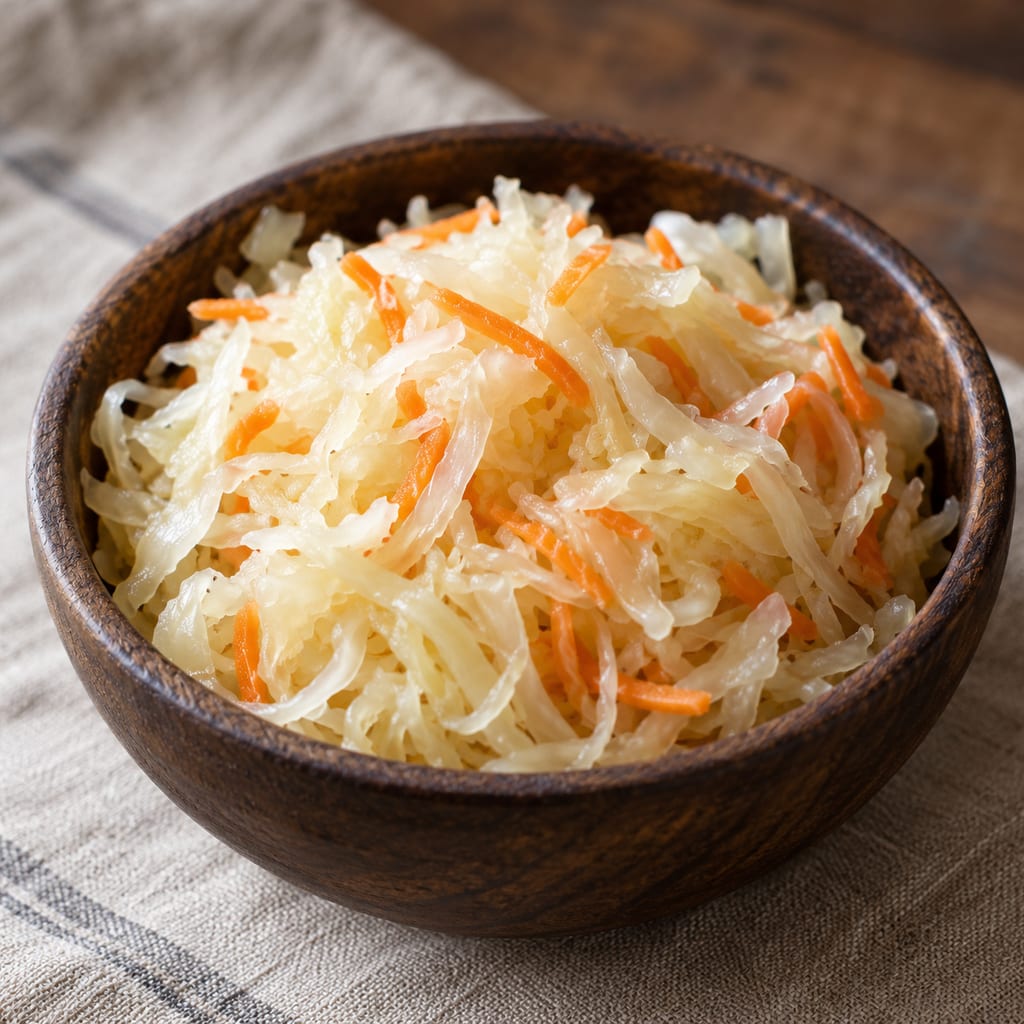
Kapusta kiszona z beczki is barrel-fermented cabbage from the Kołobrzeg area, entered on Poland’s List of Traditional Products in 2008. It is salted and fermented, with raw grated carrot added after souring.
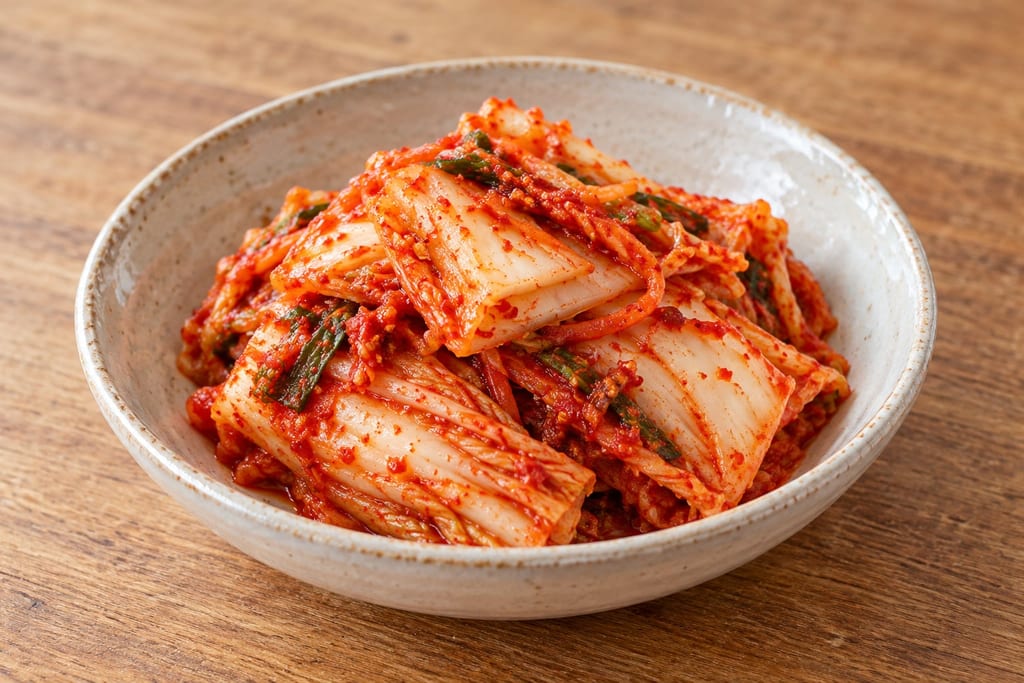
Kimchi is a Korean preserved vegetable food, most often cabbage, salted and seasoned, then fermented by the lactic acid bacteria that arrive with the vegetables. Some studies test added starter cultures, but a home jar is usually spontaneous.
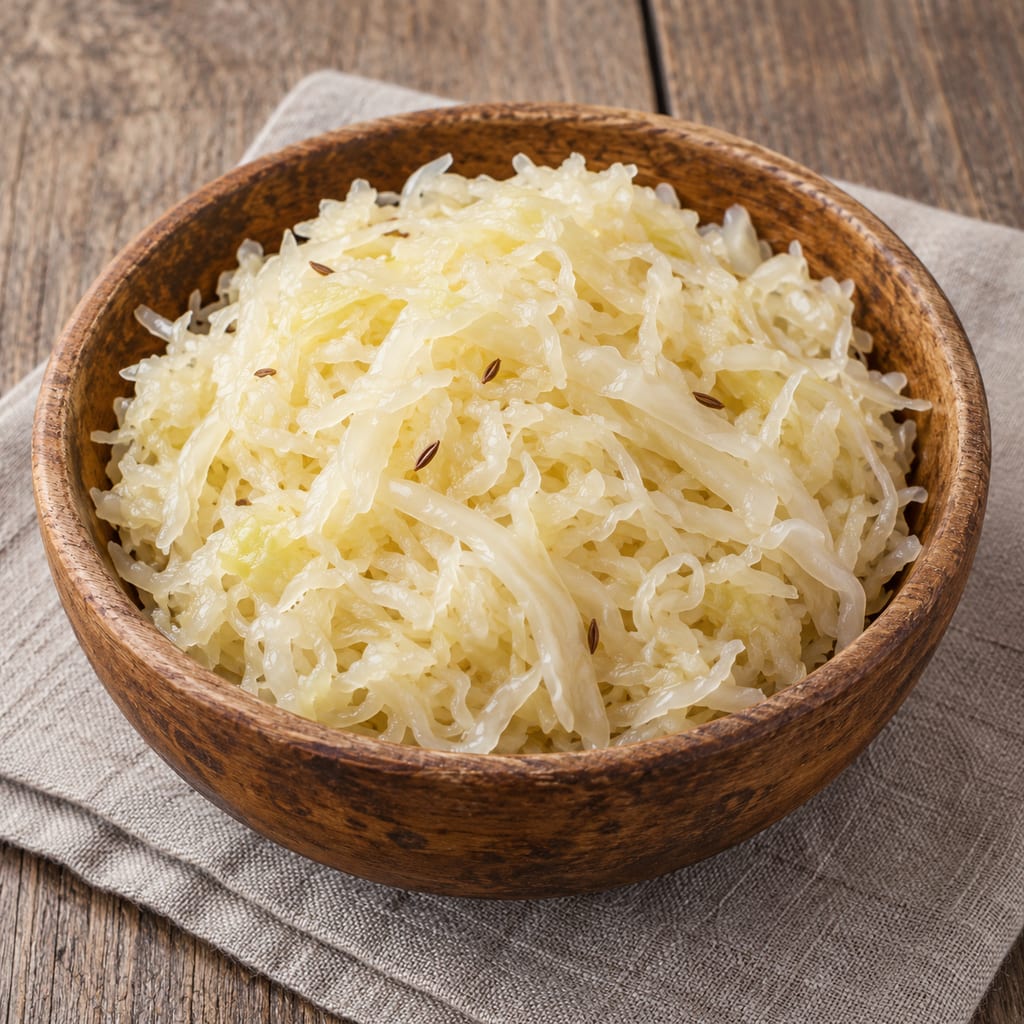
Kysané zeľí is Czech sour cabbage: shredded cabbage layered with salt and caraway and pressed in a wooden barrel. The regional account is descriptive and gives no validated salt ratio or endpoint.
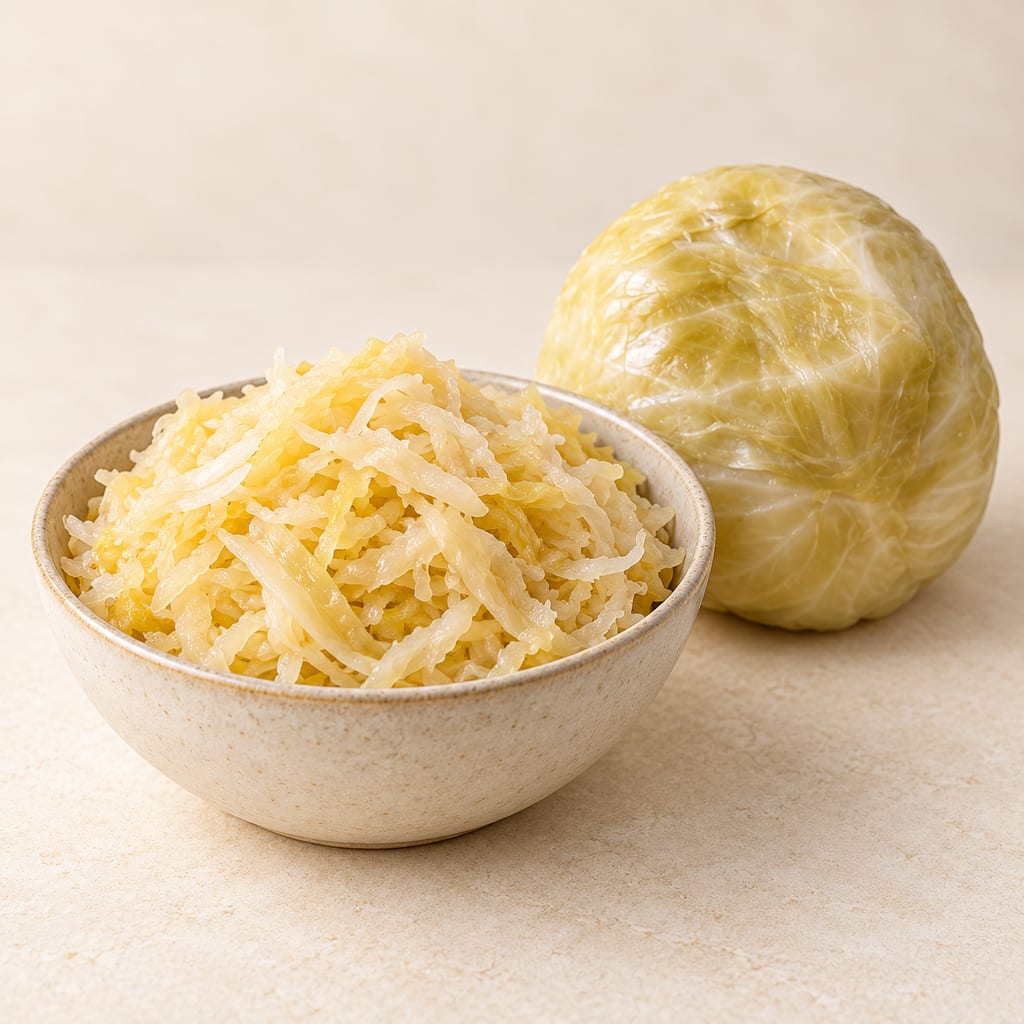
Protected Croatian sauerkraut from the Ogulin area: fresh white cabbage naturally lactic-fermented without preservatives, sold whole or shredded, from registered establishments.
No community contributions have been published for this entry yet.
Sign in to contribute. Published comments and photos are free to read.
OSU ExtensionInspiration
Kimchi basicsmeasured kimchi recipe
Cited in: A small, measured kimchi recipe; History and Korean terminology; Why the cabbage is salted first; The other ingredients; Equipment; Method; The microbiology of kimchi; Why the pH changes; What happens to the texture?; Regional varieties and comparisons; Serving kimchi; Recognizing successful fermentation
University of Minnesota ExtensionSafety
Preserving food at home: FermentationProduce fermentation equipment, acidity monitoring and submersion controls.
Cited in: Safety and storage
OSUCulinary background
OSU — Kimchi Basics, downloadable publicationOriginal publication record.
Cited in: History and Korean terminology; Regional varieties and comparisons; Serving kimchi
National Center for Home Food PreservationSafety guidance
National Center for Home Food Preservation — General Fermentation InformationFermentation handling.
Cited in: Safety and storage
pubmed.ncbi.nlm.nih.govMicrobiology background
Kimchi Microflora: History, Current Status and PerspectivesMicrobial background.
Cited in: History and Korean terminology; The microbiology of kimchi; Why the pH changes; What happens to the texture?; Regional varieties and comparisons